battery FIAT 500E 2015 2.G Owner's Guide
[x] Cancel search | Manufacturer: FIAT, Model Year: 2015, Model line: 500E, Model: FIAT 500E 2015 2.GPages: 367, PDF Size: 9.42 MB
Page 276 of 367
HAZARD WARNING FLASHERS
The Hazard Warning flasher switch is located on the
instrument panel below the radio.
Push the switch to turn on the Hazard Warning
flashers. When the switch is activated, all direc-
tional turn signals will flash on and off to warn oncoming
traffic of an emergency. Push the switch a second time to
turn off the Hazard Warning flashers.
Do not use this emergency warning system when the
vehicle is in motion. Use it when your vehicle is disabled
and it is creating a safety hazard for other motorists.
If it is necessary to leave the vehicle to go for service, the
Hazard Warning flashers will continue to operate with
the ignition key removed and the vehicle locked.
NOTE:With extended use, the Hazard Warning flashers
may wear down your battery.
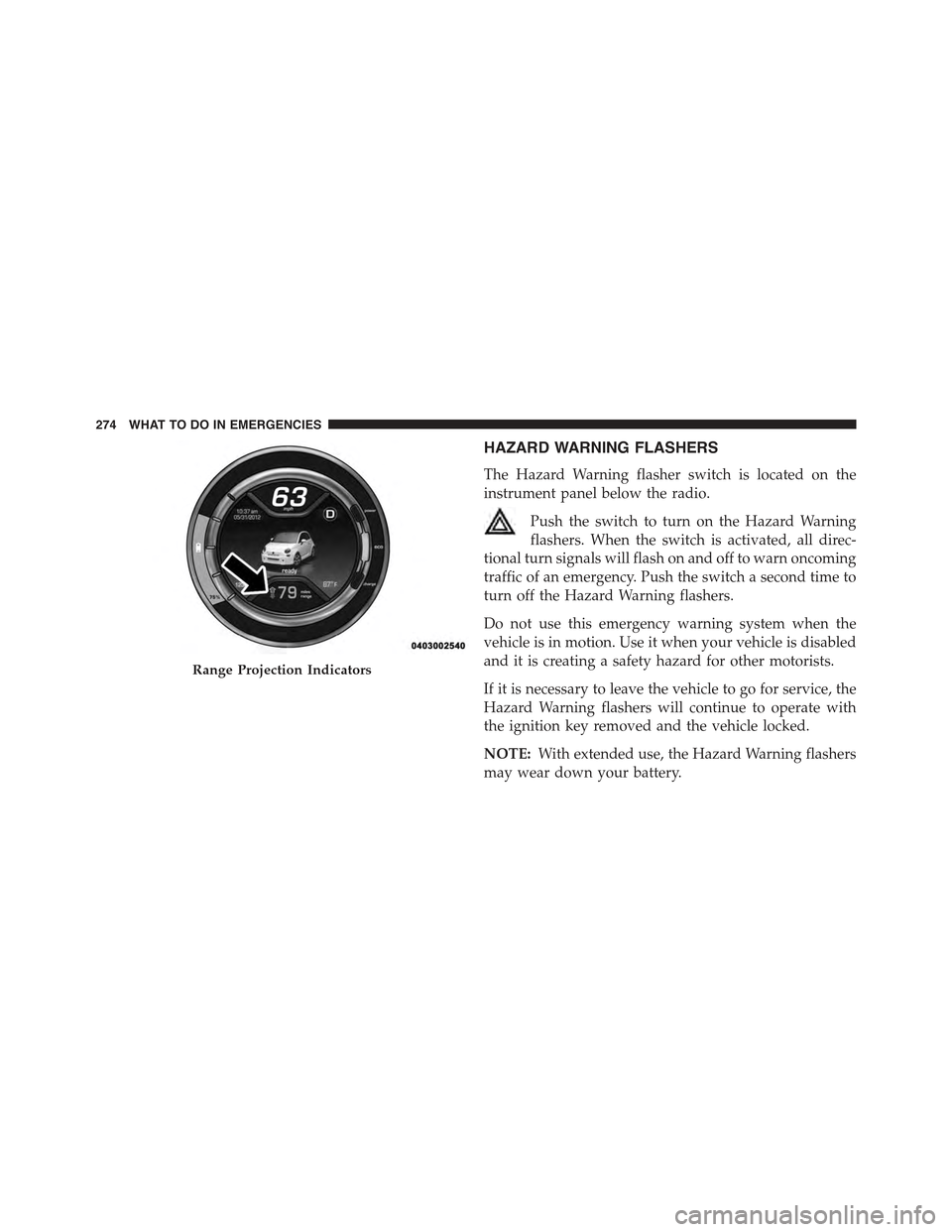
Range Projection Indicators
274 WHAT TO DO IN EMERGENCIES
Page 289 of 367
JUMP-STARTING PROCEDURE (12 VOLT
BATTERY ONLY)
If your vehicle has a discharged 12 Volt battery, it can be
jump-started using a set of jumper cables and a battery in
another vehicle or by using a portable battery booster
pack. Jump-starting can be dangerous if done improperly
so please follow the procedures in this section carefully.
NOTE:When using a portable battery booster pack,
follow the manufacturer ’s operating instructions and
precautions.
WARNING!
Do not attempt jump-starting if the battery is frozen.
It could rupture or explode and cause personal injury.
CAUTION!
Do not use a portable battery booster pack or any
other booster source with a system voltage greater
than 12 Volts or damage to the battery, power elec-
tronics or electrical system may occur.
Preparations For Jump-Start
The battery in your vehicle is located in the underhood
compartment under the beauty cover. To access the
battery pull upward on the cover.
6
WHAT TO DO IN EMERGENCIES 287
Page 290 of 367
WARNING!
•Take care to avoid the radiator cooling fan when-
ever the hood is raised. It can start anytime the
ignition switch is ON. You can be injured by
moving fan blades.
•Remove any metal jewelry such as rings, watch
bands and bracelets that could make an inadvertent
electrical contact. You could be seriously injured.
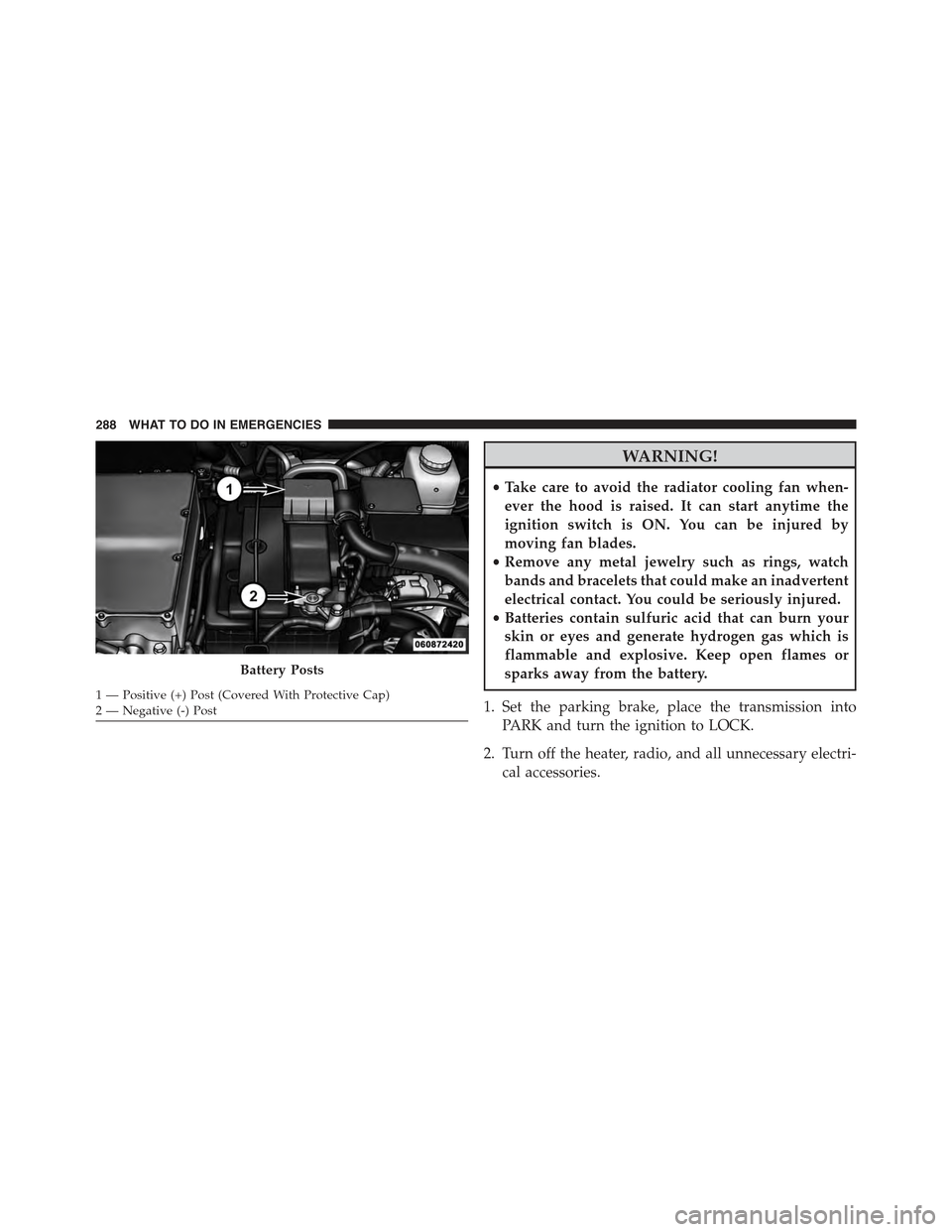
•Batteries contain sulfuric acid that can burn your
skin or eyes and generate hydrogen gas which is
flammable and explosive. Keep open flames or
sparks away from the battery.
1. Set the parking brake, place the transmission into
PARK and turn the ignition to LOCK.
2. Turn off the heater, radio, and all unnecessary electri-
cal accessories.
Battery Posts
1—Positive(+)Post(CoveredWithProtectiveCap)2 — Negative (-) Post
288 WHAT TO DO IN EMERGENCIES
Page 291 of 367
3. Remove the protective cover over the positive(+)
battery post.
4. If using another vehicle to jump-start the battery, park
the vehicle within the jumper cables reach, set the
parking brake and make sure the ignition is OFF.
WARNING!
Do not allow vehicles to touch each other as this
could establish a ground connection and personal
injury could result.
Jump-Starting Procedure
WARNING!
Failure to follow this jump-starting procedure could
result in personal injury or property damage due to
battery explosion.
CAUTION!
Failure to follow these procedures could result in
damage to the charging system of the booster vehicle
or the discharged vehicle.
Connecting The Jumper Cables
1. Connect the positive(+)end of the jumper cable to the
positive(+)post of the discharged vehicle.
2. Connect the opposite end of the positive(+)jumper
cable to the positive(+)post of the booster battery.
3. Connect the negative end(-)of the jumper cable to the
negative(-)post of the booster battery.
6
WHAT TO DO IN EMERGENCIES 289
Page 292 of 367
4. Connect the opposite end of the negative(-)jumper
cable to a good engine ground (exposed metal part of
the discharged vehicle underhood compartment)
away from the battery.
WARNING!
Do not connect the jumper cable to the negative (-)
post of the discharged battery. The resulting electri-
cal spark could cause the battery to explode and
could result in personal injury. Only use the specific
ground point, do not use any other exposed metal
parts.
5. Start the engine in the vehicle that has the booster
battery, let the engine idle a few minutes, and then
turn the key to RUN position on the vehicle with the
discharged battery.
6. Once the vehicle is started, remove the jumper cables
in the reverse sequence:
Disconnecting The Jumper Cables
1. Disconnect the negative(-)jumper cable from the
engine ground(-)of the vehicle with the discharged
battery.
2. Disconnect the negative end(-)of the jumper cable
from the negative(-)post of the booster battery.
3. Disconnect the opposite end of the positive(+)jumper
cable from the positive(+)post of the booster battery.
4. Disconnect the positive(+)end of the jumper cable
from the positive(+)post of the discharged vehicle.
If frequent jump-starting is required to start your vehicle,
you should have the battery and charging system in-
spected at your authorized dealer.
290 WHAT TO DO IN EMERGENCIES
Page 294 of 367
WARNING!(Continued)
longer than 30 seconds continuously without stop-
ping when you are stuck and do not let anyone near
a spinning wheel, no matter what the speed.
MANUAL PARK RELEASE
WARNING!
Always secure your vehicle by fully applying the
parking brake, before activating the Manual Park
Release. Activating the Manual Park Release will
allow your vehicle to roll away if it is not secured by
the parking brake or other means. Activating the
Manual Park Release on an unsecured vehicle could
lead to serious injury or death for those in or around
the vehicle.
In order to move the vehicle in cases where the transmis-
sion will not shift out of PARK (such as a dead battery),
a Manual Park Release is available. If a dead 12 volt
battery is the cause of the condition refer to “Jump Start
Procedure — 12 Volt Battery” before performing the
Manual Park Release.
To perform the Manual Park Release follow these steps:
•To prevent the vehicle from rolling unintentionally,
firmly apply the parking brake.
•If possible, raise the front driver’s side of the vehicle to
provide access to the transmission.
•Working from underneath the vehicle, remove the
black rubber plug from the front of the Park module (a
black canister mounted on the front of the transmis-
sion).
292 WHAT TO DO IN EMERGENCIES
Page 296 of 367
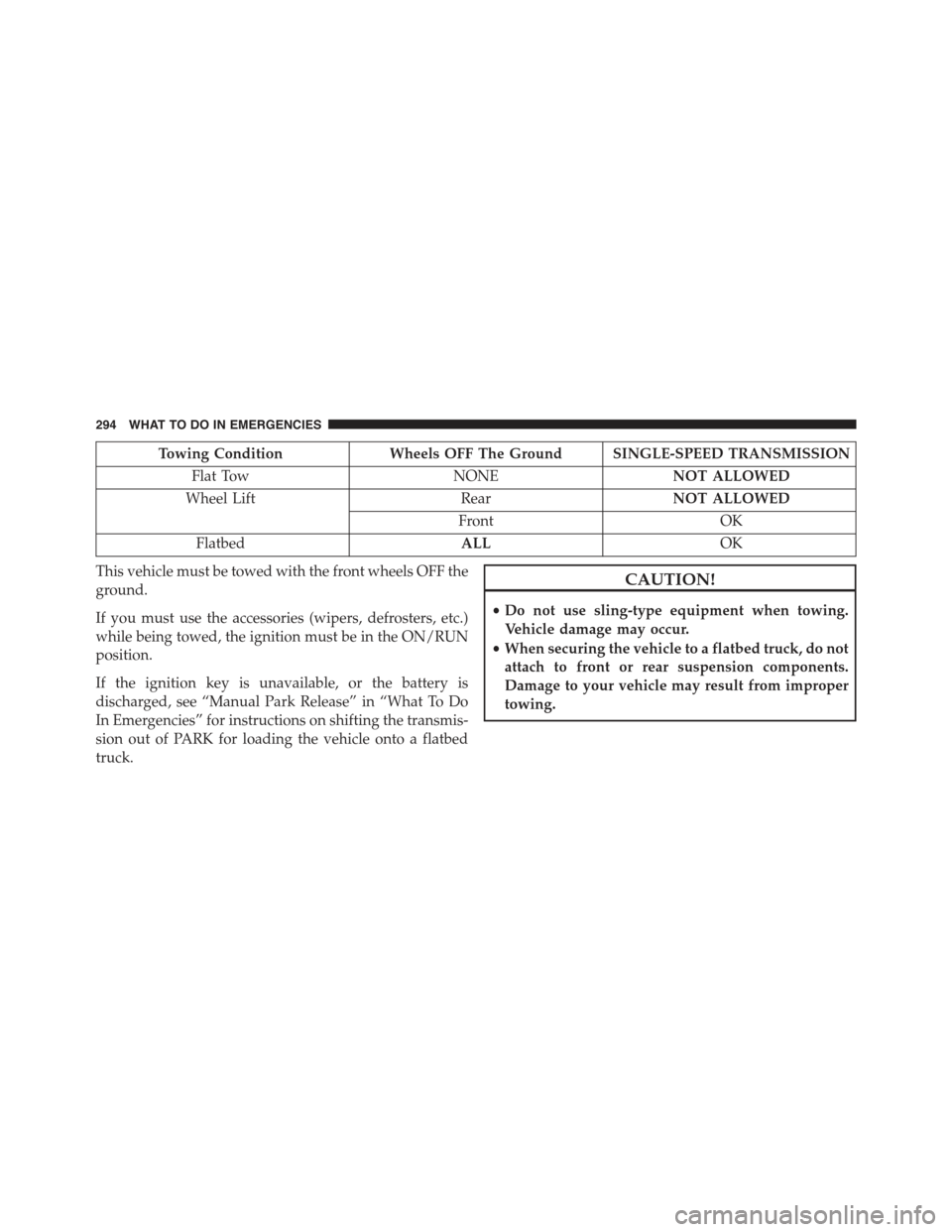
Towing ConditionWheels OFF The Ground SINGLE-SPEED TRANSMISSION
Flat TowNONENOT ALLOWED
Wheel LiftRearNOT ALLOWED
FrontOK
FlatbedALLOK
This vehicle must be towed with the front wheels OFF the
ground.
If you must use the accessories (wipers, defrosters, etc.)
while being towed, the ignition must be in the ON/RUN
position.
If the ignition key is unavailable, or the battery is
discharged, see “Manual Park Release” in “What To Do
In Emergencies” for instructions on shifting the transmis-
sion out of PARK for loading the vehicle onto a flatbed
truck.
CAUTION!
•Do not use sling-type equipment when towing.
Vehicle damage may occur.
•When securing the vehicle to a flatbed truck, do not
attach to front or rear suspension components.
Damage to your vehicle may result from improper
towing.
294 WHAT TO DO IN EMERGENCIES
Page 297 of 367
MAINTAINING YOUR VEHICLE
CONTENTS
!UNDERHOOD COMPARTMENT...........297
!REPLACEMENT PARTS..................298
!DEALER SERVICE......................298
!MAINTENANCE PROCEDURES...........299
▫Power Electronics And Battery Thermal
Management Systems...................300
▫Power Electronics and Battery Thermal
Management Systems — Coolant Level
Check..............................300
▫Power Electronics and Battery Thermal
Management Systems — Cooling Pressure
Caps...............................302
▫Selection Of Coolant...................303
▫Adding Coolant.......................304
▫Power Electronics and Battery Thermal
Management Systems — Drain, Flush And
Refill..............................305
▫Disposal Of Used Power Electronics and Battery
Thermal Management Systems Coolant......305
7
Page 298 of 367
▫Points To Remember...................306
▫Maintenance-Free Battery 12 Volt..........306
▫Air Conditioner Maintenance.............308
▫Body Lubrication.....................309
▫Wiper Blades........................309
▫Adding Washer Fluid..................311
▫Brake System........................312
▫Appearance Care And Protection From
Corrosion...........................314
!FUSES..............................321
▫Interior Fuses........................322
▫Power Distribution Center #1.............325
▫Power Distribution Center (PDC) #2........327
!VEHICLE STORAGE.....................329
!REPLACEMENT BULBS.................329
!BULB REPLACEMENT..................330
▫Headlamps Low Beam and High Beam......330
▫Front Turn Signal, Parking And Daytime
Running Lamps.......................331
▫Front Fog Lamps......................331
▫Front/Rear Side Marker Lamps............332
▫Rear Tail, Stop, Backup And Turn Signal
Lamps.............................332
▫Center High Mounted Stop Lamp (CHMSL) . . .333
!FLUID CAPACITIES....................333
!FLUIDS, LUBES, AND GENUINE PARTS.....334
296 MAINTAINING YOUR VEHICLE
Page 299 of 367
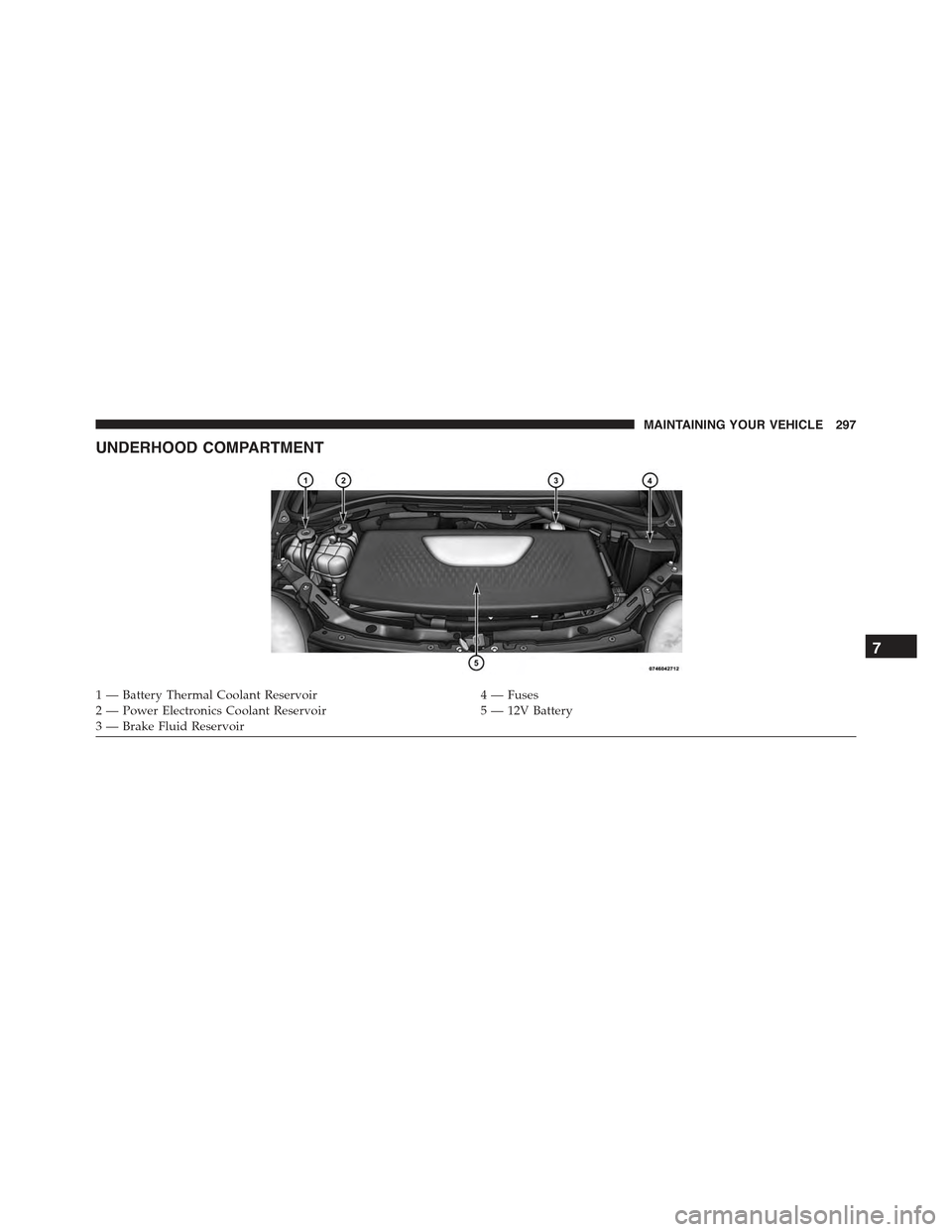
UNDERHOOD COMPARTMENT
1 — Battery Thermal Coolant Reservoir4 — Fuses2 — Power Electronics Coolant Reservoir5 — 12V Battery3 — Brake Fluid Reservoir
7
MAINTAINING YOUR VEHICLE 297