battery FIAT 500E 2015 2.G Service Manual
[x] Cancel search | Manufacturer: FIAT, Model Year: 2015, Model line: 500E, Model: FIAT 500E 2015 2.GPages: 367, PDF Size: 9.42 MB
Page 302 of 367
CAUTION!(Continued)
•Your vehicle has been built with improved fluids
that protect the performance and durability of your
vehicle and also allow extended maintenance inter-
vals. Do not use chemical flushes in these compo-
nents as the chemicals can damage them. Such
damage is not covered by the New Vehicle Limited
Warranty. If a flush is needed because of compo-
nent malfunction, use only the specified fluid for
the flushing procedure.
Power Electronics And Battery Thermal
Management Systems
The Power Electronics and Battery Thermal Management
Systems are completely separate and designed to regu-
late temperature for the high voltage battery and the
electric components.
Power Electronics and Battery Thermal
Management Systems — Coolant Level Check
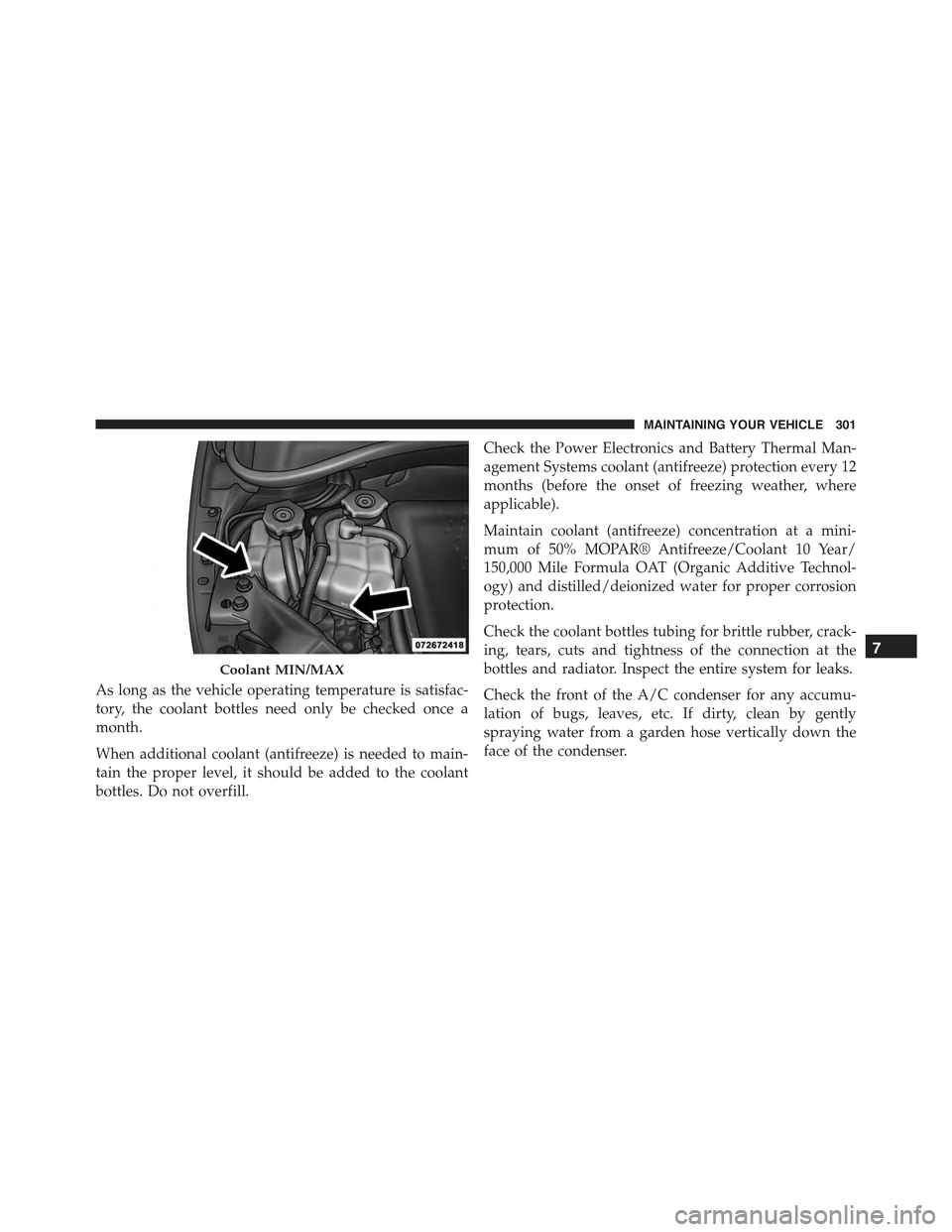
The coolant expansion bottles provides a quick visual
method for determining that the coolant level is ad-
equate. With the vehicle off and coolant at ambient
temperature, the level of the coolant (antifreeze) in the
bottles should be between the bottom and top lines
marked “MIN-MAX FILL RANGE”.
300 MAINTAINING YOUR VEHICLE
Page 303 of 367
As long as the vehicle operating temperature is satisfac-
tory, the coolant bottles need only be checked once a
month.
When additional coolant (antifreeze) is needed to main-
tain the proper level, it should be added to the coolant
bottles. Do not overfill.
Check the Power Electronics and Battery Thermal Man-
agement Systems coolant (antifreeze) protection every 12
months (before the onset of freezing weather, where
applicable).
Maintain coolant (antifreeze) concentration at a mini-
mum of 50% MOPAR® Antifreeze/Coolant 10 Year/
150,000 Mile Formula OAT (Organic Additive Technol-
ogy) and distilled/deionized water for proper corrosion
protection.
Check the coolant bottles tubing for brittle rubber, crack-
ing, tears, cuts and tightness of the connection at the
bottles and radiator. Inspect the entire system for leaks.
Check the front of the A/C condenser for any accumu-
lation of bugs, leaves, etc. If dirty, clean by gently
spraying water from a garden hose vertically down the
face of the condenser.
Coolant MIN/MAX
7
MAINTAINING YOUR VEHICLE 301
Page 304 of 367
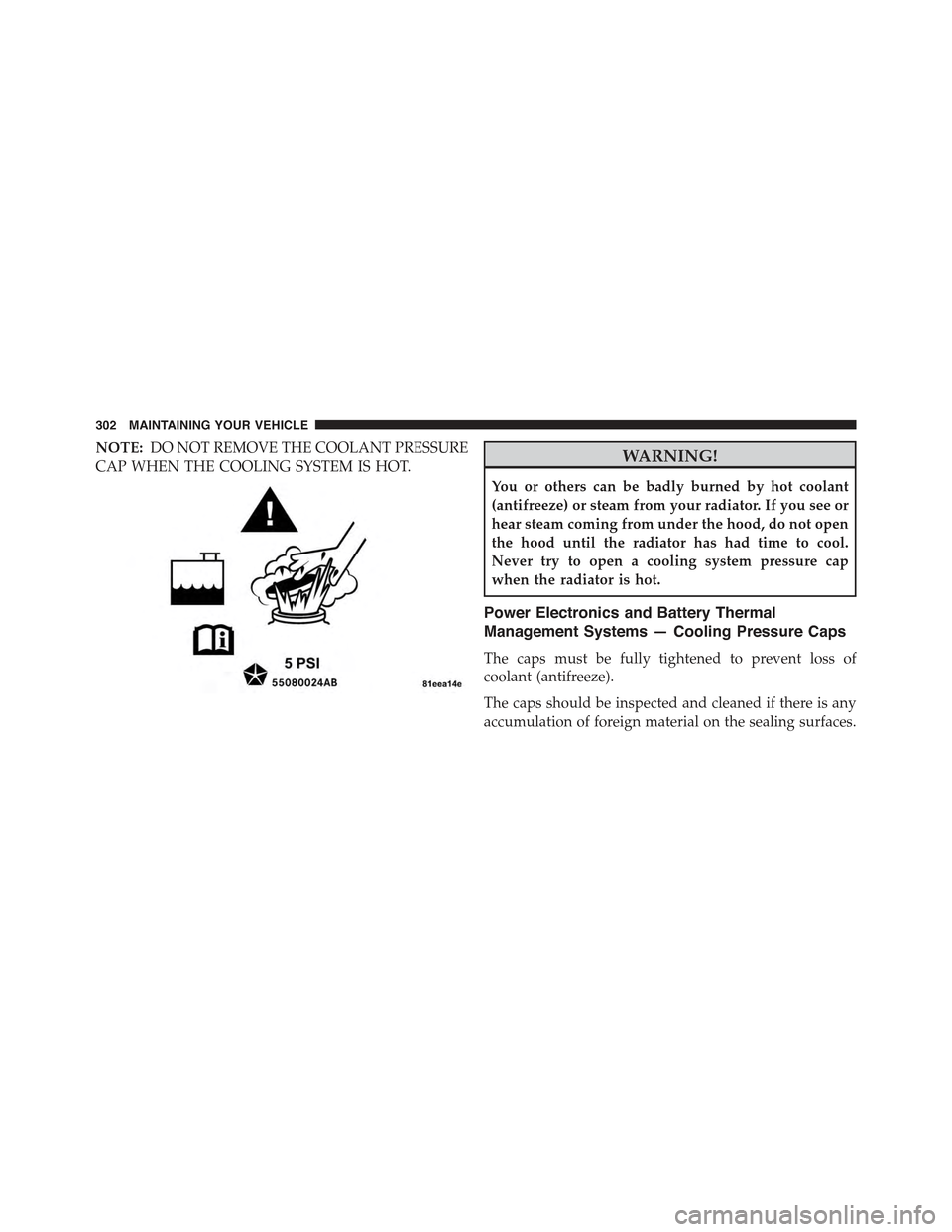
NOTE:DO NOT REMOVE THE COOLANT PRESSURE
CAP WHEN THE COOLING SYSTEM IS HOT.WARNING!
You or others can be badly burned by hot coolant
(antifreeze) or steam from your radiator. If you see or
hear steam coming from under the hood, do not open
the hood until the radiator has had time to cool.
Never try to open a cooling system pressure cap
when the radiator is hot.
Power Electronics and Battery Thermal
Management Systems — Cooling Pressure Caps
The caps must be fully tightened to prevent loss of
coolant (antifreeze).
The caps should be inspected and cleaned if there is any
accumulation of foreign material on the sealing surfaces.
302 MAINTAINING YOUR VEHICLE
Page 307 of 367
Please note that it is the owner ’s responsibility to main-
tain the proper level of protection against freezing ac-
cording to the temperatures occurring in the area where
the vehicle is operated.
NOTE:Mixing coolant (antifreeze) types will decrease
the life of the Power Electronics and Battery Thermal
Management Systems coolant (antifreeze) and will re-
quire more frequent coolant (antifreeze) changes.
Power Electronics and Battery Thermal
Management Systems — Drain, Flush And Refill
Refer to “Maintenance Schedules” in Section 7 of this
supplement for the proper maintenance intervals.
If the coolant (antifreeze) is dirty or contains a consider-
able amount of sediment, clean and flush with a reliable
cooling system cleaner. Follow with a thorough rinsing to
remove all deposits and chemicals. Properly dispose of
old coolant (antifreeze) solution.
CAUTION!
It is recommended to have the cooling systems ser-
viced at your authorized dealer. Failure to do so could
result in poor cooling system performance and/or
vehicle damage.
Disposal Of Used Power Electronics and Battery
Thermal Management Systems Coolant
Used antifreeze is a regulated substance requiring proper
disposal. Check with your local authorities to determine
the disposal rules for your community. To prevent inges-
tion by animals or children, do not store antifreeze in
open containers or allow it to remain in puddles on the
ground. If ingested by a child, contact a physician
immediately. Clean up any ground spills immediately.
7
MAINTAINING YOUR VEHICLE 305
Page 308 of 367
Points To Remember
If an examination of your underhood compartment
shows no evidence of cooler or hose leaks, the vehicle
may be safely driven.
•Do not overfill the coolant recovery bottles.
•Check coolant (antifreeze) freeze point in the coolant
recovery bottles. If coolant (antifreeze) needs to be
added, contents of coolant recovery bottles must also
be protected against freezing.
•If frequent coolant (antifreeze) additions are required,
or if the level in the coolant recovery bottles does not
drop when the engine cools, the cooling system should
be pressure tested for leaks.
•Maintain coolant (antifreeze) concentration at 50%
OAT coolant (antifreeze) (minimum) and distilled/
deionized water for proper corrosion protection of
your engine which contains aluminum components.
•Make sure that the coolant control systems recovery
bottles overflow hoses are not kinked or obstructed.
•Keep the front of the coolant control systems clean. If
your vehicle is equipped with air conditioning, keep
the front of the condenser clean.
Maintenance-Free Battery 12 Volt
Your vehicle is equipped with a maintenance-free 12 Volt
battery. You will never have to add water, nor is periodic
maintenance required.
306 MAINTAINING YOUR VEHICLE
Page 309 of 367
WARNING!
•Battery fluid is a corrosive acid solution and can
burn or even blind you. Do not allow battery fluid
to contact your eyes, skin, or clothing. Do not lean
over a battery when attaching clamps. If acid
splashes in eyes or on skin, flush the area imme-
diately with large amounts of water. Refer to
“Jump-Starting Procedures” in “What To Do In
Emergencies” for further information.
•Battery gas is flammable and explosive. Keep
flame or sparks away from the battery. Do not use
a booster battery or any other booster source with
an output greater than 12 Volts. Do not allow cable
clamps to touch each other.
•Battery posts, terminals, and related accessories
contain lead and lead compounds. Wash hands
after handling.
(Continued)
WARNING!(Continued)
•The battery in this vehicle has a vent hose that
should not be disconnected and should only be
replaced with a battery of the same type (vented).
CAUTION!
•It is essential when replacing the cables on the
battery that the positive cable is attached to the
positive post and the negative cable is attached to
the negative post. Battery posts are marked positive
(+) and negative (-) and are identified on the
battery case. Cable clamps should be tight on the
terminal posts and free of corrosion.
(Continued)
7
MAINTAINING YOUR VEHICLE 307
Page 310 of 367
CAUTION!(Continued)
•If a 12 Volt Low Voltage Battery System “fast
charger” is used while the battery is in the vehicle,
disconnect both vehicle battery cables before con-
necting the charger to the battery. Do not use a “fast
charger” to provide starting voltage.
Air Conditioner Maintenance
For best possible performance, your air conditioner
should be checked and serviced by an authorized dealer
at the start of each warm season. This service should
include cleaning of the condenser fins and air condition-
ing performance tests.
CAUTION!
Do not use chemical flushes in your air conditioning
system as the chemicals can damage your air condi-
tioning components. Such damage is not covered by
the New Vehicle Limited Warranty.
WARNING!
•Use only refrigerants and compressor lubricants
approved by the manufacturer for your air condi-
tioning system. Some unapproved refrigerants are
flammable and can explode, injuring you. Other
unapproved refrigerants or lubricants can cause the
system to fail, requiring costly repairs. Refer to
Warranty Information Book, located on the DVD,
for further warranty information.
(Continued)
308 MAINTAINING YOUR VEHICLE
Page 329 of 367
CavityMaxi
FuseMini Fuse Description
F30 – 15 Amp
Blue
Fog Lamps
F81 30 Amp
Green
– Electronic Shifter
(ESM)
F82 30 Amp
Green
– Sunroof
F84 – 25 Amp
Clear
Regen Brake Mod-
ule
F85 30 Amp
Green
– Rear Window
Heater
F87 – 5 Amp
Ta n
Electronic Shifter
(ESM)
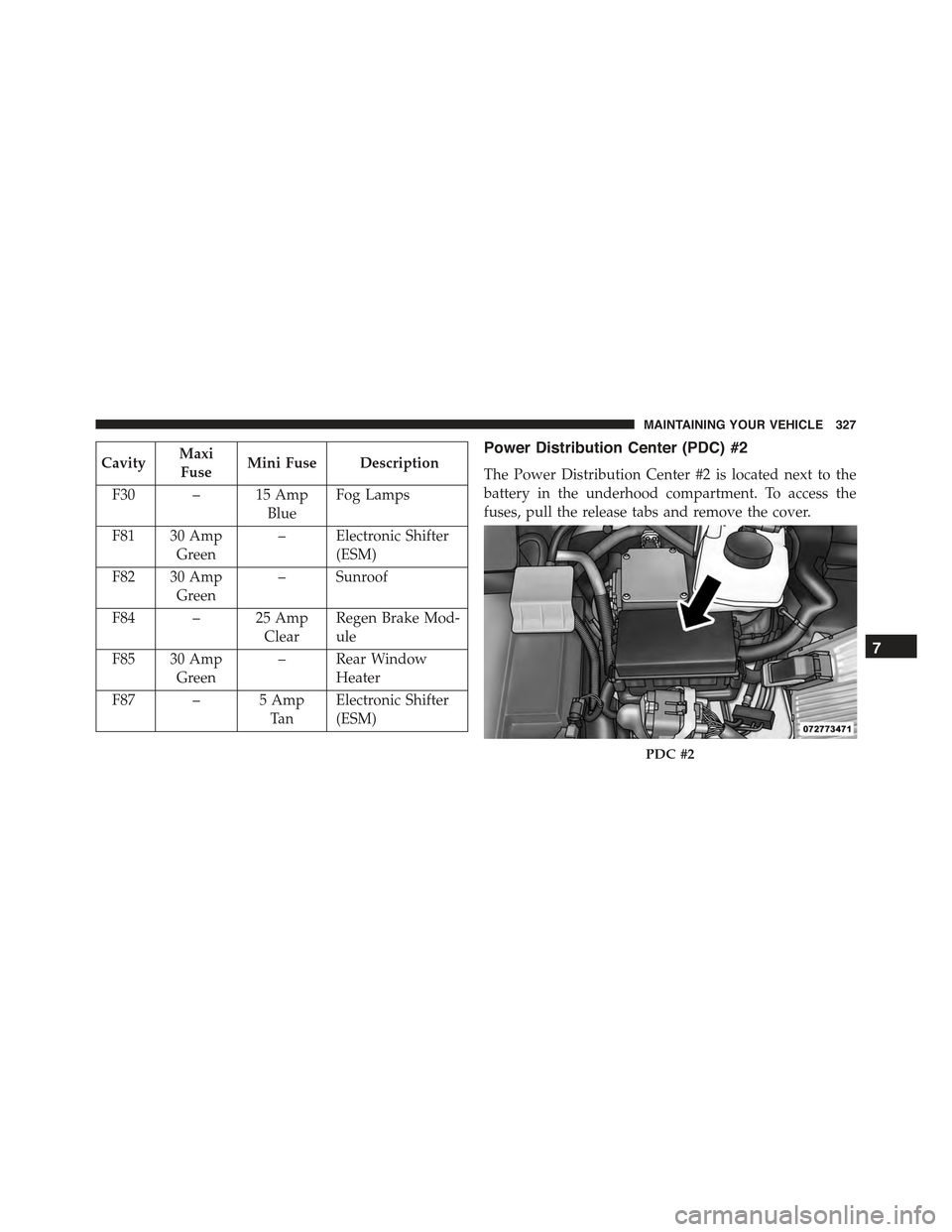
Power Distribution Center (PDC) #2
The Power Distribution Center #2 is located next to the
battery in the underhood compartment. To access the
fuses, pull the release tabs and remove the cover.
PDC #2
7
MAINTAINING YOUR VEHICLE 327
Page 330 of 367
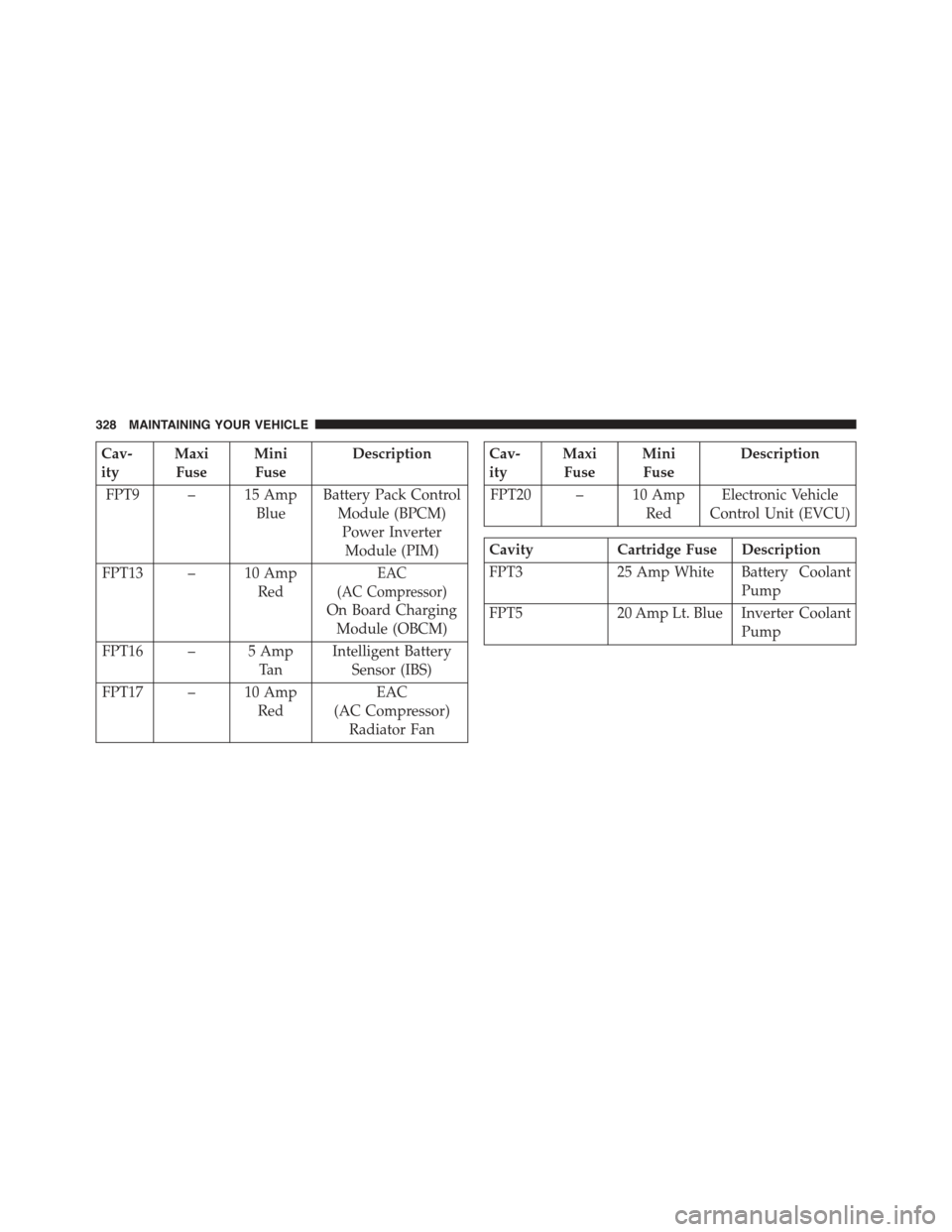
Cav-
ity
Maxi
Fuse
Mini
Fuse
Description
FPT9 – 15 Amp
Blue
Battery Pack Control
Module (BPCM)
Power Inverter
Module (PIM)
FPT13 – 10 Amp
Red
EAC
(AC Compressor)
On Board Charging
Module (OBCM)
FPT16 – 5 Amp
Ta n
Intelligent Battery
Sensor (IBS)
FPT17 – 10 Amp
Red
EAC
(AC Compressor)
Radiator Fan
Cav-
ity
Maxi
Fuse
Mini
Fuse
Description
FPT20 – 10 Amp
Red
Electronic Vehicle
Control Unit (EVCU)
CavityCartridge Fuse Description
FPT325 Amp White Battery Coolant
Pump
FPT520 Amp Lt. Blue Inverter Coolant
Pump
328 MAINTAINING YOUR VEHICLE
Page 331 of 367
VEHICLE STORAGE
The preferred way of storing your vehicle for a long
period of time is to leave it attached to a Level 1 or Level
2 charger. The vehicle has a wake-up feature that will
wake the system every 3 weeks and do a maintenance
charge on the 12 Volt battery and also top off the high
voltage battery if necessary.
Anytime you store your vehicle, or keep it out of service
(e.g., vacation) for two weeks or more, run the air
conditioning system at idle for about five minutes in the
fresh air and high blower setting. This will ensure
adequate system lubrication to minimize the possibility
of compressor damage when the air conditioning system
is started again.
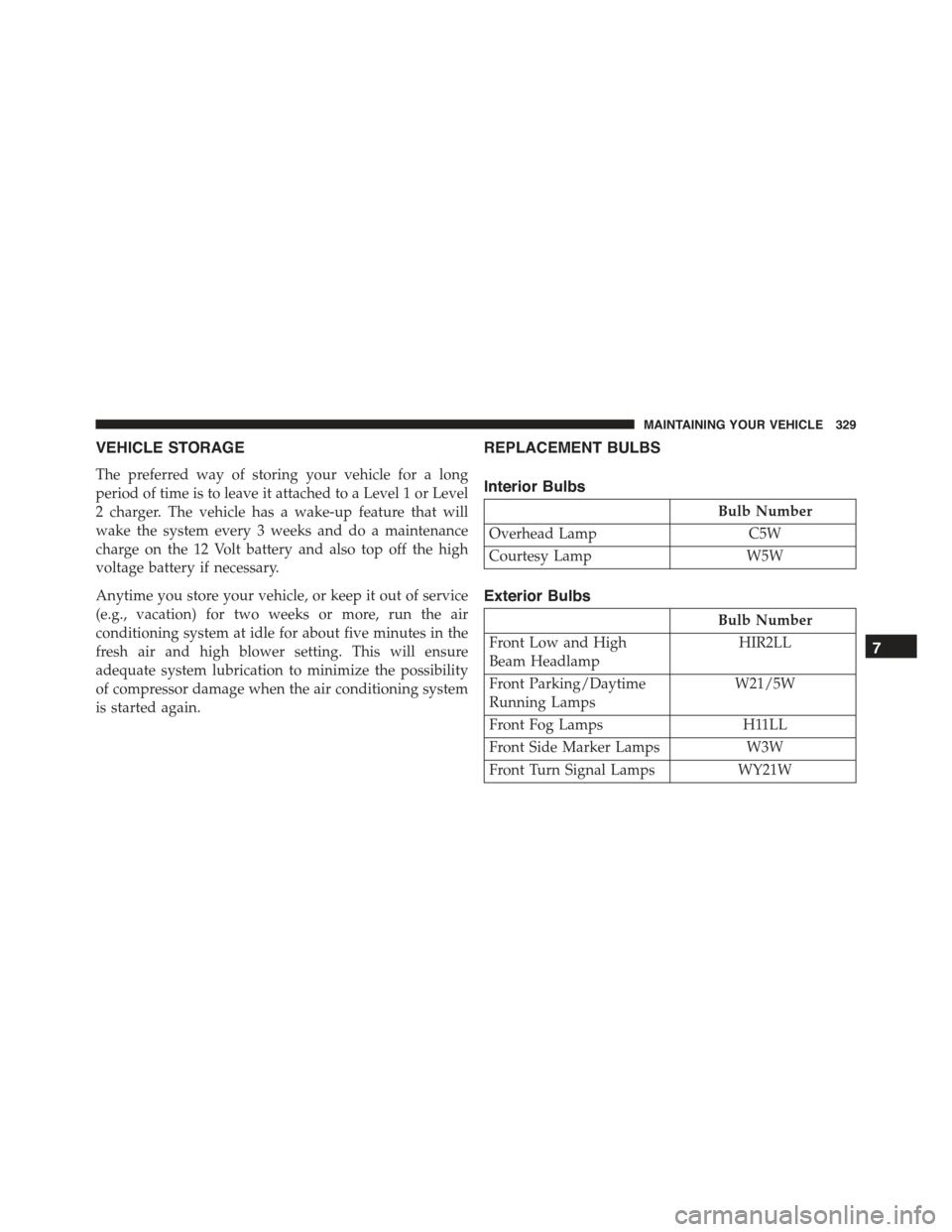
REPLACEMENT BULBS
Interior Bulbs
Bulb Number
Overhead LampC5W
Courtesy LampW5W
Exterior Bulbs
Bulb Number
Front Low and High
Beam Headlamp
HIR2LL
Front Parking/Daytime
Running Lamps
W21/5W
Front Fog Lamps H11LL
Front Side Marker Lamps W3W
Front Turn Signal Lamps WY21W
7
MAINTAINING YOUR VEHICLE 329