technical specifications FIAT 500L LIVING 2014 2.G Owners Manual
[x] Cancel search | Manufacturer: FIAT, Model Year: 2014, Model line: 500L LIVING, Model: FIAT 500L LIVING 2014 2.GPages: 420, PDF Size: 9.77 MB
Page 236 of 420
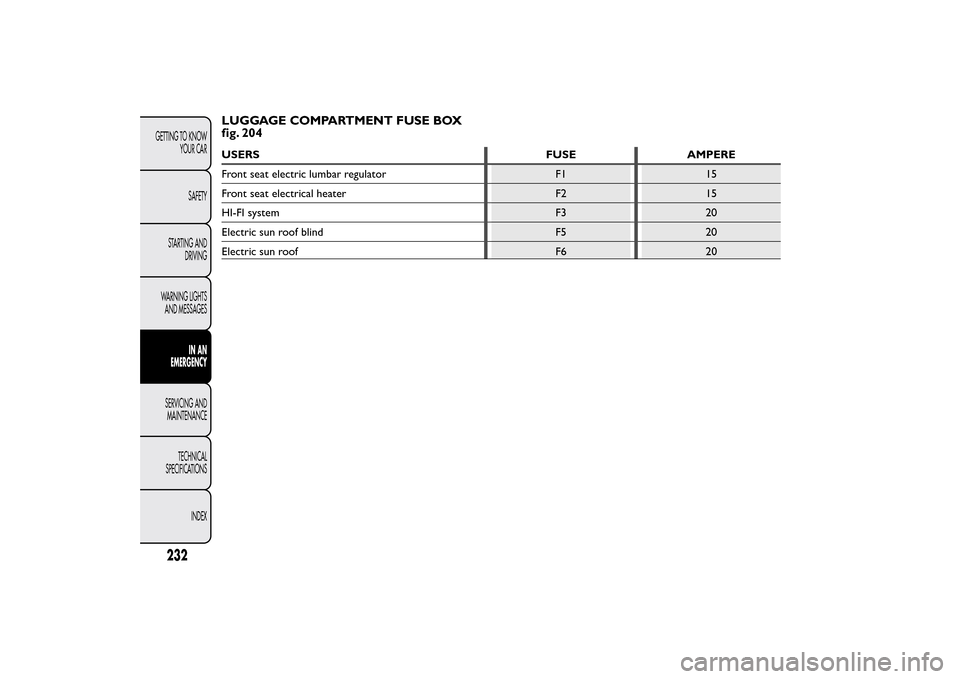
LUGGAGE COMPARTMENT FUSE BOX
fig. 204USERS FUSE AMPERE
Front seat electric lumbar regulator F1 15
Front seat electrical heater F2 15
HI-FI system F3 20
Electric sun roof blind F5 20
Electric sun roof F6 20
232GETTING TO KNOW
YOUR CAR
SAFETY
STARTING AND
DRIVING
WARNING LIGHTS
AND MESSAGES
IN AN
EMERGENCY
SERVICING AND
MAINTENANCE
TECHNICAL
SPECIFICATIONS
INDEX
Page 237 of 420
BATTERY RECHARGINGIMPORTANT The battery recharging procedure is
given as information only. You are advised to contact
a Fiat Dealership to have this operation carried
out.
Low amperage slow recharging for approximately 24
hours is advised. Charging for a longer time may
damage the battery.
VERSIONS WITHOUT Start&Stop SYSTEM
(for versions/markets, where provided)
Charge the battery as follows:
❒disconnect the negative battery terminal;
❒connect the charger cables to the battery
terminals, observing the polarity;
❒turn on the charger;
❒when finished, turn the charger off before
disconnecting the battery;
❒reconnect the negative battery terminal.
VERSIONS WITH Start&Stop SYSTEM
(for versions/markets, where provided)
Charge the battery as follows:
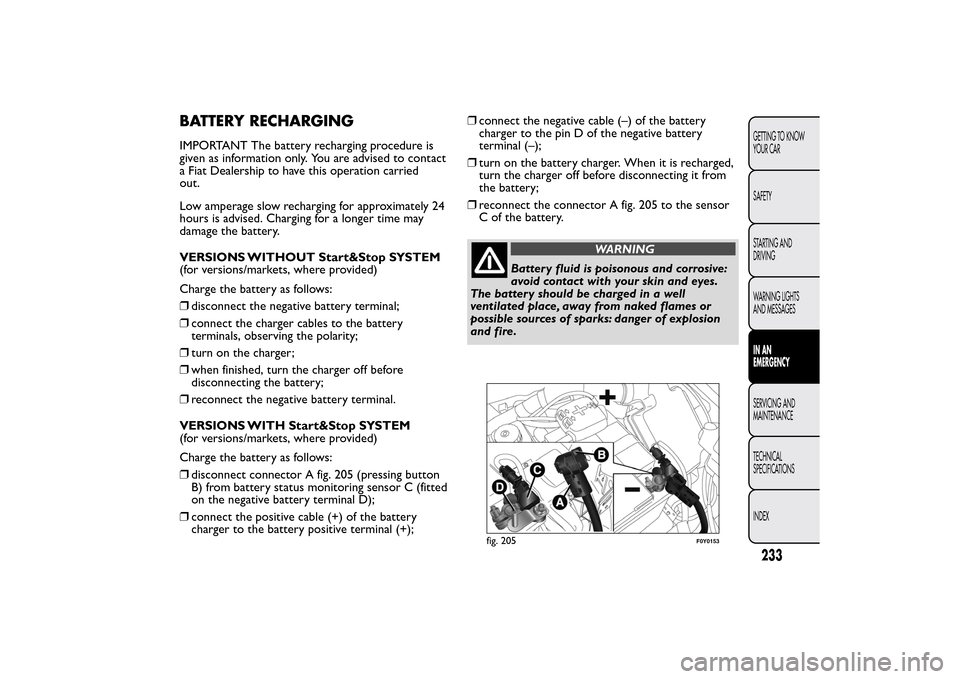
❒disconnect connector A fig. 205 (pressing button
B) from battery status monitoring sensor C (fitted
on the negative battery terminal D);
❒connect the positive cable (+) of the battery
charger to the battery positive terminal (+);❒connect the negative cable (–) of the battery
charger to the pin D of the negative battery
terminal (–);
❒turn on the battery charger. When it is recharged,
turn the charger off before disconnecting it from
the battery;
❒reconnect the connector A fig. 205 to the sensor
C of the battery.
WARNING
Battery fluid is poisonous and corrosive:
avoid contact with your skin and eyes.
The battery should be charged in a well
ventilated place, away from naked flames or
possible sources of sparks: danger of explosion
and fire.
fig. 205
F0Y0153
233GETTING TO KNOW
YOUR CAR
SAFETY
STARTING AND
DRIVING
WARNING LIGHTS
AND MESSAGESIN AN
EMERGENCYSERVICING AND
MAINTENANCE
TECHNICAL
SPECIFICATIONS
INDEX
Page 238 of 420
WARNING
Do not tr y to recharge a frozen batter y;
defrost it first to prevent the risk of
explosion. If the battery was frozen, have it
inspected by specialised technicians before
recharging to check that the internal elements
are not damaged and that the casing is not
cracked, which could cause poisonous, corrosive
acid to leak.
RAISING THE CARIf the car needs to be lifted, go to a Fiat Dealership
which is equipped with arm hoists or workshop lifts.
WARNING
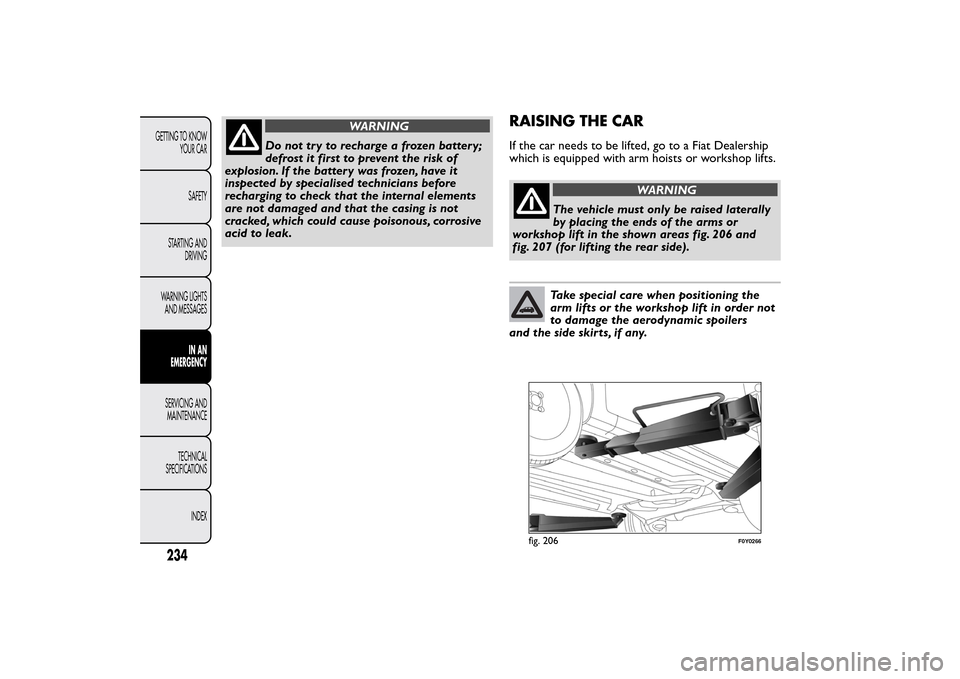
The vehicle must only be raised laterally
by placing the ends of the arms or
workshop lift in the shown areas fig. 206 and
fig. 207 (for lifting the rear side).Take special care when positioning the
arm lifts or the workshop lift in order not
to damage the aerodynamic spoilers
and the side skirts, if any.
fig. 206
F0Y0266
234GETTING TO KNOW
YOUR CAR
SAFETY
STARTING AND
DRIVING
WARNING LIGHTS
AND MESSAGES
IN AN
EMERGENCY
SERVICING AND
MAINTENANCE
TECHNICAL
SPECIFICATIONS
INDEX
Page 239 of 420
TOWING THE CARThe tow hook, which is supplied with the car, is
housed in the tool box, under the mat in the luggage
compartment.
ATTACHING THE TOW HOOK
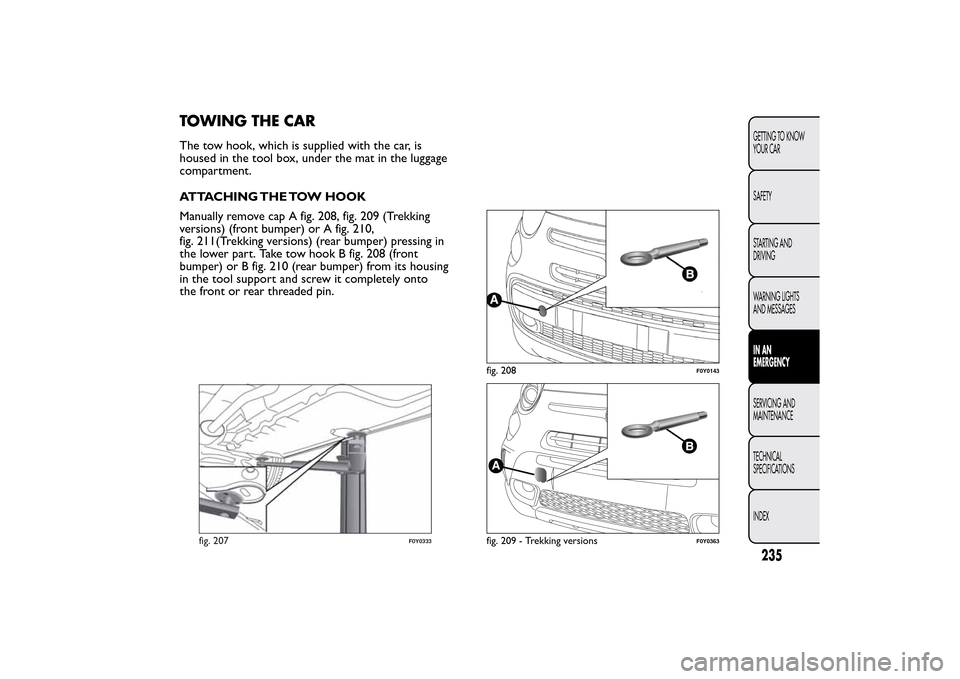
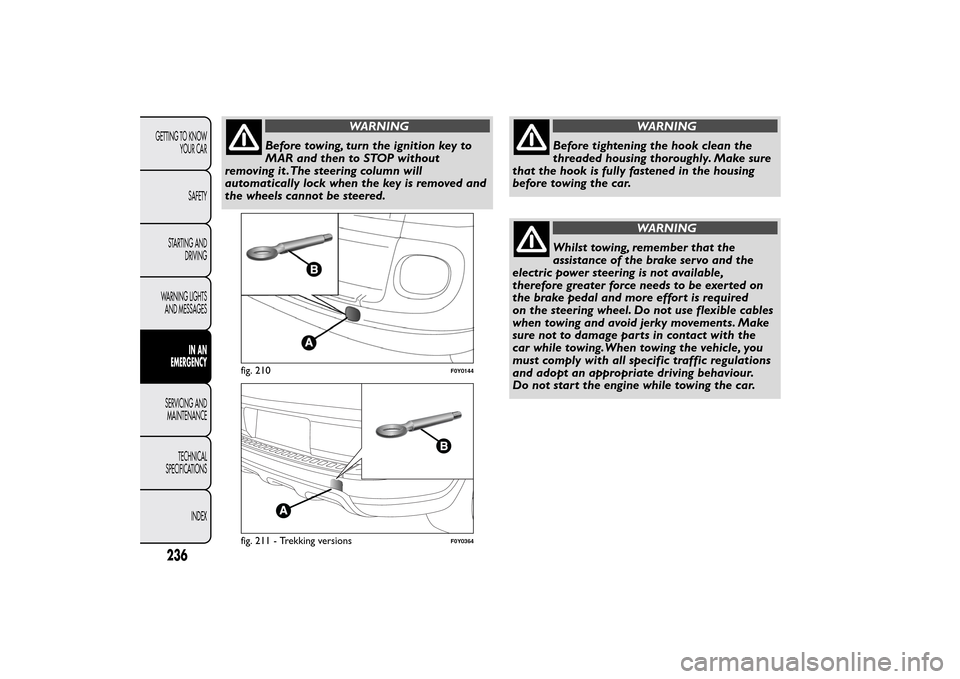
Manually remove cap A fig. 208, fig. 209 (Trekking
versions) (front bumper) or A fig. 210,
fig. 211(Trekking versions) (rear bumper) pressing in
the lower part. Take tow hook B fig. 208 (front
bumper) or B fig. 210 (rear bumper) from its housing
in the tool support and screw it completely onto
the front or rear threaded pin.
fig. 207
F0Y0333
fig. 208
F0Y0143
fig. 209 - Trekking versions
F0Y0363
235GETTING TO KNOW
YOUR CAR
SAFETY
STARTING AND
DRIVING
WARNING LIGHTS
AND MESSAGESIN AN
EMERGENCYSERVICING AND
MAINTENANCE
TECHNICAL
SPECIFICATIONS
INDEX
Page 240 of 420
WARNING
Before towing, turn the ignition key to
MAR and then to STOP without
removing it .The steering column will
automatically lock when the key is removed and
the wheels cannot be steered.
WARNING
Before tightening the hook clean the
threaded housing thoroughly. Make sure
that the hook is fully fastened in the housing
before towing the car.
WARNING
Whilst towing, remember that the
assistance of the brake servo and the
electric power steering is not available,
therefore greater force needs to be exerted on
the brake pedal and more effort is required
on the steering wheel. Do not use flexible cables
when towing and avoid jerky movements. Make
sure not to damage parts in contact with the
car while towing.When towing the vehicle, you
must comply with all specific traffic regulations
and adopt an appropriate driving behaviour.
Do not start the engine while towing the car.
fig. 210
F0Y0144
fig. 211 - Trekking versions
F0Y0364
236GETTING TO KNOW
YOUR CAR
SAFETY
STARTING AND
DRIVING
WARNING LIGHTS
AND MESSAGES
IN AN
EMERGENCY
SERVICING AND
MAINTENANCE
TECHNICAL
SPECIFICATIONS
INDEX
Page 241 of 420
237GETTING TO KNOW
YOUR CAR
SAFETY
STARTING AND
DRIVING
WARNING LIGHTS
AND MESSAGESIN AN
EMERGENCYSERVICING AND
MAINTENANCE
TECHNICAL
SPECIFICATIONS
INDEX
WARNING
The front and rear tow hooks should be
used only for emergencies on the road.
The car may be towed for short distances when
a dedicated device is used in compliance with
the Highway Code (rigid bar), and in order
to move the vehicle on the road in preparation
for towing or transport via a tow truck (on
the Trekking versions do NOT use the rear tow
hook for transport on a tow truck: use the front
tow hook).Tow hooks MUST NOT be used to
tow vehicles off the road or where there are
obstacles and/or for towing operations using
cables or other non-rigid devices. In compliance
with the above conditions, towing must take
place with the two vehicles (one towing, the
other towed) aligned as much as possible along
the same centre line.
Page 242 of 420
SERVICING AND MAINTENANCE
SCHEDULED SERVICINGCorrect servicing is essential in guaranteeing a long
life for the car under the best conditions.
Fiat has therefore arranged a series of checks and
maintenance operations to be carried out every
30,000 kilometres (for petrol versions) or every
35,000 kilometres (for diesel versions).
Check the items on the Scheduled Servicing Plan
(e.g. periodically check level of liquids, tyre pressure,
etc.) before 30,000/35,000 km and between these
services deadlines.Scheduled Servicing is offered by all Fiat Dealerships
according to a set time schedule. If, during each
operation, in addition to the ones scheduled, the
need arises for further replacements or repairs,
these may be carried out only with the explicit
agreement of the Customer. If your car is
used frequently for towing, the interval between one
service operation and the next should be reduced.
WARNING
At 2000 km from the next service operation the
display will show a message.
The Scheduled Servicing intervals are set out by the
Manufacturer. Failure to comply with the schedule
may invalidate the warranty.
It is advisable to inform a Fiat Dealership of any small
operating irregularities without waiting for the next
service.
238GETTING TO KNOW
YOUR CAR
SAFETY
STARTING AND
DRIVING
WARNING LIGHTS
AND MESSAGES
IN AN EMERGENCYSERVICING AND
MAINTENANCE
TECHNICAL
SPECIFICATIONS
INDEX
Page 243 of 420
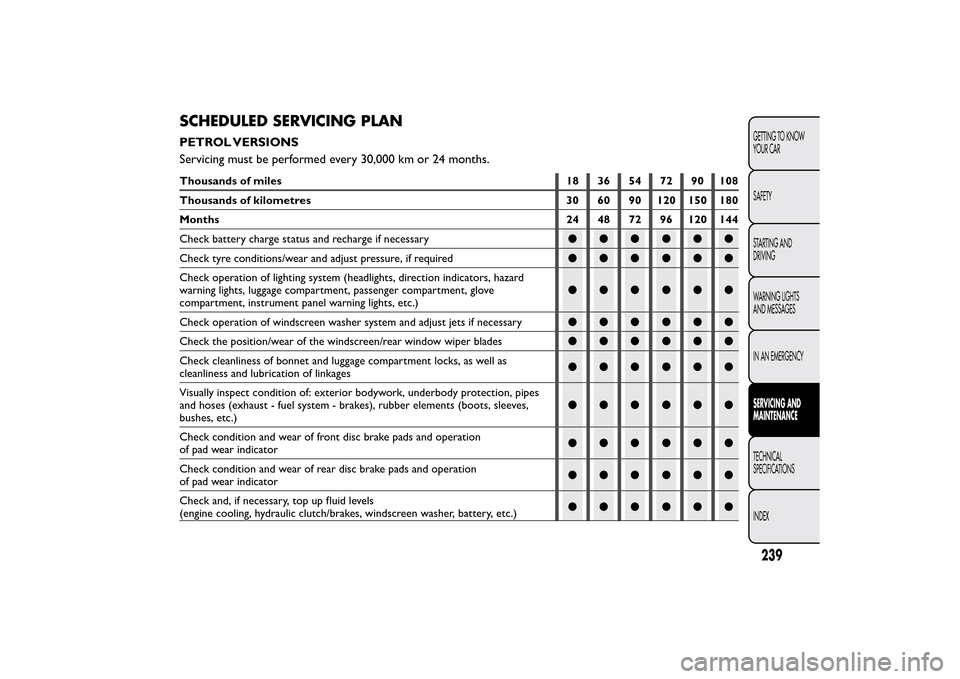
SCHEDULED SERVICING PLANPETROL VERSIONS
Servicing must be performed every 30,000 km or 24 months.Thousands of miles 18 36 54 72 90 108
Thousands of kilometres 30 60 90 120 150 180
Months 24 48 72 96 120 144
Check battery charge status and recharge if necessary●●●●●●
Check tyre conditions/wear and adjust pressure, if required●●●●●●
Check operation of lighting system (headlights, direction indicators, hazard
warning lights, luggage compartment, passenger compartment, glove
compartment, instrument panel warning lights, etc.)●●●●●●
Check operation of windscreen washer system and adjust jets if necessary●●●●●●
Check the position/wear of the windscreen/rear window wiper blades●●●●●●
Check cleanliness of bonnet and luggage compartment locks, as well as
cleanliness and lubrication of linkages●●●●●●
Visually inspect condition of: exterior bodywork, underbody protection, pipes
and hoses (exhaust - fuel system - brakes), rubber elements (boots, sleeves,
bushes, etc.)●●●●●●
Check condition and wear of front disc brake pads and operation
of pad wear indicator●●●●●●
Check condition and wear of rear disc brake pads and operation
of pad wear indicator●●●●●●
Check and, if necessary, top up fluid levels
(engine cooling, hydraulic clutch/brakes, windscreen washer, battery, etc.)●●●●●●
239GETTING TO KNOW
YOUR CAR
SAFETY
STARTING AND
DRIVING
WARNING LIGHTS
AND MESSAGES
IN AN EMERGENCYSERVICING AND
MAINTENANCETECHNICAL
SPECIFICATIONS
INDEX
Page 244 of 420
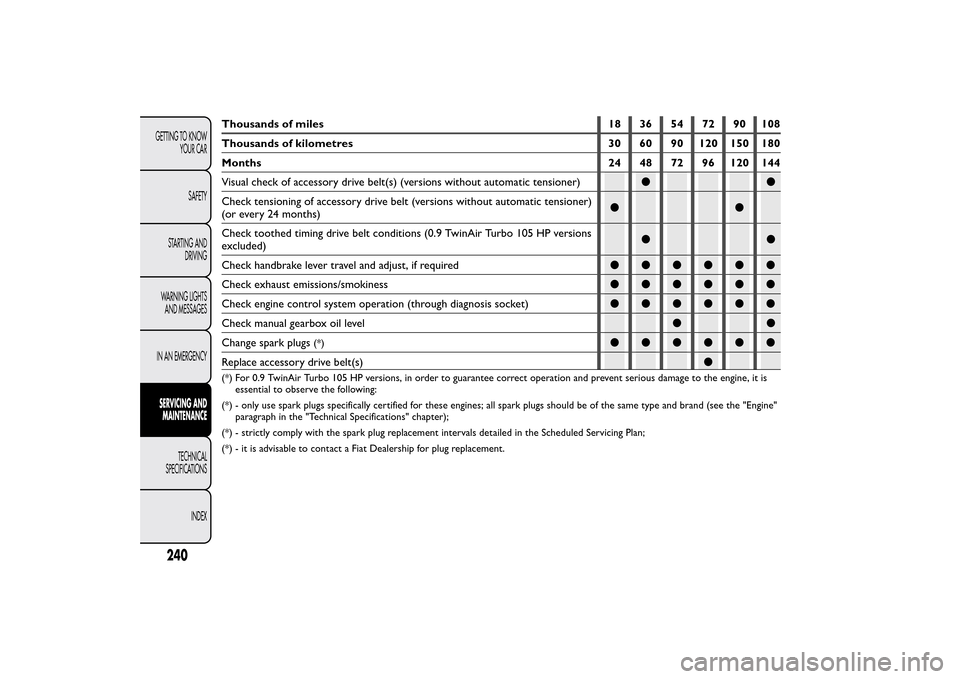
Thousands of miles 18 36 54 72 90 108
Thousands of kilometres 30 60 90 120 150 180
Months 24 48 72 96 120 144
Visual check of accessory drive belt(s) (versions without automatic tensioner)●●
Check tensioning of accessory drive belt (versions without automatic tensioner)
(or every 24 months)●●
Check toothed timing drive belt conditions (0.9 TwinAir Turbo 105 HP versions
excluded)●●
Check handbrake lever travel and adjust, if required●●●●●●
Check exhaust emissions/smokiness●●●●●●
Check engine control system operation (through diagnosis socket)●●●●●●
Check manual gearbox oil level●●
Change spark plugs
(*)
●●●●●●
Replace accessory drive belt(s)●
(*) For 0.9 TwinAir Turbo 105 HP versions, in order to guarantee correct operation and prevent serious damage to the engine, it is
essential to observe the following:
(*) - only use spark plugs specifically certified for these engines; all spark plugs should be of the same type and brand (see the "Engine"
paragraph in the "Technical Specifications" chapter);
(*) - strictly comply with the spark plug replacement intervals detailed in the Scheduled Servicing Plan;
(*) - it is advisable to contact a Fiat Dealership for plug replacement.
240GETTING TO KNOW
YOUR CAR
SAFETY
STARTING AND
DRIVING
WARNING LIGHTS
AND MESSAGES
IN AN EMERGENCYSERVICING AND
MAINTENANCE
TECHNICAL
SPECIFICATIONS
INDEX
Page 245 of 420
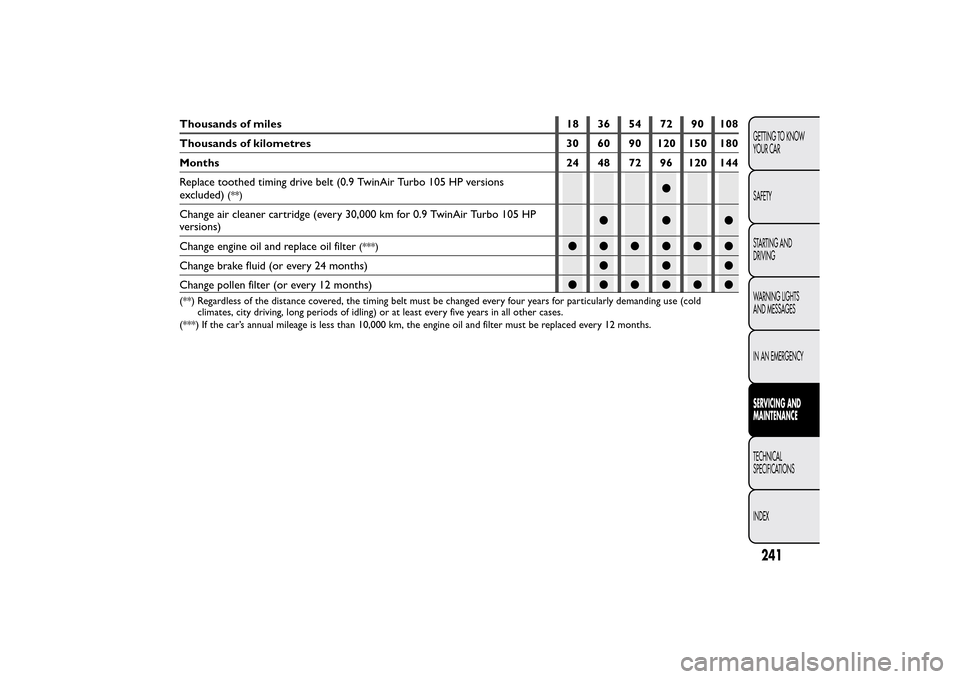
Thousands of miles 18 36 54 72 90 108
Thousands of kilometres 30 60 90 120 150 180
Months 24 48 72 96 120 144
Replace toothed timing drive belt (0.9 TwinAir Turbo 105 HP versions
excluded)
(**)
●
Change air cleaner cartridge (every 30,000 km for 0.9 TwinAir Turbo 105 HP
versions)●●●
Change engine oil and replace oil filter
(***)
●●●●●●
Change brake fluid (or every 24 months)●●●
Change pollen filter (or every 12 months)●●●●●●
(**) Regardless of the distance covered, the timing belt must be changed every four years for particularly demanding use (cold
climates, city driving, long periods of idling) or at least every five years in all other cases.
(***) If the car’s annual mileage is less than 10,000 km, the engine oil and filter must be replaced every 12 months.
241GETTING TO KNOW
YOUR CAR
SAFETY
STARTING AND
DRIVING
WARNING LIGHTS
AND MESSAGES
IN AN EMERGENCYSERVICING AND
MAINTENANCETECHNICAL
SPECIFICATIONS
INDEX