technical specifications FIAT 500L LIVING 2014 2.G Owners Manual
[x] Cancel search | Manufacturer: FIAT, Model Year: 2014, Model line: 500L LIVING, Model: FIAT 500L LIVING 2014 2.GPages: 420, PDF Size: 9.77 MB
Page 246 of 420
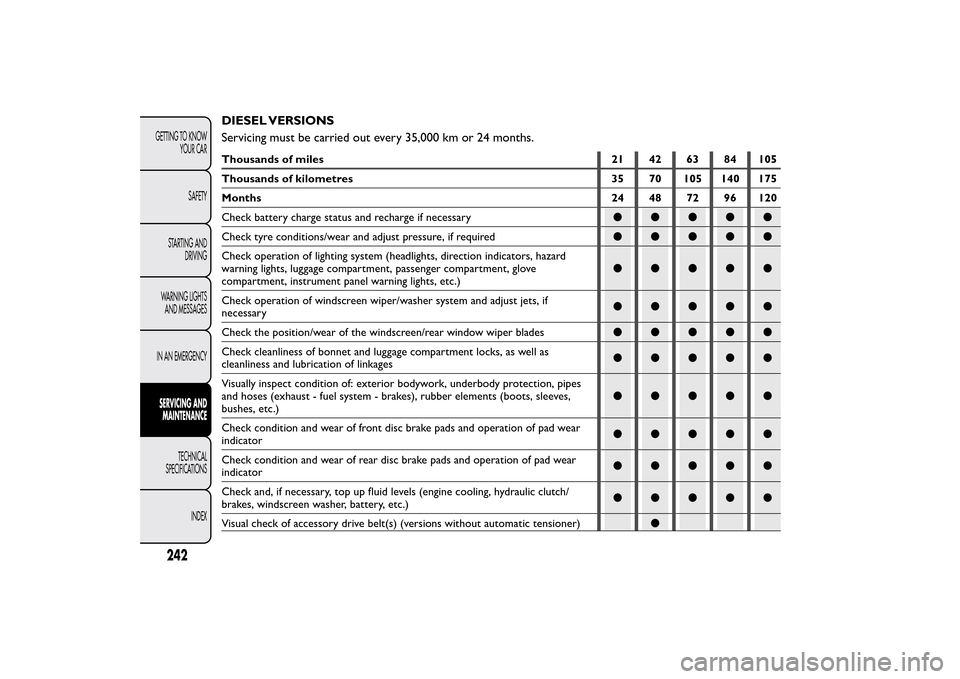
DIESEL VERSIONS
Servicing must be carried out every 35,000 km or 24 months.Thousands of miles 21 42 63 84 105
Thousands of kilometres 35 70 105 140 175
Months 24 48 72 96 120
Check battery charge status and recharge if necessary●●●●●
Check tyre conditions/wear and adjust pressure, if required●●●●●
Check operation of lighting system (headlights, direction indicators, hazard
warning lights, luggage compartment, passenger compartment, glove
compartment, instrument panel warning lights, etc.)●●●●●
Check operation of windscreen wiper/washer system and adjust jets, if
necessary●●●●●
Check the position/wear of the windscreen/rear window wiper blades●●●●●
Check cleanliness of bonnet and luggage compartment locks, as well as
cleanliness and lubrication of linkages●●●●●
Visually inspect condition of: exterior bodywork, underbody protection, pipes
and hoses (exhaust - fuel system - brakes), rubber elements (boots, sleeves,
bushes, etc.)●●●●●
Check condition and wear of front disc brake pads and operation of pad wear
indicator●●●●●
Check condition and wear of rear disc brake pads and operation of pad wear
indicator●●●●●
Check and, if necessary, top up fluid levels (engine cooling, hydraulic clutch/
brakes, windscreen washer, battery, etc.)●●●●●
Visual check of accessory drive belt(s) (versions without automatic tensioner)●
242GETTING TO KNOW
YOUR CAR
SAFETY
STARTING AND
DRIVING
WARNING LIGHTS
AND MESSAGES
IN AN EMERGENCYSERVICING AND
MAINTENANCE
TECHNICAL
SPECIFICATIONS
INDEX
Page 247 of 420
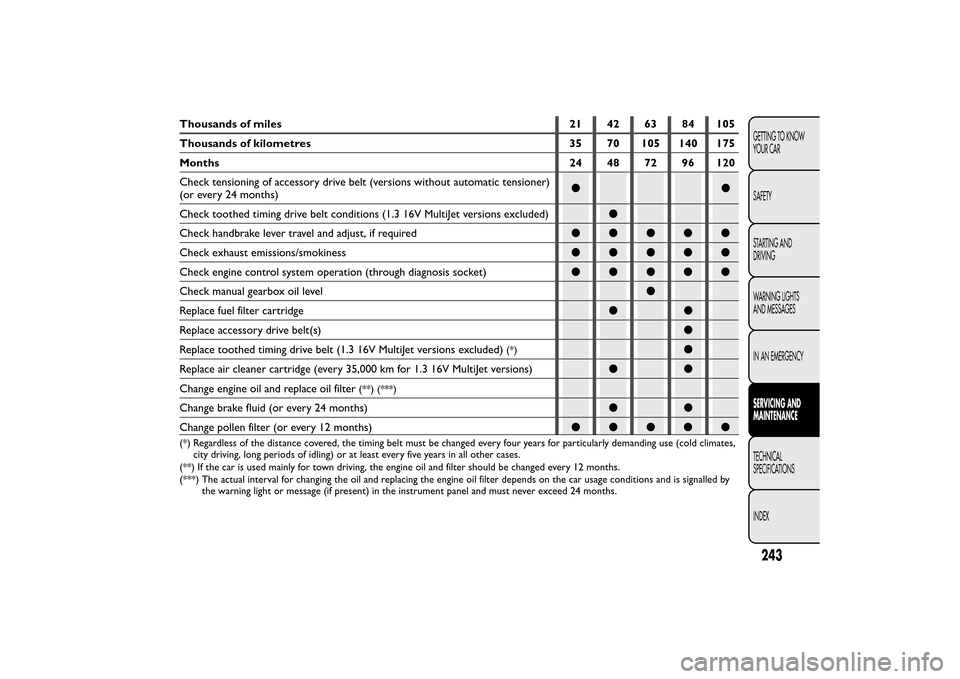
Thousands of miles 21 42 63 84 105
Thousands of kilometres 35 70 105 140 175
Months 24 48 72 96 120
Check tensioning of accessory drive belt (versions without automatic tensioner)
(or every 24 months)●●
Check toothed timing drive belt conditions (1.3 16V MultiJet versions excluded)●
Check handbrake lever travel and adjust, if required●●●●●
Check exhaust emissions/smokiness●●●●●
Check engine control system operation (through diagnosis socket)●●●●●
Check manual gearbox oil level●
Replace fuel filter cartridge●●
Replace accessory drive belt(s)●
Replace toothed timing drive belt (1.3 16V MultiJet versions excluded)
(*)
●
Replace air cleaner cartridge (every 35,000 km for 1.3 16V MultiJet versions)●●
Change engine oil and replace oil filter
(**) (***)
Change brake fluid (or every 24 months)●●
Change pollen filter (or every 12 months)●●●●●(*) Regardless of the distance covered, the timing belt must be changed every four years for particularly demanding use (cold climates,
city driving, long periods of idling) or at least every five years in all other cases.
(**) If the car is used mainly for town driving, the engine oil and filter should be changed every 12 months.
(***) The actual interval for changing the oil and replacing the engine oil filter depends on the car usage conditions and is signalled by
the warning light or message (if present) in the instrument panel and must never exceed 24 months.
243GETTING TO KNOW
YOUR CAR
SAFETY
STARTING AND
DRIVING
WARNING LIGHTS
AND MESSAGES
IN AN EMERGENCYSERVICING AND
MAINTENANCETECHNICAL
SPECIFICATIONS
INDEX
Page 248 of 420
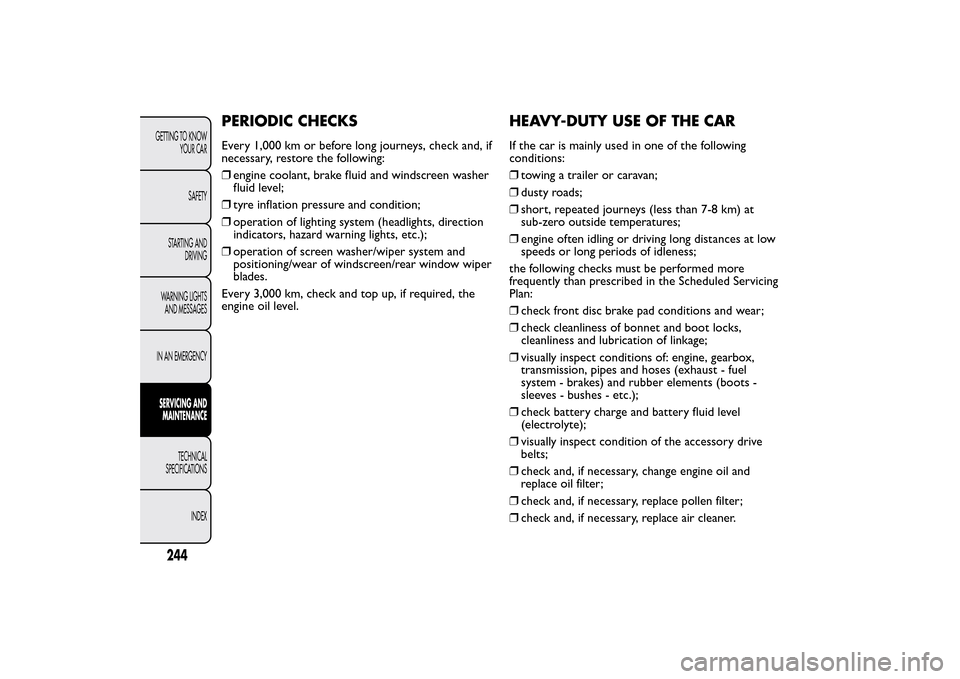
PERIODIC CHECKSEvery 1,000 km or before long journeys, check and, if
necessary, restore the following:
❒engine coolant, brake fluid and windscreen washer
fluid level;
❒tyre inflation pressure and condition;
❒operation of lighting system (headlights, direction
indicators, hazard warning lights, etc.);
❒operation of screen washer/wiper system and
positioning/wear of windscreen/rear window wiper
blades.
Every 3,000 km, check and top up, if required, the
engine oil level.
HEAVY-DUTY USE OF THE CARIf the car is mainly used in one of the following
conditions:
❒towing a trailer or caravan;
❒dusty roads;
❒short, repeated journeys (less than 7-8 km) at
sub-zero outside temperatures;
❒engine often idling or driving long distances at low
speeds or long periods of idleness;
the following checks must be performed more
frequently than prescribed in the Scheduled Servicing
Plan:
❒check front disc brake pad conditions and wear;
❒check cleanliness of bonnet and boot locks,
cleanliness and lubrication of linkage;
❒visually inspect conditions of: engine, gearbox,
transmission, pipes and hoses (exhaust - fuel
system - brakes) and rubber elements (boots -
sleeves - bushes - etc.);
❒check battery charge and battery fluid level
(electrolyte);
❒visually inspect condition of the accessory drive
belts;
❒check and, if necessary, change engine oil and
replace oil filter;
❒check and, if necessary, replace pollen filter;
❒check and, if necessary, replace air cleaner.
244GETTING TO KNOW
YOUR CAR
SAFETY
STARTING AND
DRIVING
WARNING LIGHTS
AND MESSAGES
IN AN EMERGENCYSERVICING AND
MAINTENANCE
TECHNICAL
SPECIFICATIONS
INDEX
Page 249 of 420
CHECKING LEVELS
WARNING
Never smoke while working in the
engine compartment : gas and
inflammable vapours may be present , with the
risk of fire.
WARNING
Be very careful when working in the
engine compartment when the engine is
hot : you may get burned. Remember that the
fan may start up if the engine is hot : this could
injure you. Scarves, ties and other loose clothing
might be pulled by moving parts.
When topping up, take care not to mix up
the various types of fluids: they are not
compatible with each other and could
seriously damage the car.
245GETTING TO KNOW
YOUR CAR
SAFETY
STARTING AND
DRIVING
WARNING LIGHTS
AND MESSAGES
IN AN EMERGENCYSERVICING AND
MAINTENANCETECHNICAL
SPECIFICATIONS
INDEX
Page 250 of 420
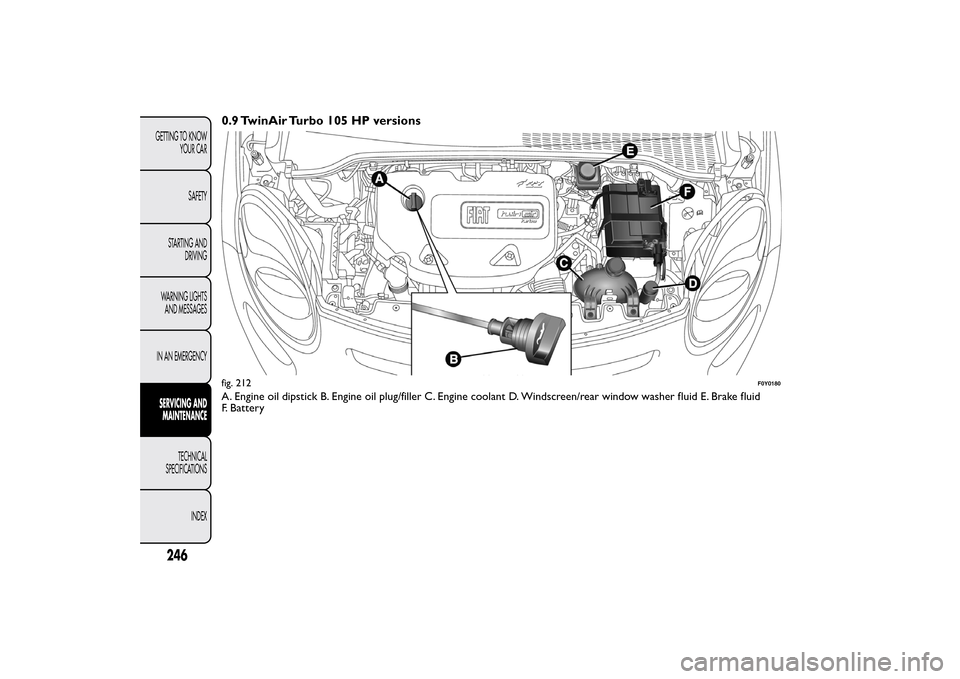
0.9 TwinAir Turbo 105 HP versionsA. Engine oil dipstick B. Engine oil plug/filler C. Engine coolant D. Windscreen/rear window washer fluid E. Brake fluid
F. Batteryfig. 212
F0Y0180
246GETTING TO KNOW
YOUR CAR
SAFETY
STARTING AND
DRIVING
WARNING LIGHTS
AND MESSAGES
IN AN EMERGENCYSERVICING AND
MAINTENANCE
TECHNICAL
SPECIFICATIONS
INDEX
Page 251 of 420
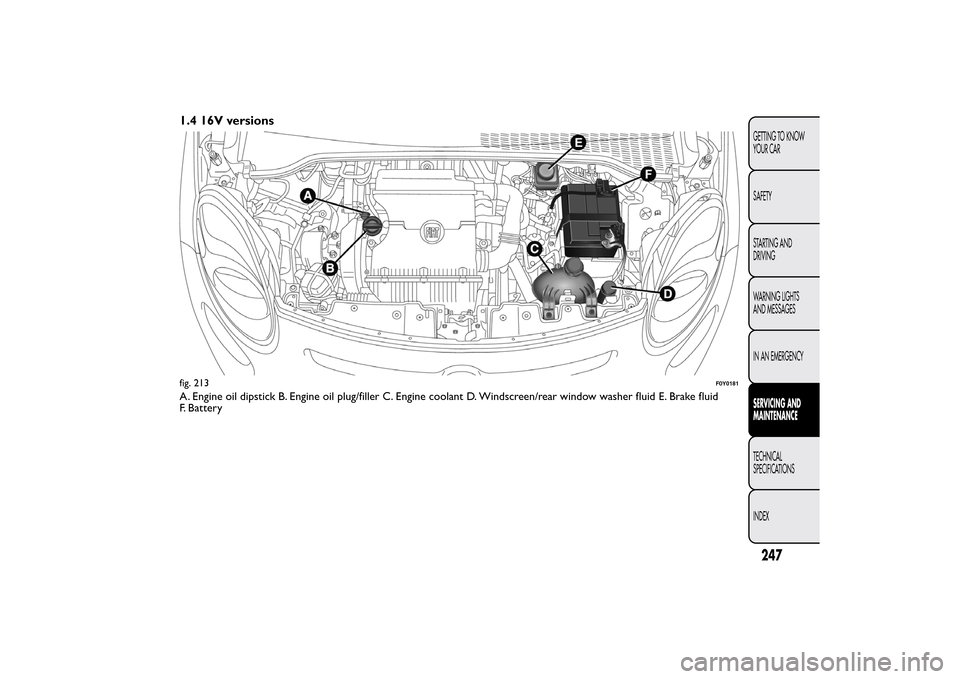
1.4 16V versionsA. Engine oil dipstick B. Engine oil plug/filler C. Engine coolant D. Windscreen/rear window washer fluid E. Brake fluid
F. Batteryfig. 213
F0Y0181
247GETTING TO KNOW
YOUR CAR
SAFETY
STARTING AND
DRIVING
WARNING LIGHTS
AND MESSAGES
IN AN EMERGENCYSERVICING AND
MAINTENANCETECHNICAL
SPECIFICATIONS
INDEX
Page 252 of 420
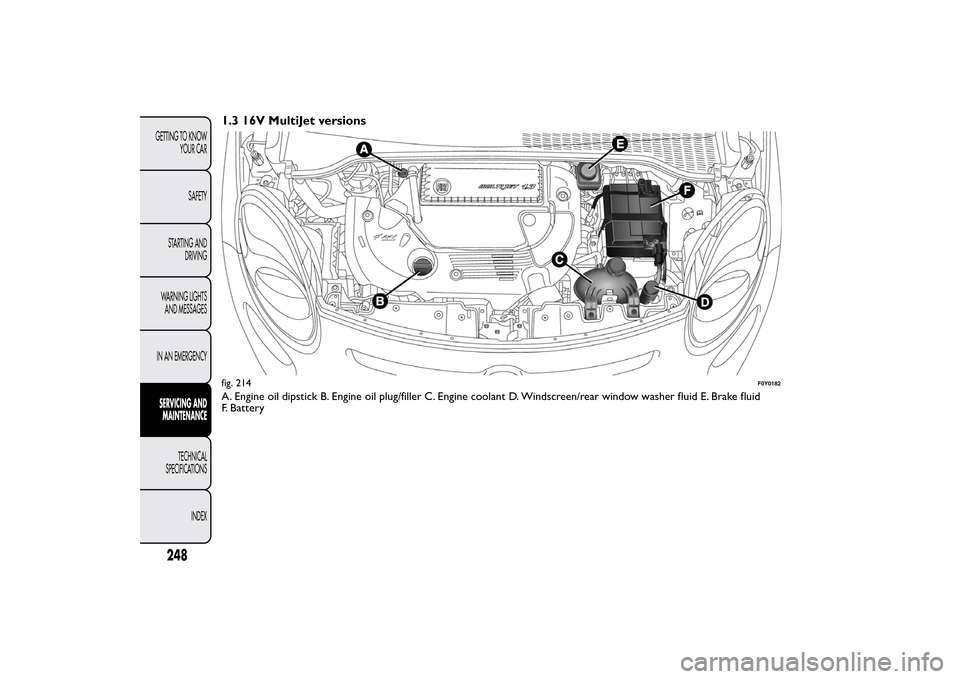
1.3 16V MultiJet versionsA. Engine oil dipstick B. Engine oil plug/filler C. Engine coolant D. Windscreen/rear window washer fluid E. Brake fluid
F. Batteryfig. 214
F0Y0182
248GETTING TO KNOW
YOUR CAR
SAFETY
STARTING AND
DRIVING
WARNING LIGHTS
AND MESSAGES
IN AN EMERGENCYSERVICING AND
MAINTENANCE
TECHNICAL
SPECIFICATIONS
INDEX
Page 253 of 420
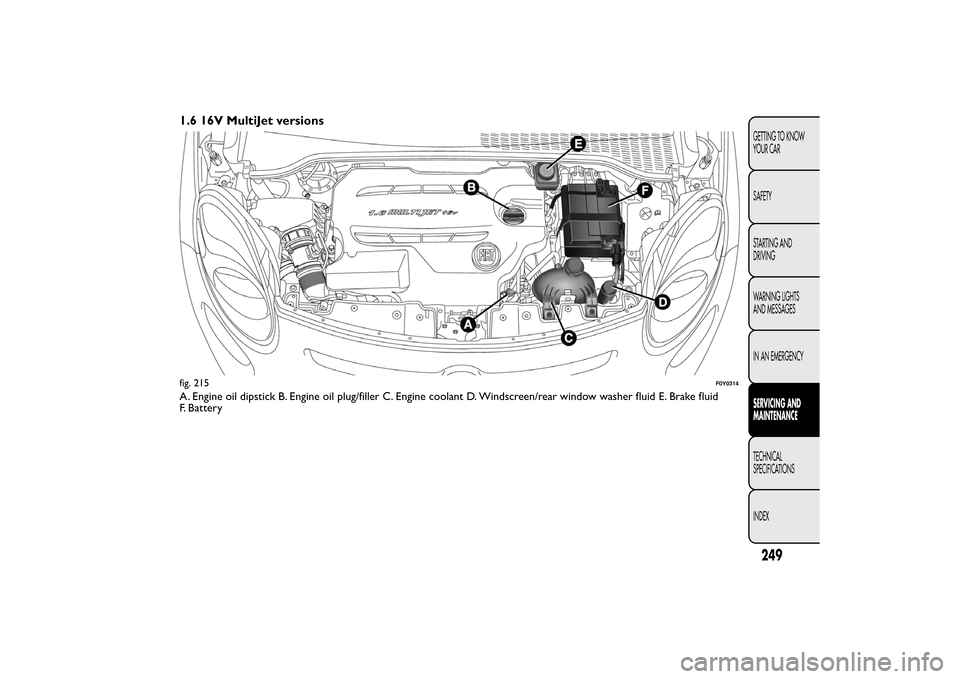
1.6 16V MultiJet versionsA. Engine oil dipstick B. Engine oil plug/filler C. Engine coolant D. Windscreen/rear window washer fluid E. Brake fluid
F. Batteryfig. 215
F0Y0314
249GETTING TO KNOW
YOUR CAR
SAFETY
STARTING AND
DRIVING
WARNING LIGHTS
AND MESSAGES
IN AN EMERGENCYSERVICING AND
MAINTENANCETECHNICAL
SPECIFICATIONS
INDEX
Page 254 of 420
ENGINE OIL
Check the oil level a few minutes (about 5) after the
engine has stopped, with the vehicle parked on
level ground.
For 1.4 16V, 1.3 16V MultiJet and 1.6 16V
MultiJet versions
Remove the engine oil dipstick A, clean it with a
lint-free cloth and reinsert it. Extract the engine oil
dipstick again and check that the level is between the
MIN and MAX marks on the dipstick.
The range between the MIN and MAX marks
corresponds to about 1 litre of oil.
If the oil level is near or under the MIN line, add oil
through the filler B until it reaches the MAX line.
The oil level must never exceed the MAX
mark.
For 0.9 TwinAir 105 HP versions
The engine oil dipstick A is integral with plug B.
Undo the plug, clean the dipstick with a cloth that
does not leave traces, reinsert the dipstick and
re-tighten the plug.
Unscrew the plug again and check that the engine oil
level is between the MIN and MAX marks on the
dipstick.Engine oil consumption
The maximum engine oil consumption is
approximately 400 grams every 1,000 km.
During the initial period of usage for the vehicle, the
engine is bedding in, therefore the engine oil
consumption may settle down only after the first
5,000 - 6,000 km.
IMPORTANT After adding or changing the oil, let the
engine run for a few seconds and wait a few minutes
after switching it off before checking the level.
Do not add oil with characteristics that
are different from those of the oil
currently in the engine.Used engine oil and oil filters contain
substances which are harmful to the
environment .To change the oil and filters,
we advise you to contact a Fiat Dealership.
250GETTING TO KNOW
YOUR CAR
SAFETY
STARTING AND
DRIVING
WARNING LIGHTS
AND MESSAGES
IN AN EMERGENCYSERVICING AND
MAINTENANCE
TECHNICAL
SPECIFICATIONS
INDEX
Page 255 of 420
ENGINE COOLANT
The coolant level must be checked when the engine
is cold and must be between the MIN. and MAX.
marks on the reservoir.
If the level is too low, undo the reservoir plug C (see
previous pages) and add the fluid described in the
chapter "Technical Specifications".
PARAFLU
UP
anti-freeze is used in the
engine cooling system. Use the same fluid
as in the cooling system when topping
up. PARAFLU
UP
cannot be mixed with any other
type of fluid. If this happens, do not start the
engine and contact a Fiat Dealership.
WARNING
The cooling system is pressurised. If
necessary, replace the plug with another
of equivalent quality and the same
specifications as the original, otherwise the
efficiency of the system may be adversely
affected. Do not remove the reservoir plug when
the engine is hot : you risk scalding yourself.
WINDSCREEN/REAR WINDOW WASHER
FLUID
If the level is too low, raise the reservoir plug D (see
previous pages) and add the fluid described in the
chapter "Technical Specifications".
WARNING
Do not travel with the windscreen
washer reservoir empty: the windscreen
washer is essential for improving visibility. Some
commercial windscreen washer additives are
flammable.The engine compartment contains
hot components which may set it on fire.
BRAKE FLUID
Check that the liquid is at the maximum level (the
fluid level in the reservoir must not exceed the
MAX. mark).
If the fluid level in the tank is too low, undo the
reservoir plug E (see previous pages) and add the
fluid described in the chapter "Technical
Specifications".
NoteCarefully clean the plug of the reservoir E and
the surrounding surface.
When opening the plug, make sure that no dirt gets
into the reservoir.
For topping-up, always use a funnel with integrated
filter with mesh equal to or lower than 0.12 mm.
IMPORTANT Brake fluid is hygroscopic (i.e. it
absorbs moisture). For this reason, if the car is
mainly used in areas with a high degree of
atmospheric humidity, the fluid must be replaced at
more frequent intervals than specified in the
“Scheduled Servicing Plan”.
251GETTING TO KNOW
YOUR CAR
SAFETY
STARTING AND
DRIVING
WARNING LIGHTS
AND MESSAGES
IN AN EMERGENCYSERVICING AND
MAINTENANCETECHNICAL
SPECIFICATIONS
INDEX