ESP FIAT BARCHETTA 2003 1.G User Guide
[x] Cancel search | Manufacturer: FIAT, Model Year: 2003, Model line: BARCHETTA, Model: FIAT BARCHETTA 2003 1.GPages: 170, PDF Size: 3.55 MB
Page 77 of 170
76
Here are some suggestions which
may help you to keep the running
costs of your vehicle down and low-
er the amount of toxic emissions re-
leased into the atmosphere.
GENERAL
CONSIDERATIONS
Car maintenance
The overall state of the car is an im-
portant factor which has a marked in-
fluence over fuel consumption and dri-
ving comfort and on the life span of
your car. For this reason care should
be taken to maintain your car by car-
rying out the necessary checks and
regulations in accordance with the
specifications given in the Scheduled
Maintenance Programme (see sec-
tions... spark plugs, idle, air filter, tim-
ing).
CONTAINING RUNNING COSTS
AND POLLUTION
Tyres
Tyres should be checked at least
every four weeks: if the pressure is
too low fuel consumption increases as
the resistance to the rolling movement
of the tyre is greater. In this state, tyre
wear is increased and car handling suf-
fers which will affect safety.
Unnecessary loads
Do not travel with too much luggage
stowed in the boot. The weight of the
vehicle (especially when driving in
town) and its trim greatly affects con-
sumption and stability. To get the most out of ABS:
– During emergency stops or when
grip conditions are poor, you will feel
a slight pulsation on the brake pedal.
This is the sign that the ABS is in ac-
tion. Do not release the brake pedal
but continue to press so as not to in-
terrupt the braking action.
– ABS prevents the wheels from
locking but it does not increase actu-
al grip conditions between tyre and
road. Therefore, even if your car is fit-
ted with ABS, respect the safety dis-
tance from the car in front of you and
keep your speed down when driving
into bends.
– ABS serves to increase the con-
trollability of the car, not to enable you
to go faster.
Page 79 of 170
78
CONDITIONS OF USE
Cold starting
Frequent cold starting will not enable
the engine to reach optimal running
temperature. It follows therefore that
consumption will be higher (from
+15% to +30% in towns) as will the
production of toxic emissions.
Traffic and road conditions
Heavy traffic and higher consumption
are synonymous; for example, when
driving slowly with frequent use of the
lower gears or in large towns where
there are numerous traffic lights.
Winding roads, mountain roads and
bumpy roads also have a negative ef-
fect on consumption.
Enforced halts
During prolonged hold-ups (traffic
lights, level crossings) the engine
should be switched off.CHEAP RUNNING THAT RESPECTS
THE ENVIRONMENT
LOOKING AFTER EMISSION
CONTROL DEVICES
The correct use of pollution control
devices not only ensures respect for
the environment but also has an effect
on the car’s performance.
Keeping these devices in good con-
dition is therefore a fundamental rule
for driving that is easy on your pock-
et and on the environment too.
The first step to take is to follow the
Service Schedule to the letter.
Use only unleaded petrol in petrol
engines.
If you have trouble starting, do not
keep turning the ignition key for long
periods. Be especially careful to avoid
bump starting the car by pushing, tow-
ing or rolling down hill: these are all
manoeuvres that can damage the cat-
alytic exhaust. For emergency starts
use only an auxiliary battery. Environmental protection has been
one of the guiding principles in the
production of the Fiat barchetta. It is
no accident that its pollution control
equipment is much more effective than
that required by current legislation.
Nonetheless, the environment can-
not get by without a concerted effort
from everyone.
By following a few simple rules you
can avoid harming the environment
and often cut down fuel consumption
at the same time.
On this subject, a few useful tips have
been given below to supplement those
marked by symbol #, at various points
of the handbook.
You are asked to read both the for-
mer and latter carefully.
Page 85 of 170
84
EMERGENCY
START-UP
If the Fiat CODE system cannot de-
activate the engine immobiliser, the
warning lights ¢and
Uwill remain
lit and the engine will not start. To
start your car, follow the emergency
startup procedure.
Read the whole procedure care-
fully before trying to carry it out.
If you make a mistake in the emer-
gency procedure you must turn the ig-
nition key back toSTOPand repeat
the whole operation from the begin-
ning, step 1).
1)Read the 5-figure electronic code
given on the CODE card.
2) Turn the ignition key to MAR.
3)Press the accelerator pedal to the
floor and keep it there. The injection
warning lamp
Uwill light up for about
8 seconds, and then go out. At this
point release the accelerator pedal and
get ready to count the flashes of warn-
ing lamp
U.4) Count the number of flashes that
corresponds to the first figure of the
code on the CODE card, then press
the accelerator pedal and keep it there
until the warning lamp
Ulights up for
four seconds and then goes out again.
Release the accelerator pedal.
5)The warning lamp
Uwill start
flashing again: when the lamp has
flashed the number of times that cor-
responds to the second figure on the
CODE card, press the accelerator
pedal to the floor and keep it there.
6) Do the same for the remaining fig-
ures on the CODE card.
7) Once the final figure has been en-
tered, keep the accelerator pedal
pressed. The warning lamp
Uwill
light up for 4 seconds and then go out.
Release the accelerator pedal.
8) The warning lamp
Uwill flash
rapidly for about 4 seconds to indicate
that the operation has been complet-
ed correctly.9)Turn on the engine by turning the
ignition key from the MARto the
AVVposition.
If however indicator light
Ustays
on, turn the ignition key to STOPand
repeat the procedure starting from
point 1).
IMPORTANT After emergency
starting the car you should have it seen
to at a Fiat Dealershipbecause the
emergency procedure will have to be
repeated each time you start the en-
gine otherwise.
Page 87 of 170
86
Observe the instructions on this and
the following pages to use the jack and
space-saver spare wheel correctly.
BUMP STARTING IF A TYRE
IS PUNCTURED
General instructions
Do not bump start by
pushing, towing or coast-
ing downhill. This way of
starting could cause a rush of fu-
el into the catalytic exhaust pipe
and damage it beyond repair.
Signal the presence of the
stopped vehicle according
to the laws in force (e.g. hazard
lights, reflecting triangle, etc.).
Any passengers on board should
leave the vehicle, especially if it is
heavily laden. Passengers should
stay away from oncoming traffic
while the wheel is being changed.
If the wheel is being changed on a
steep or badly surfaced road, place
wedges or other suitable material
under the wheels to stop the vehi-
cle.
WARNING
Remember that if the en-
gine is not running, the
brake booster will not work. You
therefore have to use considerably
more effort on the brake pedal.
WARNING
The space-saver spare
wheel is vehicle-specific.
Never use the wheel on other mod-
els. Never use other model spare
wheels on your vehicle.
If you change the type of wheels
(alloy rims instead of steel rims) you
will have to change the entire set of
fastening bolts with another set of
suitably sized bolts.
Only use the spare-saver wheel for
emergencies.
With the spare wheel do not exceed
80 kph.
An orange sticker is attached to the
spare wheel giving the main in-
structions for its use and limitations.
The sticker must never be re-
moved or covered.
Do not fit the hub cap to the
spare wheel.
WARNING
Page 99 of 170
98
IF AN INTERIOR
LIGHT BURNS
OUT
CEILING LIGHT UNIT
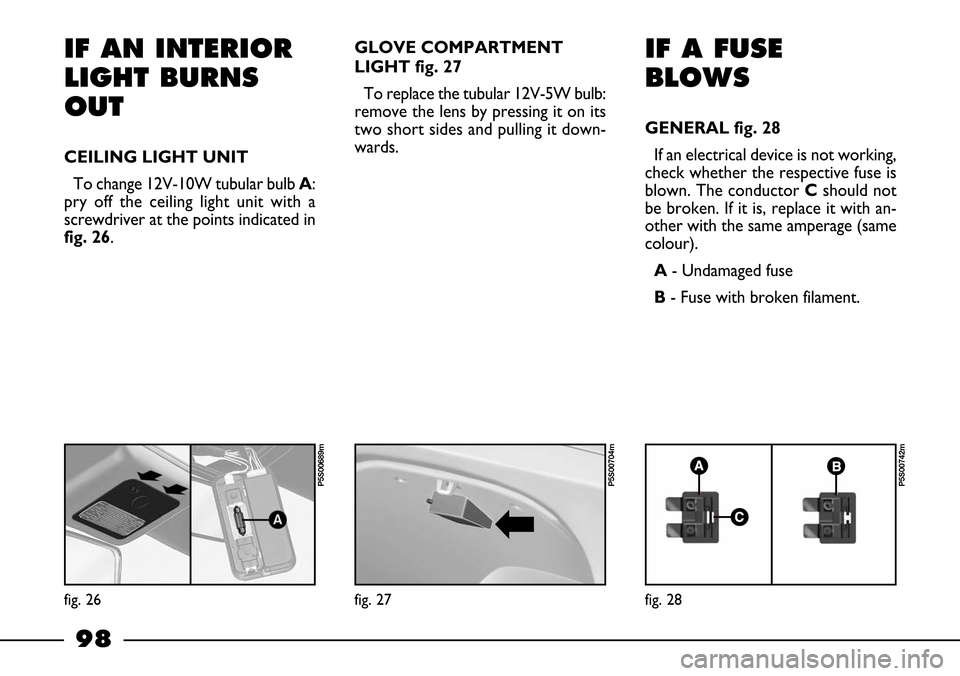
To change 12V-10W tubular bulb A:
pry off the ceiling light unit with a
screwdriver at the points indicated in
fig. 26.GLOVE COMPARTMENT
LIGHT fig. 27
To replace the tubular 12V-5W bulb:
remove the lens by pressing it on its
two short sides and pulling it down-
wards.
IF A FUSE
BLOWS
GENERAL fig. 28
If an electrical device is not working,
check whether the respective fuse is
blown. The conductor Cshould not
be broken. If it is, replace it with an-
other with the same amperage (same
colour).
A- Undamaged fuse
B- Fuse with broken filament.
fig. 26
P5S00689m
fig. 27
P5S00704m
fig. 28
P5S00742m
Page 100 of 170
99
POSITION OF THE FUSES
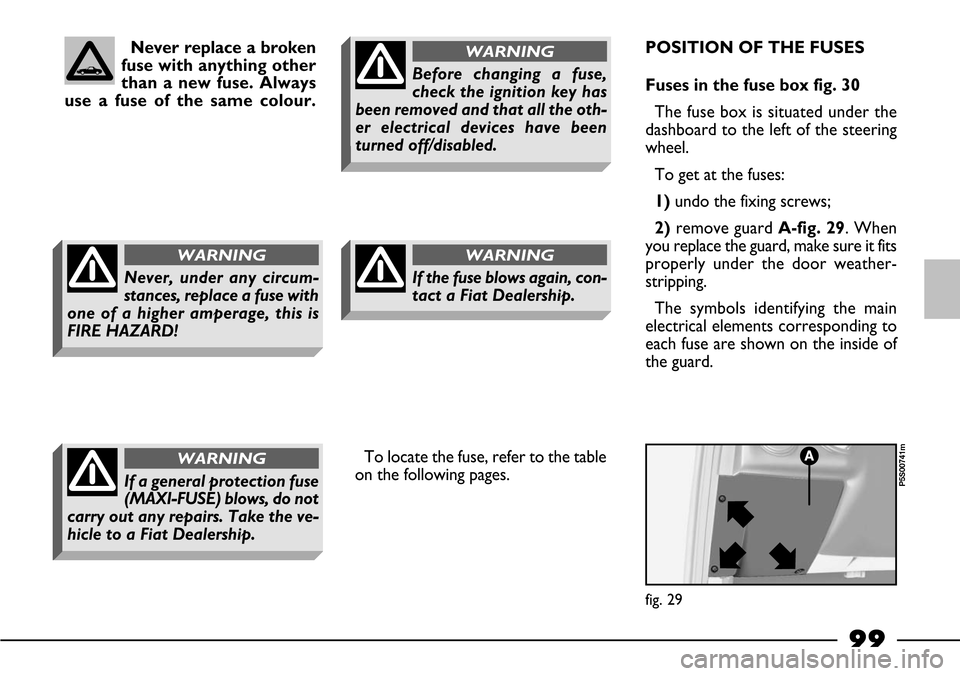
Fuses in the fuse box fig. 30
The fuse box is situated under the
dashboard to the left of the steering
wheel.
To get at the fuses:
1)undo the fixing screws;
2)remove guard A-fig. 29. When
you replace the guard, make sure it fits
properly under the door weather-
stripping.
The symbols identifying the main
electrical elements corresponding to
each fuse are shown on the inside of
the guard.
fig. 29
P5S00741m
Never replace a broken
fuse with anything other
than a new fuse. Always
use a fuse of the same colour.
To locate the fuse, refer to the table
on the following pages.
Never, under any circum-
stances, replace a fuse with
one of a higher amperage, this is
FIRE HAZARD!
WARNING
Before changing a fuse,
check the ignition key has
been removed and that all the oth-
er electrical devices have been
turned off/disabled.
WARNING
If a general protection fuse
(MAXI-FUSE) blows, do not
carry out any repairs. Take the ve-
hicle to a Fiat Dealership.
WARNING
If the fuse blows again, con-
tact a Fiat Dealership.
WARNING
Page 117 of 170
116
This check should be carried out
more frequently if the vehicle is main-
ly used for short trips, or if it is fitted
with accessories that permanently ab-
sorb electricity even with the ignition
key removed, especially in the case of
after market accessories.
You should check the battery fluid
(electrolyte) level more frequently
than shown in the Service Schedule if
the car is used in hot climates or par-
ticularly demanding conditions. IMPORTANT - Engine oil
Change the engine oil more fre-
quently than specified in the Service
Schedule if the vehicle is mainly used
under one of the following particular-
ly severe conditions:
– towing a trailer or caravan
– on dirt roads
– short, repetitive trips (less than 7
or 8 kilometres) in outside tempera-
tures below zero.
– engines that are frequently left to
idle or drive slowly over long dis-
tances.
IMPORTANT - Air cleaner
If you drive your car on dirt roads
change the air cleaner more frequently
than specified in the Service Schedule.If you are in doubt about how often
the engine oil or the air cleaner should
be changed in relation to how you use
the car, contact a Fiat Dealership.
IMPORTANT - Pollen filter
If the car is often used in dusty or ex-
tremely polluted environments, you
should change the filter element more
frequently. It should be changed espe-
cially if the amount of air introduced
into the passenger compartment is re-
duced.
IMPORTANT - Battery
You should check the status of the
battery charge preferably at the be-
ginning of the cold season to avoid the
possibility of the electrolyte freezing.Maintenance of your car
should be entrusted to a
Fiat Dealership. For in-
terventions of routine mainte-
nance and small repairs you wish
to carry out yourself, make sure
you always have the proper
equipment, genuine Fiat spare
parts and fluids available. Do not,
carry out these operations if you
have no experience.
Page 119 of 170
118
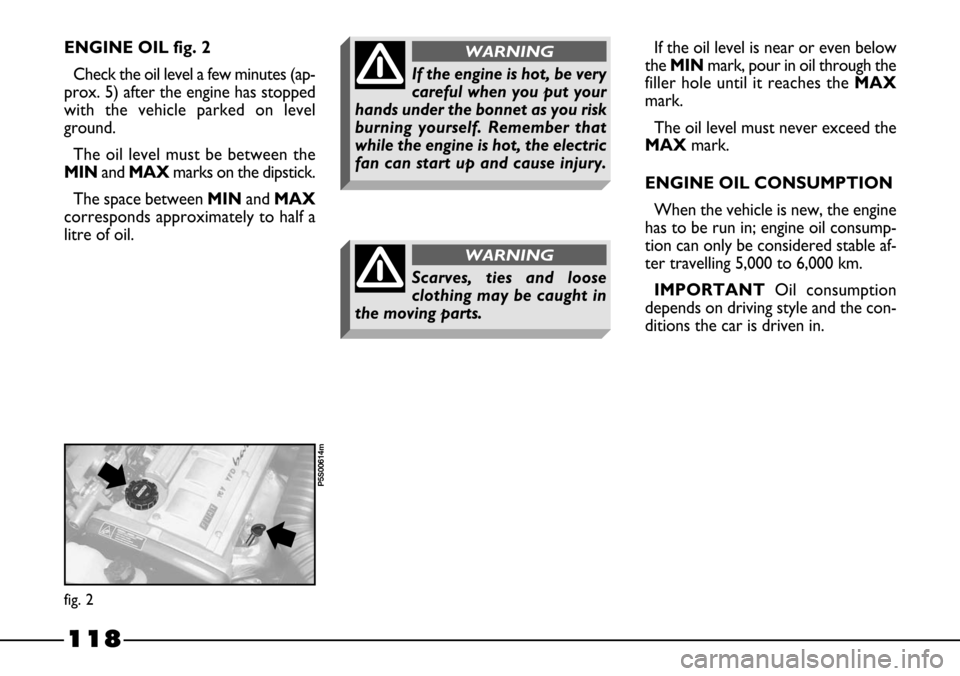
ENGINE OIL fig. 2
Check the oil level a few minutes (ap-
prox. 5) after the engine has stopped
with the vehicle parked on level
ground.
The oil level must be between the
MINand MAXmarks on the dipstick.
The space between MINand MAX
corresponds approximately to half a
litre of oil.If the oil level is near or even below
theMIN mark, pour in oil through the
filler hole until it reaches the MAX
mark.
The oil level must never exceed the
MAXmark.
ENGINE OIL CONSUMPTION
When the vehicle is new, the engine
has to be run in; engine oil consump-
tion can only be considered stable af-
ter travelling 5,000 to 6,000 km.
IMPORTANTOil consumption
depends on driving style and the con-
ditions the car is driven in.
fig. 2
P5S00614m
If the engine is hot, be very
careful when you put your
hands under the bonnet as you risk
burning yourself. Remember that
while the engine is hot, the electric
fan can start up and cause injury.
WARNING
Scarves, ties and loose
clothing may be caught in
the moving parts.
WARNING
Page 124 of 170
123
If the vehicle is to stand
for a long time in the cold,
remove the battery and
store it in a warm place to avoid
it freezing.
BATTERY
The Fiat barchetta’s battery is of the
“Limited Maintenance” type: under
normal conditions, it requires no top-
ping up with distilled water.
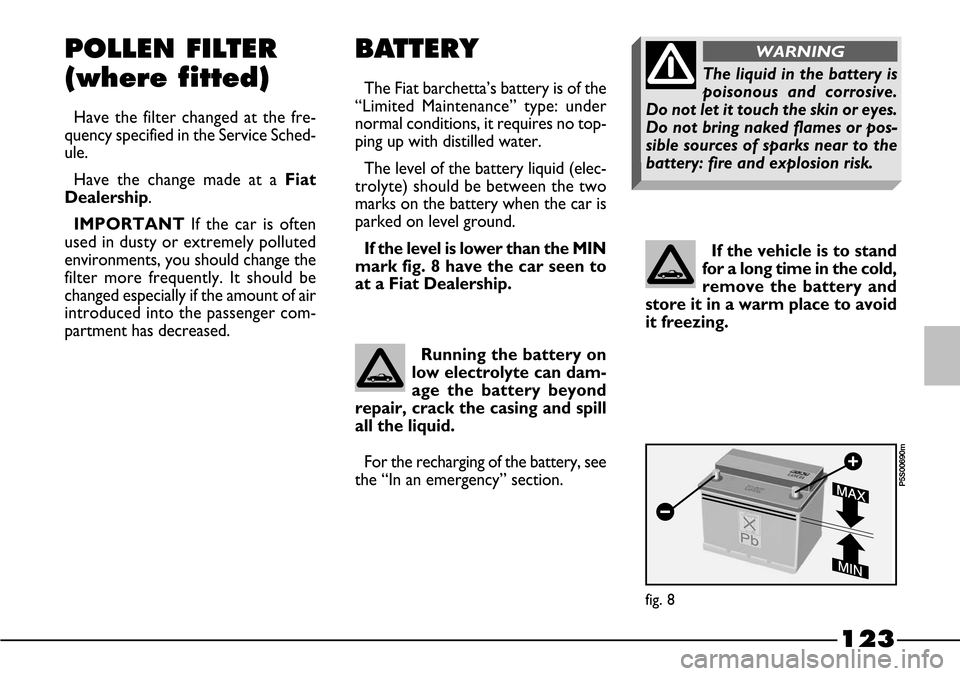
The level of the battery liquid (elec-
trolyte) should be between the two
marks on the battery when the car is
parked on level ground.
If the level is lower than the MIN
mark fig. 8 have the car seen to
at a Fiat Dealership.
Running the battery on
low electrolyte can dam-
age the battery beyond
repair, crack the casing and spill
all the liquid.
For the recharging of the battery, see
the “In an emergency” section.
fig. 8
P5S00690m
POLLEN FILTER
(where fitted)
Have the filter changed at the fre-
quency specified in the Service Sched-
ule.
Have the change made at a Fiat
Dealership.
IMPORTANTIf the car is often
used in dusty or extremely polluted
environments, you should change the
filter more frequently. It should be
changed especially if the amount of air
introduced into the passenger com-
partment has decreased.
The liquid in the battery is
poisonous and corrosive.
Do not let it touch the skin or eyes.
Do not bring naked flames or pos-
sible sources of sparks near to the
battery: fire and explosion risk.
WARNING
Page 138 of 170
ENGINE CODE - BODY VERSION
137
Engine type code Body version code
188A6.000 183SB1AA 01
PAINT IDENTIFICATION
PLATE fig. 4
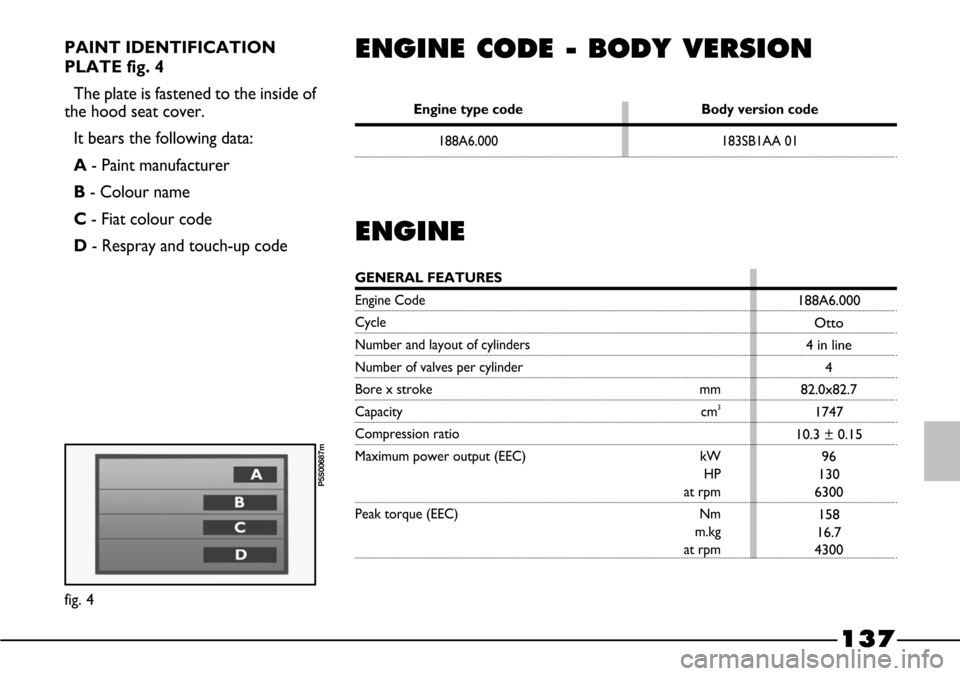
The plate is fastened to the inside of
the hood seat cover.
It bears the following data:
A- Paint manufacturer
B- Colour name
C- Fiat colour code
D- Respray and touch-up code
fig. 4
P5S00687m
ENGINE
GENERAL FEATURES
Engine Code
Cycle
Number and layout of cylinders
Number of valves per cylinder
Bore x stroke mm
Capacity cm3
Compression ratio
Maximum power output (EEC) kW
HP
at rpm
Peak torque (EEC) Nm
m.kg
at rpm
188A6.000
Otto
4 in line
4
82.0x82.7
1747
10.3 ± 0.15
96
130
6300
158
16.7
4300