ESP FIAT BARCHETTA 2003 1.G Owners Manual
[x] Cancel search | Manufacturer: FIAT, Model Year: 2003, Model line: BARCHETTA, Model: FIAT BARCHETTA 2003 1.GPages: 170, PDF Size: 3.55 MB
Page 2 of 170
Dear Customer,
Thank you for selecting Fiat and congratulations on your choice of a Fiat barchetta.
Fiat barchetta is a compact saloon with an original bodyline, designed to offer great driving satisfaction, ensure safety and
be as friendly as possible to the environment.
We have written this handbook to help you get to know all your new Fiat barchetta’s features and use it in the best
possible way. You should read it right through before taking the road for the first time. You will find information, tips and
important warnings regarding the driving of your car to help you derive the maximum from your Fiat barchetta’s
technological features. You will find very valuable tips for your own safety, the car’s wellbeing and about how to protect
the environment.
What’s more every single component of the Fiat barchetta is fully recyclable. At the end of your car’s useful lifespan any
Fiat Dealer will be pleased to make arrangements for your car to be recycled and nature benefits in two ways: there’s no
pollution from waste disposal and the demand for raw materials is reduced.
You are recommended to read carefully the warnings and indications, marked with the respective symbols, at the end of
the page:
personal safety;
the car’s wellbeing;
environmental protection.
The enclosed FIAT WARRANTY BOOKLET lists the services that Fiat offers to its Customers:
– the Warranty Certificate with terms and conditions for maintaining its validity
– the range of additional services available to Fiat Customers
Best regards and good motoring!
Page 16 of 170
15
THE REMOTE CONTROL
The remote control has a button A-
fig. 7and a led B. The button activates
the system. The led flashes while the
signal is being transmitted to the re-
ceiver.
This a radio-frequency remote con-
trol and must be used close to the ve-
hicle.
Ministerial homologation
With respect to the legislation in
force in each country on the use of ra-
dio frequencies:
– the market specific homologation
codes are given in the chapter “Ac-
cessory installation”;
– the homologation code is printed
on the remote control for the markets
which require it.SYSTEM PROGRAMMING
When your new car is handed over
to you, the electronic alarm has al-
ready been programmed by your Fi-
at Dealership. Any subsequent pro-
gramming should also be carried out
by a Fiat Dealership.
If, therefore, you ever need a new re-
mote control, go to your nearest Fi-
at Dealership, taking with you the
key with the burgundy grip, all the re-
mote controls in your possession and
the CODE card.REPLACING THE BATTERIES
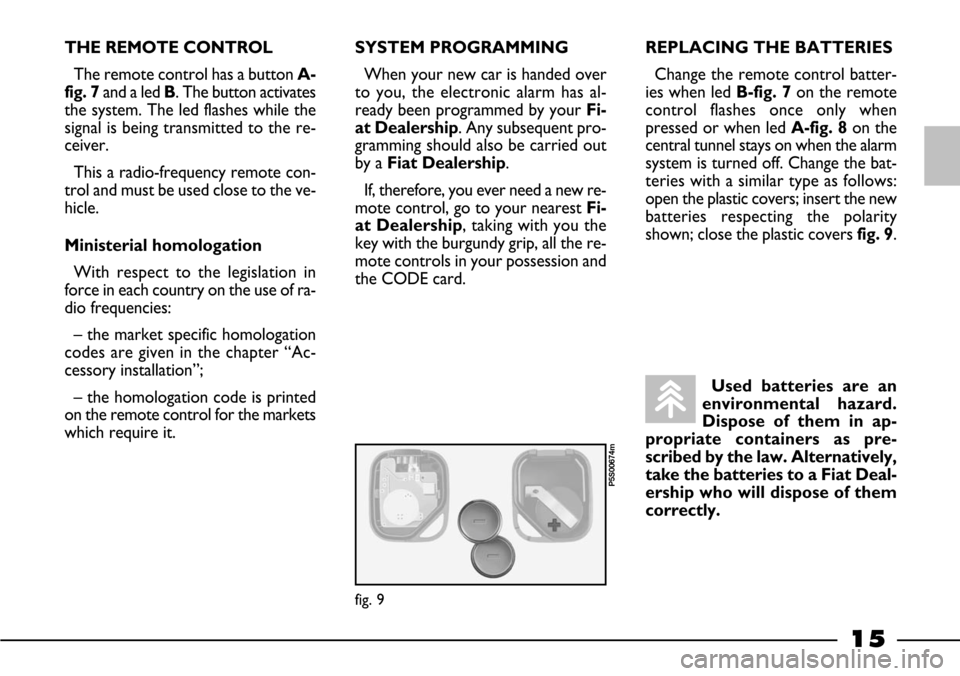
Change the remote control batter-
ies when led B-fig. 7on the remote
control flashes once only when
pressed or when ledA-fig. 8on the
central tunnel stays on when the alarm
system is turned off. Change the bat-
teries with a similar type as follows:
open the plastic covers; insert the new
batteries respecting the polarity
shown; close the plastic covers fig. 9.
Used batteries are an
environmental hazard.
Dispose of them in ap-
propriate containers as pre-
scribed by the law. Alternatively,
take the batteries to a Fiat Deal-
ership who will dispose of them
correctly.
fig. 9
P5S00674m
Page 23 of 170
22
GENERAL INSTRUCTIONS
FOR THE USE OF THE SEAT
BELTS
All the occupants of the vehicle are
obliged to respect the local traffic laws
regarding the wearing of seat belts.
Make sure the seat belts
are fastened at all times.
You increase the risk of serious in-
jury or death in a collision if you
travel with the belts unfastened.
WARNING
fig. 18
P5S00633m
fig. 19
P5S00748
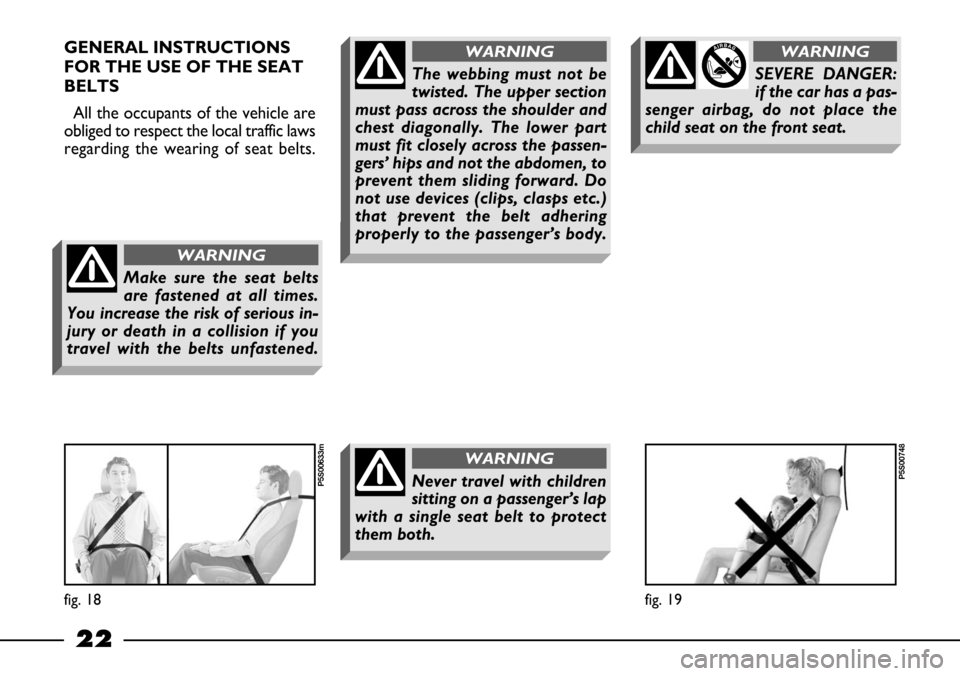
The webbing must not be
twisted. The upper section
must pass across the shoulder and
chest diagonally. The lower part
must fit closely across the passen-
gers’ hips and not the abdomen, to
prevent them sliding forward. Do
not use devices (clips, clasps etc.)
that prevent the belt adhering
properly to the passenger’s body.
WARNING
Never travel with children
sitting on a passenger’s lap
with a single seat belt to protect
them both.
WARNING
SEVERE DANGER:
if the car has a pas-
senger airbag, do not place the
child seat on the front seat.
WARNING
Page 25 of 170
24
TRANSPORTING
CHILDREN
IN SAFETY
For optimal protection in the event
of a crash, all passengers must be seat-
ed and wearing adequate restraint sys-
tems.
This is especially relevant for chil-
dren.
A child’s head is larger and heavier
than an adult’s head with respect to
their body weight. Moreover, a child’s
muscular and bone structure is not ful-
ly developed. For these reasons, chil-
dren require specific restraint systems,
different from those required by adult
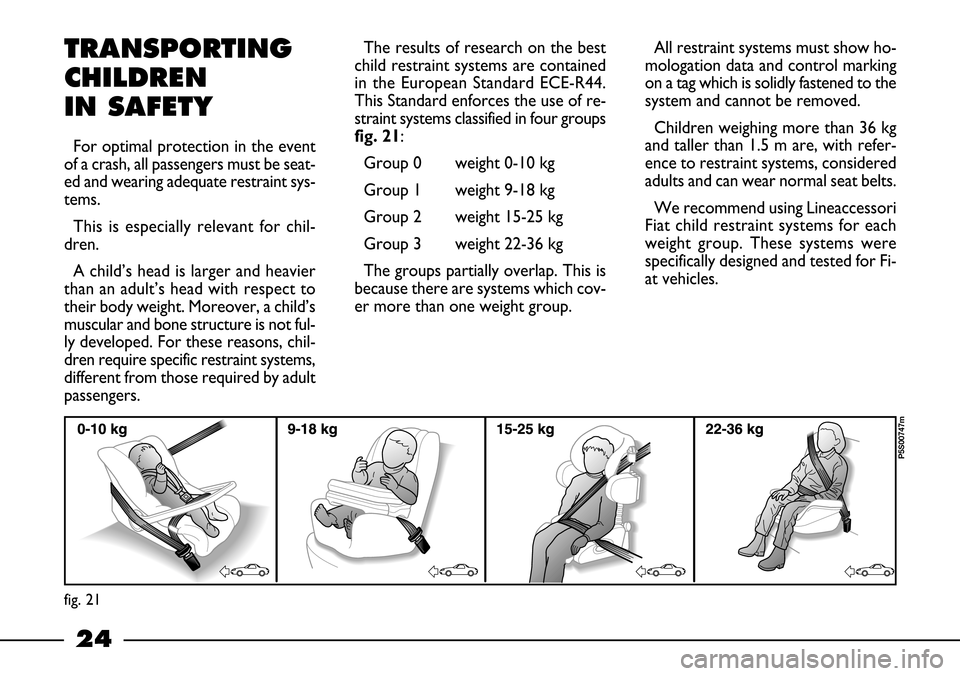
passengers.The results of research on the best
child restraint systems are contained
in the European Standard ECE-R44.
This Standard enforces the use of re-
straint systems classified in four groups
fig. 21:
Group 0 weight 0-10 kg
Group 1 weight 9-18 kg
Group 2 weight 15-25 kg
Group 3 weight 22-36 kg
The groups partially overlap. This is
because there are systems which cov-
er more than one weight group.All restraint systems must show ho-
mologation data and control marking
on a tag which is solidly fastened to the
system and cannot be removed.
Children weighing more than 36 kg
and taller than 1.5 m are, with refer-
ence to restraint systems, considered
adults and can wear normal seat belts.
We recommend using Lineaccessori
Fiat child restraint systems for each
weight group. These systems were
specifically designed and tested for Fi-
at vehicles.
fig. 21
P5S00747m
Page 27 of 170
26
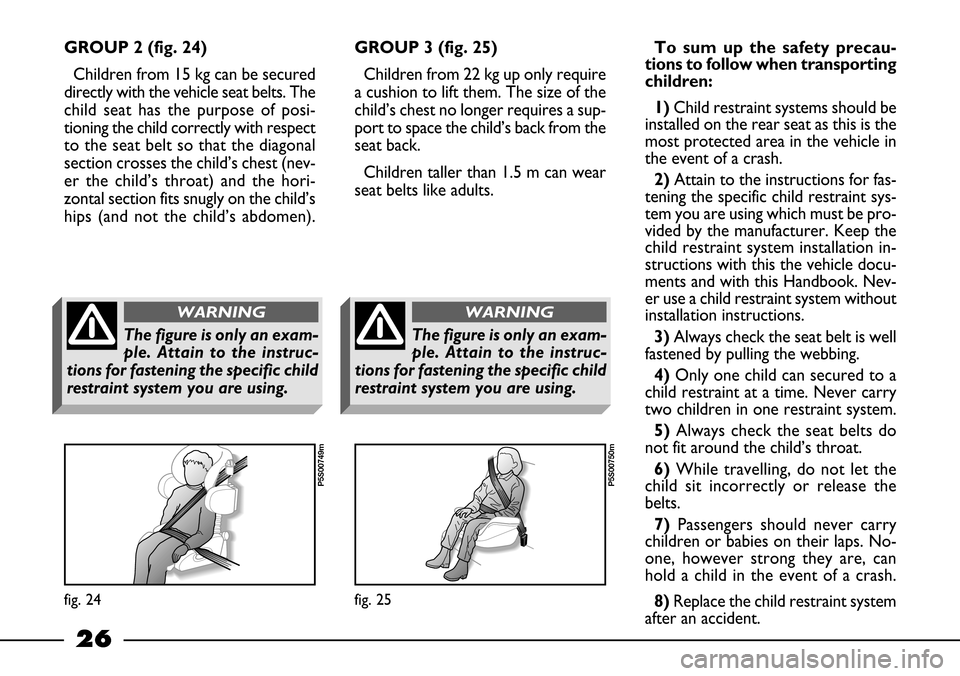
GROUP 2 (fig. 24)
Children from 15 kg can be secured
directly with the vehicle seat belts. The
child seat has the purpose of posi-
tioning the child correctly with respect
to the seat belt so that the diagonal
section crosses the child’s chest (nev-
er the child’s throat) and the hori-
zontal section fits snugly on the child’s
hips (and not the child’s abdomen). GROUP 3 (fig. 25)
Children from 22 kg up only require
a cushion to lift them. The size of the
child’s chest no longer requires a sup-
port to space the child’s back from the
seat back.
Children taller than 1.5 m can wear
seat belts like adults.To sum up the safety precau-
tions to follow when transporting
children:
1) Child restraint systems should be
installed on the rear seat as this is the
most protected area in the vehicle in
the event of a crash.
2) Attain to the instructions for fas-
tening the specific child restraint sys-
tem you are using which must be pro-
vided by the manufacturer. Keep the
child restraint system installation in-
structions with this the vehicle docu-
ments and with this Handbook. Nev-
er use a child restraint system without
installation instructions.
3) Always check the seat belt is well
fastened by pulling the webbing.
4) Only one child can secured to a
child restraint at a time. Never carry
two children in one restraint system.
5) Always check the seat belts do
not fit around the child’s throat.
6) While travelling, do not let the
child sit incorrectly or release the
belts.
7)Passengers should never carry
children or babies on their laps. No-
one, however strong they are, can
hold a child in the event of a crash.
8) Replace the child restraint system
after an accident.
fig. 24
P5S00749m
fig. 25
P5S00750m
The figure is only an exam-
ple. Attain to the instruc-
tions for fastening the specific child
restraint system you are using.
WARNING
The figure is only an exam-
ple. Attain to the instruc-
tions for fastening the specific child
restraint system you are using.
WARNING
Page 59 of 170
58
AIR BAG
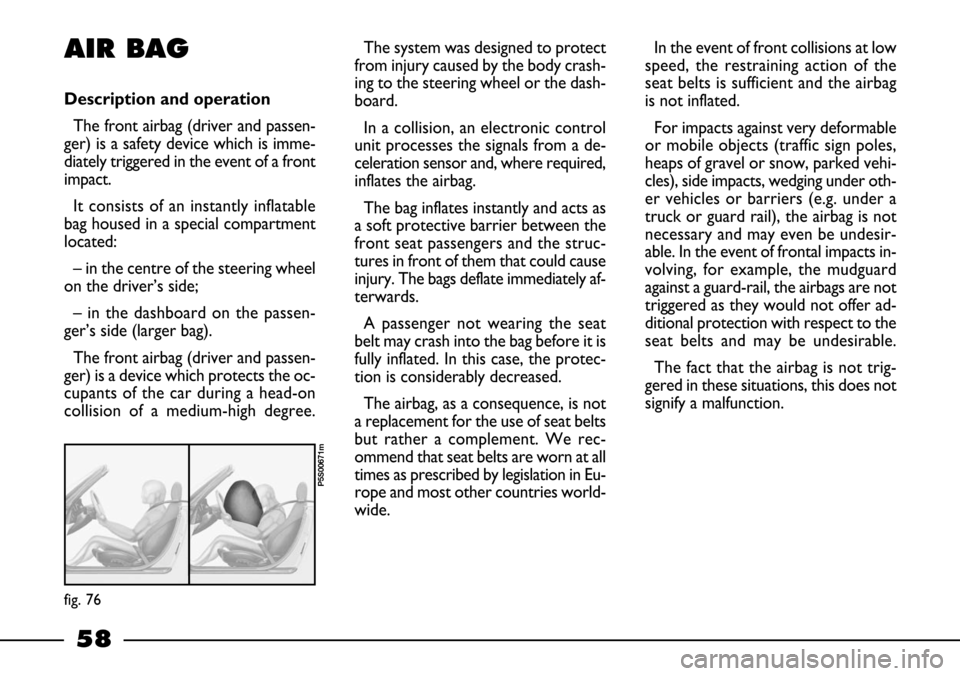
Description and operation
The front airbag (driver and passen-
ger) is a safety device which is imme-
diately triggered in the event of a front
impact.
It consists of an instantly inflatable
bag housed in a special compartment
located:
– in the centre of the steering wheel
on the driver’s side;
– in the dashboard on the passen-
ger’s side (larger bag).
The front airbag (driver and passen-
ger) is a device which protects the oc-
cupants of the car during a head-on
collision of a medium-high degree. The system was designed to protect
from injury caused by the body crash-
ing to the steering wheel or the dash-
board.
In a collision, an electronic control
unit processes the signals from a de-
celeration sensor and, where required,
inflates the airbag.
The bag inflates instantly and acts as
a soft protective barrier between the
front seat passengers and the struc-
tures in front of them that could cause
injury. The bags deflate immediately af-
terwards.
A passenger not wearing the seat
belt may crash into the bag before it is
fully inflated. In this case, the protec-
tion is considerably decreased.
The airbag, as a consequence, is not
a replacement for the use of seat belts
but rather a complement. We rec-
ommend that seat belts are worn at all
times as prescribed by legislation in Eu-
rope and most other countries world-
wide. In the event of front collisions at low
speed, the restraining action of the
seat belts is sufficient and the airbag
is not inflated.
For impacts against very deformable
or mobile objects (traffic sign poles,
heaps of gravel or snow, parked vehi-
cles), side impacts, wedging under oth-
er vehicles or barriers (e.g. under a
truck or guard rail), the airbag is not
necessary and may even be undesir-
able. In the event of frontal impacts in-
volving, for example, the mudguard
against a guard-rail, the airbags are not
triggered as they would not offer ad-
ditional protection with respect to the
seat belts and may be undesirable.
The fact that the airbag is not trig-
gered in these situations, this does not
signify a malfunction.
fig. 76
P5S00671m
Page 67 of 170
66
PROTECTING THE
ENVIRONMENT
Protecting the environment has been
the guiding principle in the design of
the Fiat barchetta right from the start.
The result is the use of materials and
creation of devices that can reduce or
considerable curtail harmful influences
on the environment.
The Fiat barchetta is ready to travel
well ahead of the most stringent in-
ternational pollution control stan-
dards.
USE OF MATERIALS
THAT DO NOT HARM
THE ENVIRONMENT
None of the car’s components con-
tain asbestos. Padding and the climate
control system do not contain CFI’s
(Chlorofluorocarbides) the gases con-
sidered responsible for the destruc-
tion of the ozone layer. Other sub-
stances which may pollute the air and
water tables, such as cadmium used in
bolt anti-rust coverings and the chro-
mate used in some colourings, have
been replaced entirely with environ-
mentally-friendly substances. DEVICES FOR REDUCING
PETROL ENGINE EMISSIONS
Three-way catalytic converter
(catalytic exhaust pipe)
Carbon monoxide, nitrogen oxides
and unburned hydrocarbons are the
main harmful components in exhaust
gases.
The catalytic exhaust pipe and the
devices connected to it are a “minia-
ture laboratory” where a very high
percentage of these components is
converted into harmless substances.
The conversion is aided by minute
particles of precious metals on the ce-
ramic core enclosed in the stainless-
steel container.Lambda Sensor
All petrol versions are fitted with this
device. It ensures that air and fuel are
constantly mixed in the correct pro-
portions. This is a fundamental condi-
tions for the proper functioning of the
engine and the catalytic converter.
Anti-evaporation canister
As it is impossible to stop the build-
up of petrol fumes even when the en-
gine is not running, the system traps
them in a special active carbon canis-
ter. They are sucked in from here and
burnt while the engine is running.
Page 68 of 170
67
DRIVING YOUR CAR
To help you handle your Fiat barchetta in the best
and safest possible way, and above all use it to its
fullest potential, we have given you some hints in this
chapter on “what to do, what not to do and what to
avoid” when at the wheel of your Fiat barchetta.
Most of the time, these suggestions apply to other
cars as well. Sometimes, however, the tip may apply
to an exclusive Fiat barchetta feature. You are there-
fore strongly recommended to pay the closest atten-
tion to this section for helpful hints on optimum dri-
ving practices and usage of the car that will help you
get the most out of your Fiat barchetta. STARTING THE ENGINE ............................................... 68
PARKING ............................................................................ 70
GEAR USE .......................................................................... 71
SAFE DRIVING .................................................................. 71
CONTAINING RUNNING COSTS
AND POLLUTION .......................................................... 76
CHEAP RUNNING THAT RESPECTS
THE ENVIRONMENT ..................................................... 78
TOWING A TRAILER ..................................................... 79
SNOW CHAINS ............................................................... 80
VEHICLE STORAGE ........................................................ 81
REPEATED CHECKS AND CHECKS
BEFORE LONG TRIPS .................................................... 82
ACCESSORIES PURCHASED BY THE OWNER ..... 82
USEFUL ACCESSORIES .................................................. 82
Page 69 of 170
68
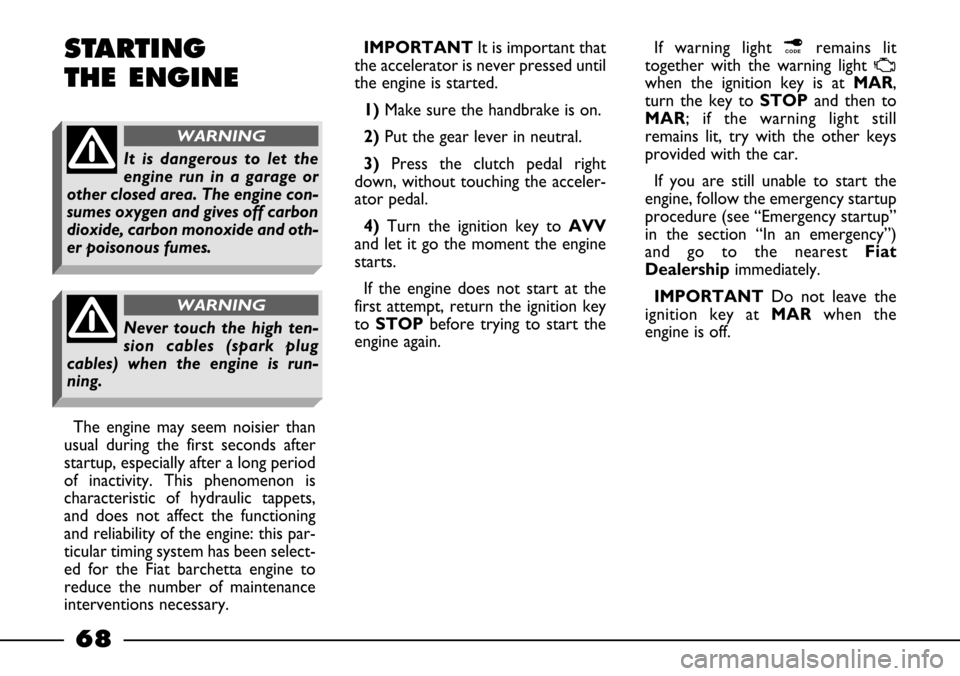
If warning light ¢remains lit
together with the warning light
U
when the ignition key is at MAR,
turn the key toSTOPand then to
MAR; if the warning light still
remains lit, try with the other keys
provided with the car.
If you are still unable to start the
engine, follow the emergency startup
procedure (see “Emergency startup”
in the section “In an emergency”)
and go to the nearestFiat
Dealership immediately.
IMPORTANTDo not leave the
ignition key at MARwhen the
engine is off.
STARTING
THE ENGINE
The engine may seem noisier than
usual during the first seconds after
startup, especially after a long period
of inactivity. This phenomenon is
characteristic of hydraulic tappets,
and does not affect the functioning
and reliability of the engine: this par-
ticular timing system has been select-
ed for the Fiat barchetta engine to
reduce the number of maintenance
interventions necessary.IMPORTANT It is important that
the accelerator is never pressed until
the engine is started.
1) Make sure the handbrake is on.
2) Put the gear lever in neutral.
3) Press the clutch pedal right
down, without touching the acceler-
ator pedal.
4) Turn the ignition key to AVV
and let it go the moment the engine
starts.
If the engine does not start at the
first attempt, return the ignition key
to STOPbefore trying to start the
engine again.
It is dangerous to let the
engine run in a garage or
other closed area. The engine con-
sumes oxygen and gives off carbon
dioxide, carbon monoxide and oth-
er poisonous fumes.
WARNING
Never touch the high ten-
sion cables (spark plug
cables) when the engine is run-
ning.
WARNING
Page 74 of 170
73
– Do not drive too many hours at a
time but stop at intervals to stretch
your legs and recoup your energies.
– Make sure the air in the car is be-
ing changed continuously.
– Never coast down steep slopes
with the engine off: you lose the aid of
engine brake, power brakes and pow-
er steering so that braking and steer-
ing require greater effort.
DRIVING AT NIGHT
If you are driving at night these are
the main rules to follow.
– Drive especially carefully: it is hard-
er to drive at night.
– Slow down especially if the road is
not lit.
– At the first signs of sleepiness, stop:
continuing would be a risk for yourself
and everybody else. Only start driving
again when you have had enough rest.
Driving while drunk or un-
der the influence of drugs
or certain medicines is dangerous
for both you and other road users.
WARNING
Always fasten your seat
belt and ensure your pas-
senger does the same. Travelling
with the seat belts unfastened in-
creases the risk of injury or death
if you are in a collision.
WARNING
Water, ice or salt on road
surfaces can deposit on
brake disks, reducing braking effi-
ciency on the first braking.
WARNING
Pay attention to assembly
of extra spoilers, wheels in
alloy or non standard wheel caps.
These could reduce ventilation of
the brakes and reduce their effi-
ciency under conditions of violent
or repeated braking or long down-
hill travel.
WARNING
Do not travel with objects
on the floor in front of dri-
ver’s seat: when braking they could
block the pedals making accelera-
tion or braking impossible.
WARNING
Pay attention to the mea-
surements of any carpets:
any hindrance, even slight, to the
braking system could result in a
longer than normal pedal run.
WARNING