lock FIAT BARCHETTA 2003 1.G Owner's Manual
[x] Cancel search | Manufacturer: FIAT, Model Year: 2003, Model line: BARCHETTA, Model: FIAT BARCHETTA 2003 1.GPages: 170, PDF Size: 3.55 MB
Page 53 of 170
52
It allows to prolong the “open hood”
season.
FITTING THE WIND STOP
(1
stfitting)
1)Fit the side brackets Aand B
fig. 69in the holes on the internal
sides of the car, on the right and on
the left.
2)Fasten the side brackets Aand B
to the body with the nuts and screws
provided. Insert the screws and the
washers from the outside of the body
side and fasten the brackets from the
inside with the nuts, fig. 69.3)Fit the ends of the wind spot C
and D fig. 70inside the previously fit-
ted brackets. Make sure that the wind
stop cover is facing the rear part of the
car.
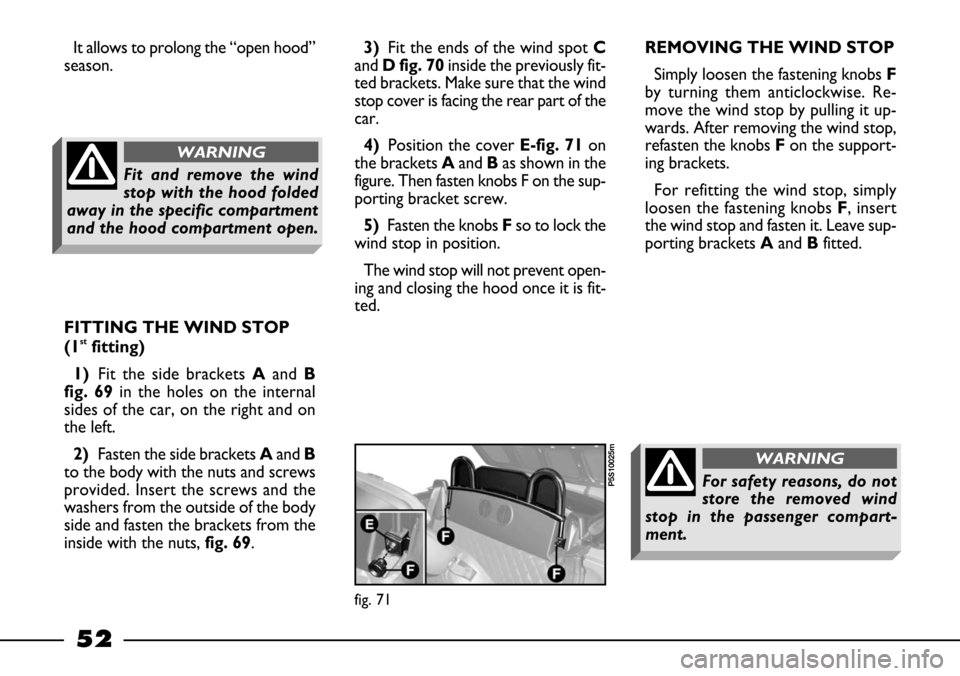
4)Position the coverE-fig. 71on
the brackets Aand Bas shown in the
figure. Then fasten knobs F on the sup-
porting bracket screw.
5)Fasten the knobs Fso to lock the
wind stop in position.
The wind stop will not prevent open-
ing and closing the hood once it is fit-
ted.REMOVING THE WIND STOP
Simply loosen the fastening knobs F
by turning them anticlockwise. Re-
move the wind stop by pulling it up-
wards. After removing the wind stop,
refasten the knobs Fon the support-
ing brackets.
For refitting the wind stop, simply
loosen the fastening knobs F, insert
the wind stop and fasten it. Leave sup-
porting brackets Aand Bfitted.
For safety reasons, do not
store the removed wind
stop in the passenger compart-
ment.
WARNING
fig. 71
P5S10025m
Fit and remove the wind
stop with the hood folded
away in the specific compartment
and the hood compartment open.
WARNING
Page 55 of 170
54
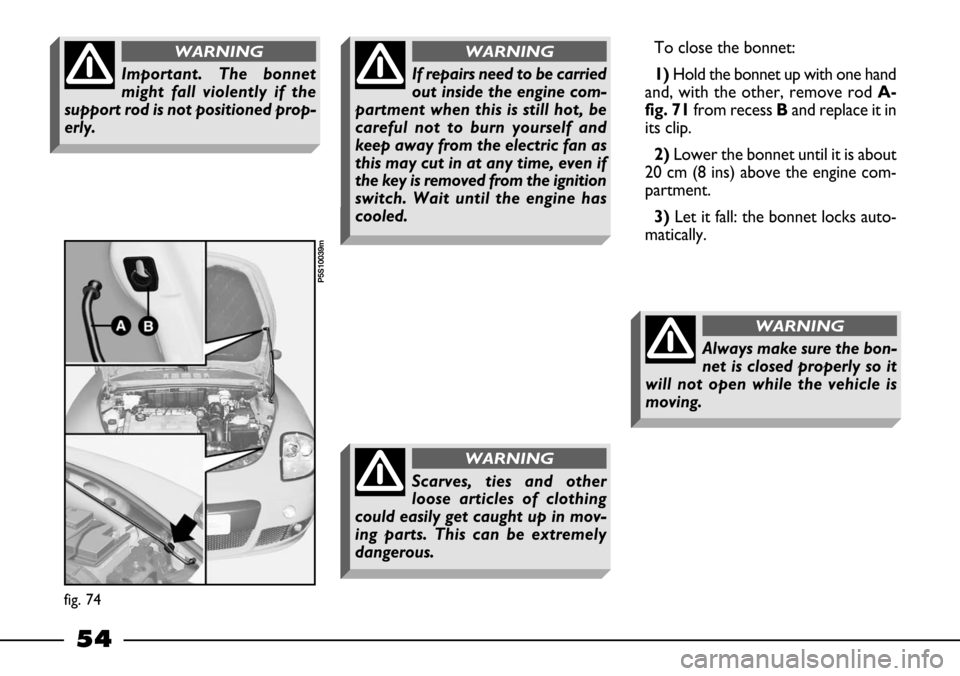
Important. The bonnet
might fall violently if the
support rod is not positioned prop-
erly.
WARNINGTo close the bonnet:
1) Hold the bonnet up with one hand
and, with the other, remove rod A-
fig. 71from recess Band replace it in
its clip.
2)Lower the bonnet until it is about
20 cm (8 ins) above the engine com-
partment.
3)Let it fall: the bonnet locks auto-
matically.
Always make sure the bon-
net is closed properly so it
will not open while the vehicle is
moving.
WARNING
fig. 74
P5S10039m
If repairs need to be carried
out inside the engine com-
partment when this is still hot, be
careful not to burn yourself and
keep away from the electric fan as
this may cut in at any time, even if
the key is removed from the ignition
switch. Wait until the engine has
cooled.
WARNING
Scarves, ties and other
loose articles of clothing
could easily get caught up in mov-
ing parts. This can be extremely
dangerous.
WARNING
Page 56 of 170
55
BOOT
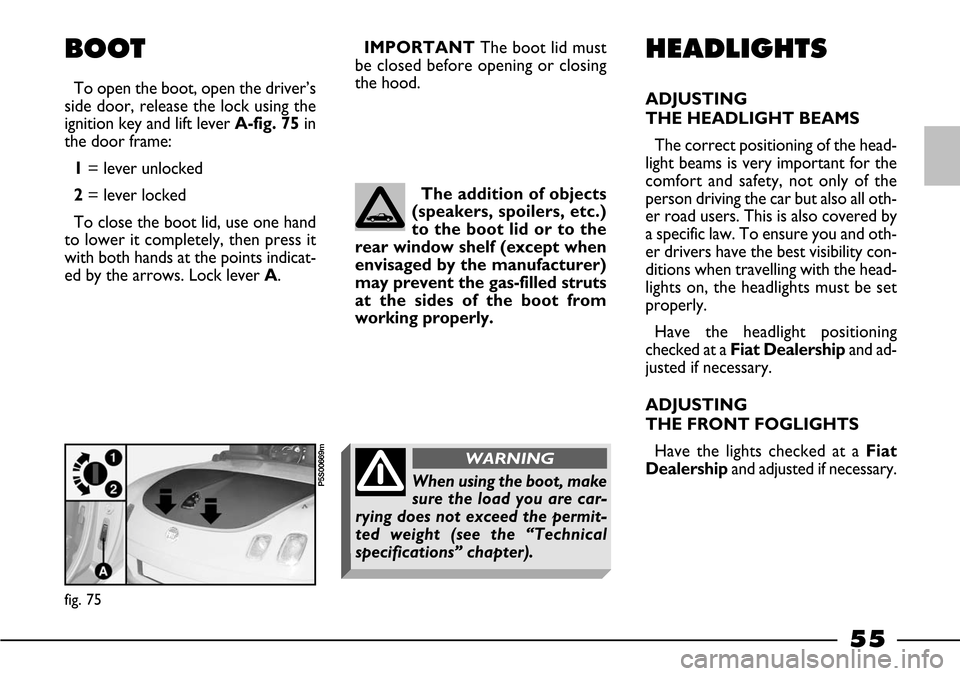
To open the boot, open the driver’s
side door, release the lock using the
ignition key and lift lever A-fig. 75in
the door frame:
1= lever unlocked
2= lever locked
To close the boot lid, use one hand
to lower it completely, then press it
with both hands at the points indicat-
ed by the arrows. Lock lever A.IMPORTANTThe boot lid must
be closed before opening or closing
the hood.
HEADLIGHTS
ADJUSTING
THE HEADLIGHT BEAMS
The correct positioning of the head-
light beams is very important for the
comfort and safety, not only of the
person driving the car but also all oth-
er road users. This is also covered by
a specific law. To ensure you and oth-
er drivers have the best visibility con-
ditions when travelling with the head-
lights on, the headlights must be set
properly.
Have the headlight positioning
checked at a Fiat Dealershipand ad-
justed if necessary.
ADJUSTING
THE FRONT FOGLIGHTS
Have the lights checked at a Fiat
Dealershipand adjusted if necessary. The addition of objects
(speakers, spoilers, etc.)
to the boot lid or to the
rear window shelf (except when
envisaged by the manufacturer)
may prevent the gas-filled struts
at the sides of the boot from
working properly.
fig. 75
P5S00669mWhen using the boot, make
sure the load you are car-
rying does not exceed the permit-
ted weight (see the “Technical
specifications” chapter).
WARNING
Page 57 of 170
56
ABS
(where fitted)
The vehicle is fitted with an ABS
braking system, which prevents the
wheels from locking when braking,
makes the most of road grip and gives
the best control when emergency
braking under difficult road conditions.
The driver can tell the ABS system
has come into play when he feels the
brake pedal pulsating slightly and the
system gets noisier.
This should not be interpreted as a
fault in the brakes; on the contrary it
is a sign that the ABS system is work-
ing: it tells the driver that the vehicle
is travelling at the limit of its road grip
and that he should alter his speed to
fit the type of road surface.
The ABS system is an addition to the
basic braking system. If there is a mal-
function, the system turns off auto-
matically and only the ordinary brakes
continue to work.If a failure occurs, and consequently
the anti-lock function is not effective,
the braking system will continue to
work as usual.
If you have never driven a vehicle
with ABS before, you should practice
using the system on slippery terrain,
obviously with the necessary safety
precautions and keeping to the High-
way Code of the country you are in.
It is also a good idea to read the fol-
lowing information carefully.
The advantage in using the ABS sys-
tem is that it continues to give you
maximum manoeuvrability even when
braking hard in conditions of poor grip
by preventing the wheels locking.
You should, however, not expect the
braking distance to always decrease:
for example surfaces with gravel or
fresh snow on a slippery road will in
fact increase the braking distance.To exploit the ABS system to the full
in the event of necessity, you should
take heed of the following advice:
The ABS exploits the tyre-
road grip available to the
full, but it cannot improve it; you
should therefore take every care
when driving on slippery surfaces,
and not take unnecessary risks.
WARNING
If the ABS system cuts in it
is a sign that the grip be-
tween the tyre and the road surface
has reached the limit: you must
slow down to match the speed to
the road grip available.
WARNING
Page 58 of 170
57
Braking while cornering always re-
quires extreme care even when using
ABS.
The most important advice to follow
is the following:If you follow these tips you will be
able to brake better in any situation.
IMPORTANTVehicles fitted with
ABS may only be fitted with wheel
rims, tyres and brake pads of the make
and model approved by the vehicle
manufacturer.
An Electronic Brake Distributor
EBD integrates the ABSsystem and
uses the control unit and sensors of
theABSsystem to increase perfor-
mance of the brake system.
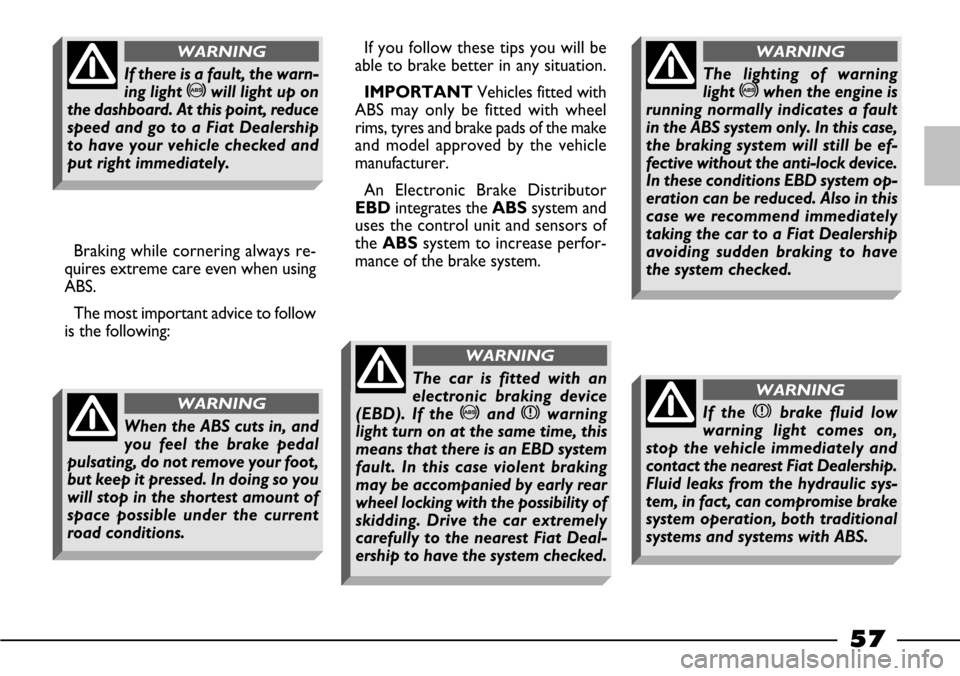
If there is a fault, the warn-
ing light >will light up on
the dashboard. At this point, reduce
speed and go to a Fiat Dealership
to have your vehicle checked and
put right immediately.
WARNING
When the ABS cuts in, and
you feel the brake pedal
pulsating, do not remove your foot,
but keep it pressed. In doing so you
will stop in the shortest amount of
space possible under the current
road conditions.
WARNING
The car is fitted with an
electronic braking device
(EBD). If the >and xwarning
light turn on at the same time, this
means that there is an EBD system
fault. In this case violent braking
may be accompanied by early rear
wheel locking with the possibility of
skidding. Drive the car extremely
carefully to the nearest Fiat Deal-
ership to have the system checked.
WARNING
The lighting of warning
light >when the engine is
running normally indicates a fault
in the ABS system only. In this case,
the braking system will still be ef-
fective without the anti-lock device.
In these conditions EBD system op-
eration can be reduced. Also in this
case we recommend immediately
taking the car to a Fiat Dealership
avoiding sudden braking to have
the system checked.
WARNING
If the xbrake fluid low
warning light comes on,
stop the vehicle immediately and
contact the nearest Fiat Dealership.
Fluid leaks from the hydraulic sys-
tem, in fact, can compromise brake
system operation, both traditional
systems and systems with ABS.
WARNING
Page 66 of 170
65
A catalytic converter
that does not work prop-
erly leads to the emission
of harmful gases and the conse-
quent pollution of the atmos-
phere.
Never put even the tini-
est amount of leaded
petrol into the fuel tank,
even in an emergency. You would
damage the catalytic converter
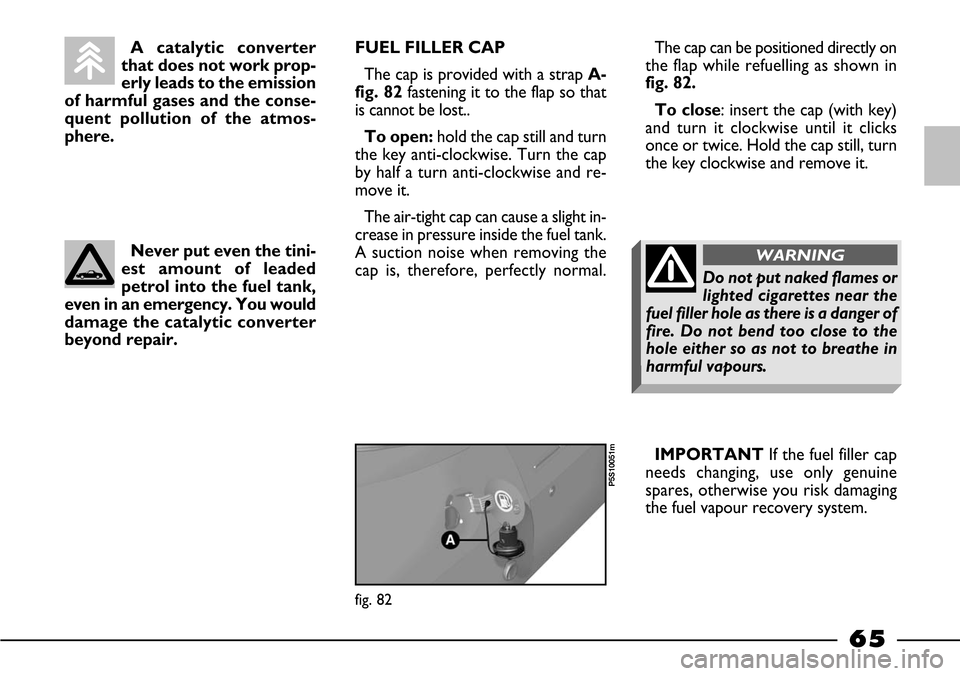
beyond repair.FUEL FILLER CAP
The cap is provided with a strap A-
fig. 82fastening it to the flap so that
is cannot be lost..
To open:hold the cap still and turn
the key anti-clockwise. Turn the cap
by half a turn anti-clockwise and re-
move it.
The air-tight cap can cause a slight in-
crease in pressure inside the fuel tank.
A suction noise when removing the
cap is, therefore, perfectly normal.The cap can be positioned directly on
the flap while refuelling as shown in
fig. 82.
To close: insert the cap (with key)
and turn it clockwise until it clicks
once or twice. Hold the cap still, turn
the key clockwise and remove it.
IMPORTANT If the fuel filler cap
needs changing, use only genuine
spares, otherwise you risk damaging
the fuel vapour recovery system.
fig. 82
P5S10051m
Do not put naked flames or
lighted cigarettes near the
fuel filler hole as there is a danger of
fire. Do not bend too close to the
hole either so as not to breathe in
harmful vapours.
WARNING
Page 71 of 170
70
PARKING
Turn off the engine, pull up the hand-
brake, put the car in gear (1st if the car
is pointing uphill, reverse if downhill)
and turn the wheels. If the car is on a
steep incline, you should put a stone
or wedge under the wheels to block
them.
Do not leave the ignition key at
MAR because it drains the battery.
Always remove the key when you
leave the car.IMPORTANTIf this is not the
case, have the handbrake adjusted at
a Fiat Dealership.
When the hand brake is on and the
ignition key is at MAR, panel indica-
tor light xcomes on.
To release the handbrake:
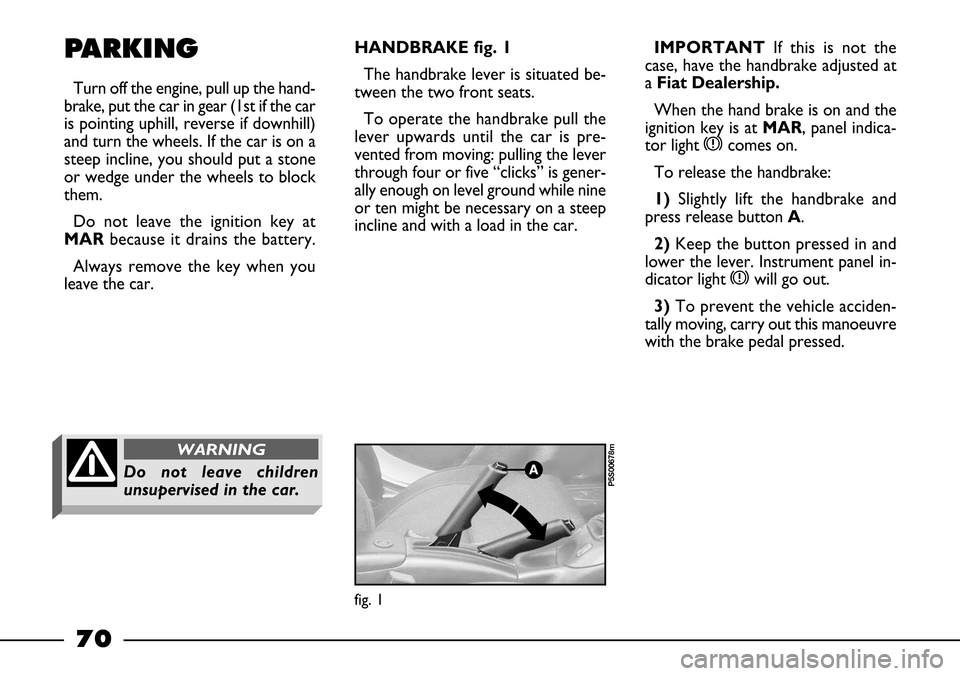
1) Slightly lift the handbrake and
press release button A.
2) Keep the button pressed in and
lower the lever. Instrument panel in-
dicator light xwill go out.
3) To prevent the vehicle acciden-
tally moving, carry out this manoeuvre
with the brake pedal pressed. HANDBRAKE fig. 1
The handbrake lever is situated be-
tween the two front seats.
To operate the handbrake pull the
lever upwards until the car is pre-
vented from moving: pulling the lever
through four or five “clicks” is gener-
ally enough on level ground while nine
or ten might be necessary on a steep
incline and with a load in the car.
fig. 1
P5S00678mDo not leave children
unsupervised in the car.
WARNING
Page 74 of 170
73
– Do not drive too many hours at a
time but stop at intervals to stretch
your legs and recoup your energies.
– Make sure the air in the car is be-
ing changed continuously.
– Never coast down steep slopes
with the engine off: you lose the aid of
engine brake, power brakes and pow-
er steering so that braking and steer-
ing require greater effort.
DRIVING AT NIGHT
If you are driving at night these are
the main rules to follow.
– Drive especially carefully: it is hard-
er to drive at night.
– Slow down especially if the road is
not lit.
– At the first signs of sleepiness, stop:
continuing would be a risk for yourself
and everybody else. Only start driving
again when you have had enough rest.
Driving while drunk or un-
der the influence of drugs
or certain medicines is dangerous
for both you and other road users.
WARNING
Always fasten your seat
belt and ensure your pas-
senger does the same. Travelling
with the seat belts unfastened in-
creases the risk of injury or death
if you are in a collision.
WARNING
Water, ice or salt on road
surfaces can deposit on
brake disks, reducing braking effi-
ciency on the first braking.
WARNING
Pay attention to assembly
of extra spoilers, wheels in
alloy or non standard wheel caps.
These could reduce ventilation of
the brakes and reduce their effi-
ciency under conditions of violent
or repeated braking or long down-
hill travel.
WARNING
Do not travel with objects
on the floor in front of dri-
ver’s seat: when braking they could
block the pedals making accelera-
tion or braking impossible.
WARNING
Pay attention to the mea-
surements of any carpets:
any hindrance, even slight, to the
braking system could result in a
longer than normal pedal run.
WARNING
Page 76 of 170
75
– Remember that fog also means the
tarmac is wet and therefore manoeu-
vres of all kinds are more difficult and
stopping distances are longer.
– Keep a good distance from the cars
in front of you.
– As far as possible, avoid spurts of
speed or sudden deceleration.
– Do not overtake other vehicles if
you can help it.
– If you are forced to stop your car
(breakdown, limited visibility etc.) try
to stop off the road. Then turn on the
hazard lights and, if possible, the
dipped headlights. Rhythmically sound
the horn if you realise another car is
coming.
DRIVING
IN THE MOUNTAINS
– When driving downhill, use the en-
gine brake by engaging a low gear so
as not to overheat the brakes.
– Under no circumstances should
you drive downhill with the engine off
or with the car in neutral, let alone
with the ignition key out.– Drive at a moderate speed without
cutting corners.
– Remember that overtaking while
going uphill is slower and therefore re-
quires more free road. If you are be-
ing overtaken while driving uphill,
make it easier for the other vehicle
to pass.
DRIVING ON SNOW OR ICE
Here are some tips for driving in
these conditions:
– Keep your speed down.
– Use chains if the roads are covered
in snow (refer to the “Snow chains”
paragraph in this section).
– Mainly use the engine brake and
under all circumstances avoid braking
sharply.
– When braking in a car not fitted
with ABS, avoid the wheels locking by
varying the pressure you exert on the
brake pedal.
– Do not accelerate suddenly and
avoid swerving.– In the winter, even apparently dry
roads may have icy patches. Be care-
ful therefore when driving over
stretches that do not get much expo-
sure to the sun or that are lined by
trees and rocks where ice might not
have melted.
– Keep a good distance from the ve-
hicles in front.
– Do not remain for long periods in
deep snow with the engine running as
the snow could force the exhaust gas-
es into the passenger compartment.
DRIVING WITH ABS
ABS is a braking system that essen-
tially offers two advantages:
1)It prevents wheel lock-up and
consequent skidding in emergency
stops, particularly when the road does
not offer much grip.
2)It makes it possible to brake and
steer at the same time so you can
avoid unexpected obstacles and direct
the car where you want while braking.
The extent to which this can be done
will depend on the physical limits of
the tyre's sideways grip.
Page 77 of 170
76
Here are some suggestions which
may help you to keep the running
costs of your vehicle down and low-
er the amount of toxic emissions re-
leased into the atmosphere.
GENERAL
CONSIDERATIONS
Car maintenance
The overall state of the car is an im-
portant factor which has a marked in-
fluence over fuel consumption and dri-
ving comfort and on the life span of
your car. For this reason care should
be taken to maintain your car by car-
rying out the necessary checks and
regulations in accordance with the
specifications given in the Scheduled
Maintenance Programme (see sec-
tions... spark plugs, idle, air filter, tim-
ing).
CONTAINING RUNNING COSTS
AND POLLUTION
Tyres
Tyres should be checked at least
every four weeks: if the pressure is
too low fuel consumption increases as
the resistance to the rolling movement
of the tyre is greater. In this state, tyre
wear is increased and car handling suf-
fers which will affect safety.
Unnecessary loads
Do not travel with too much luggage
stowed in the boot. The weight of the
vehicle (especially when driving in
town) and its trim greatly affects con-
sumption and stability. To get the most out of ABS:
– During emergency stops or when
grip conditions are poor, you will feel
a slight pulsation on the brake pedal.
This is the sign that the ABS is in ac-
tion. Do not release the brake pedal
but continue to press so as not to in-
terrupt the braking action.
– ABS prevents the wheels from
locking but it does not increase actu-
al grip conditions between tyre and
road. Therefore, even if your car is fit-
ted with ABS, respect the safety dis-
tance from the car in front of you and
keep your speed down when driving
into bends.
– ABS serves to increase the con-
trollability of the car, not to enable you
to go faster.