lock FIAT BARCHETTA 2003 1.G User Guide
[x] Cancel search | Manufacturer: FIAT, Model Year: 2003, Model line: BARCHETTA, Model: FIAT BARCHETTA 2003 1.GPages: 170, PDF Size: 3.55 MB
Page 30 of 170
29
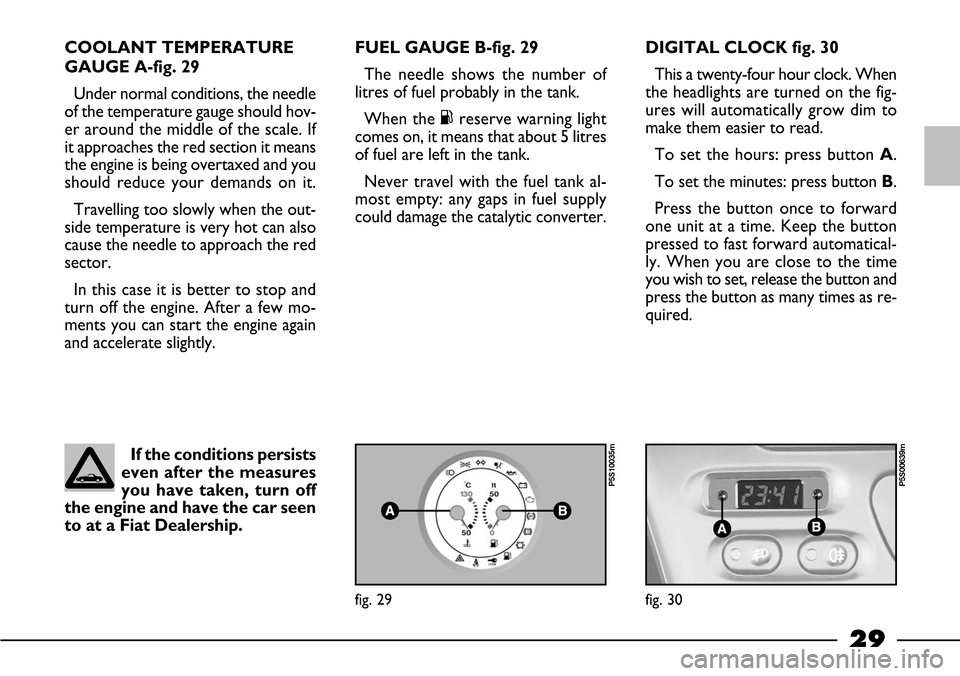
COOLANT TEMPERATURE
GAUGE A-fig. 29
Under normal conditions, the needle
of the temperature gauge should hov-
er around the middle of the scale. If
it approaches the red section it means
the engine is being overtaxed and you
should reduce your demands on it.
Travelling too slowly when the out-
side temperature is very hot can also
cause the needle to approach the red
sector.
In this case it is better to stop and
turn off the engine. After a few mo-
ments you can start the engine again
and accelerate slightly.FUEL GAUGE B-fig. 29
The needle shows the number of
litres of fuel probably in the tank.
When the Kreserve warning light
comes on, it means that about 5 litres
of fuel are left in the tank.
Never travel with the fuel tank al-
most empty: any gaps in fuel supply
could damage the catalytic converter.DIGITAL CLOCK fig. 30
This a twenty-four hour clock. When
the headlights are turned on the fig-
ures will automatically grow dim to
make them easier to read.
To set the hours: press button A.
To set the minutes: press button B.
Press the button once to forward
one unit at a time. Keep the button
pressed to fast forward automatical-
ly. When you are close to the time
you wish to set, release the button and
press the button as many times as re-
quired.
If the conditions persists
even after the measures
you have taken, turn off
the engine and have the car seen
to at a Fiat Dealership.
fig. 29
P5S10035m
fig. 30
P5S00639m
Page 32 of 170
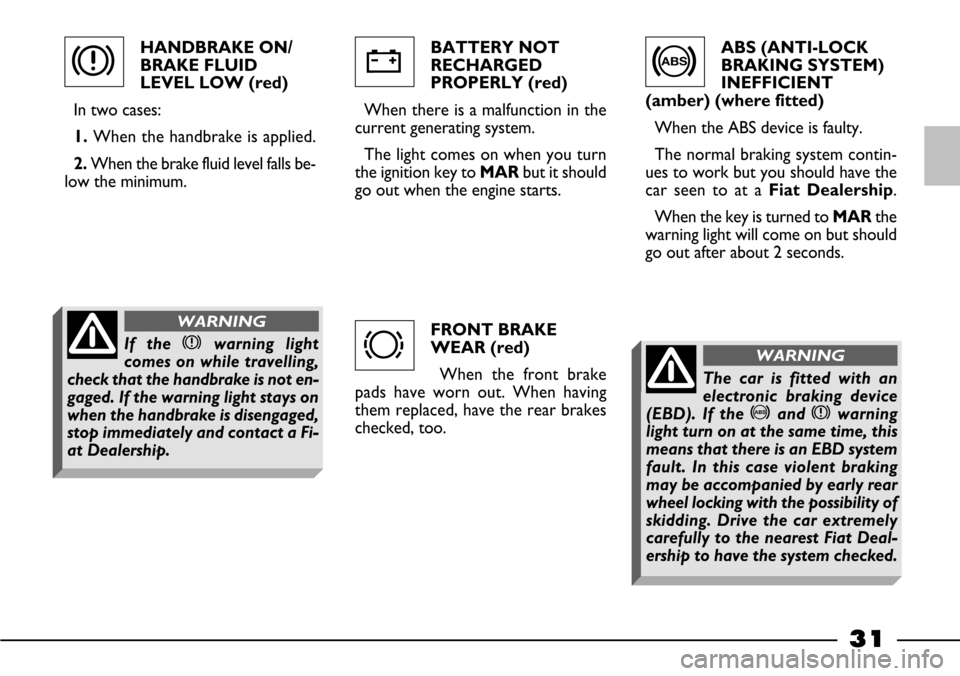
ABS (ANTI-LOCK
BRAKING SYSTEM)
INEFFICIENT
(amber) (where fitted)
When the ABS device is faulty.
The normal braking system contin-
ues to work but you should have the
car seen to at a Fiat Dealership.
When the key is turned toMARthe
warning light will come on but should
go out after about 2 seconds. HANDBRAKE ON/
BRAKE FLUID
LEVEL LOW (red)
In two cases:
1. When the handbrake is applied.
2. When the brake fluid level falls be-
low the minimum.BATTERY NOT
RECHARGED
PROPERLY (red)
When there is a malfunction in the
current generating system.
The light comes on when you turn
the ignition key to MARbut it should
go out when the engine starts.
FRONT BRAKE
WEAR (red)
When the front brake
pads have worn out. When having
them replaced, have the rear brakes
checked, too.
31
w>
d
x
If the xwarning light
comes on while travelling,
check that the handbrake is not en-
gaged. If the warning light stays on
when the handbrake is disengaged,
stop immediately and contact a Fi-
at Dealership.
WARNING
The car is fitted with an
electronic braking device
(EBD). If the >and xwarning
light turn on at the same time, this
means that there is an EBD system
fault. In this case violent braking
may be accompanied by early rear
wheel locking with the possibility of
skidding. Drive the car extremely
carefully to the nearest Fiat Deal-
ership to have the system checked.
WARNING
Page 33 of 170
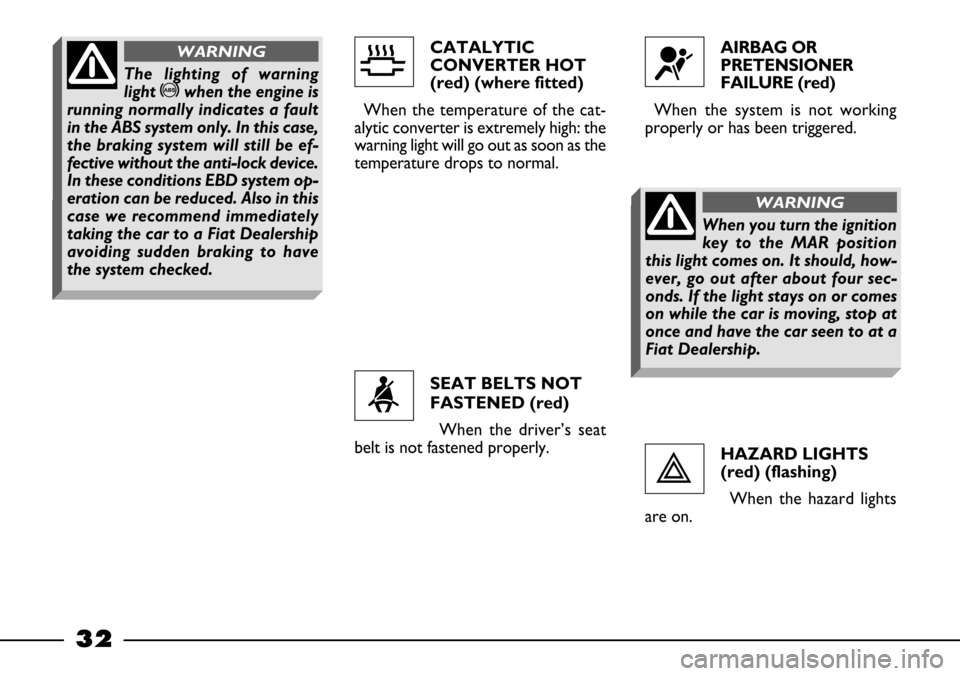
HAZARD LIGHTS
(red) (flashing)
When the hazard lights
are on.AIRBAG OR
PRETENSIONER
FAILURE (red)
When the system is not working
properly or has been triggered.
SEAT BELTS NOT
FASTENED (red)
When the driver’s seat
belt is not fastened properly. CATALYTIC
CONVERTER HOT
(red) (where fitted)
When the temperature of the cat-
alytic converter is extremely high: the
warning light will go out as soon as the
temperature drops to normal.
32
<
f¬
r
When you turn the ignition
key to the MAR position
this light comes on. It should, how-
ever, go out after about four sec-
onds. If the light stays on or comes
on while the car is moving, stop at
once and have the car seen to at a
Fiat Dealership.
WARNING
The lighting of warning
light >when the engine is
running normally indicates a fault
in the ABS system only. In this case,
the braking system will still be ef-
fective without the anti-lock device.
In these conditions EBD system op-
eration can be reduced. Also in this
case we recommend immediately
taking the car to a Fiat Dealership
avoiding sudden braking to have
the system checked.
WARNING
Page 42 of 170
41
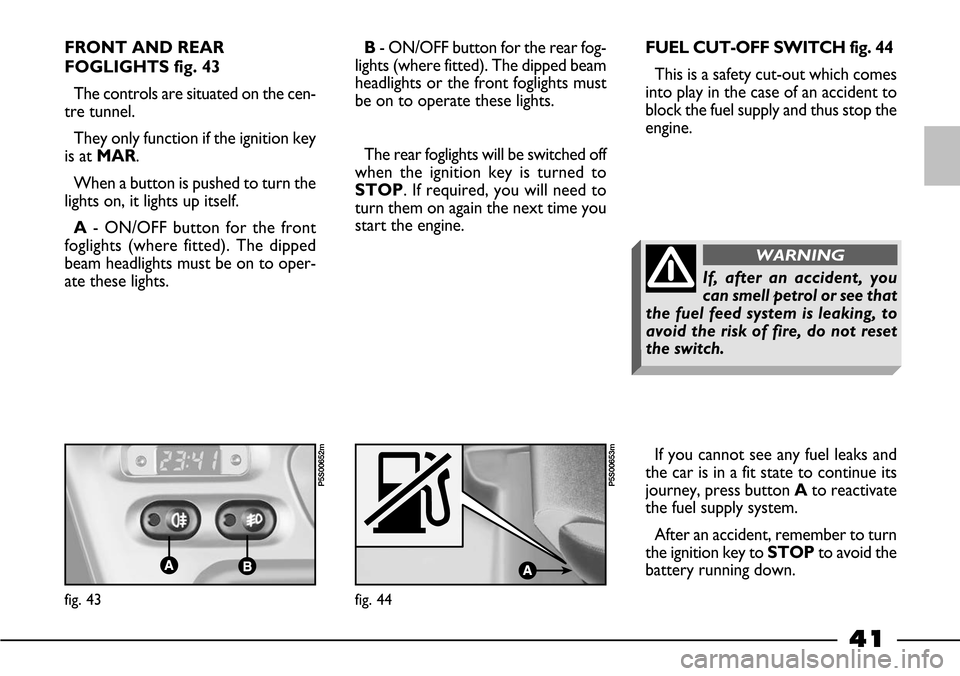
FRONT AND REAR
FOGLIGHTS fig. 43
The controls are situated on the cen-
tre tunnel.
They only function if the ignition key
is at MAR.
When a button is pushed to turn the
lights on, it lights up itself.
A- ON/OFF button for the front
foglights (where fitted). The dipped
beam headlights must be on to oper-
ate these lights.B- ON/OFF button for the rear fog-
lights (where fitted). The dipped beam
headlights or the front foglights must
be on to operate these lights.
The rear foglights will be switched off
when the ignition key is turned to
STOP. If required, you will need to
turn them on again the next time you
start the engine.FUEL CUT-OFF SWITCH fig. 44
This is a safety cut-out which comes
into play in the case of an accident to
block the fuel supply and thus stop the
engine.
If you cannot see any fuel leaks and
the car is in a fit state to continue its
journey, press button Ato reactivate
the fuel supply system.
After an accident, remember to turn
the ignition key toSTOPto avoid the
battery running down.
fig. 44
P5S00653m
fig. 43
P5S00652m
If, after an accident, you
can smell petrol or see that
the fuel feed system is leaking, to
avoid the risk of fire, do not reset
the switch.
WARNING
Page 43 of 170
42
INTERIOR
EQUIPMENT
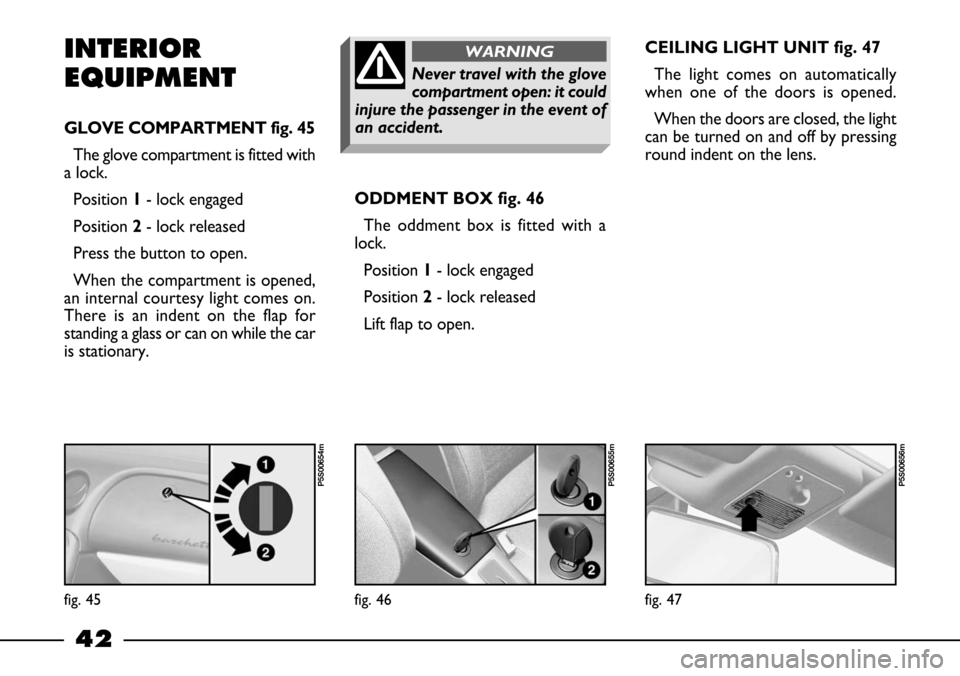
GLOVE COMPARTMENT fig. 45
The glove compartment is fitted with
a lock.
Position1- lock engaged
Position2- lock released
Press the button to open.
When the compartment is opened,
an internal courtesy light comes on.
There is an indent on the flap for
standing a glass or can on while the car
is stationary.ODDMENT BOX fig. 46
The oddment box is fitted with a
lock.
Position 1- lock engaged
Position 2- lock released
Lift flap to open. CEILING LIGHT UNIT fig. 47
The light comes on automatically
when one of the doors is opened.
When the doors are closed, the light
can be turned on and off by pressing
round indent on the lens.
fig. 45
P5S00654m
fig. 46
P5S00655m
fig. 47
P5S00656m
Never travel with the glove
compartment open: it could
injure the passenger in the event of
an accident.
WARNING
Page 45 of 170
44
DOORSClosing by hand
from the outside
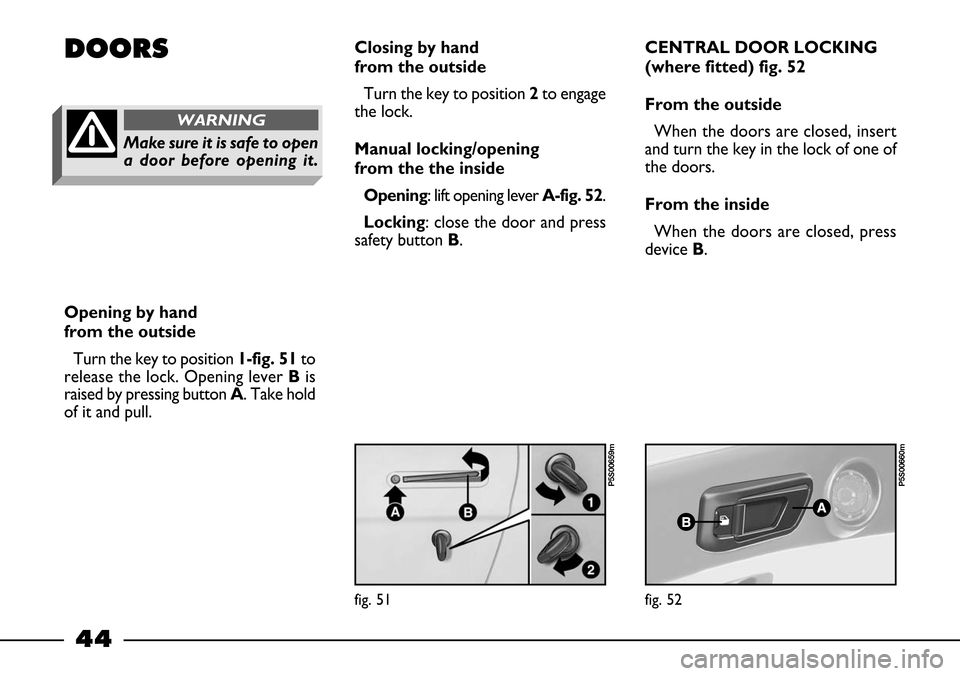
Turn the key to position 2to engage
the lock.
Manual locking/opening
from the the inside
Opening: lift opening lever A-fig. 52.
Locking: close the door and press
safety button B.CENTRAL DOOR LOCKING
(where fitted) fig. 52
From the outside
When the doors are closed, insert
and turn the key in the lock of one of
the doors.
From the inside
When the doors are closed, press
device B.
Opening by hand
from the outside
Turn the key to position 1-fig. 51to
release the lock. Opening lever Bis
raised by pressing button A. Take hold
of it and pull.
fig. 51
P5S00659m
fig. 52
P5S00660m
Make sure it is safe to open
a door before opening it.
WARNING
Page 46 of 170
45
IMPORTANT If one of the doors
is not shut properly or there is a fail-
ure in the system, the central locking
feature will not work and, after some
attempts, the device stops working for
around two minutes. In these two
minutes the doors can be locked or
unlocked manually without the elec-
trical system coming into play. After
the two minutes the control unit is
ready to receive commands once
more.
If the reason for the malfunction has
been removed, the device will start to
work properly again. If not it will cut
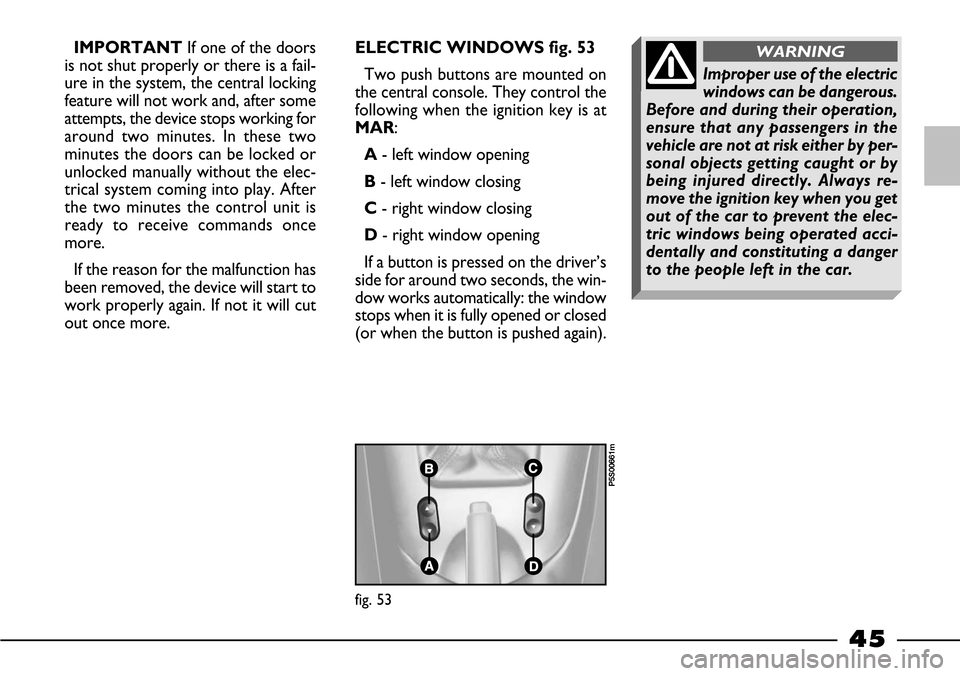
out once more.ELECTRIC WINDOWS fig. 53
Two push buttons are mounted on
the central console. They control the
following when the ignition key is at
MAR:
A- left window opening
B- left window closing
C- right window closing
D- right window opening
If a button is pressed on the driver’s
side for around two seconds, the win-
dow works automatically: the window
stops when it is fully opened or closed
(or when the button is pushed again).
fig. 53
P5S00661m
Improper use of the electric
windows can be dangerous.
Before and during their operation,
ensure that any passengers in the
vehicle are not at risk either by per-
sonal objects getting caught or by
being injured directly. Always re-
move the ignition key when you get
out of the car to prevent the elec-
tric windows being operated acci-
dentally and constituting a danger
to the people left in the car.
WARNING
Page 48 of 170
47
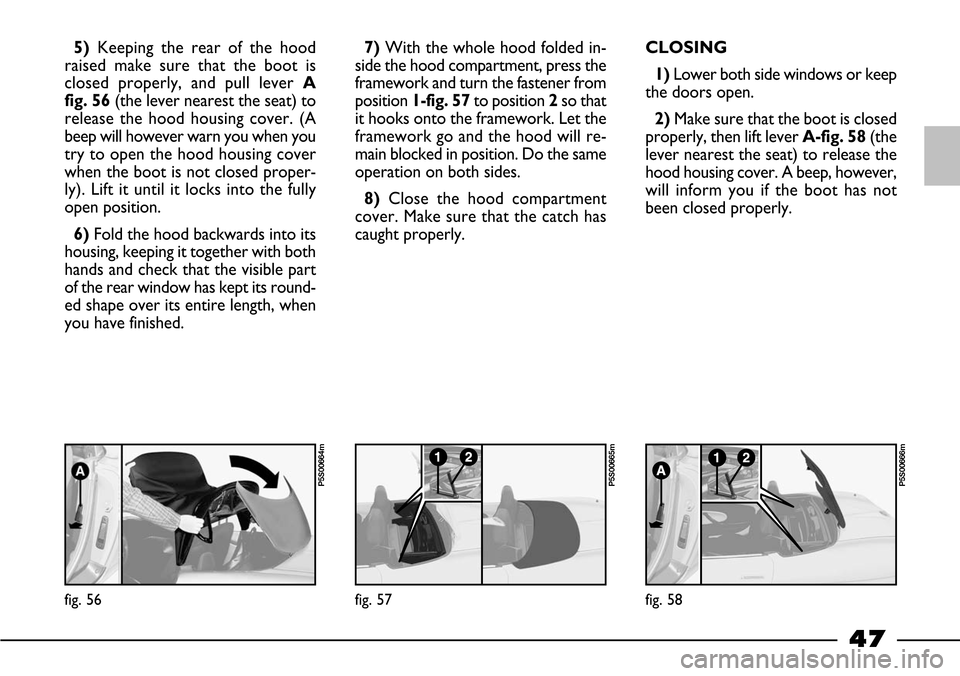
5)Keeping the rear of the hood
raised make sure that the boot is
closed properly, and pull lever A
fig. 56(the lever nearest the seat) to
release the hood housing cover. (A
beep will however warn you when you
try to open the hood housing cover
when the boot is not closed proper-
ly). Lift it until it locks into the fully
open position.
6) Fold the hood backwards into its
housing, keeping it together with both
hands and check that the visible part
of the rear window has kept its round-
ed shape over its entire length, when
you have finished.7) With the whole hood folded in-
side the hood compartment, press the
framework and turn the fastener from
position 1-fig. 57to position 2so that
it hooks onto the framework. Let the
framework go and the hood will re-
main blocked in position. Do the same
operation on both sides.
8)Close the hood compartment
cover. Make sure that the catch has
caught properly.CLOSING
1) Lower both side windows or keep
the doors open.
2)Make sure that the boot is closed
properly, then lift lever A-fig. 58(the
lever nearest the seat) to release the
hood housing cover. A beep, however,
will inform you if the boot has not
been closed properly.
fig. 56
P5S00664m
fig. 57
P5S00665m
fig. 58
P5S00666m
Page 49 of 170

48
3) Lift the hood housing cover until
it locks into the completely open po-
sition.
4)Turn the hood fastener from po-
sition2-fig. 58to position 1so that it
rests in the appropriate recess. Do the
same operation on both sides. Work-
ing from outside the car, lift hood with
one hand until you can grip the rear
part of the hood with the other hand.
Keep the hood folded, and pull it right
to the front of the car so you can close
the hood compartment cover, fig. 59.
Make sure the catch on the cover has
caught properly.5) Rest the rear of the hood on the
hood compartment cover fig. 60.
6)Rest the front part of the hood on
the windscreen transom.7) From the inside of the car, swing
the sun visors down, keep the hood
lowered with one hand using the re-
cess for the purpose fig. 61and, with
the other hand, lock it onto the wind-
screen transom by turning the handles.
8)Lift the sun visors.
fig. 60
P5S00667m
fig. 59
P5S00729m
fig. 61
P5S00668m
Page 51 of 170
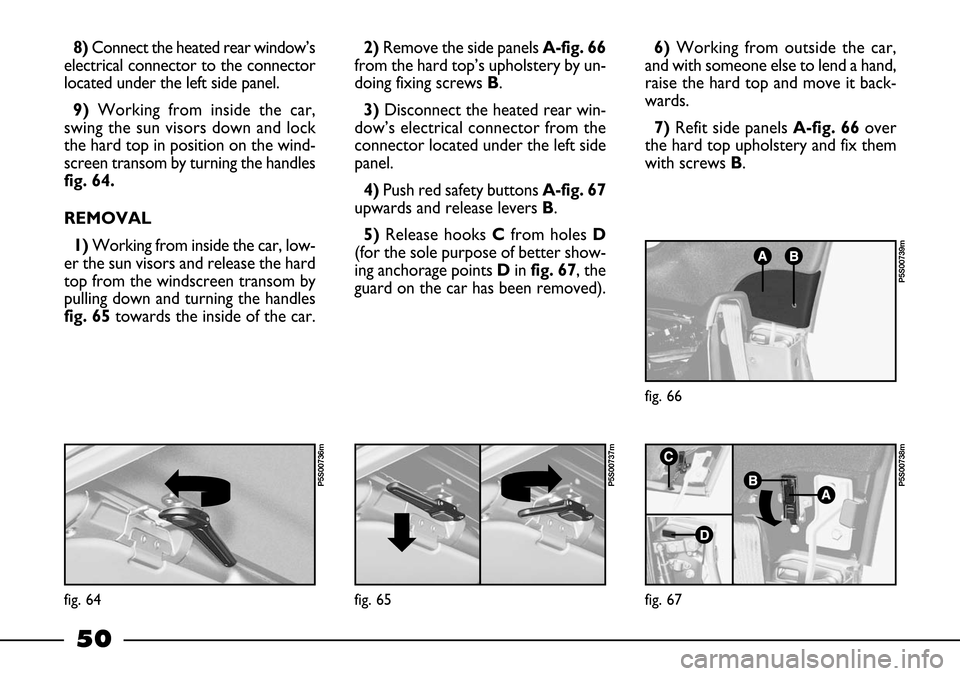
50
8) Connect the heated rear window’s
electrical connector to the connector
located under the left side panel.
9) Working from inside the car,
swing the sun visors down and lock
the hard top in position on the wind-
screen transom by turning the handles
fig. 64.
REMOVAL
1)Working from inside the car, low-
er the sun visors and release the hard
top from the windscreen transom by
pulling down and turning the handles
fig. 65towards the inside of the car.2)Remove the side panels A-fig. 66
from the hard top’s upholstery by un-
doing fixing screws B.
3) Disconnect the heated rear win-
dow’s electrical connector from the
connector located under the left side
panel.
4) Push red safety buttons A-fig. 67
upwards and release levers B.
5)Release hooks Cfrom holes D
(for the sole purpose of better show-
ing anchorage points Din fig. 67, the
guard on the car has been removed).6) Working from outside the car,
and with someone else to lend a hand,
raise the hard top and move it back-
wards.
7) Refit side panels A-fig. 66over
the hard top upholstery and fix them
with screws B.
fig. 64
P5S00736m
fig. 65
P5S00737m
fig. 67
P5S00738m
fig. 66
P5S00739m