warning light FIAT BARCHETTA 2003 1.G Owner's Manual
[x] Cancel search | Manufacturer: FIAT, Model Year: 2003, Model line: BARCHETTA, Model: FIAT BARCHETTA 2003 1.GPages: 170, PDF Size: 3.55 MB
Page 69 of 170
68
If warning light ¢remains lit
together with the warning light
U
when the ignition key is at MAR,
turn the key toSTOPand then to
MAR; if the warning light still
remains lit, try with the other keys
provided with the car.
If you are still unable to start the
engine, follow the emergency startup
procedure (see “Emergency startup”
in the section “In an emergency”)
and go to the nearestFiat
Dealership immediately.
IMPORTANTDo not leave the
ignition key at MARwhen the
engine is off.
STARTING
THE ENGINE
The engine may seem noisier than
usual during the first seconds after
startup, especially after a long period
of inactivity. This phenomenon is
characteristic of hydraulic tappets,
and does not affect the functioning
and reliability of the engine: this par-
ticular timing system has been select-
ed for the Fiat barchetta engine to
reduce the number of maintenance
interventions necessary.IMPORTANT It is important that
the accelerator is never pressed until
the engine is started.
1) Make sure the handbrake is on.
2) Put the gear lever in neutral.
3) Press the clutch pedal right
down, without touching the acceler-
ator pedal.
4) Turn the ignition key to AVV
and let it go the moment the engine
starts.
If the engine does not start at the
first attempt, return the ignition key
to STOPbefore trying to start the
engine again.
It is dangerous to let the
engine run in a garage or
other closed area. The engine con-
sumes oxygen and gives off carbon
dioxide, carbon monoxide and oth-
er poisonous fumes.
WARNING
Never touch the high ten-
sion cables (spark plug
cables) when the engine is run-
ning.
WARNING
Page 70 of 170
69
HOW TO WARM UP
THE ENGINE AFTER
IT HAS JUST STARTED
– Begin to move forward slowly, let-
ting the engine turn over at medium
revs. Do not floor the accelerator.
– Do not push the engine to its lim-
it for the first few kilometres. You are
recommended to wait until the water
temperature has reached 50° to 60°C.
EMERGENCY START-UP
If the Fiat CODE system fails to
recognise the code transmitted by
the ignition key (warning lamp ¢on
instrument panel lit with a fixed
light), you can start the engine by fol-
lowing the emergency procedure
using the code written on the CODE
card.
See the section “In an emergency”.Do not bump start by
pushing, towing or coast-
ing downhill. This way of
starting could cause a rush of fu-
el into the catalytic exhaust pipe
and damage it beyond repair.
A quick burst on the ac-
celerator before turning
off the engine serves ab-
solutely no practical purpose and
wastes fuel.
IMPORTANT After a taxing drive it
is better to allow the engine to “catch
its breath” before turning it off by let-
ting it idle to allow the temperature in
the engine compartment to fall.STOPPING THE ENGINE
Turn the ignition key to STOP
while the engine is idling.
Remember that as long as
the engine is not running,
the power brakes and power steer-
ing do not work. You therefore have
to use considerably more effort on
both the brake pedal and the steer-
ing wheel.
WARNING
Page 71 of 170
70
PARKING
Turn off the engine, pull up the hand-
brake, put the car in gear (1st if the car
is pointing uphill, reverse if downhill)
and turn the wheels. If the car is on a
steep incline, you should put a stone
or wedge under the wheels to block
them.
Do not leave the ignition key at
MAR because it drains the battery.
Always remove the key when you
leave the car.IMPORTANTIf this is not the
case, have the handbrake adjusted at
a Fiat Dealership.
When the hand brake is on and the
ignition key is at MAR, panel indica-
tor light xcomes on.
To release the handbrake:
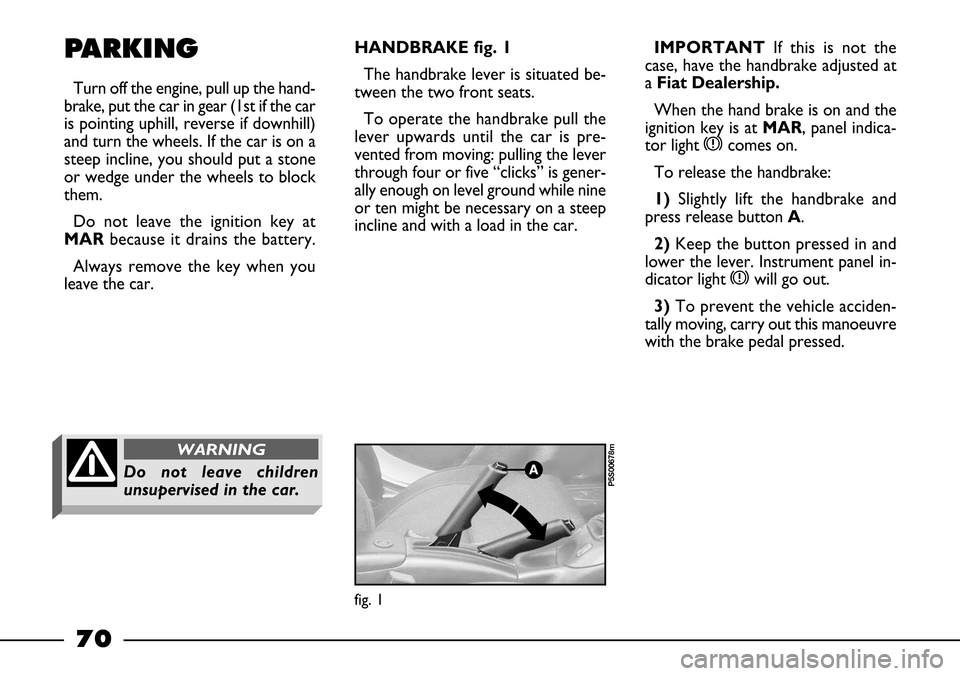
1) Slightly lift the handbrake and
press release button A.
2) Keep the button pressed in and
lower the lever. Instrument panel in-
dicator light xwill go out.
3) To prevent the vehicle acciden-
tally moving, carry out this manoeuvre
with the brake pedal pressed. HANDBRAKE fig. 1
The handbrake lever is situated be-
tween the two front seats.
To operate the handbrake pull the
lever upwards until the car is pre-
vented from moving: pulling the lever
through four or five “clicks” is gener-
ally enough on level ground while nine
or ten might be necessary on a steep
incline and with a load in the car.
fig. 1
P5S00678mDo not leave children
unsupervised in the car.
WARNING
Page 72 of 170
71
GEAR USE
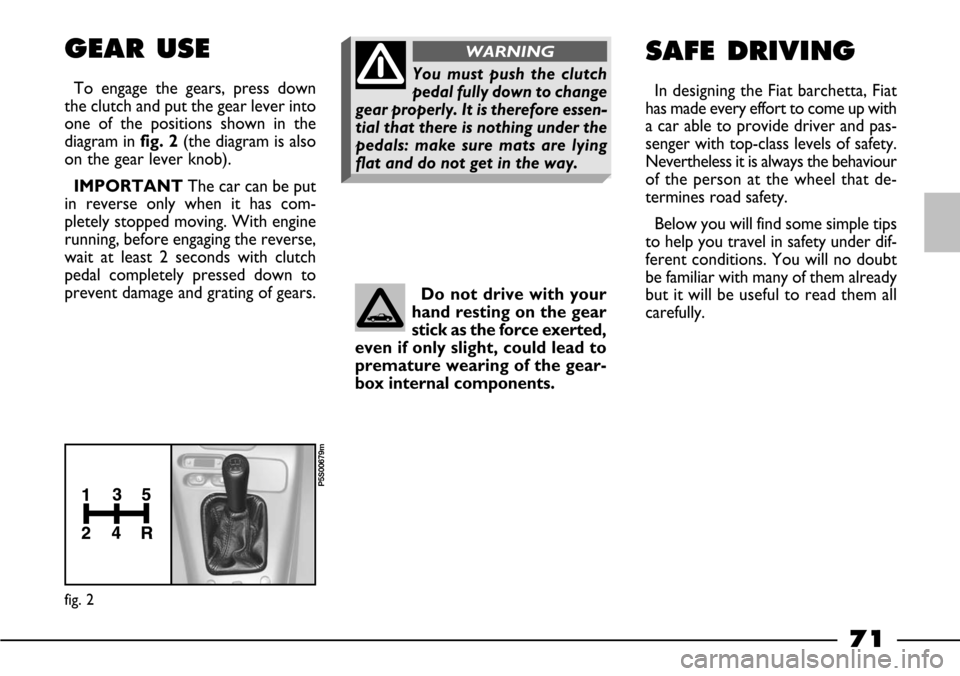
To engage the gears, press down
the clutch and put the gear lever into
one of the positions shown in the
diagram infig. 2(the diagram is also
on the gear lever knob).
IMPORTANT The car can be put
in reverse only when it has com-
pletely stopped moving. With engine
running, before engaging the reverse,
wait at least 2 seconds with clutch
pedal completely pressed down to
prevent damage and grating of gears.
Do not drive with your
hand resting on the gear
stick as the force exerted,
even if only slight, could lead to
premature wearing of the gear-
box internal components.
fig. 2
P5S00679m
SAFE DRIVING
In designing the Fiat barchetta, Fiat
has made every effort to come up with
a car able to provide driver and pas-
senger with top-class levels of safety.
Nevertheless it is always the behaviour
of the person at the wheel that de-
termines road safety.
Below you will find some simple tips
to help you travel in safety under dif-
ferent conditions. You will no doubt
be familiar with many of them already
but it will be useful to read them all
carefully.
You must push the clutch
pedal fully down to change
gear properly. It is therefore essen-
tial that there is nothing under the
pedals: make sure mats are lying
flat and do not get in the way.
WARNING
Page 74 of 170
73
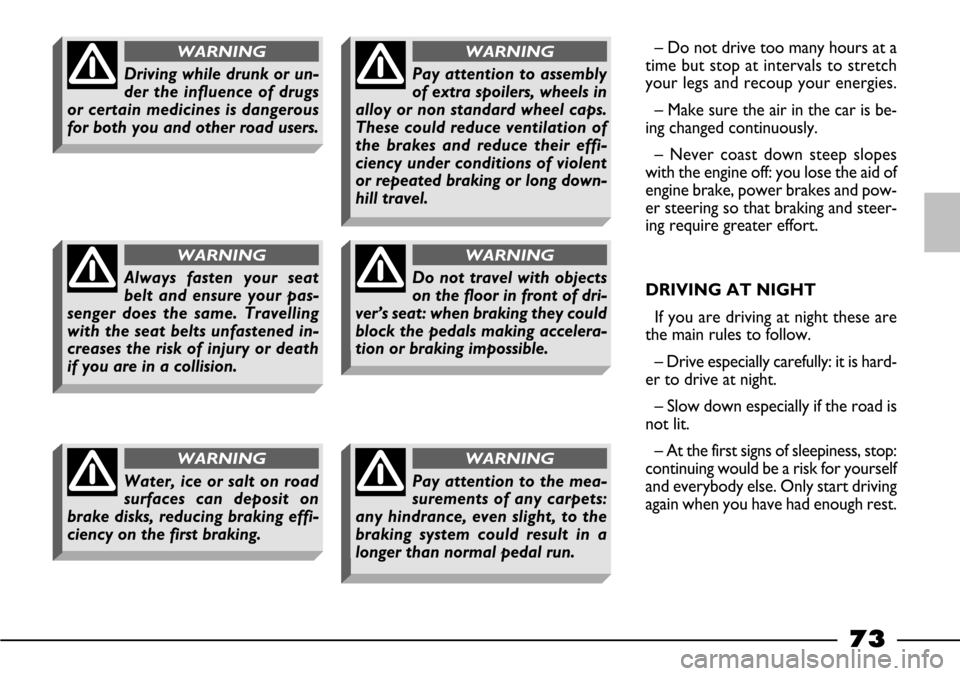
– Do not drive too many hours at a
time but stop at intervals to stretch
your legs and recoup your energies.
– Make sure the air in the car is be-
ing changed continuously.
– Never coast down steep slopes
with the engine off: you lose the aid of
engine brake, power brakes and pow-
er steering so that braking and steer-
ing require greater effort.
DRIVING AT NIGHT
If you are driving at night these are
the main rules to follow.
– Drive especially carefully: it is hard-
er to drive at night.
– Slow down especially if the road is
not lit.
– At the first signs of sleepiness, stop:
continuing would be a risk for yourself
and everybody else. Only start driving
again when you have had enough rest.
Driving while drunk or un-
der the influence of drugs
or certain medicines is dangerous
for both you and other road users.
WARNING
Always fasten your seat
belt and ensure your pas-
senger does the same. Travelling
with the seat belts unfastened in-
creases the risk of injury or death
if you are in a collision.
WARNING
Water, ice or salt on road
surfaces can deposit on
brake disks, reducing braking effi-
ciency on the first braking.
WARNING
Pay attention to assembly
of extra spoilers, wheels in
alloy or non standard wheel caps.
These could reduce ventilation of
the brakes and reduce their effi-
ciency under conditions of violent
or repeated braking or long down-
hill travel.
WARNING
Do not travel with objects
on the floor in front of dri-
ver’s seat: when braking they could
block the pedals making accelera-
tion or braking impossible.
WARNING
Pay attention to the mea-
surements of any carpets:
any hindrance, even slight, to the
braking system could result in a
longer than normal pedal run.
WARNING
Page 80 of 170
79
If the engine begins to “lose its
smoothness” when travelling, contin-
ue your journey but reduce the
demands you are making on the
engine and have the car seen to at a
Fiat Dealership.
When the instrument panel fuel
reserve warning light Kcomes on, fill
up as soon as possible. A low level of
fuel can cause an uneven supply of
fuel to the engine with the inevitable
increase in the temperature of the
exhaust gas and serious damage to
the catalytic converter.
Never run the engine with one or
more spark plugs disconnected, even
for testing purposes.
Do not warm up the engine by let-
ting it idle for a while before moving
off unless the outside temperature is
very low and, even in this case, only
do so for less than thirty seconds.TOWING
A TRAILER
IMPORTANT
The car must be fitted with a
homologated tow hitch and suitable
electrical system for towing a cara-
van or trailer. Have the tow hitch fit-
ted by an expert who will issue spe-
cific documentation for use on
roads.
Fit special and/or additional
rearview mirrors in accordance with
the highway code.
Remember that towing a trailer
makes it harder for the car to climb
the maximum gradients specified,
increases braking and overtaking dis-
tance, proportionally to the overall
weight of the trailer.
The weight the trailer exerts on
the car’s tow hitch coupling reduces
the car’s loading capacity by the
same amount. Do not install other heat shields
and do not remove those already fit-
ted to the catalytic converter and
exhaust pipe.
Do not allow anything to be
sprayed onto the catalytic converter,
lambda sensor and exhaust pipe.
When functioning normal-
ly the catalytic converter
develops high temperatures. For
this reason do not park the car
over inflammable material (grass,
dry leaves, pine needles, etc.): fire
hazard.
WARNING
Failure to heed these pre-
cautions could cause a
fire.
WARNING
Page 85 of 170
84
EMERGENCY
START-UP
If the Fiat CODE system cannot de-
activate the engine immobiliser, the
warning lights ¢and
Uwill remain
lit and the engine will not start. To
start your car, follow the emergency
startup procedure.
Read the whole procedure care-
fully before trying to carry it out.
If you make a mistake in the emer-
gency procedure you must turn the ig-
nition key back toSTOPand repeat
the whole operation from the begin-
ning, step 1).
1)Read the 5-figure electronic code
given on the CODE card.
2) Turn the ignition key to MAR.
3)Press the accelerator pedal to the
floor and keep it there. The injection
warning lamp
Uwill light up for about
8 seconds, and then go out. At this
point release the accelerator pedal and
get ready to count the flashes of warn-
ing lamp
U.4) Count the number of flashes that
corresponds to the first figure of the
code on the CODE card, then press
the accelerator pedal and keep it there
until the warning lamp
Ulights up for
four seconds and then goes out again.
Release the accelerator pedal.
5)The warning lamp
Uwill start
flashing again: when the lamp has
flashed the number of times that cor-
responds to the second figure on the
CODE card, press the accelerator
pedal to the floor and keep it there.
6) Do the same for the remaining fig-
ures on the CODE card.
7) Once the final figure has been en-
tered, keep the accelerator pedal
pressed. The warning lamp
Uwill
light up for 4 seconds and then go out.
Release the accelerator pedal.
8) The warning lamp
Uwill flash
rapidly for about 4 seconds to indicate
that the operation has been complet-
ed correctly.9)Turn on the engine by turning the
ignition key from the MARto the
AVVposition.
If however indicator light
Ustays
on, turn the ignition key to STOPand
repeat the procedure starting from
point 1).
IMPORTANT After emergency
starting the car you should have it seen
to at a Fiat Dealershipbecause the
emergency procedure will have to be
repeated each time you start the en-
gine otherwise.
Page 86 of 170
85
Under no circumstances
should a battery charger
be used to start the en-
gine: it could damage the elec-
tronic systems and in particular
the control units governing igni-
tion and fuel feed.
JUMP STARTING
If the battery is flat, you can use an-
other battery to start the engine. Its
capacity must be the same or slightly
greater than the flat battery (see the
chapter “Technical specifications”).
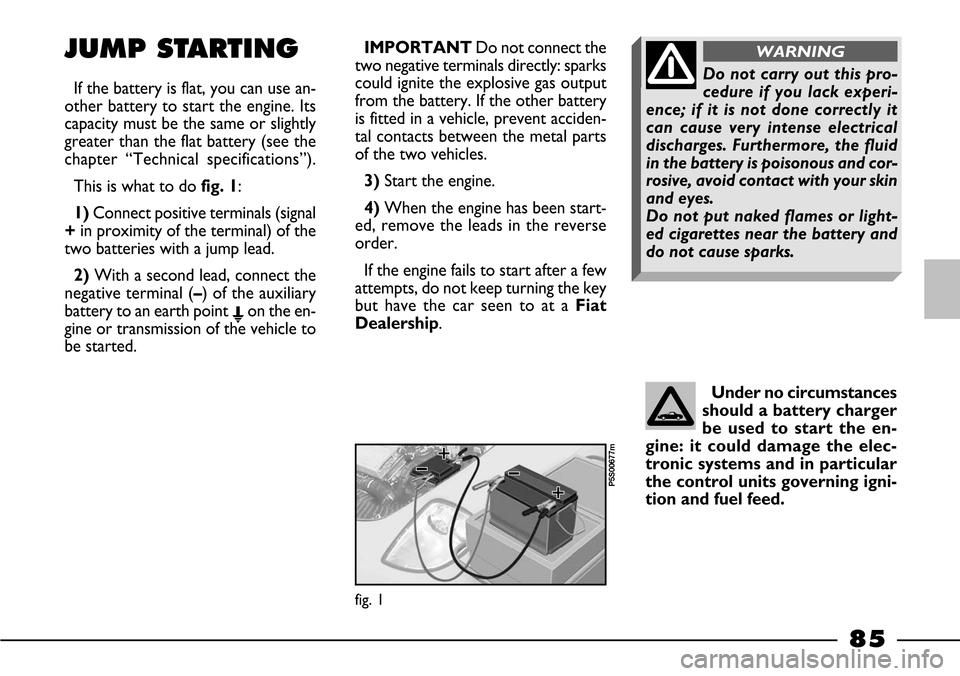
This is what to do fig. 1:
1)Connect positive terminals (signal
+in proximity of the terminal) of the
two batteries with a jump lead.
2)With a second lead, connect the
negative terminal (–) of the auxiliary
battery to an earth point Eon the en-
gine or transmission of the vehicle to
be started.IMPORTANTDo not connect the
two negative terminals directly: sparks
could ignite the explosive gas output
from the battery. If the other battery
is fitted in a vehicle, prevent acciden-
tal contacts between the metal parts
of the two vehicles.
3)Start the engine.
4)When the engine has been start-
ed, remove the leads in the reverse
order.
If the engine fails to start after a few
attempts, do not keep turning the key
but have the car seen to at a Fiat
Dealership.
fig. 1
P5S00677m
Do not carry out this pro-
cedure if you lack experi-
ence; if it is not done correctly it
can cause very intense electrical
discharges. Furthermore, the fluid
in the battery is poisonous and cor-
rosive, avoid contact with your skin
and eyes.
Do not put naked flames or light-
ed cigarettes near the battery and
do not cause sparks.
WARNING
Page 87 of 170
86
Observe the instructions on this and
the following pages to use the jack and
space-saver spare wheel correctly.
BUMP STARTING IF A TYRE
IS PUNCTURED
General instructions
Do not bump start by
pushing, towing or coast-
ing downhill. This way of
starting could cause a rush of fu-
el into the catalytic exhaust pipe
and damage it beyond repair.
Signal the presence of the
stopped vehicle according
to the laws in force (e.g. hazard
lights, reflecting triangle, etc.).
Any passengers on board should
leave the vehicle, especially if it is
heavily laden. Passengers should
stay away from oncoming traffic
while the wheel is being changed.
If the wheel is being changed on a
steep or badly surfaced road, place
wedges or other suitable material
under the wheels to stop the vehi-
cle.
WARNING
Remember that if the en-
gine is not running, the
brake booster will not work. You
therefore have to use considerably
more effort on the brake pedal.
WARNING
The space-saver spare
wheel is vehicle-specific.
Never use the wheel on other mod-
els. Never use other model spare
wheels on your vehicle.
If you change the type of wheels
(alloy rims instead of steel rims) you
will have to change the entire set of
fastening bolts with another set of
suitably sized bolts.
Only use the spare-saver wheel for
emergencies.
With the spare wheel do not exceed
80 kph.
An orange sticker is attached to the
spare wheel giving the main in-
structions for its use and limitations.
The sticker must never be re-
moved or covered.
Do not fit the hub cap to the
spare wheel.
WARNING
Page 92 of 170
91
IF A BULB
BURNS OUT
You should, where pos-
sible, have your bulbs
changed at a Fiat Dealer-
ship. Correct operation of exter-
nal light beams are essential for
safe driving and compliance with
legal requirements.Only touch the metal
part when handling halo-
gen bulbs. If the transpar-
ent bulb is touched it reduces the
intensity of the light emitted and
can also reduce the life of the
bulb. If you touch the bulb acci-
dentally, rub it with a cloth moist-
ened with alcohol and leave it to
dry.
GENERAL INSTRUCTIONS
– When a light is not working, check
that it has not fused before changing
the bulb.
– For the location of the fuses, re-
fer to “If a fuse blows” in this section.
– Before replacing a bulb that does
not work, check that the contacts are
not oxidised.
– Burnt out bulbs must be replaced
with ones of the same type.
– Always check the height of the
headlight beam after changing a bulb
for safety purposes.
Halogen bulbs contain
pressurised gas which, if
broken, may cause small fragments
of glass to be projected outwards.
WARNING
Modifications or repairs to
the electrical system car-
ried out incorrectly and without
bearing the features of the system
in mind can cause malfunctions
with the risk of fire.
WARNING