wheel FIAT BARCHETTA 2003 1.G Owner's Manual
[x] Cancel search | Manufacturer: FIAT, Model Year: 2003, Model line: BARCHETTA, Model: FIAT BARCHETTA 2003 1.GPages: 170, PDF Size: 3.55 MB
Page 81 of 170
80
In order to be sure you are not
exceeding the maximum towing
weight you have to take into account
the trailer’s fully laden weight,
including accessories and personal
luggage.
Do not exceed the speed limits for
towing a trailer in the country you
are driving in. In any case, do not
exceed the top speed of 100 km/h. SNOW CHAINS
Keep your speed down
when snow chains have
been fitted to the
wheels. Avoid potholes, steps
and pavements, and do not
drive for long stretches on
snow-free roads, otherwise you
risk damaging the tyres, suspen-
sion and steering.
The use of snow chains is regulated
by the legislation in force in the
country the car is driven in.
The chains may only be applied to
the drive wheel tyres (front wheels).
Check the tautness of the chains
after driving some twenty to thirty
metres.Do not use snow chains with
195/55 R15 (84V) or 195/45 R16
(80V) tyres as the chains are likely to
interfere with the plastic wheelarch-
es.
Use only low-profile chains with
185/55 R15 (81H) tyres: maximum
height off the wheel 12 mm
IMPORTANT As the spare
wheel is small, it is not possible to fit
snow chains to it. If a front tyre is
punctured, first exchange a rear
wheel with the spare tyre and then
change the flat tyre with the rear
wheel thus removed. This way there
will be two ordinary wheels at the
front and the snow chains can fitted.
The ABS system which
may be fitted to the vehi-
cle will not control the trailer
braking system. Great care should
therefore be taken when driving
on slippery road surfaces.
WARNING
Under no circumstances
modify the car's braking
system for trailer braking control.
The trailer's braking system must
be completely independent of the
car's hydraulic system.
WARNING
Page 87 of 170
86
Observe the instructions on this and
the following pages to use the jack and
space-saver spare wheel correctly.
BUMP STARTING IF A TYRE
IS PUNCTURED
General instructions
Do not bump start by
pushing, towing or coast-
ing downhill. This way of
starting could cause a rush of fu-
el into the catalytic exhaust pipe
and damage it beyond repair.
Signal the presence of the
stopped vehicle according
to the laws in force (e.g. hazard
lights, reflecting triangle, etc.).
Any passengers on board should
leave the vehicle, especially if it is
heavily laden. Passengers should
stay away from oncoming traffic
while the wheel is being changed.
If the wheel is being changed on a
steep or badly surfaced road, place
wedges or other suitable material
under the wheels to stop the vehi-
cle.
WARNING
Remember that if the en-
gine is not running, the
brake booster will not work. You
therefore have to use considerably
more effort on the brake pedal.
WARNING
The space-saver spare
wheel is vehicle-specific.
Never use the wheel on other mod-
els. Never use other model spare
wheels on your vehicle.
If you change the type of wheels
(alloy rims instead of steel rims) you
will have to change the entire set of
fastening bolts with another set of
suitably sized bolts.
Only use the spare-saver wheel for
emergencies.
With the spare wheel do not exceed
80 kph.
An orange sticker is attached to the
spare wheel giving the main in-
structions for its use and limitations.
The sticker must never be re-
moved or covered.
Do not fit the hub cap to the
spare wheel.
WARNING
Page 88 of 170
The sticker gives the follow-
ing information in four lan-
guages:
CAUTION!FOR TEMPORARY USE
ONLY
. MAX. 80 KM/H! REPLACE BY NOR-
MAL WHEEL AS SOON AS POSSIBLE. DO NOT
COVER THIS LABEL IN USE
. When driving
with a space-saver spare wheel fitted
the driving performance of your car
may change. Avoid accelerating or
braking suddenly, steering abruptly or
driving fast on bends. The life span of
a space-saver spare wheel is approx-
imately 3000 km, after which it will
need to be replaced with another
spare wheel of the same type. Nev-
er fit a standard tyre on the spare-
saver spare wheel rim. Have the
wheel replaced and refitted as soon
as possible. Never use two or more
spare wheel at the same time. Do not
lubricate the bolt threads before fit-
ting them back: they could come
loose. The jack should only be used
to change a wheel on the car for
which it was designed. It should not
be put to other uses or employed to
raise other models of car. Under no
circumstances should it be used when
carrying out repairs under the vehi-
cle.
87
WARNING
An incorrectly positioned
jack may cause the vehicle
to fall.
Do not use the jack to lift loads ex-
ceeding that indicated on the label
attached to the jack itself.
Never start the engine when the car
is jacked up.
If you are towing a trailer, release
the trailer before jacking up the car.
Do not fit snow chains on space-
saver spare wheels. If a front wheel
(drive wheel) is punctured and you
require snow chains to proceed,
take a standard wheel from the
rear axle and fit the space-saver
spare wheel in its place. Having fit-
ted two standard wheels on the dri-
ve axle, you can use snow chains,
thus solving the emergency situa-
tion.
WARNING
Torque the wheel cap cor-
rectly to prevent the wheel
from coming free in motion.
Never tamper with the inflation
valve.
Never place tools between the rim
and tyre.
Check the tyre and space-saver
spare wheel pressure regularly. Tyre
pressure is shown in the “Technical
specifications” chapter.
WARNING
Page 89 of 170
88
CHANGING A WHEEL
Please note:
– the jack weighs 1.85 kg;
– the jack requires no adjustments;
– the jack cannot be repaired. If it
breaks it must be replaced with a new
jack;
– no other tool, part from the han-
dle shown in this chapter can be fitted
to the jack.
Change the wheel as follows:
1)Stop the vehicle so that it is not
a hazard for other road users or your-
self when changing the wheel. The
ground should be as flat and firm as
possible.2)Stop the engine and engage the
handbrake.
3)Engage first gear or reverse.
4)Lift the boot carpet.
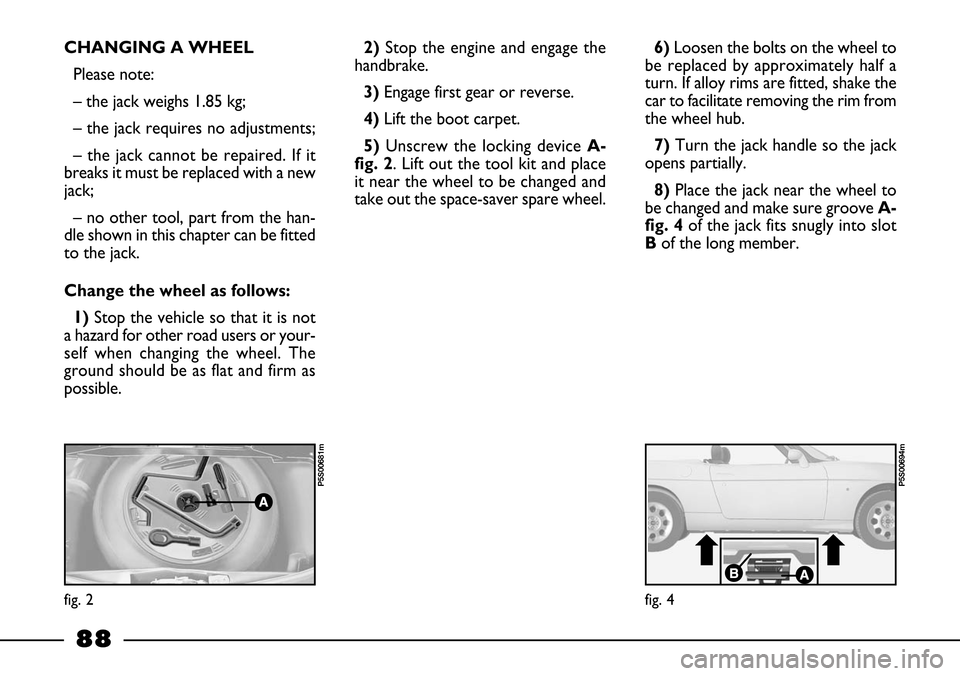
5)Unscrew the locking device A-
fig. 2. Lift out the tool kit and place
it near the wheel to be changed and
take out the space-saver spare wheel.6)Loosen the bolts on the wheel to
be replaced by approximately half a
turn. If alloy rims are fitted, shake the
car to facilitate removing the rim from
the wheel hub.
7)Turn the jack handle so the jack
opens partially.
8)Place the jack near the wheel to
be changed and make sure groove A-
fig. 4of the jack fits snugly into slot
Bof the long member.
fig. 2
P5S00681m
fig. 4
P5S00694m
Page 90 of 170
89
Depending on whether the normal
wheels are fitted with steel or light al-
loy rims, the spare wheel (always
made of steel) differs in order to be
compatible with the wheel bolts which
are specific for each of the two types
of rim.
If the type of wheel to be used is to
be changed (alloy rims in place of steel
rims and vice-versa) the bolts must al-
so be changed and a specific spare
wheel adopted.
Keep the bolts and the spare wheel
as they are essential if the original
wheels are to be refitted at some time
in the future. 9) Warn anyone nearby that the ve-
hicle is about to be lifted. They must
stay clear and not touch the vehicle
until it is back on the ground.
10) Turn the jack handle and raise
the car until the wheel is a few cen-
timetres above the ground.
The jack handle must turn freely,
without touching the ground to avoid
scraping your hands. Do not touch the
moving parts of the jack as they can
cause injuries. If you dirty your hands
with grease, clean them carefully.
11) Fully unscrew the 4 bolts, re-
move the wheel and, where provided
recover the wheel hub cap.
12)Make sure the surfaces of the
space-saver spare wheel that come in-
to contact with the hub are clean and
free from any impurities which could
result in the wheel bolts working
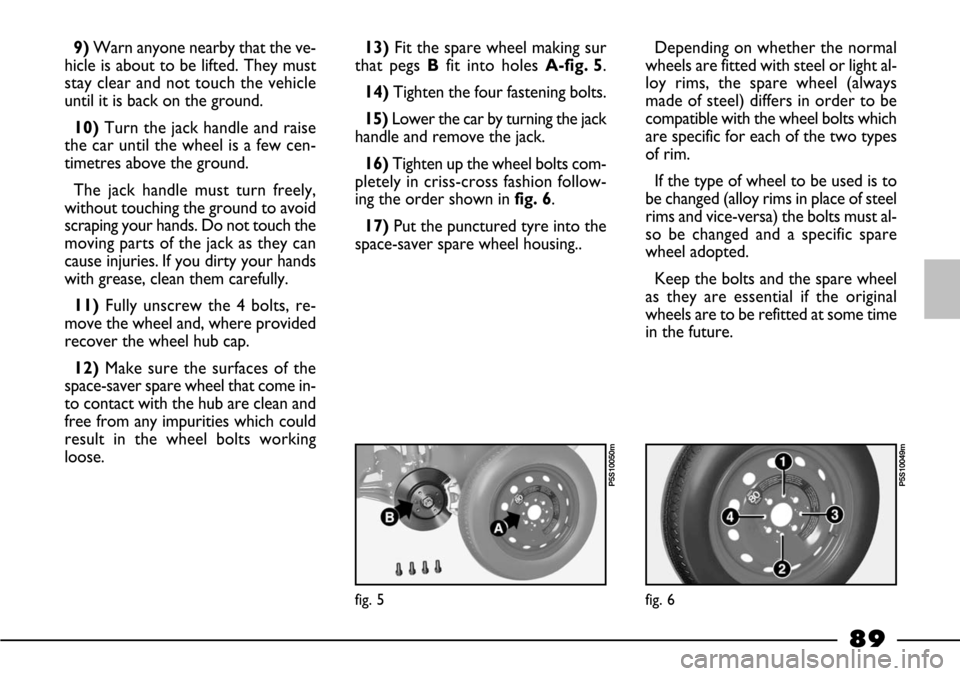
loose.13)Fit the spare wheel making sur
that pegs Bfit into holes A-fig. 5.
14) Tighten the four fastening bolts.
15) Lower the car by turning the jack
handle and remove the jack.
16)Tighten up the wheel bolts com-
pletely in criss-cross fashion follow-
ing the order shown in fig. 6.
17) Put the punctured tyre into the
space-saver spare wheel housing..
fig. 5
P5S10050m
fig. 6
P5S10049m
Page 91 of 170
90
3)Screw up the bolts with the span-
ner provided.
4) Lower the vehicle and remove the
jack.
5)Tighten up the bolts in the same
order as shown above.When you have finished
1)Put the space-saver spare wheel
back in the boot.
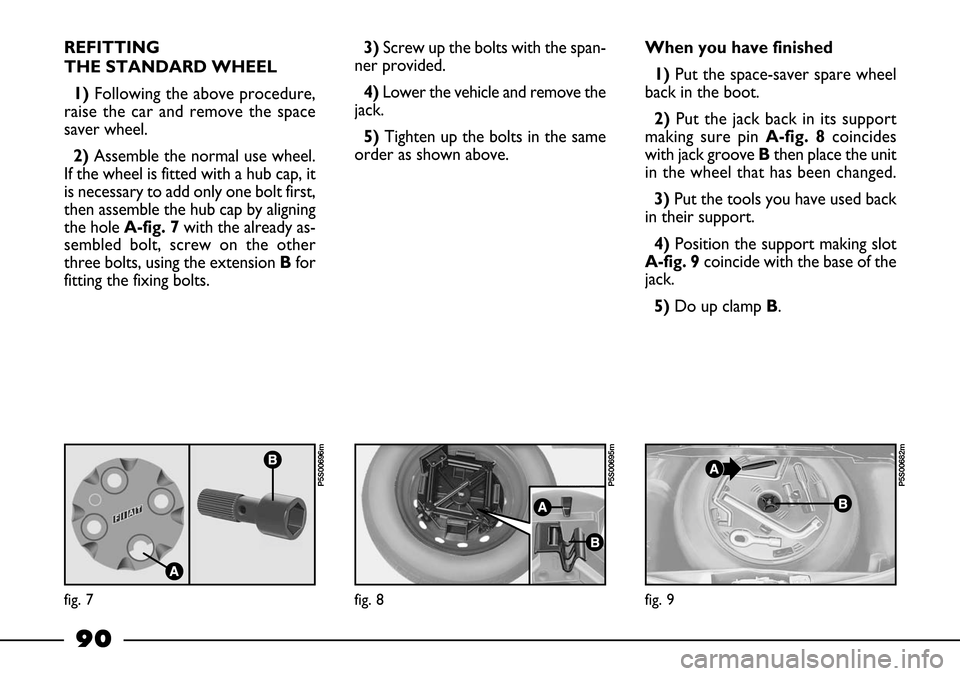
2) Put the jack back in its support
making sure pin A-fig. 8coincides
with jack groove Bthen place the unit
in the wheel that has been changed.
3) Put the tools you have used back
in their support.
4)Position the support making slot
A-fig. 9coincide with the base of the
jack.
5)Do up clamp B. REFITTING
THE STANDARD WHEEL
1) Following the above procedure,
raise the car and remove the space
saver wheel.
2)Assemble the normal use wheel.
If the wheel is fitted with a hub cap, it
is necessary to add only one bolt first,
then assemble the hub cap by aligning
the hole A-fig. 7with the already as-
sembled bolt, screw on the other
three bolts, using the extension Bfor
fitting the fixing bolts.
fig. 7
P5S00696m
fig. 8
P5S00695m
fig. 9
P5S00682m
Page 100 of 170
99
POSITION OF THE FUSES
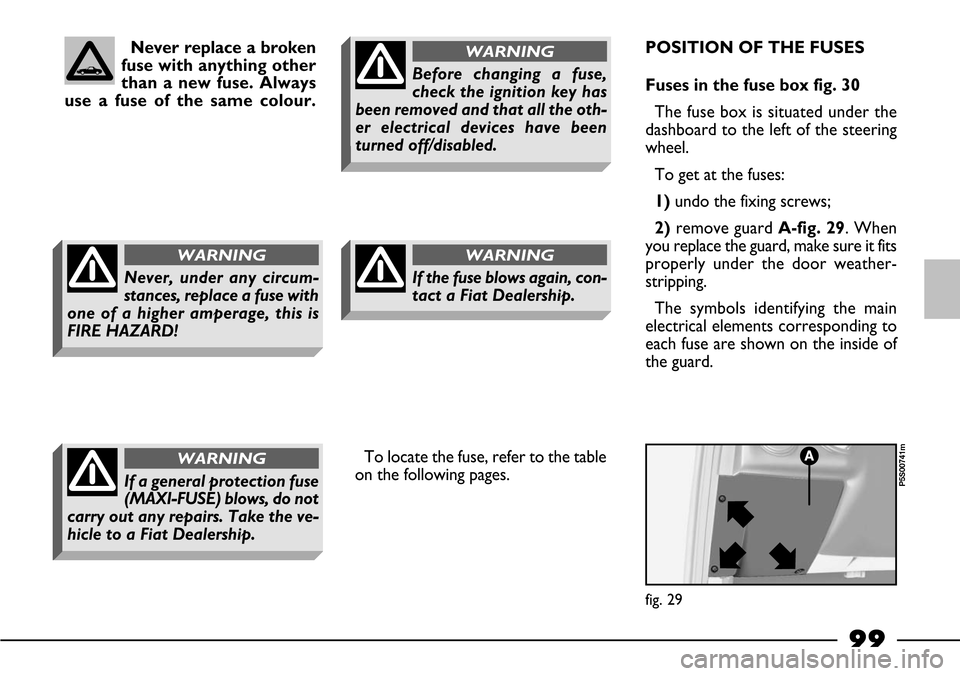
Fuses in the fuse box fig. 30
The fuse box is situated under the
dashboard to the left of the steering
wheel.
To get at the fuses:
1)undo the fixing screws;
2)remove guard A-fig. 29. When
you replace the guard, make sure it fits
properly under the door weather-
stripping.
The symbols identifying the main
electrical elements corresponding to
each fuse are shown on the inside of
the guard.
fig. 29
P5S00741m
Never replace a broken
fuse with anything other
than a new fuse. Always
use a fuse of the same colour.
To locate the fuse, refer to the table
on the following pages.
Never, under any circum-
stances, replace a fuse with
one of a higher amperage, this is
FIRE HAZARD!
WARNING
Before changing a fuse,
check the ignition key has
been removed and that all the oth-
er electrical devices have been
turned off/disabled.
WARNING
If a general protection fuse
(MAXI-FUSE) blows, do not
carry out any repairs. Take the ve-
hicle to a Fiat Dealership.
WARNING
If the fuse blows again, con-
tact a Fiat Dealership.
WARNING
Page 107 of 170
106
Please note:
– the jack requires no adjustments;
– the jack cannot be repaired. If it
breaks it must be replaced with a new
jack;
– no tool, other than its handle, in-
dicated in this chapter, can be fitted
onto the jack.
IF THE CAR NEEDS
TO BE RAISED
WITH THE JACK
See “If a tyre is punctured”, in this
chapter. Under no circumstances
should a battery charger
be used to start the en-
gine: it could damage the elec-
tronic systems and in particular,
the control units governing igni-
tion and fuel feed.
The jack is used solely for
changing the wheels. It
must not be used for any other pur-
poses, for example lifting other
cars. It must not be used for carry-
ing out repairs under the car.
WARNING
The vehicle may fall if the
jack is not positioned cor-
rectly. Do not use the jack to lift
loads exceeding that indicated on
the jack itself.
WARNING
Page 109 of 170
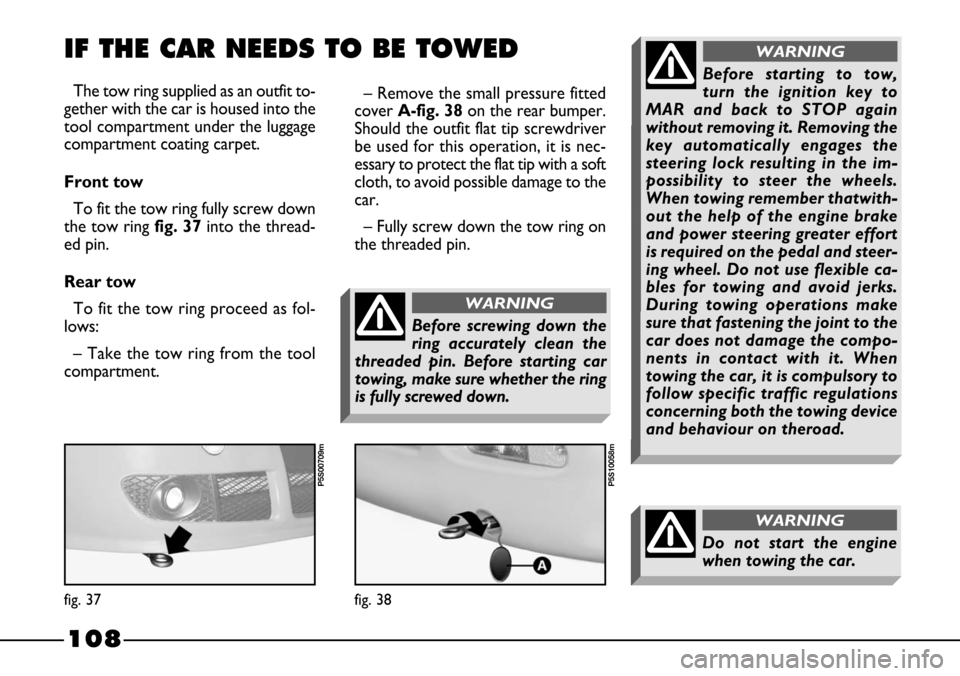
108
The tow ring supplied as an outfit to-
gether with the car is housed into the
tool compartment under the luggage
compartment coating carpet.
Front tow
To fit the tow ring fully screw down
the tow ring fig. 37into the thread-
ed pin.
Rear tow
To fit the tow ring proceed as fol-
lows:
– Take the tow ring from the tool
compartment.
IF THE CAR NEEDS TO BE TOWED
fig. 37
P5S00709m
fig. 38
P5S10058m
– Remove the small pressure fitted
cover A-fig. 38on the rear bumper.
Should the outfit flat tip screwdriver
be used for this operation, it is nec-
essary to protect the flat tip with a soft
cloth, to avoid possible damage to the
car.
– Fully screw down the tow ring on
the threaded pin.
Before screwing down the
ring accurately clean the
threaded pin. Before starting car
towing, make sure whether the ring
is fully screwed down.
WARNING
Do not start the engine
when towing the car.
WARNING
Before starting to tow,
turn the ignition key to
MAR and back to STOP again
without removing it. Removing the
key automatically engages the
steering lock resulting in the im-
possibility to steer the wheels.
When towing remember thatwith-
out the help of the engine brake
and power steering greater effort
is required on the pedal and steer-
ing wheel. Do not use flexible ca-
bles for towing and avoid jerks.
During towing operations make
sure that fastening the joint to the
car does not damage the compo-
nents in contact with it. When
towing the car, it is compulsory to
follow specific traffic regulations
concerning both the towing device
and behaviour on theroad.
WARNING
Page 112 of 170
111
CAR MAINTENANCE
The Fiat barchetta is brand new throughout, even
in its service schedule. For example: the first service
schedule coupon is to be used at 20,000 km making the
traditional check at 1,500 km unnecessary. You should
however remember that your car needs routine main-
tenance such as systematic checking of the fluid level
and tyre pressure, and any necessary topping up.
You should nonetheless bear in mind that proper car
maintenance is certainly the best way to keep your car
in tip-top condition for years to come and safeguard its
safety features, its environmentally-friendly nature and
its low running costs.
Also remember that following the servicing regula-
tions marked with the symbol ∑as specified might be
essential to ensuring the warranty remains valid.SCHEDULED SERVICING ............................................... 112
SERVICE SCHEDULE ......................................................... 113
ANNUAL INSPECTION SCHEDULE ........................... 115
ADDITIONAL OPERATIONS ........................................ 115
CHECKING FLUID LEVELS ............................................. 117
AIR CLEANER ..................................................................... 122
POLLEN FILTER .................................................................. 123
BATTERY .............................................................................. 123
ELECTRONIC CONTROL UNITS ............................... 125
SPARK PLUGS ..................................................................... 126
WHEELS AND TYRES ...................................................... 126
RUBBER TUBING .............................................................. 128
WINDSCREEN WIPER ..................................................... 128
MANUAL CLIMATE CONTROL SYSTEM ................. 130
BODYWORK ...................................................................... 130
HOOD ................................................................................... 133
INTERIORS ........................................................................... 133