wheel FIAT BARCHETTA 2003 1.G User Guide
[x] Cancel search | Manufacturer: FIAT, Model Year: 2003, Model line: BARCHETTA, Model: FIAT BARCHETTA 2003 1.GPages: 170, PDF Size: 3.55 MB
Page 62 of 170
61
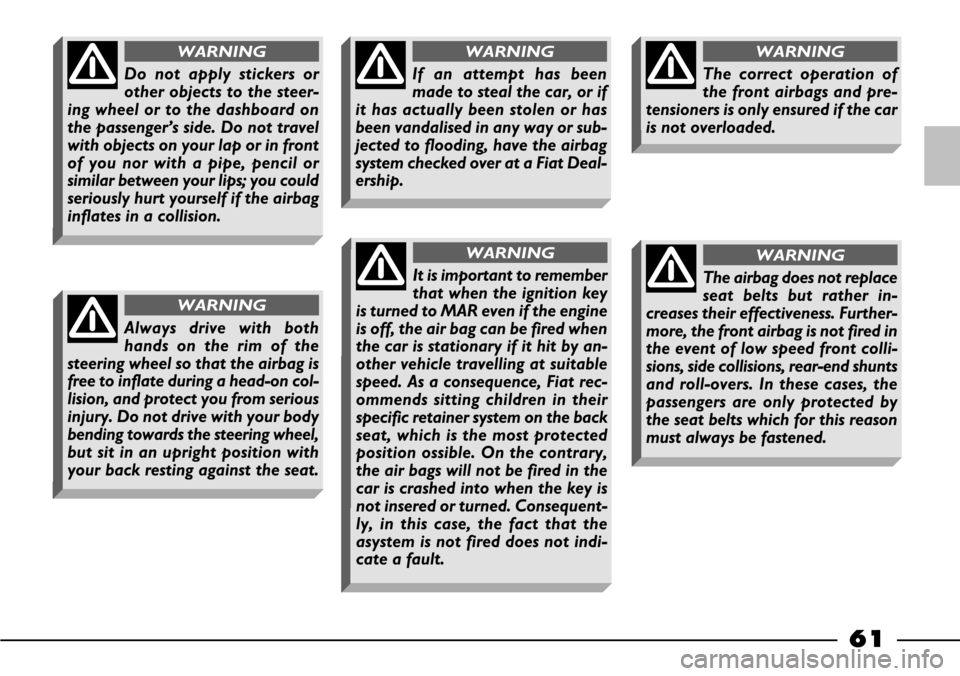
Do not apply stickers or
other objects to the steer-
ing wheel or to the dashboard on
the passenger’s side. Do not travel
with objects on your lap or in front
of you nor with a pipe, pencil or
similar between your lips; you could
seriously hurt yourself if the airbag
inflates in a collision.
WARNING
The correct operation of
the front airbags and pre-
tensioners is only ensured if the car
is not overloaded.
WARNING
The airbag does not replace
seat belts but rather in-
creases their effectiveness. Further-
more, the front airbag is not fired in
the event of low speed front colli-
sions, side collisions, rear-end shunts
and roll-overs. In these cases, the
passengers are only protected by
the seat belts which for this reason
must always be fastened.
WARNING
Always drive with both
hands on the rim of the
steering wheel so that the airbag is
free to inflate during a head-on col-
lision, and protect you from serious
injury. Do not drive with your body
bending towards the steering wheel,
but sit in an upright position with
your back resting against the seat.
WARNING
If an attempt has been
made to steal the car, or if
it has actually been stolen or has
been vandalised in any way or sub-
jected to flooding, have the airbag
system checked over at a Fiat Deal-
ership.
WARNING
It is important to remember
that when the ignition key
is turned to MAR even if the engine
is off, the air bag can be fired when
the car is stationary if it hit by an-
other vehicle travelling at suitable
speed. As a consequence, Fiat rec-
ommends sitting children in their
specific retainer system on the back
seat, which is the most protected
position ossible. On the contrary,
the air bags will not be fired in the
car is crashed into when the key is
not insered or turned. Consequent-
ly, in this case, the fact that the
asystem is not fired does not indi-
cate a fault.
WARNING
Page 68 of 170
67
DRIVING YOUR CAR
To help you handle your Fiat barchetta in the best
and safest possible way, and above all use it to its
fullest potential, we have given you some hints in this
chapter on “what to do, what not to do and what to
avoid” when at the wheel of your Fiat barchetta.
Most of the time, these suggestions apply to other
cars as well. Sometimes, however, the tip may apply
to an exclusive Fiat barchetta feature. You are there-
fore strongly recommended to pay the closest atten-
tion to this section for helpful hints on optimum dri-
ving practices and usage of the car that will help you
get the most out of your Fiat barchetta. STARTING THE ENGINE ............................................... 68
PARKING ............................................................................ 70
GEAR USE .......................................................................... 71
SAFE DRIVING .................................................................. 71
CONTAINING RUNNING COSTS
AND POLLUTION .......................................................... 76
CHEAP RUNNING THAT RESPECTS
THE ENVIRONMENT ..................................................... 78
TOWING A TRAILER ..................................................... 79
SNOW CHAINS ............................................................... 80
VEHICLE STORAGE ........................................................ 81
REPEATED CHECKS AND CHECKS
BEFORE LONG TRIPS .................................................... 82
ACCESSORIES PURCHASED BY THE OWNER ..... 82
USEFUL ACCESSORIES .................................................. 82
Page 70 of 170
69
HOW TO WARM UP
THE ENGINE AFTER
IT HAS JUST STARTED
– Begin to move forward slowly, let-
ting the engine turn over at medium
revs. Do not floor the accelerator.
– Do not push the engine to its lim-
it for the first few kilometres. You are
recommended to wait until the water
temperature has reached 50° to 60°C.
EMERGENCY START-UP
If the Fiat CODE system fails to
recognise the code transmitted by
the ignition key (warning lamp ¢on
instrument panel lit with a fixed
light), you can start the engine by fol-
lowing the emergency procedure
using the code written on the CODE
card.
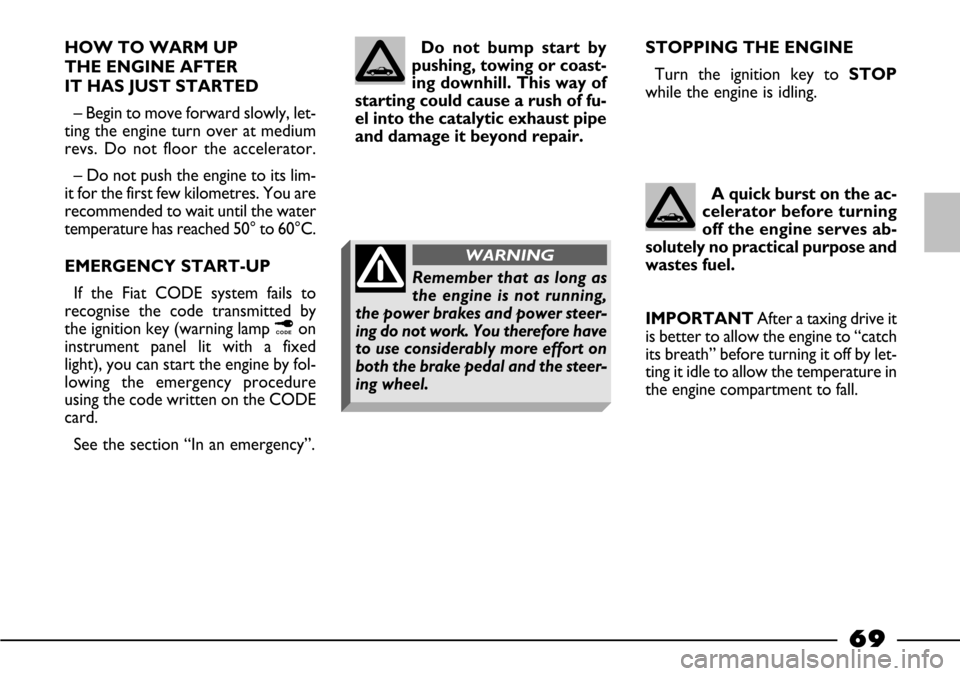
See the section “In an emergency”.Do not bump start by
pushing, towing or coast-
ing downhill. This way of
starting could cause a rush of fu-
el into the catalytic exhaust pipe
and damage it beyond repair.
A quick burst on the ac-
celerator before turning
off the engine serves ab-
solutely no practical purpose and
wastes fuel.
IMPORTANT After a taxing drive it
is better to allow the engine to “catch
its breath” before turning it off by let-
ting it idle to allow the temperature in
the engine compartment to fall.STOPPING THE ENGINE
Turn the ignition key to STOP
while the engine is idling.
Remember that as long as
the engine is not running,
the power brakes and power steer-
ing do not work. You therefore have
to use considerably more effort on
both the brake pedal and the steer-
ing wheel.
WARNING
Page 71 of 170
70
PARKING
Turn off the engine, pull up the hand-
brake, put the car in gear (1st if the car
is pointing uphill, reverse if downhill)
and turn the wheels. If the car is on a
steep incline, you should put a stone
or wedge under the wheels to block
them.
Do not leave the ignition key at
MAR because it drains the battery.
Always remove the key when you
leave the car.IMPORTANTIf this is not the
case, have the handbrake adjusted at
a Fiat Dealership.
When the hand brake is on and the
ignition key is at MAR, panel indica-
tor light xcomes on.
To release the handbrake:
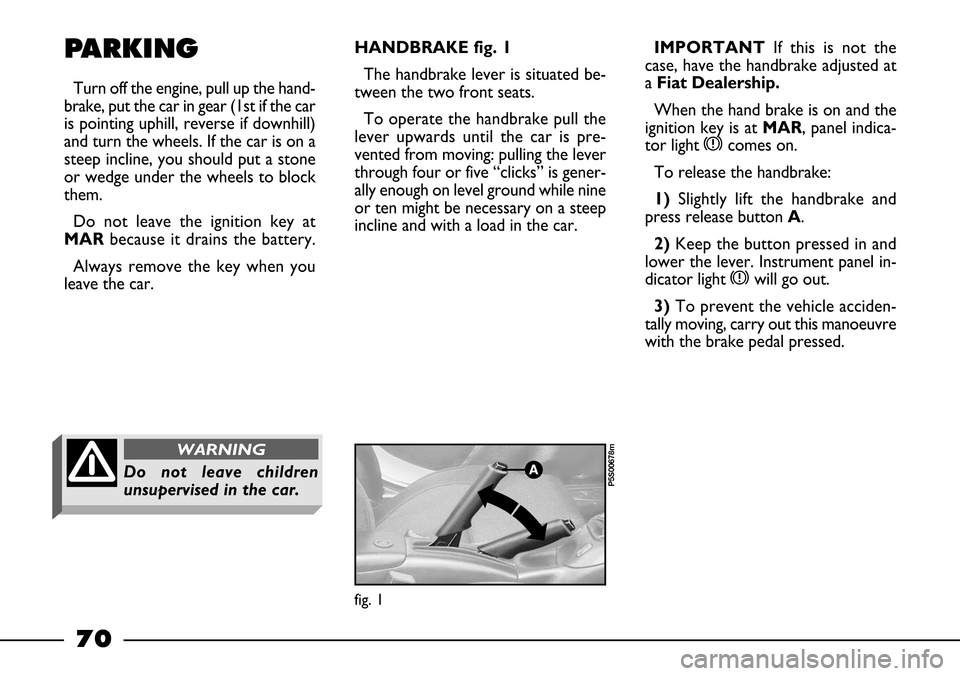
1) Slightly lift the handbrake and
press release button A.
2) Keep the button pressed in and
lower the lever. Instrument panel in-
dicator light xwill go out.
3) To prevent the vehicle acciden-
tally moving, carry out this manoeuvre
with the brake pedal pressed. HANDBRAKE fig. 1
The handbrake lever is situated be-
tween the two front seats.
To operate the handbrake pull the
lever upwards until the car is pre-
vented from moving: pulling the lever
through four or five “clicks” is gener-
ally enough on level ground while nine
or ten might be necessary on a steep
incline and with a load in the car.
fig. 1
P5S00678mDo not leave children
unsupervised in the car.
WARNING
Page 72 of 170
71
GEAR USE
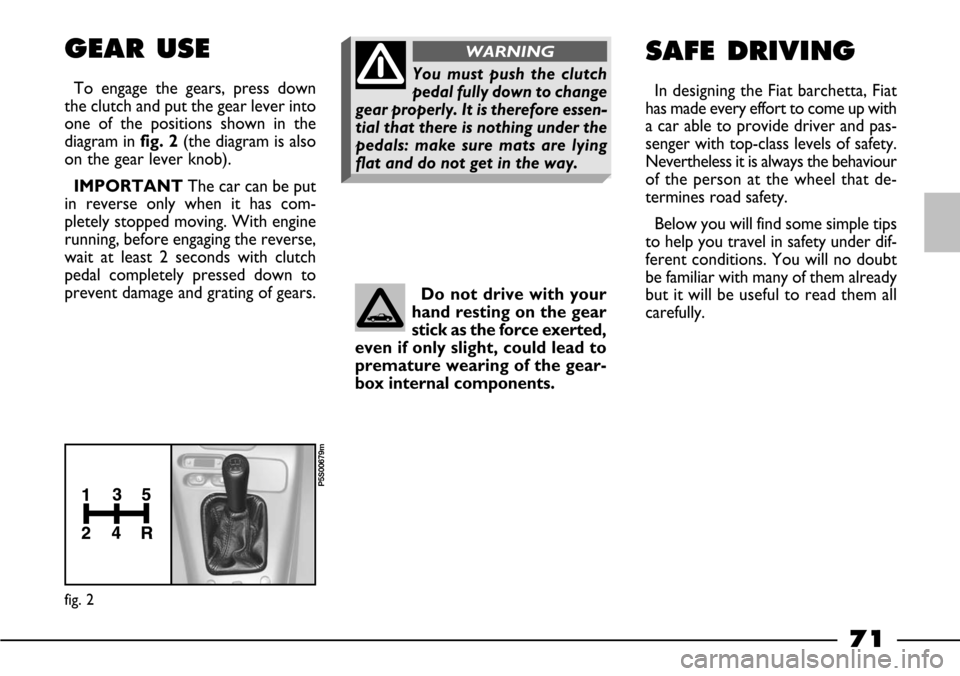
To engage the gears, press down
the clutch and put the gear lever into
one of the positions shown in the
diagram infig. 2(the diagram is also
on the gear lever knob).
IMPORTANT The car can be put
in reverse only when it has com-
pletely stopped moving. With engine
running, before engaging the reverse,
wait at least 2 seconds with clutch
pedal completely pressed down to
prevent damage and grating of gears.
Do not drive with your
hand resting on the gear
stick as the force exerted,
even if only slight, could lead to
premature wearing of the gear-
box internal components.
fig. 2
P5S00679m
SAFE DRIVING
In designing the Fiat barchetta, Fiat
has made every effort to come up with
a car able to provide driver and pas-
senger with top-class levels of safety.
Nevertheless it is always the behaviour
of the person at the wheel that de-
termines road safety.
Below you will find some simple tips
to help you travel in safety under dif-
ferent conditions. You will no doubt
be familiar with many of them already
but it will be useful to read them all
carefully.
You must push the clutch
pedal fully down to change
gear properly. It is therefore essen-
tial that there is nothing under the
pedals: make sure mats are lying
flat and do not get in the way.
WARNING
Page 73 of 170
72
BEFORE GETTING BEHIND
THE WHEEL
– Make sure all lights including the
headlights are working properly.
– Adjust the position of the seats,
steering wheel, driving and door mir-
rors properly for the best driving
position.
– Carefully adjust head restraints
so the back of the head and not the
nape of the neck is supported.
– Make sure that nothing (mats
etc.) gets in the way of the pedals
when they are pushed down.
– Adjust the height of the seat
belts, adapting them to your height
(see indications given in the chapter
“Getting to know your car - seat
belts”).
– Make sure that any child restraint
systems (child seats, carriers, etc.)
are properly fixed.– Stow objects in the luggage com-
partment with care to prevent them
from being thrown forwards in the
event of an accident.
– Make sure that any child restraint
systems are properly fixed. If the
child seat is installed when a passen-
ger airbag is fitted, make sure it is
facing forwards, and position the car
seat as far back as possible.
– Do not eat a heavy meal before
travelling. Light eating will help keep
your reflexes prompt. Above all, do
not have anything alcoholic to drink.
– Remember to check what is spec-
ified in the “Repeated checks and
checks before long trips” in this sec-
tion.WHEN TRAVELLING
– The first rule of safe driving is
prudence.
– Prudence also means putting
yourself into a position where you
can predict wrong or imprudent
behaviour of other drivers.
– Stick closely to the rules of the
road in the particular country where
the car is being driven and, above all,
do not exceed speed limits.
– Do not drive with your foot rest-
ing on the clutch pedal as this will
quickly wear the clutch out.
– Ensure that, besides yourself, all
the other passengers in the car have
their seat belts fastened, that chil-
dren are sitting in the appropriate
child seats and any animals are in
special compartments.
– You should be physically fit and
mentally alert before setting out on
long journeys.
Page 74 of 170
73
– Do not drive too many hours at a
time but stop at intervals to stretch
your legs and recoup your energies.
– Make sure the air in the car is be-
ing changed continuously.
– Never coast down steep slopes
with the engine off: you lose the aid of
engine brake, power brakes and pow-
er steering so that braking and steer-
ing require greater effort.
DRIVING AT NIGHT
If you are driving at night these are
the main rules to follow.
– Drive especially carefully: it is hard-
er to drive at night.
– Slow down especially if the road is
not lit.
– At the first signs of sleepiness, stop:
continuing would be a risk for yourself
and everybody else. Only start driving
again when you have had enough rest.
Driving while drunk or un-
der the influence of drugs
or certain medicines is dangerous
for both you and other road users.
WARNING
Always fasten your seat
belt and ensure your pas-
senger does the same. Travelling
with the seat belts unfastened in-
creases the risk of injury or death
if you are in a collision.
WARNING
Water, ice or salt on road
surfaces can deposit on
brake disks, reducing braking effi-
ciency on the first braking.
WARNING
Pay attention to assembly
of extra spoilers, wheels in
alloy or non standard wheel caps.
These could reduce ventilation of
the brakes and reduce their effi-
ciency under conditions of violent
or repeated braking or long down-
hill travel.
WARNING
Do not travel with objects
on the floor in front of dri-
ver’s seat: when braking they could
block the pedals making accelera-
tion or braking impossible.
WARNING
Pay attention to the mea-
surements of any carpets:
any hindrance, even slight, to the
braking system could result in a
longer than normal pedal run.
WARNING
Page 75 of 170
74
– Keep a greater safety distance from
the cars in front of you than during
daylight hours: it is hard to judge how
fast other cars are going when all you
can see are their lights.
– Make sure the headlight beams are
properly positioned: if they are too
low, they reduce visibility and are hard
on the eyes. If they are too high they
can dazzle other drivers.
– Only use main-beam headlights
when you are driving outside the city
and when you are sure they do not an-
noy other drivers.
– If the headlights are on full, dip
them in good time to prevent dazzling
other drivers coming in the other di-
rection.
– Keep all lights clean.
– Be careful of animals crossing the
road when driving in the country.DRIVING IN THE RAIN
Rain and wet road surfaces spell dan-
ger.
All manoeuvres are more difficult on
a wet road because the friction of the
wheels on the tarmac is greatly re-
duced. This is why braking distances
are much longer and roadholding is
lower.
Here is some advice to follow if it is
raining:
– Reduce speed and keep a greater
safety distance from the cars in front.
– If it is raining particularly heavily,
visibility is also reduced. In these cas-
es, switch on the dipped headlights
even if it is still daylight so you can be
seen more clearly by other drivers.
– Do not drive through puddles at
speed and hold on tightly to the wheel:
a puddle taken at speed can make you
lose control of the car (“aquaplaning”).
– Move the ventilation controls to
the position for demisting the win-
dows (see the “Getting to know your
car” section), to avoid visibility prob-
lems.– Periodically check the condition of
the windscreen wiper blades.
DRIVING IN FOG
– If the fog is thick, do not start out
on a journey unless you absolutely
have to.
If driving in mist, blanket fog or when
there is the danger of patches of fog :
– Keep the speed down.
– Turn on the dipped headlights, rear
foglights and front foglights, if fitted,
even during the day. Do not drive with
your headlights at full-beam.
IMPORTANTOn stretches of
road with good visibility, switch off
your rear foglights; the brightness of
these lights could annoy the people
travelling in the cars behind.
Page 76 of 170
75
– Remember that fog also means the
tarmac is wet and therefore manoeu-
vres of all kinds are more difficult and
stopping distances are longer.
– Keep a good distance from the cars
in front of you.
– As far as possible, avoid spurts of
speed or sudden deceleration.
– Do not overtake other vehicles if
you can help it.
– If you are forced to stop your car
(breakdown, limited visibility etc.) try
to stop off the road. Then turn on the
hazard lights and, if possible, the
dipped headlights. Rhythmically sound
the horn if you realise another car is
coming.
DRIVING
IN THE MOUNTAINS
– When driving downhill, use the en-
gine brake by engaging a low gear so
as not to overheat the brakes.
– Under no circumstances should
you drive downhill with the engine off
or with the car in neutral, let alone
with the ignition key out.– Drive at a moderate speed without
cutting corners.
– Remember that overtaking while
going uphill is slower and therefore re-
quires more free road. If you are be-
ing overtaken while driving uphill,
make it easier for the other vehicle
to pass.
DRIVING ON SNOW OR ICE
Here are some tips for driving in
these conditions:
– Keep your speed down.
– Use chains if the roads are covered
in snow (refer to the “Snow chains”
paragraph in this section).
– Mainly use the engine brake and
under all circumstances avoid braking
sharply.
– When braking in a car not fitted
with ABS, avoid the wheels locking by
varying the pressure you exert on the
brake pedal.
– Do not accelerate suddenly and
avoid swerving.– In the winter, even apparently dry
roads may have icy patches. Be care-
ful therefore when driving over
stretches that do not get much expo-
sure to the sun or that are lined by
trees and rocks where ice might not
have melted.
– Keep a good distance from the ve-
hicles in front.
– Do not remain for long periods in
deep snow with the engine running as
the snow could force the exhaust gas-
es into the passenger compartment.
DRIVING WITH ABS
ABS is a braking system that essen-
tially offers two advantages:
1)It prevents wheel lock-up and
consequent skidding in emergency
stops, particularly when the road does
not offer much grip.
2)It makes it possible to brake and
steer at the same time so you can
avoid unexpected obstacles and direct
the car where you want while braking.
The extent to which this can be done
will depend on the physical limits of
the tyre's sideways grip.
Page 77 of 170
76
Here are some suggestions which
may help you to keep the running
costs of your vehicle down and low-
er the amount of toxic emissions re-
leased into the atmosphere.
GENERAL
CONSIDERATIONS
Car maintenance
The overall state of the car is an im-
portant factor which has a marked in-
fluence over fuel consumption and dri-
ving comfort and on the life span of
your car. For this reason care should
be taken to maintain your car by car-
rying out the necessary checks and
regulations in accordance with the
specifications given in the Scheduled
Maintenance Programme (see sec-
tions... spark plugs, idle, air filter, tim-
ing).
CONTAINING RUNNING COSTS
AND POLLUTION
Tyres
Tyres should be checked at least
every four weeks: if the pressure is
too low fuel consumption increases as
the resistance to the rolling movement
of the tyre is greater. In this state, tyre
wear is increased and car handling suf-
fers which will affect safety.
Unnecessary loads
Do not travel with too much luggage
stowed in the boot. The weight of the
vehicle (especially when driving in
town) and its trim greatly affects con-
sumption and stability. To get the most out of ABS:
– During emergency stops or when
grip conditions are poor, you will feel
a slight pulsation on the brake pedal.
This is the sign that the ABS is in ac-
tion. Do not release the brake pedal
but continue to press so as not to in-
terrupt the braking action.
– ABS prevents the wheels from
locking but it does not increase actu-
al grip conditions between tyre and
road. Therefore, even if your car is fit-
ted with ABS, respect the safety dis-
tance from the car in front of you and
keep your speed down when driving
into bends.
– ABS serves to increase the con-
trollability of the car, not to enable you
to go faster.