wheel FIAT BARCHETTA 2003 1.G Owner's Guide
[x] Cancel search | Manufacturer: FIAT, Model Year: 2003, Model line: BARCHETTA, Model: FIAT BARCHETTA 2003 1.GPages: 170, PDF Size: 3.55 MB
Page 116 of 170
115
ANNUAL
INSPECTION
SCHEDULE
The following annual inspection
schedule is required for cars travelling
less than 20,000 km a year (e.g. ap-
proximately 10,000 km). The schedule
includes the following operations:
– Check tyre condition and wear and
adjust pressure, if required (including
spare-saver spare wheel).
– Check operation of lights (head-
lights, direction indicators, hazard
lights, boot light, passenger compart-
ment ceiling light, glove compartment
light, instrument panel lights, etc.).
– Check windscreen wiper/washer
and adjust nozzles.
– Check position wear of windscreen
window wiper blades.
ADDITIONAL
OPERATIONS
Every 1,000 kmor before long
trips, check and top up as necessary:
– coolant level
– brake fluid level
– power steering fluid level
– electrolyte level
– windscreen washer liquid level
– tyre condition and pressure.
We advise you to use FL Selenia
products, which have been designed
and produced expressly for the Fiat
vehicles (see the table “Capacities” giv-
en in the “Technical specifications”
section).
Every 3,000 km check and top up
as necessary: engine oil level. – Check rear brake pad conditions
and wear.
– Inspect conditions of. engine, gear-
box, transmission, piping (exhaust - fu-
el feed - brakes), rubber parts (boots
- sleeves - bushings - etc.), brake and
fuel line hoses.
– Check battery charge status.
– Check conditions of various con-
trol belts.
– Check and top up fluid levels (en-
gine coolant, brakes, windscreen
washer, battery, etc.).
– Change engine oil.
– Replace engine oil filter.
– Replace pollen filter (where fitted).
Page 127 of 170
126
WHEELS
AND TYRES
TYRES PRESSURE
Every two weeks and before long
journeys, check the pressure of each
tyre including the spare.
The pressure must be checked when
the tyre is rested and cold.
It is normal for the pressure to rise
when you are driving. If you have to
check or restore the pressure when
the tyres are warm remember that the
pressure value must be 0.3 bar above
the specified value.
SPARK PLUGS
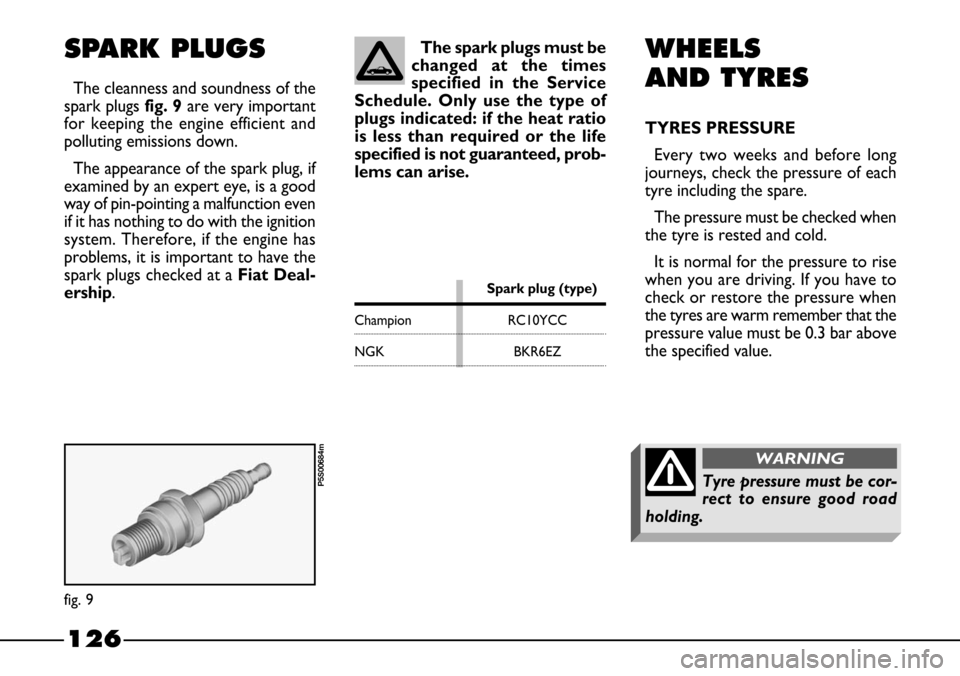
The cleanness and soundness of the
spark plugs fig. 9are very important
for keeping the engine efficient and
polluting emissions down.
The appearance of the spark plug, if
examined by an expert eye, is a good
way of pin-pointing a malfunction even
if it has nothing to do with the ignition
system. Therefore, if the engine has
problems, it is important to have the
spark plugs checked at a Fiat Deal-
ership.The spark plugs must be
changed at the times
specified in the Service
Schedule. Only use the type of
plugs indicated: if the heat ratio
is less than required or the life
specified is not guaranteed, prob-
lems can arise.
fig. 9
P5S00684m
Spark plug (type)
Champion RC10YCC
NGK BKR6EZ
Tyre pressure must be cor-
rect to ensure good road
holding.
WARNING
Page 128 of 170
127
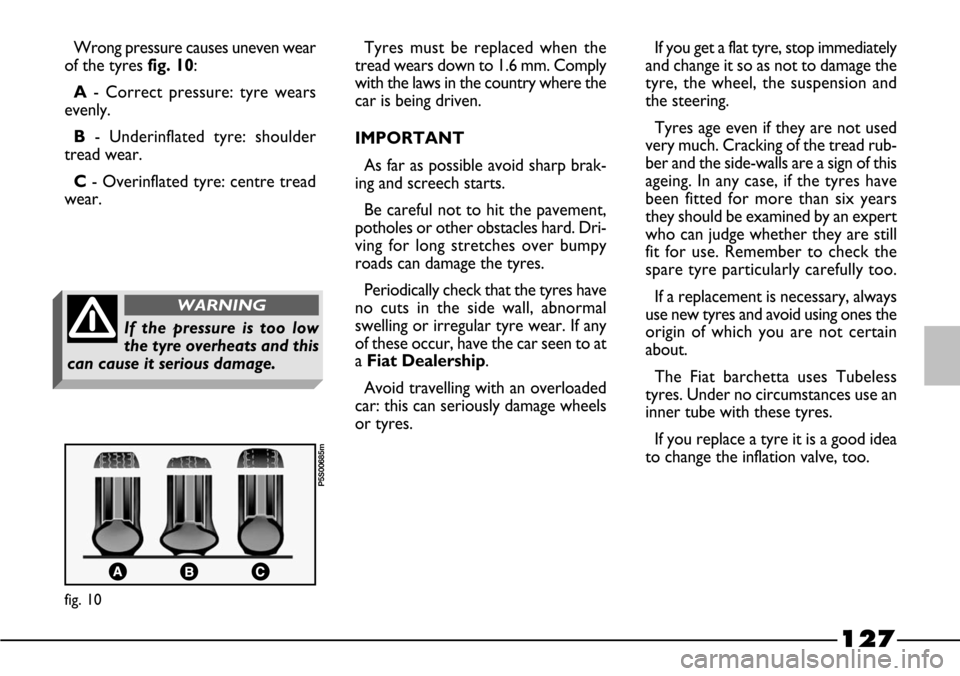
Wrong pressure causes uneven wear
of the tyresfig. 10:
A- Correct pressure: tyre wears
evenly.
B- Underinflated tyre: shoulder
tread wear.
C- Overinflated tyre: centre tread
wear.If you get a flat tyre, stop immediately
and change it so as not to damage the
tyre, the wheel, the suspension and
the steering.
Tyres age even if they are not used
very much. Cracking of the tread rub-
ber and the side-walls are a sign of this
ageing. In any case, if the tyres have
been fitted for more than six years
they should be examined by an expert
who can judge whether they are still
fit for use. Remember to check the
spare tyre particularly carefully too.
If a replacement is necessary, always
use new tyres and avoid using ones the
origin of which you are not certain
about.
The Fiat barchetta uses Tubeless
tyres. Under no circumstances use an
inner tube with these tyres.
If you replace a tyre it is a good idea
to change the inflation valve, too. Tyres must be replaced when the
tread wears down to 1.6 mm. Comply
with the laws in the country where the
car is being driven.
IMPORTANT
As far as possible avoid sharp brak-
ing and screech starts.
Be careful not to hit the pavement,
potholes or other obstacles hard. Dri-
ving for long stretches over bumpy
roads can damage the tyres.
Periodically check that the tyres have
no cuts in the side wall, abnormal
swelling or irregular tyre wear. If any
of these occur, have the car seen to at
a Fiat Dealership.
Avoid travelling with an overloaded
car: this can seriously damage wheels
or tyres.
fig. 10
P5S00685m
If the pressure is too low
the tyre overheats and this
can cause it serious damage.
WARNING
Page 131 of 170
130
BODYWORK
PROTECTING THE CAR
FROM ATMOSPHERIC
AGENTS
The main causes of rust are:
– atmospheric pollution
– salt and humidity in the atmosphere
(seaside or very hot and humid areas)
– environmental conditions that are
specific to the season.
In addition, the abrasiveness of dust
in the atmosphere and sand carried by
the wind as well as mud and stones
kicked up by other vehicles must not
be underestimated.
For your Fiat barchetta, Fiat has used
leading-edge technological solutions to
effectively protect the body from rust.These are the main ones:
– Painting systems and products that
make the car particularly resistant to
rust and scratching.
– The use of zinc-plated (or pre-
treated) sheet steel which is highly re-
sistant to rust.
– The spraying of the underbody, en-
gine compartment, inside the wheel-
arches and other parts with wax-based
products with a high protective ca-
pacity.
– Spraying plastic-coating materials
for protecting the most exposed
points: under the door, inside the
wings, the edges etc.
– The use of “open” box sections to
prevent condensation and water from
building up and rusting the inside of
the parts.
MANUAL CLIMATE
CONTROL SYSTEM
(where fitted)
During the winter, the climate con-
trol system must be turned on at least
once a month for about ten minutes.
Have the system checked at a Fiat
Dealershipbefore the summer.
The system uses R134a
refrigerating liquid. If it
accidentally leaks it will
not damage the environment.
Under no circumstances should
R12 fluid be used. Besides being
incompatible with the system's
components, it contains chloro-
fluorocarbides (CFC).
Page 136 of 170
135
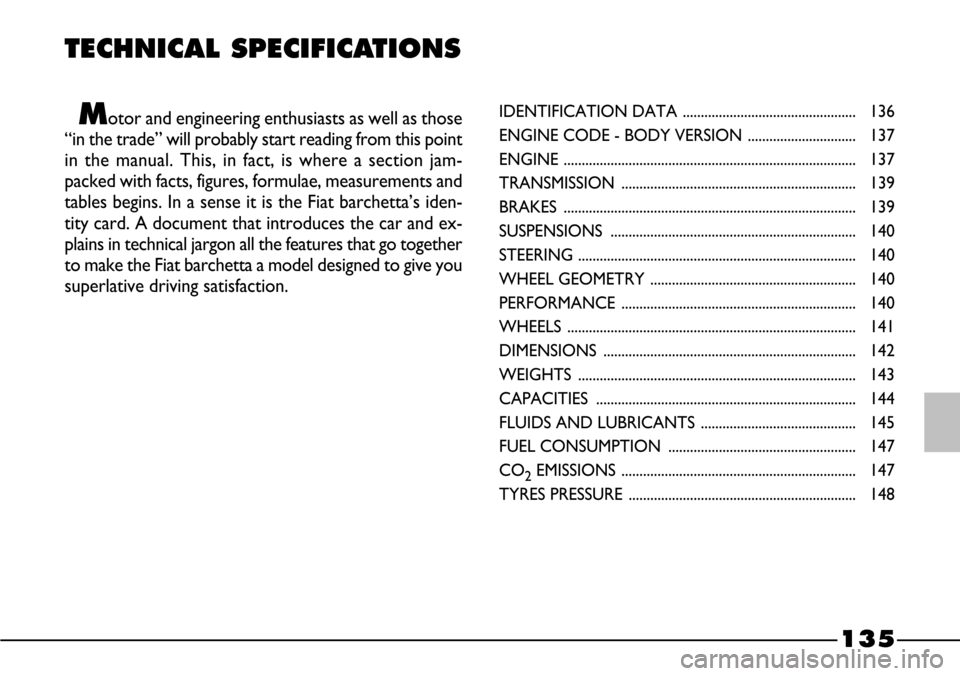
TECHNICAL SPECIFICATIONS
Motor and engineering enthusiasts as well as those
“in the trade” will probably start reading from this point
in the manual. This, in fact, is where a section jam-
packed with facts, figures, formulae, measurements and
tables begins. In a sense it is the Fiat barchetta’s iden-
tity card. A document that introduces the car and ex-
plains in technical jargon all the features that go together
to make the Fiat barchetta a model designed to give you
superlative driving satisfaction.IDENTIFICATION DATA ................................................ 136
ENGINE CODE - BODY VERSION .............................. 137
ENGINE ................................................................................. 137
TRANSMISSION ................................................................. 139
BRAKES ................................................................................. 139
SUSPENSIONS .................................................................... 140
STEERING ............................................................................. 140
WHEEL GEOMETRY ......................................................... 140
PERFORMANCE ................................................................. 140
WHEELS ................................................................................ 141
DIMENSIONS ...................................................................... 142
WEIGHTS ............................................................................. 143
CAPACITIES ........................................................................ 144
FLUIDS AND LUBRICANTS ........................................... 145
FUEL CONSUMPTION .................................................... 147
CO
2EMISSIONS ................................................................. 147
TYRES PRESSURE ............................................................... 148
Page 140 of 170
139
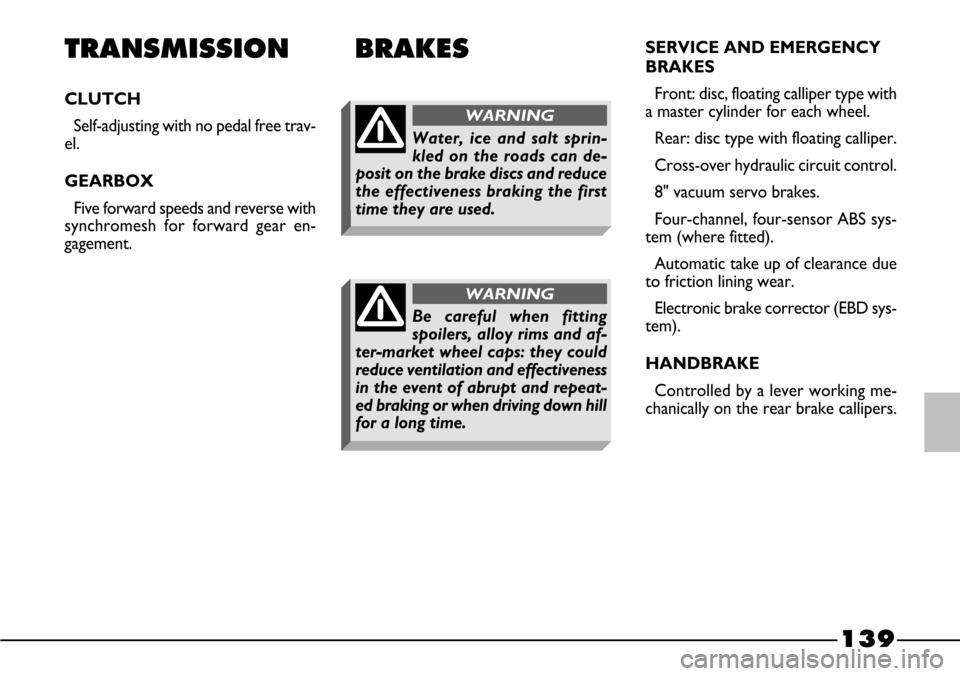
TRANSMISSION
CLUTCH
Self-adjusting with no pedal free trav-
el.
GEARBOX
Five forward speeds and reverse with
synchromesh for forward gear en-
gagement. SERVICE AND EMERGENCY
BRAKES
Front: disc, floating calliper type with
a master cylinder for each wheel.
Rear: disc type with floating calliper.
Cross-over hydraulic circuit control.
8" vacuum servo brakes.
Four-channel, four-sensor ABS sys-
tem (where fitted).
Automatic take up of clearance due
to friction lining wear.
Electronic brake corrector (EBD sys-
tem).
HANDBRAKE
Controlled by a lever working me-
chanically on the rear brake callipers.
BRAKES
Water, ice and salt sprin-
kled on the roads can de-
posit on the brake discs and reduce
the effectiveness braking the first
time they are used.
WARNING
Be careful when fitting
spoilers, alloy rims and af-
ter-market wheel caps: they could
reduce ventilation and effectiveness
in the event of abrupt and repeat-
ed braking or when driving down hill
for a long time.
WARNING
Page 141 of 170
140
SUSPENSIONS
FRONT
Independent wheel, MacPherson-
type with ferritic cast-iron wishbone
anchored to an auxiliary cross-mem-
ber.
Off-set coil springs and double-action
telescopic gas dampers.
Anti-roll bar.
REAR
Independent wheels with spheroidal
cast-iron wishbones.
Coil springs and gas dampers with
vulcanised bushings.
Anti-roll bar.
Auxiliary rigid H-shaped frame con-
sisting of a tubular cross structure and
two pressed steel long members weld-
ed to it.
STEERING
Energy-absorbing jointed steering
column with rake adjustment system.
Permanently lubricated rack and pin-
ion control.
Hydraulic power steering.
Permanently lubricated joints.
Minimum turning circle: 10.5 metres.
Number of steering wheel turns lock
to lock: approx. 2.5.
WHEEL
GEOMETRY
Wheel toe-in measured from rim to
rim: 0±1 mm.
The figures refer to the car in full
running order.
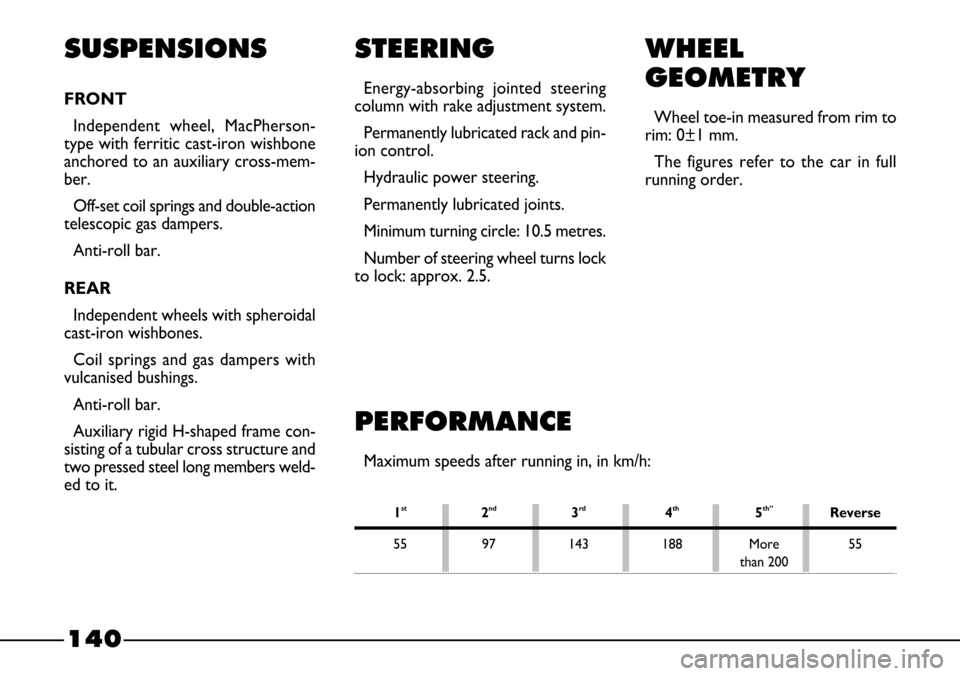
PERFORMANCE
Maximum speeds after running in, in km/h:
1st2nd3rd 4th5th”Reverse
55 97 143 188 More 55
than 200
Page 142 of 170
141
WHEELS
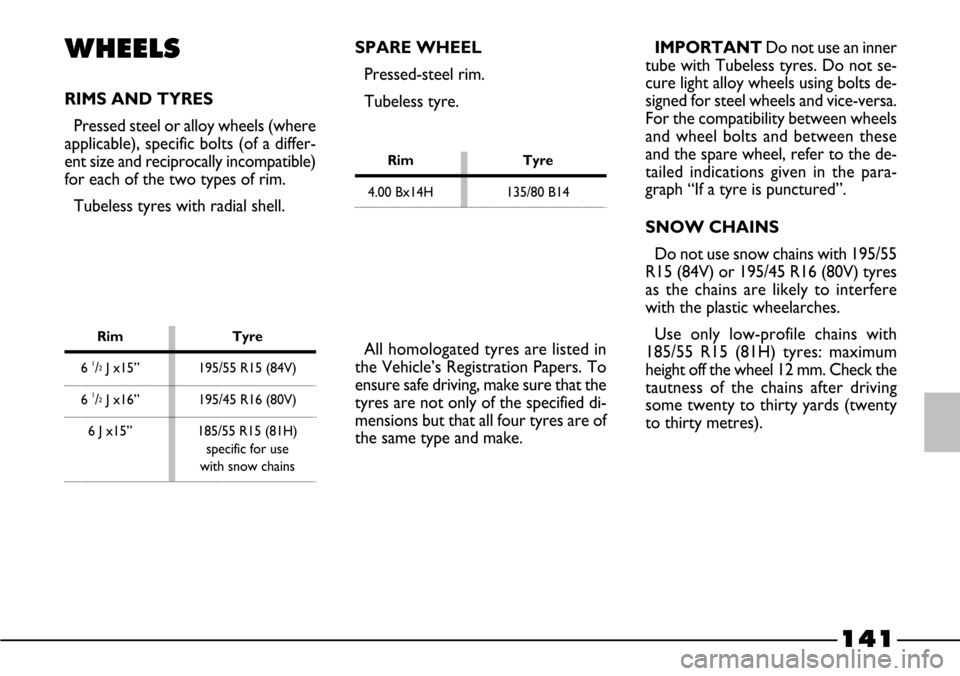
RIMS AND TYRES
Pressed steel or alloy wheels (where
applicable), specific bolts (of a differ-
ent size and reciprocally incompatible)
for each of the two types of rim.
Tubeless tyres with radial shell.IMPORTANT Do not use an inner
tube with Tubeless tyres. Do not se-
cure light alloy wheels using bolts de-
signed for steel wheels and vice-versa.
For the compatibility between wheels
and wheel bolts and between these
and the spare wheel, refer to the de-
tailed indications given in the para-
graph “If a tyre is punctured”.
SNOW CHAINS
Do not use snow chains with 195/55
R15 (84V) or 195/45 R16 (80V) tyres
as the chains are likely to interfere
with the plastic wheelarches.
Use only low-profile chains with
185/55 R15 (81H) tyres: maximum
height off the wheel 12 mm. Check the
tautness of the chains after driving
some twenty to thirty yards (twenty
to thirty metres).
Rim Tyre
6 1/2J x15” 195/55 R15 (84V)
6 1/2J x16” 195/45 R16 (80V)
6 J x15” 185/55 R15 (81H)
specific for use
with snow chains
SPARE WHEEL
Pressed-steel rim.
Tubeless tyre.
All homologated tyres are listed in
the Vehicle’s Registration Papers. To
ensure safe driving, make sure that the
tyres are not only of the specified di-
mensions but that all four tyres are of
the same type and make.
Rim Tyre
4.00 Bx14H 135/80 B14
Page 144 of 170
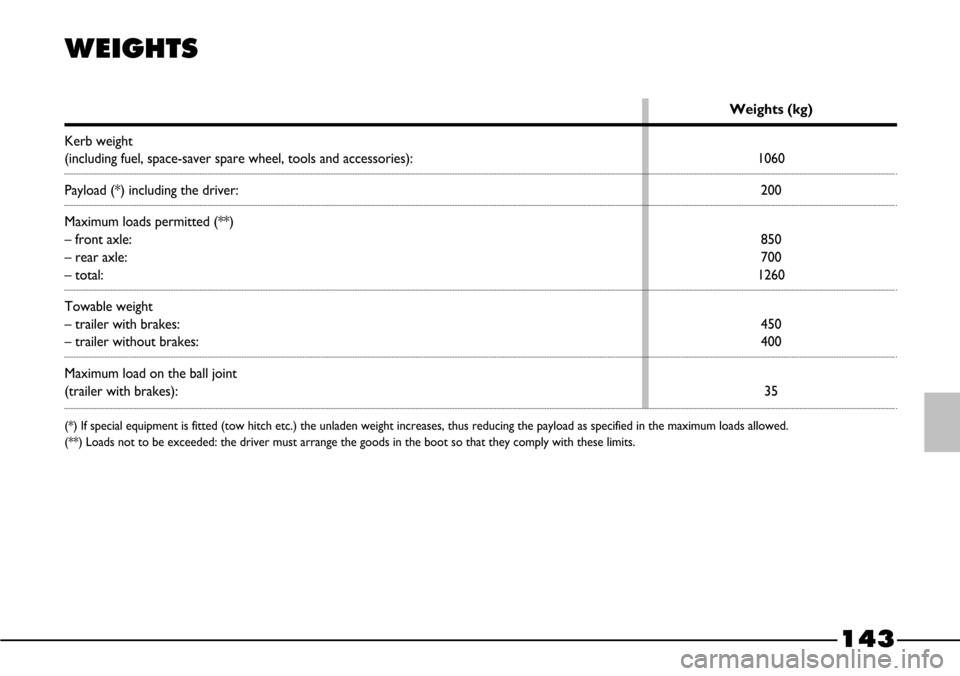
143
Kerb weight
(including fuel, space-saver spare wheel, tools and accessories):
Payload (*) including the driver:
Maximum loads permitted (**)
– front axle:
– rear axle:
– total:
Towable weight
– trailer with brakes:
– trailer without brakes:
Maximum load on the ball joint
(trailer with brakes):
(*) If special equipment is fitted (tow hitch etc.) the unladen weight increases, thus reducing the payload as specified in the maximum loads allowed.
(**) Loads not to be exceeded: the driver must arrange the goods in the boot so that they comply with these limits.
WEIGHTS
Weights (kg)
1060
200
850
700
1260
450
400
35
Page 149 of 170
148
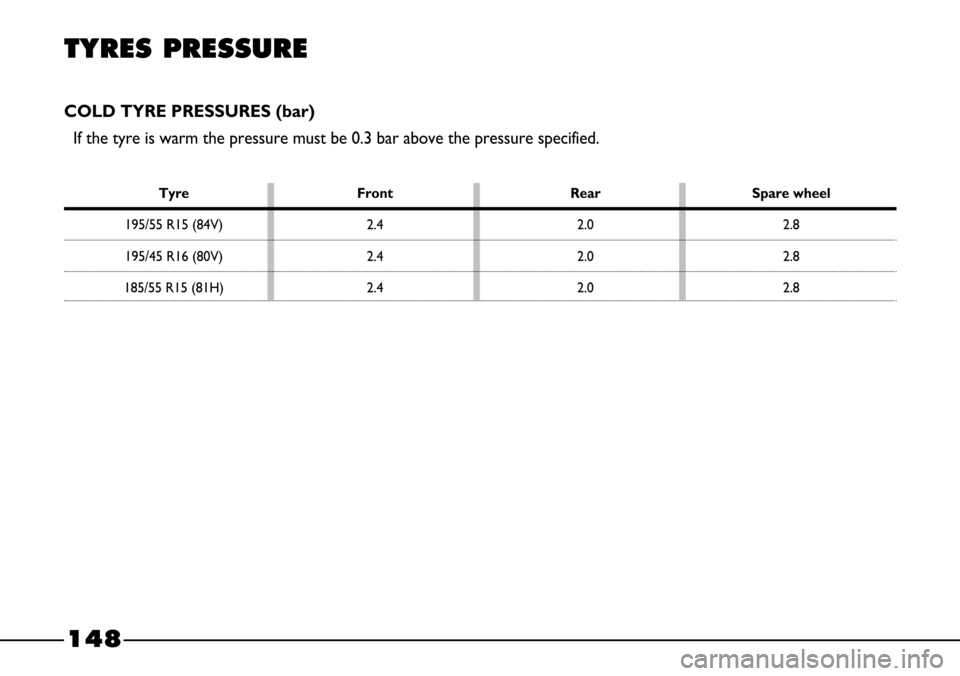
TYRES PRESSURE
COLD TYRE PRESSURES (bar)
If the tyre is warm the pressure must be 0.3 bar above the pressure specified.
Tyre Front Rear Spare wheel
195/55 R15 (84V) 2.4 2.0 2.8
195/45 R16 (80V) 2.4 2.0 2.8
185/55 R15 (81H) 2.4 2.0 2.8