light FIAT BARCHETTA 2003 1.G Service Manual
[x] Cancel search | Manufacturer: FIAT, Model Year: 2003, Model line: BARCHETTA, Model: FIAT BARCHETTA 2003 1.GPages: 170, PDF Size: 3.55 MB
Page 79 of 170
78
CONDITIONS OF USE
Cold starting
Frequent cold starting will not enable
the engine to reach optimal running
temperature. It follows therefore that
consumption will be higher (from
+15% to +30% in towns) as will the
production of toxic emissions.
Traffic and road conditions
Heavy traffic and higher consumption
are synonymous; for example, when
driving slowly with frequent use of the
lower gears or in large towns where
there are numerous traffic lights.
Winding roads, mountain roads and
bumpy roads also have a negative ef-
fect on consumption.
Enforced halts
During prolonged hold-ups (traffic
lights, level crossings) the engine
should be switched off.CHEAP RUNNING THAT RESPECTS
THE ENVIRONMENT
LOOKING AFTER EMISSION
CONTROL DEVICES
The correct use of pollution control
devices not only ensures respect for
the environment but also has an effect
on the car’s performance.
Keeping these devices in good con-
dition is therefore a fundamental rule
for driving that is easy on your pock-
et and on the environment too.
The first step to take is to follow the
Service Schedule to the letter.
Use only unleaded petrol in petrol
engines.
If you have trouble starting, do not
keep turning the ignition key for long
periods. Be especially careful to avoid
bump starting the car by pushing, tow-
ing or rolling down hill: these are all
manoeuvres that can damage the cat-
alytic exhaust. For emergency starts
use only an auxiliary battery. Environmental protection has been
one of the guiding principles in the
production of the Fiat barchetta. It is
no accident that its pollution control
equipment is much more effective than
that required by current legislation.
Nonetheless, the environment can-
not get by without a concerted effort
from everyone.
By following a few simple rules you
can avoid harming the environment
and often cut down fuel consumption
at the same time.
On this subject, a few useful tips have
been given below to supplement those
marked by symbol #, at various points
of the handbook.
You are asked to read both the for-
mer and latter carefully.
Page 80 of 170
79
If the engine begins to “lose its
smoothness” when travelling, contin-
ue your journey but reduce the
demands you are making on the
engine and have the car seen to at a
Fiat Dealership.
When the instrument panel fuel
reserve warning light Kcomes on, fill
up as soon as possible. A low level of
fuel can cause an uneven supply of
fuel to the engine with the inevitable
increase in the temperature of the
exhaust gas and serious damage to
the catalytic converter.
Never run the engine with one or
more spark plugs disconnected, even
for testing purposes.
Do not warm up the engine by let-
ting it idle for a while before moving
off unless the outside temperature is
very low and, even in this case, only
do so for less than thirty seconds.TOWING
A TRAILER
IMPORTANT
The car must be fitted with a
homologated tow hitch and suitable
electrical system for towing a cara-
van or trailer. Have the tow hitch fit-
ted by an expert who will issue spe-
cific documentation for use on
roads.
Fit special and/or additional
rearview mirrors in accordance with
the highway code.
Remember that towing a trailer
makes it harder for the car to climb
the maximum gradients specified,
increases braking and overtaking dis-
tance, proportionally to the overall
weight of the trailer.
The weight the trailer exerts on
the car’s tow hitch coupling reduces
the car’s loading capacity by the
same amount. Do not install other heat shields
and do not remove those already fit-
ted to the catalytic converter and
exhaust pipe.
Do not allow anything to be
sprayed onto the catalytic converter,
lambda sensor and exhaust pipe.
When functioning normal-
ly the catalytic converter
develops high temperatures. For
this reason do not park the car
over inflammable material (grass,
dry leaves, pine needles, etc.): fire
hazard.
WARNING
Failure to heed these pre-
cautions could cause a
fire.
WARNING
Page 82 of 170
81
VEHICLE
STORAGE
Do the following if the car is not to
be used for several months:
– Park the car with the hood closed
in covered, dry and if possible well-
ventilated premises.
– Engage a gear.
– Make sure the handbrake is not
engaged.
– Disconnect the terminals from
the battery poles (negative pole first)
and check the battery charge. When
the vehicle is in storage, this check
should be carried out once a month.
If the no-load voltage is less than
12.5V, recharge the battery.– Inflate the tyres to 0.5 bar above
the normal specified pressure and
check it at intervals.
– Check battery charge once a
month.
– Do not drain the engine cooling
system. IMPORTANTIf the car is fitted
with an electronic car alarm, turn off
the alarm with the remote control
and deactivate the system by turning
the emergency key to “OFF”(see
the “Electronic alarm” in the
“Getting to know your car” section).
– Clean and protect the painted
parts using a protective wax.
– Clean and protect the shiny metal
parts using special compounds avail-
able on the market.
– Sprinkle talcum powder on the
rubber windscreen wiper blades and
lift them off the glass.
– Open the windows slightly.
– Cover the car with a cloth or
perforated plastic sheet. Do not use
sheets of imperforated plastic as
they do not allow moisture on the
car body to evaporate.
Page 84 of 170
83
IN AN EMERGENCY
People who find themselves in an emergency situa-
tion need immediate and concrete help.
The following pages have been written to help you if
the need arises.
As you will see, a host of little snags have been tak-
en into account and, for each of them, the measures
you yourself can take are suggested. If the problems are
more serious however, you should have the car seen
to at a Fiat Dealership.
With regard to this, we would like to remind you that,
in addition to the Owner Handbook, you have also been
provided with the WARRANTY BOOKLET where you
will find details of all the services Fiat can provide should
you find yourself in difficulty.
We nevertheless recommend you read these pages.
If in need you will be able to find the information you
require much more quickly.EMERGENCY START-UP ................................................. 84
JUMP STARTING ................................................................ 85
BUMP STARTING .............................................................. 86
IF A TYRE IS PUNCTURED ............................................ 86
IF A BULB BURNS OUT .................................................. 91
IF AN EXTERIOR LIGHT BURNS OUT ...................... 93
IF AN INTERIOR LIGHT BURNS OUT ....................... 98
IF A FUSE BLOWS ............................................................. 98
IF THE BATTERY IS FLAT ............................................... 105
IF THE CAR NEEDS TO BE RAISED ............................ 106
IF THE CAR NEEDS TO BE TOWED .......................... 108
IF AN ACCIDENT OCCOURS ...................................... 109
Page 85 of 170
84
EMERGENCY
START-UP
If the Fiat CODE system cannot de-
activate the engine immobiliser, the
warning lights ¢and
Uwill remain
lit and the engine will not start. To
start your car, follow the emergency
startup procedure.
Read the whole procedure care-
fully before trying to carry it out.
If you make a mistake in the emer-
gency procedure you must turn the ig-
nition key back toSTOPand repeat
the whole operation from the begin-
ning, step 1).
1)Read the 5-figure electronic code
given on the CODE card.
2) Turn the ignition key to MAR.
3)Press the accelerator pedal to the
floor and keep it there. The injection
warning lamp
Uwill light up for about
8 seconds, and then go out. At this
point release the accelerator pedal and
get ready to count the flashes of warn-
ing lamp
U.4) Count the number of flashes that
corresponds to the first figure of the
code on the CODE card, then press
the accelerator pedal and keep it there
until the warning lamp
Ulights up for
four seconds and then goes out again.
Release the accelerator pedal.
5)The warning lamp
Uwill start
flashing again: when the lamp has
flashed the number of times that cor-
responds to the second figure on the
CODE card, press the accelerator
pedal to the floor and keep it there.
6) Do the same for the remaining fig-
ures on the CODE card.
7) Once the final figure has been en-
tered, keep the accelerator pedal
pressed. The warning lamp
Uwill
light up for 4 seconds and then go out.
Release the accelerator pedal.
8) The warning lamp
Uwill flash
rapidly for about 4 seconds to indicate
that the operation has been complet-
ed correctly.9)Turn on the engine by turning the
ignition key from the MARto the
AVVposition.
If however indicator light
Ustays
on, turn the ignition key to STOPand
repeat the procedure starting from
point 1).
IMPORTANT After emergency
starting the car you should have it seen
to at a Fiat Dealershipbecause the
emergency procedure will have to be
repeated each time you start the en-
gine otherwise.
Page 86 of 170
85
Under no circumstances
should a battery charger
be used to start the en-
gine: it could damage the elec-
tronic systems and in particular
the control units governing igni-
tion and fuel feed.
JUMP STARTING
If the battery is flat, you can use an-
other battery to start the engine. Its
capacity must be the same or slightly
greater than the flat battery (see the
chapter “Technical specifications”).
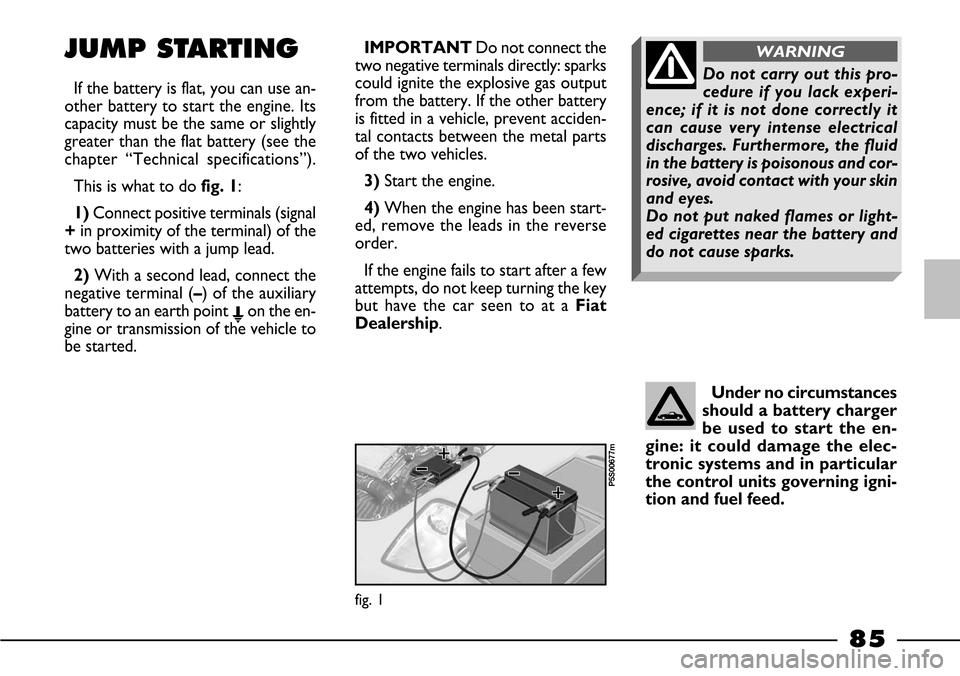
This is what to do fig. 1:
1)Connect positive terminals (signal
+in proximity of the terminal) of the
two batteries with a jump lead.
2)With a second lead, connect the
negative terminal (–) of the auxiliary
battery to an earth point Eon the en-
gine or transmission of the vehicle to
be started.IMPORTANTDo not connect the
two negative terminals directly: sparks
could ignite the explosive gas output
from the battery. If the other battery
is fitted in a vehicle, prevent acciden-
tal contacts between the metal parts
of the two vehicles.
3)Start the engine.
4)When the engine has been start-
ed, remove the leads in the reverse
order.
If the engine fails to start after a few
attempts, do not keep turning the key
but have the car seen to at a Fiat
Dealership.
fig. 1
P5S00677m
Do not carry out this pro-
cedure if you lack experi-
ence; if it is not done correctly it
can cause very intense electrical
discharges. Furthermore, the fluid
in the battery is poisonous and cor-
rosive, avoid contact with your skin
and eyes.
Do not put naked flames or light-
ed cigarettes near the battery and
do not cause sparks.
WARNING
Page 87 of 170
86
Observe the instructions on this and
the following pages to use the jack and
space-saver spare wheel correctly.
BUMP STARTING IF A TYRE
IS PUNCTURED
General instructions
Do not bump start by
pushing, towing or coast-
ing downhill. This way of
starting could cause a rush of fu-
el into the catalytic exhaust pipe
and damage it beyond repair.
Signal the presence of the
stopped vehicle according
to the laws in force (e.g. hazard
lights, reflecting triangle, etc.).
Any passengers on board should
leave the vehicle, especially if it is
heavily laden. Passengers should
stay away from oncoming traffic
while the wheel is being changed.
If the wheel is being changed on a
steep or badly surfaced road, place
wedges or other suitable material
under the wheels to stop the vehi-
cle.
WARNING
Remember that if the en-
gine is not running, the
brake booster will not work. You
therefore have to use considerably
more effort on the brake pedal.
WARNING
The space-saver spare
wheel is vehicle-specific.
Never use the wheel on other mod-
els. Never use other model spare
wheels on your vehicle.
If you change the type of wheels
(alloy rims instead of steel rims) you
will have to change the entire set of
fastening bolts with another set of
suitably sized bolts.
Only use the spare-saver wheel for
emergencies.
With the spare wheel do not exceed
80 kph.
An orange sticker is attached to the
spare wheel giving the main in-
structions for its use and limitations.
The sticker must never be re-
moved or covered.
Do not fit the hub cap to the
spare wheel.
WARNING
Page 90 of 170
89
Depending on whether the normal
wheels are fitted with steel or light al-
loy rims, the spare wheel (always
made of steel) differs in order to be
compatible with the wheel bolts which
are specific for each of the two types
of rim.
If the type of wheel to be used is to
be changed (alloy rims in place of steel
rims and vice-versa) the bolts must al-
so be changed and a specific spare
wheel adopted.
Keep the bolts and the spare wheel
as they are essential if the original
wheels are to be refitted at some time
in the future. 9) Warn anyone nearby that the ve-
hicle is about to be lifted. They must
stay clear and not touch the vehicle
until it is back on the ground.
10) Turn the jack handle and raise
the car until the wheel is a few cen-
timetres above the ground.
The jack handle must turn freely,
without touching the ground to avoid
scraping your hands. Do not touch the
moving parts of the jack as they can
cause injuries. If you dirty your hands
with grease, clean them carefully.
11) Fully unscrew the 4 bolts, re-
move the wheel and, where provided
recover the wheel hub cap.
12)Make sure the surfaces of the
space-saver spare wheel that come in-
to contact with the hub are clean and
free from any impurities which could
result in the wheel bolts working
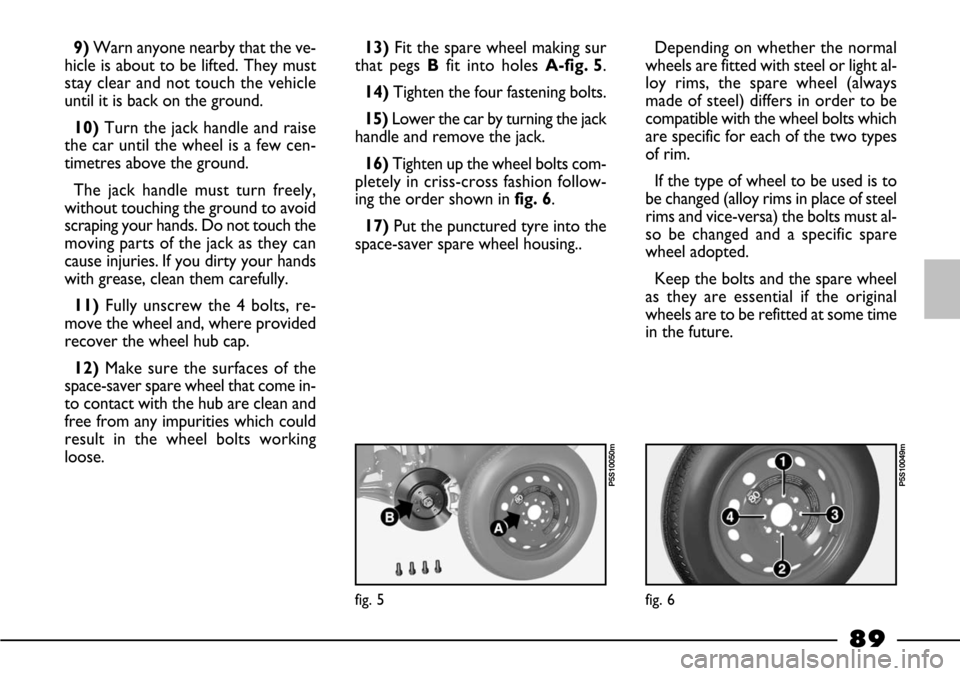
loose.13)Fit the spare wheel making sur
that pegs Bfit into holes A-fig. 5.
14) Tighten the four fastening bolts.
15) Lower the car by turning the jack
handle and remove the jack.
16)Tighten up the wheel bolts com-
pletely in criss-cross fashion follow-
ing the order shown in fig. 6.
17) Put the punctured tyre into the
space-saver spare wheel housing..
fig. 5
P5S10050m
fig. 6
P5S10049m
Page 92 of 170
91
IF A BULB
BURNS OUT
You should, where pos-
sible, have your bulbs
changed at a Fiat Dealer-
ship. Correct operation of exter-
nal light beams are essential for
safe driving and compliance with
legal requirements.Only touch the metal
part when handling halo-
gen bulbs. If the transpar-
ent bulb is touched it reduces the
intensity of the light emitted and
can also reduce the life of the
bulb. If you touch the bulb acci-
dentally, rub it with a cloth moist-
ened with alcohol and leave it to
dry.
GENERAL INSTRUCTIONS
– When a light is not working, check
that it has not fused before changing
the bulb.
– For the location of the fuses, re-
fer to “If a fuse blows” in this section.
– Before replacing a bulb that does
not work, check that the contacts are
not oxidised.
– Burnt out bulbs must be replaced
with ones of the same type.
– Always check the height of the
headlight beam after changing a bulb
for safety purposes.
Halogen bulbs contain
pressurised gas which, if
broken, may cause small fragments
of glass to be projected outwards.
WARNING
Modifications or repairs to
the electrical system car-
ried out incorrectly and without
bearing the features of the system
in mind can cause malfunctions
with the risk of fire.
WARNING
Page 93 of 170
92
TYPES OF BULBS
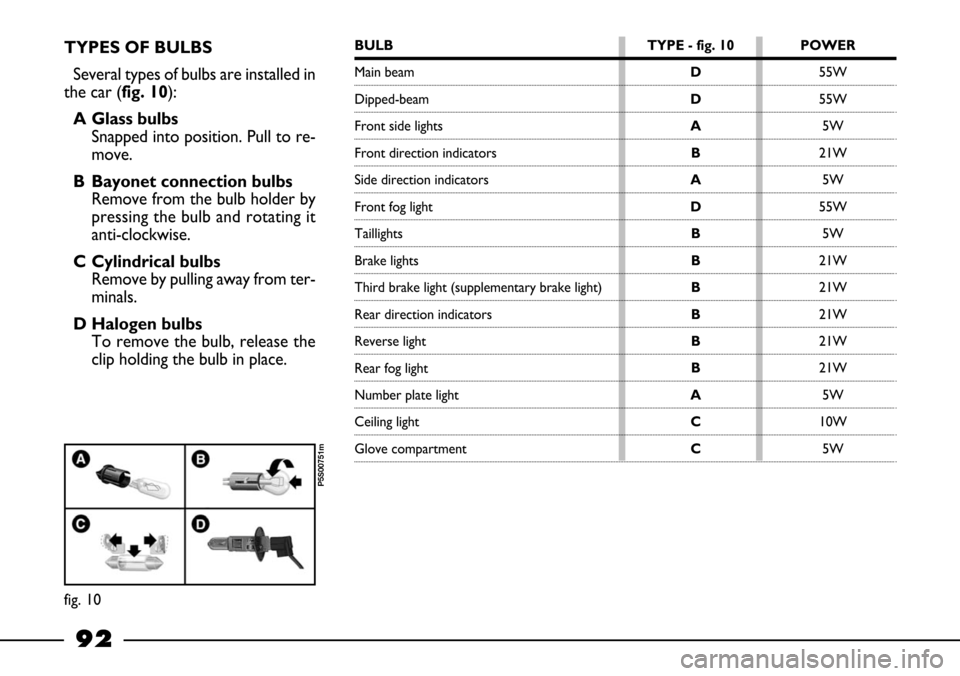
Several types of bulbs are installed in
the car (fig. 10):
A Glass bulbs
Snapped into position. Pull to re-
move.
B Bayonet connection bulbs
Remove from the bulb holder by
pressing the bulb and rotating it
anti-clockwise.
C Cylindrical bulbs
Remove by pulling away from ter-
minals.
D Halogen bulbs
To remove the bulb, release the
clip holding the bulb in place.
fig. 10
P5S00751m
D55W
D55W
A5W
B21W
A5W
D55W
B5W
B21W
B21W
B21W
B21W
B21W
A5W
C10W
C5W
BULB TYPE - fig. 10 POWER
Main beam
Dipped-beam
Front side lights
Front direction indicators
Side direction indicators
Front fog light
Taillights
Brake lights
Third brake light (supplementary brake light)
Rear direction indicators
Reverse light
Rear fog light
Number plate light
Ceiling light
Glove compartment