instrument panel FIAT BRAVO 2014 2.G Owner's Manual
[x] Cancel search | Manufacturer: FIAT, Model Year: 2014, Model line: BRAVO, Model: FIAT BRAVO 2014 2.GPages: 275, PDF Size: 3.95 MB
Page 104 of 275
TPMS (Tyre Pressure Monitoring
System)(for versions/markets, where provided)
The car may be fitted with a tyre pressure
monitoring system (TPMS), which informs the driver
of the tyre inflation status via the "Check tyre
pressure" and "Low tyre pressure" messages on the
display. For a detailed description of the two
messages, see the "Warning lights and messages"
chapter.
The system comprises a radio-frequency transmitter
fitted to each wheel (on the wheel rim inside the
tyre), which is able to send information on the tyre
inflation pressure of each wheel to the control unit.
WARNING
The presence of the TPMS does not
permit the driver to neglect regular
checking of the pressure of the tyres and the
spare wheel (see "Wheels" in the "Maintenance
and care" chapter).
WARNING
Sensor malfunctioning fault indications are not stored
and will therefore not be displayed after the engine
has been switched off and then on again. If the
fault conditions persist, the control unit will send the
relative indications to the instrument panel only
after the vehicle has been in motion for a short time.Tyre pressure must be checked with tyres rested and
cold. Should it become necessary for whatever
reason to check pressure with warm tyres, do not
reduce pressure even though it is higher than the
prescribed value, but repeat the check when tyres
are cold (see "Wheels" in the "Technical data"
chapter).
The TPMS is not able to warn you of sudden tyre
pressure losses (for example when a tyre bursts). In
this case, stop the car, braking with caution and
avoiding abrupt steering.
Particularly strong radio-frequency interference may
cause the TPMS to function incorrectly. This
condition is indicated to the driver by a warning light
or symbol lighting up on the instrument panel
together with a dedicated message. The message will
disappear automatically as soon as the radio-
frequency interference ceases to affect the system.
The TPMS requires the use of specific equipment.
Contact a Fiat Dealership to find out which
accessories are compatible with the system (wheels,
hub caps, etc.). Using other accessories may hinder
the normal operation of the system. Given the
unique valve specifications, only use Fiat-approved
sealers to repair the tyres. The use of other sealers
may prevent the normal operation of the system.
100GETTING TO
KNOW YOUR CAR
SAFETY
STARTING AND
DRIVING
WARNING LIGHTS
AND MESSAGES
IN AN EMERGENCY
SERVICING AND
MAINTENANCE
TECHNICAL
SPECIFICATIONS
INDEX
Page 105 of 275
If the vehicle is fitted with TPMS, when a tyre is
removed, it is advisable to replace the rubber gasket
for the valve as well as the ring nut fixing the sensor.
Have this operation performed at a Fiat Dealership.
If the punctured tyre indication persists on the
instrument panel after the initial conditions have
been restored using the tyre repair kit ("Fix&Go
Automatic"), contact a Fiat Dealership.
Changes in outside temperature may cause tyre
pressures to vary. The TPMS may temporarily
indicate insufficient pressure. In this case, check the
tyre pressure when cold and, if necessary, restore
the inflation values.
If the vehicle is fitted with TPMS, tyre and/or rims
fitting/removal operations require specific
precautions. To avoid damaging the sensors or fitting
them incorrectly, tyre and/or rims fitting/removal
operations should be carried out only by specialists.
Contact a Fiat Dealership.
The tyre repair kit ("Fix&Go Automatic")
provided with the car is compatible with
the TPMS sensors; using sealants not
equivalent with that in the original kit may
adversely affect its operation. If sealants not
equivalent with the original one are used, it
is recommended to have the TPMS sensors
checked by a qualified repair centre.
101GETTING TO
KNOW YOUR CARSAFETY
STARTING AND
DRIVING
WARNING LIGHTS
AND MESSAGES
IN AN EMERGENCY
SERVICING AND
MAINTENANCE
TECHNICAL
SPECIFICATIONS
INDEX
Page 110 of 275
SENSOR OPERATING RANGE
The sensors allow the system to check the front part
(version with 8 sensors) and rear part of the vehicle.
Their position covers the middle and side areas of
the front and rear of the vehicle.
If an obstacle is located in a middle area, it is
detected when the distance is less than about 0.9 m
(front) and 1.40 m (rear).
If the obstacle is located at the side, it is detected at
distances of less than 0.6 m.
OPERATION WITH TRAILER
The operation of the sensors is automatically
deactivated when the trailer's electric cable plug is
inserted in the car's tow hook socket.
The sensors are automatically enabled again when
the trailer's cable plug is removed.
IMPORTANT If you wish to leave the tow hook
fitted when there is no trailer, it is advisable to
contact a Fiat Dealership to have the system updated
because the tow hook could be detected as an
obstacle by the central sensors.FAILURE INDICATIONS
Any failures in the parking sensor system are
signalled, when reverse gear is engaged, by the
warning light
in the instrument panel lighting up
or by the symbol
together with a message in the
display (see "Warning lights and messages" chapter).
GENERAL WARNINGS
During parking manoeuvres, pay the utmost
attention to any obstacles that could be located
above or below the sensors.
Under certain circumstances close objects located in
front of or behind the car may not be detected and
could therefore cause damage to the car or be
damaged themselves.
The following conditions may influence the
performance of the parking sensor system:
❒Reduced sensor sensitivity and a reduction in the
parking assistance system performance could be
due to the presence on the surface of the sensor
of: ice, snow, mud, thick paint.
❒The sensors may detect a non-existent obstacle
(echo interference) due to mechanical
interference, for example when washing the car, in
rain (strong wind), hail.
❒The signals sent by the sensors can also be altered
by the presence of ultrasonic systems (e.g.
pneumatic brake systems or pneumatic drills) near
the vehicle.
106GETTING TO
KNOW YOUR CAR
SAFETY
STARTING AND
DRIVING
WARNING LIGHTS
AND MESSAGES
IN AN EMERGENCY
SERVICING AND
MAINTENANCE
TECHNICAL
SPECIFICATIONS
INDEX
Page 113 of 275
PROTECTING THE ENVIRONMENTThe following devices are used for reducing diesel
fuel engine emissions:
❒oxidising catalytic converter
❒exhaust gas recirculation system (EGR)
❒particulate filter (DPF).
WARNING
Under normal operating conditions, the
silencer becomes very hot .Therefore
do not park the car on flammable materials
(grass, dry leaves, pine needles, etc .): fire
hazard.
DIESEL PARTICULATE FILTER (DPF)
(for versions/markets, where provided)
The Diesel Particulate Filter is a mechanical filter,
integral with the exhaust system, that physically traps
particulates present in the exhaust gases of diesel
engines. The diesel particulate filter has been
adopted to eliminate almost all particulates in
compliance with current / future legal regulations.
During normal use of the vehicle, the engine control
unit records a set of data (e.g.: travel time, type of
route, temperatures, etc.) and it will then calculate
how much particulate has been trapped by the filter.Since this filter physically traps particulate, it should
be regenerated (cleaned) at regular intervals by
burning the carbon particles. The regeneration
procedure is controlled automatically by the engine
management control unit according to the filter
conditions and vehicle use conditions. There may be
a limited increase in the engine speed during the
regeneration, a limited increase in fumes and high
temperatures at the exhaust. These are not faults;
they do not impair vehicle performance or damage
the environment.
Particulate filter clogged
If the warning light switches on on the instrument
panel (along with the message on the display) refer
to the "Warning lights and messages" chapter.
109GETTING TO
KNOW YOUR CARSAFETY
STARTING AND
DRIVING
WARNING LIGHTS
AND MESSAGES
IN AN EMERGENCY
SERVICING AND
MAINTENANCE
TECHNICAL
SPECIFICATIONS
INDEX
Page 116 of 275
Correct adjustment is obtained when the belt passes
approximately half way between the shoulder and
the neck.
WARNING
Make height adjustment of the seat
belts when the car is stationary.
WARNING
After adjustment , always check that the
cursor to which the ring is fastened is
locked in one of the preset positions.To do this,
with the button A fig. 101 released, exert a
fur ther pressure to allow the anchor device to
catch if release did not take place at one of the
preset positions.
SBR SYSTEMThis system consists of a buzzer which, in
conjunction with the
warning light flashing on the
instrument panel (initially in fixed mode with
continuous acoustic signal and then in flashing mode
with intermittent acoustic signal), warns the driver
and front passenger that their seat belts have not
been fastened.
For long-term deactivation of the SBR system,
contact a Fiat Dealership. The SBR system can be
reactivated at any time through the Setup Menu only
(see the "Menu Items" paragraph in the "Knowing
your car" chapter).
112GETTING TO KNOW
YOUR CAR
SAFETY
STARTING AND
DRIVING
WARNING LIGHTS
AND MESSAGES
IN AN EMERGENCY
SERVICING AND
MAINTENANCE
TECHNICAL
SPECIFICATIONS
INDEX
Page 129 of 275
WARNING
Fit the child restraint system according
to the instructions, which must be
included.
Main recommendations to carry children
safely:
❒Install the child restraint systems on the rear seat,
which is the most protected position in the event
of an accident.
❒Keep children in rear facing restraint systems for as
long as possible, until 3–4 years old if possible.
❒Should a rear facing child restraint system be
installed on the rear seats, it is advisable to
position it as far forward as the position of the
front seat allows.
❒If the passenger's front airbag is deactivated always
check the warning light on the instrument panel
to make sure that it has actually been deactivated.
❒Carefully follow the child restraint manufacturer's
instruction supplied with the child restraint
system. Keep the instructions in the car along with
the other documents and this handbook. Do not
use second-hand child restraint systems without
instructions.
❒Only one child is to be strapped into each
retaining system; never carry two children using
one child restraint system.❒Always check that the seat belts do not interfere
with the child's throat.
❒Always check that the seat belt is well fastened by
pulling on it.
❒While travelling, do not let the child sit incorrectly
or unfasten the belts.
❒Never allow a child to put the belt's diagonal
section under an arm or behind their back.
❒Never carry children on your lap, even newborns.
No-one can restrain a child in the event of an
accident.
❒In the event of an accident, replace the child
restraint system with a new one.
125GETTING TO KNOW
YOUR CARSAFETYSTARTING AND
DRIVING
WARNING LIGHTS
AND MESSAGES
IN AN EMERGENCY
SERVICING AND
MAINTENANCE
TECHNICAL
SPECIFICATIONS
INDEX
Page 134 of 275
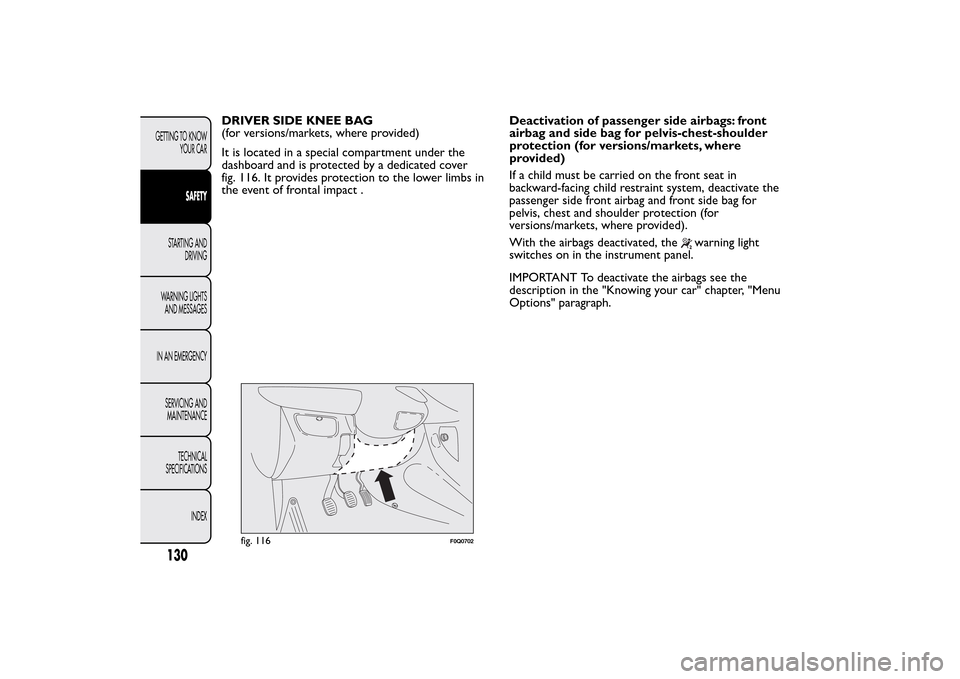
DRIVER SIDE KNEE BAG
(for versions/markets, where provided)
It is located in a special compartment under the
dashboard and is protected by a dedicated cover
fig. 116. It provides protection to the lower limbs in
the event of frontal impact .Deactivation of passenger side airbags: front
airbag and side bag for pelvis-chest-shoulder
protection (for versions/markets, where
provided)
If a child must be carried on the front seat in
backward-facing child restraint system, deactivate the
passenger side front airbag and front side bag for
pelvis, chest and shoulder protection (for
versions/markets, where provided).
With the airbags deactivated, the
warning light
switches on in the instrument panel.
IMPORTANT To deactivate the airbags see the
description in the "Knowing your car" chapter, "Menu
Options" paragraph.
AU
TO
fig. 116
F0Q0702
130GETTING TO KNOW
YOUR CAR
SAFETY
STARTING AND
DRIVING
WARNING LIGHTS
AND MESSAGES
IN AN EMERGENCY
SERVICING AND
MAINTENANCE
TECHNICAL
SPECIFICATIONS
INDEX
Page 139 of 275
STARTING AND DRIVING
STARTING THE ENGINEThe car is fitted with an electronic engine lock
device: if the engine fails to start, see the paragraph
“The Fiat CODE system” in the section “Knowing
your car”.
Engine starting is guaranteed to -18°C (Italy and
central Europe) and -20°C (Northern Europe).
We recommend that during the initial
period you do not demand to full
performance from the car (e.g. excessive
acceleration, long journeys at top speed, sharp
braking etc .).When the engine is switched off never
leave the key turned to MAR to prevent
useless current absorption from draining
the battery.
WARNING
It is dangerous to have the engine
running indoors.The engine consumes
oxygen and engine exhaust contains carbon
dioxide, carbon monoxide and other toxic
gasses.
WARNING
Remember that the brake servo and
power steering are not operational until
the engine has been started, therefore much
effort than usual is required on the brake pedal
and steering wheel.
STARTING PROCEDURE FOR DIESEL
VERSIONS
Proceed as follows:
❒engage the handbrake and place the gear lever in
neutral;
❒turn the ignition key to MAR: the warning lightsand
on the instrument panel will turn on;
❒wait for the warning lights
and
to switch
off;
❒press the clutch pedal down to the floor without
touching the accelerator;
❒turn the ignition key to AVV as soon as warning
light
switches off. Waiting too long will waste
the heating work carried out by the glow plugs.
Release the key as soon as the engine starts.
IMPORTANT With cold engine, the accelerator must
be entirely released when turning the ignition key
to position AVV.
135GETTING TO KNOW
YOUR CAR
SAFETYSTARTING AND
DRIVINGWARNING LIGHTS
AND MESSAGES
IN AN EMERGENCY
SERVICING AND
MAINTENANCE
TECHNICAL
SPECIFICATIONS
INDEX
Page 140 of 275
If the engine does not start at the first attempt,
return the ignition key to STOP before attempting to
start again.
If, when the ignition key is at MAR-ON the
warning light remains lit, turn the key to STOP
and then back to MAR-ON. If the warning light
remains lit, try with the other keys provided with the
car.
If you still cannot start the engine, contact a Fiat
Dealership.
Warning light
will flash for 60 seconds
after starting or during prolonged
cranking to indicate a fault with the glow
plug heating system.You can use the car as usual
if the engine starts but you should contact a
Fiat Dealership as soon as possible.
When the engine is switched off never
leave the key turned to MAR to prevent
useless current absorption from draining
the battery.
HOW TO WARM UP THE ENGINE AFTER IT
HAS JUST STARTED
Proceed as follows:
❒Drive off slowly, letting the engine turn at medium
revs. Do not accelerate abruptly;
❒Do not demand full performance at first. Wait
until the engine coolant temperature gauge starts
moving.
Never jump start the engine by pushing,
towing or coasting downhill.This could
cause fuel to flow into the catalytic
converter and damage it beyond repair.
EMERGENCY START-UP
Contact a Fiat Dealership if instrument panel
warning light
(or the symbol on the display) stays
on constantly.
STOPPING THE ENGINE
Turn the ignition key to STOP while the engine is
idling.
IMPORTANT After a taxing drive, you should allow
the engine to “catch its breath” before turning it
off by letting it idle to allow the temperature in the
engine compartment to fall.
A quick burst on the accelerator before
stopping the engine serves no practical
purpose; it wastes fuel and is especially
damaging to turbocharged engines.
136GETTING TO KNOW
YOUR CAR
SAFETYSTARTING AND
DRIVINGWARNING LIGHTS
AND MESSAGES
IN AN EMERGENCY
SERVICING AND
MAINTENANCE
TECHNICAL
SPECIFICATIONS
INDEX
Page 141 of 275
PARKINGProceed as follows:
❒stop the engine and engage the handbrake;
❒engage a gear (on a slope, engage first gear if the
car is facing uphill or reverse if it is facing
downhill) and leave the wheels steered.
Block the wheels with a wedge or a stone if the car
is parked on a steep slope.
Do not leave the key in the ignition switch to
prevent the battery from running down.
WARNING
Never leave children unattended in the
car. Always remove the key from the
ignition when leaving the car and take it with
you.
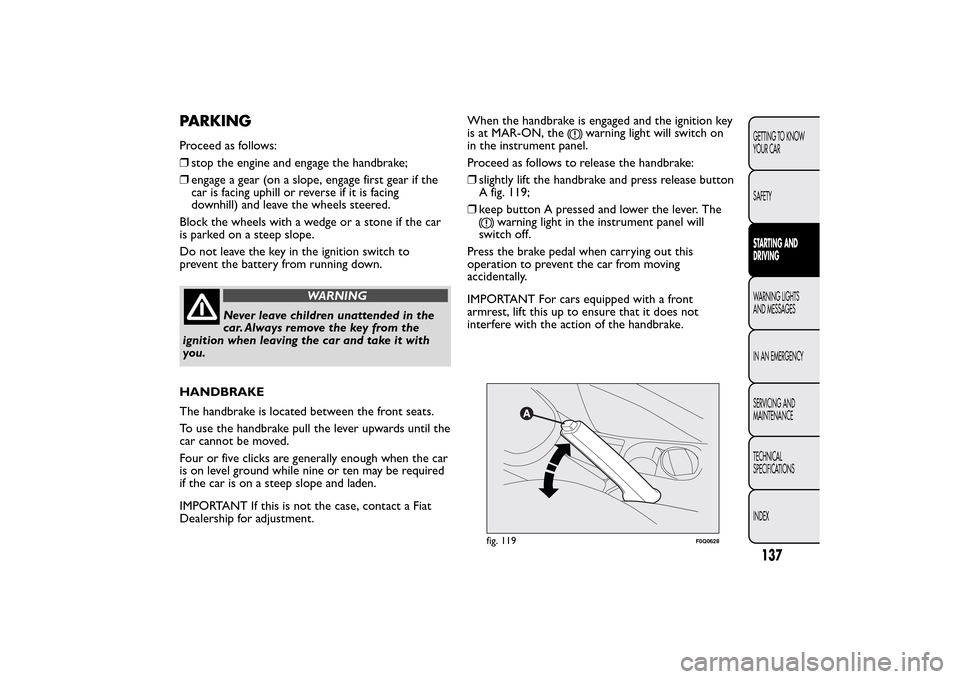
HANDBRAKE
The handbrake is located between the front seats.
To use the handbrake pull the lever upwards until the
car cannot be moved.
Four or five clicks are generally enough when the car
is on level ground while nine or ten may be required
if the car is on a steep slope and laden.
IMPORTANT If this is not the case, contact a Fiat
Dealership for adjustment.When the handbrake is engaged and the ignition key
is at MAR-ON, the
warning light will switch on
in the instrument panel.
Proceed as follows to release the handbrake:
❒slightly lift the handbrake and press release button
A fig. 119;
❒keep button A pressed and lower the lever. The
warning light in the instrument panel will
switch off.
Press the brake pedal when carrying out this
operation to prevent the car from moving
accidentally.
IMPORTANT For cars equipped with a front
armrest, lift this up to ensure that it does not
interfere with the action of the handbrake.fig. 119
F0Q0628
137GETTING TO KNOW
YOUR CAR
SAFETYSTARTING AND
DRIVINGWARNING LIGHTS
AND MESSAGES
IN AN EMERGENCY
SERVICING AND
MAINTENANCE
TECHNICAL
SPECIFICATIONS
INDEX