Electric FIAT CROMA 2006 2.G User Guide
[x] Cancel search | Manufacturer: FIAT, Model Year: 2006, Model line: CROMA, Model: FIAT CROMA 2006 2.GPages: 240, PDF Size: 7.41 MB
Page 94 of 240
94
SAFETY
DEVICES
CORRECT USE
OF THE CAR
WARNING
LIGHTS AND
MESSAGES
IN AN
EMERGENCY
CAR
MAINTENANCE
TECHNICAL
SPECIFICATIONS
INDEX
DASHBOARD
AND CONTROLS
PARKING SENSORS
(where provided)
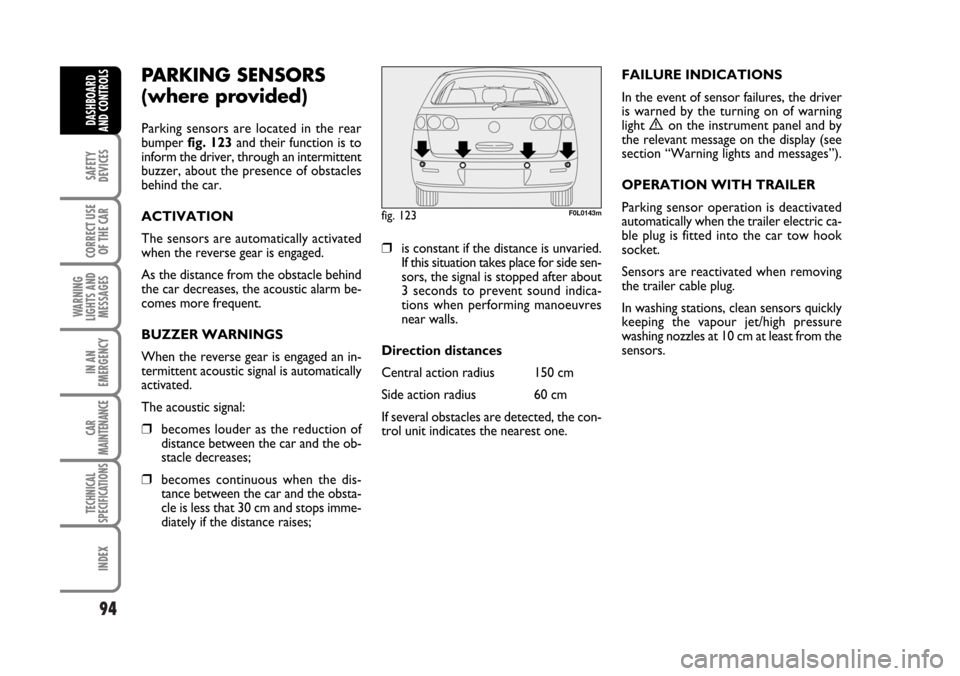
Parking sensors are located in the rear
bumper fig. 123and their function is to
inform the driver, through an intermittent
buzzer, about the presence of obstacles
behind the car.
ACTIVATION
The sensors are automatically activated
when the reverse gear is engaged.
As the distance from the obstacle behind
the car decreases, the acoustic alarm be-
comes more frequent.
BUZZER WARNINGS
When the reverse gear is engaged an in-
termittent acoustic signal is automatically
activated.
The acoustic signal:
❒becomes louder as the reduction of
distance between the car and the ob-
stacle decreases;
❒becomes continuous when the dis-
tance between the car and the obsta-
cle is less that 30 cm and stops imme-
diately if the distance raises;
❒is constant if the distance is unvaried.
If this situation takes place for side sen-
sors, the signal is stopped after about
3 seconds to prevent sound indica-
tions when performing manoeuvres
near walls.
Direction distances
Central action radius 150 cm
Side action radius 60 cm
If several obstacles are detected, the con-
trol unit indicates the nearest one.
fig. 123F0L0143m
FAILURE INDICATIONS
In the event of sensor failures, the driver
is warned by the turning on of warning
light
èon the instrument panel and by
the relevant message on the display (see
section “Warning lights and messages”).
OPERATION WITH TRAILER
Parking sensor operation is deactivated
automatically when the trailer electric ca-
ble plug is fitted into the car tow hook
socket.
Sensors are reactivated when removing
the trailer cable plug.
In washing stations, clean sensors quickly
keeping the vapour jet/high pressure
washing nozzles at 10 cm at least from the
sensors.
062-098 Croma TRW GB 20-11-2006 15:01 Pagina 94
Page 96 of 240
96
SAFETY
DEVICES
CORRECT USE
OF THE CAR
WARNING
LIGHTS AND
MESSAGES
IN AN
EMERGENCY
CAR
MAINTENANCE
TECHNICAL
SPECIFICATIONS
INDEX
DASHBOARD
AND CONTROLS
MULTIJET ENGINES
If the outside temperature is very low, the
diesel thickens due to the formation of
paraffins and could clog the diesel fuel fil-
ter.
In order to avoid these problems, different
types of diesel are distributed according to
the season: summer type, winter type and
arctic type (cold, mountain areas).
If refuelling with diesel fuel not suitable for
the current temperature, mix diesel fuel
with DIESEL MIX additive in the propor-
tions stated on the can, putting first the
antifreeze in the tank and then the diesel
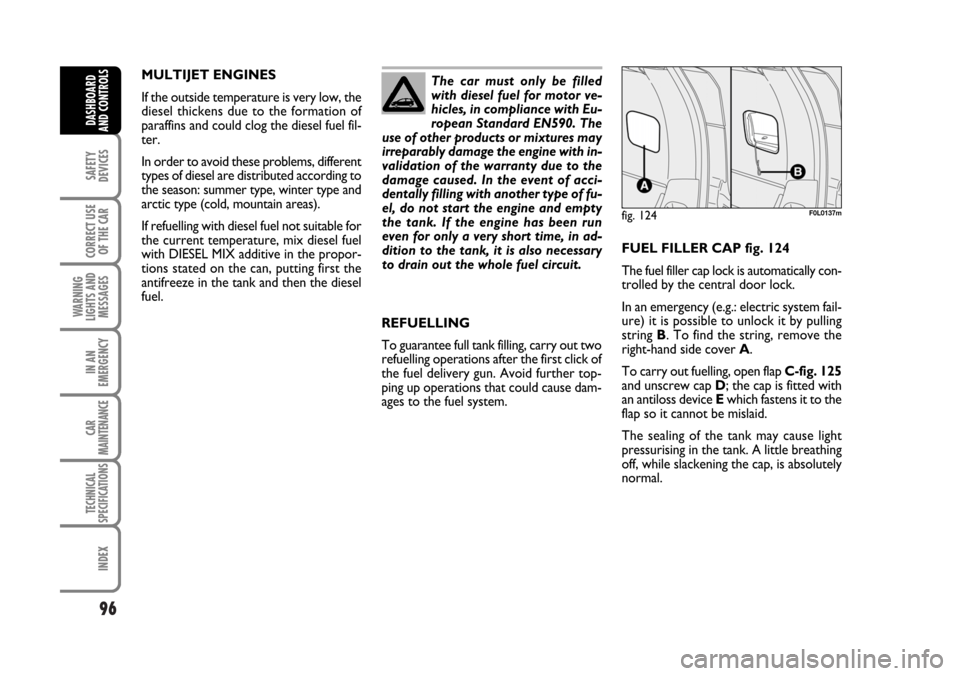
fuel.FUEL FILLER CAP fig. 124
The fuel filler cap lock is automatically con-
trolled by the central door lock.
In an emergency (e.g.: electric system fail-
ure) it is possible to unlock it by pulling
string B. To find the string, remove the
right-hand side cover A.
To carry out fuelling, open flap C-fig. 125
and unscrew cap D; the cap is fitted with
an antiloss device Ewhich fastens it to the
flap so it cannot be mislaid.
The sealing of the tank may cause light
pressurising in the tank. A little breathing
off, while slackening the cap, is absolutely
normal. The car must only be filled
with diesel fuel for motor ve-
hicles, in compliance with Eu-
ropean Standard EN590. The
use of other products or mixtures may
irreparably damage the engine with in-
validation of the warranty due to the
damage caused. In the event of acci-
dentally filling with another type of fu-
el, do not start the engine and empty
the tank. If the engine has been run
even for only a very short time, in ad-
dition to the tank, it is also necessary
to drain out the whole fuel circuit.
fig. 124F0L0137m
REFUELLING
To guarantee full tank filling, carry out two
refuelling operations after the first click of
the fuel delivery gun. Avoid further top-
ping up operations that could cause dam-
ages to the fuel system.
062-098 Croma TRW GB 20-11-2006 15:01 Pagina 96
Page 130 of 240
Roof rack/ski rack
Remove the roof rack or the ski rack from
the roof as soon as they are no longer
used. These accessories lower air pene-
tration and adversely affect consumption
levels. When needing to carry particular-
ly voluminous objects, preferably use a
trailer.
Electric devices
Use electric devices only for the amount
of time needed. Rear heated window, ad-
ditional headlights, windscreen wipers and
heater fan need a considerable amount of
energy, therefore increasing the require-
ment of current increases fuel consump-
tion (up to +25% in the urban cycle).
Climate control
The air conditioner is an additional load
which greatly affects the engine leading to
higher consumption (on average up to
+20%). When the temperature outside
the car permits it, use the air vents where
possible.
Spoilers
The use of non-certified aerodynamic
items may adversely affect air drag and
consumption levels.DRIVING STYLE
Starting
Do not warm the engine with the car at
a standstill or at idle or high speed: under
these conditions the engine warms up
much more slowly, increasing electrical
consumption and emissions. It is therefore
advisable to move off immediately, slow-
ly, avoiding high speeds. This way the en-
gine will warm faster.
Unnecessary actions
Avoid accelerating when waiting at traffic
lights or before switching off the engine.
This and also double declutching is ab-
solutely pointless on modern cars and al-
so increase consumption and pollution.
Gear selection
As soon as the conditions of the traffic and
road allow, use a higher gear. Using a low
gear to obtain brilliant performance in-
creases consumption.
In the same way improper use of a high
gear increases consumption, emissions an
engine wear.CONTAINING
RUNNING COSTS
Here are some suggestions which may
help you to keep the running costs of your
car down and lower the amount of toxic
emissions released into the atmosphere.
GENERAL CONSIDERATIONS
Car maintenance
Have checks and adjustments carried out
in accordance with the “Service schedule”.
Tyres
Check the pressure of the tyres routine-
ly at an interval of no more than 4 weeks:
if the pressure is too low, consumption
levels increase as resistance to rolling is
higher.
Unnecessary loads
Do not travel with too much luggage
stowed in the boot. The weight of the car
(especially when driving in town) and its
trim greatly affects consumption and sta-
bility.
130
WARNING
LIGHTS AND
MESSAGES
IN AN
EMERGENCY
CAR
MAINTENANCE
TECHNICAL
SPECIFICATIONS
INDEX
DASHBOARD
AND CONTROLS
SAFETY
DEVICES
CORRECT USE
OF THE CAR
Page 131 of 240
Traffic situations and road
conditions
Rather high consumption levels are tied to
situations with heavy traffic, for example
in queues with frequent use of the lower
gears or in cities with many traffic lights.
Also winding mountain roads and rough
road surfaces adversely affect consump-
tion.
Traffic hold-ups
During prolonged hold-ups (e.g.: level
crossings) the engine should be switched
off.TOWING TRAILERS
IMPORTANT NOTES
For towing caravans or trailers the car
must be fitted with a certified tow hook
and an adequate electric system. Installa-
tion should be carried out by specialised
personnel who release a special document
for circulation on the road.
Install any specific and/or additional rear-
view mirrors as specified by law.
Remember that when towing a trailer,
steep hills are harder to climb, the brak-
ing spaces increase and overtaking takes
longer depending on the overall weight.
Engage a low gear when driving downhill,
rather than constantly using the brake.
The weight the trailer exerts on the car
tow hook reduces by the same amount
the actual car loading capacity. To make
sure the maximum towable weight is not
exceeded (given in the log book) account
should be taken of the fully laden trailer,
including accessories and personal be-
longings. Top speed
Fuel consumption considerably increases
with speed. Avoid superfluous braking and
accelerating, which cost in terms of both
fuel and emissions.
Acceleration
Accelerating violently increasing the revs
will greatly affect consumption and emis-
sions: acceleration should be gradual and
should not exceed the maximum torque.
CONDITIONS OF USE
Cold starting
Short journeys and frequent cold starts do
not allow the engine to reach optimum
operating temperature. This results in a
significant increase in consumption levels
(from +15 to +30% on the urban cycle)
and emission of harmful substances.
131
WARNING
LIGHTS AND
MESSAGES
IN AN
EMERGENCY
CAR
MAINTENANCE
TECHNICAL
SPECIFICATIONS
INDEX
DASHBOARD
AND CONTROLS
SAFETY
DEVICES
CORRECT USE
OF THE CAR
Page 132 of 240

INSTALLING THE TOW HOOK
The towing device should be fastened to
the body by specialised personnel accord-
ing to any additional and/or integrative in-
formation supplied by the Manufacturer of
the device.
The towing device must meet current reg-
ulations with reference to 94/20/EC Di-
rective and subsequent amendments.
For any version the towing device used
must match the towable weight of the car
on which it is to be installed.
For the electric connection a unified con-
nector should be used which is generally
placed on a special bracket normally fas-
tened to the towing device, and a special
ECU for external trailer light control shall
be installed on the car.
For the electrical connection, 7 or 13 pin
12VDC connection is to be used (CU-
NA/UNI and ISO/DIN Standards). Follow
the instructions provided by the car man-
ufacturer and/or the tow hitch manufac-
turer.An electric brake should be supplied di-
rectly by the battery through a cable with
a cross section of no less than
2.5 mm
2.
IMPORTANT Electric brake or other de-
vice shall be used with running engine.
In addition to the electrical branches, the
car’s electric system can only be con-
nected to the supply cable for an electric
brake and to the cable for an internal light,
though not above 15W.
For connections use the preset control
unit with battery cable no less than 2.5
mm
2. Do not exceed the speed limits of the
country you are driving in. In any case do
not exceed 100 km/h.
It is recommended to use a proper tow-
ing stabiliser on the trailer drawbar.
132
WARNING
LIGHTS AND
MESSAGES
IN AN
EMERGENCY
CAR
MAINTENANCE
TECHNICAL
SPECIFICATIONS
INDEX
DASHBOARD
AND CONTROLS
SAFETY
DEVICES
CORRECT USE
OF THE CAR
The ABS system with which
the car may be fitted does
not control the trailer braking system.
Drive with extreme care on slippery
roadbeds.
WARNING
Under no circumstances
should the car brake system
be altered to control the trailer brake.
The trailer braking system must be
fully independent of the car hydraulic
system.
WARNING
Page 136 of 240
❒clean and protect the painted parts us-
ing protective wax;
❒clean and protect the shiny metal parts
using special compounds readily avail-
able;
❒sprinkle talcum powder on the rubber
windscreen and rear window wiper
blades and lift them off the glass;
❒slightly open the windows;
❒cover the car with a cloth or perfo-
rated plastic sheet. Do not use sheets
of non-perforated plastic as they do
not allow moisture on the car body to
evaporate;
❒inflate tyres to +0,5 bar above the
normal specified pressure and check it
at intervals;
❒if you don’t disconnect the battery
from the electric system, check its
charge every month and recharge it if
the optical indicator shows a dark
colour without the central green area;
❒do not drain the engine cooling sys-
tem.
IMPORTANT Where relevant, switch off
the car alarm with the remote control.
CAR INACTIVITY
If the car is to be left inactive for longer
than a month, the following precautions
should be noted:
❒park the car in covered, dry and if pos-
sible well-ventilated premises;
❒engage a gear (position P with auto-
matic transmission);
❒check that the handbrake is not en-
gaged;
❒disconnect battery terminals (first dis-
connect the negative terminal) and
check the battery charge. This check
is to be repeated every three months
when the car is left inactive. Recharge
if the optical indicator shows a dark
colour without the central green area;
136
WARNING
LIGHTS AND
MESSAGES
IN AN
EMERGENCY
CAR
MAINTENANCE
TECHNICAL
SPECIFICATIONS
INDEX
DASHBOARD
AND CONTROLS
SAFETY
DEVICES
CORRECT USE
OF THE CAR
Page 144 of 240
Warning light vturns on
together with the dedicated
message on the display to in-
dicate that the cleaning pro-
cedure cannot be performed, contact
Fiat Dealership as soon as possible.
144
IN AN
EMERGENCY
CAR
MAINTENANCE
TECHNICAL
SPECIFICATIONS
INDEX
DASHBOARD
AND CONTROLS
SAFETY
DEVICES
CORRECT USE
OF THE CAR
WARNING
LIGHTS AND
MESSAGES
GENERIC FAILURE
INDICATION
(amber)
The warning light turns on in the follow-
ing circumstances.
Engine oil pressure
sensor failure
The warning light comes on when the en-
gine oil pressure sensor is faulty. Contact
Fiat Dealership as soon as possible.
The display will show the dedicated mes-
sage.
è
EXTERNAL LIGHT
FAILURE (amber)
The warning light turns on
when one of the following lights is failing:
– side/taillights
– brake lights (third brake light excluded)
– rear fog lights
– direction indicators
– number plate lights.
The failure referring to these lights could
be: one or more blown bulbs, a blown
protection fuse or an electric connection
cut-off.
The display will show the dedicated mes-
sage.
W
REAR FOG LIGHTS
(amber)
The warning light turns on
when the rear fog lights are turned on.
4
Diesel particulate filter clogged
(Multijet versions)
The warning light turns on together with
the message on the display and the buzzer
when the diesel particulate filter is clogged
and the driving conditions do not enable
to activate automatically the reclaiming
procedure.
To enable the cleaning procedure, keep
the car running until the warning light
turns off.
Inertial fuel cut-off switch
intervened
The warning light turns on together with
the message on the display, when the in-
ertial fuel cut-off switch is triggered.
To reset the fuel cut-off switch, see para-
graph “Power and fuel cut-off switch” in
section “Dashboard and controls”.
Rain sensor failure
The warning light on the dial turns on (on
certain versions together with the mes-
sage on the display) when the rain sensor
is faulty. Contact Fiat Dealership.
Page 150 of 240
150
WARNING
LIGHTS AND
MESSAGES
CAR
MAINTENANCE
TECHNICAL
SPECIFICATIONS
INDEX
DASHBOARD
AND CONTROLS
SAFETY
DEVICES
CORRECT USE
OF THE CAR
IN AN
EMERGENCY
If after a few attempts the engine does not
start, do not insist but contact the nea-
rest Fiat Dealership.
IMPORTANT Do not directly connect the
negative terminals of the two batteries:
sparks could ignite the flammable gas from
the battery. If the other battery is fitted in
another car, prevent accidental contacts
between the metal parts of the two cars.
JUMP STARTING
If the battery is flat, it is possible to start
the engine using an auxiliary battery with
the same capacity or a little higher than
the flat one.
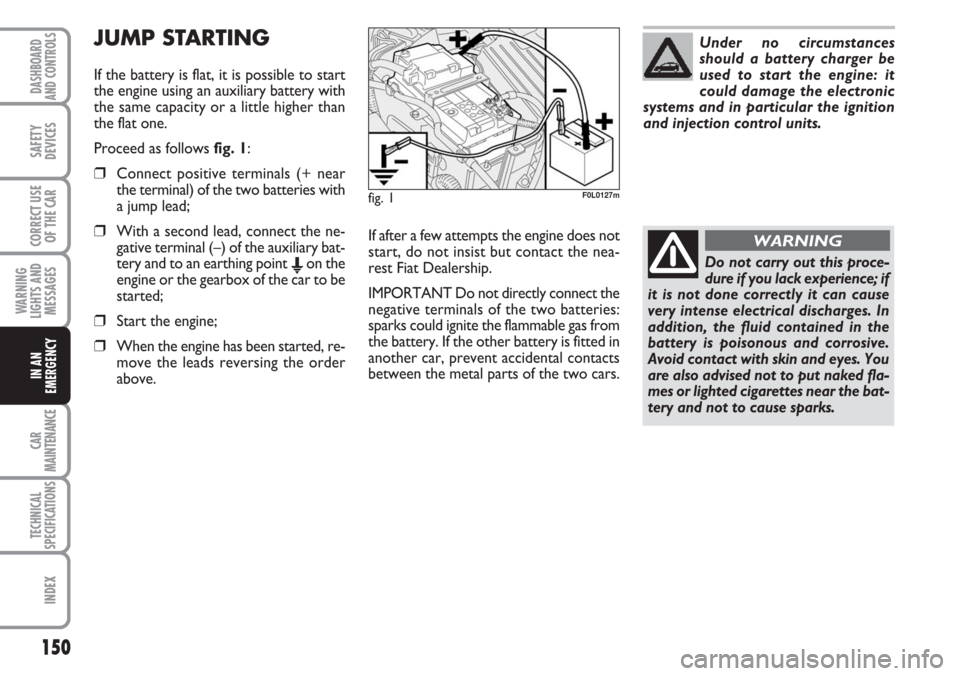
Proceed as follows fig. 1:
❒Connect positive terminals (+ near
the terminal) of the two batteries with
a jump lead;
❒With a second lead, connect the ne-
gative terminal (–) of the auxiliary bat-
tery and to an earthing point
Eon the
engine or the gearbox of the car to be
started;
❒Start the engine;
❒When the engine has been started, re-
move the leads reversing the order
above.
fig. 1F0L0127m
Under no circumstances
should a battery charger be
used to start the engine: it
could damage the electronic
systems and in particular the ignition
and injection control units.
Do not carry out this proce-
dure if you lack experience; if
it is not done correctly it can cause
very intense electrical discharges. In
addition, the fluid contained in the
battery is poisonous and corrosive.
Avoid contact with skin and eyes. You
are also advised not to put naked fla-
mes or lighted cigarettes near the bat-
tery and not to cause sparks.
WARNING
Page 157 of 240
157
WARNING
LIGHTS AND
MESSAGES
CAR
MAINTENANCE
TECHNICAL
SPECIFICATIONS
INDEX
DASHBOARD
AND CONTROLS
SAFETY
DEVICES
CORRECT USE
OF THE CAR
IN AN
EMERGENCY
WHEN NEEDING TO
CHANGE A BULB
GENERAL INSTRUCTIONS
❒When a light is not working, check
that the corresponding fuse is intact
before changing a bulb. For the loca-
tion of fuses, refer to the paragraph “If
a fuse blows” in this section;
❒Before changing a bulb check the con-
tacts for oxidation;
❒Burnt bulbs must be replaced by
others of the same type and power;
❒Always check the height of the head-
light beam after changing a bulb.
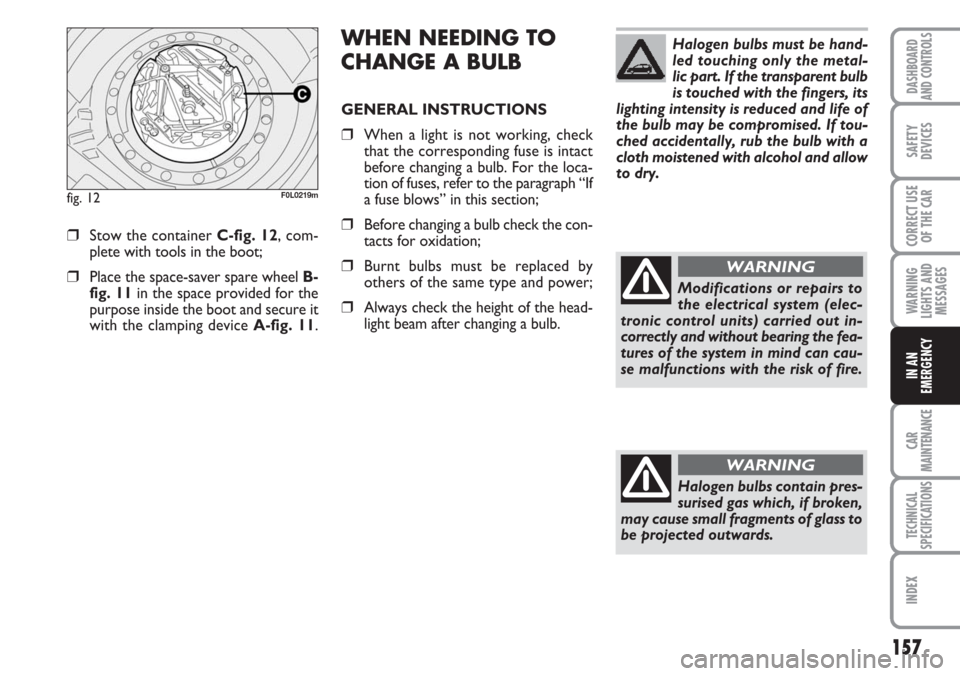
❒Stow the container C-fig. 12, com-
plete with tools in the boot;
❒Place the space-saver spare wheel B-
fig. 11in the space provided for the
purpose inside the boot and secure it
with the clamping device A-fig. 11.
fig. 12F0L0219m
Halogen bulbs must be hand-
led touching only the metal-
lic part. If the transparent bulb
is touched with the fingers, its
lighting intensity is reduced and life of
the bulb may be compromised. If tou-
ched accidentally, rub the bulb with a
cloth moistened with alcohol and allow
to dry.
Modifications or repairs to
the electrical system (elec-
tronic control units) carried out in-
correctly and without bearing the fea-
tures of the system in mind can cau-
se malfunctions with the risk of fire.
WARNING
Halogen bulbs contain pres-
surised gas which, if broken,
may cause small fragments of glass to
be projected outwards.
WARNING
Page 162 of 240
162
WARNING
LIGHTS AND
MESSAGES
CAR
MAINTENANCE
TECHNICAL
SPECIFICATIONS
INDEX
DASHBOARD
AND CONTROLS
SAFETY
DEVICES
CORRECT USE
OF THE CAR
IN AN
EMERGENCY
Gas-discharge lamps (Xenon)
(where provided)
IMPORTANT When gas-discharge bulbs
are provided, front fog lights are not fit-
ted.
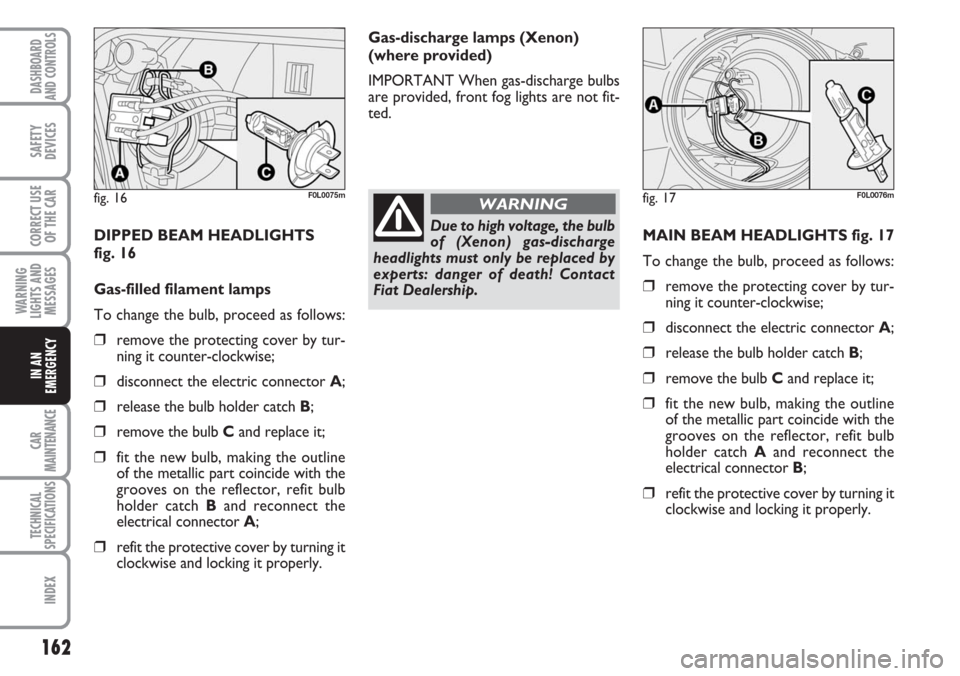
MAIN BEAM HEADLIGHTS fig. 17
To change the bulb, proceed as follows:
❒remove the protecting cover by tur-
ning it counter-clockwise;
❒disconnect the electric connector A;
❒release the bulb holder catch B;
❒remove the bulb Cand replace it;
❒fit the new bulb, making the outline
of the metallic part coincide with the
grooves on the reflector, refit bulb
holder catch Aand reconnect the
electrical connector B;
❒refit the protective cover by turning it
clockwise and locking it properly. DIPPED BEAM HEADLIGHTS
fig. 16
Gas-filled filament lamps
To change the bulb, proceed as follows:
❒remove the protecting cover by tur-
ning it counter-clockwise;
❒disconnect the electric connector A;
❒release the bulb holder catch B;
❒remove the bulb Cand replace it;
❒fit the new bulb, making the outline
of the metallic part coincide with the
grooves on the reflector, refit bulb
holder catch Band reconnect the
electrical connector A;
❒refit the protective cover by turning it
clockwise and locking it properly.
fig. 16F0L0075m
Due to high voltage, the bulb
of (Xenon) gas-discharge
headlights must only be replaced by
experts: danger of death! Contact
Fiat Dealership.
WARNINGfig. 17F0L0076m