Key FIAT CROMA 2006 2.G Service Manual
[x] Cancel search | Manufacturer: FIAT, Model Year: 2006, Model line: CROMA, Model: FIAT CROMA 2006 2.GPages: 240, PDF Size: 7.41 MB
Page 91 of 240
91
SAFETY
DEVICES
CORRECT USE
OF THE CAR
WARNING
LIGHTS AND
MESSAGES
IN AN
EMERGENCY
CAR
MAINTENANCE
TECHNICAL
SPECIFICATIONS
INDEX
DASHBOARD
AND CONTROLS
IMPORTANT After eliminating the in-
convenience, to check the system com-
pletely, Fiat Dealerships are obliged to run
a bench test and, if necessary, road tests
which may also call for a long journey.TYRE PRESSURE
MONITORING SYSTEM
- T.P.M.S. (where
provided)
The car can be equipped with the T.P.M.S.
(Tyre Pressure Monitoring System). This
system consists of a radio-frequency sen-
sor, installed on each wheel (on the rim
inside the tyre) that sends pressure infor-
mation to the control unit.
IMPORTANT System control unit moni-
tors the pressure of the four car tyres but
not the space-saver spare wheel. It is
therefore recommended to always check
also the space-saver spare wheel pressure.
IMPORTANT Pay the utmost attention
when checking or inflating tyres. Excessive
pressure impairs road holding, increases
suspension and wheel stress and causes
abnormal tyre wear.IMPORTANT Tyre pressure should be
checked with tyres rested and cold.
Should it become necessary for whatev-
er reason to check pressure with hot
tyres, do not reduce pressure although it
is higher than the prescribed value but re-
peat the check when tyres are cold.
If turning the ignition key to
ON, the warning light Udoes not turn on or if, while travelling
it turns on glowing steadily or flash-
ing (together with the message on the
display), contact Fiat Dealership as
soon as possible. Warning light
Uoperation can be checked by means
of special equipment by traffic
agents. Always comply with the traf-
fic regulations in force in the coun-
try where you are travelling.
WARNING
The T.P.M.S. system does not
exempt the driver to check
tyre and space-saver spare wheel pres-
sure at regular intervals.
WARNING
062-098 Croma TRW GB 20-11-2006 15:01 Pagina 91
Page 107 of 240
107
CORRECT USE
OF THE CAR
WARNING
LIGHTS AND
MESSAGES
IN AN
EMERGENCY
CAR
MAINTENANCE
TECHNICAL
SPECIFICATIONS
IINDEX
DASHBOARD
AND CONTROLS
SAFETY
DEVICES
Group 3
For children from 22 kg to 36 kg the size
of the child’s chest no longer requires a
support to space the child’s back from the
seat back.
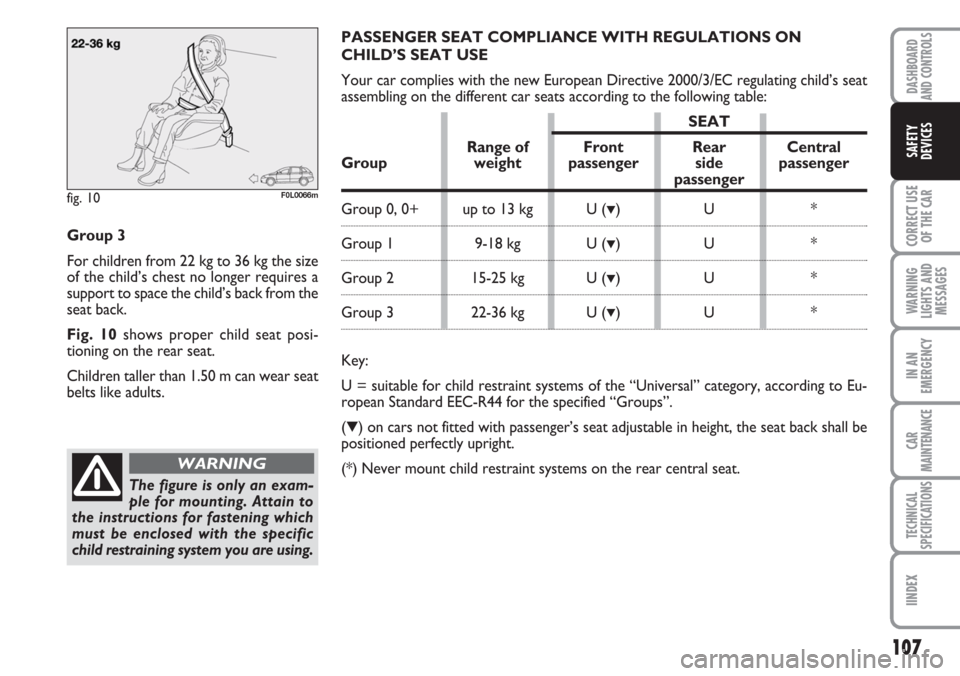
Fig. 10shows proper child seat posi-
tioning on the rear seat.
Children taller than 1.50 m can wear seat
belts like adults.
fig. 10F0L0066m
The figure is only an exam-
ple for mounting. Attain to
the instructions for fastening which
must be enclosed with the specific
child restraining system you are using.
WARNING
PASSENGER SEAT COMPLIANCE WITH REGULATIONS ON
CHILD’S SEAT USE
Your car complies with the new European Directive 2000/3/EC regulating child’s seat
assembling on the different car seats according to the following table:
SEAT
Range of Front Rear Central
Group weight passenger side passenger
passenger
Group 0, 0+ up to 13 kg U (▼)U *
Group 1 9-18 kg U (▼)U *
Group 2 15-25 kg U (▼)U *
Group 3 22-36 kg U (▼)U *
Key:
U = suitable for child restraint systems of the “Universal” category, according to Eu-
ropean Standard EEC-R44 for the specified “Groups”.
(
▼) on cars not fitted with passenger’s seat adjustable in height, the seat back shall be
positioned perfectly upright.
(*) Never mount child restraint systems on the rear central seat.
Page 113 of 240
113
CORRECT USE
OF THE CAR
WARNING
LIGHTS AND
MESSAGES
IN AN
EMERGENCY
CAR
MAINTENANCE
TECHNICAL
SPECIFICATIONS
IINDEX
DASHBOARD
AND CONTROLS
SAFETY
DEVICES
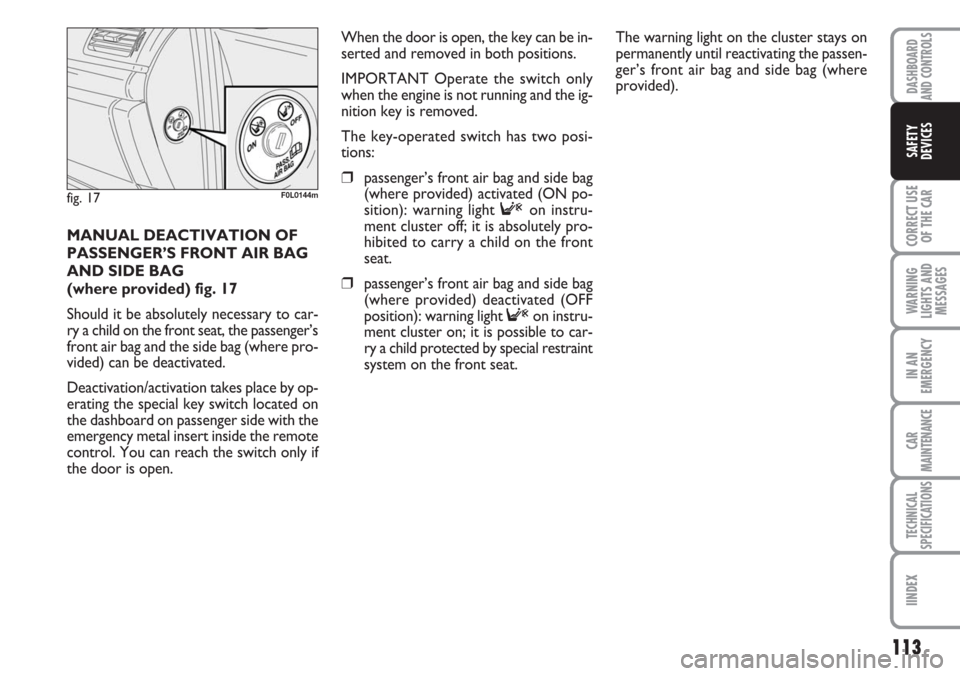
MANUAL DEACTIVATION OF
PASSENGER’S FRONT AIR BAG
AND SIDE BAG
(where provided) fig. 17
Should it be absolutely necessary to car-
ry a child on the front seat, the passenger’s
front air bag and the side bag (where pro-
vided) can be deactivated.
Deactivation/activation takes place by op-
erating the special key switch located on
the dashboard on passenger side with the
emergency metal insert inside the remote
control. You can reach the switch only if
the door is open.When the door is open, the key can be in-
serted and removed in both positions.
IMPORTANT Operate the switch only
when the engine is not running and the ig-
nition key is removed.
The key-operated switch has two posi-
tions:
❒passenger’s front air bag and side bag
(where provided) activated (ON po-
sition): warning light
Fon instru-
ment cluster off; it is absolutely pro-
hibited to carry a child on the front
seat.
❒passenger’s front air bag and side bag
(where provided) deactivated (OFF
position): warning light
Fon instru-
ment cluster on; it is possible to car-
ry a child protected by special restraint
system on the front seat.
fig. 17F0L0144m
The warning light on the cluster stays on
permanently until reactivating the passen-
ger’s front air bag and side bag (where
provided).
Page 116 of 240
116
CORRECT USE
OF THE CAR
WARNING
LIGHTS AND
MESSAGES
IN AN
EMERGENCY
CAR
MAINTENANCE
TECHNICAL
SPECIFICATIONS
INDEX
DASHBOARD
AND CONTROLS
SAFETY
DEVICES
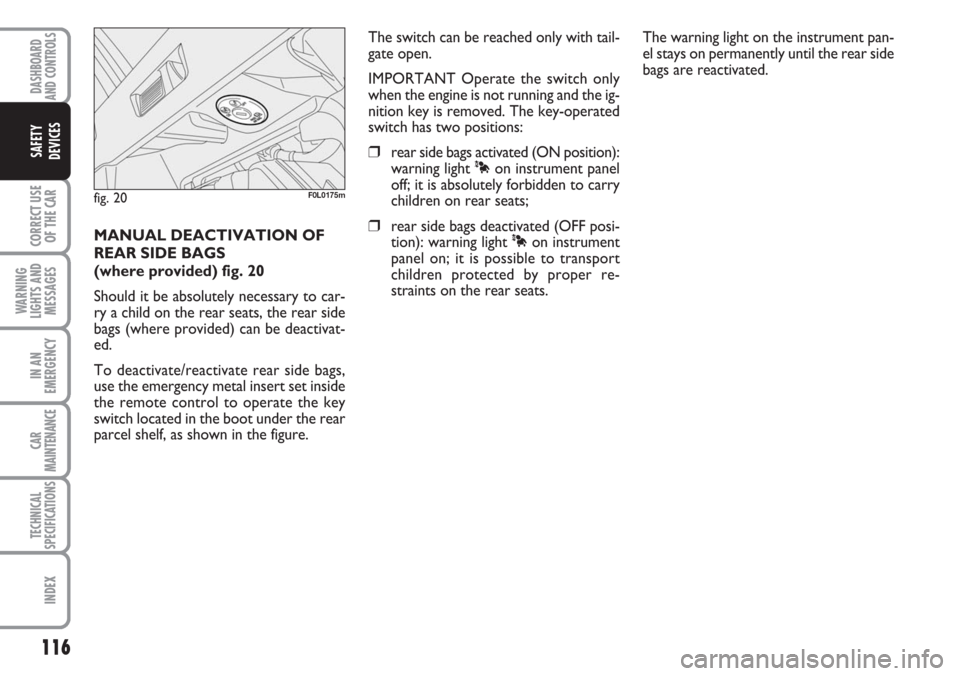
MANUAL DEACTIVATION OF
REAR SIDE BAGS
(where provided) fig. 20
Should it be absolutely necessary to car-
ry a child on the rear seats, the rear side
bags (where provided) can be deactivat-
ed.
To deactivate/reactivate rear side bags,
use the emergency metal insert set inside
the remote control to operate the key
switch located in the boot under the rear
parcel shelf, as shown in the figure.
fig. 20F0L0175m
The switch can be reached only with tail-
gate open.
IMPORTANT Operate the switch only
when the engine is not running and the ig-
nition key is removed. The key-operated
switch has two positions:
❒rear side bags activated (ON position):
warning light Àon instrument panel
off; it is absolutely forbidden to carry
children on rear seats;
❒rear side bags deactivated (OFF posi-
tion): warning light Àon instrument
panel on; it is possible to transport
children protected by proper re-
straints on the rear seats.The warning light on the instrument pan-
el stays on permanently until the rear side
bags are reactivated.
Page 117 of 240
117
CORRECT USE
OF THE CAR
WARNING
LIGHTS AND
MESSAGES
IN AN
EMERGENCY
CAR
MAINTENANCE
TECHNICAL
SPECIFICATIONS
IINDEX
DASHBOARD
AND CONTROLS
SAFETY
DEVICES
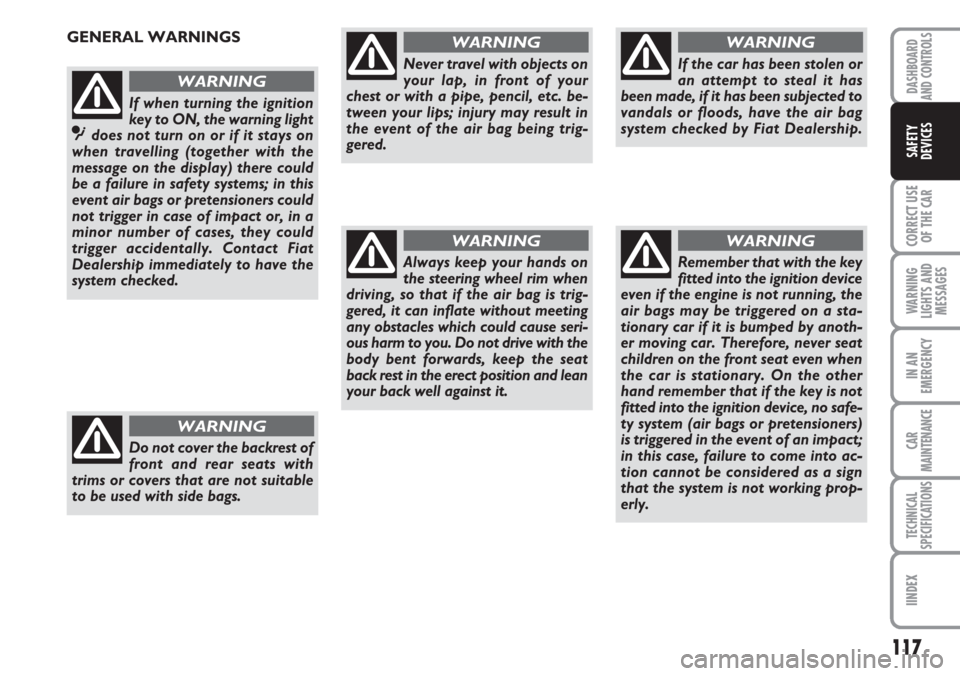
GENERAL WARNINGS
If when turning the ignition
key to ON, the warning light
ûdoes not turn on or if it stays on
when travelling (together with the
message on the display) there could
be a failure in safety systems; in this
event air bags or pretensioners could
not trigger in case of impact or, in a
minor number of cases, they could
trigger accidentally. Contact Fiat
Dealership immediately to have the
system checked.
WARNING
Do not cover the backrest of
front and rear seats with
trims or covers that are not suitable
to be used with side bags.
WARNING
Never travel with objects on
your lap, in front of your
chest or with a pipe, pencil, etc. be-
tween your lips; injury may result in
the event of the air bag being trig-
gered.
WARNING
Always keep your hands on
the steering wheel rim when
driving, so that if the air bag is trig-
gered, it can inflate without meeting
any obstacles which could cause seri-
ous harm to you. Do not drive with the
body bent forwards, keep the seat
back rest in the erect position and lean
your back well against it.
WARNING
If the car has been stolen or
an attempt to steal it has
been made, if it has been subjected to
vandals or floods, have the air bag
system checked by Fiat Dealership.
WARNING
Remember that with the key
fitted into the ignition device
even if the engine is not running, the
air bags may be triggered on a sta-
tionary car if it is bumped by anoth-
er moving car. Therefore, never seat
children on the front seat even when
the car is stationary. On the other
hand remember that if the key is not
fitted into the ignition device, no safe-
ty system (air bags or pretensioners)
is triggered in the event of an impact;
in this case, failure to come into ac-
tion cannot be considered as a sign
that the system is not working prop-
erly.
WARNING
Page 118 of 240
118
CORRECT USE
OF THE CAR
WARNING
LIGHTS AND
MESSAGES
IN AN
EMERGENCY
CAR
MAINTENANCE
TECHNICAL
SPECIFICATIONS
INDEX
DASHBOARD
AND CONTROLS
SAFETY
DEVICES
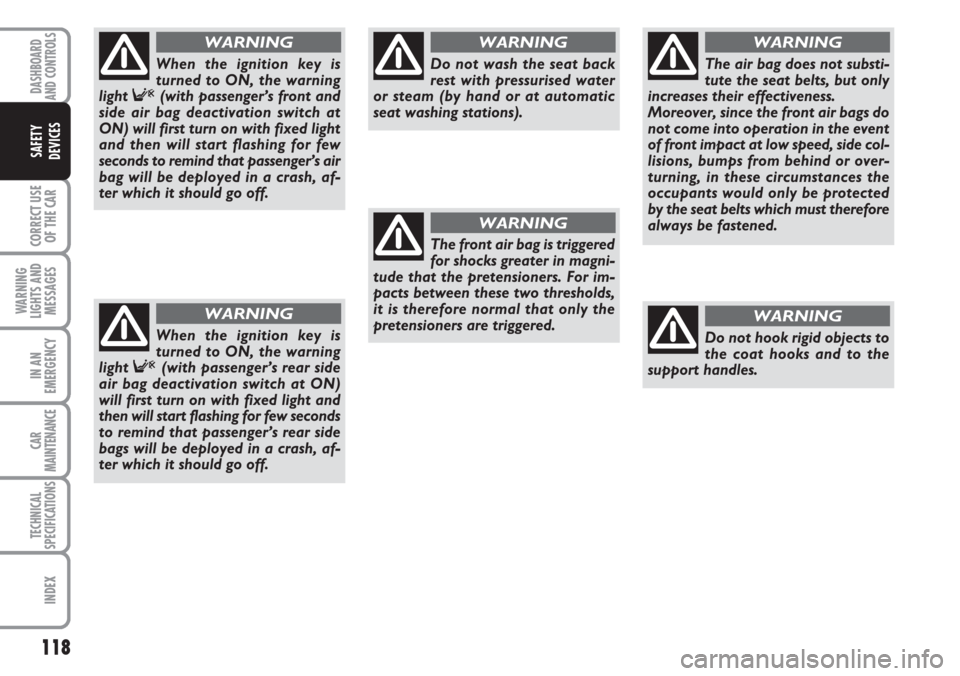
When the ignition key is
turned to ON, the warning
light
F(with passenger’s rear side
air bag deactivation switch at ON)
will first turn on with fixed light and
then will start flashing for few seconds
to remind that passenger’s rear side
bags will be deployed in a crash, af-
ter which it should go off.
WARNING
Do not wash the seat back
rest with pressurised water
or steam (by hand or at automatic
seat washing stations).
WARNING
The front air bag is triggered
for shocks greater in magni-
tude that the pretensioners. For im-
pacts between these two thresholds,
it is therefore normal that only the
pretensioners are triggered.
WARNING
The air bag does not substi-
tute the seat belts, but only
increases their effectiveness.
Moreover, since the front air bags do
not come into operation in the event
of front impact at low speed, side col-
lisions, bumps from behind or over-
turning, in these circumstances the
occupants would only be protected
by the seat belts which must therefore
always be fastened.
WARNING
Do not hook rigid objects to
the coat hooks and to the
support handles.
WARNING
When the ignition key is
turned to ON, the warning
light
F(with passenger’s front and
side air bag deactivation switch at
ON) will first turn on with fixed light
and then will start flashing for few
seconds to remind that passenger’s air
bag will be deployed in a crash, af-
ter which it should go off.
WARNING
Page 120 of 240
STARTING PROCEDURE FOR
PETROL VERSIONS
Proceed as follows:
❒Ensure that the handbrake is up;
❒put the gear lever into neutral (posi-
tions P or N for automatic transmis-
sion);
❒press the clutch pedal (or brake ped-
al with automatic transmission) down
to the floor without pressing the ac-
celerator;
❒turn the ignition key to STARTand
let it go the moment the engine starts.
If the engine does not start at the first at-
tempt, return the ignition key to OFFbe-
fore repeating starting.
IMPORTANT In the event of fast engine
start-up (i.e.: fitting the ignition key and
turning it to ON), any slight jamming is to
be attributed to correct recognition of the
electronic key by the ignition switch.
ENGINE STARTING
The car is fitted with an electronic engine
lock device: if the engine fails to start, see
the paragraph “The Fiat CODE system” in
section “Dashboard and controls”.
The engine may be noisier than usual dur-
ing the first seconds of operation, espe-
cially after it has not been used for a while.
This characteristic feature of the hydraulic
tappet system does not compromise func-
tionality or reliability. This timing system
for petrol engines was adopted to limit
servicing.
120
WARNING
LIGHTS AND
MESSAGES
IN AN
EMERGENCY
CAR
MAINTENANCE
TECHNICAL
SPECIFICATIONS
INDEX
DASHBOARD
AND CONTROLS
SAFETY
DEVICES
CORRECT USE
OF THE CAR
We recommend that during
the initial period you do not
drive to full car performance
(e.g.: excessive acceleration,
long journeys at top speed, sharp brak-
ing, etc.).
When the engine is switched
off never leave the key into
the ignition switch to prevent
pointless current absorption
from draining the battery.
Running the engine in con-
fined areas is extremely dan-
gerous. The engine consumes oxygen
and produces carbon monoxide
which is a highly toxic and lethal gas.
WARNING
Page 121 of 240
IMPORTANT Never leave the ignition key
into the ignition switch when the engine
is off. In this event, when opening the dri-
ver’s door, a buzzer will sound for about
1 second.
STARTING PROCEDURE FOR
MULTIJET VERSIONS
Proceed as follows:
❒Ensure that the handbrake is up;
❒Put the gear lever into neutral (posi-
tions P or N for automatic transmis-
sion);
❒Turn the ignition key to ON: the
warning lights
mand Yon the in-
strument panel will turn on;
❒Wait for the warning lights mand
Yto turn off. The hotter the engine
is, the quicker this will happen;
❒Press the clutch pedal (or brake ped-
al with automatic transmission) down
to the floor without pressing the ac-
celerator;
❒Turn the ignition key to STARTas
soon as warning light
mgoes out. If
you wait too long you will lose the
benefit of the work done by the glow
plugs. Release the key as soon as the
engine starts.IMPORTANT With cold engine, the accel-
erator pedal shall be completely released
while turning the ignition key to START.
If the engine does not start at the first at-
tempt, return the ignition key to OFFbe-
fore repeating starting.
IMPORTANT In the event of fast engine
start-up (i.e.: fitting the ignition key and
turning it to ON), any slight jamming is to
be attributed to correct recognition of the
electronic key by the ignition switch.
IMPORTANT If when fitting the key into
the ignition switch, the multifunction dis-
play shows the message stating that the
electronic key has not been recognised,
remove and refit the key; if the problem
persists try with the other keys provided
with the car. If you still cannot start the
engine, contact Fiat Dealership. IMPORTANT If when fitting the key into
the ignition switch, the multifunction dis-
play shows the message stating that the
electronic key has not been recognised,
remove and refit the key; if the problem
persists try with the other keys provided
with the car. If you still cannot start the
engine, contact Fiat Dealership.
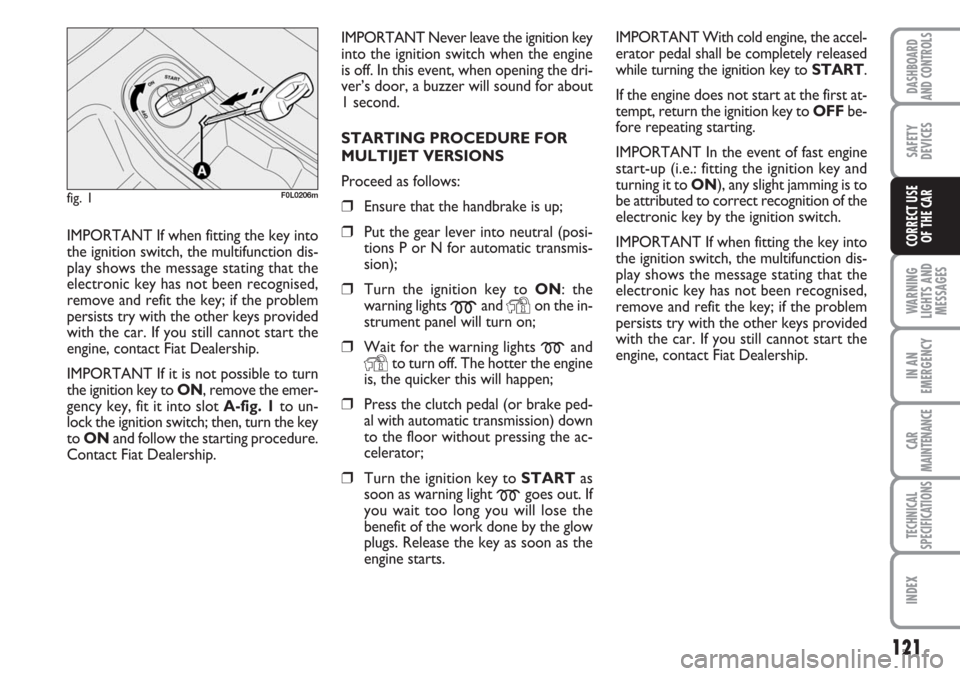
IMPORTANT If it is not possible to turn
the ignition key to ON, remove the emer-
gency key, fit it into slot A-fig. 1to un-
lock the ignition switch; then, turn the key
to ONand follow the starting procedure.
Contact Fiat Dealership.
121
WARNING
LIGHTS AND
MESSAGES
IN AN
EMERGENCY
CAR
MAINTENANCE
TECHNICAL
SPECIFICATIONS
INDEX
DASHBOARD
AND CONTROLS
SAFETY
DEVICES
CORRECT USE
OF THE CAR
fig. 1F0L0206m
Page 122 of 240
IMPORTANT If it is not possible to turn
the ignition key to ON, remove the emer-
gency key, fit it into slot A-fig. 1to un-
lock the ignition switch; then, turn the key
to ONand follow the starting procedure.
Contact Fiat Dealership.
IMPORTANT Never leave the ignition key
into the ignition switch when the engine
is off. In this event, when opening the dri-
ver’s door, a buzzer will sound for about
1 second.
HOW TO WARM UP THE
ENGINE AFTER IT HAS JUST
STARTED (petrol and diesel
engines)
Proceed as follows:
❒Drive off slowly, letting the engine turn
at medium revs. Do not accelerate
abruptly;
❒Do not drive at full performance for
the initial kilometres. Wait until the
coolant temperature gauge starts
moving.
122
WARNING
LIGHTS AND
MESSAGES
IN AN
EMERGENCY
CAR
MAINTENANCE
TECHNICAL
SPECIFICATIONS
INDEX
DASHBOARD
AND CONTROLS
SAFETY
DEVICES
CORRECT USE
OF THE CAR
Never bump start the engine
by pushing, towing or coasting
downhill as this could cause
fuel to flow into the catalytic
exhaust system and damage it beyond
repair.
A quick burst on the acceler-
ator before turning off the en-
gine serves absolutely no prac-
tical purpose, it wastes fuel
and is damaging especially to tur-
bocharged engines.
Remember that the servo-
brake and power steering
are not operational until the engine
has been started, therefore much ef-
fort than usual is required on the
brake pedal and steering wheel.
WARNING
STOPPING THE ENGINE
Turn the ignition key to OFFwhile the
engine is idling.
IMPORTANT After a taxing drive, you
should allow the engine to “catch its
breath” before turning it off by letting it
idle to allow the temperature in the en-
gine compartment to fall.
IMPORTANT If the engine is turned off
while the car is still moving, for safety rea-
sons it will be impossible to remove the
key from the ignition switch. To remove
the key, turn it to ONand then to OFF
with the car stopped without forcing at re-
moval.
Page 123 of 240
PARKING THE CAR
Proceed as follows:
❒Stop the engine and engage the hand-
brake;
❒Engage a gear (on a slope, engage first
gear if the car is faced uphill or reverse
if it is faced downhill; position P with
automatic transmission) and leave the
wheels steered.
Block the wheels with a wedge or a stone
if the car is parked on a steep slope. Do
not leave the key in the ignition switch to
prevent draining the battery. Always re-
move the key when you leave the car.HANDBRAKE fig. 3
The handbrake lever is located between
the two front seats.
Pull the handbrake lever upwards until the
car cannot be moved. Four or five clicks
are generally enough when the car is on
level ground while nine or ten may be re-
quired if the car is on a steep slope or
laden.
IMPORTANT If this is not the case, con-
tact Fiat Dealership to have the handbrake
adjusted.
When the handbrake lever is pulled up
and the ignition key is at ONthe instru-
ment panel warning light
xwill come on. IMPORTANT If after turning the engine
off with the car stopped, it is not possi-
ble to remove the key from the ignition
switch, try to turn it to ONand then to
OFF. If the problem persists, remove the
emergency key without forcing and fit it
into the proper slot A-fig. 2in the igni-
tion switch; now it will be possible to turn
the key to OFFand remove it. Contact
Fiat Dealership.
123
WARNING
LIGHTS AND
MESSAGES
IN AN
EMERGENCY
CAR
MAINTENANCE
TECHNICAL
SPECIFICATIONS
INDEX
DASHBOARD
AND CONTROLS
SAFETY
DEVICES
CORRECT USE
OF THE CAR
fig. 2F0L0207m
Never leave children unat-
tended in the car. Always re-
move the ignition key when
leaving the car and take it out
with you.
fig. 3F0L0126m