Load FIAT DOBLO 2007 1.G Owner's Manual
[x] Cancel search | Manufacturer: FIAT, Model Year: 2007, Model line: DOBLO, Model: FIAT DOBLO 2007 1.GPages: 218, PDF Size: 3.19 MB
Page 122 of 218
121IN AN EMERGENCY
BUMP STARTING IF A TYRE IS
PUNCTURED
GENERAL INSTRUCTIONS
Wheel changing and correct use of
the jack and spare wheel call for some
precautions as listed below. Catalysed vehicles must
not be bump started
(pushed, towed or coast-
ed down hill) as this could cause
fuel to flow into the catalytic ex-
haust system and damage it be-
yond repair.
Remember that until
the engine has started the
brake booster and hy-
draulic power steering systems
will not work and a greater effort
will therefore be required to de-
press the brake pedal or turn the
steering wheel.
Alert other drivers that
the vehicle is stationary in
compliance with local
regulations: hazard warning
lights, warning triangle etc.
Passengers on board should
leave the vehicle, especially if it is
heavily laden. Passengers should
stay away from oncoming traffic
while the wheel is being changed.
If the wheel is being changed on
a steep or badly surfaced road,
place wedges or other suitable
material under the wheels to
stop the vehicle.
The spare wheel is vehicle-spe-
cific. Never use the wheel on oth-
er models. Never fit other mod-
el spare wheels on your vehicle.
Do not use the jack for
loads over the value indi-
cated on the plate.
The jack should only be used to
change a wheel on the vehicle for
which it was designed. It should
not be put to other uses or em-
ployed to raise other models of
vehicle. Under no circumstances
should it be used when carrying
out repairs under the vehicle.
An incorrectly positioned jack
may cause the vehicle to fall.
Page 142 of 218
141IN AN EMERGENCY
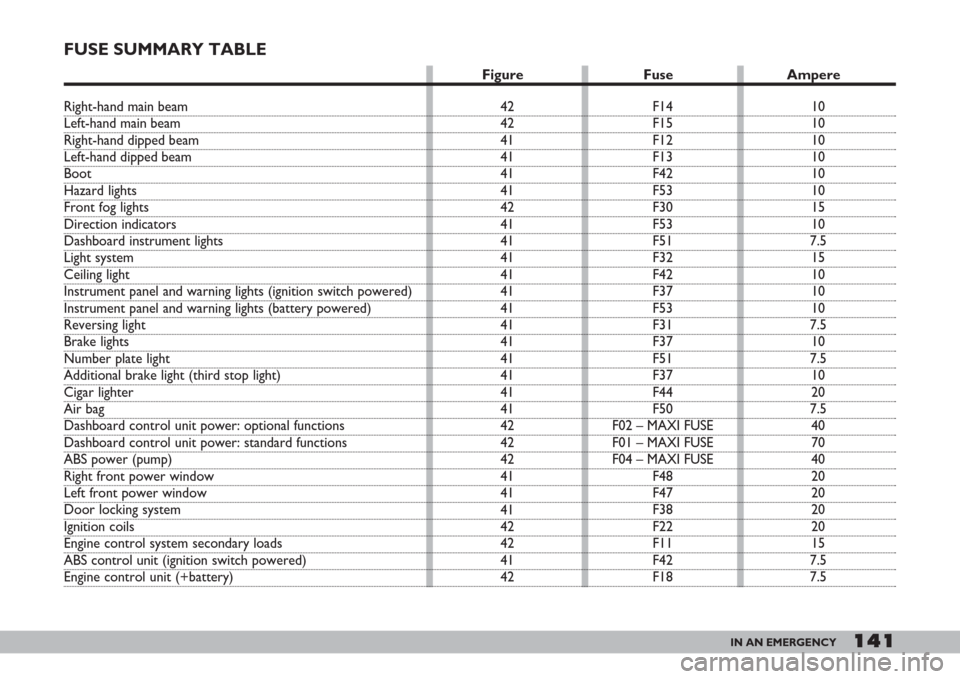
FUSE SUMMARY TABLE
10
10
10
10
10
10
15
10
7.5
15
10
10
10
7.5
10
7.5
10
20
7.5
40
70
40
20
20
20
20
15
7.5
7.5 F14
F15
F12
F13
F42
F53
F30
F53
F51
F32
F42
F37
F53
F31
F37
F51
F37
F44
F50
F02 – MAXI FUSE
F01 – MAXI FUSE
F04 – MAXI FUSE
F48
F47
F38
F22
F11
F42
F18 42
42
41
41
41
41
42
41
41
41
41
41
41
41
41
41
41
41
41
42
42
42
41
41
41
42
42
41
42
Figure Fuse Ampere
Right-hand main beam
Left-hand main beam
Right-hand dipped beam
Left-hand dipped beam
Boot
Hazard lights
Front fog lights
Direction indicators
Dashboard instrument lights
Light system
Ceiling light
Instrument panel and warning lights (ignition switch powered)
Instrument panel and warning lights (battery powered)
Reversing light
Brake lights
Number plate light
Additional brake light (third stop light)
Cigar lighter
Air bag
Dashboard control unit power: optional functions
Dashboard control unit power: standard functions
ABS power (pump)
Right front power window
Left front power window
Door locking system
Ignition coils
Engine control system secondary loads
ABS control unit (ignition switch powered)
Engine control unit (+battery)
Page 146 of 218
145IN AN EMERGENCY
JACKING
THE VEHICLE
WITH THE JACK
See “If a tyre is punctured”, in this
section.
Please note:
– The jack requires no adjustments.
– The jack cannot be repaired. If it
breaks it must be replaced with a new
jack;
– No other tool, part from the han-
dle shown in this chapter, can be fit-
ted to the jack.WITH A SHOP JACK
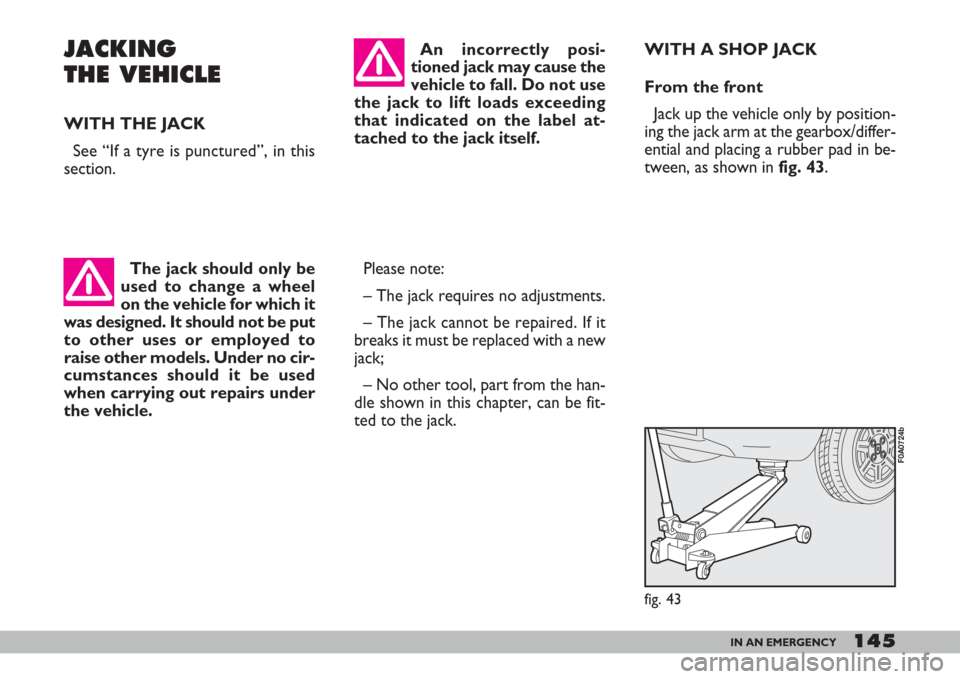
From the front
Jack up the vehicle only by position-
ing the jack arm at the gearbox/differ-
ential and placing a rubber pad in be-
tween, as shown in fig. 43.
fig. 43
F0A0724b
The jack should only be
used to change a wheel
on the vehicle for which it
was designed. It should not be put
to other uses or employed to
raise other models. Under no cir-
cumstances should it be used
when carrying out repairs under
the vehicle.
An incorrectly posi-
tioned jack may cause the
vehicle to fall. Do not use
the jack to lift loads exceeding
that indicated on the label at-
tached to the jack itself.
Page 165 of 218
164VEHICLE MAINTENANCE
Incorrect fitting of elec-
trical and electronic ac-
cessories can seriously
damage the vehicle.
If after buying the vehicle, you
want to install electric acces-
sories which require permanent
electric supply (alarm, free-hand
phone kit, etc.) contact Fiat Deal-
ership whose qualified personnel,
in addition to suggesting the
most suitable devices, will evalu-
ate the overall electric absorp-
tion, checking whether the vehi-
cle electric system is capable of
withstanding the load required,
or whether it should be integrat-
ed with a more powerful battery.
Batteries contain sub-
stances that are very
harmful for the environ-
ment. You are advised to have
the battery changed at a Fiat
Dealership. It is properly
equipped for disposing of used
batteries in an environmentally-
friendly way that complies with
the law.The liquid in the battery
is poisonous and corro-
sive. Avoid contact with
eyes and skin. Do not bring naked
flames or possible sources of
sparks near the battery: risk of
fire and explosion.CHANGING THE BATTERY
If required, replace the battery with
a genuine spare part having the same
specifications.
If a battery with different specifica-
tions is fitted, the service intervals giv-
en in the “Service schedule” in this
section will no longer be valid. Refer
therefore to the instructions provid-
ed by the battery manufacturer.
Running the battery
with low fluid level can
damage the battery be-
yond repair and could also cause
its explosion.
Page 166 of 218
When working on the
battery or near it, always
wear the
USEFUL ADVICE FOR
LENGTHENING THE LIFE OF
YOUR BATTERY
To avoid draining your battery and
lengthen its life, observe the follow-
ing indications:
– when you park the vehicle, ensure
the doors, tailgate and bonnet are
closed properly;If the vehicle is left inac-
tive for long periods at
cold, remove the battery
and store it in a warm place to
prevent freezing.
165VEHICLE MAINTENANCE
IMPORTANTA battery which is
kept at a charge of less than 50% for
any length of time will be damaged by
sulphation leading to a reduction in
cranking power and a higher risk of
the battery electrolyte freezing (this
may even occur at –10°C).
If the vehicle is inactive for a long pe-
riod of time, refer to the “Vehicle
storage” paragraph in section “Driving
your vehicle”.
If you want to add accessories after
buying the vehicle (alarm system, free-
hand phone kit, etc.) visit a Fiat Deal-
ership. They can suggest the most suit-
able accessories to get and check
whether the electric system can sup-
port the required load or whether a
larger capacity battery is required.
These devices will, in fact, run off the
battery even when the key is not in-
serted (vehicle parked) and can deploy
the battery. – the ceiling lights must be off. The
vehicle is however provided with an
automatic system for switching off in-
ternal lights;
– do not keep accessories (e.g. sound
system, hazard lights, etc.) switched on
for a long time when the engine is not
running;
– before performing any operation
on the electrical system, disconnect
the battery negative cable;
– battery terminals shall always be
perfectly tightened.
Page 169 of 218
168VEHICLE MAINTENANCE
Avoid overloading your vehicle: this
can seriously damage wheels and tyres.
If you get a flat tyre, stop immediately
and change it so as not to damage the
tyre, the wheel, the suspension and
the steering.
Tyres age even if they are not used
very much. Cracking of the tread rub-
ber and the side walls are a sign of this
ageing. In any case, if the tyres have
been fitted for more than six years
they should be examined by an expert
who can judge whether they are still
fit for use. Remember to check the
spare tyre particularly carefully too.
If a replacement is necessary, always
use new tyres and avoid using ones the
origin of which you are not certain
about.
The Fiat Doblò fits tubeless tyres.
Under no circumstances use an inner
tube with these tyres.If you replace a tyre it is a good idea
to change the inflation valve, too.
To ensure the front and rear tyres all
wear evenly, you are advised to change
the tyres over every 10-15 thousand
kilometres keeping them on the same
side of the vehicle so as not to reverse
the direction of rotation.
Do not change the tyres
over in criss-cross fashion
by moving a tyre from the
left hand side of the vehicle to the
right and vice versa.RUBBER TUBING
Follow the “Service Schedule” to the
letter as concerns braking and fuel line
rubber tubing. Ozone, high tempera-
tures and long absence of fluid in the
system can in fact cause the hardening
and cracking of the pipes with possi-
ble loss of fluid. A careful check is
therefore essential.
Page 176 of 218
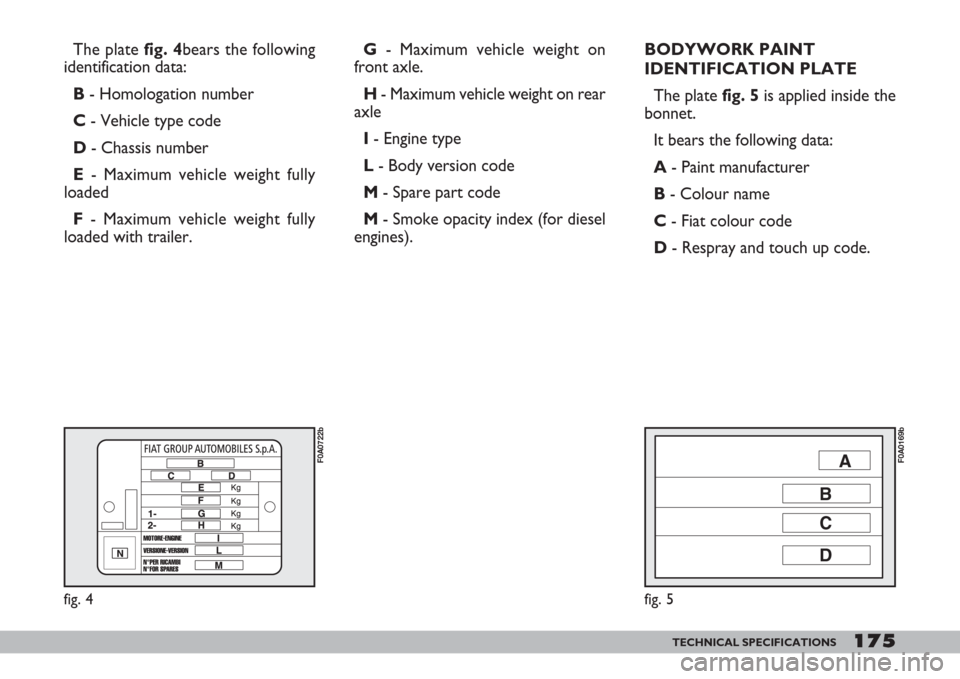
The plate fig. 4bears the following
identification data:
B - Homologation number
C - Vehicle type code
D - Chassis number
E - Maximum vehicle weight fully
loaded
F- Maximum vehicle weight fully
loaded with trailer.G- Maximum vehicle weight on
front axle.
H - Maximum vehicle weight on rear
axle
I - Engine type
L - Body version code
M - Spare part code
M - Smoke opacity index (for diesel
engines).BODYWORK PAINT
IDENTIFICATION PLATE
The plate fig. 5is applied inside the
bonnet.
It bears the following data:
A - Paint manufacturer
B - Colour name
C - Fiat colour code
D- Respray and touch up code.
fig. 4
F0A0722bA
B
C
D
fig. 5
F0A0169b
175TECHNICAL SPECIFICATIONS
Page 183 of 218
182TECHNICAL SPECIFICATIONS
TRANSMISSION
CLUTCH
Hydraulic, self-adjusting external
control.
GEARBOX
Five forward gears and reverse with
synchromesh for front gear engage-
ment.
Cyclical gear reduction and differen-
tial assembly incorporated in the gear-
box.
Drive transmission to the front
wheels by means of drive shafts con-
nected to the differential assembly and
the wheels with CV joints.
BRAKES
SERVICE AND
EMERGENCY BRAKES
Front:
– disc, floating shoe, self-ventilated.
Rear:
– drum, self-centring callipers.
Crossed hydraulic circuit control.
Vacuum brake booster.
ABS system with four sensors and
EBD.
Automatic take-up of friction liner
wear.
Lacking the ABS, there is the brake
force distributor that acts on rear
brake circuit according to load on rear
axle
HANDBRAKE
Controlled by a lever, it works me-
chanically on the rear brake shoes.
SUSPENSIONS
FRONT
Independent wheel, McPherson sus-
pension with steel wishbones an-
chored to an auxiliary crossmember.
Coil springs and sway bar.
Double acting telescopic hydraulic
shock absorbers.
REAR
Stiff axle with wishbones.
Double acting telescopic hydraulic
shock absorbers.
Sway bar in Fiat Doblò Passengers
Transport versions.
Page 185 of 218
184TECHNICAL SPECIFICATIONS
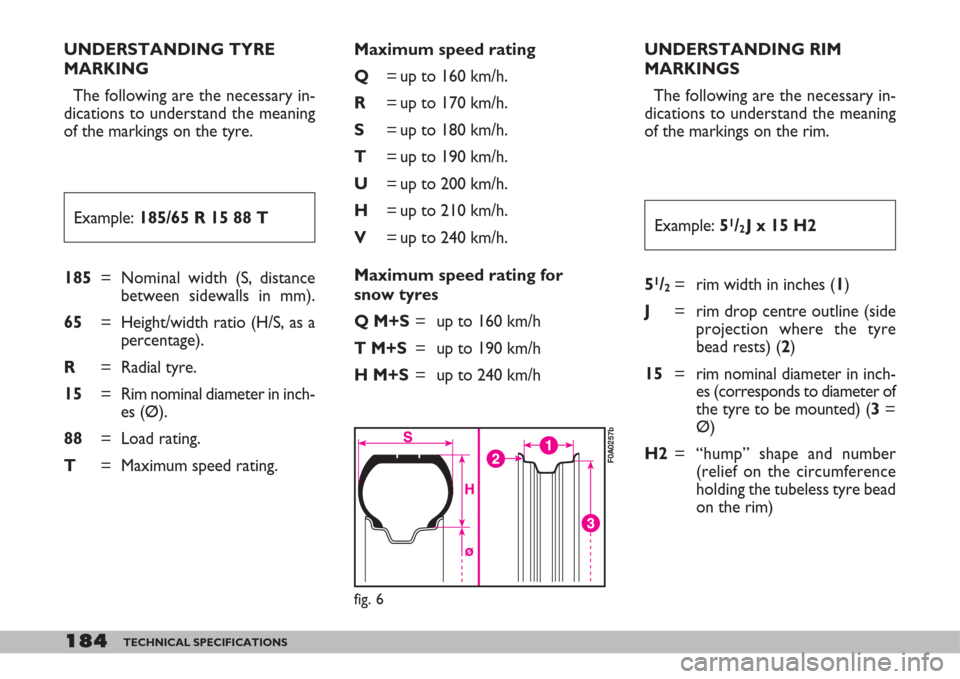
UNDERSTANDING TYRE
MARKING
The following are the necessary in-
dications to understand the meaning
of the markings on the tyre.Maximum speed rating
Q= up to 160 km/h.
R= up to 170 km/h.
S= up to 180 km/h.
T= up to 190 km/h.
U= up to 200 km/h.
H= up to 210 km/h.
V= up to 240 km/h.
Maximum speed rating for
snow tyres
Q M+S= up to 160 km/h
T M+S= up to 190 km/h
H M+S= up to 240 km/hUNDERSTANDING RIM
MARKINGS
The following are the necessary in-
dications to understand the meaning
of the markings on the rim.
Example: 185/65 R 15 88 T
185= Nominal width (S, distance
between sidewalls in mm).
65= Height/width ratio (H/S, as a
percentage).
R= Radial tyre.
15= Rim nominal diameter in inch-
es (Ø).
88= Load rating.
T= Maximum speed rating.Example: 5
1/2J x 15 H2
51/2= rim width in inches (1)
J= rim drop centre outline (side
projection where the tyre
bead rests) (2)
15= rim nominal diameter in inch-
es (corresponds to diameter of
the tyre to be mounted) (3 =
Ø)
H2= “hump” shape and number
(relief on the circumference
holding the tubeless tyre bead
on the rim)
fig. 6
F0A0257b
Page 186 of 218
185TECHNICAL SPECIFICATIONS
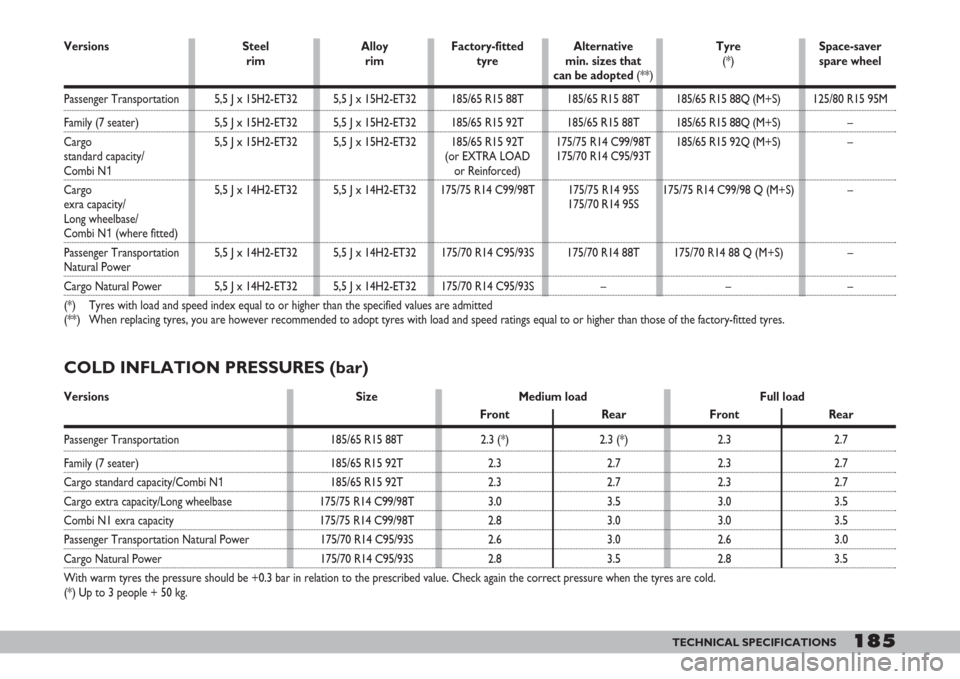
COLD INFLATION PRESSURES (bar)
Versions Size Medium load Full load
Front Rear Front Rear
Passenger Transportation 185/65 R15 88T 2.3 (*) 2.3 (*) 2.3 2.7
Family (7 seater) 185/65 R15 92T 2.3 2.7 2.3 2.7
Cargo standard capacity/Combi N1185/65 R15 92T 2.3 2.7 2.3 2.7
Cargo extra capacity/Long wheelbase 175/75 R14 C99/98T 3.0 3.5 3.0 3.5
Combi N1 exra capacity 175/75 R14 C99/98T 2.8 3.0 3.0 3.5
Passenger Transportation Natural Power 175/70 R14 C95/93S 2.6 3.0 2.6 3.0
Cargo Natural Power 175/70 R14 C95/93S 2.8 3.5 2.8 3.5
With warm tyres the pressure should be +0.3 bar in relation to the prescribed value. Check again the correct pressure when the tyres are cold.
(*) Up to 3 people + 50 kg. Versions Steel Alloy Factory-fitted Alternative Tyre Space-saver
rim rim tyre min. sizes that (*)spare wheel
can be adopted (**)
Passenger Transportation 5,5 J x 15H2-ET32 5,5 J x 15H2-ET32 185/65 R15 88T 185/65 R15 88T185/65 R15 88Q (M+S)125/80 R15 95M
Family (7 seater) 5,5 J x 15H2-ET32 5,5 J x 15H2-ET32185/65 R15 92T 185/65 R15 88T185/65 R15 88Q (M+S) –
Cargo 5,5 J x 15H2-ET32 5,5 J x 15H2-ET32 185/65 R15 92T 175/75 R14 C99/98T185/65 R15 92Q (M+S) –
standard capacity/ (or EXTRA LOAD 175/70 R14 C95/93T
Combi N1or Reinforced)
Cargo 5,5 J x 14H2-ET32 5,5 J x 14H2-ET32 175/75 R14 C99/98T 175/75 R14 95S 175/75 R14 C99/98 Q (M+S) –
exra capacity/175/70 R14 95S
Long wheelbase/
Combi N1(where fitted)
Passenger Transportation 5,5 J x 14H2-ET32 5,5 J x 14H2-ET32 175/70 R14 C95/93S 175/70 R14 88T 175/70 R14 88 Q (M+S) –
Natural Power
Cargo Natural Power 5,5 J x 14H2-ET32 5,5 J x 14H2-ET32 175/70 R14 C95/93S – – –
(*) Tyres with load and speed index equal to or higher than the specified values are admitted
(**) When replacing tyres, you are however recommended to adopt tyres with load and speed ratings equal to or higher than those of the factory-fitted tyres.