belt FIAT DOBLO 2009 2.G Owner's Manual
[x] Cancel search | Manufacturer: FIAT, Model Year: 2009, Model line: DOBLO, Model: FIAT DOBLO 2009 2.GPages: 274, PDF Size: 6.6 MB
Page 131 of 274
130
KNOW
YOUR
VEHICLE
SAFETY
STARTING
AND
DRIVING
WARNING
LIGHTS AND
MESSAGES
IN AN
EMERGENCY
SERVICING
AND
MAINTENANCE
TECHNICAL
SPECIFICATIONS
INDEXMANUAL DEACTIVATION OF FRONT AND
SIDE PASSENGER AIRBAGS FOR HEAD AND
TORSE PROTECTION
(for versions/markets where provided)
On Doblò M1 versions, whenever a child needs to be car-
ried on the front seat, the passenger’s front airbags and
side bags for head and chest protection (for versions/mar-
kets where provided) can be deactivated.
The warning light
“on the instrument panel stays on un-
til the passenger’s front and side airbags for head and torse
protection (for versions/markets where provided) are re-
activated.
On Doblò Cargo versions with foldaway passenger seat
and split, revolving partition or ladder, the passenger front
airbags and the side bags for chest/head protection (for
versions/markets where provided) need to be deactivat-
ed if a load is carried with the seat folded down.
IMPORTANT To manually deactivate the passenger’s front
and side airbags for head and torse protection (for ver-
sions/markets where provided), refer to “Digital display”
and “Multifunction display” in the “Know your vehicle”
section.
SIDE BAGS
(for versions/markets where provided)
On some versions, the vehicle may be fitted with driver
and passenger front side airbags for head and torse pro-
tection.
Side bags protect occupants from side-on crashes of medi-
um/high severity by placing the bag between the occu-
pant and the internal parts of the side structure of the
vehicle.
Non-activation of side bags in other types of collisions
(head-on collisions, rear shunts, roll-overs, etc...) is not
an indication of system malfunction.
An electronic control unit causes the bags to inflate in
the event of a side-on collision. The bags inflate instanta-
neously, placing themselves between the occupant’s body
and the structures which could cause injury. They deflate
immediately afterwards.
Side bags are not a replacement of, but rather a comple-
ment to, seat belts, which you are recommended to wear
at all times, as specified by law in Europe and most non-
European countries.
For this reason, the seat belt must be worn at all times.
In the case of side-on collisions, the seat belts hold occu-
pants in the correct position and prevent them from be-
ing thrown out of the car by a very violent collision.
Page 149 of 274
148
KNOW
YOUR
VEHICLE
SAFETY
STARTING
AND
DRIVING
WARNING
LIGHTS AND
MESSAGES
IN AN
EMERGENCY
SERVICING
AND
MAINTENANCE
TECHNICAL
SPECIFICATIONS
INDEXDegraded engine oil should be replaced
as soon as possible after the warning light
comes on, and never more than 500 km after it
first comes on. Failure to change the oil within the
first 500 km may result in severe damage to the
engine and invalidate the warranty. Remember
that when the warning light comes on, it does not
mean that the level of engine oil is low, so if the
light flashes you do not need to top up the en-
gine oil.
WARNING
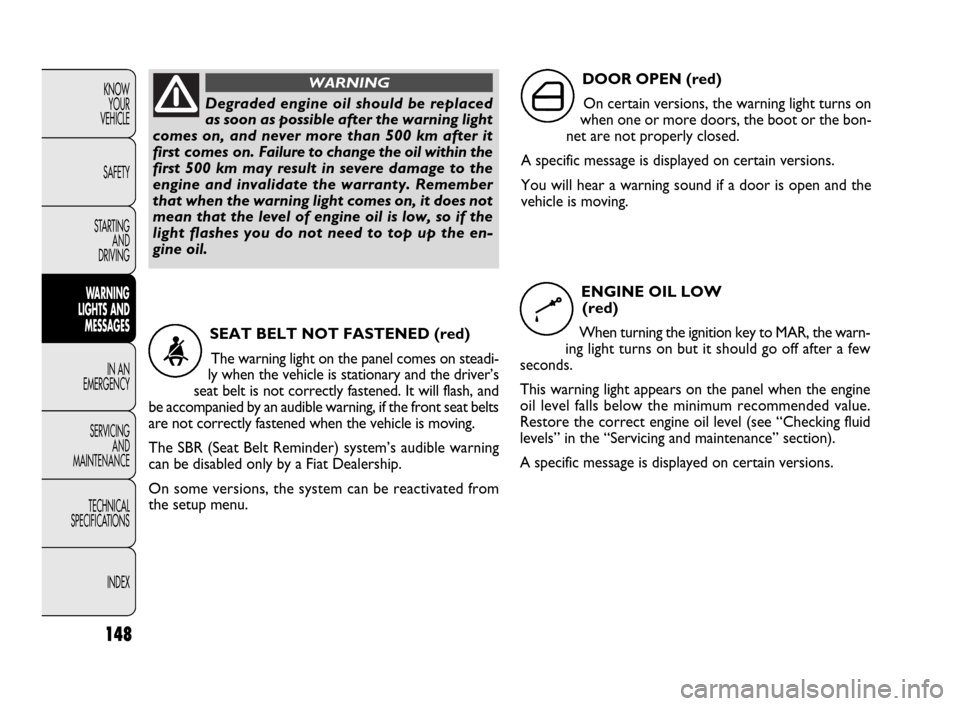
SEAT BELT NOT FASTENED (red)
The warning light on the panel comes on steadi-
ly when the vehicle is stationary and the driver’s
seat belt is not correctly fastened. It will flash, and
be accompanied by an audible warning, if the front seat belts
are not correctly fastened when the vehicle is moving.
The SBR (Seat Belt Reminder) system’s audible warning
can be disabled only by a Fiat Dealership.
On some versions, the system can be reactivated from
the setup menu.
<
DOOR OPEN (red)
On certain versions, the warning light turns on
when one or more doors, the boot or the bon-
net are not properly closed.
A specific message is displayed on certain versions.
You will hear a warning sound if a door is open and the
vehicle is moving.
ENGINE OIL LOW
(red)
When turning the ignition key to MAR, the warn-
ing light turns on but it should go off after a few
seconds.
This warning light appears on the panel when the engine
oil level falls below the minimum recommended value.
Restore the correct engine oil level (see “Checking fluid
levels” in the “Servicing and maintenance” section).
A specific message is displayed on certain versions.
´
k
Page 193 of 274
●●●●●●
●●●●●●
●●●●●●
●●●●●●
●●●●●●
●●●
●●●●●●
●●●●●●
●●
●●●
●●●●●●
●●●●●●
●●●●●●
192
KNOW
YOUR
VEHICLE
SAFETY
STARTING
AND
DRIVING
WARNING
LIGHTS AND
MESSAGES
IN AN
EMERGENCY
SERVICING
AND
MAINTENANCE
TECHNICAL
SPECIFICATIONS
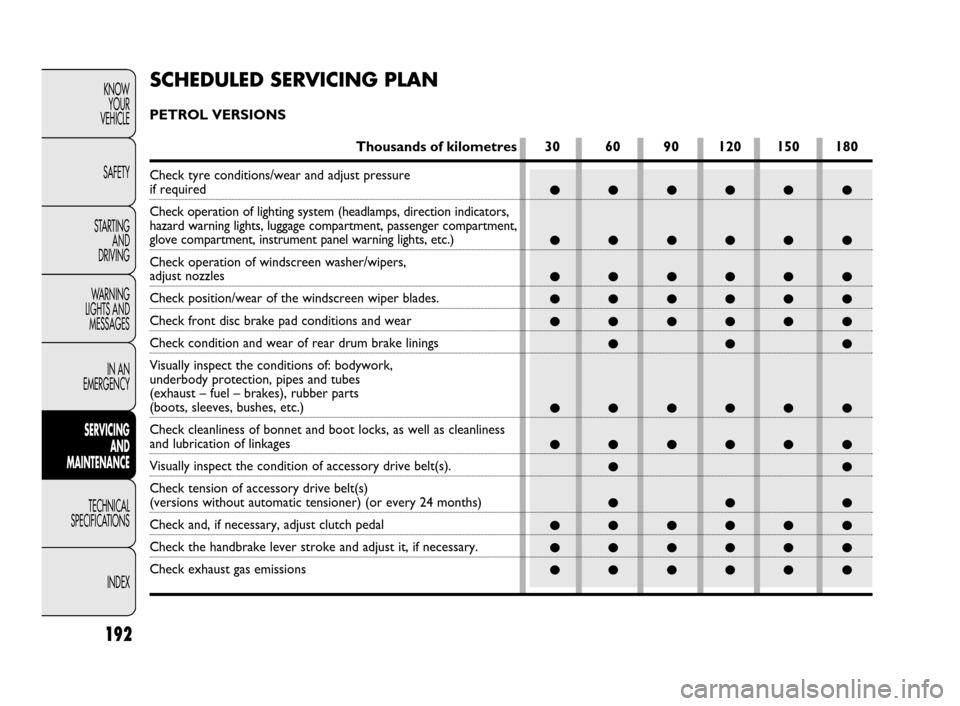
INDEXSCHEDULED SERVICING PLAN
PETROL VERSIONS
Thousands of kilometres 30 60 90 120 150 180
Check tyre conditions/wear and adjust pressure if required
Check operation of lighting system (headlamps, direction indicators,
hazard warning lights, luggage compartment, passenger compartment,
glove compartment, instrument panel warning lights, etc.)
Check operation of windscreen washer/wipers,
adjust nozzles
Check position/wear of the windscreen wiper blades.
Check front disc brake pad conditions and wear
Check condition and wear of rear drum brake linings
Visually inspect the conditions of: bodywork,
underbody protection, pipes and tubes
(exhaust – fuel – brakes), rubber parts
(boots, sleeves, bushes, etc.)
Check cleanliness of bonnet and boot locks, as well as cleanliness
and lubrication of linkages
Visually inspect the condition of accessory drive belt(s).
Check tension of accessory drive belt(s)
(versions without automatic tensioner) (or every 24 months)
Check and, if necessary, adjust clutch pedal
Check the handbrake lever stroke and adjust it, if necessary.
Check exhaust gas emissions
Page 194 of 274
●●
●●●
●
●
●●●
●●●●●●
●●●●●●
●●●●●●
●●●●●●
●●●
●●●●●●
193
KNOW
YOUR
VEHICLE
SAFETY
STARTING
AND
DRIVING
WARNING
LIGHTS AND
MESSAGES
IN AN
EMERGENCY
SERVICING
AND
MAINTENANCE
TECHNICAL
SPECIFICATIONS
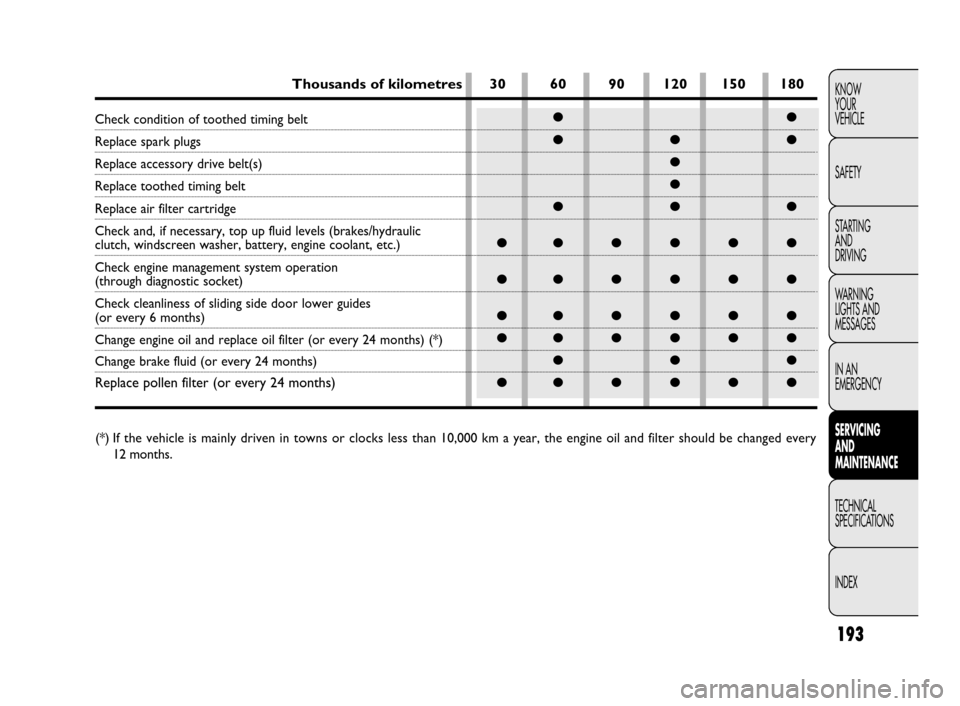
INDEXThousands of kilometres 30 60 90 120 150 180
Check condition of toothed timing belt
Replace spark plugs
Replace accessory drive belt(s)
Replace toothed timing belt
Replace air filter cartridge
Check and, if necessary, top up fluid levels (brakes/hydraulic
clutch, windscreen washer, battery, engine coolant, etc.)
Check engine management system operation
(through diagnostic socket)
Check cleanliness of sliding side door lower guides
(or every 6 months)
Change engine oil and replace oil filter (or every 24 months) (*)
Change brake fluid (or every 24 months)
Replace pollen filter (or every 24 months)
(*) If the vehicle is mainly driven in towns or clocks less than 10,000 km a year, the engine oil and filter should be changed every
12 months.
Page 195 of 274
●●●●●●
●●●●●●
●●●●●●
●●●●●●
●●●●●●
●●●
●●●●●●
●●●●●●
●●●●●●
●●
●●●●●●
●●
●●
●●●●●●
194
KNOW
YOUR
VEHICLE
SAFETY
STARTING
AND
DRIVING
WARNING
LIGHTS AND
MESSAGES
IN AN
EMERGENCY
SERVICING
AND
MAINTENANCE
TECHNICAL
SPECIFICATIONS
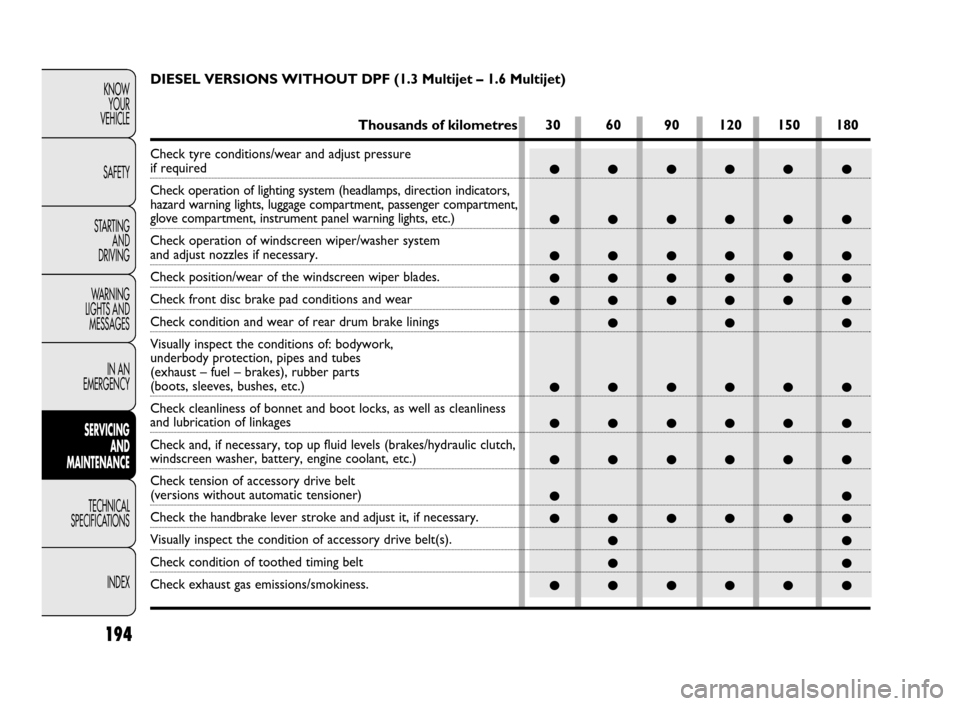
INDEXDIESEL VERSIONS WITHOUT DPF (1.3 Multijet – 1.6 Multijet)
Thousands of kilometres 30 60 90 120 150 180
Check tyre conditions/wear and adjust pressure if required
Check operation of lighting system (headlamps, direction indicators,
hazard warning lights, luggage compartment, passenger compartment,
glove compartment, instrument panel warning lights, etc.)
Check operation of windscreen wiper/washer system
and adjust nozzles if necessary.
Check position/wear of the windscreen wiper blades.
Check front disc brake pad conditions and wear
Check condition and wear of rear drum brake linings
Visually inspect the conditions of: bodywork,
underbody protection, pipes and tubes
(exhaust – fuel – brakes), rubber parts
(boots, sleeves, bushes, etc.)
Check cleanliness of bonnet and boot locks, as well as cleanliness
and lubrication of linkages
Check and, if necessary, top up fluid levels (brakes/hydraulic clutch,
windscreen washer, battery, engine coolant, etc.)
Check tension of accessory drive belt
(versions without automatic tensioner)
Check the handbrake lever stroke and adjust it, if necessary.
Visually inspect the condition of accessory drive belt(s).
Check condition of toothed timing belt
Check exhaust gas emissions/smokiness.
Page 196 of 274
●●●●●●
●
●
●●●
●●●
●●●●●●
●●●●●●
●●●●●●
195
KNOW
YOUR
VEHICLE
SAFETY
STARTING
AND
DRIVING
WARNING
LIGHTS AND
MESSAGES
IN AN
EMERGENCY
SERVICING
AND
MAINTENANCE
TECHNICAL
SPECIFICATIONS
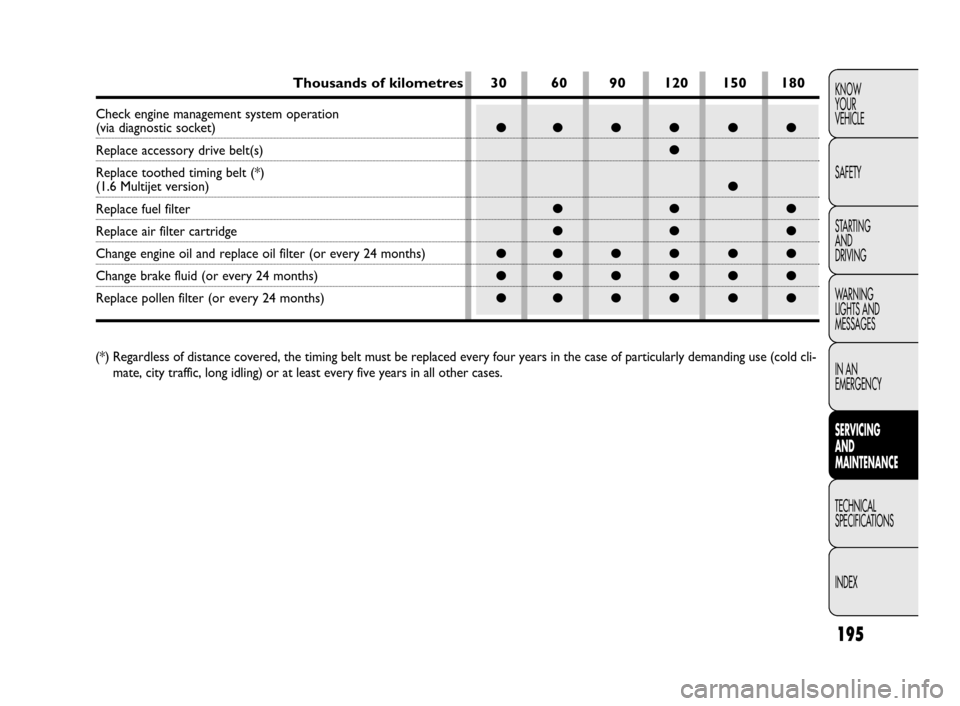
INDEXThousands of kilometres 30 60 90 120 150 180
Check engine management system operation (via diagnostic socket)
Replace accessory drive belt(s)
Replace toothed timing belt (*)
(1.6 Multijet version)
Replace fuel filter
Replace air filter cartridge
Change engine oil and replace oil filter (or every 24 months)
Change brake fluid (or every 24 months)
Replace pollen filter (or every 24 months)
(*) Regardless of distance covered, the timing belt must be replaced every four years in the case of particularly demanding use (cold cli-
mate, city traffic, long idling) or at least every five years in all other cases.
Page 197 of 274
196
KNOW
YOUR
VEHICLE
SAFETY
STARTING
AND
DRIVING
WARNING
LIGHTS AND
MESSAGES
IN AN
EMERGENCY
SERVICING
AND
MAINTENANCE
TECHNICAL
SPECIFICATIONS
INDEX
● ●●●●
● ●●●●
● ●●●●
● ●●●●
● ●●●●
●●
● ●●●●
● ●●●●
● ●●●●
●●
● ●●●●
●●
● ●●●●
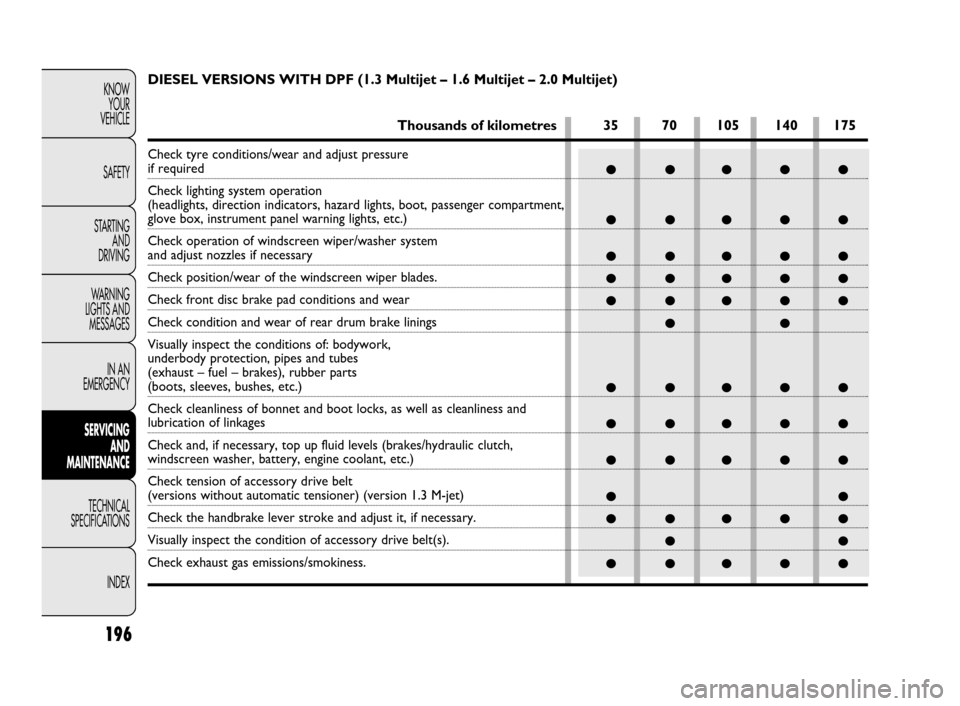
DIESEL VERSIONS WITH DPF (1.3 Multijet – 1.6 Multijet – 2.0 Multijet)
Thousands of kilometres 35 70 105 140 175
Check tyre conditions/wear and adjust pressure if required
Check lighting system operation
(headlights, direction indicators, hazard lights, boot, passenger compartment,
glove box, instrument panel warning lights, etc.)
Check operation of windscreen wiper/washer system
and adjust nozzles if necessary
Check position/wear of the windscreen wiper blades.
Check front disc brake pad conditions and wear
Check condition and wear of rear drum brake linings
Visually inspect the conditions of: bodywork,
underbody protection, pipes and tubes
(exhaust – fuel – brakes), rubber parts
(boots, sleeves, bushes, etc.)
Check cleanliness of bonnet and boot locks, as well as cleanliness and
lubrication of linkages
Check and, if necessary, top up fluid levels (brakes/hydraulic clutch,
windscreen washer, battery, engine coolant, etc.)
Check tension of accessory drive belt
(versions without automatic tensioner) (version 1.3 M-jet)
Check the handbrake lever stroke and adjust it, if necessary.
Visually inspect the condition of accessory drive belt(s).
Check exhaust gas emissions/smokiness.
Page 198 of 274
197
KNOW
YOUR
VEHICLE
SAFETY
STARTING
AND
DRIVING
WARNING
LIGHTS AND
MESSAGES
IN AN
EMERGENCY
SERVICING
AND
MAINTENANCE
TECHNICAL
SPECIFICATIONS
INDEX
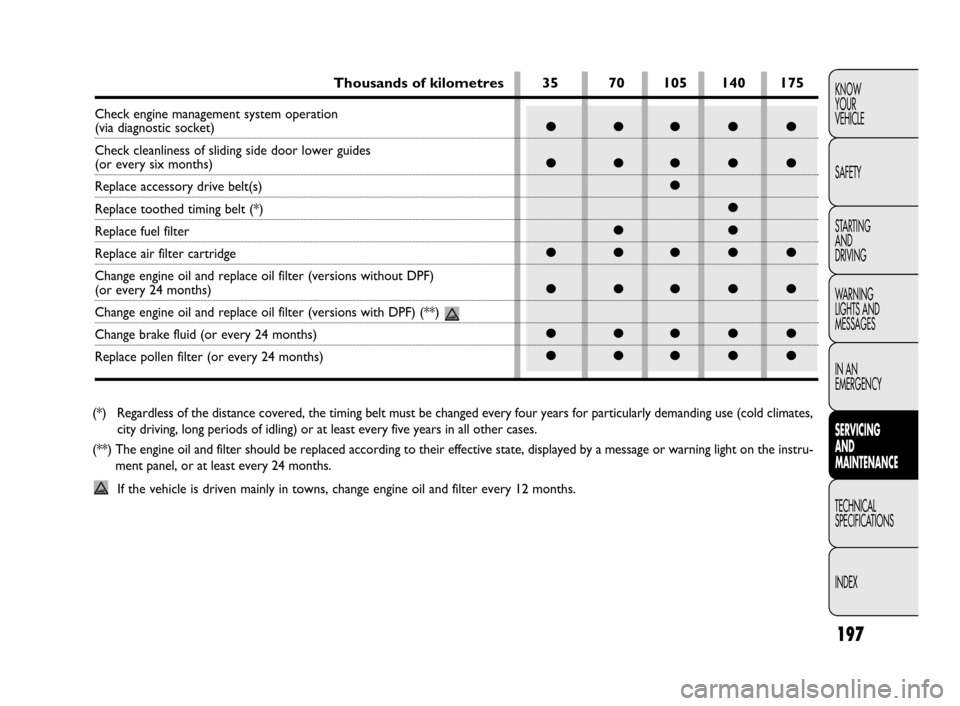
(*) Regardless of the distance covered, the timing belt must be changed every four years for particularly demanding use (cold climates,
city driving, long periods of idling) or at least every five years in all other cases.
(**) The engine oil and filter should be replaced according to their effective state, displayed by a message or warning light on the instru-
ment panel, or at least every 24 months.
If the vehicle is driven mainly in towns, change engine oil and filter every 12 months.
● ●●●●
● ●●●●
●
●
●●
● ●●●●
● ●●●●
● ●●●●
● ●●●●
Thousands of kilometres 35 70 105 140 175
Check engine management system operation (via diagnostic socket)
Check cleanliness of sliding side door lower guides
(or every six months)
Replace accessory drive belt(s)
Replace toothed timing belt (*)
Replace fuel filter
Replace air filter cartridge
Change engine oil and replace oil filter (versions without DPF)
(or every 24 months)
Change engine oil and replace oil filter (versions with DPF) (**)
Change brake fluid (or every 24 months)
Replace pollen filter (or every 24 months)
Page 199 of 274
198
KNOW
YOUR
VEHICLE
SAFETY
STARTING
AND
DRIVING
WARNING
LIGHTS AND
MESSAGES
IN AN
EMERGENCY
SERVICING
AND
MAINTENANCE
TECHNICAL
SPECIFICATIONS
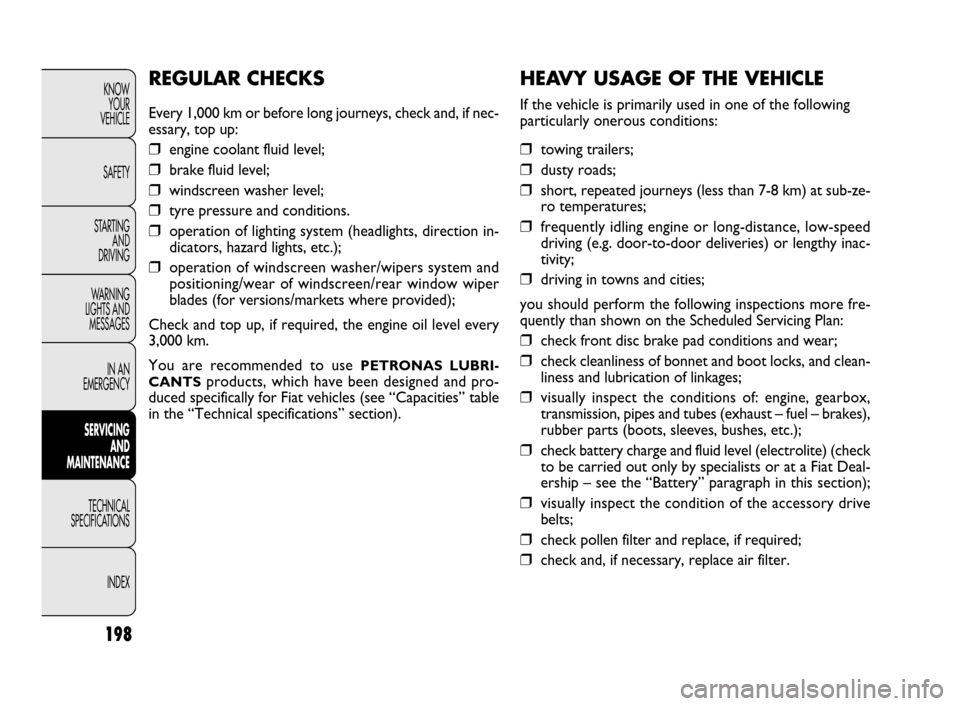
INDEXHEAVY USAGE OF THE VEHICLE
If the vehicle is primarily used in one of the following
particularly onerous conditions:
❒ towing trailers;
❒ dusty roads;
❒ short, repeated journeys (less than 7-8 km) at sub-ze-
ro temperatures;
❒ frequently idling engine or long-distance, low-speed
driving (e.g. door-to-door deliveries) or lengthy inac-
tivity;
❒ driving in towns and cities;
you should perform the following inspections more fre-
quently than shown on the Scheduled Servicing Plan:
❒ check front disc brake pad conditions and wear;
❒ check cleanliness of bonnet and boot locks, and clean-
liness and lubrication of linkages;
❒ visually inspect the conditions of: engine, gearbox,
transmission, pipes and tubes (exhaust – fuel – brakes),
rubber parts (boots, sleeves, bushes, etc.);
❒ check battery charge and fluid level (electrolite) (check
to be carried out only by specialists or at a Fiat Deal-
ership – see the “Battery” paragraph in this section);
❒ visually inspect the condition of the accessory drive
belts;
❒ check pollen filter and replace, if required;
❒ check and, if necessary, replace air filter.
REGULAR CHECKS
Every 1,000 km or before long journeys, check and, if nec-
essary, top up:
❒ engine coolant fluid level;
❒ brake fluid level;
❒ windscreen washer level;
❒ tyre pressure and conditions.
❒ operation of lighting system (headlights, direction in-
dicators, hazard lights, etc.);
❒ operation of windscreen washer/wipers system and
positioning/wear of windscreen/rear window wiper
blades (for versions/markets where provided);
Check and top up, if required, the engine oil level every
3,000 km.
You are recommended to use
PETRONAS LUBRI-
CANTS
products, which have been designed and pro-
duced specifically for Fiat vehicles (see “Capacities” table
in the “Technical specifications” section).
Page 269 of 274
268
KNOW
YOUR
VEHICLE
SAFETY
STARTING
AND
DRIVING
WARNING
LIGHTS AND
MESSAGES
IN AN
EMERGENCY
SERVICING
AND
MAINTENANCE
TECHNICAL
SPECIFICATIONS
INDEX
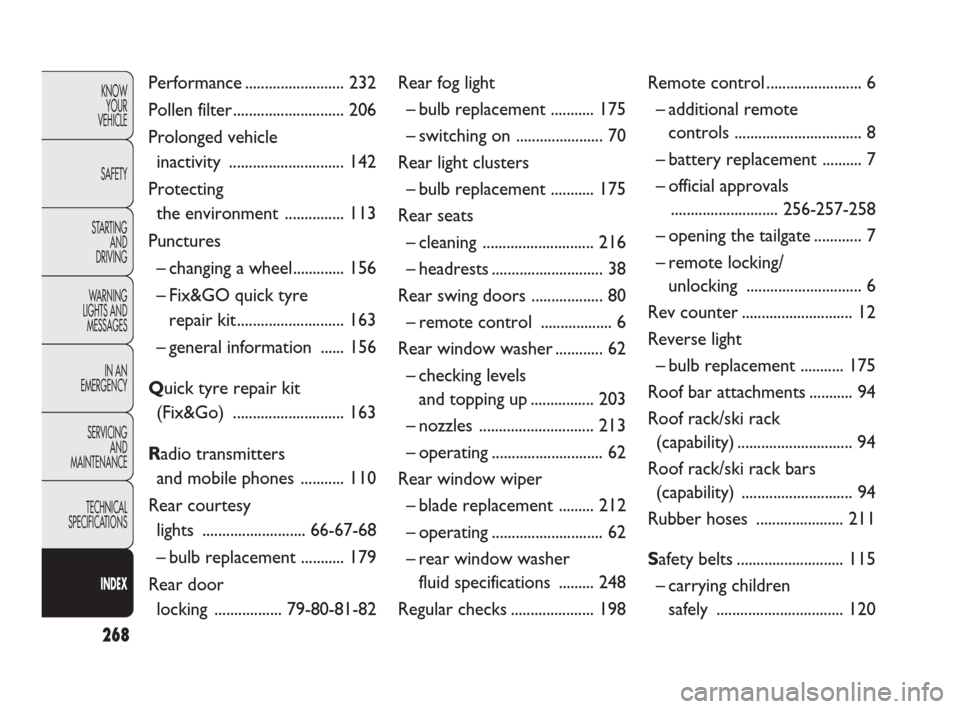
Performance......................... 232
Pollen filter............................ 206
Prolonged vehicle
inactivity ............................. 142
Protecting
the environment ............... 113
Punctures
– changing a wheel............. 156
– Fix&GO quick tyre
repair kit........................... 163
– general information ...... 156
Quick tyre repair kit
(Fix&Go) ............................ 163
Radio transmitters
and mobile phones ........... 110
Rear courtesy
lights ..........................66-67-68
– bulb replacement ........... 179
Rear door
locking .................79-80-81-82Rear fog light
– bulb replacement ........... 175
– switching on ...................... 70
Rear light clusters
– bulb replacement ........... 175
Rear seats
– cleaning ............................ 216
– headrests............................ 38
Rear swing doors .................. 80
– remote control .................. 6
Rear window washer............ 62
– checking levels
and topping up................ 203
– nozzles ............................. 213
– operating............................ 62
Rear window wiper
– blade replacement ......... 212
– operating............................ 62
– rear window washer
fluid specifications ......... 248
Regular checks..................... 198Remote control........................ 6
– additional remote
controls ................................ 8
– battery replacement .......... 7
– official approvals
...........................256-257-258
– opening the tailgate............ 7
– remote locking/
unlocking ............................. 6
Rev counter ............................ 12
Reverse light
– bulb replacement ........... 175
Roof bar attachments ........... 94
Roof rack/ski rack
(capability)............................. 94
Roof rack/ski rack bars
(capability) ............................ 94
Rubber hoses ...................... 211
Safety belts ........................... 115
– carrying children
safely ................................ 120