seats FIAT DOBLO 2009 2.G Owner's Manual
[x] Cancel search | Manufacturer: FIAT, Model Year: 2009, Model line: DOBLO, Model: FIAT DOBLO 2009 2.GPages: 274, PDF Size: 6.6 MB
Page 129 of 274
128
KNOW
YOUR
VEHICLE
SAFETY
STARTING
AND
DRIVING
WARNING
LIGHTS AND
MESSAGES
IN AN
EMERGENCY
SERVICING
AND
MAINTENANCE
TECHNICAL
SPECIFICATIONS
INDEXFRONT AIRBAGS
The vehicle is fitted with front airbags for the driver and,
for versions/markets where provided, front airbags for
the passenger.
FRONT AIRBAGS
The front driver/passenger airbags (for versions/markets
where provided) have been designed to protect the front-
seat occupants in the event of head-on crashes of medi-
um-high severity, by placing the bag between the occu-
pant and the steering wheel or dashboard.
Non-activation in other types of crash (side-on collisions,
rear shunts, roll-overs, etc.) is therefore not a sign of sys-
tem malfunction.
An electronic control unit causes the bag to inflate, if nec-
essary, in the event of a head-on crash.
The bag will inflate instantaneously, placing itself between
the front occupant’s body and the structures which could
cause injury. It will deflate immediately afterwards.
Front driver/passenger airbags (for versions/markets
where provided) are not a replacement for, but rather
a complement to, the seat belts, which should be worn
at all times as specified by law in Europe and most non-
European countries.
In the event of an impact, someone not wearing a seat
belt could move forward and come into contact with a bag
which is still in the opening phase. The protection offered
by the bag is reduced in such a case. The front airbags may not be activated in the following
situations:❒head-on impacts against highly deformable objects that
do not affect the vehicle’s front surface (e.g. front wing
hitting the guard rail);
❒car getting wedged under other vehicles or protective
barriers (e.g. trucks or guard rails);
they could not provide any additional protection com-
pared with seat belts, so their activation would not be
worthwhile. In these cases, non-deployment of the airbag
does not necessarily indicate a system malfunction.
Do not apply stickers or other objects to
the steering wheel, the dashboard in the
passenger side airbag area and the seats. Do not
place objects (e.g. mobile phones) on the passen-
ger side dashboard because these could interfere
with the correct opening of the airbag and cause
severe injury to occupants.
WARNING
The front driver and passenger airbags are designed and
calibrated to best protect front-seat passengers wearing
seat belts.
The volume of the front airbags at maximum inflation fills
most of the space between the steering wheel and the
driver and between the dashboard and the passenger.
Page 130 of 274
129
KNOW
YOUR
VEHICLE
SAFETY
STARTING
AND
DRIVING
WARNING
LIGHTS AND
MESSAGES
IN AN
EMERGENCY
SERVICING
AND
MAINTENANCE
TECHNICAL
SPECIFICATIONS
INDEX
F0V0024mfig. 123F0V0025mfig. 124
The airbags are not deployed in the event of small head-
on collisions (for which the withholding action of the seat
belts is sufficient). Seat belts must always be worn. In the
event of head-on collisions, they ensure the correct po-
sitioning of the occupant.
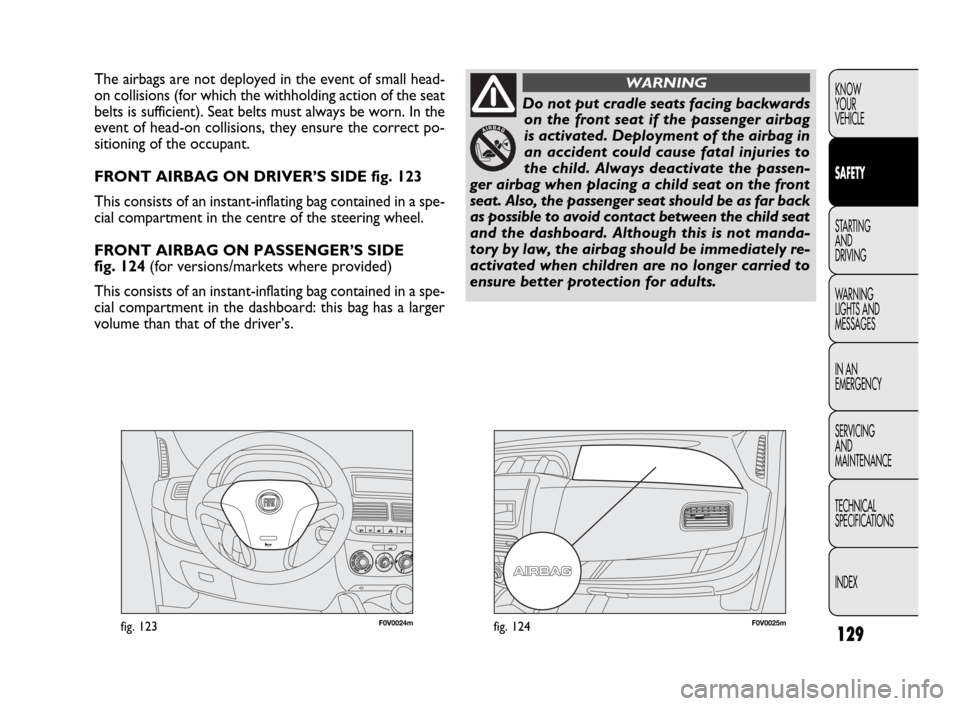
FRONT AIRBAG ON DRIVER’S SIDE fig. 123
This consists of an instant-inflating bag contained in a spe-
cial compartment in the centre of the steering wheel.
FRONT AIRBAG ON PASSENGER’S SIDE
fig. 124 (for versions/markets where provided)
This consists of an instant-inflating bag contained in a spe-
cial compartment in the dashboard: this bag has a larger
volume than that of the driver’s.
Do not put cradle seats facing backwards
on the front seat if the passenger airbag
is activated. Deployment of the airbag in
an accident could cause fatal injuries to
the child. Always deactivate the passen-
ger airbag when placing a child seat on the front
seat. Also, the passenger seat should be as far back
as possible to avoid contact between the child seat
and the dashboard. Although this is not manda-
tory by law, the airbag should be immediately re-
activated when children are no longer carried to
ensure better protection for adults.
WARNING
Page 132 of 274
131
KNOW
YOUR
VEHICLE
SAFETY
STARTING
AND
DRIVING
WARNING
LIGHTS AND
MESSAGES
IN AN
EMERGENCY
SERVICING
AND
MAINTENANCE
TECHNICAL
SPECIFICATIONS
INDEXIMPORTANT The best protection in the event of side-
on crash is achieved by maintaining a correct position on
the seat. This allows the side bag to be correctly deployed.
IMPORTANT Do not wash the seats with water or pres-
surised steam (by hand or at automatic seat washing sta-
tions).
GENERAL WARNINGS
The front airbags and/or side bags (where provided) may
be deployed if the vehicle is subject to heavy knocks or
accidents involving the underbody area, such as for ex-
ample violent shocks against steps, kerbs or low obsta-
cles, or the vehicle falling into big potholes or depressions
in the road.
A small amount of dust will be released when the airbags
are deployed. The dust is not harmful and does not indi-
cate the beginning of a fire. Furthermore, the surface of
the deployed bag and the interior of the vehicle may be
covered in a dusty residue: this may irritate your skin and
eyes. Wash with mild soap and water in the event of ex-
posure.
Should an accident occur in which any of the safety de-
vices are activated, take the vehicle to a Fiat Dealership
to have the activated devices replaced and to have the
whole system checked.
Any airbag checks, repairs or replacements must be car-
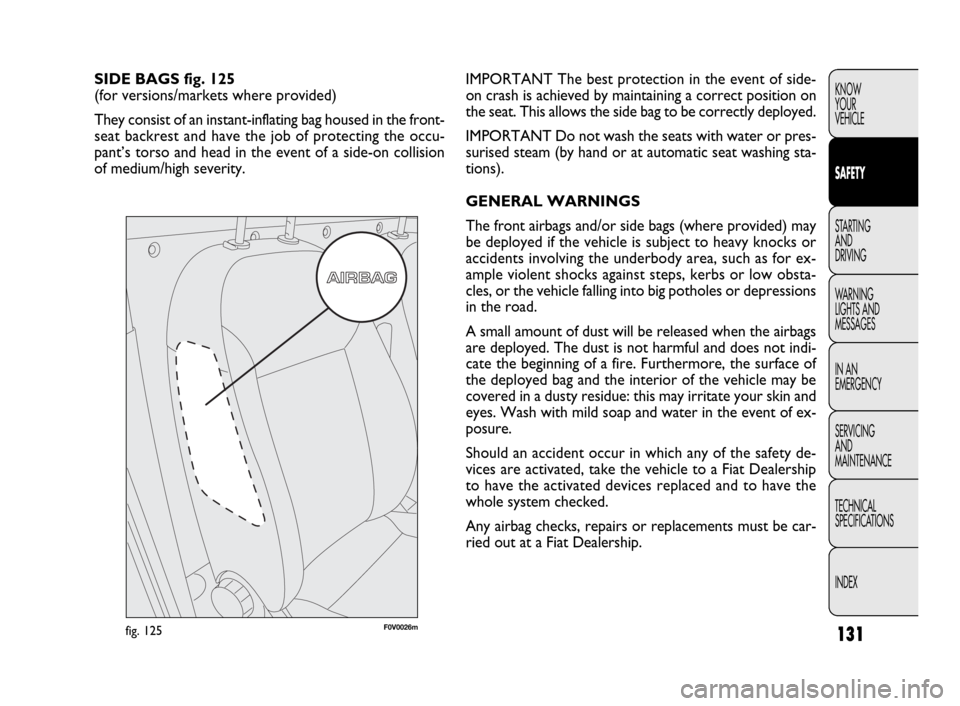
ried out at a Fiat Dealership. SIDE BAGS fig. 125
(for versions/markets where provided)
They consist of an instant-inflating bag housed in the front-
seat backrest and have the job of protecting the occu-
pant’s torso and head in the event of a side-on collision
of medium/high severity.
F0V0026mfig. 125
Page 136 of 274
135
KNOW
YOUR
VEHICLE
SAFETY
STARTING
AND
DRIVING
WARNING
LIGHTS AND
MESSAGES
IN AN
EMERGENCY
SERVICING
AND
MAINTENANCE
TECHNICAL
SPECIFICATIONS
INDEXHANDBRAKE
The handbrake is located between the two front seats.
Pull the lever upwards to engage the handbrake and en-
sure that the vehicle does not move.
STOPPING THE ENGINE
Turn the ignition key to STOP while the engine is idling.
IMPORTANT After a long drive, you should allow the
engine to “catch its breath” before turning it off by let-
ting it idle to allow the temperature in the engine com-
partment to fall.
Never jump start the engine by pushing,
towing or driving downhill. This could cause
fuel to flow into the catalytic converter and
damage it beyond repair.
The vehicle should be secured after sev-
eral clicks of the lever. If it is not, contact
a FIAT Dealership to have it adjusted.
WARNING
When the handbrake is on and the ignition key is at MAR,
the instrument panel warning light
xwill come on.
Proceed as follows to release the handbrake:
❒lift the lever slightly and press release button A-fig. 126;
❒hold button A down and lower the lever. The xwarn-
ing light on the instrument panel will go out.
Depress the brake pedal when carrying out this opera-
tion to prevent the vehicle from moving accidentally.
Page 186 of 274
185
KNOW
YOUR
VEHICLE
SAFETY
STARTING
AND
DRIVING
WARNING
LIGHTS AND
MESSAGES
IN AN
EMERGENCY
SERVICING
AND
MAINTENANCE
TECHNICAL
SPECIFICATIONS
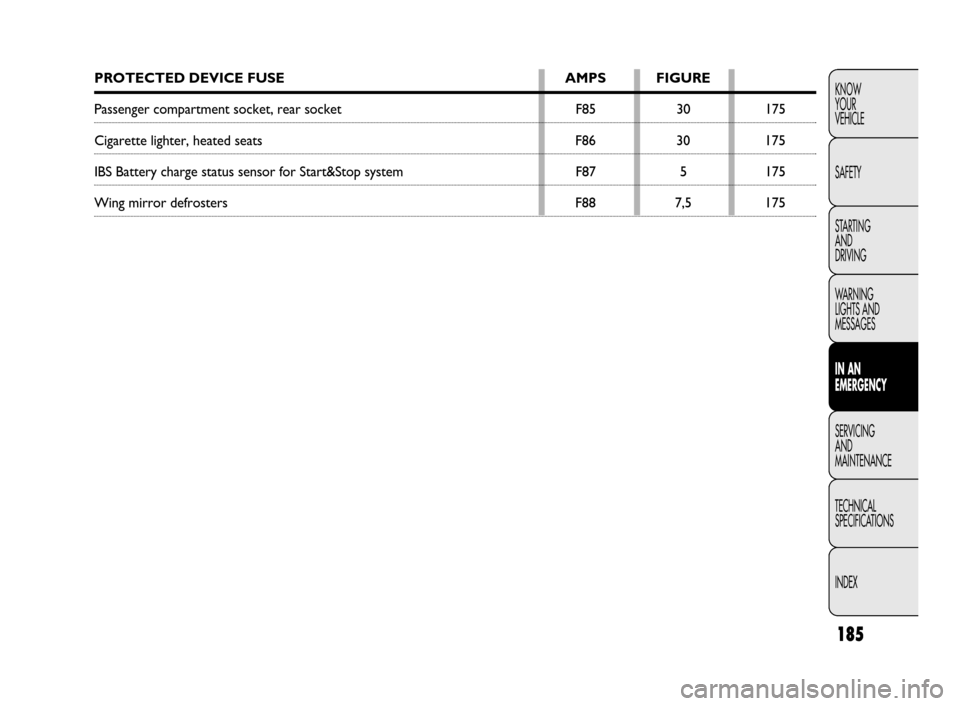
INDEXPROTECTED DEVICE FUSE AMPS FIGURE
Passenger compartment socket, rear socket F85 30 175
Cigarette lighter, heated seats F86 30 175
IBS Battery charge status sensor for Start&Stop system F87 5 175
Wing mirror defrosters F88 7,5 175
Page 218 of 274

217
KNOW
YOUR
VEHICLE
SAFETY
STARTING
AND
DRIVING
WARNING
LIGHTS AND
MESSAGES
IN AN
EMERGENCY
SERVICING
AND
MAINTENANCE
TECHNICAL
SPECIFICATIONS
INDEXLEATHER UPHOLSTERED STEERING
WHEEL/GEAR KNOB/HANDBRAKE LEVER
(for versions/market, where provided)
These components must be cleaned with mild soap and
water only. Never use spirits or alcohol-based products.
Read the product label carefully before using specific prod-
ucts for cleaning the interiors: make sure the product does
not contain spirits or alcohol-based substances.
If, when cleaning the windscreen with special products,
window cleaner accidentally drips onto the leather of the
steering wheel/gear lever knob/hand brake, wipe away im-
mediately and then wash the affected area with mild soap
and water.
IMPORTANT Be careful when installing a steering wheel
locking device not to damage the leather upholstery. SEATS AND FABRIC PARTS
Remove dust with a soft brush or a vacuum cleaner. It is
advisable to use a damp brush on velvet upholstery.
Rub the seats with a sponge and a solution of water and
mild soap.
PLASTIC PARTS
It is advisable to clean interior plastic parts with a damp
cloth and a solution of water and non-abrasive mild soap.
To remove grease and tough stains, use products designed
specifically for cleaning plastics. These have no solvents
and have been designed so that they do not alter the ap-
pearance and colour of the components.
IMPORTANT Never use spirits or petroleum to clean
the instrument panel glass.
Page 222 of 274
221
KNOW
YOUR
VEHICLE
SAFETY
STARTING
AND
DRIVING
WARNING
LIGHTS AND
MESSAGES
IN AN
EMERGENCY
SERVICING
AND
MAINTENANCE
TECHNICAL
SPECIFICATIONS
INDEX
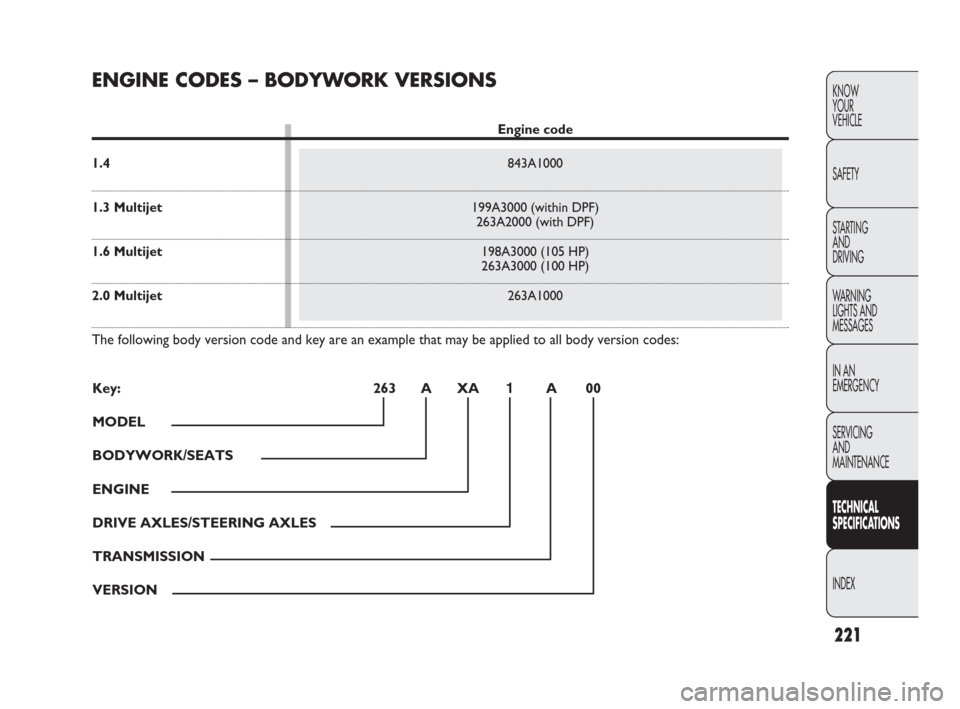
ENGINE CODES – BODYWORK VERSIONS
Engine code
1.4843A1000
1.3 Multijet199A3000 (within DPF)263A2000 (with DPF)
1.6 Multijet198A3000 (105 HP)
263A3000 (100 HP)
2.0 Multijet263A1000
The following body version code and key are an example that may be applied to all body version codes:
Key: 263 A XA1A00
MODEL
BODYWORK/SEATS
ENGINE
DRIVE AXLES/STEERING AXLES
TRANSMISSION
VERSION
Page 223 of 274
222
KNOW
YOUR
VEHICLE
SAFETY
STARTING
AND
DRIVING
WARNING
LIGHTS AND
MESSAGES
IN AN
EMERGENCY
SERVICING
AND
MAINTENANCE
TECHNICAL
SPECIFICATIONS
INDEX
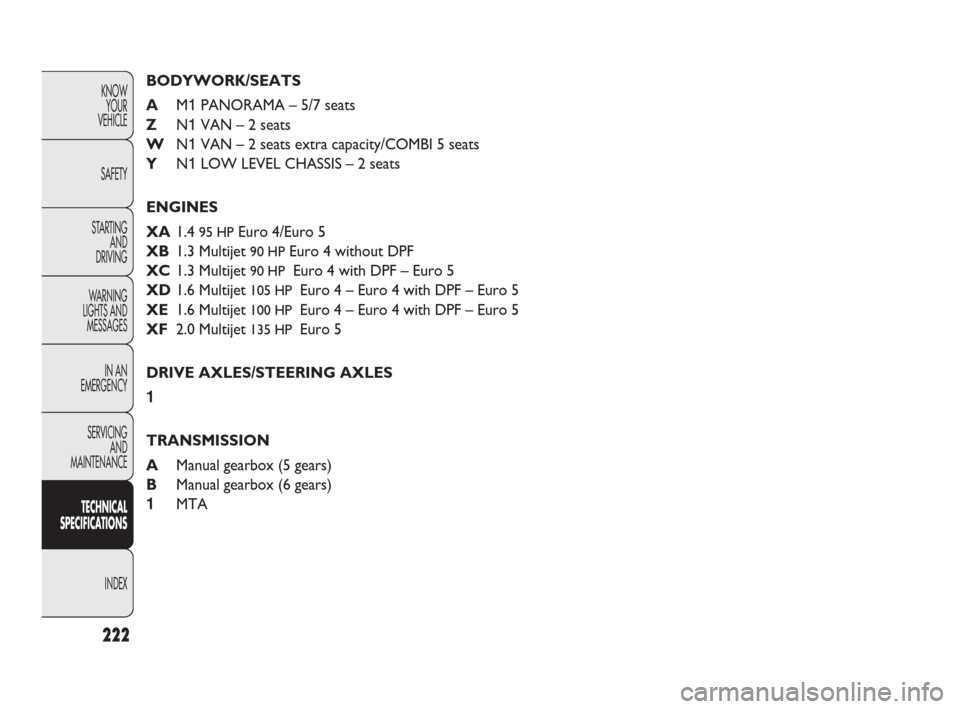
BODYWORK/SEATS
AM1PANORAMA – 5/7 seats
ZN1VAN – 2 seats
WN1VAN – 2 seats extra capacity/COMBI 5 seats
YN1LOW LEVEL CHASSIS – 2 seats
ENGINES
XA1.4
95 HPEuro 4/Euro 5
XB1.3 Multijet
90 HPEuro 4 without DPF
XC1.3 Multijet
90 HP Euro 4 with DPF – Euro 5
XD1.6 Multijet
105 HP Euro 4 – Euro 4 with DPF – Euro 5
XE1.6 Multijet
100 HP Euro 4 – Euro 4 with DPF – Euro 5
XF2.0 Multijet
135 HP Euro 5
DRIVE AXLES/STEERING AXLES
1
TRANSMISSION
AManual gearbox (5 gears)
BManual gearbox (6 gears)
1MTA
Page 256 of 274
255
KNOW
YOUR
VEHICLE
SAFETY
STARTING
AND
DRIVING
WARNING
LIGHTS AND
MESSAGES
IN AN
EMERGENCY
SERVICING
AND
MAINTENANCE
TECHNICAL
SPECIFICATIONS
INDEX
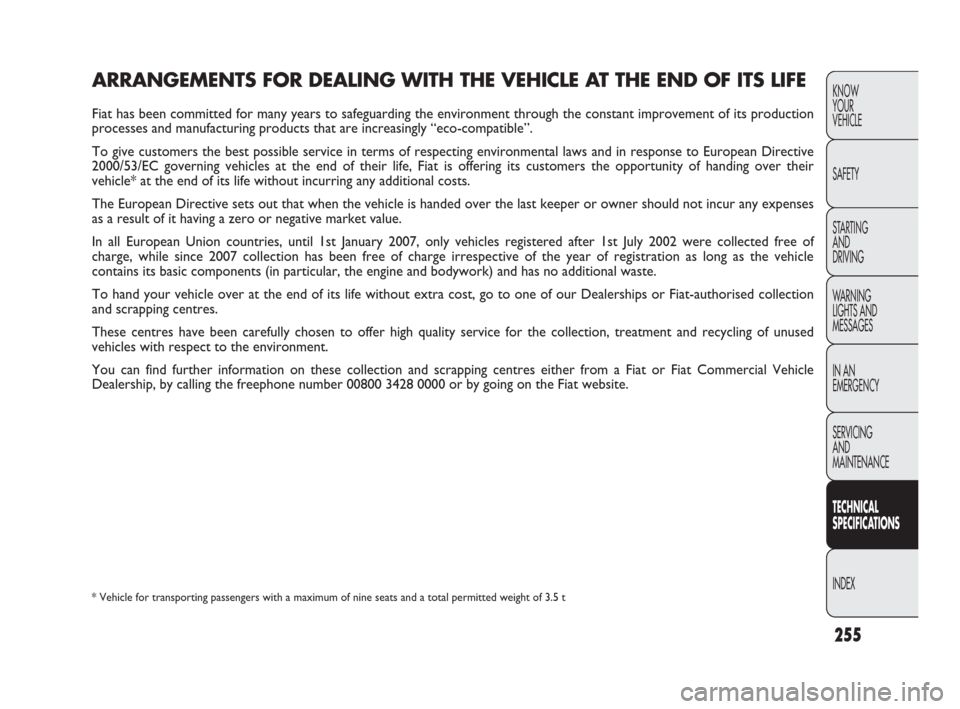
ARRANGEMENTS FOR DEALING WITH THE VEHICLE AT THE END OF ITS LIFE
Fiat has been committed for many years to safeguarding the environment through the constant improvement of its production
processes and manufacturing products that are increasingly “eco-compatible”.
To give customers the best possible service in terms of respecting environmental laws and in response to European Directive
2000/53/EC governing vehicles at the end of their life, Fiat is offering its customers the opportunity of handing over their
vehicle* at the end of its life without incurring any additional costs.
The European Directive sets out that when the vehicle is handed over the last keeper or owner should not incur any expenses
as a result of it having a zero or negative market value.
In all European Union countries, until 1st January 2007, only vehicles registered after 1st July 2002 were collected free of
charge, while since 2007 collection has been free of charge irrespective of the year of registration as long as the vehicle
contains its basic components (in particular, the engine and bodywork) and has no additional waste.
To hand your vehicle over at the end of its life without extra cost, go to one of our Dealerships or Fiat-authorised collection
and scrapping centres.
These centres have been carefully chosen to offer high quality service for the collection, treatment and recycling of unused
vehicles with respect to the environment.
You can find further information on these collection and scrapping centres either from a Fiat or Fiat Commercial Vehicle
Dealership, by calling the freephone number 00800 3428 0000 or by going on the Fiat website.
* Vehicle for transporting passengers with a maximum of nine seats and a total permitted weight of 3.5 t
Page 262 of 274
261
KNOW
YOUR
VEHICLE
SAFETY
STARTING
AND
DRIVING
WARNING
LIGHTS AND
MESSAGES
IN AN
EMERGENCY
SERVICING
AND
MAINTENANCE
TECHNICAL
SPECIFICATIONS
INDEX
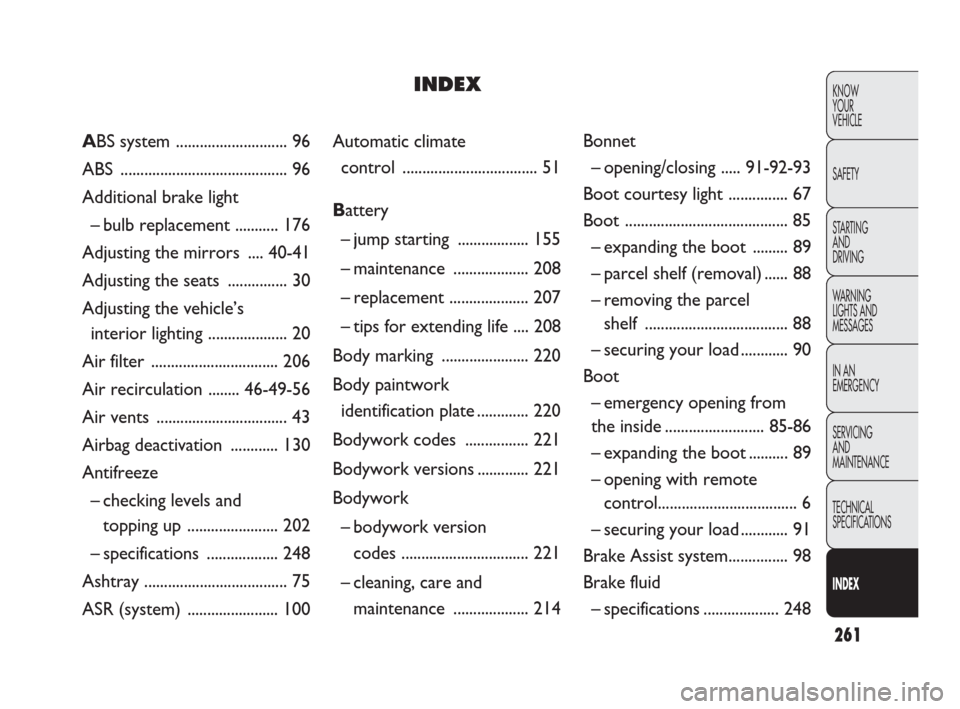
Automatic climate
control .................................. 51
Battery
– jump starting .................. 155
– maintenance ................... 208
– replacement .................... 207
– tips for extending life .... 208
Body marking ...................... 220
Body paintwork
identification plate............. 220
Bodywork codes ................ 221
Bodywork versions ............. 221
Bodywork
– bodywork version
codes ................................ 221
– cleaning, care and
maintenance ................... 214Bonnet
– opening/closing ..... 91-92-93
Boot courtesy light ............... 67
Boot ......................................... 85
– expanding the boot ......... 89
– parcel shelf (removal) ...... 88
– removing the parcel
shelf .................................... 88
– securing your load ............ 90
Boot
– emergency opening from
the inside.........................85-86
– expanding the boot .......... 89
– opening with remote
control................................... 6
– securing your load ............ 91
Brake Assist system............... 98
Brake fluid
– specifications................... 248 ABS system ............................ 96
ABS .......................................... 96
Additional brake light
– bulb replacement ........... 176
Adjusting the mirrors .... 40-41
Adjusting the seats ............... 30
Adjusting the vehicle’s
interior lighting .................... 20
Air filter ................................ 206
Air recirculation ........ 46-49-56
Air vents ................................. 43
Airbag deactivation ............ 130
Antifreeze
– checking levels and
topping up ....................... 202
– specifications .................. 248
Ashtray .................................... 75
ASR (system) ....................... 100
INDEX