engine FIAT DOBLO 2009 2.G Workshop Manual
[x] Cancel search | Manufacturer: FIAT, Model Year: 2009, Model line: DOBLO, Model: FIAT DOBLO 2009 2.GPages: 274, PDF Size: 6.6 MB
Page 167 of 274
166
KNOW
YOUR
VEHICLE
SAFETY
STARTING
AND
DRIVING
WARNING
LIGHTS AND
MESSAGES
IN AN
EMERGENCY
SERVICING
AND
MAINTENANCE
TECHNICAL
SPECIFICATIONS
INDEX
F0V0096mfig. 144F0V0097mfig. 145
❒if in this case a pressure of at least 1.8 bar is not reached
within five minutes of switching on the compressor,
do not continue driving because the tyre is too dam-
aged and the hold cannot be guaranteed. Contact
a Fiat Dealership
❒if you do reach the tyre pressure specified in the “Cold
tyre pressures” paragraph of the “Technical specifica-
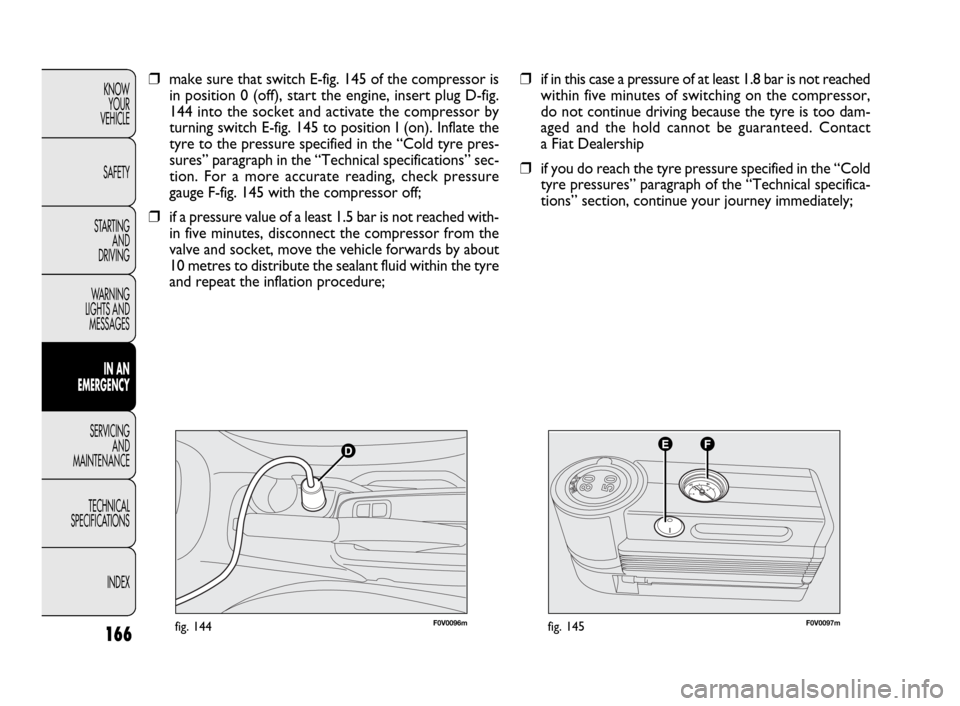
tions” section, continue your journey immediately; ❒make sure that switch E-fig. 145 of the compressor is
in position 0 (off), start the engine, insert plug D-fig.
144 into the socket and activate the compressor by
turning switch E-fig. 145 to position I (on). Inflate the
tyre to the pressure specified in the “Cold tyre pres-
sures” paragraph in the “Technical specifications” sec-
tion. For a more accurate reading, check pressure
gauge F-fig. 145 with the compressor off;
❒if a pressure value of a least 1.5 bar is not reached with-
in five minutes, disconnect the compressor from the
valve and socket, move the vehicle forwards by about
10 metres to distribute the sealant fluid within the tyre
and repeat the inflation procedure;
Page 168 of 274
167
KNOW
YOUR
VEHICLE
SAFETY
STARTING
AND
DRIVING
WARNING
LIGHTS AND
MESSAGES
IN AN
EMERGENCY
SERVICING
AND
MAINTENANCE
TECHNICAL
SPECIFICATIONS
INDEX
F0V0098mfig. 146
❒If you get a pressure reading of at least 1.8 bar, restore
the proper pressure (with engine running and hand-
brake on) and continue your journey.
❒drive with the utmost care to the nearest Fiat Dealer-
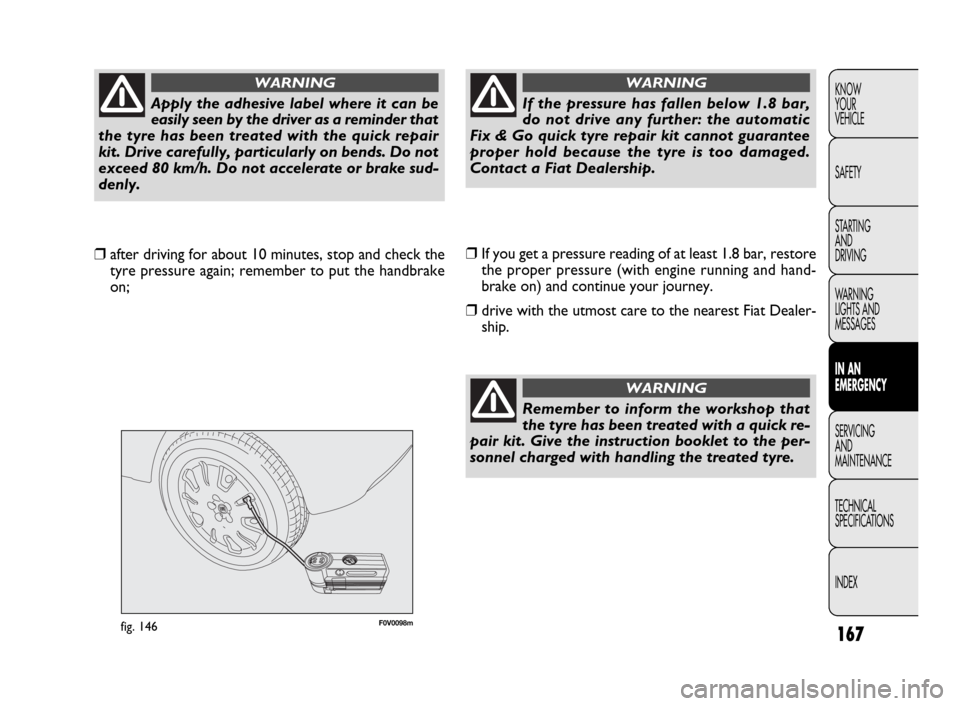
ship. ❒after driving for about 10 minutes, stop and check the
tyre pressure again; remember to put the handbrake
on;
Apply the adhesive label where it can be
easily seen by the driver as a reminder that
the tyre has been treated with the quick repair
kit. Drive carefully, particularly on bends. Do not
exceed 80 km/h. Do not accelerate or brake sud-
denly.
WARNING
If the pressure has fallen below 1.8 bar,
do not drive any further: the automatic
Fix & Go quick tyre repair kit cannot guarantee
proper hold because the tyre is too damaged.
Contact a Fiat Dealership.
WARNING
Remember to inform the workshop that
the tyre has been treated with a quick re-
pair kit. Give the instruction booklet to the per-
sonnel charged with handling the treated tyre.
WARNING
Page 183 of 274
182
KNOW
YOUR
VEHICLE
SAFETY
STARTING
AND
DRIVING
WARNING
LIGHTS AND
MESSAGES
IN AN
EMERGENCY
SERVICING
AND
MAINTENANCE
TECHNICAL
SPECIFICATIONS
INDEX
F0V0081mfig. 174
F0V0089mfig. 175
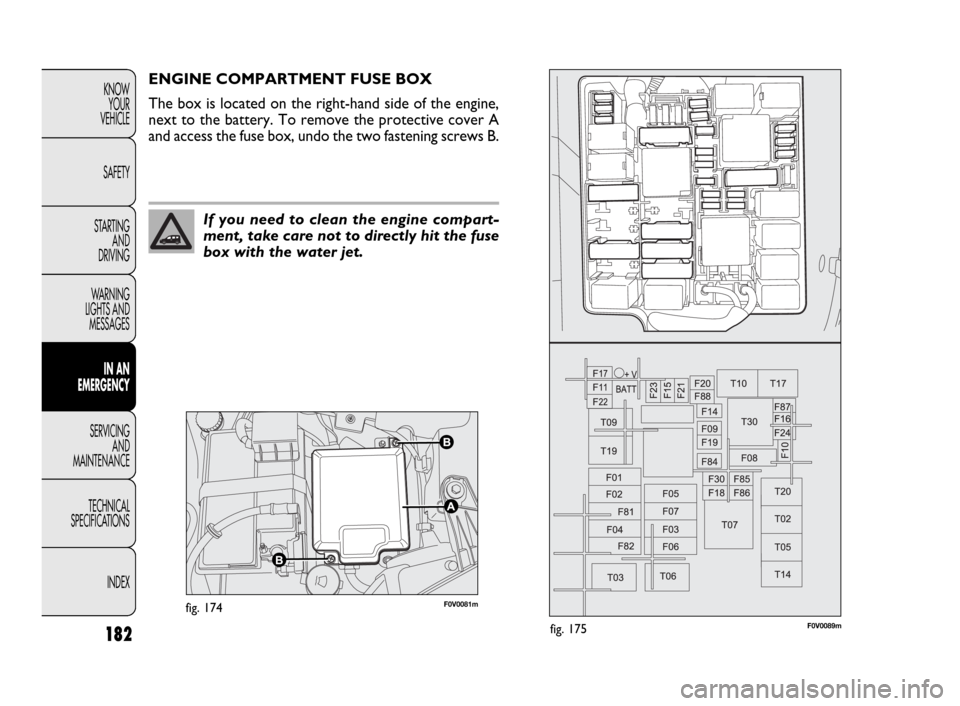
ENGINE COMPARTMENT FUSE BOX
The box is located on the right-hand side of the engine,
next to the battery. To remove the protective cover A
and access the fuse box, undo the two fastening screws B.
If you need to clean the engine compart-
ment, take care not to directly hit the fuse
box with the water jet.
Page 184 of 274
183
KNOW
YOUR
VEHICLE
SAFETY
STARTING
AND
DRIVING
WARNING
LIGHTS AND
MESSAGES
IN AN
EMERGENCY
SERVICING
AND
MAINTENANCE
TECHNICAL
SPECIFICATIONS
INDEXPROTECTED DEVICE FUSE AMPS FIGURE
BCM – Body Computer Control Unit F01 60 175
Rear window winder driver’s side manual gearbox
(Doblò/Doblò Combi versions) F02 20 175
Ignition switch F03 20 175
BSM Braking system control unit (electropump) F04 40 175
Additional heater PTC2 (diesel engines) F05 50 175
Radiator fan (low speed) F06 30 175
Radiator fan (high speed, 187/300/350W) F07 40 175
Radiator fan (high speed, 500W) F07 60 175
Passenger compartment fan F08 40 175
Remote control switch for opening swing door (Cargo version) F09 10 175
Single tone horn F10 10 175
Engine control system secondary loads F11 10 175
Main beams F14 15 175
Additional heater PTC1 (diesel engines) F15 30 175
ECM Engine management control unit, ignition management relay 1
with Start&Stop system F16 7,5 175
Page 185 of 274
184
KNOW
YOUR
VEHICLE
SAFETY
STARTING
AND
DRIVING
WARNING
LIGHTS AND
MESSAGES
IN AN
EMERGENCY
SERVICING
AND
MAINTENANCE
TECHNICAL
SPECIFICATIONS
INDEXPROTECTED DEVICE FUSE AMPS FIGURE
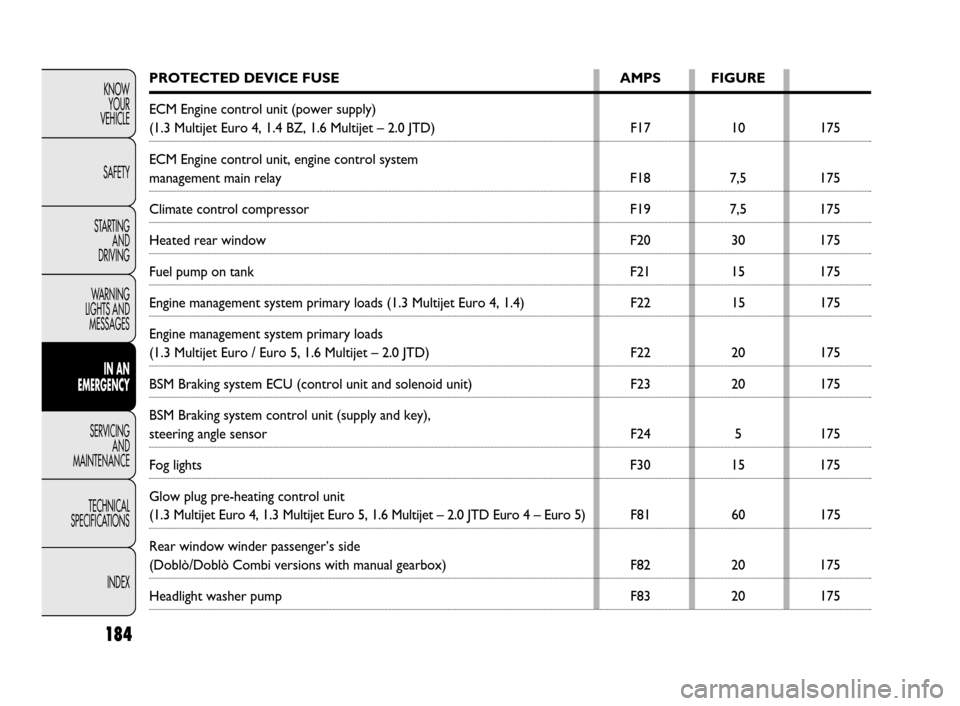
ECM Engine control unit (power supply)
(1.3 Multijet Euro 4, 1.4 BZ, 1.6 Multijet – 2.0 JTD) F17 10 175
ECM Engine control unit, engine control system
management main relay F18 7,5 175
Climate control compressor F19 7,5 175
Heated rear window F20 30 175
Fuel pump on tank F21 15 175
Engine management system primary loads (1.3 Multijet Euro 4, 1.4) F22 15 175
Engine management system primary loads
(1.3 Multijet Euro / Euro 5, 1.6 Multijet – 2.0 JTD) F22 20 175
BSM Braking system ECU (control unit and solenoid unit) F23 20 175
BSM Braking system control unit (supply and key),
steering angle sensor F24 5 175
Fog lights F30 15 175
Glow plug pre-heating control unit
(1.3 Multijet Euro 4, 1.3 Multijet Euro 5, 1.6 Multijet – 2.0 JTD Euro 4 – Euro 5) F81 60 175
Rear window winder passenger’s side
(Doblò/Doblò Combi versions with manual gearbox) F82 20 175
Headlight washer pump F83 20 175
Page 188 of 274
187
KNOW
YOUR
VEHICLE
SAFETY
STARTING
AND
DRIVING
WARNING
LIGHTS AND
MESSAGES
IN AN
EMERGENCY
SERVICING
AND
MAINTENANCE
TECHNICAL
SPECIFICATIONS
INDEXPROTECTED DEVICE FUSE AMPS FIGURE
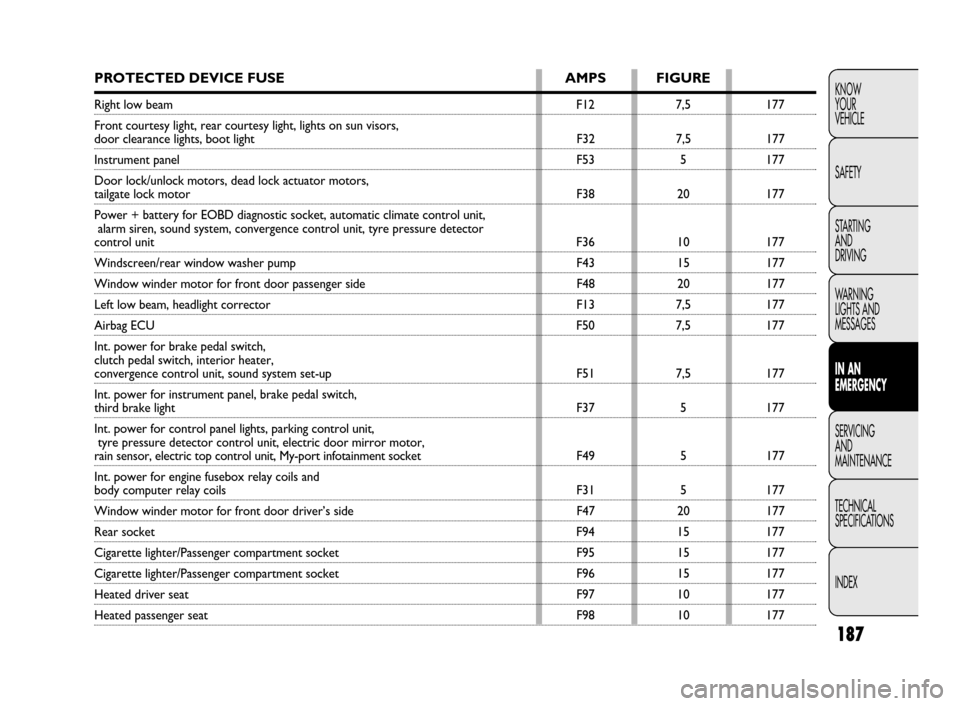
Right low beamF12 7,5 177
Front courtesy light, rear courtesy light, lights on sun visors,
door clearance lights, boot light F32 7,5 177
Instrument panel F53 5 177
Door lock/unlock motors, dead lock actuator motors,
tailgate lock motor F38 20 177
Power + battery for EOBD diagnostic socket, automatic climate control unit,
alarm siren, sound system, convergence control unit, tyre pressure detector
control unitF36 10 177
Windscreen/rear window washer pump F43 15 177
Window winder motor for front door passenger side F48 20 177
Left low beam, headlight corrector F13 7,5 177
Airbag ECUF50 7,5 177
Int. power for brake pedal switch,
clutch pedal switch, interior heater,
convergence control unit, sound system set-up F51 7,5 177
Int. power for instrument panel, brake pedal switch,
third brake light F37 5 177
Int. power for control panel lights, parking control unit,
tyre pressure detector control unit, electric door mirror motor,
rain sensor, electric top control unit, My-port infotainment socket F49 5 177
Int. power for engine fusebox relay coils and
body computer relay coils F31 5 177
Window winder motor for front door driver’s side F47 20 177
Rear socketF94 15 177
Cigarette lighter/Passenger compartment socket F95 15 177
Cigarette lighter/Passenger compartment socket F96 15 177
Heated driver seat F97 10 177
Heated passenger seat F98 10 177
Page 191 of 274
190
KNOW
YOUR
VEHICLE
SAFETY
STARTING
AND
DRIVING
WARNING
LIGHTS AND
MESSAGES
IN AN
EMERGENCY
SERVICING
AND
MAINTENANCE
TECHNICAL
SPECIFICATIONS
INDEX
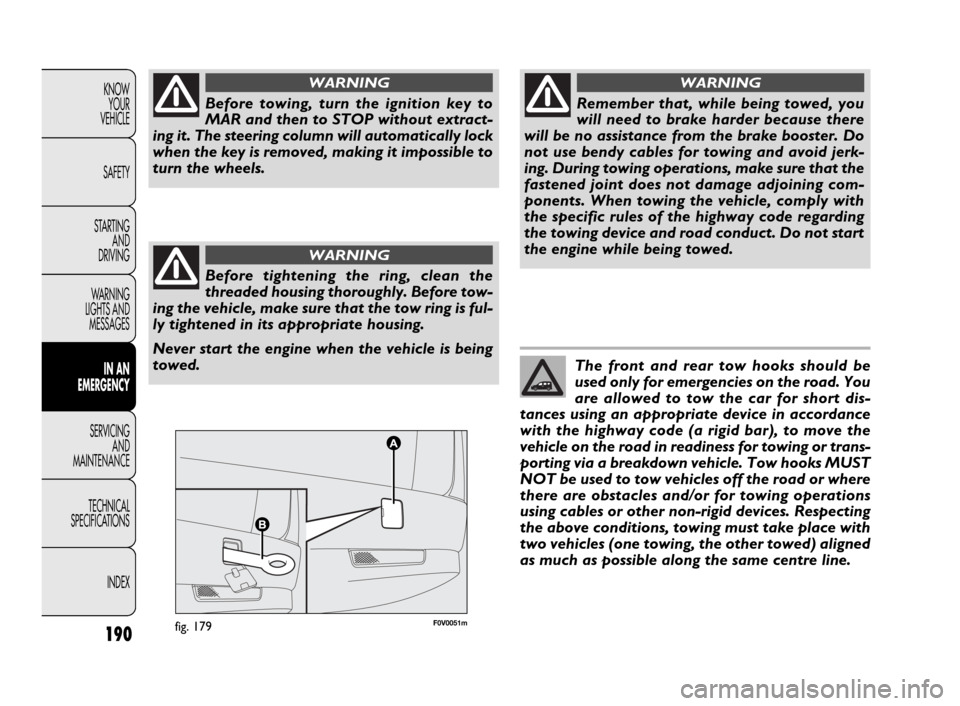
F0V0051mfig. 179
Before towing, turn the ignition key to
MAR and then to STOP without extract-
ing it. The steering column will automatically lock
when the key is removed, making it impossible to
turn the wheels.
WARNING
Before tightening the ring, clean the
threaded housing thoroughly. Before tow-
ing the vehicle, make sure that the tow ring is ful-
ly tightened in its appropriate housing.
Never start the engine when the vehicle is being
towed.
WARNING
Remember that, while being towed, you
will need to brake harder because there
will be no assistance from the brake booster. Do
not use bendy cables for towing and avoid jerk-
ing. During towing operations, make sure that the
fastened joint does not damage adjoining com-
ponents. When towing the vehicle, comply with
the specific rules of the highway code regarding
the towing device and road conduct. Do not start
the engine while being towed.
WARNING
The front and rear tow hooks should be
used only for emergencies on the road. You
are allowed to tow the car for short dis-
tances using an appropriate device in accordance
with the highway code (a rigid bar), to move the
vehicle on the road in readiness for towing or trans-
porting via a breakdown vehicle. Tow hooks MUST
NOT be used to tow vehicles off the road or where
there are obstacles and/or for towing operations
using cables or other non-rigid devices. Respecting
the above conditions, towing must take place with
two vehicles (one towing, the other towed) aligned
as much as possible along the same centre line.
Page 194 of 274
●●
●●●
●
●
●●●
●●●●●●
●●●●●●
●●●●●●
●●●●●●
●●●
●●●●●●
193
KNOW
YOUR
VEHICLE
SAFETY
STARTING
AND
DRIVING
WARNING
LIGHTS AND
MESSAGES
IN AN
EMERGENCY
SERVICING
AND
MAINTENANCE
TECHNICAL
SPECIFICATIONS
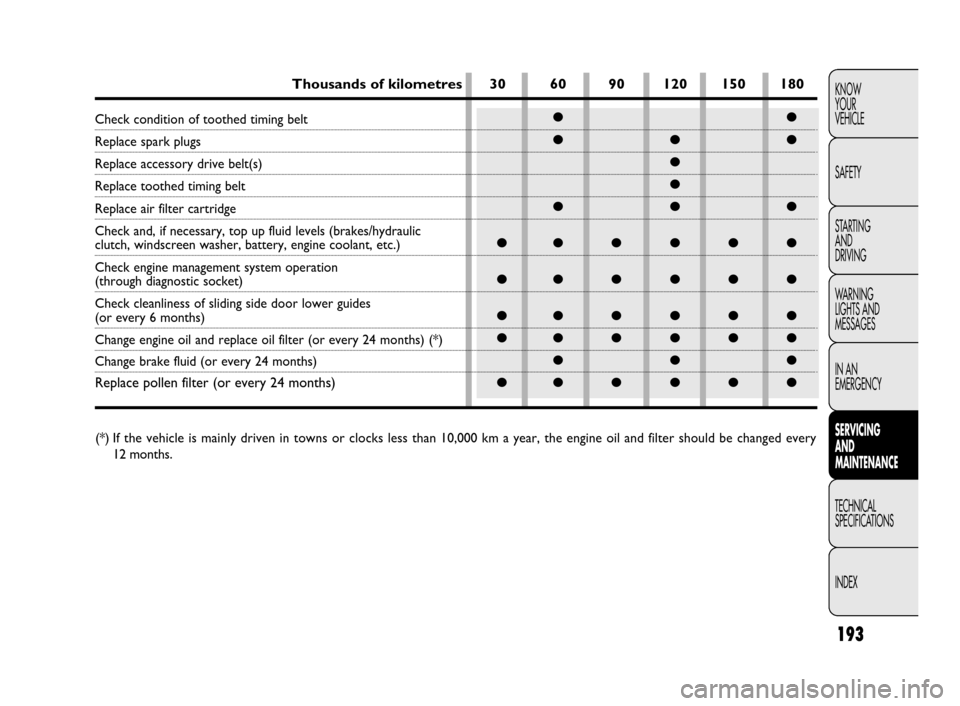
INDEXThousands of kilometres 30 60 90 120 150 180
Check condition of toothed timing belt
Replace spark plugs
Replace accessory drive belt(s)
Replace toothed timing belt
Replace air filter cartridge
Check and, if necessary, top up fluid levels (brakes/hydraulic
clutch, windscreen washer, battery, engine coolant, etc.)
Check engine management system operation
(through diagnostic socket)
Check cleanliness of sliding side door lower guides
(or every 6 months)
Change engine oil and replace oil filter (or every 24 months) (*)
Change brake fluid (or every 24 months)
Replace pollen filter (or every 24 months)
(*) If the vehicle is mainly driven in towns or clocks less than 10,000 km a year, the engine oil and filter should be changed every
12 months.
Page 195 of 274
●●●●●●
●●●●●●
●●●●●●
●●●●●●
●●●●●●
●●●
●●●●●●
●●●●●●
●●●●●●
●●
●●●●●●
●●
●●
●●●●●●
194
KNOW
YOUR
VEHICLE
SAFETY
STARTING
AND
DRIVING
WARNING
LIGHTS AND
MESSAGES
IN AN
EMERGENCY
SERVICING
AND
MAINTENANCE
TECHNICAL
SPECIFICATIONS
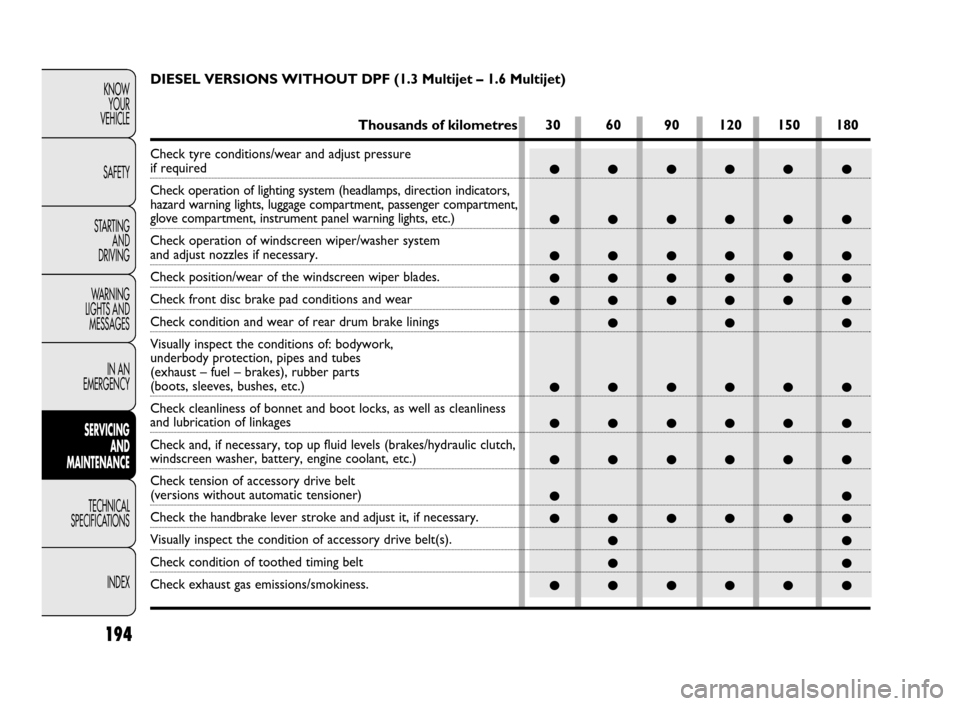
INDEXDIESEL VERSIONS WITHOUT DPF (1.3 Multijet – 1.6 Multijet)
Thousands of kilometres 30 60 90 120 150 180
Check tyre conditions/wear and adjust pressure if required
Check operation of lighting system (headlamps, direction indicators,
hazard warning lights, luggage compartment, passenger compartment,
glove compartment, instrument panel warning lights, etc.)
Check operation of windscreen wiper/washer system
and adjust nozzles if necessary.
Check position/wear of the windscreen wiper blades.
Check front disc brake pad conditions and wear
Check condition and wear of rear drum brake linings
Visually inspect the conditions of: bodywork,
underbody protection, pipes and tubes
(exhaust – fuel – brakes), rubber parts
(boots, sleeves, bushes, etc.)
Check cleanliness of bonnet and boot locks, as well as cleanliness
and lubrication of linkages
Check and, if necessary, top up fluid levels (brakes/hydraulic clutch,
windscreen washer, battery, engine coolant, etc.)
Check tension of accessory drive belt
(versions without automatic tensioner)
Check the handbrake lever stroke and adjust it, if necessary.
Visually inspect the condition of accessory drive belt(s).
Check condition of toothed timing belt
Check exhaust gas emissions/smokiness.
Page 196 of 274
●●●●●●
●
●
●●●
●●●
●●●●●●
●●●●●●
●●●●●●
195
KNOW
YOUR
VEHICLE
SAFETY
STARTING
AND
DRIVING
WARNING
LIGHTS AND
MESSAGES
IN AN
EMERGENCY
SERVICING
AND
MAINTENANCE
TECHNICAL
SPECIFICATIONS
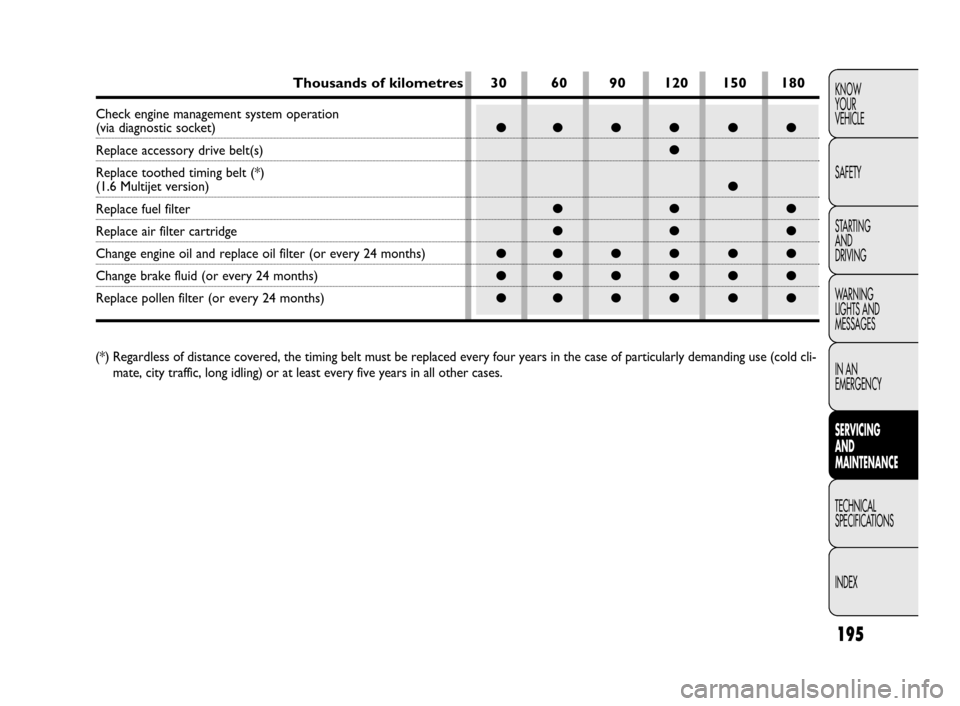
INDEXThousands of kilometres 30 60 90 120 150 180
Check engine management system operation (via diagnostic socket)
Replace accessory drive belt(s)
Replace toothed timing belt (*)
(1.6 Multijet version)
Replace fuel filter
Replace air filter cartridge
Change engine oil and replace oil filter (or every 24 months)
Change brake fluid (or every 24 months)
Replace pollen filter (or every 24 months)
(*) Regardless of distance covered, the timing belt must be replaced every four years in the case of particularly demanding use (cold cli-
mate, city traffic, long idling) or at least every five years in all other cases.