door lock FIAT DOBLO COMBI 2017 2.G User Guide
[x] Cancel search | Manufacturer: FIAT, Model Year: 2017, Model line: DOBLO COMBI, Model: FIAT DOBLO COMBI 2017 2.GPages: 300, PDF Size: 24.91 MB
Page 58 of 300
The electric windows are fitted with a
security system (where provided) that
can detect the presence of an obstacle
whilst the window is closing; when
this happens, the system kicks in and
the movement of the glass is
immediately reversed.
IMPORTANT In the event that the
anti-crushing function is activated 5
times in only 1 minute, the system will
automatically enter the "recovery" mode
(self-protection). This condition is
apparent from the window closing in
stages.
If this occurs, restore the system as
follows:
open the windows.
If no malfunction is present, the window
returns to its normal operation
automatically.
IMPORTANT With the ignition key at
STOP or removed, the electric windows
remain activated for about two minutes
and are deactivated as soon as a
door is opened.
28) 29)
FRONT AND REAR
ELECTRIC WINDOWS
(for versions/markets, where provided)
Driver side door
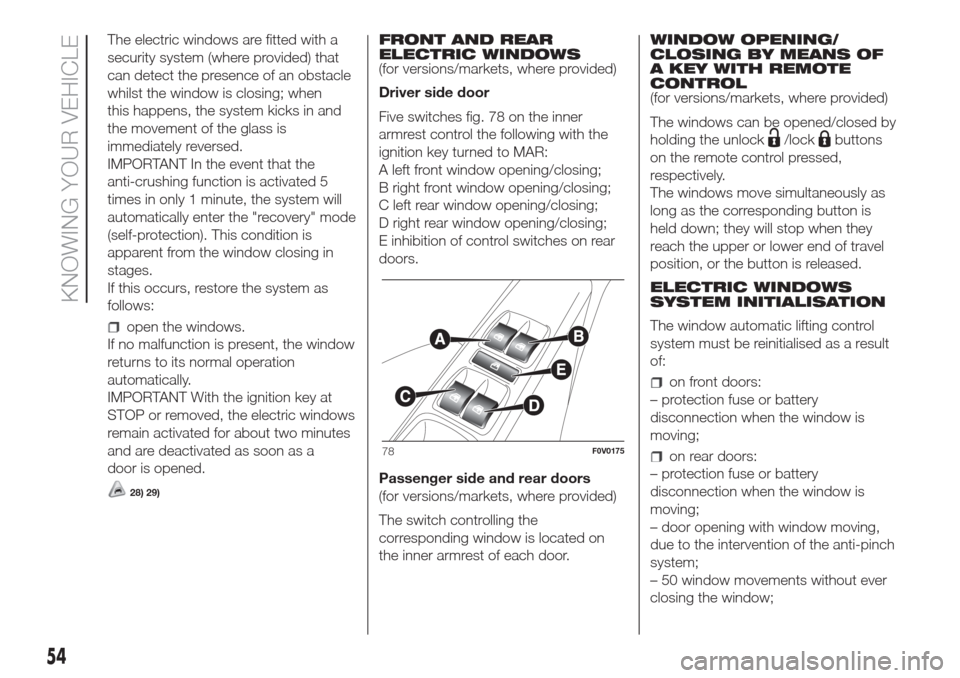
Five switches fig. 78 on the inner
armrest control the following with the
ignition key turned to MAR:
A left front window opening/closing;
B right front window opening/closing;
C left rear window opening/closing;
D right rear window opening/closing;
E inhibition of control switches on rear
doors.
Passenger side and rear doors
(for versions/markets, where provided)
The switch controlling the
corresponding window is located on
the inner armrest of each door.WINDOW OPENING/
CLOSING BY MEANS OF
A KEY WITH REMOTE
CONTROL
(for versions/markets, where provided)
The windows can be opened/closed by
holding the unlock
/lockbuttons
on the remote control pressed,
respectively.
The windows move simultaneously as
long as the corresponding button is
held down; they will stop when they
reach the upper or lower end of travel
position, or the button is released.
ELECTRIC WINDOWS
SYSTEM INITIALISATION
The window automatic lifting control
system must be reinitialised as a result
of:
on front doors:
– protection fuse or battery
disconnection when the window is
moving;
on rear doors:
– protection fuse or battery
disconnection when the window is
moving;
– door opening with window moving,
due to the intervention of the anti-pinch
system;
– 50 window movements without ever
closing the window;78F0V0175
54
KNOWING YOUR VEHICLE
Page 61 of 300
32)When the engine is warm, work
carefully inside the engine compartment to
avoid getting burnt. Do not place your
hands near the fan as it may be activated
even when the key is removed. Wait for the
engine to cool down.
33)Pay attention to scarves, ties and other
loose-fitting garments. If they accidentally
come into contact with moving parts,
they may get caught up and dragged with
serious risks for those wearing them.
34)For safety reasons, the bonnet must
always be properly closed while driving.
Make sure that the bonnet is perfectly
closed and that the lock is engaged. If you
notice when driving that the bonnet has
not been properly locked, stop immediately
and close the bonnet correctly.BOOT
35) 36) 37) 38) 39) 40)
OPENING/CLOSING THE
BOOT FROM THE
OUTSIDE
The tailgate (when unlocked) can only
be opened from the outside of the
vehicle using the electric opening
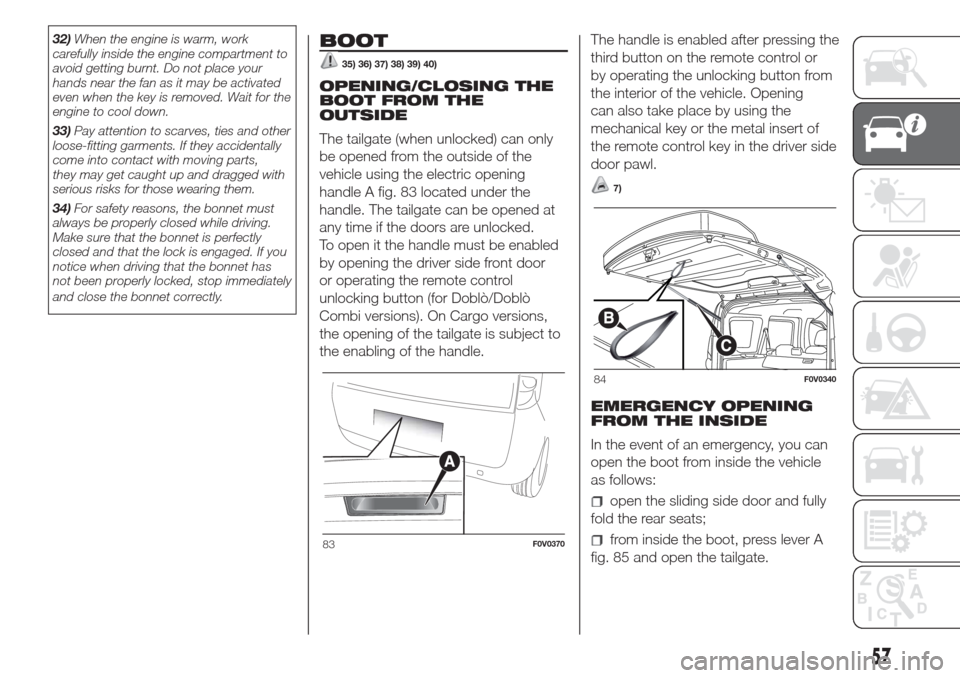
handle A fig. 83 located under the
handle. The tailgate can be opened at
any time if the doors are unlocked.
To open it the handle must be enabled
by opening the driver side front door
or operating the remote control
unlocking button (for Doblò/Doblò
Combi versions). On Cargo versions,
the opening of the tailgate is subject to
the enabling of the handle.The handle is enabled after pressing the
third button on the remote control or
by operating the unlocking button from
the interior of the vehicle. Opening
can also take place by using the
mechanical key or the metal insert of
the remote control key in the driver side
door pawl.
7)
EMERGENCY OPENING
FROM THE INSIDE
In the event of an emergency, you can
open the boot from inside the vehicle
as follows:
open the sliding side door and fully
fold the rear seats;
from inside the boot, press lever A
fig. 85 and open the tailgate.83F0V0370
84F0V0340
57
Page 81 of 300
See radio (audio
information repetition)
(for versions/markets, where provided)
With this function the display shows
information about the radio.
– Radio: selected radio station
frequency or RDS message, automatic
tuning activation or AutoSTore;
– Audio CD, MP3 CDs: track number;
To show the sound system information
on the display (On) or clear it (Off),
proceed as follows:
– briefly press theMENU
button,
making the display flash On or Off
depending on the previous setting;
– press the
orbutton to select;
– press theMENU
button briefly to
return to the menu screen or hold the
button down to return to the standard
screen without storing.
Autoclose (Automatic
central locking with the
vehicle moving)
(for versions/markets, where provided)
When activated (On), this function locks
the doors automatically when the
vehicle speed exceeds 20 km/h.
Proceed as follows to activate or
deactivate this function:
– press theMENU
button briefly to
display a submenu;
– press theMENU
button briefly to
make the display flash On or Off
according to the previous setting;– press the
orbutton to select;
– press theMENU
button briefly to
return to the submenu screen or hold
the button down to return to the main
menu screen without saving;
– hold theMENU
button down
again to return to the standard screen
or to the main menu according to
where you are in the menu.
Unit of measurement
(Setting the unit of
measurement)
With this function is possible to set the
unit of measurement in three
submenus: “Distance”, “Consumption”
and “Temperature”.
To set the required unit of measurement
proceed as follows:
– briefly press theMENU
button to
display the three submenus;
– press the
orbutton to navigate
through the three submenus;
– select the required option and then
pressMENU
briefly;
– if selecting the "Distance" submenu:
briefly press theMENU
button and
the display will show "km" or "mi"
depending on the previous setting;
– press the
orbutton to select;when you select the “Consumption”
submenu: briefly pressing theMENU
button makes “km/l”, “l/100km” or
“mpg” appear on the display,
depending on the previous setting;
If the set distance unit of measurement
is "km", the fuel consumption unit will
be displayed in km/l or l/100 km.
If the set distance unit of measurement
is "mi" the fuel consumption unit will
be displayed in "mpg".
– press the
orbutton to select;
– if selecting the "Temperature"
submenu: briefly press the
MENU
button and the display will
show "°C" or "°F" depending on the
previous setting;
– press the
orbutton to select;
When you have made the required
settings, press theMENU
button
briefly to go back to the submenu
screen or hold the button down to go
back to the main menu screen without
saving.
– hold theMENU
button down
again to return to the standard screen
or to the main menu according to
where you are in the menu.
77
Page 145 of 300
If they are open, they can cause the
system to send false signals: always
close the rear doors.
Do not apply stickers to the sensors.
WARNING
114)The sensors must be clean of mud,
dirt, snow and ice in order for the system
to work. Be careful not to scratch or
damage the sensors while cleaning them.
Avoid using dry, rough or hard cloths.
The sensors must be washed using clean
water, with the addition of car shampoo
if necessary. When using special washing
equipment such as high pressure jets or
steam cleaning, clean the sensors very
quickly keeping the jet more than 10 cm
away.
115)Parking manoeuvres, however, are
always the driver’s responsibility. While
carrying out these manoeuvres, always
make sure that no people (especially
children) or animals are in the area
concerned. The parking sensor is designed
to assist drivers, who must still never
allow their attention to lapse during
potentially dangerous manoeuvres even if
performed at low speed.
REFUELLING THE
VEHICLE
PETROL ENGINES
Only use unleaded petrol, with an
octane number (R.O.N.) not lower than
95.
IMPORTANT An inefficient catalytic
converter leads to harmful exhaust
emissions, thus contributing to air
pollution.
IMPORTANT Never use leaded petrol,
even in small amounts or in an
emergency, as this would damage the
catalytic converter beyond repair.
DIESEL ENGINES
Operation at low temperatures
If the outside temperature is very low,
the diesel thickens due to the formation
of paraffin clots with consequent
defective operation of the fuel supply
system.In order to avoid these problems,
different types of Diesel are distributed
according to the season: summer
type, winter type and Arctic type (cold,
mountain areas). If refuelling with diesel
whose specifications are not suitable
for the usage temperature, it is
advisable to mix PETRONAS
DURANCE DIESEL ART additive in the
proportions shown on the container
with the fuel. Pour the additive into the
tank before the fuel.
When using or parking the vehicle for a
long time in the mountains or cold
areas, it is advisable to refuel using
locally available diesel fuel.
In this case, it is also advisable to keep
the tank over 50% full.
22)
TANK CAPACITY
To ensure that you fill the tank
completely, top up twice after the first
click of the fuel supply gun. Further
top-ups could cause faults in the fuel
feeding system.
FUEL TANK CAP
Opening
1) Open the flap A fig. 156 by pulling it
outwards, keep the cap B still, insert
the ignition key in the lock and turn
it anticlockwise.
141
Page 156 of 300
Side
IMPORTANT Go to a Fiat Dealership to
have bulbs for the side direction
indicators replaced, because they are
located inside the wing mirror.
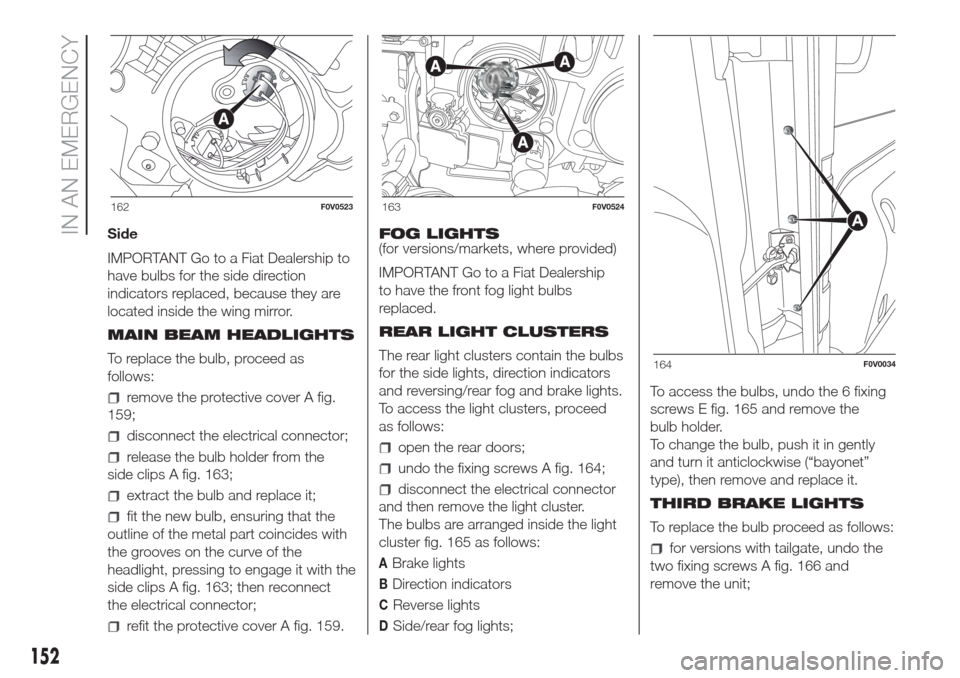
MAIN BEAM HEADLIGHTS
To replace the bulb, proceed as
follows:
remove the protective cover A fig.
159;
disconnect the electrical connector;
release the bulb holder from the
side clips A fig. 163;
extract the bulb and replace it;
fit the new bulb, ensuring that the
outline of the metal part coincides with
the grooves on the curve of the
headlight, pressing to engage it with the
side clips A fig. 163; then reconnect
the electrical connector;
refit the protective cover A fig. 159.FOG LIGHTS
(for versions/markets, where provided)
IMPORTANT Go to a Fiat Dealership
to have the front fog light bulbs
replaced.
REAR LIGHT CLUSTERS
The rear light clusters contain the bulbs
for the side lights, direction indicators
and reversing/rear fog and brake lights.
To access the light clusters, proceed
as follows:
open the rear doors;
undo the fixing screws A fig. 164;
disconnect the electrical connector
and then remove the light cluster.
The bulbs are arranged inside the light
cluster fig. 165 as follows:
ABrake lights
BDirection indicators
CReverse lights
DSide/rear fog lights;To access the bulbs, undo the 6 fixing
screws E fig. 165 and remove the
bulb holder.
To change the bulb, push it in gently
and turn it anticlockwise (“bayonet”
type), then remove and replace it.
THIRD BRAKE LIGHTS
To replace the bulb proceed as follows:
for versions with tailgate, undo the
two fixing screws A fig. 166 and
remove the unit;
162F0V0523163F0V0524
164F0V0034
152
IN AN EMERGENCY
Page 158 of 300
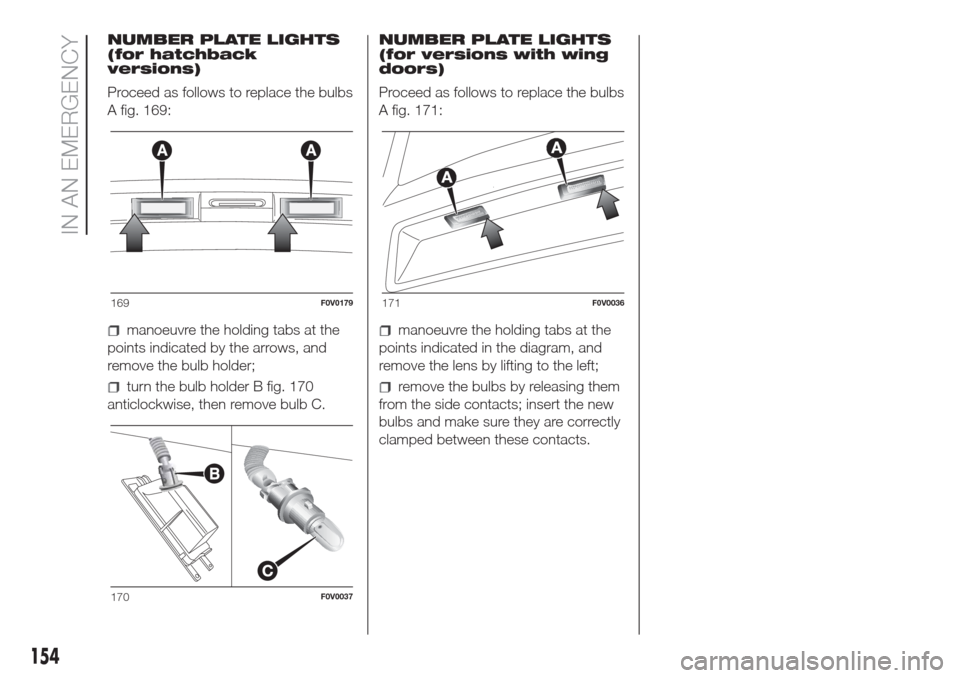
NUMBER PLATE LIGHTS
(for hatchback
versions)
Proceed as follows to replace the bulbs
A fig. 169:
manoeuvre the holding tabs at the
points indicated by the arrows, and
remove the bulb holder;
turn the bulb holder B fig. 170
anticlockwise, then remove bulb C.NUMBER PLATE LIGHTS
(for versions with wing
doors)
Proceed as follows to replace the bulbs
A fig. 171:
manoeuvre the holding tabs at the
points indicated in the diagram, and
remove the lens by lifting to the left;
remove the bulbs by releasing them
from the side contacts; insert the new
bulbs and make sure they are correctly
clamped between these contacts.
169F0V0179
170F0V0037
171F0V0036
154
IN AN EMERGENCY
Page 164 of 300
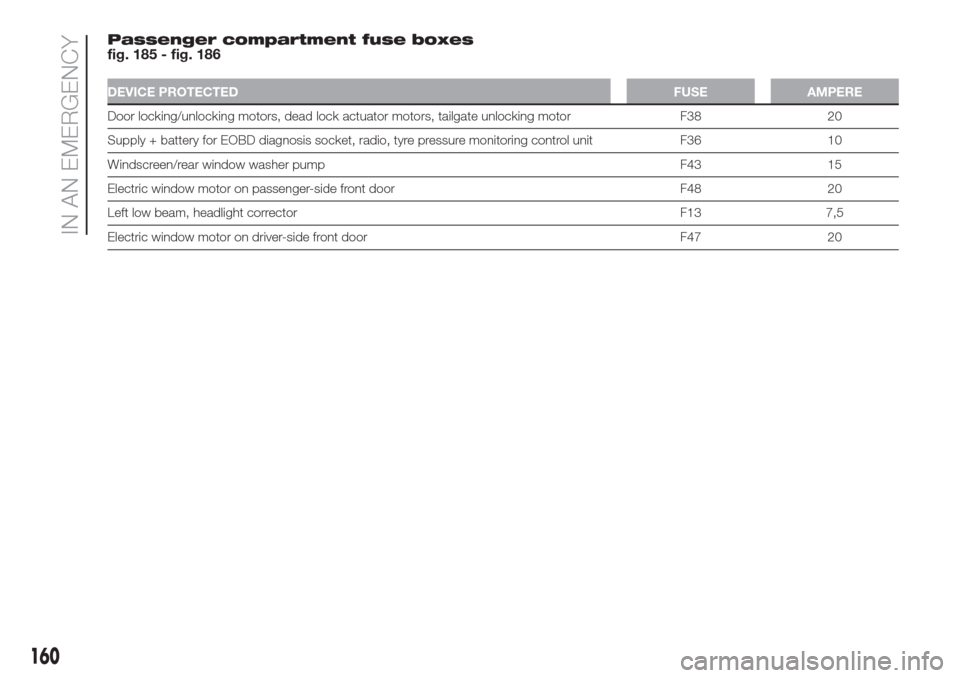
Passenger compartment fuse boxes
fig. 185 - fig. 186
DEVICE PROTECTEDFUSE AMPERE
Door locking/unlocking motors, dead lock actuator motors, tailgate unlocking motor F38 20
Supply + battery for EOBD diagnosis socket, radio, tyre pressure monitoring control unit F36 10
Windscreen/rear window washer pump F43 15
Electric window motor on passenger-side front door F48 20
Left low beam, headlight corrector F13 7,5
Electric window motor on driver-side front door F47 20
160
IN AN EMERGENCY
Page 173 of 300
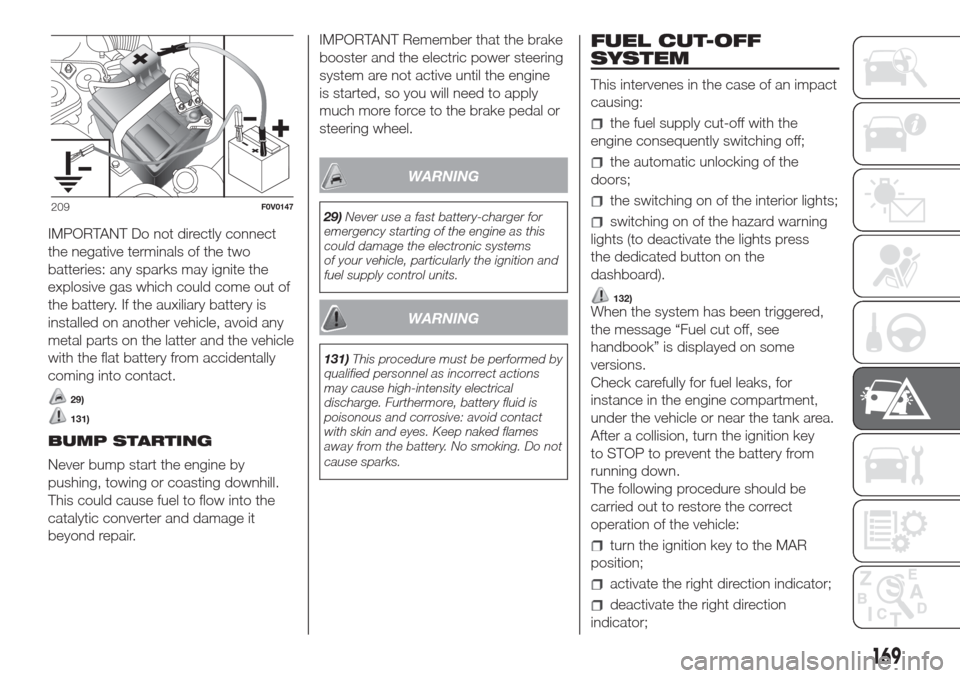
IMPORTANT Do not directly connect
the negative terminals of the two
batteries: any sparks may ignite the
explosive gas which could come out of
the battery. If the auxiliary battery is
installed on another vehicle, avoid any
metal parts on the latter and the vehicle
with the flat battery from accidentally
coming into contact.
29)
131)
BUMP STARTING
Never bump start the engine by
pushing, towing or coasting downhill.
This could cause fuel to flow into the
catalytic converter and damage it
beyond repair.IMPORTANT Remember that the brake
booster and the electric power steering
system are not active until the engine
is started, so you will need to apply
much more force to the brake pedal or
steering wheel.
WARNING
29)Never use a fast battery-charger for
emergency starting of the engine as this
could damage the electronic systems
of your vehicle, particularly the ignition and
fuel supply control units.
WARNING
131)This procedure must be performed by
qualified personnel as incorrect actions
may cause high-intensity electrical
discharge. Furthermore, battery fluid is
poisonous and corrosive: avoid contact
with skin and eyes. Keep naked flames
away from the battery. No smoking. Do not
cause sparks.
FUEL CUT-OFF
SYSTEM
This intervenes in the case of an impact
causing:
the fuel supply cut-off with the
engine consequently switching off;
the automatic unlocking of the
doors;
the switching on of the interior lights;
switching on of the hazard warning
lights (to deactivate the lights press
the dedicated button on the
dashboard).
132)When the system has been triggered,
the message “Fuel cut off, see
handbook” is displayed on some
versions.
Check carefully for fuel leaks, for
instance in the engine compartment,
under the vehicle or near the tank area.
After a collision, turn the ignition key
to STOP to prevent the battery from
running down.
The following procedure should be
carried out to restore the correct
operation of the vehicle:
turn the ignition key to the MAR
position;
activate the right direction indicator;
deactivate the right direction
indicator;
209F0V0147
169
Page 180 of 300
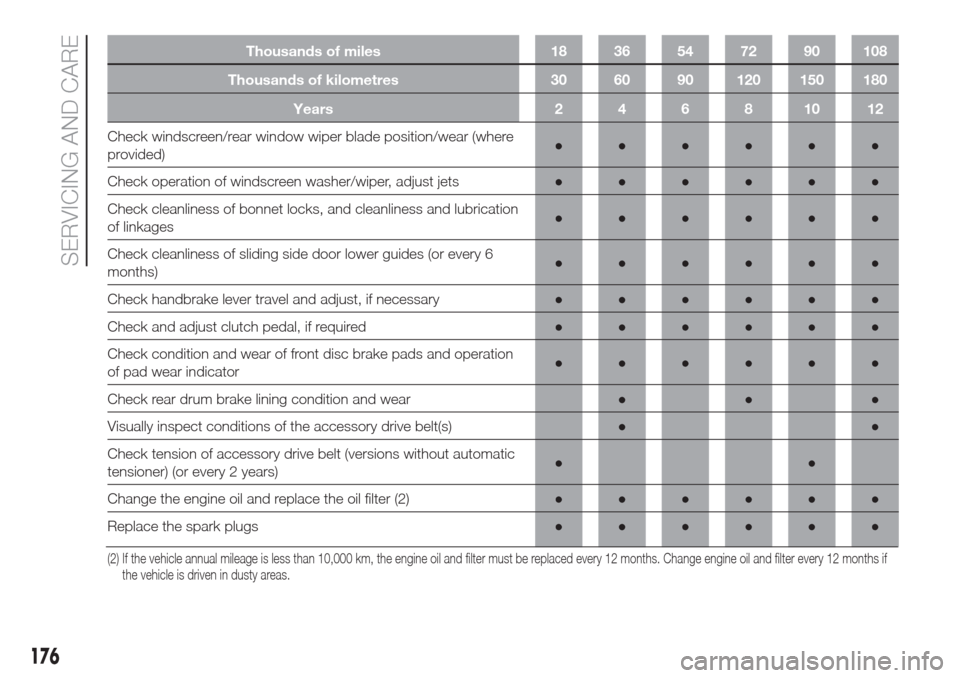
Thousands of miles 18 36 54 72 90 108
Thousands of kilometres 30 60 90 120 150 180
Years 2 4 6 8 10 12
Check windscreen/rear window wiper blade position/wear (where
provided)●●●●●●
Check operation of windscreen washer/wiper, adjust jets●●●●●●
Check cleanliness of bonnet locks, and cleanliness and lubrication
of linkages●●●●●●
Check cleanliness of sliding side door lower guides (or every 6
months)●●●●●●
Check handbrake lever travel and adjust, if necessary●●●●●●
Check and adjust clutch pedal, if required●●●●●●
Check condition and wear of front disc brake pads and operation
of pad wear indicator●●●●●●
Check rear drum brake lining condition and wear●●●
Visually inspect conditions of the accessory drive belt(s)●●
Check tension of accessory drive belt (versions without automatic
tensioner) (or every 2 years)●●
Change the engine oil and replace the oil filter (2)●●●●●●
Replace the spark plugs●●●●●●
(2) If the vehicle annual mileage is less than 10,000 km, the engine oil and filter must be replaced every 12 months. Change engine oil and filter every 12months if
the vehicle is driven in dusty areas.
176
SERVICING AND CARE
Page 183 of 300
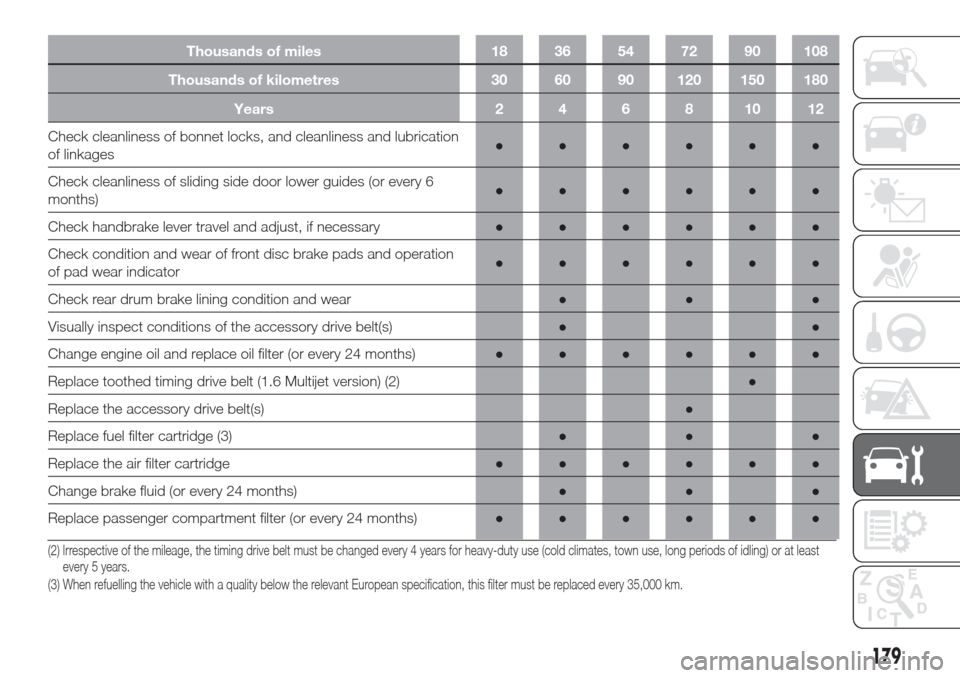
Thousands of miles 18 36 54 72 90 108
Thousands of kilometres 30 60 90 120 150 180
Years 2 4 6 8 10 12
Check cleanliness of bonnet locks, and cleanliness and lubrication
of linkages●●●●●●
Check cleanliness of sliding side door lower guides (or every 6
months)●●●●●●
Check handbrake lever travel and adjust, if necessary●●●●●●
Check condition and wear of front disc brake pads and operation
of pad wear indicator●●●●●●
Check rear drum brake lining condition and wear●●●
Visually inspect conditions of the accessory drive belt(s)●●
Change engine oil and replace oil filter (or every 24 months)●●●●●●
Replace toothed timing drive belt (1.6 Multijet version) (2)●
Replace the accessory drive belt(s)●
Replace fuel filter cartridge (3)●●●
Replace the air filter cartridge●●●●●●
Change brake fluid (or every 24 months)●●●
Replace passenger compartment filter (or every 24 months)●●●●●●
(2) Irrespective of the mileage, the timing drive belt must be changed every 4 years for heavy-duty use (cold climates, town use, long periods of idling) or at least
every 5 years.
(3) When refuelling the vehicle with a quality below the relevant European specification, this filter must be replaced every 35,000 km.
179