engine FIAT DOBLO PANORAMA 2016 2.G Service Manual
[x] Cancel search | Manufacturer: FIAT, Model Year: 2016, Model line: DOBLO PANORAMA, Model: FIAT DOBLO PANORAMA 2016 2.GPages: 323, PDF Size: 25.46 MB
Page 138 of 323
START&STOP
SYSTEM
IN BRIEF
The Start&Stop device automatically
stops the engine each time the
vehicle is stationary and starts it
again when the driver wants to move
off.
This improves the efficiency of the
vehicle by reducing fuel consumption,
the emission of harmful gases and
noise pollution.
OPERATING MODE
Engine stopping mode
WITH MANUAL GEARBOX
With the vehicle stationary, the engine
stops with the gearbox in neutral and
the clutch pedal released.
WITH ROBOTIZED GEARBOX
The engine cuts out if the vehicle stops
with the brake pedal pressed.
This condition can be maintained even
if the brake pedal is not depressed, if
the gear lever is in position N.NOTE: The engine can only be stopped
automatically after a speed of about
10 km/h is reached, to prevent the
engine from being repeatedly stopped
when driving at walking pace.
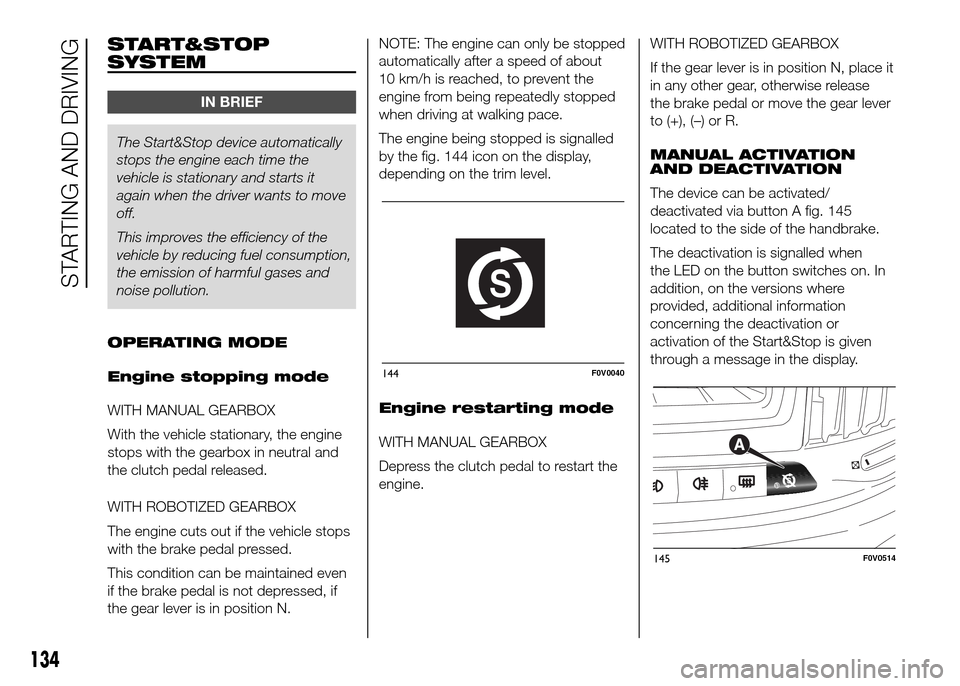
The engine being stopped is signalled
by the fig. 144 icon on the display,
depending on the trim level.
Engine restarting mode
WITH MANUAL GEARBOX
Depress the clutch pedal to restart the
engine.WITH ROBOTIZED GEARBOX
If the gear lever is in position N, place it
in any other gear, otherwise release
the brake pedal or move the gear lever
to (+), (–) or R.
MANUAL ACTIVATION
AND DEACTIVATION
The device can be activated/
deactivated via button A fig. 145
located to the side of the handbrake.
The deactivation is signalled when
the LED on the button switches on. In
addition, on the versions where
provided, additional information
concerning the deactivation or
activation of the Start&Stop is given
through a message in the display.
144F0V0040
145F0V0514
134
STARTING AND DRIVING
Page 139 of 323
ENGINE STOPPING
FAILURE CONDITIONS
With the device activated, for reasons
of comfort, limiting emissions and
safety, the engine does not stop in
certain conditions, including:
❒engine still cold;
❒particularly cold external
temperatures, if the corresponding
indication is provided;
❒battery not sufficiently charged;
❒particulate filter regeneration in
progress (diesel engines only);
❒driver's door not shut;
❒driver's seat belt not fastened;
❒reverse gear engaged (for example,
for parking manoeuvres);
❒automatic climate control, if a
suitable thermal comfort level has not
yet been reached or MAX-DEF
function activation;
❒during the first period of use, to
initialise the system.
In the above cases, the warning light
flashes fig. 103 and, where available,
there is a message in the display.RESTARTING
CONDITIONS
For reasons of comfort, limiting harmful
emissions and safety purposes, the
power unit can restart automatically
without any action by the driver if
certain conditions are met, including:
❒battery not sufficiently charged;
❒reduced braking system vacuum
(e.g. if the brake pedal is pressed
repeatedly);
❒vehicle in motion (e.g. when driving
on roads with a gradient);
❒stopping the engine through the
Start&Stop system for more than
about three minutes.
❒automatic climate control system for
adjusting the thermal comfort level or
to enable MAX-DEF function.
With a gear engaged, the engine can
be automatically restarted only by
fully depressing the clutch pedal. The
driver is asked to perform this operation
through the warning light flashing in
the instrument panel fig. 103 and,
where provided, the message in the
display.N.B.: If you stall the engine, for example
by releasing off the clutch pedal quickly
when in gear, if the Start&Stop system
is activated, the engine can be
restarted by fully depressing the clutch
pedal or by putting the gear lever into
neutral.
N.B.: If the clutch is not depressed
when the three minutes have elapsed
since the engine was stopped, the
engine can only be restarted using the
key.
SAFETY FUNCTIONS
In engine cut-out conditions through
the Start&Stop system, if the driver
unfastens his/her seat belt and opens
the driver's door or the passenger door,
the engine can be restarted only by
using the key.
The driver is notified of this condition by
a buzzer, through the fig. 144 warning
light flashing in the instrument panel
and, where provided, by a message in
the display.
135
Page 140 of 323
"ENERGY SAVING"
FUNCTION
(for versions/markets, where provided)
If, after the engine has been
automatically restarted, the driver does
not take any action for a period of
about 3 minutes, the Start&Stop
system will definitively stop the engine
to avoid fuel consumption.
The engine can only be started using
the key in such cases. N.B.: In any
case, it is possible to keep the engine
running by deactivating the Start&Stop
system.
IRREGULAR OPERATION
In the case of malfunctions the
Start&Stop system is disabled.
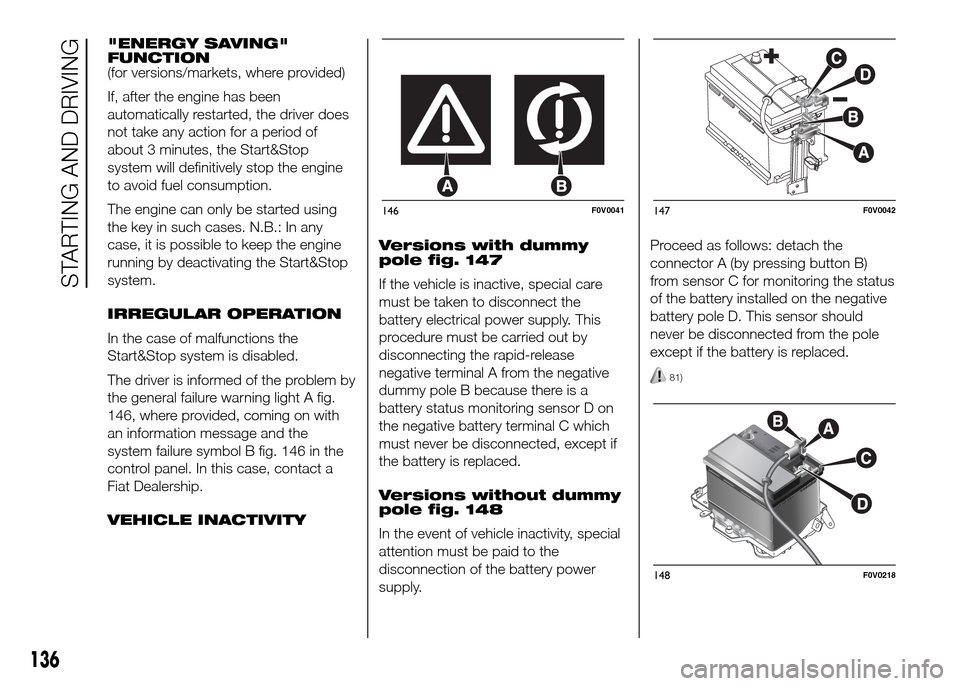
The driver is informed of the problem by
the general failure warning light A fig.
146, where provided, coming on with
an information message and the
system failure symbol B fig. 146 in the
control panel. In this case, contact a
Fiat Dealership.
VEHICLE INACTIVITYVersions with dummy
pole fig. 147
If the vehicle is inactive, special care
must be taken to disconnect the
battery electrical power supply. This
procedure must be carried out by
disconnecting the rapid-release
negative terminal A from the negative
dummy pole B because there is a
battery status monitoring sensor D on
the negative battery terminal C which
must never be disconnected, except if
the battery is replaced.
Versions without dummy
pole fig. 148
In the event of vehicle inactivity, special
attention must be paid to the
disconnection of the battery power
supply.Proceed as follows: detach the
connector A (by pressing button B)
from sensor C for monitoring the status
of the battery installed on the negative
battery pole D. This sensor should
never be disconnected from the pole
except if the battery is replaced.
81)
146F0V0041147F0V0042
148F0V0218
136
STARTING AND DRIVING
Page 141 of 323
EMERGENCY STARTING
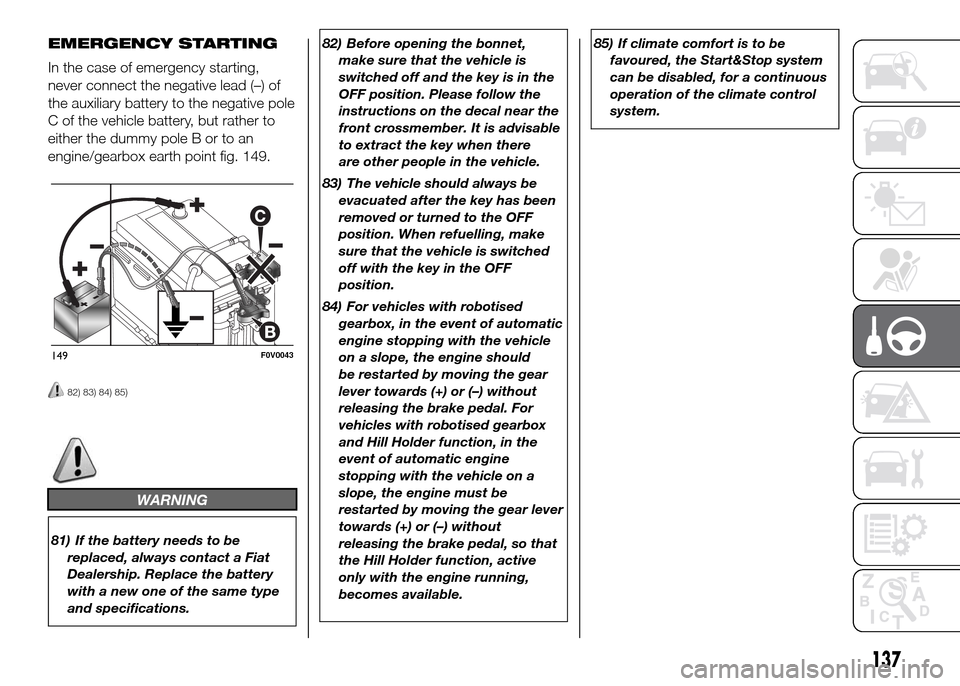
In the case of emergency starting,
never connect the negative lead (–) of
the auxiliary battery to the negative pole
C of the vehicle battery, but rather to
either the dummy pole B or to an
engine/gearbox earth point fig. 149.
82) 83) 84) 85)
WARNING
81) If the battery needs to be
replaced, always contact a Fiat
Dealership. Replace the battery
with a new one of the same type
and specifications.82) Before opening the bonnet,
make sure that the vehicle is
switched off and the key is in the
OFF position. Please follow the
instructions on the decal near the
front crossmember. It is advisable
to extract the key when there
are other people in the vehicle.
83) The vehicle should always be
evacuated after the key has been
removed or turned to the OFF
position. When refuelling, make
sure that the vehicle is switched
off with the key in the OFF
position.
84) For vehicles with robotised
gearbox, in the event of automatic
engine stopping with the vehicle
on a slope, the engine should
be restarted by moving the gear
lever towards (+) or (–) without
releasing the brake pedal. For
vehicles with robotised gearbox
and Hill Holder function, in the
event of automatic engine
stopping with the vehicle on a
slope, the engine must be
restarted by moving the gear lever
towards (+) or (–) without
releasing the brake pedal, so that
the Hill Holder function, active
only with the engine running,
becomes available.85) If climate comfort is to be
favoured, the Start&Stop system
can be disabled, for a continuous
operation of the climate control
system.
149F0V0043
137
Page 143 of 323
The TPMS continues to advise the
driver of the low tyre pressure condition
until this is corrected; the warning
continues until the pressure
corresponds or exceeds the pressure
prescribed for the cold tyres. When the
tyre low pressure control warning
light
switches on constantly, the
inflation pressure must be adjusted until
it reaches the pressure prescribed for
cold tyres. After the automatic update
of the system, the tyre pressure control
warning light switches off. You may
need to drive the vehicle for about 20
minutes at a speed higher than 20
km/h to allow the TPMS to receive this
information.
IMPORTANT In the case of deflation of
more than one tyre sequentially, without
switching off and on the engine, from
the second tyre involved the acoustic
signal is not activated, only the
dedicated signal is shown on the
display.
To prevent the signal from being stored
in the event of pressure loss of a
subsequent tyre (with deactivation of
the acoustic signal), the ignition key
must be turned to MAR and then to
STOP, each time pressure is restored.TPMS operation faults
The system fault is indicated by
warning light
which first flashes for
75 seconds and then stays on steadily.
This can occur in any of the following
situations:
❒interference caused by electronic
devices or radio frequency emissions
similar to those of the TPM sensors.
❒Application of tinted films which
interfere with the signals of the radio
waves.
❒Presence of snow or ice on the
wheels or the wheel arches.
❒Use of snow chains.
❒Use of wheels/tyres not equipped
with TPM sensors.
❒The space-saver wheel is not
equipped with the tyre pressure
control sensor. Therefore, the tyre
pressure is not controlled by the
system.
NOTE The vehicle may be equipped
with FiX&Go Automatic tyre repair
kit, space-saver wheel or full size spare
wheel (with or without original TPMS
sensor to measure tyre pressure).After the punctured tyre has been
repaired with the original tyre sealant
contained in the FiX&Go Automatic tyre
repair kit, the previous condition must
be restored, so that the
warning
light is off during normal driving.
Space-saver wheel (for versions/
markets, where provided): the
space-saver wheel is not equipped with
a TPMS sensor. Once fitted, while
driving normally, the warning light
comes on (flashing for about 75
seconds, and then constantly). This
condition lasts until a wheel equipped
with an original TPMS sensor is fitted
on the vehicle.
Normal spare wheel (without TPMS
sensor): once fitted, while driving
normally, the
warning light comes on
(flashing for about 75 seconds, and
then constantly). This condition lasts
until a wheel equipped with an original
TPMS sensor is fitted on the vehicle.
The system is then restored and the
warning light switches off.
Normal spare wheel (with TPMS
sensor): once fitted, while driving
normally, the
warning light switches
off.
139
Page 146 of 323
Restoring the stored
speed
If the device has been deactivated, for
example by depressing the brake or
clutch pedal, the stored speed can be
restored as follows:
❒accelerate progressively until a speed
close to that stored is reached;
❒engage the gear selected at the time
that the speed was stored;
❒press button B fig. 150.
Increasing the stored
speed
This can be done in two ways:
❒by pressing the accelerator and
memorizing the new speed reached;
or
❒by moving the stalk upwards (+).
Each operation of the stalk will
correspond to a slight increase in
speed of about 1 km/h, while keeping
the stalk upwards will increase the
speed continuously.Reducing the stored
speed
This can be done in two ways:
❒by deactivating the device and then
storing the new speed
or
❒by moving the stalk downwards (-)
until the new speed, which will
automatically remain memorised, is
reached.
Each movement of the stalk will
correspond to a slight reduction in
speed of about 1 km/h, while keeping
the stalk held downwards will decrease
the speed continuously.
Deactivating the device
The device can be switched off by the
driver in the following ways:
❒by turning ring nut A to the OFF
position;
❒if the engine is stopped (leaving the
stalk ring nut at ON), when the
ignition key is next turned to ON,
Cruise Control will be activated
automatically.Deactivating the
function
The device can be switched off by the
driver in the following ways:
❒by pressing the brake pedal when the
device is adjusting the speed:
❒by pressing the clutch pedal when
the device is adjusting the speed;
❒by pressing button B fig. 150 when
the device is adjusting the speed
(for versions/markets, where
provided);
❒by pressing the accelerator pedal (in
this case the system is not actually
turned off but the acceleration
request takes priority; the cruise
control remains activated, without the
need to the press button B fig. 150
to restore the previous conditions
once the acceleration is over).
The device is automatically switched off
in the following cases:
❒if the ABS or ESC systems intervene
❒with the vehicle speed below the
set limit
❒in the event of system failure.
142
STARTING AND DRIVING
Page 147 of 323
WARNING
95) When travelling with the device
active, never move the gear lever
to neutral.
96) In the event of device faults or
failures, turn the ring nut A to
OFF and contact a Fiat
Dealership.
TRACTION PLUS
SYSTEM
(for versions/markets, where provided)
Traction Plus is a driving aid, useful
for setting off in poor grip conditions
(snow, ice, mud, etc.) which allows the
drive force to be distributed in the
best way over the front axle when one
wheel is slipping.
Traction Plus acts by braking the
wheels with poor grip (or those slipping
more than the others), thereby
transferring the drive force to those
which have greater grip on the ground.
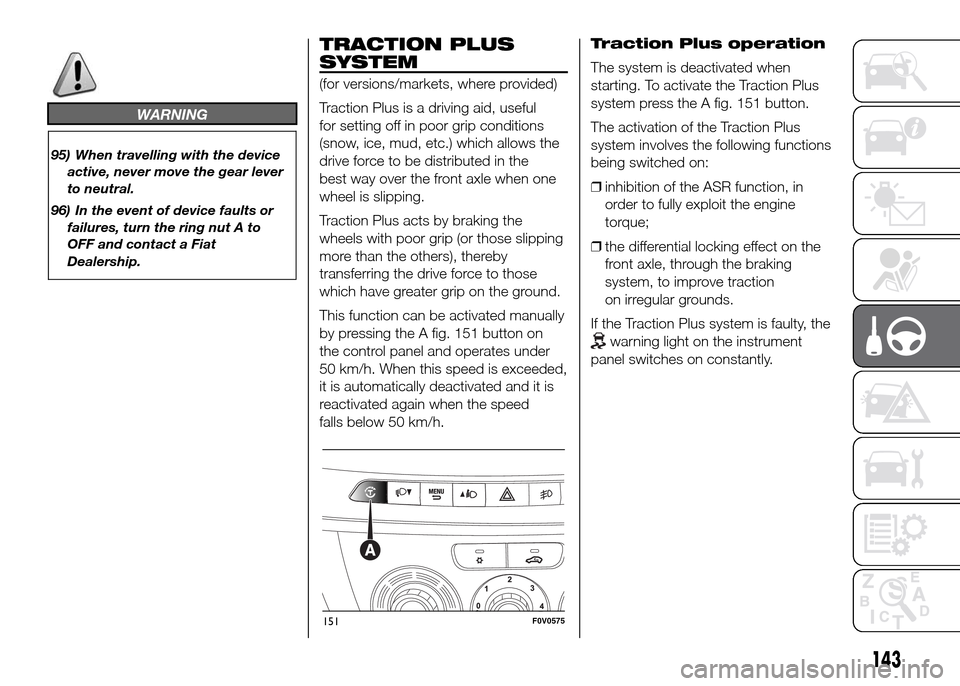
This function can be activated manually
by pressing the A fig. 151 button on
the control panel and operates under
50 km/h. When this speed is exceeded,
it is automatically deactivated and it is
reactivated again when the speed
falls below 50 km/h.Traction Plus operation
The system is deactivated when
starting. To activate the Traction Plus
system press the A fig. 151 button.
The activation of the Traction Plus
system involves the following functions
being switched on:
❒inhibition of the ASR function, in
order to fully exploit the engine
torque;
❒the differential locking effect on the
front axle, through the braking
system, to improve traction
on irregular grounds.
If the Traction Plus system is faulty, the
warning light on the instrument
panel switches on constantly.
151F0V0575
143
Page 150 of 323
REFUELLING THE
VEHICLE
PETROL ENGINES
Only use unleaded petrol, with an
octane number (R.O.N.) not lower than
95.
IMPORTANT An inefficient catalytic
converter leads to harmful exhaust
emissions, thus contributing to air
pollution.
IMPORTANT Never use leaded petrol,
even in small amounts or in an
emergency, as this would damage the
catalytic converter beyond repair.
DIESEL ENGINES
Operation at low
temperatures
If the outside temperature is very low,
the diesel thickens due to the formation
of paraffin clots with consequent
defective operation of the fuel supply
system.In order to avoid these problems,
different types of diesel are distributed
according to the season: summer type,
winter type and arctic type (cold/
mountain areas). If refuelling with diesel
fuel whose specifications are not
suitable for the current temperature, it is
advisable to mix TUTELA DIESEL ART
additive in the proportions shown on
the container. Pour the additive into the
tank before the diesel fuel.
When using or parking the vehicle for a
long time in the mountains or cold
areas, it is advisable to refuel using
locally available diesel fuel.
In this case, it is also advisable to keep
the tank over 50% full.
22)
FILLING THE TANK
To fill the tank completely, top up twice
after the first click of the fuel supply
gun. Further top ups could cause faults
in the fuel supply system.
FUEL TANK PLUG
Opening
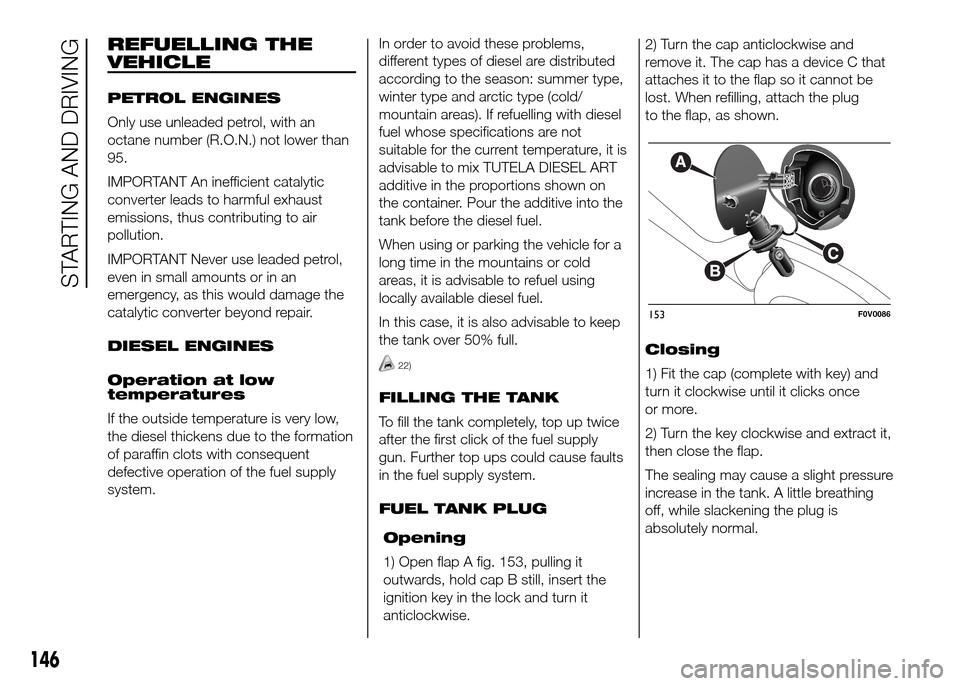
1) Open flap A fig. 153, pulling it
outwards, hold cap B still, insert the
ignition key in the lock and turn it
anticlockwise.2) Turn the cap anticlockwise and
remove it. The cap has a device C that
attaches it to the flap so it cannot be
lost. When refilling, attach the plug
to the flap, as shown.
Closing
1) Fit the cap (complete with key) and
turn it clockwise until it clicks once
or more.
2) Turn the key clockwise and extract it,
then close the flap.
The sealing may cause a slight pressure
increase in the tank. A little breathing
off, while slackening the plug is
absolutely normal.
153F0V0086
146
STARTING AND DRIVING
Page 151 of 323
23)
IMPORTANT
22) For diesel engines, use only
diesel fuel for motor vehicles
in accordance with EN590
European specifications. The use
of other products or mixtures
may damage the engine beyond
repair and consequently invalidate
the warranty, due to the damage
caused. If you accidentally refuel
with another type of fuel, do not
start the engine, and drain the
tank. If the engine has run, even
for a very short time, you will need
to have the entire fuel supply
system emptied in addition to the
tank.
23) Do not bring naked flames or lit
cigarettes near the fuel tank filler:
fire risk. Keep your face away
from the fuel filler to prevent
breathing in harmful vapours.
SAVING FUEL
Some useful tips are given below for
fuel saving and reducing harmful
emissions of CO2 and other pollutants
(nitrogen oxides, unburnt
hydrocarbons, Particulate Matter (PM),
etc.).
PRACTICAL ADVICE FOR
REDUCING FUEL
CONSUMPTION AND
HARMFUL EMISSIONS
Vehicle conditions
❒Have checks and adjustments for
vehicle maintenancecarried out
in accordance with the “Scheduled
servicing plan”.
❒Checktyrepressure regularly, at
least once every four weeks.
Excessively low pressures will
increase consumption because
rolling resistance will be higher. In
addition, this wears the tyre more
quickly and impairs performance.
❒Only usesnow tyreswhen
the weather conditions make them
absolutely necessary. They increase
consumption and noise.❒Do not travel witha heavy load: the
weight of the vehicle (especially when
driving in town) and its geometry
greatly affect fuel consumption and
stability.
❒Removeroof racks or ski racks
after use. These accessories reduce
the vehicle's aerodynamic
penetration and have a negative
effect on fuel consumption.
❒When transporting particularly large
objects, use atrailerif possible.
❒Use the vehicle's air vents if possible:
travelling with the windows open
impairs aerodynamics.
❒Use electrical devices only for the
amount of time needed. The vehicle’s
heated rear window, additional
headlights, screen wipers and heater
fan require a considerable amount
of energy; this increases fuel
consumption (by up to +25% in an
urban cycle).
❒Air conditioning leads to higher fuel
consumption (on average up to
+30%). If the temperature outside is
not too extreme, try and use the
air vents.
147
Page 152 of 323
Driving style
❒Afterstarting the engineyou
should drive away immediately and
slowly, avoiding high revs. Do not
warm up the engine at low or high
revs when the vehicle is stationary;
this causes the engine to warm
up more slowly, thereby increasing
fuel consumption, emissions and
mechanical component wear.
❒Avoidpointless actionssuch as
revving up when at traffic lights or
before stopping the engine. The latter
action, like double-declutching, is
unnecessary and causes increased
fuel consumption and pollution.
❒Gear selection:select a high gear
as soon as possible (taking into
account normal engine operation and
traffic conditions) without pushing
the engine to high revs during the
intermediate gears. Using low gears
at high revs to get lively acceleration
increases fuel consumption, harmful
emissions and engine wear.❒Vehicle speed:fuel consumption
increases exponentially as the speed
of the vehicle increases. Keep your
speed moderate and as even as
possible, avoiding unnecessary
braking and acceleration, which
cause excessive fuel consumption
and increased emissions. Keeping a
safe distance from the vehicle in
front helps to maintain a steady
speed.
❒Acceleration:accelerating violently
severely affects consumption and
emissions. Acceleration should
be gradual and should not exceed
the maximum engine torque rate.
CONDITIONS OF USE
Cold starting
Short journeys and frequent cold starts
do not allow the engine to reach
optimum operating temperature.
This results in a significant increase in
consumption levels (from +15 to +30%
on the urban cycle) and emissions.Traffic and road
conditions
Rather high consumption levels are
linked to situations with heavy traffic, for
instance when travelling in queues
with frequent use of the lower gears or
in cities with many traffic lights. Winding
mountain roads and rough road
surfaces also adversely affect
consumption.
Stops in traffic
During prolonged hold-ups (e.g. level
crossings) the engine should be
switched off.
148
STARTING AND DRIVING