wheel FIAT DUCATO 2006 Owner handbook (in English)
[x] Cancel search | Manufacturer: FIAT, Model Year: 2006, Model line: DUCATO, Model: FIAT DUCATO 2006Pages: 238, PDF Size: 3.29 MB
Page 118 of 238
117
WARNING
LIGHTS AND
MESSAGES
IN AN
EMERGENCY
VEHICLE
MAINTENANCE
TECHNICAL
SPECIFICATIONS
INDEX
DASHBOARD
AND CONTROLS
SAFETY
DEVICES
CORRECT USE
OF THE VEHICLE
If the engine does not start at the first at-
tempt, return the ignition key to STOP
before repeating starting.
If, when the ignition key is at MAR, the in-
strument panel warning light
Yremains
lit together with warning light
mturn
the key to STOPand then back to MAR;
if the warning lights remain on, try with
the other keys provided with the vehicle.
IMPORTANT If the instrument panel
warning light
Ystays on glowing steadi-
ly, contact immediately Fiat Dealership.
IMPORTANT Never leave the ignition key
to MARwhen the engine is off.
The warning light
mwill
flash for 60 seconds at start-
up or during prolonged crank-
ing to indicate a fault in the
glow plug heating system. You can use
the vehicle as usual if the engine starts
but you should contact Fiat Dealership
as soon as possible.
HOW TO WARM UP THE
ENGINE AFTER IT HAS JUST
STARTED
Proceed as follows:
❒drive off slowly, letting the engine turn
at medium revs. Do not accelerate
abruptly;
❒do not drive at full performance for
the initial kilometres. Wait until the
coolant temperature gauge starts
moving.
Remember that the servo-
brake and power steering are
not operational until the en-
gine has been started, there-
fore much effort than usual is required
on the brake pedal and steering wheel.
Never bump start the engine
by pushing, towing or coast-
ing downhill as this could
cause fuel to flow into the
catalytic exhaust system and damage
it beyond repair.
STOPPING THE ENGINE
Turn the ignition to STOPwhile the en-
gine is idling.
IMPORTANT After a taxing drive, you
should allow the engine to “catch its
breath” before turning it off by letting it
idle to allow the temperature in the en-
gine compartment to fall.
A quick burst on the acceler-
ator before turning off the en-
gine serves absolutely no
practical purpose, it wastes
fuel and is damaging especially to tur-
bocharged engines.
Page 119 of 238
118
WARNING
LIGHTS AND
MESSAGES
IN AN
EMERGENCY
VEHICLE
MAINTENANCE
TECHNICAL
SPECIFICATIONS
INDEX
DASHBOARD
AND CONTROLS
SAFETY
DEVICES
CORRECT USE
OF THE VEHICLEWhen the handbrake lever is pulled up
and the ignition key is at MAR, the in-
strument panel warning light
xwill turn
on.
To release the handbrake:
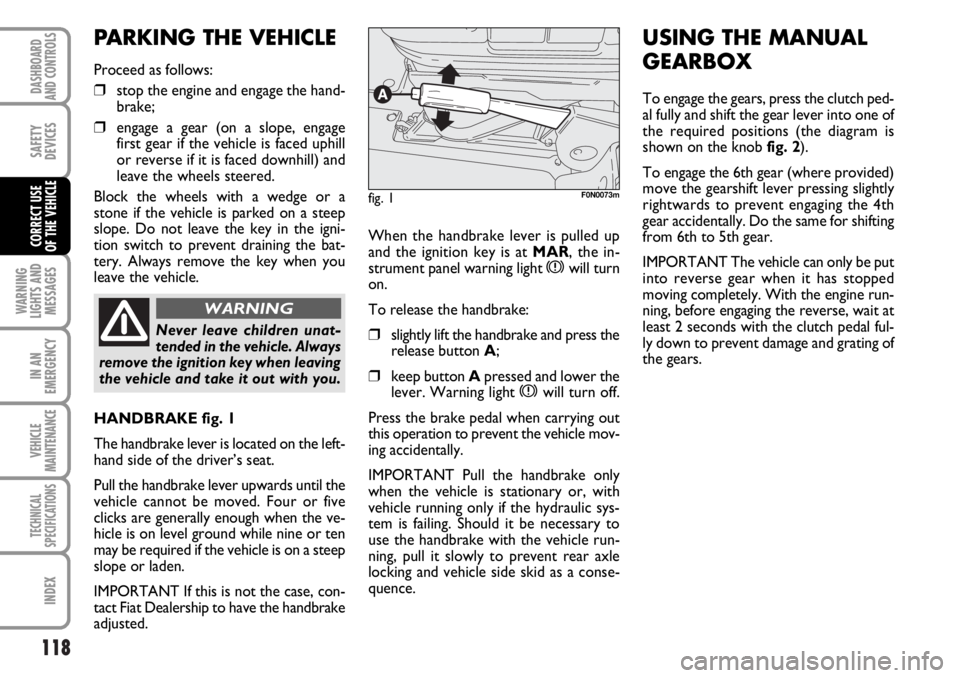
❒slightly lift the handbrake and press the
release button A;
❒keep button Apressed and lower the
lever. Warning light xwill turn off.
Press the brake pedal when carrying out
this operation to prevent the vehicle mov-
ing accidentally.
IMPORTANT Pull the handbrake only
when the vehicle is stationary or, with
vehicle running only if the hydraulic sys-
tem is failing. Should it be necessary to
use the handbrake with the vehicle run-
ning, pull it slowly to prevent rear axle
locking and vehicle side skid as a conse-
quence.
PARKING THE VEHICLE
Proceed as follows:
❒stop the engine and engage the hand-
brake;
❒engage a gear (on a slope, engage
first gear if the vehicle is faced uphill
or reverse if it is faced downhill) and
leave the wheels steered.
Block the wheels with a wedge or a
stone if the vehicle is parked on a steep
slope. Do not leave the key in the igni-
tion switch to prevent draining the bat-
tery. Always remove the key when you
leave the vehicle.
HANDBRAKE fig. 1
The handbrake lever is located on the left-
hand side of the driver’s seat.
Pull the handbrake lever upwards until the
vehicle cannot be moved. Four or five
clicks are generally enough when the ve-
hicle is on level ground while nine or ten
may be required if the vehicle is on a steep
slope or laden.
IMPORTANT If this is not the case, con-
tact Fiat Dealership to have the handbrake
adjusted.
Never leave children unat-
tended in the vehicle. Always
remove the ignition key when leaving
the vehicle and take it out with you.
WARNING
fig. 1F0N0073m
USING THE MANUAL
GEARBOX
To engage the gears, press the clutch ped-
al fully and shift the gear lever into one of
the required positions (the diagram is
shown on the knob fig. 2).
To engage the 6th gear (where provided)
move the gearshift lever pressing slightly
rightwards to prevent engaging the 4th
gear accidentally. Do the same for shifting
from 6th to 5th gear.
IMPORTANT The vehicle can only be put
into reverse gear when it has stopped
moving completely. With the engine run-
ning, before engaging the reverse, wait at
least 2 seconds with the clutch pedal ful-
ly down to prevent damage and grating of
the gears.
Page 126 of 238
125
WARNING
LIGHTS AND
MESSAGES
IN AN
EMERGENCY
VEHICLE
MAINTENANCE
TECHNICAL
SPECIFICATIONS
INDEX
DASHBOARD
AND CONTROLS
SAFETY
DEVICES
CORRECT USE
OF THE VEHICLE
IMPORTANT When snow tyres are used
with a max speed index below the one
that can be reached by the vehicle (in-
creased by 5%), place a notice in the pas-
senger’s compartment, plainly in the dri-
ver’s view which states the max permis-
sible speed of the snow tyres (as per EC
Directive).
All four tyres should be the same (brand
and track) to ensure greater safety when
driving and braking and better driveability.
Remember that it is inappropriate to
change the direction of rotation of tyres.SNOW CHAINS
Use of snow chains should be in compli-
ance with local regulations.
Snow chains should only be applied to the
driving wheels (front wheels). We rec-
ommend using Lineaccessori Fiat snow
chains.
Check the tension of the chains after the
first few metres have been driven.
IMPORTANT With snow chains, use the
accelerator with extreme care to prevent
or to limit as much as possible slipping of
the driving wheels that could cause chain
breaking resulting in damages to the ve-
hicle body or mechanical components.
IMPORTANT Use snow chains with re-
duced size.
SNOW TYRES
Fiat Dealership will be happy to provide
advice concerning the most suitable type
of tyre for the customer’s requirements.
The winter features of these tyres are re-
duced considerably when the tread depth
is below 4 mm. In this case, they should
be replaced.
Due to the snow tyre features, under nor-
mal conditions of use or on long motor-
way journeys, the performance of these
tyres is lower than that of normal tyres. It
is therefore necessary to limit their use to
the purposes for which they are certified.
The max speed for snow
tyres with “Q” marking is
160 km/h; 190 km/h for tyres with “T”
marking and 210 km/h for tyres with
H marking. The Road Traffic Code
speed limits must however be always
strictly observed.
WARNING
Page 132 of 238

131
IN AN
EMERGENCY
VEHICLE
MAINTENANCE
TECHNICAL
SPECIFICATIONS
INDEX
DASHBOARD
AND CONTROLS
SAFETY
DEVICES
CORRECT USE
OF THE
VEHICLE
WARNING
LIGHTS AND
MESSAGES
INCOMPLETE DOOR/
LOAD COMPARTMENT
LOCKING (red)
On certain versions the warn-
ing light turns on when one or more
doors or the tailgate are not properly
shut.
On certain versions the display shows a
dedicated message when the front left/right
door or rear doors/load compartment are
open.
A buzzer will sound when one of the doors
is open and the vehicle is moving.
´
INEFFICIENT
EBD
ELECTRONIC
BRAKING
DISTRIBUTOR
(red) (amber)
The turning on at the same time of warn-
ing lights
xand >with the engine run-
ning indicates an EBD system failure or
that the system is unavailable; in this case
heavy braking may cause the rear wheels
to lock before time, with the possibility of
skidding. Drive with the utmost care to
the nearest Fiat Dealership to have the
system checked.
On certain versions the dedicated message
is displayed.
x>
SEAT BELTS NOT
FASTENED
(red)
The warning light on the instru-
ment panel turns on glowing steadily with
the vehicle stationary and driver’s seat belt
not fastened correctly. The warning light
will turn on flashing together with the
buzzer when, with the vehicle moving, dri-
ver’s seat belt is not fastened correctly. The
S.B.R. (Seat Belt Reminder) buzzer can on-
ly be excluded by Fiat Dealership. On cer-
tain versions the system can be reactivat-
ed through the set-up menu.<
Page 138 of 238

137
IN AN
EMERGENCY
VEHICLE
MAINTENANCE
TECHNICAL
SPECIFICATIONS
INDEX
DASHBOARD
AND CONTROLS
SAFETY
DEVICES
CORRECT USE
OF THE
VEHICLE
WARNING
LIGHTS AND
MESSAGES
CRUISE CONTROL
(where provided) (green)
Turning the ignition key to
MARthe warning light will turn on but
it should go off after a few seconds.
The instrument panel warning light turns
on when turning the knurled ring of the
Cruise Control to ON.
On certain versions the dedicated mes-
sage is displayed.
Ü
MAIN BEAMS (blue)
The warning light turns on
when the main beams are
turned on.
1
RIGHT-HAND
DIRECTION
INDICATOR (green -
intermittent)
The warning light turns on when the di-
rection indicator control lever is moved
upwards or, together with the left indica-
tor, when the hazard warning light button
is pressed.
D
ASR SYSTEM
(where provided)
(amber)
Turning the ignition key to
MAR, the warning light turns on but it
should go off after few seconds. The led
on the ASR button turns on when the sys-
tem is switched off. The warning light
flashes when the ASR system cuts in to
alert the driver that the system is adapt-
ing to the road surface grip conditions.
The turning on of the warning light to-
gether with the message on the display
and the buzzer, also indicates a failure of
the ASR system. In this case contact Fiat
Dealership as soon as possible.
Messages are displayed when the ASR
function is activated/deactivated manual-
ly (see “ASR system” in section “Dash-
board and controls”).
In versions fitted with ASR system only, at
deactivation (ASR OFF) the warning light
will always stay on.
V
POWER STEERING
FAILURE (red)
Turning the ignition key to
MARthe warning light on the di-
al turns on, but it should go off after few
seconds.
If the warning light stays on together with
the message on the display and the buzzer,
you will not have steering assistance and
the effort on the steering wheel will be in-
creased, steering is however possible.
Contact Fiat Dealership.
g
Page 142 of 238
141
WARNING
LIGHTS AND
MESSAGES
VEHICLE
MAINTENANCE
TECHNICAL
SPECIFICATIONS
INDEX
DASHBOARD
AND CONTROLS
SAFETY
DEVICES
CORRECT USE
OF THE
VEHICLE
IN AN
EMERGENCY
IMPORTANT Do not directly connect the
negative terminals of the two batteries:
sparks could ignite the flammable gas from
the battery. If the other battery is fitted in
another vehicle, prevent accidental con-
tacts between the metal parts of the two
vehicles.BUMP STARTING
Never bump start the engine (by pushing,
towing, or coasting downhill) as this could
cause fuel to flow into the catalytic ex-
haust system and damage it beyond repair.
IMPORTANT Remember that the brake
booster and the power steering system
are not operating until the engine is start-
ed, a greater effort will therefore be re-
quired to press the brake pedal or turn
the steering wheel.IF A TYRE
IS PUNCTURED
GENERAL INSTRUCTIONS
Wheel changing and correct use of the
jack and spare wheel call for some pre-
cautions as listed below.
Alert other drivers that the
vehicle is stationary in com-
pliance with the regulations in force:
hazard warning lights, warning trian-
gle etc. Any passengers on board
should leave the vehicle, especially if
it is heavily laden. Passengers should
stay away from oncoming traffic
while the wheel is being changed on.
Pull the handbrake.
WARNING
Page 143 of 238
142
WARNING
LIGHTS AND
MESSAGES
VEHICLE
MAINTENANCE
TECHNICAL
SPECIFICATIONS
IINDEX
DASHBOARD
AND CONTROLS
SAFETY
DEVICES
CORRECT USE
OF THE
VEHICLE
IN AN
EMERGENCY
The spare wheel is specific to
your vehicle, do not use it on
other models, or use the spare wheel
of other models on your vehicle.
Wheel bolts are specific to your vehi-
cle: do not use them on other models
and do not use bolts of other models.
WARNING
Have the punctured wheel
repaired and refitted as soon
as possible. Do not grease the threads
of bolts before installing them: they
might slip out.
WARNING
The jack shall only be used
for changing wheels on the
vehicle with which it is provided or on
vehicles of the same model. It must
not be used for other purposes such
as for instance raising vehicles of oth-
er models. In no case should it be used
for repairs under the vehicle. Incor-
rect positioning of the jack may cause
the jacked vehicle to fall. Do not use
the jack for higher capacities than
stated on its label.
WARNING
Fasten the wheel cap cor-
rectly to prevent the wheel
from coming free in motion. Never
tamper with the inflation valve. Nev-
er place tools between the rim and
tyre. Check and restore, if required,
the pressure of tyres and spare wheel
to the values given in section “Tech-
nical Specifications”.
WARNING
Please note:
❒the jack weight is 4,5 kg;
❒the jack requires no adjustment;
❒the jack cannot be repaired. If it breaks
it must be replaced with a new jack;
❒no tool other than its cranking device
may be fitted on the jack.
Page 144 of 238
143
WARNING
LIGHTS AND
MESSAGES
VEHICLE
MAINTENANCE
TECHNICAL
SPECIFICATIONS
INDEX
DASHBOARD
AND CONTROLS
SAFETY
DEVICES
CORRECT USE
OF THE
VEHICLE
IN AN
EMERGENCY
To change a wheel proceed as
follows:
❒stop the vehicle in a position that is
not dangerous for oncoming traffic
where you can change the wheel safe-
ly. The ground should be flat and ad-
equately firm;
❒turn the engine off and pull up the
handbrake;
❒engage first gear or reverse;
❒wear the reflecting safety jacket (com-
pulsory by law in certain countries) be-
fore getting out of the vehicle;
❒alert other drivers that the vehicle is
stationary, using the proper devices in
compliance with the regulations in
force (e.g.: warning triangle, hazard
warning lights, etc …);
❒take the extension and the wrench
from the tool bag under the passen-
ger’s seat (see “Compartment under
the front passenger’s seat” in section
“dashboard and controls”);
❒loosen one turn the bolts of the wheel
to change;
❒turn the ring nut to extend the jack
partially;
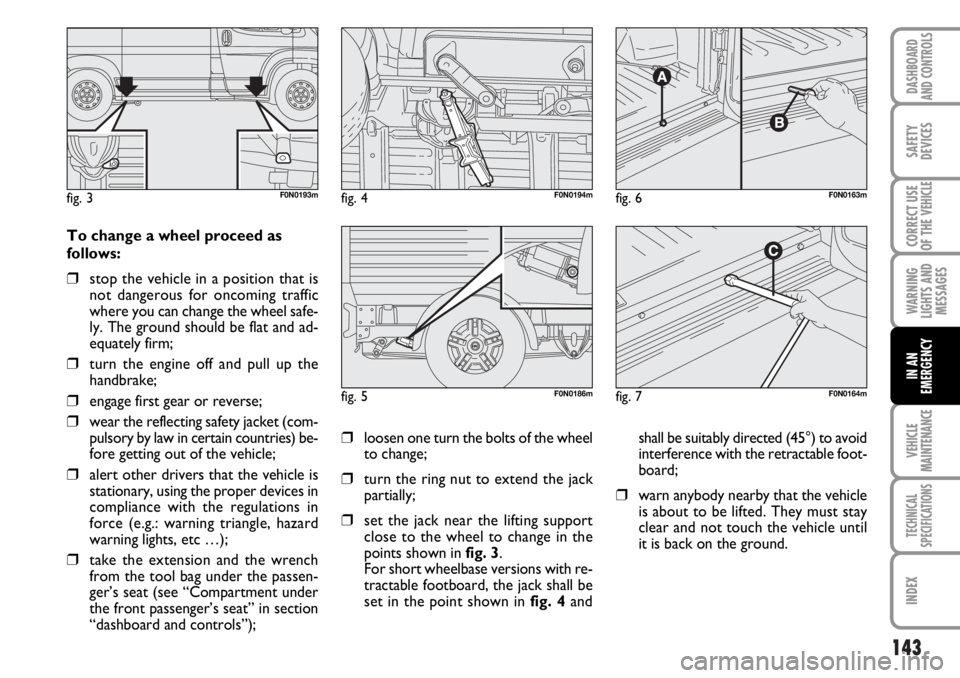
❒set the jack near the lifting support
close to the wheel to change in the
points shown in fig. 3.
For short wheelbase versions with re-
tractable footboard, the jack shall be
set in the point shown in fig. 4andshall be suitably directed (45°) to avoid
interference with the retractable foot-
board;
❒warn anybody nearby that the vehicle
is about to be lifted. They must stay
clear and not touch the vehicle until
it is back on the ground.
fig. 3F0N0193mfig. 4F0N0194m
fig. 5F0N0186m
fig. 6F0N0163m
fig. 7F0N0164m
Page 145 of 238
144
WARNING
LIGHTS AND
MESSAGES
VEHICLE
MAINTENANCE
TECHNICAL
SPECIFICATIONS
IINDEX
DASHBOARD
AND CONTROLS
SAFETY
DEVICES
CORRECT USE
OF THE
VEHICLE
IN AN
EMERGENCY
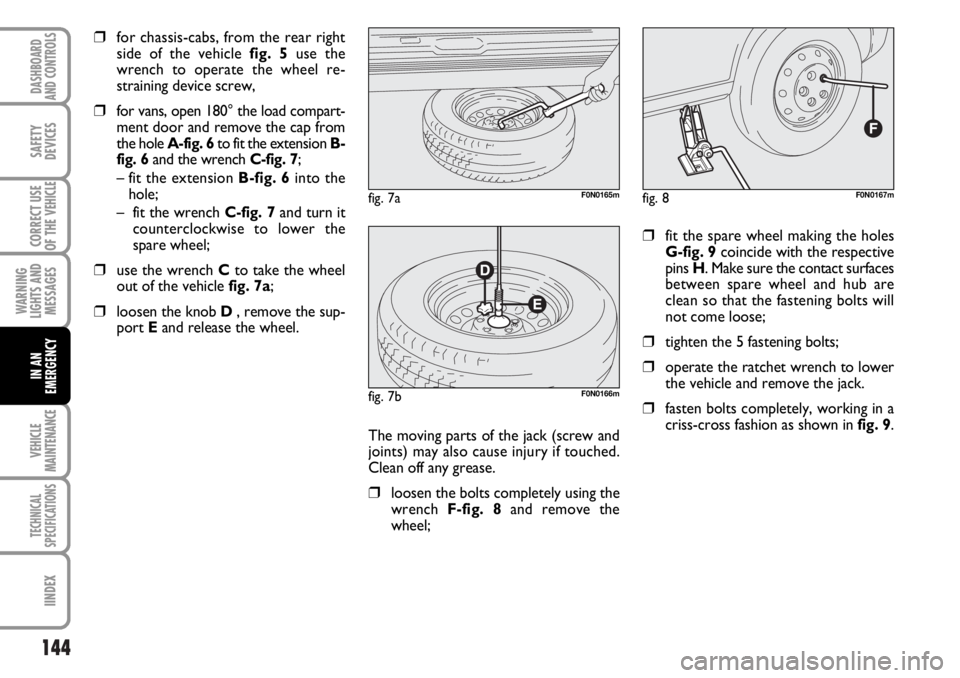
❒for chassis-cabs, from the rear right
side of the vehicle fig. 5use the
wrench to operate the wheel re-
straining device screw,
❒for vans, open 180° the load compart-
ment door and remove the cap from
the hole A-fig. 6to fit the extension B-
fig. 6and the wrench C-fig. 7;
– fit the extension B-fig. 6into the
hole;
– fit the wrench C-fig. 7and turn it
counterclockwise to lower the
spare wheel;
❒use the wrench Cto take the wheel
out of the vehicle fig. 7a;
❒loosen the knob D , remove the sup-
port Eand release the wheel.
❒fit the spare wheel making the holes
G-fig. 9coincide with the respective
pins H. Make sure the contact surfaces
between spare wheel and hub are
clean so that the fastening bolts will
not come loose;
❒tighten the 5 fastening bolts;
❒operate the ratchet wrench to lower
the vehicle and remove the jack.
❒fasten bolts completely, working in a
criss-cross fashion as shown in fig. 9.
fig. 8F0N0167m
The moving parts of the jack (screw and
joints) may also cause injury if touched.
Clean off any grease.
❒loosen the bolts completely using the
wrench F-fig. 8and remove the
wheel;
fig. 7aF0N0165m
fig. 7bF0N0166m
Page 146 of 238
145
WARNING
LIGHTS AND
MESSAGES
VEHICLE
MAINTENANCE
TECHNICAL
SPECIFICATIONS
INDEX
DASHBOARD
AND CONTROLS
SAFETY
DEVICES
CORRECT USE
OF THE
VEHICLE
IN AN
EMERGENCY
QUICK TYRE REPAIR
KIT - FIX & GO automatic
Il Fix & Go automatic kit includes:
❒bottle A containing sealer and fitted
with:
– filling pipe B;
– sticker Cbearing the notice “max.
80 km/h”, to be placed in a position
visible to the driver (on the instru-
ment panel) after fixing the tyre;
❒instruction brochure (see fig. 11), to
be used for prompt and proper use
of the quick repair kit and to be then
handed to the personnel charged with
handling the treated tyre;
❒compressor D-fig. 10including gauge
and connections;
❒adapters for inflating different ele-
ments. When you have finished:
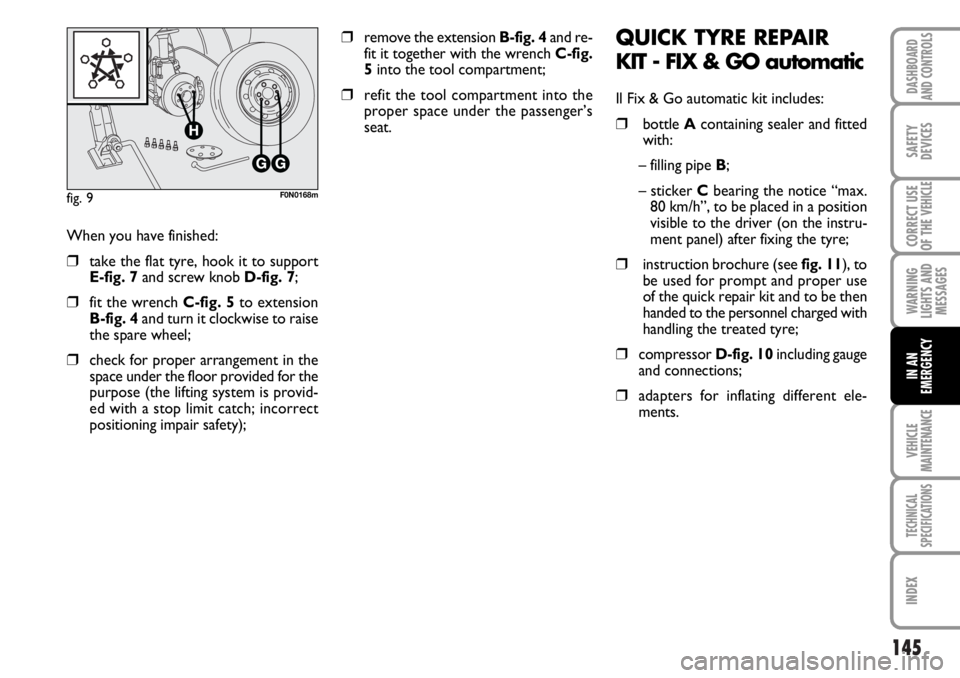
❒take the flat tyre, hook it to support
E-fig. 7and screw knob D-fig. 7;
❒fit the wrench C-fig. 5to extension
B-fig. 4and turn it clockwise to raise
the spare wheel;
❒check for proper arrangement in the
space under the floor provided for the
purpose (the lifting system is provid-
ed with a stop limit catch; incorrect
positioning impair safety);
fig. 9F0N0168m
❒remove the extension B-fig. 4and re-
fit it together with the wrench C-fig.
5into the tool compartment;
❒refit the tool compartment into the
proper space under the passenger’s
seat.