change wheel FIAT DUCATO 2006 Owner handbook (in English)
[x] Cancel search | Manufacturer: FIAT, Model Year: 2006, Model line: DUCATO, Model: FIAT DUCATO 2006Pages: 238, PDF Size: 3.29 MB
Page 60 of 238
59
SAFETY
DEVICES
CORRECT USE
OF THE
VEHICLE
WARNING
LIGHTS AND
MESSAGES
IN AN
EMERGENCY
VEHICLE
MAINTENANCE
TECHNICAL
SPECIFICATIONS
INDEX
DASHBOARD
AND CONTROLS
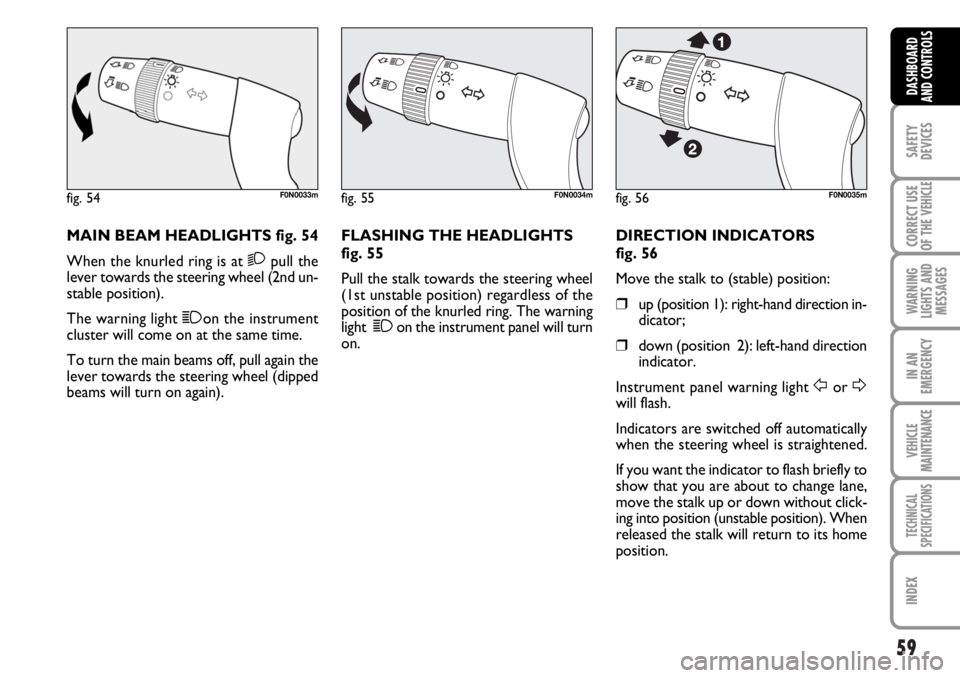
MAIN BEAM HEADLIGHTS fig. 54
When the knurled ring is at
2pull the
lever towards the steering wheel (2nd un-
stable position).
The warning light 1on the instrument
cluster will come on at the same time.
To turn the main beams off, pull again the
lever towards the steering wheel (dipped
beams will turn on again).FLASHING THE HEADLIGHTS
fig. 55
Pull the stalk towards the steering wheel
(1st unstable position) regardless of the
position of the knurled ring. The warning
light 1on the instrument panel will turn
on.DIRECTION INDICATORS
fig. 56
Move the stalk to (stable) position:
❒up (position 1): right-hand direction in-
dicator;
❒down (position 2): left-hand direction
indicator.
Instrument panel warning light
ForDwill flash.
Indicators are switched off automatically
when the steering wheel is straightened.
If you want the indicator to flash briefly to
show that you are about to change lane,
move the stalk up or down without click-
ing into position (unstable position). When
released the stalk will return to its home
position.
fig. 54F0N0033mfig. 55F0N0034mfig. 56F0N0035m
Page 61 of 238
60
SAFETY
DEVICES
CORRECT USE
OF THE
VEHICLE
WARNING
LIGHTS AND
MESSAGES
IN AN
EMERGENCY
VEHICLE
MAINTENANCE
TECHNICAL
SPECIFICATIONS
INDEX
DASHBOARD
AND CONTROLS
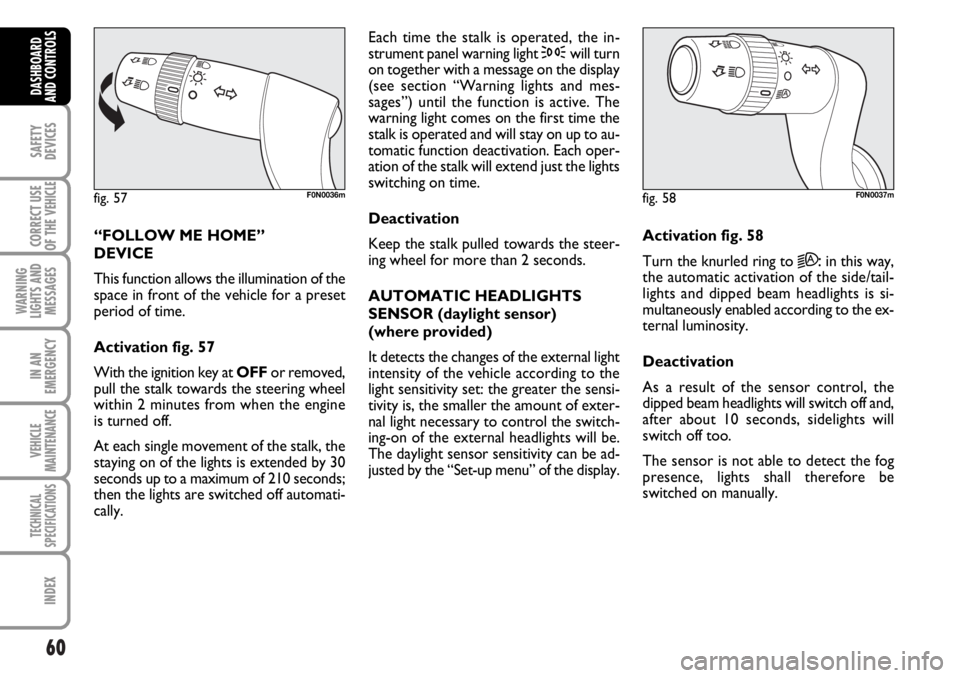
“FOLLOW ME HOME”
DEVICE
This function allows the illumination of the
space in front of the vehicle for a preset
period of time.
Activation fig. 57
With the ignition key at OFFor removed,
pull the stalk towards the steering wheel
within 2 minutes from when the engine
is turned off.
At each single movement of the stalk, the
staying on of the lights is extended by 30
seconds up to a maximum of 210 seconds;
then the lights are switched off automati-
cally. Each time the stalk is operated, the in-
strument panel warning light 3will turn
on together with a message on the display
(see section “Warning lights and mes-
sages”) until the function is active. The
warning light comes on the first time the
stalk is operated and will stay on up to au-
tomatic function deactivation. Each oper-
ation of the stalk will extend just the lights
switching on time.
Deactivation
Keep the stalk pulled towards the steer-
ing wheel for more than 2 seconds.
AUTOMATIC HEADLIGHTS
SENSOR (daylight sensor)
(where provided)
It detects the changes of the external light
intensity of the vehicle according to the
light sensitivity set: the greater the sensi-
tivity is, the smaller the amount of exter-
nal light necessary to control the switch-
ing-on of the external headlights will be.
The daylight sensor sensitivity can be ad-
justed by the “Set-up menu” of the display.Activation fig. 58
Turn the knurled ring to
2A:in this way,
the automatic activation of the side/tail-
lights and dipped beam headlights is si-
multaneously enabled according to the ex-
ternal luminosity.
Deactivation
As a result of the sensor control, the
dipped beam headlights will switch off and,
after about 10 seconds, sidelights will
switch off too.
The sensor is not able to detect the fog
presence, lights shall therefore be
switched on manually.
fig. 57F0N0036mfig. 58F0N0037m
Page 86 of 238
85
SAFETY
DEVICES
CORRECT USE
OF THE
VEHICLE
WARNING
LIGHTS AND
MESSAGES
IN AN
EMERGENCY
VEHICLE
MAINTENANCE
TECHNICAL
SPECIFICATIONS
INDEX
DASHBOARD
AND CONTROLS
BRAKE ASSIST
(emergency braking assistance
integral with ESP) (where provided)
The system, which cannot be cut out, rec-
ognizes emergency braking (on the ground
of the brake pedal operation speed) and
considerably increases the pressure in the
brake circuit.
Brake Assist is deactivated on the versions
equipped with ESP, in the event of ESP sys-
tem failure (indicated by warning light
áswitching on together with the message
on the multifunction display, where pro-
vided).
ESP SYSTEM
(Electronic Stability
Program)
(where provided)
The ESP system is an electronic system
controlling the vehicle stability in the event
of tyre grip loss.
The ESP system is therefore particularly
useful when grip conditions of the road sur-
faces changes.
In addition to the ESP system, ASR system
and Hill Holder, (where provided) also the
MSR system (adjusting the engine braking
torque) and the HBA system (improving
the braking force during emergency brak-
ing) are provided.
ESP SYSTEM INTERVENTION
It is signalled by the blinking of the warn-
ing light áon the instrument panel, to in-
form the driver that the vehicle is in crit-
ical stability and grip conditions.
When the ABS cuts in, and
you feel the brake pedal pul-
sating, do not remove your foot, but
keep it pressed; in doing so you will
stop in the shortest amount of space
possible under the current road con-
ditions.
WARNING
EBD failure
EBD failure is indicated by the turning on
of warning lights
>and xon the in-
strument panel together with the dedi-
cated message on the multifunction dis-
play (where provided), (see section
“Warning lights and messages”).
In this case with sharp braking the rear
wheels might lock too early, with the pos-
sibility of skidding. Drive extremely care-
fully to the nearest Fiat Dealership to have
the system checked.
If warning light xalone
comes on (together with the
message on the multifunction display,
where provided), stop the vehicle im-
mediately and contact the nearest Fi-
at Dealership. Fluid leaks from the hy-
draulic system, in fact, can compro-
mise the braking system, both tradi-
tional systems and systems with ABS.
WARNING
Page 88 of 238
87
SAFETY
DEVICES
CORRECT USE
OF THE
VEHICLE
WARNING
LIGHTS AND
MESSAGES
IN AN
EMERGENCY
VEHICLE
MAINTENANCE
TECHNICAL
SPECIFICATIONS
INDEX
DASHBOARD
AND CONTROLS
MSR system
(engine braking torque control)
It is an integral part of the ASR system that
in case of sudden gear shifting, cuts in pro-
viding torque to the engine thus prevent-
ing excessive driving wheel drive that, spe-
cially in poor grip conditions, can lead to
loss of stability.
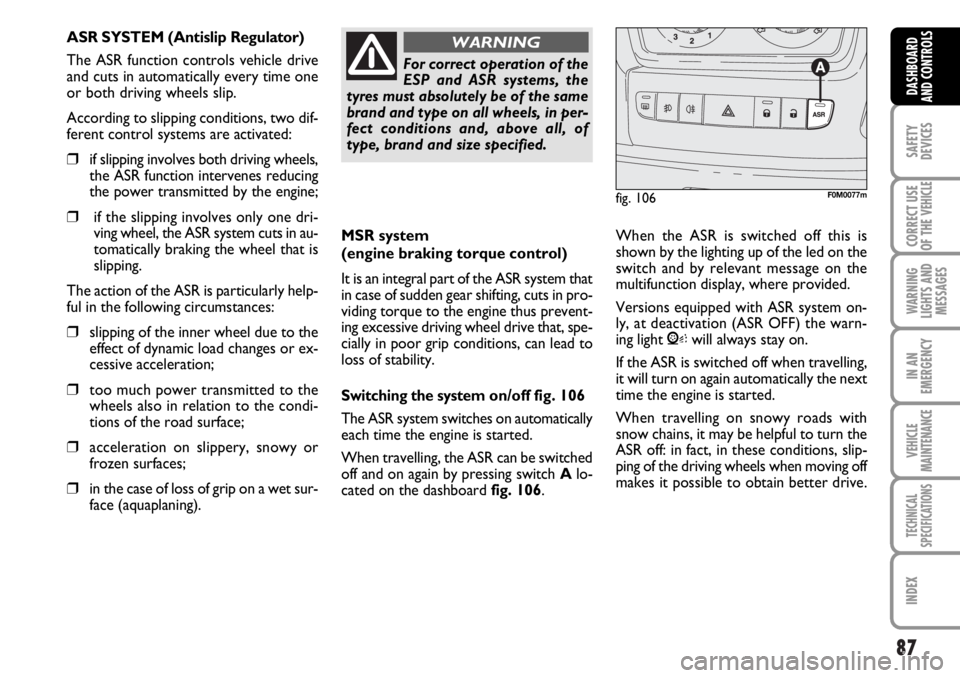
Switching the systemon/off fig. 106
The ASR system switches on automatically
each time the engine is started.
When travelling, the ASR can be switched
off and on again by pressing switch Alo-
cated on the dashboard fig. 106. When the ASR is switched off this is
shown by the lighting up of the led on the
switch and by relevant message on the
multifunction display, where provided.
Versions equipped with ASR system on-
ly, at deactivation (ASR OFF) the warn-
ing light Vwill always stay on.
If the ASR is switched off when travelling,
it will turn on again automatically the next
time the engine is started.
When travelling on snowy roads with
snow chains, it may be helpful to turn the
ASR off: in fact, in these conditions, slip-
ping of the driving wheels when moving off
makes it possible to obtain better drive.
For correct operation of the
ESP and ASR systems, the
tyres must absolutely be of the same
brand and type on all wheels, in per-
fect conditions and, above all, of
type, brand and size specified.
WARNING
fig. 106F0M0077m
ASR SYSTEM (Antislip Regulator)
The ASR function controls vehicle drive
and cuts in automatically every time one
or both driving wheels slip.
According to slipping conditions, two dif-
ferent control systems are activated:
❒if slipping involves both driving wheels,
the ASR function intervenes reducing
the power transmitted by the engine;
❒if the slipping involves only one dri-
ving wheel, the ASR system cuts in au-
tomatically braking the wheel that is
slipping.
The action of the ASR is particularly help-
ful in the following circumstances:
❒slipping of the inner wheel due to the
effect of dynamic load changes or ex-
cessive acceleration;
❒too much power transmitted to the
wheels also in relation to the condi-
tions of the road surface;
❒acceleration on slippery, snowy or
frozen surfaces;
❒in the case of loss of grip on a wet sur-
face (aquaplaning).
Page 126 of 238
125
WARNING
LIGHTS AND
MESSAGES
IN AN
EMERGENCY
VEHICLE
MAINTENANCE
TECHNICAL
SPECIFICATIONS
INDEX
DASHBOARD
AND CONTROLS
SAFETY
DEVICES
CORRECT USE
OF THE VEHICLE
IMPORTANT When snow tyres are used
with a max speed index below the one
that can be reached by the vehicle (in-
creased by 5%), place a notice in the pas-
senger’s compartment, plainly in the dri-
ver’s view which states the max permis-
sible speed of the snow tyres (as per EC
Directive).
All four tyres should be the same (brand
and track) to ensure greater safety when
driving and braking and better driveability.
Remember that it is inappropriate to
change the direction of rotation of tyres.SNOW CHAINS
Use of snow chains should be in compli-
ance with local regulations.
Snow chains should only be applied to the
driving wheels (front wheels). We rec-
ommend using Lineaccessori Fiat snow
chains.
Check the tension of the chains after the
first few metres have been driven.
IMPORTANT With snow chains, use the
accelerator with extreme care to prevent
or to limit as much as possible slipping of
the driving wheels that could cause chain
breaking resulting in damages to the ve-
hicle body or mechanical components.
IMPORTANT Use snow chains with re-
duced size.
SNOW TYRES
Fiat Dealership will be happy to provide
advice concerning the most suitable type
of tyre for the customer’s requirements.
The winter features of these tyres are re-
duced considerably when the tread depth
is below 4 mm. In this case, they should
be replaced.
Due to the snow tyre features, under nor-
mal conditions of use or on long motor-
way journeys, the performance of these
tyres is lower than that of normal tyres. It
is therefore necessary to limit their use to
the purposes for which they are certified.
The max speed for snow
tyres with “Q” marking is
160 km/h; 190 km/h for tyres with “T”
marking and 210 km/h for tyres with
H marking. The Road Traffic Code
speed limits must however be always
strictly observed.
WARNING
Page 142 of 238
141
WARNING
LIGHTS AND
MESSAGES
VEHICLE
MAINTENANCE
TECHNICAL
SPECIFICATIONS
INDEX
DASHBOARD
AND CONTROLS
SAFETY
DEVICES
CORRECT USE
OF THE
VEHICLE
IN AN
EMERGENCY
IMPORTANT Do not directly connect the
negative terminals of the two batteries:
sparks could ignite the flammable gas from
the battery. If the other battery is fitted in
another vehicle, prevent accidental con-
tacts between the metal parts of the two
vehicles.BUMP STARTING
Never bump start the engine (by pushing,
towing, or coasting downhill) as this could
cause fuel to flow into the catalytic ex-
haust system and damage it beyond repair.
IMPORTANT Remember that the brake
booster and the power steering system
are not operating until the engine is start-
ed, a greater effort will therefore be re-
quired to press the brake pedal or turn
the steering wheel.IF A TYRE
IS PUNCTURED
GENERAL INSTRUCTIONS
Wheel changing and correct use of the
jack and spare wheel call for some pre-
cautions as listed below.
Alert other drivers that the
vehicle is stationary in com-
pliance with the regulations in force:
hazard warning lights, warning trian-
gle etc. Any passengers on board
should leave the vehicle, especially if
it is heavily laden. Passengers should
stay away from oncoming traffic
while the wheel is being changed on.
Pull the handbrake.
WARNING
Page 144 of 238
143
WARNING
LIGHTS AND
MESSAGES
VEHICLE
MAINTENANCE
TECHNICAL
SPECIFICATIONS
INDEX
DASHBOARD
AND CONTROLS
SAFETY
DEVICES
CORRECT USE
OF THE
VEHICLE
IN AN
EMERGENCY
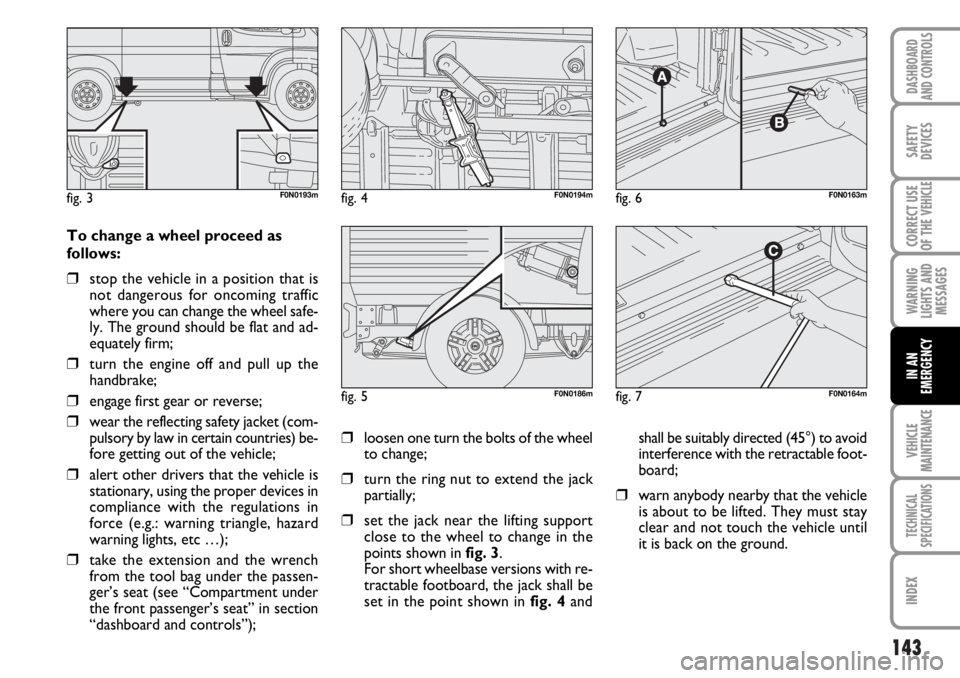
To change a wheel proceed as
follows:
❒stop the vehicle in a position that is
not dangerous for oncoming traffic
where you can change the wheel safe-
ly. The ground should be flat and ad-
equately firm;
❒turn the engine off and pull up the
handbrake;
❒engage first gear or reverse;
❒wear the reflecting safety jacket (com-
pulsory by law in certain countries) be-
fore getting out of the vehicle;
❒alert other drivers that the vehicle is
stationary, using the proper devices in
compliance with the regulations in
force (e.g.: warning triangle, hazard
warning lights, etc …);
❒take the extension and the wrench
from the tool bag under the passen-
ger’s seat (see “Compartment under
the front passenger’s seat” in section
“dashboard and controls”);
❒loosen one turn the bolts of the wheel
to change;
❒turn the ring nut to extend the jack
partially;
❒set the jack near the lifting support
close to the wheel to change in the
points shown in fig. 3.
For short wheelbase versions with re-
tractable footboard, the jack shall be
set in the point shown in fig. 4andshall be suitably directed (45°) to avoid
interference with the retractable foot-
board;
❒warn anybody nearby that the vehicle
is about to be lifted. They must stay
clear and not touch the vehicle until
it is back on the ground.
fig. 3F0N0193mfig. 4F0N0194m
fig. 5F0N0186m
fig. 6F0N0163m
fig. 7F0N0164m
Page 155 of 238
154
WARNING
LIGHTS AND
MESSAGES
VEHICLE
MAINTENANCE
TECHNICAL
SPECIFICATIONS
IINDEX
DASHBOARD
AND CONTROLS
SAFETY
DEVICES
CORRECT USE
OF THE
VEHICLE
IN AN
EMERGENCY
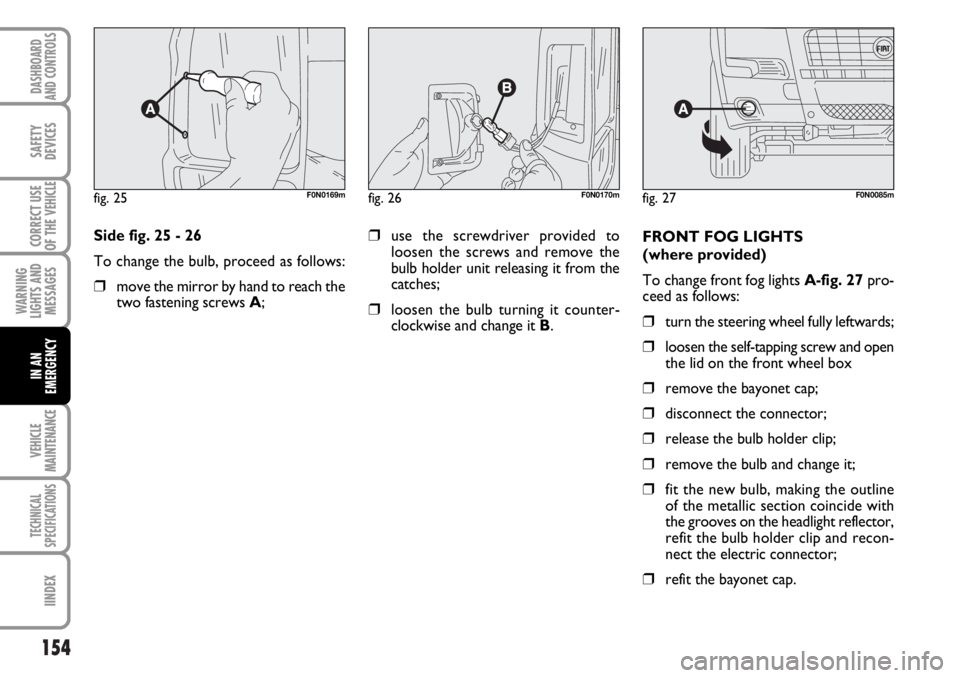
Side fig. 25 - 26
To change the bulb, proceed as follows:
❒move the mirror by hand to reach the
two fastening screws A;FRONT FOG LIGHTS
(where provided)
To change front fog lights A-fig. 27pro-
ceed as follows:
❒turn the steering wheel fully leftwards;
❒loosen the self-tapping screw and open
the lid on the front wheel box
❒remove the bayonet cap;
❒disconnect the connector;
❒release the bulb holder clip;
❒remove the bulb and change it;
❒fit the new bulb, making the outline
of the metallic section coincide with
the grooves on the headlight reflector,
refit the bulb holder clip and recon-
nect the electric connector;
❒refit the bayonet cap.
fig. 25F0N0169mfig. 27F0N0085mfig. 26F0N0170m
❒use the screwdriver provided to
loosen the screws and remove the
bulb holder unit releasing it from the
catches;
❒loosen the bulb turning it counter-
clockwise and change it B.
Page 188 of 238
187
WARNING
LIGHTS AND
MESSAGES
TECHNICAL
SPECIFICATIONS
INDEX
DASHBOARD
AND CONTROLS
SAFETY
DEVICES
CORRECT USE
OF THE VEHICLE
IN AN
EMERGENCY
VEHICLE
MAINTENANCE
WHEELS AND TYRES
Check the pressure of each tyre, includ-
ing the spare, every two weeks and before
long journeys. The pressure should be
checked with the tyre rested and cold.
It is normal for pressure to rise when you
are driving. For the correct tyre inflation
pressure, see “Wheels” in section “Tech-
nical specifications”.
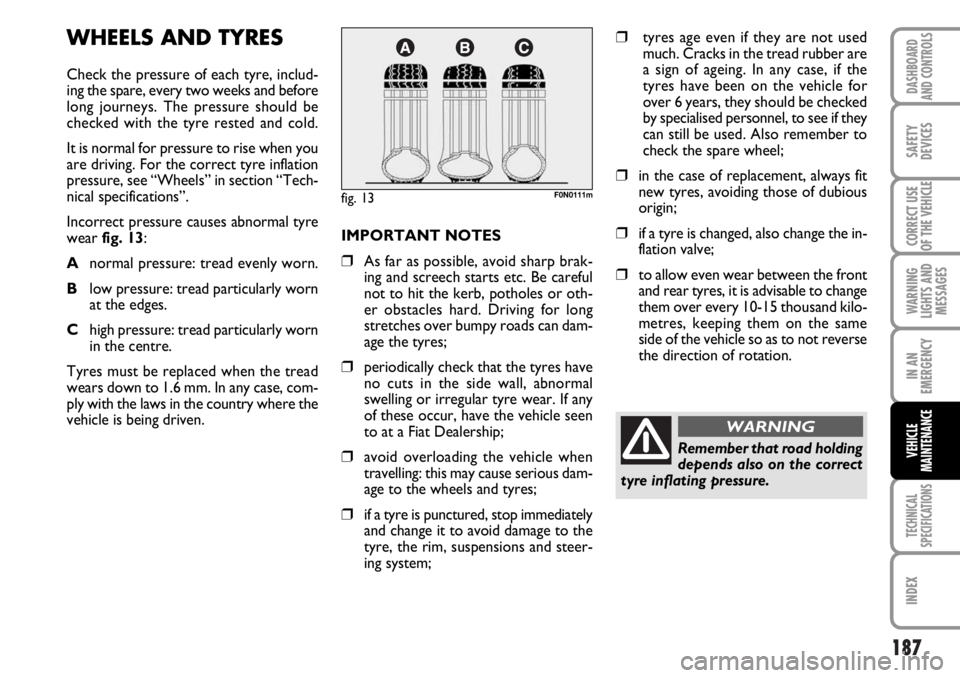
Incorrect pressure causes abnormal tyre
wearfig. 13:
Anormal pressure: tread evenly worn.
Blow pressure: tread particularly worn
at the edges.
Chigh pressure: tread particularly worn
in the centre.
Tyres must be replaced when the tread
wears down to 1.6 mm. In any case, com-
ply with the laws in the country where the
vehicle is being driven.
fig. 13F0N0111m
IMPORTANT NOTES
❒As far as possible, avoid sharp brak-
ing and screech starts etc. Be careful
not to hit the kerb, potholes or oth-
er obstacles hard. Driving for long
stretches over bumpy roads can dam-
age the tyres;
❒periodically check that the tyres have
no cuts in the side wall, abnormal
swelling or irregular tyre wear. If any
of these occur, have the vehicle seen
to at a Fiat Dealership;
❒avoid overloading the vehicle when
travelling: this may cause serious dam-
age to the wheels and tyres;
❒if a tyre is punctured, stop immediately
and change it to avoid damage to the
tyre, the rim, suspensions and steer-
ing system;
❒tyres age even if they are not used
much. Cracks in the tread rubber are
a sign of ageing. In any case, if the
tyres have been on the vehicle for
over 6 years, they should be checked
by specialised personnel, to see if they
can still be used. Also remember to
check the spare wheel;
❒in the case of replacement, always fit
new tyres, avoiding those of dubious
origin;
❒if a tyre is changed, also change the in-
flation valve;
❒to allow even wear between the front
and rear tyres, it is advisable to change
them over every 10-15 thousand kilo-
metres, keeping them on the same
side of the vehicle so as to not reverse
the direction of rotation.
Remember that road holding
depends also on the correct
tyre inflating pressure.
WARNING
Page 189 of 238
188
WARNING
LIGHTS AND
MESSAGES
TECHNICAL
SPECIFICATIONS
INDEX
DASHBOARD
AND CONTROLS
SAFETY
DEVICES
CORRECT USE
OF THE VEHICLE
IN AN
EMERGENCY
VEICHLE
MAINTENANCE
WINDSCREEN
BLADES
Periodically clean the rubber part using
special products; TUTELA PROFES-
SIONAL SC 35is recommended.
If the rubber blades are bent or worn they
should be replaced. In any case they should
be changed once a year.
A few simple notions can reduce the pos-
sibility of damage to the blades:
❒if the temperature fall below zero,
make sure that ice has not frozen the
rubber against glass. If necessary, thaw
using an antifreeze product;
❒remove any snow from the glass: in ad-
dition to protecting the blades, this
prevents effort on the motor and
overheating;
❒do not operate the windscreen
wipers on dry glass.
RUBBER HOSES
As far as the brake system and fuel rubber
hoses are concerned, carefully follow the
“Service schedule” in this section.
Indeed ozone, high temperatures and pro-
longed lack of fluid in the system may
cause hardening and cracking of the hoses,
with possible leaks. Careful control is
therefore necessary.If the pressure is too low the
tyre overheats and this can
cause it serious damage.
WARNING
Do not cross switch the
tyres, moving them from the
right of the vehicle to the left and vice
versa.
WARNING
Never submit alloy rims to
repainting treatments re-
quiring to use temperatures exceed-
ing 150°C since the mechanical prop-
erties of the wheels could be im-
paired.
WARNING