weight FIAT DUCATO 2006 Owner handbook (in English)
[x] Cancel search | Manufacturer: FIAT, Model Year: 2006, Model line: DUCATO, Model: FIAT DUCATO 2006Pages: 238, PDF Size: 3.29 MB
Page 36 of 238
35
SAFETY
DEVICES
CORRECT USE
OF THE
VEHICLE
WARNING
LIGHTS AND
MESSAGES
IN AN
EMERGENCY
VEHICLE
MAINTENANCE
TECHNICAL
SPECIFICATIONS
INDEX
DASHBOARD
AND CONTROLS
Fabric upholstery of your Fiat
Ducato is purpose-made to
withstand common wear re-
sulting from normal use of the
vehicle. It is however absolutely neces-
sary to prevent hard and/or prolonged
scratching/scraping caused by clothing
accessories like metallic buckles, studs,
“Velcro” fixings, etc. that stressing lo-
cally the fabric could break yarns and
damage the upholstery as a conse-
quence.
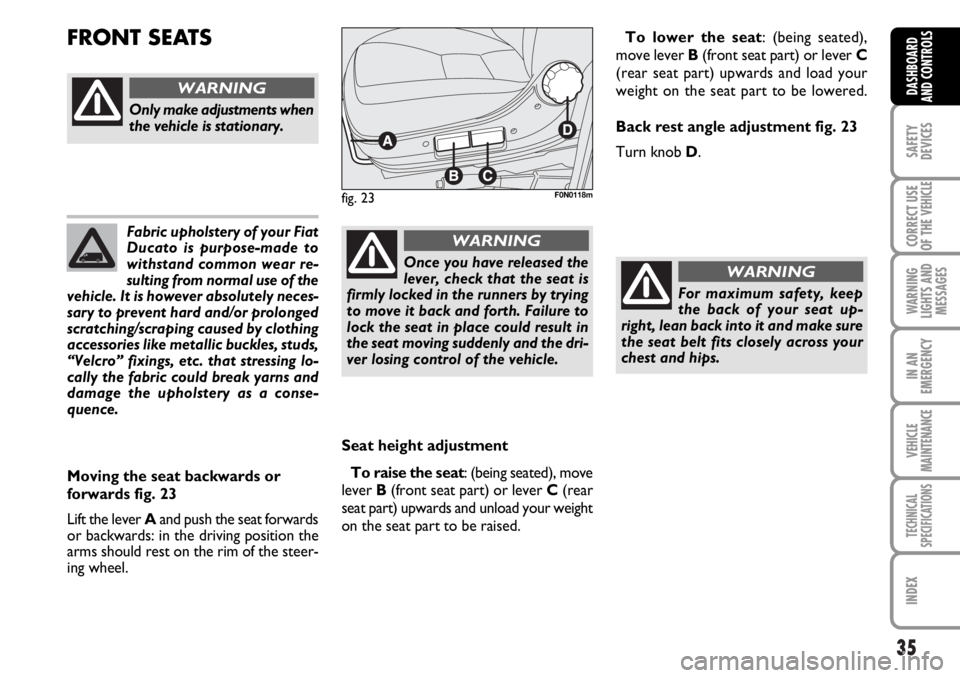
Seat height adjustment
To raise the seat: (being seated), move
lever B (front seat part) or lever C (rear
seat part) upwards and unload your weight
on the seat part to be raised.
FRONT SEATS
fig. 23F0N0118m
Only make adjustments when
the vehicle is stationary.
WARNING
Moving the seat backwards or
forwards fig. 23
Lift the lever Aand push the seat forwards
or backwards: in the driving position the
arms should rest on the rim of the steer-
ing wheel.
Once you have released the
lever, check that the seat is
firmly locked in the runners by trying
to move it back and forth. Failure to
lock the seat in place could result in
the seat moving suddenly and the dri-
ver losing control of the vehicle.
WARNING
For maximum safety, keep
the back of your seat up-
right, lean back into it and make sure
the seat belt fits closely across your
chest and hips.
WARNING
To lower the seat: (being seated),
move lever B(front seat part) or lever C
(rear seat part) upwards and load your
weight on the seat part to be lowered.
Back rest angle adjustment fig. 23
Turn knob D.
Page 37 of 238
36
SAFETY
DEVICES
CORRECT USE
OF THE
VEHICLE
WARNING
LIGHTS AND
MESSAGES
IN AN
EMERGENCY
VEHICLE
MAINTENANCE
TECHNICAL
SPECIFICATIONS
INDEX
DASHBOARD
AND CONTROLS
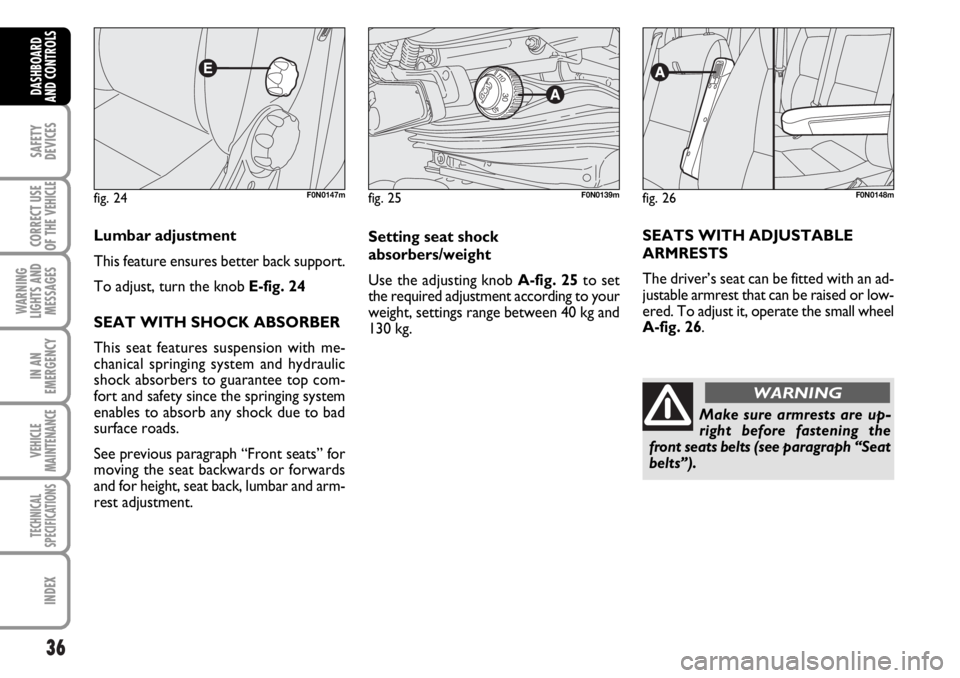
fig. 24F0N0147m
Lumbar adjustment
This feature ensures better back support.
To adjust, turn the knob E-fig. 24
SEAT WITH SHOCK ABSORBER
This seat features suspension with me-
chanical springing system and hydraulic
shock absorbers to guarantee top com-
fort and safety since the springing system
enables to absorb any shock due to bad
surface roads.
See previous paragraph “Front seats” for
moving the seat backwards or forwards
and for height, seat back, lumbar and arm-
rest adjustment.
fig. 25F0N0139m
Setting seat shock
absorbers/weight
Use the adjusting knob A-fig. 25to set
the required adjustment according to your
weight, settings range between 40 kg and
130 kg.
Make sure armrests are up-
right before fastening the
front seats belts (see paragraph “Seat
belts”). SEATS WITH ADJUSTABLE
ARMRESTS
The driver’s seat can be fitted with an ad-
justable armrest that can be raised or low-
ered. To adjust it, operate the small wheel
A-fig. 26.
fig. 26F0N0148m
WARNING
Page 74 of 238
73
SAFETY
DEVICES
CORRECT USE
OF THE
VEHICLE
WARNING
LIGHTS AND
MESSAGES
IN AN
EMERGENCY
VEHICLE
MAINTENANCE
TECHNICAL
SPECIFICATIONS
INDEX
DASHBOARD
AND CONTROLS
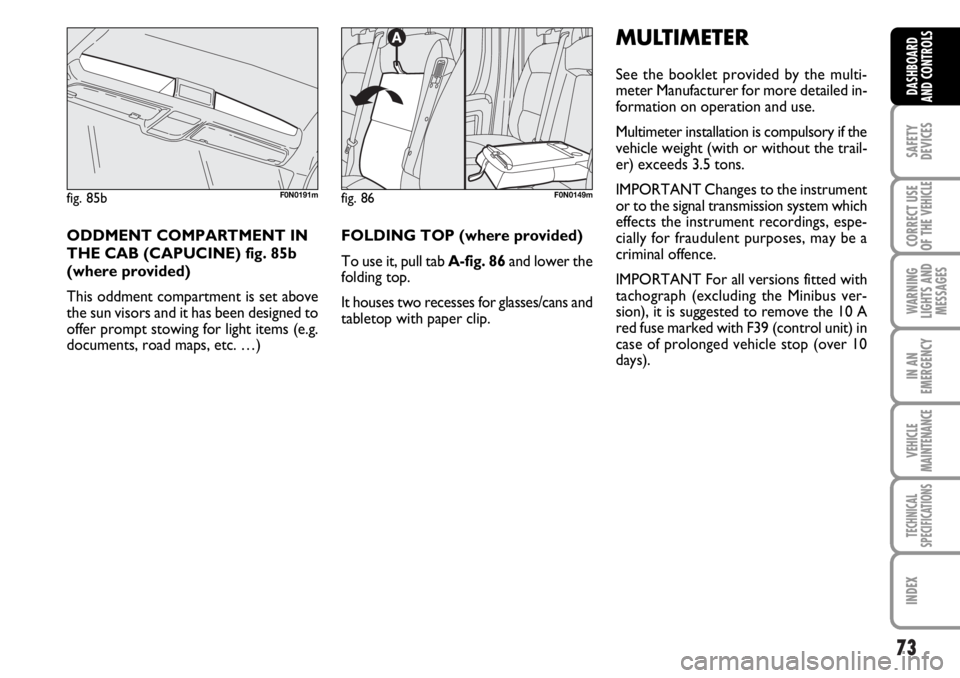
fig. 86F0N0149m
FOLDING TOP (where provided)
To use it, pull tab A-fig. 86and lower the
folding top.
It houses two recesses for glasses/cans and
tabletop with paper clip.
MULTIMETER
See the booklet provided by the multi-
meter Manufacturer for more detailed in-
formation on operation and use.
Multimeter installation is compulsory if the
vehicle weight (with or without the trail-
er) exceeds 3.5 tons.
IMPORTANT Changes to the instrument
or to the signal transmission system which
effects the instrument recordings, espe-
cially for fraudulent purposes, may be a
criminal offence.
IMPORTANT For all versions fitted with
tachograph (excluding the Minibus ver-
sion), it is suggested to remove the 10 A
red fuse marked with F39 (control unit) in
case of prolonged vehicle stop (over 10
days).
fig. 85bF0N0191m
ODDMENT COMPARTMENT IN
THE CAB (CAPUCINE) fig. 85b
(where provided)
This oddment compartment is set above
the sun visors and it has been designed to
offer prompt stowing for light items (e.g.
documents, road maps, etc. …)
Page 83 of 238
Distribute the load evenly
and when driving, bear in
mind the increased sensitivity of the
vehicle to side wind.
82
SAFETY
DEVICES
CORRECT USE
OF THE
VEHICLE
WARNING
LIGHTS AND
MESSAGES
IN AN
EMERGENCY
VEHICLE
MAINTENANCE
TECHNICAL
SPECIFICATIONS
INDEX
DASHBOARD
AND CONTROLS
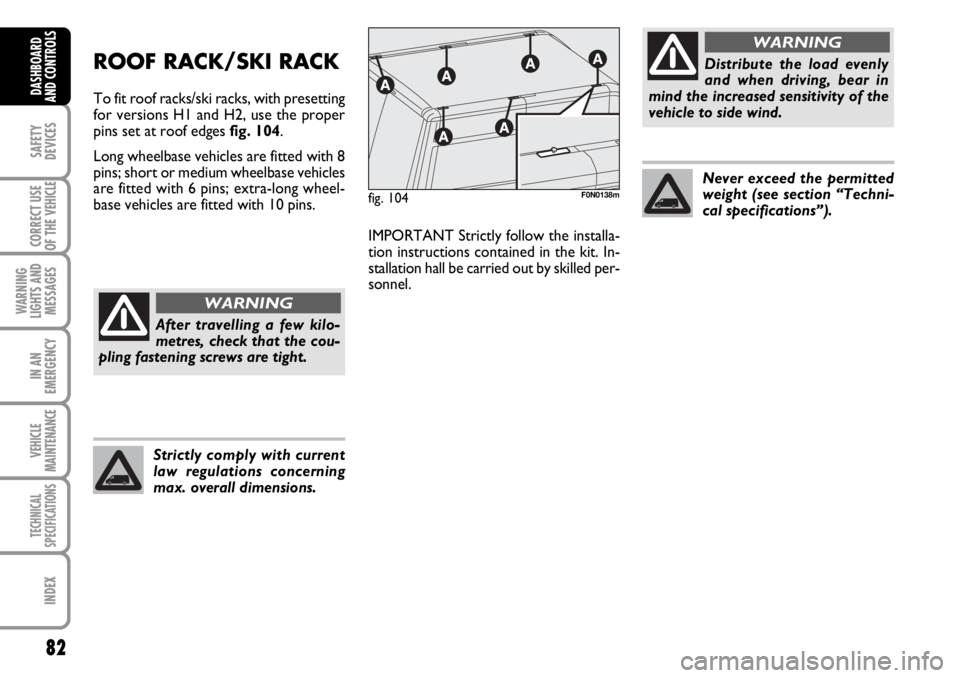
ROOF RACK/SKI RACK
To fit roof racks/ski racks, with presetting
for versions H1 and H2, use the proper
pins set at roof edges fig. 104.
Long wheelbase vehicles are fitted with 8
pins; short or medium wheelbase vehicles
are fitted with 6 pins; extra-long wheel-
base vehicles are fitted with 10 pins.
After travelling a few kilo-
metres, check that the cou-
pling fastening screws are tight.
WARNING
Strictly comply with current
law regulations concerning
max. overall dimensions.
Never exceed the permitted
weight (see section “Techni-
cal specifications”).
IMPORTANT Strictly follow the installa-
tion instructions contained in the kit. In-
stallation hall be carried out by skilled per-
sonnel.
fig. 104F0N0138m
WARNING
Page 104 of 238
HOW TO KEEP THE SEAT
BELTS ALWAYS IN EFFICIENT
CONDITIONS
Observe the following:
❒always use the belt with the tap taut
and never twisted; make sure that it
is free to run without impediments;
❒after a serious accident, replace the
belt being worn at that time, even if it
does not appear damaged. Always re-
place the seat belts if pretensioners
have been activated;
❒to clean the belts, wash by hand with
neutral soap, rinse and leave to dry in
the shade. Never use strong deter-
gents, bleach or dyes or other chem-
ical substance that might weaken the
fibres;
❒prevent the reels from getting wet:
their correct operation is only guar-
anteed if water does not get inside;
❒replace the seat belt when showing
significant wear or cut signs.For optimal protection in the event of a
crash, all passengers must be seated and
wearing adequate restraint systems.
This is even more important for children.
This prescription is compulsory in all EC
countries according to EC Directive
2003/20/EC.
Compared with adults, their head is pro-
portionally larger and heavier than the rest
of the body, while the muscles and bone
structure are not completely developed.
Therefore, correct restraint systems are
necessary, other than adult seat belts. The
results of research on the best child re-
straint systems are contained in the Euro-
pean Standard EEC-R44. This Standard en-
forces the use of restraint systems classi-
fied in five groups:Group 0 0-10 kg in weight
Group 0+ 0-13 kg in weight
Group 1 9-18 kg in weight
Group 2 15-25 kg in weight
Group 3 22-36 kg in weight
As it may be noted, the groups overlap
partly and in fact, in commerce it is pos-
sible to find devices that cover more than
one weight group.
All restraint devices must bear the certi-
fication data, together with the control
brand, on a solidly fixed label which must
absolutely never be removed.
103
CORRECT USE
OF THE
VEHICLE
WARNING
LIGHTS AND
MESSAGES
IN AN
EMERGENCY
VEHICLE
MAINTENANCE
TECHNICAL
SPECIFICATIONS
INDEX
DASHBOARD
AND CONTROLS
SAFETY
DEVICES
CARRYING CHILDREN SAFELY
Page 106 of 238
105
CORRECT USE
OF THE
VEHICLE
WARNING
LIGHTS AND
MESSAGES
IN AN
EMERGENCY
VEHICLE
MAINTENANCE
TECHNICAL
SPECIFICATIONS
INDEX
DASHBOARD
AND CONTROLS
SAFETY
DEVICES
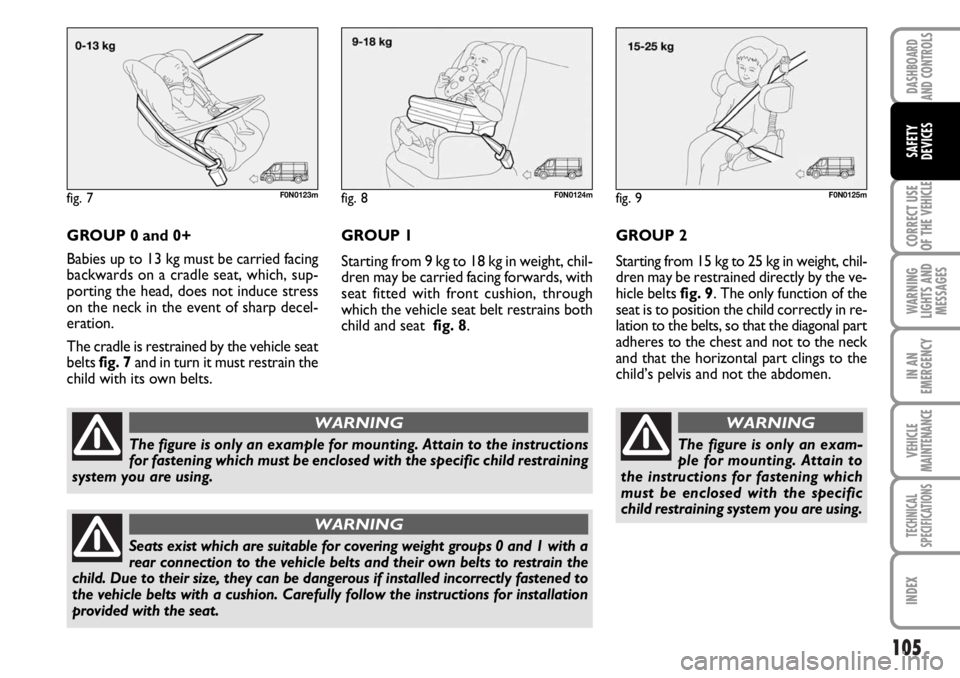
GROUP 0 and 0+
Babies up to 13 kg must be carried facing
backwards on a cradle seat, which, sup-
porting the head, does not induce stress
on the neck in the event of sharp decel-
eration.
The cradle is restrained by the vehicle seat
belts fig. 7and in turn it must restrain the
child with its own belts.
fig. 7F0N0123m
The figure is only an example for mounting. Attain to the instructions
for fastening which must be enclosed with the specific child restraining
system you are using.
WARNING
Seats exist which are suitable for covering weight groups 0 and 1 with a
rear connection to the vehicle belts and their own belts to restrain the
child. Due to their size, they can be dangerous if installed incorrectly fastened to
the vehicle belts with a cushion. Carefully follow the instructions for installation
provided with the seat.
WARNING
fig. 8F0N0124mfig. 9F0N0125m
GROUP 2
Starting from 15 kg to 25 kg in weight, chil-
dren may be restrained directly by the ve-
hicle belts fig. 9. The only function of the
seat is to position the child correctly in re-
lation to the belts, so that the diagonal part
adheres to the chest and not to the neck
and that the horizontal part clings to the
child’s pelvis and not the abdomen. GROUP 1
Starting from 9 kg to 18 kg in weight, chil-
dren may be carried facing forwards, with
seat fitted with front cushion, through
which the vehicle seat belt restrains both
child and seat fig. 8.
The figure is only an exam-
ple for mounting. Attain to
the instructions for fastening which
must be enclosed with the specific
child restraining system you are using.
WARNING
Page 107 of 238
106
CORRECT USE
OF THE
VEHICLE
WARNING
LIGHTS AND
MESSAGES
IN AN
EMERGENCY
VEHICLE
MAINTENANCE
TECHNICAL
SPECIFICATIONS
IINDEX
DASHBOARD
AND CONTROLS
SAFETY
DEVICES
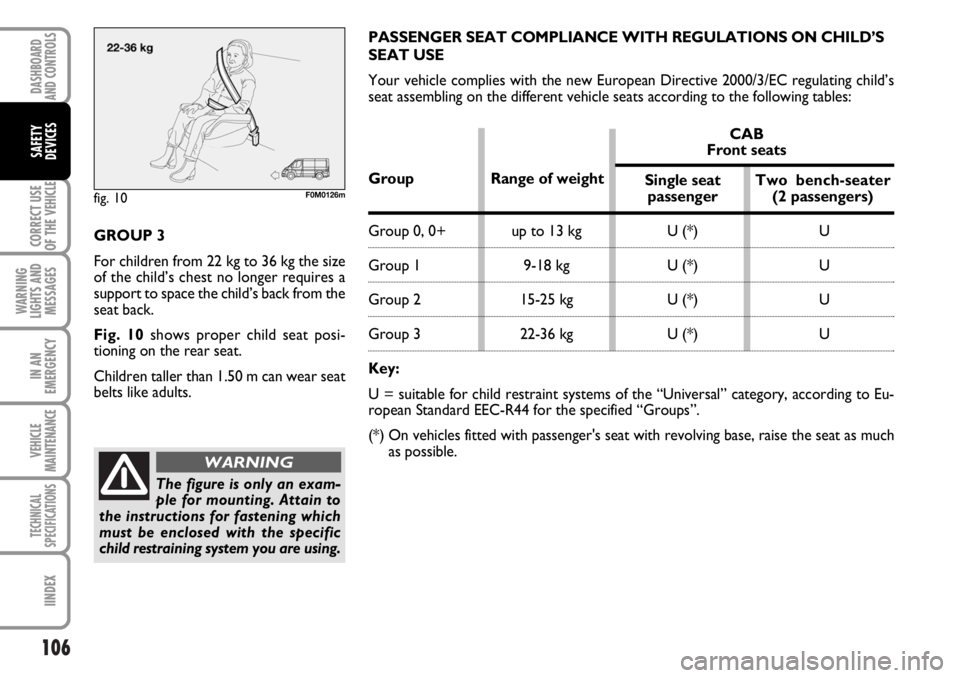
GROUP 3
For children from 22 kg to 36 kg the size
of the child’s chest no longer requires a
support to space the child’s back from the
seat back.
Fig. 10shows proper child seat posi-
tioning on the rear seat.
Children taller than 1.50 m can wear seat
belts like adults.PASSENGER SEAT COMPLIANCE WITH REGULATIONS ON CHILD’S
SEAT USE
Your vehicle complies with the new European Directive 2000/3/EC regulating child’s
seat assembling on the different vehicle seats according to the following tables:
fig. 10F0M0126m
The figure is only an exam-
ple for mounting. Attain to
the instructions for fastening which
must be enclosed with the specific
child restraining system you are using.
WARNING
CABFront seats
Group Range of weight
Single seatTwo bench-seater
passenger (2 passengers)
Group 0, 0+ up to 13 kg U (*) U
Group 1 9-18 kg U (*) U
Group 2 15-25 kg U (*) U
Group 3 22-36 kg U (*) U
Key:
U = suitable for child restraint systems of the “Universal” category, according to Eu-
ropean Standard EEC-R44 for the specified “Groups”.
(*) On vehicles fitted with passenger's seat with revolving base, raise the seat as much
as possible.
Page 120 of 238
119
WARNING
LIGHTS AND
MESSAGES
IN AN
EMERGENCY
VEHICLE
MAINTENANCE
TECHNICAL
SPECIFICATIONS
INDEX
DASHBOARD
AND CONTROLS
SAFETY
DEVICES
CORRECT USE
OF THE VEHICLE
fig. 2F0N0074m
To change gears properly
you must push the clutch
pedal fully down. It is therefore es-
sential that there is nothing under the
pedals: make sure the mats are lying
flat and do not get in the way of the
pedals.
WARNING
Do not drive with your hand
resting on the gear lever as
the force exerted, even if
slight, could lead over time to
premature wear on the gearbox inter-
nal components.
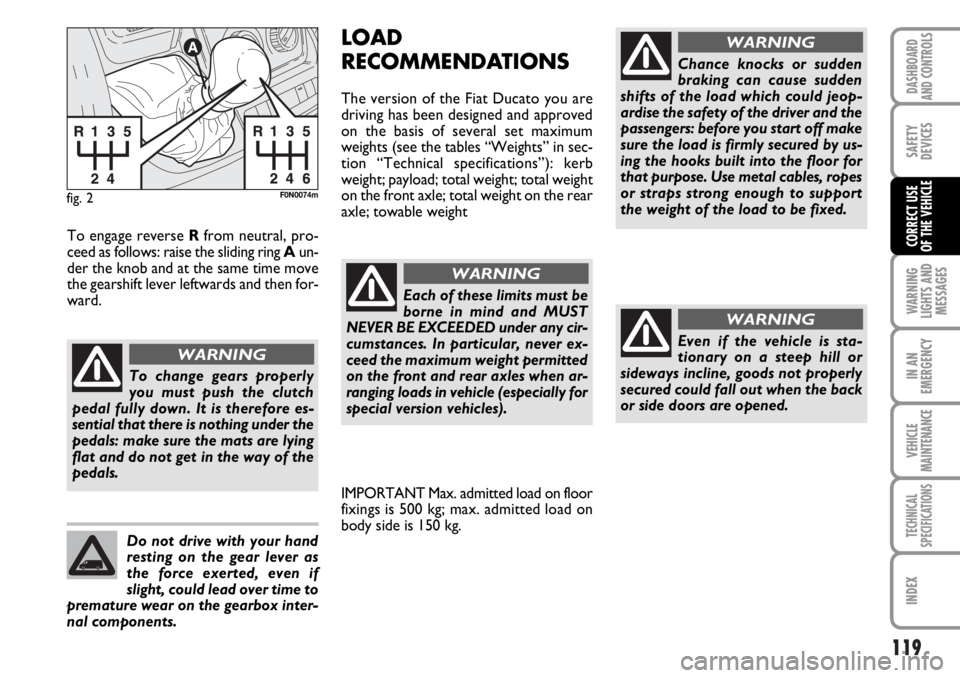
To engage reverse R from neutral, pro-
ceed as follows: raise the sliding ring Aun-
der the knob and at the same time move
the gearshift lever leftwards and then for-
ward.
LOAD
RECOMMENDATIONS
The version of the Fiat Ducato you are
driving has been designed and approved
on the basis of several set maximum
weights (see the tables “Weights” in sec-
tion “Technical specifications”): kerb
weight; payload; total weight; total weight
on the front axle; total weight on the rear
axle; towable weight
Each of these limits must be
borne in mind and MUST
NEVER BE EXCEEDED under any cir-
cumstances. In particular, never ex-
ceed the maximum weight permitted
on the front and rear axles when ar-
ranging loads in vehicle (especially for
special version vehicles).Chance knocks or sudden
braking can cause sudden
shifts of the load which could jeop-
ardise the safety of the driver and the
passengers: before you start off make
sure the load is firmly secured by us-
ing the hooks built into the floor for
that purpose. Use metal cables, ropes
or straps strong enough to support
the weight of the load to be fixed.
WARNING
WARNING
Even if the vehicle is sta-
tionary on a steep hill or
sideways incline, goods not properly
secured could fall out when the back
or side doors are opened.
WARNING
IMPORTANT Max. admitted load on floor
fixings is 500 kg; max. admitted load on
body side is 150 kg.
Page 121 of 238
120
WARNING
LIGHTS AND
MESSAGES
IN AN
EMERGENCY
VEHICLE
MAINTENANCE
TECHNICAL
SPECIFICATIONS
INDEX
DASHBOARD
AND CONTROLS
SAFETY
DEVICES
CORRECT USE
OF THE VEHICLE
CONTAINING
RUNNING COSTS
Here are some suggestions which may
help you to keep the running costs of your
vehicle down and lower the amount of
toxic emissions released into the atmos-
phere.
GENERAL CONSIDERATIONS
Vehicle maintenance
Carry out the checks and adjustments/reg-
ulations specified in the “Service Sched-
ule”.
Tyres
Check the pressure of the tyres routine-
ly at an interval of no more than 4 weeks:
if the pressure is too low, consumption
levels increase as resistance to rolling is
higher.
Unnecessary loads
Do not travel with too much luggage
stowed in the boot. The weight of the ve-
hicle (especially when driving in town) and
its trim greatly affects consumption and
stability.Roof rack/ski rack
Remove the roof rack or the ski rack from
the roof as soon as they are no longer
used. These accessories lower air pene-
tration and adversely affect consumption
levels. When needing to carry particular-
ly voluminous objects, preferably use a
trailer.
Electric devices
Use electric devices only for the amount
of time needed. Rear heated window, ad-
ditional headlights, windscreen wipers and
heater fan need a considerable amount of
energy, therefore increasing the require-
ment of current increases fuel consump-
tion (up to +25% in the urban cycle).
Climate control
The air conditioner is an additional load
which greatly affects the engine leading to
higher consumption (on average up to
+20%). When the temperature outside
the vehicle permits it, use the air vents
where possible.
Spoilers
The use of non-certified aerodynamic
items may adversely affect air drag and
consumption levels.
Observe the enforced rules if
you need to carry a spare
can of petrol. Only use a homologat-
ed can and secure it to the load an-
choring eyebolts. Even given these
precautions, the risk of fire in the
event of an accident is increased.
WARNING
In addition to these general precautions,
some simple measures could enhance dri-
ving safety, comfort and the length of the
vehicle’s life:
❒distribute the load evenly over the
load floor: if you need to concentrate
it all in one point choose the part be-
tween the axles;
❒remember that the lower the load is,
the lower the vehicle’s centre of grav-
ity will be, contributing to a safe drive;
you should therefore always position
the heavier goods at the bottom;
❒finally, remember that the way in
which the vehicle moves is influenced
by the weight being carried. In partic-
ular, stopping distance lengthens par-
ticularly at high speed.
Page 122 of 238

121
WARNING
LIGHTS AND
MESSAGES
IN AN
EMERGENCY
VEHICLE
MAINTENANCE
TECHNICAL
SPECIFICATIONS
INDEX
DASHBOARD
AND CONTROLS
SAFETY
DEVICES
CORRECT USE
OF THE VEHICLE
Acceleration
Accelerating violently increasing the revs
will greatly affect consumption and emis-
sions: acceleration should be gradual and
should not exceed the maximum torque.
CONDITIONS OF USE
Cold starting
Short journeys and frequent cold starts do
not allow the engine to reach optimum op-
erating temperature. This results in a sig-
nificant increase in consumption levels
(from +15 to +30% on the urban cycle)
and emission of harmful substances.
Traffic and
road conditions
Rather high consumption levels are tied to
situations with heavy traffic, for example
in queues with frequent use of the lower
gears or in cities with many traffic lights.
Also winding mountain roads and rough
road surfaces adversely affect consump-
tion.
Traffic hold-ups
During prolonged hold-ups (level crossings)
the engine should be switched off.TOWING TRAILERS
IMPORTANT NOTES
For towing caravans or trailers the vehi-
cle must be fitted with a certified tow
hook and an adequate electric system. In-
stallation should be carried out by spe-
cialised personnel who release a special
document for circulation on the road.
Install any specific and/or additional rear-
view mirrors as specified by law.
Remember that when towing a trailer,
steep hills are harder to climb, the brak-
ing spaces increase and overtaking takes
longer depending on the overall weight.
Engage a low gear when driving downhill,
rather than constantly using the brake.
The weight the trailer exerts on the ve-
hicle tow hook reduces by the same
amount the actual vehicle loading capaci-
ty. To make sure the maximum towable
weight is not exceeded (given in the log
book) account should be taken of the ful-
ly laden trailer, including accessories and
personal belongings. DRIVING STYLE
Starting
Do not warm the engine when the vehi-
cle is stationary or at high or low speed:
in this way the engine will warm up grad-
ually increasing consumption and emis-
sions. You should drive off slowly straight
away avoiding high revs so that the engine
will warm up more quickly.
Unnecessary actions
Avoid accelerating when waiting at traffic
lights or before switching off the engine.
This and also double declutching is ab-
solutely pointless on modern vehicles and
also increase consumption and pollution.
Gear selection
As soon as the conditions of the traffic and
road allow, use a higher gear. Using a low
gear to obtain brilliant performance in-
creases consumption.
In the same way improper use of a high
gear increases consumption, emissions an
engine wear.
Top speed
Fuel consumption considerably increases
with speed. Avoid superfluous braking and
accelerating, which cost in terms of both
fuel and emissions.