200 FIAT DUCATO 2011 Owner handbook (in English)
[x] Cancel search | Manufacturer: FIAT, Model Year: 2011, Model line: DUCATO, Model: FIAT DUCATO 2011Pages: 287, PDF Size: 4.42 MB
Page 26 of 287
To cancel the setting, proceed as follows:
– briefly press button MODE: ON flashes on the display;
– press button
▼: OFF flashes on the display;
– press the MODE button briefly to return to the menu
screen or press the button for longer to return to the
standard screen without memorising.
Headlight sensor sensitivity adjustment
(for versions/markets where provided)
With this function it is possible to adjust the rain
headlight sensitivity according to 3 levels.
To set the required sensitivity level, proceed as follows:
– briefly press button MODE: the previously set
sensitivity “level” start to flash on the display;
– press button
▲or ▼to adjust;
– press the MODE button briefly to return to the menu
screen or press the button for longer to return to the
standard screen without memorising. Speed limit (Speed Beep)
This function enables setting of the vehicle speed limit
(km/h or mph). When this limit is exceeded the driver is
immediately alerted (see section “Warning lights and
messages”).
To set the desired speed limit, proceed as follows:
– briefly press button MODE: the display will show the
wording “Speed Beep”;
– press button
▲or ▼to activate (On) or deactivate
(Off) the speed limit;
– if the function has been activated (On), press buttons
▲or ▼to select the required speed limit and then
press MODE to confirm.
NOTE.
The speed may be set in the range from 30 to
200 km/h, or from 20 to 125 mph according to the
previously chosen unit (see “Setting the distance unit”
paragraph ) described below. The setting will increase/
decrease by five units each time button
▲/▼is pressed.
Hold down button
▲/▼to increase/decrease the setting
rapidly. Complete the setting by briefly pressing the
button when you approach the required value.
– press the MODE button briefly to return to the menu
screen or press the button for longer to return to the
standard screen without memorising.
22
KNOWING
YOUR CAR
SAFETY
STARTING
AND
DRIVING
WARNING
LIGHTS AND
MESSAGES
IN AN
EMERGENCY
MAINTENANCE
AND CARE
TECHNICAL
SPECIFICATIONS
INDEX
Page 31 of 287
27
KNOWING
YOUR CAR
SAFETY
STARTING
AND
DRIVING
WARNING
LIGHTS AND
MESSAGES
IN AN
EMERGENCY
MAINTENANCE
AND CARE
TECHNICAL
SPECIFICATIONS
INDEX
NOTE The “Scheduled Maintenance Plan” sets out
different service intervals depending on the engine type.
This indication will appear automatically with the key at
MAR-ONstarting from 2,000 km (or 1240 mi) and will
be presented automatically every 200 km (or 124 mi).
Oil change notification messages are displayed in the
same way. Use keys
▲and ▼to display service and oil
change due dates alternately. Below 200 km servicing
indications are more frequent. The display will be in
kilometres or miles depending on the measurement unit
settings. When the next scheduled service is
approaching, the message “Service” will appear on the
display followed by the number of kilometres or miles
left when the key is turned to
MAR-ON. Contact a Fiat
Dealership to carry out any service operation in the
“Scheduled servicing plan” and to reset the display. Scheduled Servicing (Service)
Using this function you can display information about
the mileage intervals for car servicing.
To consult this display, proceed as follows:
– briefly press button MODE: the display shows service
requirements in km or mi according to the previous
setting (see paragraph “Unit of measure”);
– briefly press button MODE to go back to the menu
screen or press the button for longer to go back to the
standard screen.
Page 134 of 287
Over 1.50 m in height, from the point of view of
restraint systems, children are considered as adults and
wear the seat belts normally.
130
KNOWING
YOUR CAR
SAFETY
STARTING
AND
DRIVING
WARNING
LIGHTS AND
MESSAGES
IN AN
EMERGENCY
MAINTENANCE
AND CARE
TECHNICAL
SPECIFICATIONS
INDEX
CARRYING CHILDREN SAFELY
For optimal protection in the event of a collision, all
passengers must be seated and wearing adequate
restraint systems. This is even more important for
children. This prescription is compulsory in all EU
countries pursuant to Directive 2003/20/EC.
Compared with adults, a child’s head is proportionally
larger and heavier than the rest of the body, while
muscles and bone structure are not fully developed.
Therefore, correct restraint systems are necessary
which are different from adult seat belts. The results of
research in relation to the best protection for children
is summarised in European Regulation EEC-R44, which
divides the restraint systems into five groups in addition
to making their use compulsory:
Group 0 up to 10 kg of weight
Group 0+ up to 13 kg of weight
Group 1 9–18 kg in weight
Group 2 15–25 kg in weight
Group 3 22–36 kg of weight
As you can see, the groups overlap partly and, in fact,
there are devices on sale that cover more than one
weight group. All child restraint devices must bear the
certification data, together with the control mark,
on a label solidly fixed to the seat which must never be
removed.
Do not place a cradle seat facing
backwards on the front seat if the
passenger side airbag is on. Deployment of the
airbag in an accident could cause fatal injuries
to the baby regardless of the severity of the
collision. It is advisable to always carry children
in dedicated child seats on the rear seat, which
is the most protected position in the event of an
accident.
WARNING
SERIOUS DANGER Should it be
absolutely necessary to carry a child on
the front seat in a backwards-facing
child seat, the passenger’s front and side
airbags must be deactivated through the
setup menu. Deactivation can be verified by
checking the Fwarning light on the
instrument panel. Move the passenger’s seat as
far back as possible to avoid contact between
the child seat and the dashboard.
WARNING
Page 137 of 287
133
KNOWING
YOUR CAR
SAFETY
STARTING
AND
DRIVING
WARNING
LIGHTS AND
MESSAGES
IN AN
EMERGENCY
MAINTENANCE
AND CARE
TECHNICAL
SPECIFICATIONS
INDEX
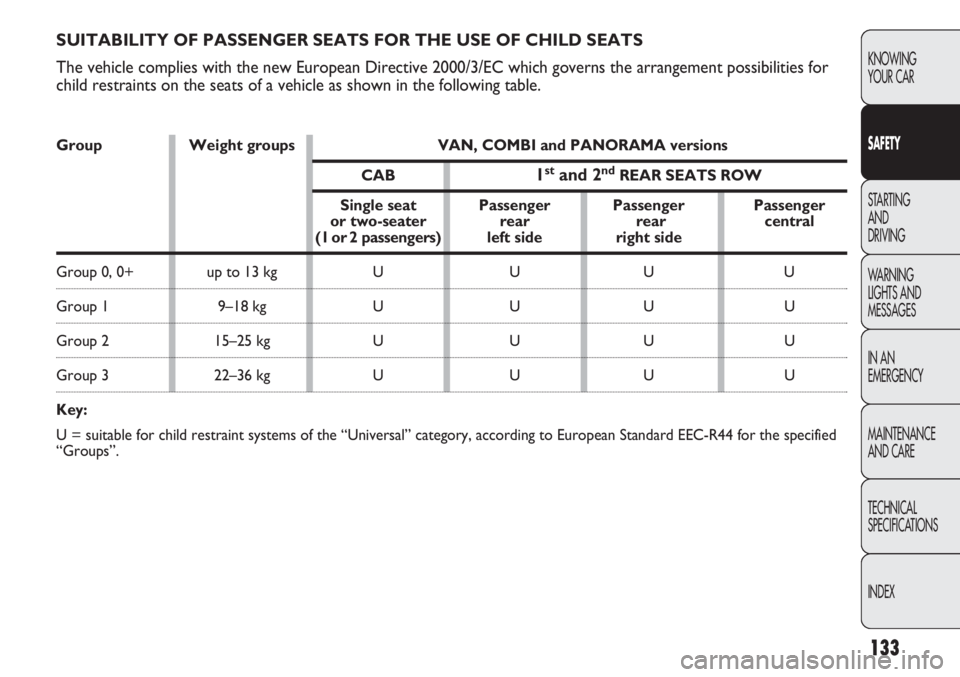
SUITABILITY OF PASSENGER SEATS FOR THE USE OF CHILD SEATS
The vehicle complies with the new European Directive 2000/3/EC which governs the arrangement possibilities for
child restraints on the seats of a vehicle as shown in the following table.
Group Weight groups VAN, COMBI and PANORAMA versions
CAB1stand 2ndREAR SEATS ROW
Single seat Passenger Passenger Passenger
or two-seater rear rear central
(1 or 2 passengers) left side right side
Group 0, 0+ up to 13 kg U U U U
Group 1 9–18 kg U U U U
Group 2 15–25 kg U U U U
Group 3 22–36 kg U U U U
Key:
U = suitable for child restraint systems of the “Universal” category, according to European Standard EEC-R44 for the specified
“Groups”.
Page 169 of 287
165
KNOWING
YOUR CAR
SAFETY
STARTING
AND
DRIVING
WARNING
LIGHTS AND
MESSAGES
IN AN
EMERGENCY
MAINTENANCE
AND CARE
TECHNICAL
SPECIFICATIONS
INDEX
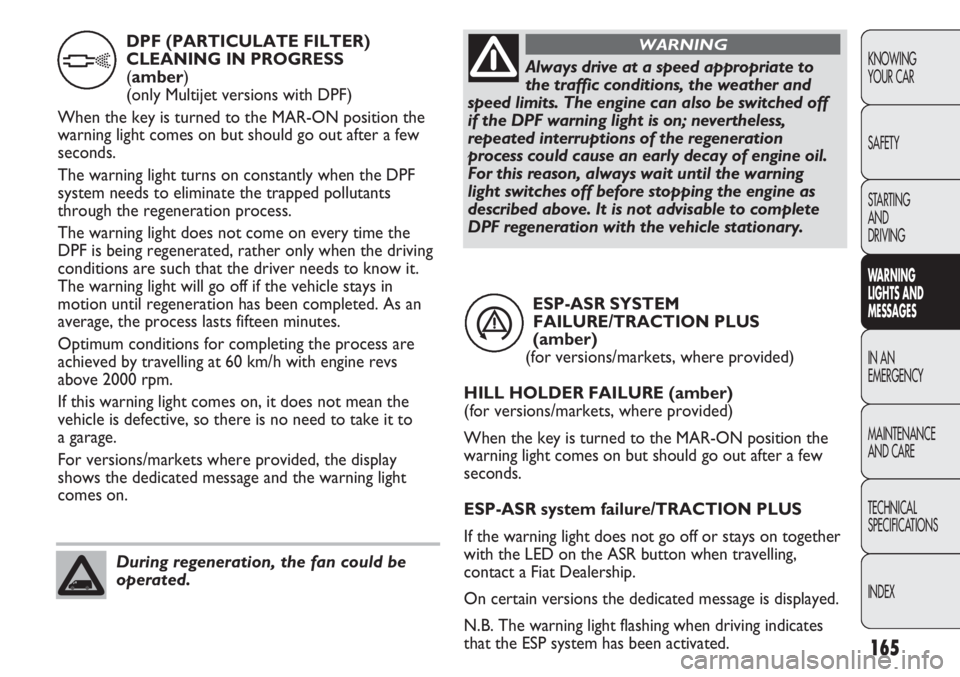
ESP-ASR SYSTEM
FAILURE/TRACTION PLUS
(amber)
(for versions/markets, where provided)
HILL HOLDER FAILURE (amber)
(for versions/markets, where provided)
When the key is turned to the MAR-ON position the
warning light comes on but should go out after a few
seconds.
ESP-ASR system failure/TRACTION PLUS
If the warning light does not go off or stays on together
with the LED on the ASR button when travelling,
contact a Fiat Dealership.
On certain versions the dedicated message is displayed.
N.B. The warning light flashing when driving indicates
that the ESP system has been activated.
á
DPF (PARTICULATE FILTER)
CLEANING IN PROGRESS
(amber)
(only Multijet versions with DPF)
When the key is turned to the MAR-ON position the
warning light comes on but should go out after a few
seconds.
The warning light turns on constantly when the DPF
system needs to eliminate the trapped pollutants
through the regeneration process.
The warning light does not come on every time the
DPF is being regenerated, rather only when the driving
conditions are such that the driver needs to know it.
The warning light will go off if the vehicle stays in
motion until regeneration has been completed. As an
average, the process lasts fifteen minutes.
Optimum conditions for completing the process are
achieved by travelling at 60 km/h with engine revs
above 2000 rpm.
If this warning light comes on, it does not mean the
vehicle is defective, so there is no need to take it to
a garage.
For versions/markets where provided, the display
shows the dedicated message and the warning light
comes on.
hAlways drive at a speed appropriate to
the traffic conditions, the weather and
speed limits. The engine can also be switched off
if the DPF warning light is on; nevertheless,
repeated interruptions of the regeneration
process could cause an early decay of engine oil.
For this reason, always wait until the warning
light switches off before stopping the engine as
described above. It is not advisable to complete
DPF regeneration with the vehicle stationary.
WARNING
During regeneration, the fan could be
operated.
Page 197 of 287
193
KNOWING
YOUR CAR
SAFETY
STARTING
AND
DRIVING
WARNING
LIGHTS AND
MESSAGES
IN AN
EMERGENCY
MAINTENANCE
AND CARE
TECHNICAL
SPECIFICATIONS
INDEX
F0N0244mfig. 199
CHANGING AN INTERIOR LIGHT
For the type of bulb and relevant power rating, see
“Changing a bulb”.
FRONT CEILING LIGHT
Proceed as follows to replace the bulbs:
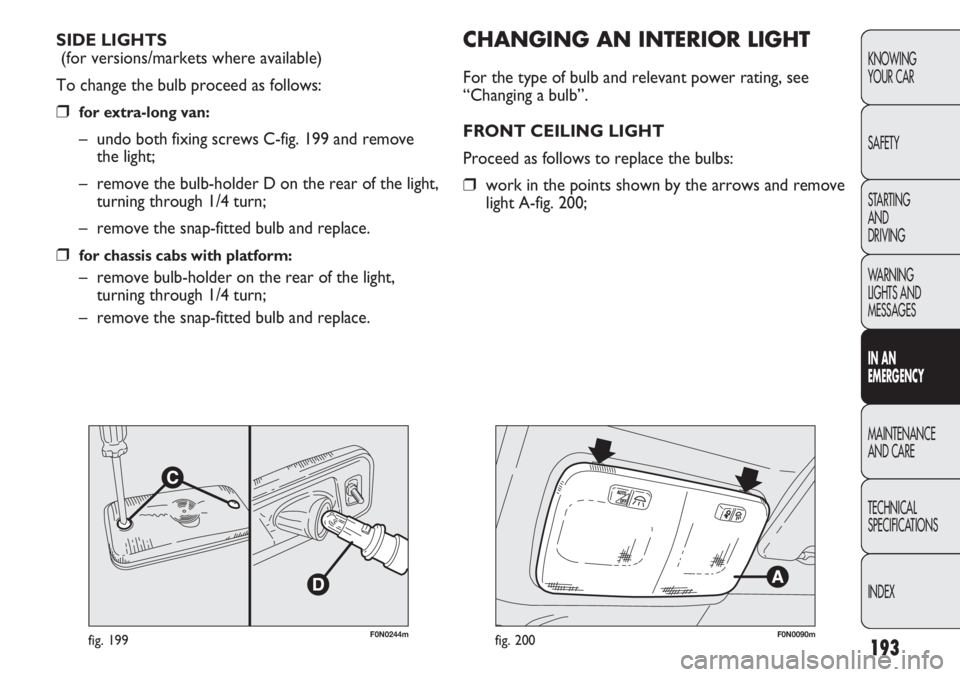
❒work in the points shown by the arrows and remove
light A-fig. 200; SIDE LIGHTS
(for versions/markets where available)
To change the bulb proceed as follows:
❒for extra-long van:
– undo both fixing screws C-fig. 199 and remove
the light;
– remove the bulb-holder D on the rear of the light,
turning through 1/4 turn;
– remove the snap-fitted bulb and replace.
❒for chassis cabs with platform:
– remove bulb-holder on the rear of the light,
turning through 1/4 turn;
– remove the snap-fitted bulb and replace.
F0N0090mfig. 200
Page 198 of 287
194
KNOWING
YOUR CAR
SAFETY
STARTING
AND
DRIVING
WARNING
LIGHTS AND
MESSAGES
IN AN
EMERGENCY
MAINTENANCE
AND CARE
TECHNICAL
SPECIFICATIONS
INDEX
F0N0091mfig. 201
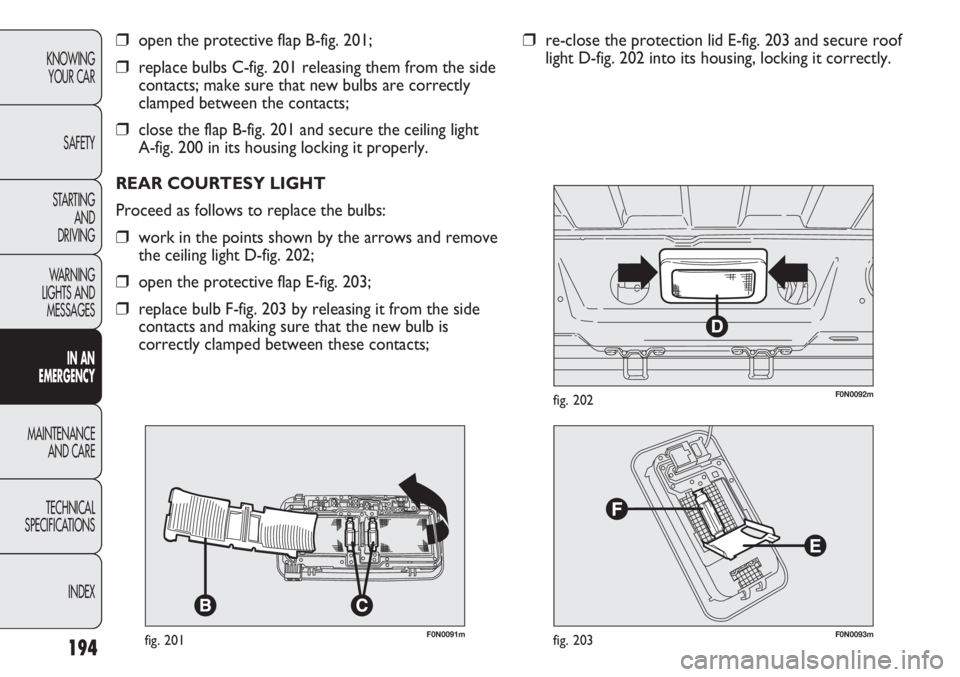
❒open the protective flap B-fig. 201;
❒replace bulbs C-fig. 201 releasing them from the side
contacts; make sure that new bulbs are correctly
clamped between the contacts;
❒close the flap B-fig. 201 and secure the ceiling light
A-fig. 200 in its housing locking it properly.
REAR COURTESY LIGHT
Proceed as follows to replace the bulbs:
❒work in the points shown by the arrows and remove
the ceiling light D-fig. 202;
❒open the protective flap E-fig. 203;
❒replace bulb F-fig. 203 by releasing it from the side
contacts and making sure that the new bulb is
correctly clamped between these contacts;
F0N0093mfig. 203
F0N0092mfig. 202
❒re-close the protection lid E-fig. 203 and secure roof
light D-fig. 202 into its housing, locking it correctly.
Page 204 of 287
200
KNOWING
YOUR CAR
SAFETY
STARTING
AND
DRIVING
WARNING
LIGHTS AND
MESSAGES
IN AN
EMERGENCY
MAINTENANCE
AND CARE
TECHNICAL
SPECIFICATIONS
INDEX
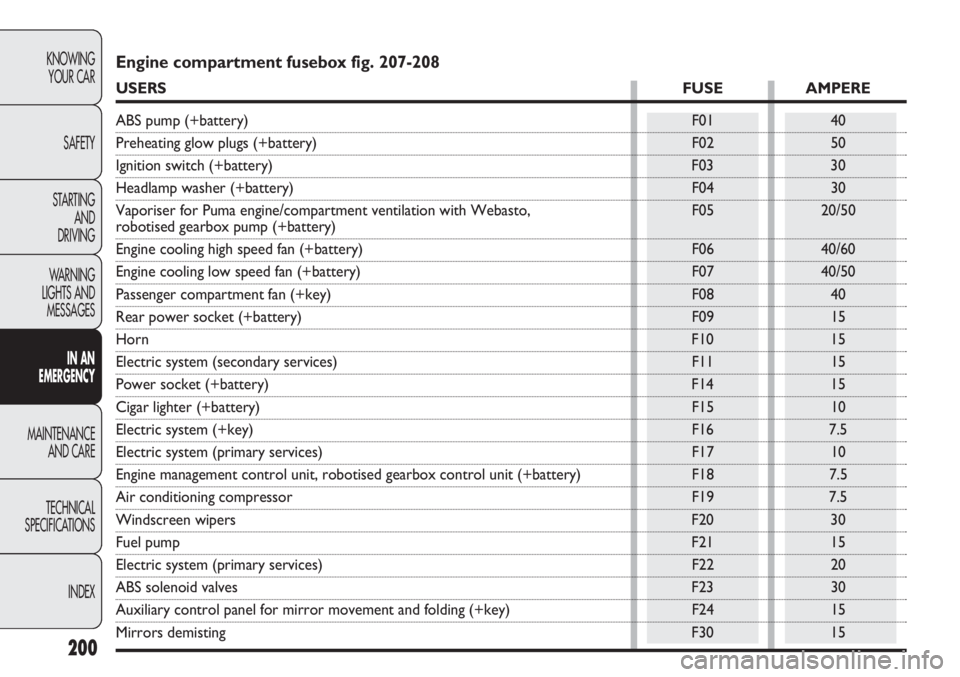
Engine compartment fusebox fig. 207-208
USERSFUSE AMPERE
ABS pump (+battery) F01 40
Preheating glow plugs (+battery) F02 50
Ignition switch (+battery) F03 30
Headlamp washer (+battery) F04 30
Vaporiser for Puma engine/compartment ventilation with Webasto, F05 20/50
robotised gearbox pump (+battery)
Engine cooling high speed fan (+battery) F06 40/60
Engine cooling low speed fan (+battery) F07 40/50
Passenger compartment fan (+key) F08 40
Rear power socket (+battery) F09 15
HornF10 15
Electric system (secondary services) F11 15
Power socket (+battery) F14 15
Cigar lighter (+battery) F15 10
Electric system (+key) F16 7.5
Electric system (primary services) F17 10
Engine management control unit, robotised gearbox control unit (+battery) F18 7.5
Air conditioning compressor F19 7.5
Windscreen wipers F20 30
Fuel pumpF21 15
Electric system (primary services) F22 20
ABS solenoid valves F23 30
Auxiliary control panel for mirror movement and folding (+key) F24 15
Mirrors demisting F30 15
Page 238 of 287
234
KNOWING
YOUR CAR
SAFETY
STARTING
AND
DRIVING
WARNING
LIGHTS AND
MESSAGES
IN AN
EMERGENCY
MAINTENANCE
AND CARE
TECHNICAL
SPECIFICATIONS
INDEX
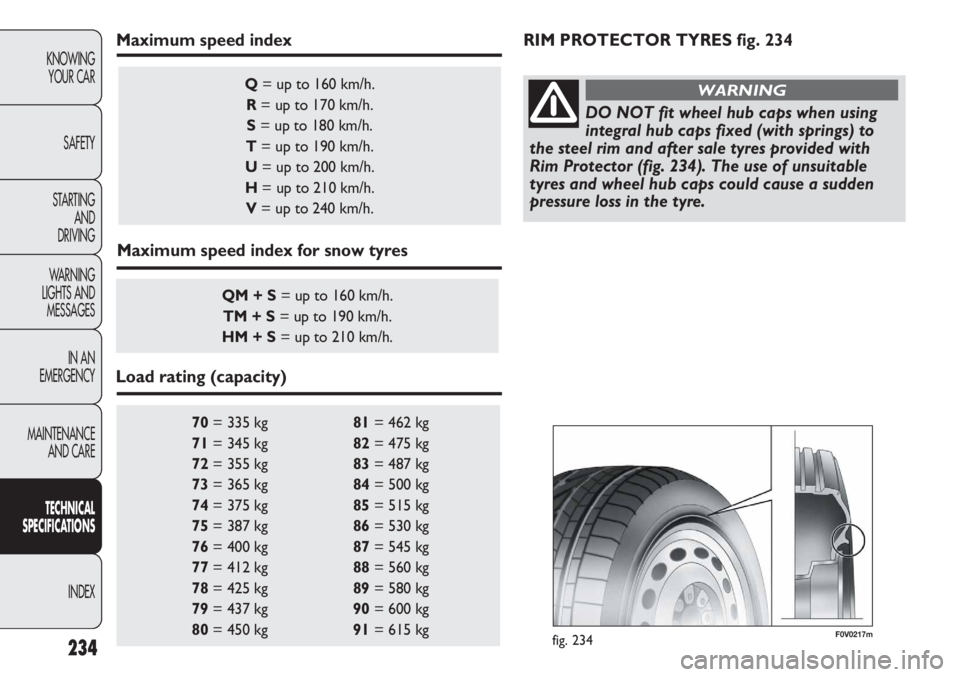
70= 335 kg 81= 462 kg
71= 345 kg 82= 475 kg
72= 355 kg 83= 487 kg
73= 365 kg 84= 500 kg
74= 375 kg 85= 515 kg
75= 387 kg 86= 530 kg
76= 400 kg 87= 545 kg
77= 412 kg 88= 560 kg
78= 425 kg 89= 580 kg
79= 437 kg 90= 600 kg
80= 450 kg 91= 615 kg
Q= up to 160 km/h.
R= up to 170 km/h.
S= up to 180 km/h.
T= up to 190 km/h.
U= up to 200 km/h.
H= up to 210 km/h.
V= up to 240 km/h.
QM + S= up to 160 km/h.
TM + S= up to 190 km/h.
HM + S= up to 210 km/h.
Maximum speed index
Maximum speed index for snow tyres
Load rating (capacity)RIM PROTECTOR TYRES fig. 234
DO NOT fit wheel hub caps when using
integral hub caps fixed (with springs) to
the steel rim and after sale tyres provided with
Rim Protector (fig. 234). The use of unsuitable
tyres and wheel hub caps could cause a sudden
pressure loss in the tyre.
WARNING
F0V0217mfig. 234
Page 246 of 287
242
KNOWING
YOUR CAR
SAFETY
STARTING
AND
DRIVING
WARNING
LIGHTS AND
MESSAGES
IN AN
EMERGENCY
MAINTENANCE
AND CARE
TECHNICAL
SPECIFICATIONS
INDEX
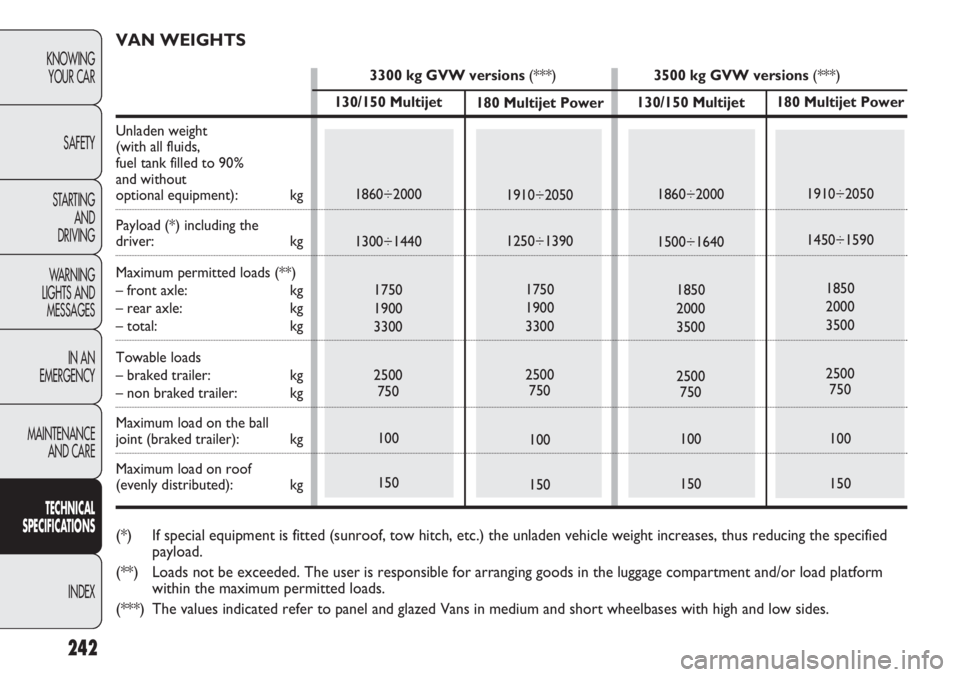
130/150 Multijet
1860÷2000
1300÷1440
1750
1900
3300
2500
750
100
150180 Multijet Power
1910÷2050
1250÷1390
1750
1900
3300
2500
750
100
150130/150 Multijet
1860÷2000
1500÷1640
1850
2000
3500
2500
750
100
150180 Multijet Power
1910÷2050
1450÷1590
1850
2000
3500
2500
750
100
150
VAN WEIGHTS
3300 kg GVW versions (***)3500 kg GVW versions (***)
Unladen weight
(with all fluids,
fuel tank filled to 90%
and without
optional equipment): kg
Payload (*) including the
driver: kg
Maximum permitted loads (**)
– front axle: kg
– rear axle: kg
– total: kg
Towable loads
– braked trailer: kg
– non braked trailer: kg
Maximum load on the ball
joint (braked trailer): kg
Maximum load on roof
(evenly distributed): kg
(*) If special equipment is fitted (sunroof, tow hitch, etc.) the unladen vehicle weight increases, thus reducing the specified
payload.
(**) Loads not be exceeded. The user is responsible for arranging goods in the luggage compartment and/or load platform
within the maximum permitted loads.
(***) The values indicated refer to panel and glazed Vans in medium and short wheelbases with high and low sides.