Fuel FIAT DUCATO 244 2005 3.G User Guide
[x] Cancel search | Manufacturer: FIAT, Model Year: 2005, Model line: DUCATO 244, Model: FIAT DUCATO 244 2005 3.GPages: 258, PDF Size: 4.05 MB
Page 74 of 258
73GETTING TO KNOW YOUR VEHICLE
Inspect the vehicle carefully to make
sure there is no fuel leak in the en-
gine compartment, under the vehicle
or near the fuel tank.
If you cannot see any fuel leaks and
the vehicle is in a fit state to continue
its journey, press button A-fig. 105
to reactivate the fuel supply system, as
illustrated.
Remember to turn the ignition key
to STOPto prevent running the bat-
tery down.INTERIOR
EQUIPMENT
GLOVE COMPARTMENT/
ODDMENT TRAY
The right-hand side of the dashboard
is fitted with oddment trays of differ-
ent sizefig. 108designed to contain
documents, papers or small objects.
According to versions, the glove
compartment lid can be fitted with a
lock openable with the vehicle key.
fig. 108
F0D0062m
fig. 106
F0D0652m
fig. 107
F0D0653m
BATTERY CUT OUT
Vehicle is equipped with a battery cut
out, fitted into the control unit (CBA)
located over the battery positive pole,
operating in concurrence with inertial
switch intervention and providing to
cut out starter motor power supply.
If the vehicle can restart after the ac-
cident, the battery cut out button, yel-
low colour, must be on to allow start-
ing.
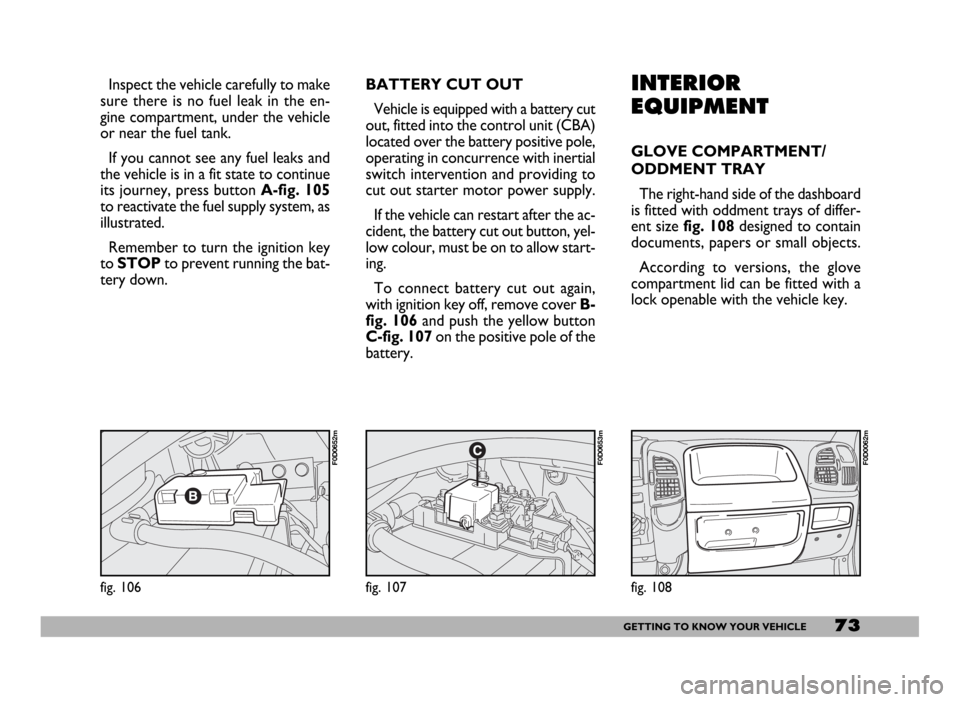
To connect battery cut out again,
with ignition key off, remove cover B-
fig. 106 and push the yellow button
C-fig. 107 on the positive pole of the
battery.
Page 103 of 258
102GETTING TO KNOW YOUR VEHICLE
DIESEL ENGINES
The vehicle must only
be filled with diesel fuel
for motor vehicles, in
compliance with European Spec-
ification EN590. The use of other
products or mixtures may ir-
reparably damage the engine
with invalidation of the warran-
ty due to the damage caused. In
the event of accidentally filling
with another type of fuel, do not
start the engine and empty the
tank. If the engine has been run
even for only a very short time,
in addition to the tank, it is also
necessary to drain out the whole
fuel circuit.AT THE FILLING
STATION
PETROL ENGINES
Use unleaded petrol only.
However, to avoid mistakes, the fu-
el filler is too small for the leaded
petrol pump.
Octane rating (R.O.N.) must not be
lower than 95.
fig. 151
F0D0193m
Never put even the tini-
est amount of leaded
petrol in the fuel tank of
your Ducato even in an emer-
gency. You would damage the
catalytic converter beyond re-
pair.
An inefficient catalytic
converter will allow
harmful exhaust fumes to
be emitted and thus contribute
to air pollution.
Page 104 of 258
103GETTING TO KNOW YOUR VEHICLE
FUEL FILLER CAP
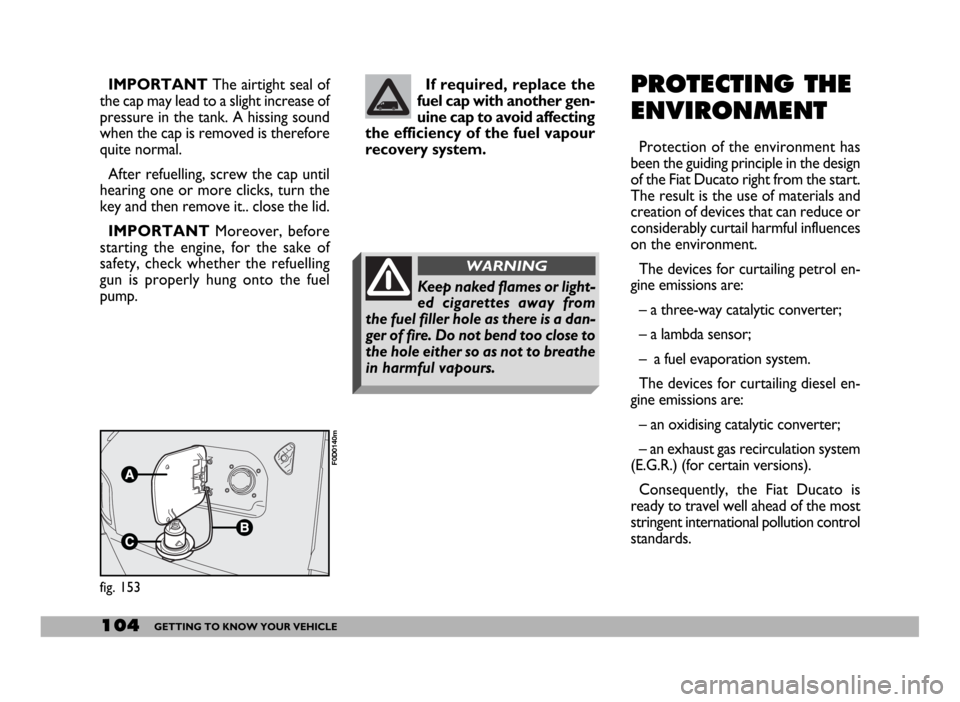
The fuel filler cap C-fig. 153is fitted
with a key lock and a device Bsecur-
ing it to the lid Aso that it cannot be
lost.
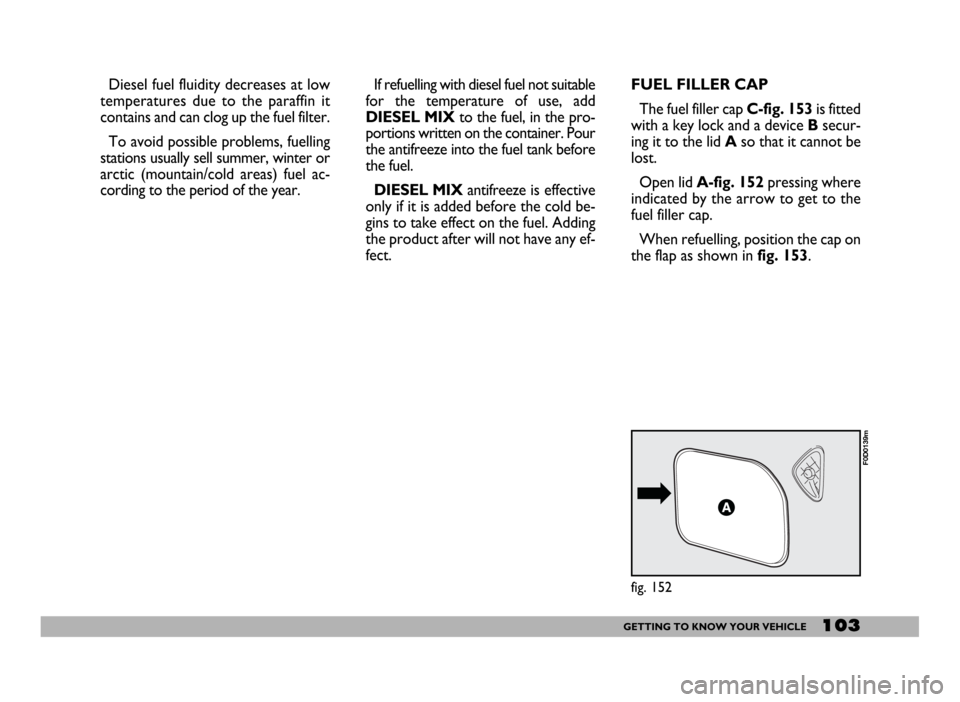
Open lid A-fig. 152pressing where
indicated by the arrow to get to the
fuel filler cap.
When refuelling, position the cap on
the flap as shown in fig. 153.
fig. 152
F0D0139m
Diesel fuel fluidity decreases at low
temperatures due to the paraffin it
contains and can clog up the fuel filter.
To avoid possible problems, fuelling
stations usually sell summer, winter or
arctic (mountain/cold areas) fuel ac-
cording to the period of the year. If refuelling with diesel fuel not suitable
for the temperature of use, add
DIESEL MIXto the fuel, in the pro-
portions written on the container. Pour
the antifreeze into the fuel tank before
the fuel.
DIESEL MIXantifreeze is effective
only if it is added before the cold be-
gins to take effect on the fuel. Adding
the product after will not have any ef-
fect.
Page 105 of 258
104GETTING TO KNOW YOUR VEHICLE
IMPORTANTThe airtight seal of
the cap may lead to a slight increase of
pressure in the tank. A hissing sound
when the cap is removed is therefore
quite normal.
After refuelling, screw the cap until
hearing one or more clicks, turn the
key and then remove it.. close the lid.
IMPORTANTMoreover, before
starting the engine, for the sake of
safety, check whether the refuelling
gun is properly hung onto the fuel
pump.If required, replace the
fuel cap with another gen-
uine cap to avoid affecting
the efficiency of the fuel vapour
recovery system.
fig. 153
F0D0140m
PROTECTING THE
ENVIRONMENT
Protection of the environment has
been the guiding principle in the design
of the Fiat Ducato right from the start.
The result is the use of materials and
creation of devices that can reduce or
considerably curtail harmful influences
on the environment.
The devices for curtailing petrol en-
gine emissions are:
– a three-way catalytic converter;
– a lambda sensor;
– a fuel evaporation system.
The devices for curtailing diesel en-
gine emissions are:
– an oxidising catalytic converter;
– an exhaust gas recirculation system
(E.G.R.) (for certain versions).
Consequently, the Fiat Ducato is
ready to travel well ahead of the most
stringent international pollution control
standards.
Keep naked flames or light-
ed cigarettes away from
the fuel filler hole as there is a dan-
ger of fire. Do not bend too close to
the hole either so as not to breathe
in harmful vapours.
WARNING
Page 108 of 258
107GETTING THE BEST OUT OF YOUR VEHICLE
If you still cannot start the engine,
get in touch with a Fiat Dealership.
IMPORTANT When the outside
temperature is low, it is important to
note that the use of a more fluid oil
will facilitate starting the cold engine.
Therefore, in winter, follow the advice
in chapter “Technical specifications”,
paragraph “Fluids and lubricants”.
IMPORTANTNever leave the igni-
tion key at MARwhen the engine is off.
Minibus and School Bus versions:
press the ignition enable button lo-
cated to the left of the steering col-
umn as shown in the specific supple-
ment to this handbook.HOW TO WARM UP
THE ENGINE AFTER IT
HAS JUST STARTED
(petrol and diesel versions)
– Begin to move forward slowly let-
ting the engine turn at medium revs.
Do not accelerate abruptly.
– Do not push the engine to its lim-
it for the first few kilometres. You are
recommended to wait until the
coolant temperature indicator starts
to move.
EMERGENCY START-UP
If the Fiat CODE system fails to
recognise that code transmitted by the
ignition key (warning light Yon the
instrument panel lit) the emergency
start-up can be performed by using the
CODE card code.
See the “In an emergency” section.Catalysed vehicles must
not be bump started
(pushed, towed or coast-
ed downhill) as this could cause
fuel to flow into the catalytic ex-
haust system and damage it be-
yond repair.
Remember that until the
engine has started the
brake booster and power steering
systems will not work and a greater
effort will therefore be required to
depress the brake pedal or turn the
steering wheel.
WARNING
Page 109 of 258
108GETTING THE BEST OUT OF YOUR VEHICLE
SWITCHING OFF
THE ENGINE
Turn the ignition key to STOPwhile
the engine is idling.
IMPORTANTAfter a taxing drive
you should allow the engine to “catch
its breath” before turning it off by let-
ting it idle to allow temperature in the
engine compartment to fall.PARKING
Switch off the engine, pull up the
handbrake and engage a gear (1st gear
or reverse, according to whether the
vehicle is facing up or downhill) and
leave the wheels turned. If the vehi-
cle is left on a steep slope, wedges or
a rock should be used to lock the
wheels.
Do not leave the ignition key at
MAR to prevent running the battery
down. Always remove the key when
you leave the vehicle.HANDBRAKE
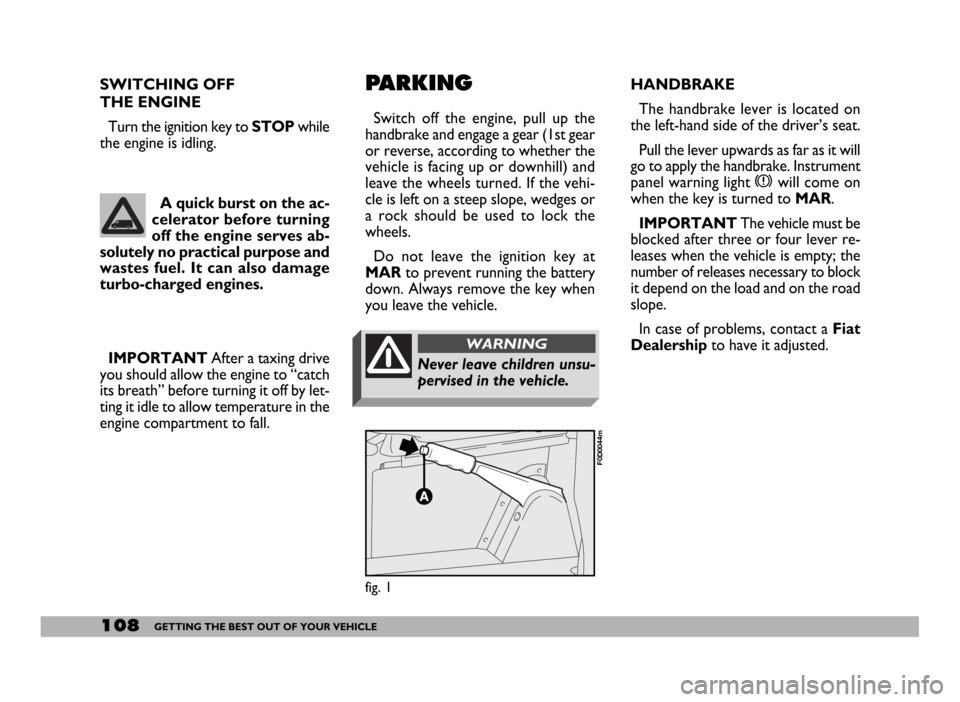
The handbrake lever is located on
the left-hand side of the driver’s seat.
Pull the lever upwards as far as it will
go to apply the handbrake. Instrument
panel warning light xwill come on
when the key is turned to MAR.
IMPORTANTThe vehicle must be
blocked after three or four lever re-
leases when the vehicle is empty; the
number of releases necessary to block
it depend on the load and on the road
slope.
In case of problems, contact a Fiat
Dealershipto have it adjusted. A quick burst on the ac-
celerator before turning
off the engine serves ab-
solutely no practical purpose and
wastes fuel. It can also damage
turbo-charged engines.
fig. 1
F0D0044m
Never leave children unsu-
pervised in the vehicle.
WARNING
Page 125 of 258
124GETTING THE BEST OUT OF YOUR VEHICLE
To get the most out of ABS:
– During emergency stops or when
grip conditions are poor, you will feel
a slight pulsation on the brake pedal.
This is the sign that the ABS is work-
ing. Do not release the brake pedal but
continue to press so as not to inter-
rupt the braking action;
– ABS enables you to brake and steer
at the same time. If you meet an un-
expected obstacle you can therefore
steer around it;
– the ABS prevents the wheels from
locking but it does not increase actu-
al grip conditions between tyre and
road. Therefore, even if your vehicle
is fitted with ABS, keep a safe distance
from the vehicle in front of you and
keep your speed down when driving
into bends.
ABS serves to increase your control
over the vehicle, not to enable you to
go faster.Some suggestions which may help
you to keep the running costs of the
vehicle down and lower the amount
of toxic emissions released into the at-
mosphere are given below.
GENERAL
CONSIDERATIONS
Vehicle maintenance
Carry out the checks and adjust-
ments/regulations specified in the
“Service Schedule”.
Tyres
Check tyre inflation pressure regu-
larly. Tyres should be checked at least
once every four weeks: if the pressure
is too low, fuel consumption increas-
es as the resistance to the rolling
movement of the tyre is greater.Unnecessary loads
Do not travel with too much load.
The weight of the vehicle (specially in
urban traffic) and its trim greatly ef-
fects consumption and stability.
Roof rack/ski rack
Remove the roof or ski racks from
the vehicle as soon as they are no
longer needed. These accessories re-
duce the aerodynamic penetration of
the vehicle and will increase con-
sumption. When transporting partic-
ularly large objects, use a trailer,
where possible.CONTAINING RUNNING COSTS
Page 126 of 258
125GETTING THE BEST OUT OF YOUR VEHICLE
Electric devices
Use electric devices for the neces-
sary time only. The heated rear win-
dow, fog lights, windscreen wipers,
heater fan require large amounts of
electricity and increasing the request
for power will also increase fuel con-
sumption (up to +25% when driving in
towns).
Climate control system
The climate control system is an ad-
ditional load which greatly affects the
engine leading to higher consumption.
When the temperature outside the
vehicle allows it, use the air vents
where possible.
DRIVING STYLE
Starting
Do not warm the engine when the
vehicle is stationary or at high or low
speed: in this way the engine will warm
up gradually increasing consumption
and emissions. You should drive off
slowly straight away avoiding high revs
so that the engine will warm up more
quickly.Unnecessary actions
Avoid revving the engine when
stopped at traffic lights or before
switching off the engine and avoid dou-
bling the clutch as these actions have
no purpose on modern vehicles and
serve only to increase consumption
and pollution.
Gear selections
As soon as the traffic and road con-
ditions allow it, shift to a higher gear.
Using a low gear to liven up accelera-
tion greatly increases consumption. In
the same way improper use of high
gears will increase consumption, emis-
sions and engine wear.
On passenger transportation versions
fitted with 2.3, 2.8 JTD and 2.8 JTD
POWER engines, fuel consumption can
be optimised by starting (on level road)
in 2nd gear instead of 1st gear.Top speeds
Fuel consumption increases consid-
erably as speed increases. Your speed
should be kept as even as possible and
superfluous braking and acceleration
avoided as this increases both con-
sumption and emissions.
Acceleration
Accelerating violently increasing the
revs will greatly affect consumption
and emissions; acceleration should be
gradual and should not exceed the
maximum torque.
Page 128 of 258
127GETTING THE BEST OUT OF YOUR VEHICLE
In addition to these general precau-
tions, some simple measures could en-
hance driving safety, comfort and the
length of the vehicle’s life:
– distribute the load evenly over the
load floor: if you need to concentrate
it all in one point choose the part be-
tween the axles;
– remember that the lower the load
is, the lower the vehicle’s centre of
gravity will be, contributing to a safe
drive; you should therefore always po-
sition the heavier goods at the bottom;
– finally, remember that the way in
which the vehicle moves is influenced
by the weight being carried. In partic-
ular, stopping distance lengthens par-
ticularly at high speed.CHEAP RUNNING
THAT RESPECTS
THE ENVIRONMENT
Environmental protection has been
one of the guiding principles in the
production of the Ducato. It is no ac-
cident that its pollution control equip-
ment is much more effective than that
required by current legislation.
Nonetheless, the environment can-
not get by without a concerted effort
from everyone. By following a few sim-
ple rules you can avoid harming the
environment and often cut down fuel
consumption at the same time.
On this subject, a few useful tips have
been given below to supplement those
marked by symbol #at various points
of the handbook. You are asked to
read both the former and latter care-
fully.
Even if the vehicle is sta-
tionary on a steep hill or
sideways incline, goods not proper-
ly secured could fall out when the
back or side doors are opened.
WARNING
Observe the enforced rules
if you need to carry a spare
can of petrol. Only use a homolo-
gated can and secure it to the load
anchoring eyebolts. Even given
these precautions, the risk of fire in
the event of an accident is in-
creased.
WARNING
Page 129 of 258
128GETTING THE BEST OUT OF YOUR VEHICLE
LOOKING AFTER EMISSION
CONTROL DEVICES
The correct use of pollution control
devices not only ensures respect for
the environment but also has an effect
on the vehicle’s performance.
Keeping these devices in good con-
ditions is therefore a fundamental rule
for driving that is easy on your pock-
et and on the environment too.
The first step to take is to follow the
Service Schedule to the letter.
If your vehicle has a petrol engine
with catalytic converter use only un-
leaded petrol.
if you have trouble starting, do not
keep turning the ignition key for long
periods. Be especially careful to avoid
bump starting the vehicle by pushing,
towing or rolling downhill: these are
all manoeuvres that can damage the
catalyst.
Use an auxiliary battery for start-ups
only.If the engine begins to “loose its
smoothness” when travelling, contin-
ue your journey but reduce the de-
mands you are making on the engine
and have the vehicle seen to at a Fi-
at Dealershipas soon as you can.
When the instrument panel fuel re-
serve warning light comes on, fill up as
soon as possible. A low fuel level may
cause an uneven supply of fuel to the
engine with inevitable increase in the
temperature of the exhaust gas and se-
rious damage to the catalytic con-
verter.
Never run the engine with one or
more spark plugs disconnected, even
for testing purposes.
Do not warm up the engine by let-
ting it idle for a while before moving
off unless the outside temperature is
very low and, even in this case, only
do so for less than thirty seconds.
Do not install heat shields and do not
remove those already fitted to the cat-
alytic converter and exhaust pipe.
Do not allow anything to
be sprayed onto the cat-
alytic converter, lambda sensor and
exhaust pipe.
WARNING
Ignoring the above rules
may lead to fire.
WARNING
When functioning normal-
ly the catalytic converter
reaches high temperatures. For this
reason do not park the vehicle over
inflammable material (grass, dry
leaves, pine needles, etc.): fire haz-
ard.
WARNING