control unit FIAT DUCATO 244 2005 3.G Owners Manual
[x] Cancel search | Manufacturer: FIAT, Model Year: 2005, Model line: DUCATO 244, Model: FIAT DUCATO 244 2005 3.GPages: 258, PDF Size: 4.05 MB
Page 8 of 258
7GETTING TO KNOW YOUR VEHICLE
SYMBOLS
Special coloured labels have been at-
tached near or actually on some of
the components of your Ducato.
These labels bear symbols that remind
you of the precautions to be taken as
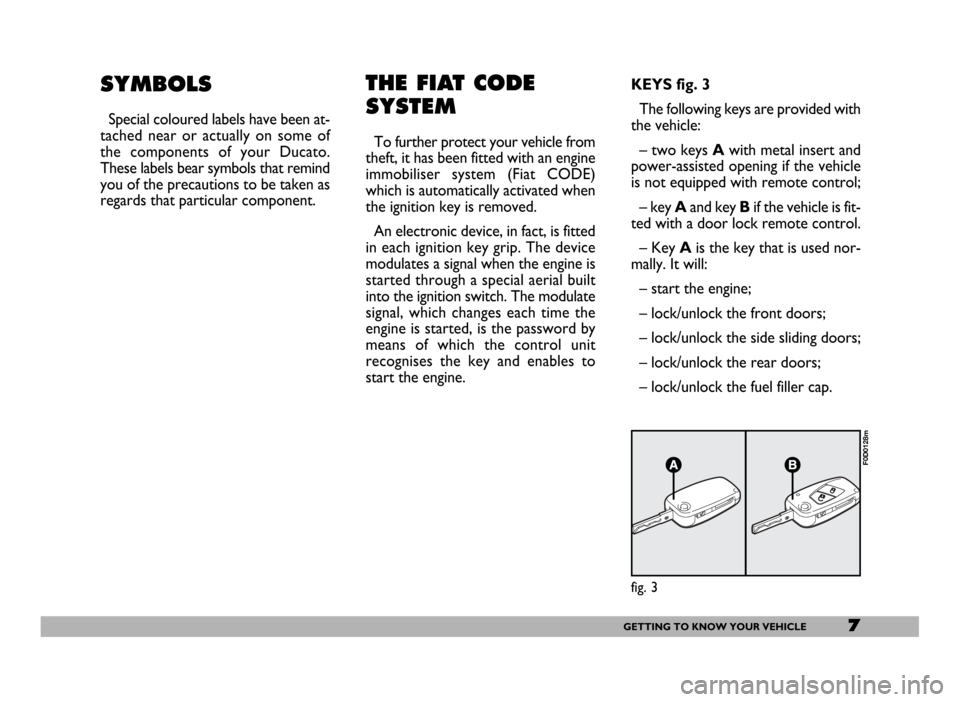
regards that particular component.KEYS fig. 3
The following keys are provided with
the vehicle:
– two keys Awith metal insert and
power-assisted opening if the vehicle
is not equipped with remote control;
– key Aand key Bif the vehicle is fit-
ted with a door lock remote control.
– Key Ais the key that is used nor-
mally. It will:
– start the engine;
– lock/unlock the front doors;
– lock/unlock the side sliding doors;
– lock/unlock the rear doors;
– lock/unlock the fuel filler cap.
fig. 3
F0D0128m
THE FIAT CODE
SYSTEM
To further protect your vehicle from
theft, it has been fitted with an engine
immobiliser system (Fiat CODE)
which is automatically activated when
the ignition key is removed.
An electronic device, in fact, is fitted
in each ignition key grip. The device
modulates a signal when the engine is
started through a special aerial built
into the ignition switch. The modulate
signal, which changes each time the
engine is started, is the password by
means of which the control unit
recognises the key and enables to
start the engine.
Page 10 of 258
9GETTING TO KNOW YOUR VEHICLE
DUPLICATE KEYS
When additional keys are required,
go to your Fiat Dealership, taking all
the keys in your possession and the
CODE card with you. The Fiat Deal-
ershipwill store the old and new keys
(up to eight) in the system. The Fiat
Dealershipmay ask you to demon-
strate that you own the vehicle.
The codes of any keys that are not
available when the new storage pro-
cedure is carried out will be deleted
from the memory to prevent any lost
or stolen keys being used to start the
engine.
All the keys and the CODE card
must be handed over to the new own-
er when selling the vehicle.DOOR LOCK
REMOTE CONTROL
The radio-frequency remote control
is built into the ignition key.
The key fig. 6includes the following:
– a metal insert Athat can be en-
closed in the key grip
– a button Efor power-assisted
opening of the metal insert
– a button Cfor remote door un-
locking and electronic alarm deactiva-
tion (where provided) at the same
time, and timed switching on of the in-
ternal ceiling lights;
– a button Dfor remote door lock-
ing and electronic alarm activation
(where provided) at the same time,
and switching off of the internal ceiling
lights;
– led Bindicating control sending to
electronic alarm system receiver. If you are still unable to start the en-
gine, perform the emergency start-up
procedure (see “In an emergency”)
and call your Fiat Dealership.
When the vehicle is travelling and the
key is at MAR:
1)If the Ywarning light comes on
while the vehicle is moving, this means
that the system is running a self-test
(e.g. due to a voltage drop).
2)If the Ywarning light flashes, the
vehicle is not protected by the engine
immobiliser. Contact a Fiat Dealer-
shipimmediately and get them to
store the codes of all the keys in the
memory.
IMPORTANTThe electronic com-
ponents inside the key may be dam-
aged if the key is subjected to sharp
knocks.
IMPORTANTEach key provided
with the vehicle has its own code, dif-
ferent from all the others, which must
be stored in the memory of the sys-
tem control unit.
Page 13 of 258
12GETTING TO KNOW YOUR VEHICLE
OPERATION
The electronic alarm fitted on the Fi-
at Ducato is controlled by the receiv-
er located on the front ceiling light and
is switched on by means of the radio-
frequency remote control.
Volumetric protection sensors C-
fig. 8 are located in the ceiling light.
The alarm can only be switched on
when the ignition key is removed from
STOPor PARKposition.
The electronic alarm control unit in-
cludes also the alarm siren that can be
cut out.
To switch the electronic alarm
on: press button D-fig. 6 on the re-
mote control briefly. You will hear a
beep and the direction indicators will
flash for approximately three seconds
(only in countries where this is al-
lowed).
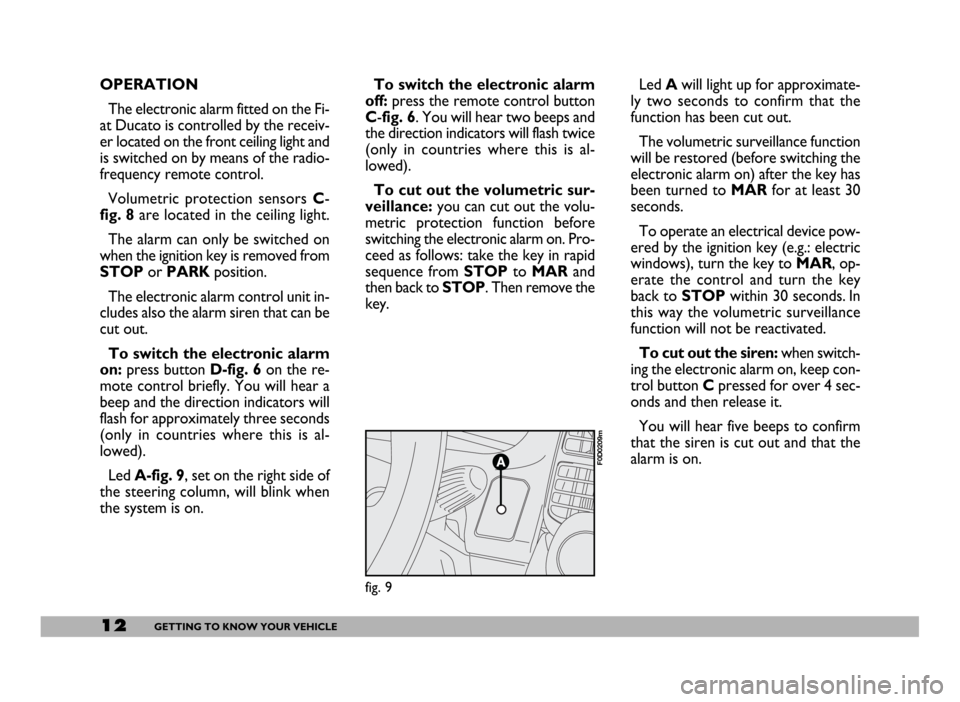
Led A-fig. 9, set on the right side of
the steering column, will blink when
the system is on.To switch the electronic alarm
off: press the remote control button
C-fig. 6. You will hear two beeps and
the direction indicators will flash twice
(only in countries where this is al-
lowed).
To cut out the volumetric sur-
veillance:you can cut out the volu-
metric protection function before
switching the electronic alarm on. Pro-
ceed as follows: take the key in rapid
sequence from STOP to MAR and
then back to STOP. Then remove the
key.Led Awill light up for approximate-
ly two seconds to confirm that the
function has been cut out.
The volumetric surveillance function
will be restored (before switching the
electronic alarm on) after the key has
been turned to MARfor at least 30
seconds.
To operate an electrical device pow-
ered by the ignition key (e.g.: electric
windows), turn the key to MAR, op-
erate the control and turn the key
back to STOP within 30 seconds. In
this way the volumetric surveillance
function will not be reactivated.
To cut out the siren:when switch-
ing the electronic alarm on, keep con-
trol button Cpressed for over 4 sec-
onds and then release it.
You will hear five beeps to confirm
that the siren is cut out and that the
alarm is on.
fig. 9
F0D0209m
Page 15 of 258
14GETTING TO KNOW YOUR VEHICLE
Do not leave the key inserted in the
switch. Cover the keyhole with the
rubber cap to prevent dust and wa-
ter getting in.
Emergency keys should be left in the
car coupled with the switch.
HOW TO KNOW IF THE
ALARM HAS GONE OFF
After deactivating the system, led A-
fig. 9will indicate the theft attempt
specifying also the cause of the alarm:
fixed light:remote control bat-
tery down
1 blink:right-hand door
2 blinks:left-hand door
5 blinks:volumetric sensors
(indicate a movement
inside the passenger’s
compartment)
6 blinks:bonnet To cut off the alarm before this,
press the remote control button; if
this is unsuccessful, turn the emer-
gency key to OFF(see next paragraph
“How to turn the alarm off”)
HOW TO TURN
THE ALARM OFF
If the remote control batteries run
down, or the car alarm system is
faulty, the electronic alarm can be cut
out by using one of the two emer-
gency keys supplied set on the system
deactivation control unit (that is
housed in the fuse box on the right
side of the dashboard).
To do this, open the fuse box, take
off the switch rubber cap, insert the
key and turn it counterclockwise
(OFFposition); the system is now de-
activated.
To turn the system back on, turn the
key clockwise (ONposition).7 blinks:load
compartment
8 blinks:tampering with
ignition switch
9 blinks:alarm wires cut
10 blinks:at least three causes
of alarm.
The led goes off when turning the
key to MAR or after about 2 minutes
blinking.
Since the electronic car
alarm absorbs electricity,
if you will not be using
your car for more than a month,
switch the system off with the re-
mote control and turn the emer-
gency key to OFF.
Page 23 of 258
22GETTING TO KNOW YOUR VEHICLE
HOW TO KEEP THE SEAT
BELTS IN PROPER WORKING
ORDER AT ALL TIMES
1)When wearing the seat belts, al-
ways ensure they are not twisted and
are free to wind in and out.
2)Following a serious accident, re-
place the belt being worn at that time,
even if it does not seem damaged. Al-
ways replace the seat belts if preten-
sioners have been activated.
3)When cleaning the belts, wash
them by hand with water and neutral
soap, rinse them and let them dry in
the shade. Do not use strong deter-
gents, bleach, colouring or any other
chemical substance that could weaken
the fibres.
4)Do not allow the reel mechanisms
to get wet: they are only guaranteed
to work properly if they remain dry.
5)Replace the seat belt when show-
ing significant wear or cut signs.TRANSPORTING
CHILDREN
IN SAFETY
For optimal protection in the event
of a crash, all passengers must be seat-
ed and wearing adequate restraint sys-
tems.
This is even more important for chil-
dren.
According to 2003/20/EC Directive,
this prescription is compulsory for all
European Community countries.
Compared with adults, their head is
proportionally larger and heavier than
the rest of the body, while the mus-
cles and bone structure are not com-
pletely developed. Therefore, correct
restraint systems are necessary, oth-
er then adult seat belts.The results of research on the best
child restraint systems are contained
in the European Standard ECE-R44.
This Standard enforces the use of re-
straint systems classified in five groups:
Group 0 - weight 0-10 kg
Group 0+ - weight 0-13 kg
Group 1 weight 9-18 kg
Group 2 weight 15-25 kg
Group 3 weight 22-36 kg
As it may be noted, the groups over-
lap partly and in fact, in commerce it
is possible to find devices that cover
more than one weight group fig. 21.
All restraint devices must bear the
certification data, together with the
control brand, on a solidly fixed label
which must absolutely never be re-
moved.
Page 39 of 258
38GETTING TO KNOW YOUR VEHICLE
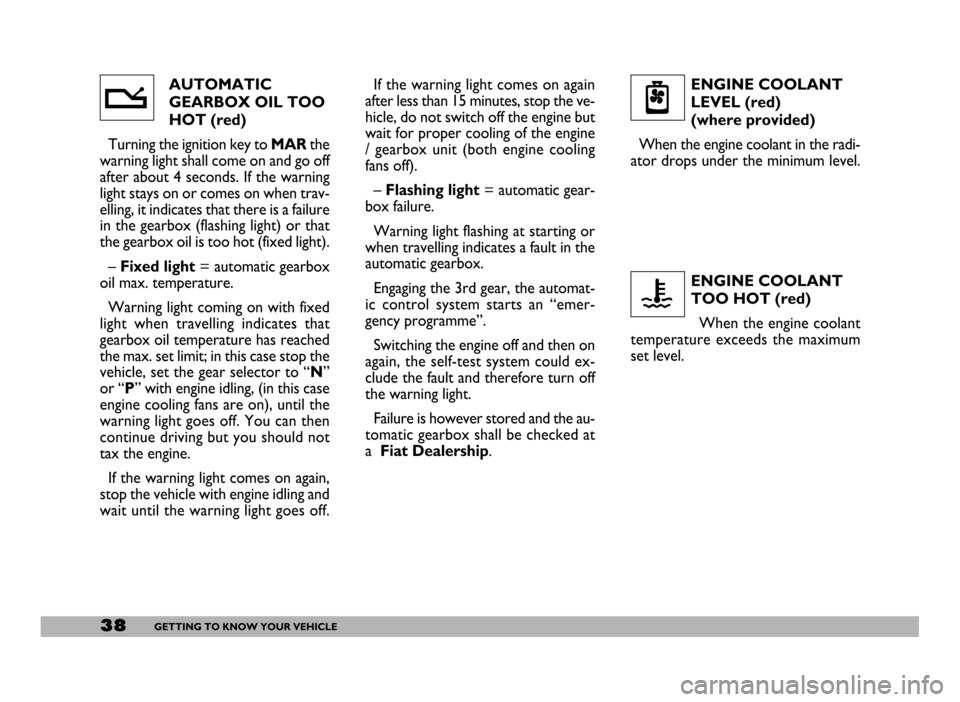
ENGINE COOLANT
LEVEL (red)
(where provided)
When the engine coolant in the radi-
ator drops under the minimum level.
n
AUTOMATIC
GEARBOX OIL TOO
HOT (red)
Turning the ignition key to MARthe
warning light shall come on and go off
after about 4 seconds. If the warning
light stays on or comes on when trav-
elling, it indicates that there is a failure
in the gearbox (flashing light) or that
the gearbox oil is too hot (fixed light).
– Fixed light= automatic gearbox
oil max. temperature.
Warning light coming on with fixed
light when travelling indicates that
gearbox oil temperature has reached
the max. set limit; in this case stop the
vehicle, set the gear selector to “N”
or “P” with engine idling, (in this case
engine cooling fans are on), until the
warning light goes off. You can then
continue driving but you should not
tax the engine.
If the warning light comes on again,
stop the vehicle with engine idling and
wait until the warning light goes off.If the warning light comes on again
after less than 15 minutes, stop the ve-
hicle, do not switch off the engine but
wait for proper cooling of the engine
/ gearbox unit (both engine cooling
fans off).
– Flashing light= automatic gear-
box failure.
Warning light flashing at starting or
when travelling indicates a fault in the
automatic gearbox.
Engaging the 3rd gear, the automat-
ic control system starts an “emer-
gency programme”.
Switching the engine off and then on
again, the self-test system could ex-
clude the fault and therefore turn off
the warning light.
Failure is however stored and the au-
tomatic gearbox shall be checked at
a Fiat Dealership.ENGINE COOLANT
TOO HOT (red)
When the engine coolant
temperature exceeds the maximum
set level.
u
t
Page 61 of 258
60GETTING TO KNOW YOUR VEHICLE
– a control unit connected to the
heater/ventilation unit for automatic
operation;
– an electronic control unit to check
and adjusted the integrated heater
burner;
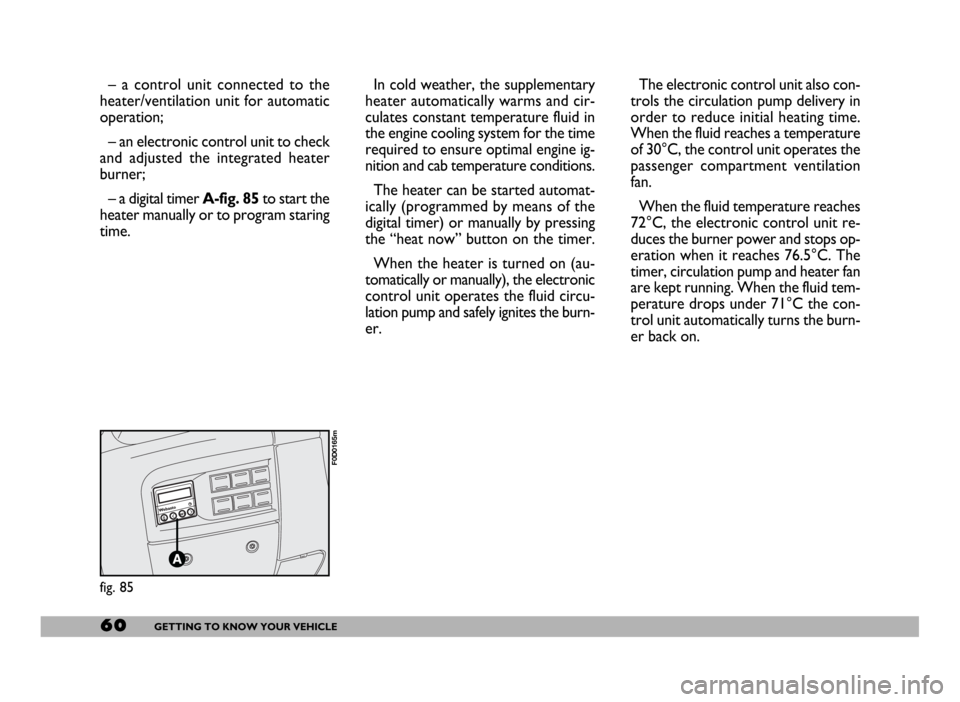
– a digital timer A-fig. 85to start the
heater manually or to program staring
time.In cold weather, the supplementary
heater automatically warms and cir-
culates constant temperature fluid in
the engine cooling system for the time
required to ensure optimal engine ig-
nition and cab temperature conditions.
The heater can be started automat-
ically (programmed by means of the
digital timer) or manually by pressing
the “heat now” button on the timer.
When the heater is turned on (au-
tomatically or manually), the electronic
control unit operates the fluid circu-
lation pump and safely ignites the burn-
er.The electronic control unit also con-
trols the circulation pump delivery in
order to reduce initial heating time.
When the fluid reaches a temperature
of 30°C, the control unit operates the
passenger compartment ventilation
fan.
When the fluid temperature reaches
72°C, the electronic control unit re-
duces the burner power and stops op-
eration when it reaches 76.5°C. The
timer, circulation pump and heater fan
are kept running. When the fluid tem-
perature drops under 71°C the con-
trol unit automatically turns the burn-
er back on.
fig. 85
F0D0165m
Page 65 of 258
64GETTING TO KNOW YOUR VEHICLE
– Always remember to turn the
heater off when refuelling or standing
in service stations to avoid fires and
explosions.
– Do not park the vehicle over in-
flammable material such as paper, dry
grass or leaves: fire risk!
– The temperature near the heater
must never exceed 120°C (e.g. during
painting operations in a workshop
oven). Higher temperatures could
damage the electronic control unit
components.
– When the engine is off, the heater
runs off the battery: it is consequently
important to run the engine for a cer-
tain period of time in order to restore
the battery charge.– Follow the prescriptions in “Vehi-
cle maintenance” section at paragraph
“Engine coolant level” to check the
coolant level. The coolant in the cir-
cuit must contain at least 10% an-
tifreeze fluid.
– Maintenance and repairs must al-
ways be carried out by a Fiat Deal-
ershipand only genuine spare parts
must be used.
MAINTENANCE
Have the heater checked at a Fiat
Dealership periodically (always be-
fore winter). This will ensure safe and
cheap running and long appliance life.
The heater burns fuel in the
same way as the engine,
though, of course, to a lesser degree
and therefore to avoid intoxication
and suffocation, never use the sup-
plementary heater in closed areas,
garages or workshops not equipped
with specific exhaust evacuation
devices even for short periods of
time.
WARNING
Page 74 of 258
73GETTING TO KNOW YOUR VEHICLE
Inspect the vehicle carefully to make
sure there is no fuel leak in the en-
gine compartment, under the vehicle
or near the fuel tank.
If you cannot see any fuel leaks and
the vehicle is in a fit state to continue
its journey, press button A-fig. 105
to reactivate the fuel supply system, as
illustrated.
Remember to turn the ignition key
to STOPto prevent running the bat-
tery down.INTERIOR
EQUIPMENT
GLOVE COMPARTMENT/
ODDMENT TRAY
The right-hand side of the dashboard
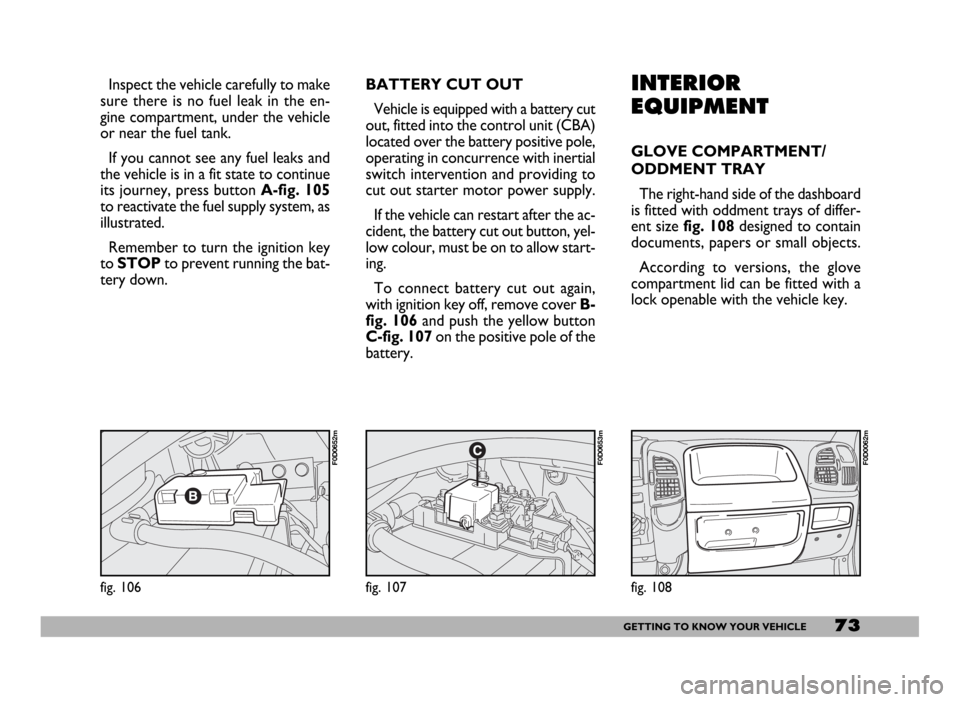
is fitted with oddment trays of differ-
ent sizefig. 108designed to contain
documents, papers or small objects.
According to versions, the glove
compartment lid can be fitted with a
lock openable with the vehicle key.
fig. 108
F0D0062m
fig. 106
F0D0652m
fig. 107
F0D0653m
BATTERY CUT OUT
Vehicle is equipped with a battery cut
out, fitted into the control unit (CBA)
located over the battery positive pole,
operating in concurrence with inertial
switch intervention and providing to
cut out starter motor power supply.
If the vehicle can restart after the ac-
cident, the battery cut out button, yel-
low colour, must be on to allow start-
ing.
To connect battery cut out again,
with ignition key off, remove cover B-
fig. 106 and push the yellow button
C-fig. 107 on the positive pole of the
battery.
Page 79 of 258
78GETTING TO KNOW YOUR VEHICLE
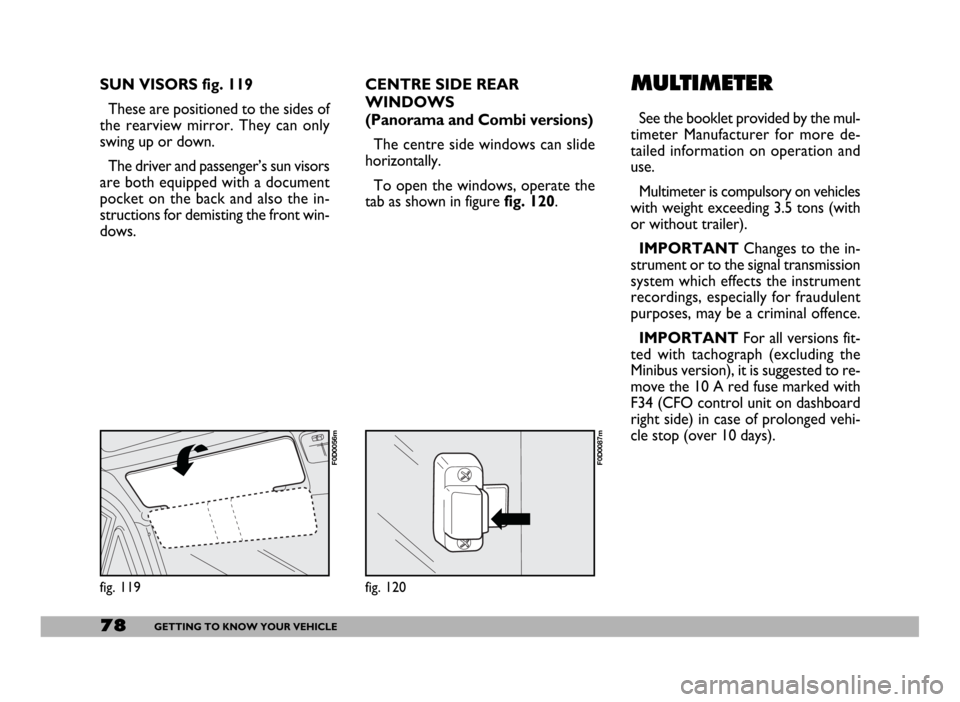
SUN VISORS fig. 119
These are positioned to the sides of
the rearview mirror. They can only
swing up or down.
The driver and passenger’s sun visors
are both equipped with a document
pocket on the back and also the in-
structions for demisting the front win-
dows.
fig. 119
F0D0056m
CENTRE SIDE REAR
WINDOWS
(Panorama and Combi versions)
The centre side windows can slide
horizontally.
To open the windows, operate the
tab as shown in figure fig. 120.
fig. 120
F0D0087m
MULTIMETER
See the booklet provided by the mul-
timeter Manufacturer for more de-
tailed information on operation and
use.
Multimeter is compulsory on vehicles
with weight exceeding 3.5 tons (with
or without trailer).
IMPORTANTChanges to the in-
strument or to the signal transmission
system which effects the instrument
recordings, especially for fraudulent
purposes, may be a criminal offence.
IMPORTANTFor all versions fit-
ted with tachograph (excluding the
Minibus version), it is suggested to re-
move the 10 A red fuse marked with
F34 (CFO control unit on dashboard
right side) in case of prolonged vehi-
cle stop (over 10 days).