brake light FIAT FIORINO 2017 Owner handbook (in English)
[x] Cancel search | Manufacturer: FIAT, Model Year: 2017, Model line: FIORINO, Model: FIAT FIORINO 2017Pages: 272, PDF Size: 5.87 MB
Page 101 of 272
ENGINE STOPPING FAILURE CONDITIONS
With the device activated, for reasons of comfort,
limiting emissions and safety, the power unit does
not stop in certain conditions, including:
engine still cold;
particularly cold external temperatures, if the
corresponding indication is provided;
battery not sufficiently charged;
particulate filter regeneration in progress (diesel
engines only);
driver's door not shut;
driver's seat belt not fastened;
reverse gear engaged (for example, for parking
manoeuvres);
automatic climate control, if a suitable thermal
comfort level has not yet been reached or to
enable MAX-DEF function;
during the first period of use, to initialize the
system.
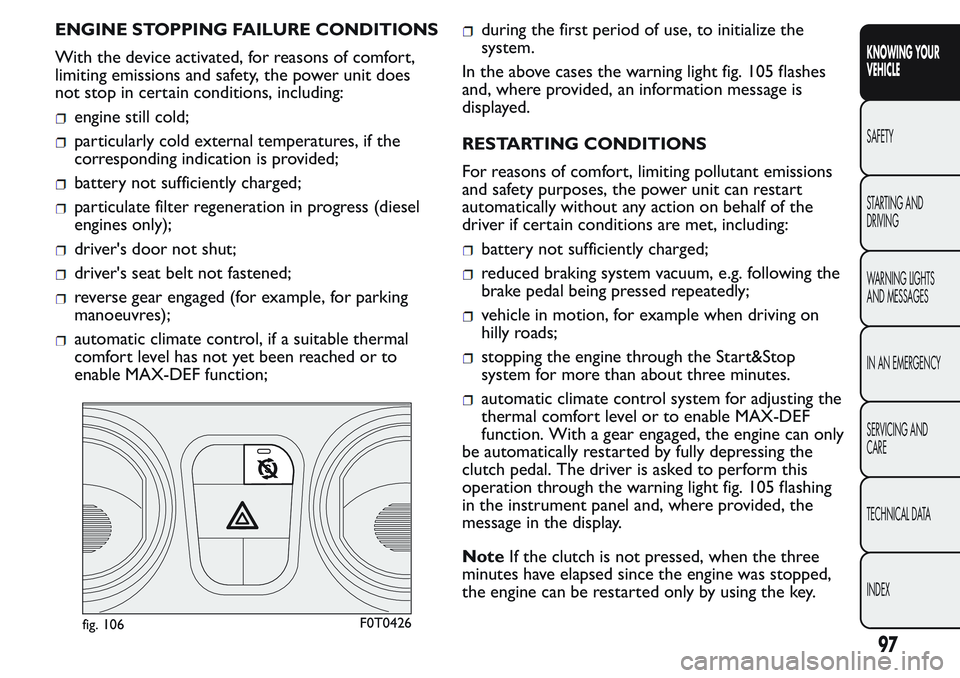
In the above cases the warning light fig. 105 flashes
and, where provided, an information message is
displayed.
RESTARTING CONDITIONS
For reasons of comfort, limiting pollutant emissions
and safety purposes, the power unit can restart
automatically without any action on behalf of the
driver if certain conditions are met, including:
battery not sufficiently charged;
reduced braking system vacuum, e.g. following the
brake pedal being pressed repeatedly;
vehicle in motion, for example when driving on
hilly roads;
stopping the engine through the Start&Stop
system for more than about three minutes.
automatic climate control system for adjusting the
thermal comfort level or to enable MAX-DEF
function. With a gear engaged, the engine can only
be automatically restarted by fully depressing the
clutch pedal. The driver is asked to perform this
operation through the warning light fig. 105 flashing
in the instrument panel and, where provided, the
message in the display.
NoteIf the clutch is not pressed, when the three
minutes have elapsed since the engine was stopped,
the engine can be restarted only by using the key.
fig. 106F0T0426
97
KNOWING YOUR
VEHICLE
SAFETY
STARTING AND
DRIVING
WARNING LIGHTS
AND MESSAGES
IN AN EMERGENCY
SERVICING AND
CARE
TECHNICAL DATA
INDEX
Page 104 of 272
WARNING
For vehicles with robotised gearbox, in
the event of automatic engine stopping
with the car on a slope, the engine should be
restarted by moving the gear lever towards (+)
or (-) without releasing the brake pedal. For
vehicles with robotised gearbox and Hill Holder
function, in the event of automatic engine
stopping with the car on a slope, the engine
must be restarted by moving the gear lever
towards (+) or (-) without releasing the brake
pedal, so that the Hill Holder function, active
only with the engine running, becomes
available.
WARNING
If climate comfort is to be favoured, the
Star t&Stop system can be disabled,
for a continuous operation of the climate
control system.
RADIO
(for versions/markets, where provided)
Read the Supplement attached to this Owner's
Handbook for the operation of the radio with
CD/MP3 player (for versions/markets, where
provided).
LIGHT SETUP
The system consists of:
radio power wires
speaker wires in front door panels
rear speaker wires (located next to parcel shelf )
(for versions/markets, where provided)
radio housing
antenna wires.
FULL SETUP
The system consists of:
radio power wires
speaker wires in front door panels
rear speaker wires (located next to parcel shelf )
(for versions/markets, where provided)
2 full-range Ø 130 mm placed in the door;
2 full-range speakers with Ø 100 mm placed on
the parcel shelf bracket (for versions / markets,
where provided);
radio housing
100
KNOWING YOUR
VEHICLE
SAFETY
STARTING AND
DRIVING
WARNING LIGHTS
AND MESSAGES
IN AN EMERGENCY
SERVICING AND
CARE
TECHNICAL DATA
INDEX
Page 136 of 272
STARTING AND DRIVING
STARTING THE ENGINE
The vehicle is fitted with an immobiliser: if the engine
fails to start, see the paragraph on “The Fiat CODE
system” in the “Knowing your vehicle” section.
The engine may be noisier during the first few
seconds of operation, particularly after a long period
of inactivity. This is due to the hydraulic tappets,
the timing system chosen for petrol engine versions
to reduce the number of servicing interventions,
and affects neither functionality nor reliability.
It is advisable not to demand maximum
performance from your vehicle (e.g.
excessive acceleration, long distances at
high speeds, excessive intense braking, etc .) during
the initial period of use.
When the engine is switched off never
leave the key on (at MAR) to prevent
unnecessary consumption and draining
the battery.
WARNING
It is dangerous to have the engine
running indoors.The engine takes in
oxygen and discharges carbon dioxide, carbon
monoxide and other toxic gases.
WARNING
Remember that the brake booster and
electric power steering are not
operational until the engine has been started,
so you need to apply much more force than
usual to the brake pedal and steering wheel.
STARTING PROCEDURE FOR PETROL
VERSIONS
Proceed as follows:
apply the handbrake;
put the gear lever into neutral;
press the clutch pedal down to the floor without
touching the accelerator;
turn the ignition key to AVV and let it go the
moment the engine starts.
132
KNOWING YOUR
VEHICLE
SAFETY
STARTING AND
DRIVING
WARNING LIGHTS
AND MESSAGES
IN AN EMERGENCY
SERVICING AND
CARE
TECHNICAL DATA
INDEX
Page 137 of 272
If the engine does not start at the first attempt,
return the ignition key to STOP before repeating the
procedure.
If the
warning light remains on together with
warning light
when the ignition key is at MAR,
turn the key to STOP and then back to MAR; if the
warning light stays on, try with the other keys
provided with the car.
If you still cannot start the engine, perform an
emergency start (see “Emergency starting” in the “In
an emergency” section) and go to a Fiat Dealership.
STARTING PROCEDURE FOR DIESEL
VERSIONS
Proceed as follows:
apply the handbrake;
put the gear lever into neutral;
turn the key on (MAR position): instrument panel
warning light
will light up;
wait for the warning lightsandto go out.
The hotter the engine is, the quicker this will
happen;
press the clutch pedal down to the floor without
touching the accelerator;
turn the ignition key to AVV as soon as the
warning light goes out. Waiting too long will
waste the heating work carried out by the glow
plugs.
Release the key as soon as the engine starts.IMPORTANT With the engine cold, the accelerator
pedal must be fully released when you turn the
ignition key to AVV.
If the engine does not start at the first attempt,
return the ignition key to STOP before repeating the
procedure.
If the
warning light stays on when the ignition key
is at MAR, turn the key to STOP and then back to
MAR; if the warning light remains on, try with the
other keys provided with the car.
Contact a Fiat Dealership if the engine still does not
start.
Warning lightwill blink for 60 seconds
after starting or during prolonged
cranking to indicate a fault to the glow
plug heating system. Use the vehicle normally if
the engine starts, but go to a Fiat Dealership
as soon as possible.
HOW TO WARM UP THE ENGINE AFTER IT
HAS JUST STARTED
Proceed as follows:
drive off slowly, letting the engine turn at medium
revs. Do not accelerate abruptly;
do not demand to performance for the first few
kilometres. Wait until the engine coolant gauge
starts moving.
133
KNOWING YOUR
VEHICLE
SAFETY
STARTING AND
DRIVING
WARNING LIGHTS
AND MESSAGES
IN AN EMERGENCY
SERVICING AND
CARE
TECHNICAL DATA
INDEX
Page 138 of 272
EMERGENCY STARTING
Go to a Fiat Dealership immediately if warning light
comes on steady on the instrument panel.
Never jump start the engine by pushing,
towing or coasting downhill.This could
cause fuel to flow into the catalytic
conver ter and damage it beyond repair.
STOPPING THE ENGINE
Turn the ignition key to STOP while the engine is
idling.
IMPORTANT After a long drive, you should allow
the engine to “catch its breath” before turning it off
by letting it idle to allow the temperature in the
engine compartment to fall.
A quick burst on the accelerator before
turning off the engine serves absolutely no
practical purpose, it wastes fuel and is
especially damaging to turbocharged engines.
HANDBRAKE
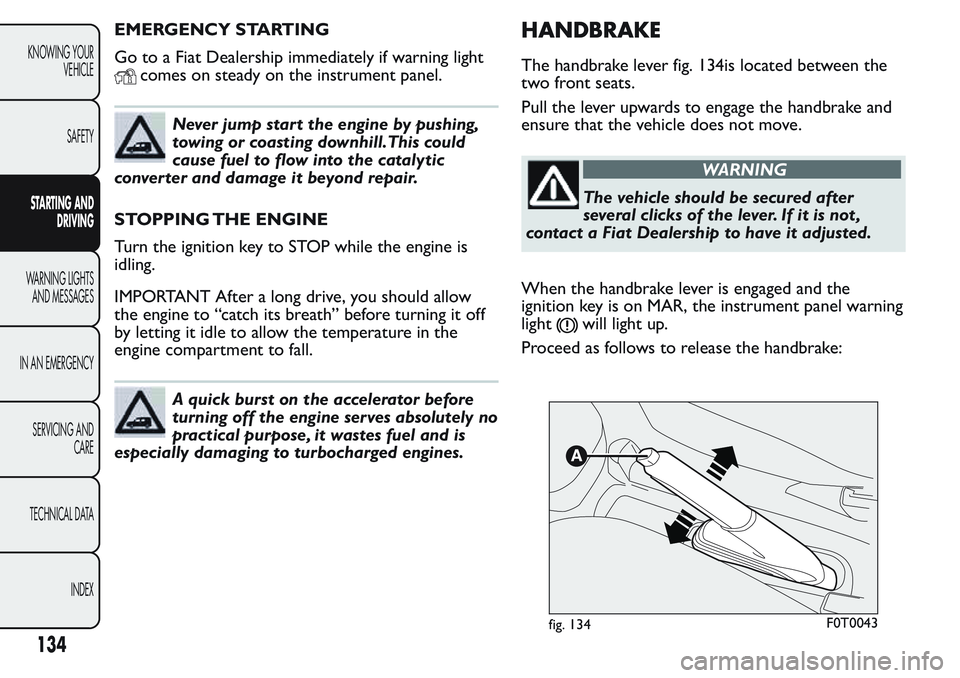
The handbrake lever fig. 134is located between the
two front seats.
Pull the lever upwards to engage the handbrake and
ensure that the vehicle does not move.
WARNING
The vehicle should be secured after
several clicks of the lever. If it is not ,
contact a Fiat Dealership to have it adjusted.
When the handbrake lever is engaged and the
ignition key is on MAR, the instrument panel warning
light
will light up.
Proceed as follows to release the handbrake:
fig. 134F0T0043
134
KNOWING YOUR
VEHICLE
SAFETY
STARTING AND
DRIVING
WARNING LIGHTS
AND MESSAGES
IN AN EMERGENCY
SERVICING AND
CARE
TECHNICAL DATA
INDEX
Page 139 of 272
slightly lift the handbrake and press release button
Afig. 134;
hold button A pressed and lower the lever. The
instrument panel warning light
will go out.
Press the brake pedal when carrying out this
operation to prevent the vehicle from moving
accidentally.
PARKING THE CAR
Proceed as follows:
stop the engine and engage the handbrake;
engage a gear (1stgear if parked uphill or reverse if
facing downhill) and leave the wheels turned.
If the vehicle is parked on a steep slope, it is
advisable to block the wheels with a wedge or stone.
To prevent draining the battery, do not leave the
ignition key turned to MAR. Always remove the key
when you leave the vehicle.
Never leave children unattended in the vehicle.
Always remove the ignition key when leaving the
vehicle, and take it with you.
SNOW TYRES
The Fiat Dealership will be happy to provide advice
concerning the most suitable type of tyre for the
customer's requirements.
For the type, pressures and specifications of the
snow tyre to be used, follow carefully the
instructions given in the “Wheels” paragraph of the
“Technical specifications” section.
The winter performance of these tyres is
considerably reduced when the tread thickness is less
than 4 mm. If this is the case, replace them.
Due to the specific characteristics of snow tyres, in
normal weather conditions or on long motorway
journeys, the performance of these tyres is lower
than that of standard tyres. Their usage should
therefore be restricted in accordance with their type
approval.
IMPORTANT When using snow tyres with a
maximum speed index below the one that can be
reached by the vehicle (increased by 5%), place
a notice in the passenger compartment, plainly in
view, which states the maximum speed allowed
by the snow tyres (as per EC Directive).
All four tyres should be the same (brand and profile)
to ensure greater safety when driving and braking
as well as making the car more responsive.
Remember that you should not change the rotation
direction of the tyres.
135
KNOWING YOUR
VEHICLE
SAFETY
STARTING AND
DRIVING
WARNING LIGHTS
AND MESSAGES
IN AN EMERGENCY
SERVICING AND
CARE
TECHNICAL DATA
INDEX
Page 143 of 272
Cold starting
Short distances and frequent cold start-ups prevent
the engine from reaching its optimum running
temperature.
Consequently, both consumption (from +15 to +30%
on the urban cycle) and emissions will increase.
Traffic and road conditions
Heavy traffic, for instance when travelling in a queue
with frequent use of low gears or in cities with
lots of traffic lights, causes fairly high fuel
consumption. Mountain roads and uneven surfaces
also have a negative effect on consumption.
Traffic hold-ups
During prolonged hold-ups (e.g. at level crossings)
the engine should be switched off.TOWING TRAILERS
IMPORTANT
The vehicle must be provided with a type-approved
tow hitch and adequate electrical system to tow
trailers. Installation must be performed by specialised
personnel who will issue the required papers for
travelling on roads.
Install any specific and/or additional rear-view mirrors
in accordance with the highway code of the country
in which you are travelling.
Remember that when towing a trailer, steep hills are
harder to climb, braking distances increase and
overtaking takes longer depending on the overall
weight of the trailer.
Engage a low gear when driving downhill, rather than
constantly using the brake.
The weight of the trailer on the vehicle tow hitch
will reduce the loading capacity of the vehicle by the
same amount.
Consider the weight at full load, including accessories
and luggage, to make sure you do not exceed the
maximum towable weight (shown in the log book).
Respect each country's speed limits for vehicles
towing trailers. In all cases, the top speed must not
exceed 80 km/h.
139
KNOWING YOUR
VEHICLE
SAFETY
STARTING AND
DRIVING
WARNING LIGHTS
AND MESSAGES
IN AN EMERGENCY
SERVICING AND
CARE
TECHNICAL DATA
INDEX
Page 144 of 272
WARNING
The ABS with which the vehicle may be
equipped will not control the braking
system of the trailer. Particular caution is
therefore required on slippery roads.
WARNING
Never modify the braking system of the
vehicle to control the trailer brake.
The trailer braking system must be fully
independent from the hydraulic system of the
vehicle.
SNOW CHAINS
The use of snow chains should be in compliance with
local regulations.
Snow chains may be fitted only to the front wheel
tyres (drive wheels).
Check the tension of the chains after the first few
metres have been driven.
Keep your speed down when snow chains
are fitted: do not exceed 50 km/h. Avoid
potholes, steps and pavements and also
avoid driving for long distances on roads not
covered with snow to avoid damaging the car and
the road surface.
140
KNOWING YOUR
VEHICLE
SAFETY
STARTING AND
DRIVING
WARNING LIGHTS
AND MESSAGES
IN AN EMERGENCY
SERVICING AND
CARE
TECHNICAL DATA
INDEX
Page 145 of 272
PROLONGED VEHICLE INACTIVITY
If the vehicle needs to be off the road for longer than
one month, the following precautions must be
taken:
park the vehicle indoors in a dry and, if possible,
well-ventilated place;
engage a gear and check that the handbrake is not
on;
disconnect the battery negative terminal and
check the charge (see “Battery” in the
“Maintenance and care”);
clean and protect the painted parts using
protective wax;
clean and protect the shiny metal parts using
special compounds readily available;
sprinkle talcum powder on the rubber windscreen
and rear window wiper blades and lift them off the
glass;
slightly open the windows;
cover the vehicle with a piece of fabric or
perforated plastic sheet. Do not use compact
plastic tarpaulins, which prevent humidity from
evaporating from the surface of the vehicle;
inflate tyres to +0.5 bar above the normal
specified pressure and check it at intervals;
do not drain the engine cooling system.
141
KNOWING YOUR
VEHICLE
SAFETY
STARTING AND
DRIVING
WARNING LIGHTS
AND MESSAGES
IN AN EMERGENCY
SERVICING AND
CARE
TECHNICAL DATA
INDEX
Page 146 of 272
WARNING LIGHTS AND MESSAGES
WARNING LIGHTS AND MESSAGES
The warning light (where allowed by the instrument
panel) is associated to a specific message and/or
acoustic tone. These indications are brief and
precautionary and as such must not be considered as
exhaustive and/or alternative to the information
contained in the Owner's Handbook, which you are
recommended to read carefully in all cases. Always
refer to the information in this chapter in the event
of a failure indication.
IMPORTANT The fault indicators appearing on the
display are divided into two categories: very serious
and less serious failures.
Serious failures prompt a prolonged cycle of signals.
Less serious failures prompt a shorter cycle of
signals.
The display cycle of both categories can be
interrupted by pressing the SET
button. The
warning light (or the symbol on the display) on the
instrument panel will stay on until the cause of
the failure is eliminated.
LOW BRAKE FLUID
(red)/HANDBRAKE ENGAGED (red)
When the ignition key is turned to MAR, the warning
light turns on but should go off after a few seconds.
Low brake fluid
The warning light turns on when the level of the
brake fluid in the reservoir falls below the minimum
level, possibly due to a leak in the circuit.
A specific message is displayed on certain versions.
WARNING
If the warning lightturns on when
travelling (on cer tain versions together
with the message on the display) stop the
vehicle immediately and contact Fiat
Dealership.
Handbrake engaged
The warning light turns on when the handbrake is
engaged.
On some versions, an acoustic tone accompanies the
warning light when the vehicle is moving.
142
KNOWING YOUR
VEHICLE
SAFETY
STARTING AND
DRIVING
WARNING LIGHTS
AND MESSAGES
IN AN EMERGENCY
SERVICING AND
CARE
TECHNICAL DATA
INDEX