ESP FIAT FIORINO 2018 Owner handbook (in English)
[x] Cancel search | Manufacturer: FIAT, Model Year: 2018, Model line: FIORINO, Model: FIAT FIORINO 2018Pages: 196, PDF Size: 4.99 MB
Page 80 of 196
IMPORTANT For correct installation on
the car, some universal child restraint
systems require an accessory (base)
sold separately by the restraint
system's producer. Therefore, FCA
advises customers to check that their
chosen child restraint system can
be installed on their vehicle by
performing a trial installation, on the
vendor's premises, before purchase.
67) 68) 69) 70)
INSTALLING A CHILD
CARSEAT WITH
SEATBELTS
71) 72) 73) 74) 75)
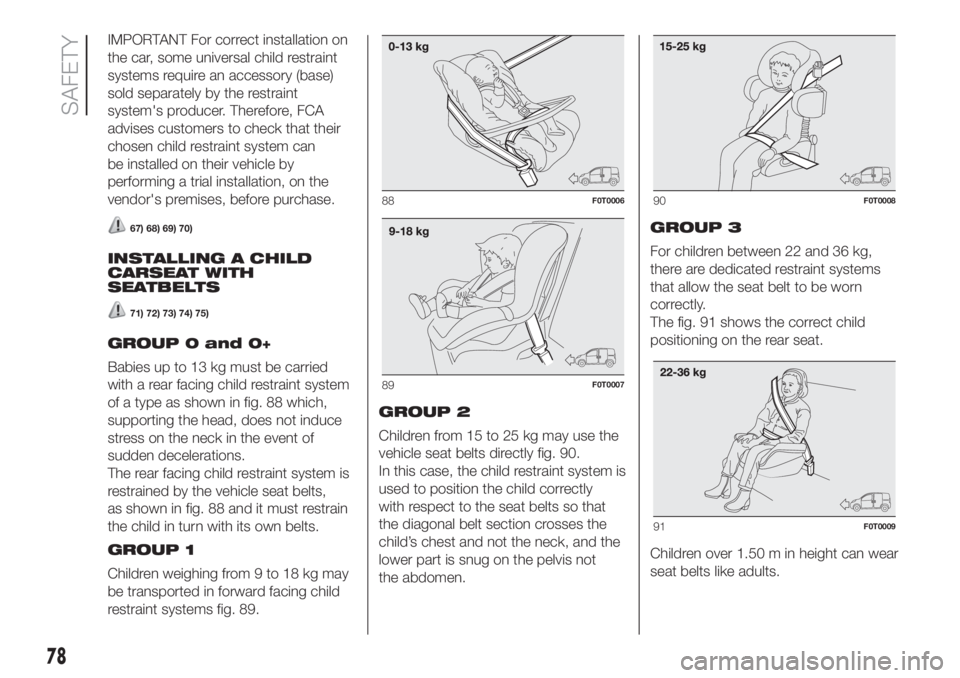
GROUP 0 and 0+
Babies up to 13 kg must be carried
with a rear facing child restraint system
of a type as shown in fig. 88 which,
supporting the head, does not induce
stress on the neck in the event of
sudden decelerations.
The rear facing child restraint system is
restrained by the vehicle seat belts,
as shown in fig. 88 and it must restrain
the child in turn with its own belts.
GROUP 1
Children weighing from 9 to 18 kg may
be transported in forward facing child
restraint systems fig. 89.GROUP 2
Children from 15 to 25 kg may use the
vehicle seat belts directly fig. 90.
In this case, the child restraint system is
used to position the child correctly
with respect to the seat belts so that
the diagonal belt section crosses the
child’s chest and not the neck, and the
lower part is snug on the pelvis not
the abdomen.GROUP 3
For children between 22 and 36 kg,
there are dedicated restraint systems
that allow the seat belt to be worn
correctly.
The fig. 91 shows the correct child
positioning on the rear seat.
Children over 1.50 m in height can wear
seat belts like adults.
88F0T0006
89F0T0007
90F0T0008
91F0T0009
78
SAFETY
Page 95 of 196
WARNING
90)It is dangerous to run the engine in
enclosed areas. The engine consumes
oxygen and engine exhaust contains
carbon dioxide, carbon monoxide and
other toxic gasses.
91)Remember that the brake servo and
electrical power steering system are not
operational until the engine is started,
therefore a greater effort will be required to
press the brake pedal or turn the steering
wheel.
WARNING
22)It is advisable not to demand maximum
performance from your vehicle (e.g.
excessive acceleration, long distances at
high speeds, excessive intense braking,
etc.) during the initial period of use.
23)When the engine is switched off never
leave the key turned to MAR-ON to prevent
useless current absorption from draining
the battery.
24)If the warning light
flashes for 60
seconds after starting or during an
extended towing period, this indicates a
problem in the glow plug preheating
system. Use the vehicle normally if the
engine starts, but contact a Fiat Dealership
as soon as possible.25)There must therefore always be
enough petrol in the tank to protect the
petrol pump and to guarantee temporary
switching from methane to petrol
operation, if high performance is required.
26)If the engine fails to start with a gear
engaged, the potentially dangerous
situation due to the fact that the gearbox is
automatically placed in neutral will be
signalled by a buzzer.
27)Never, under any circumstances, jump
start the engine by pushing, towing or
coasting downhill. This could cause fuel to
flow into the catalytic converter and
damage it beyond repair.
28)A quick burst on the accelerator before
turning off the engine serves absolutely
no practical purpose, it wastes fuel and is
especially damaging to turbocharged
engines.
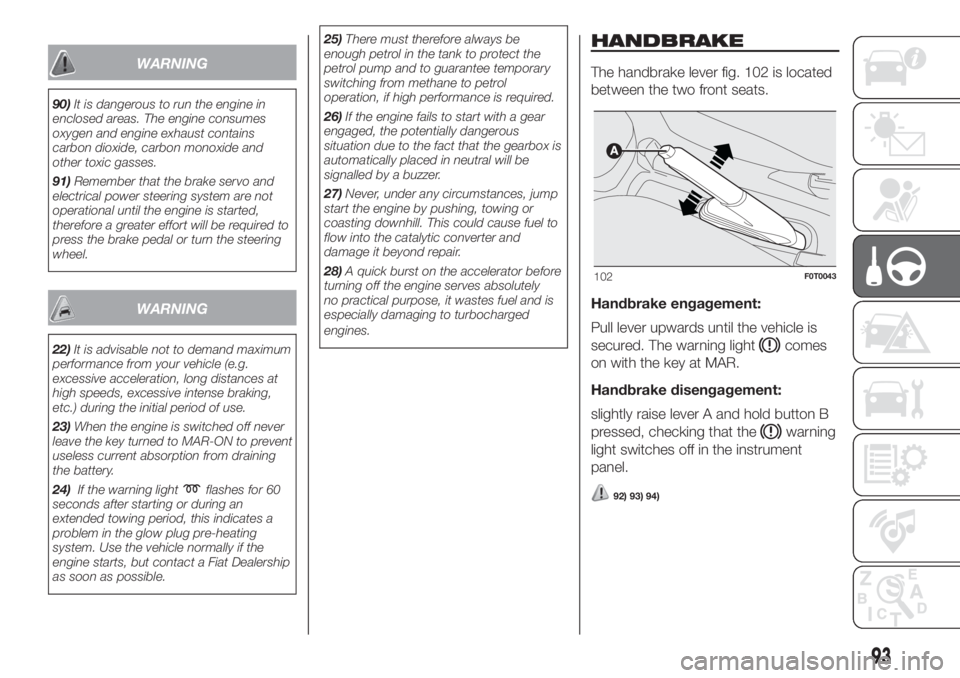
HANDBRAKE
The handbrake lever fig. 102 is located
between the two front seats.
Handbrake engagement:
Pull lever upwards until the vehicle is
secured. The warning light
comes
on with the key at MAR.
Handbrake disengagement:
slightly raise lever A and hold button B
pressed, checking that the
warning
light switches off in the instrument
panel.
92) 93) 94)
102F0T0043
93
Page 100 of 196
Increasing the stored speed
This can be done in two ways:
by pressing the accelerator and
storing the new speed reached
or
by moving the stalk upwards (+).
Each activation of the lever
corresponds to an increase in speed of
about 1 km/h, whilst keeping the lever
upwards varies the speed continuously.
Reducing the memorised speed
This can be done in two ways:
by deactivating the device and then
storing the new speed
or
by moving the stalk downwards (-)
until the new speed, which will be
stored automatically, is reached.
Each movement of the stalk will
correspond to a slight reduction in
speed of about 1 km/h, while keeping
the stalk held downwards will decrease
the speed continuously.
Turning the device off
The device can be switched off by the
driver in the following ways:
by turning ring nut A to the OFF
position;
by switching off the engine;Deactivating the function
The device can be switched off by the
driver in the following ways:
by pressing the brake pedal when
the device is adjusting the speed:
by pressing the clutch pedal when
the device is adjusting the speed;
by pressing button B fig. 109 when
the device is adjusting the speed (for
versions/markets, where provided);
by pressing the accelerator pedal (in
this case the system is not actually
turned off but the acceleration request
takes priority; the cruise control remains
activated, without the need to the
press button B fig. 109 to restore the
previous conditions once the
acceleration is over).
The device is automatically switched off
in the following cases:
if the ABS or ESC systems
intervene;
with the vehicle speed below the set
limit
in the event of system failure.
97) 98)
WARNING
97)When travelling with the device active,
never move the gear lever to neutral.
98)In the event of device faults or failures,
turn knob A to OFF and contact a Fiat
Dealership.
98
STARTING AND DRIVING
Page 102 of 196
The parking sensors work properly
with the swing doors closed. If they are
open, they can cause the system to
send false signals: always close the rear
doors.
Also, do not apply stickers to the
sensors.
The following conditions may influence
the performance of the parking
assistance system:
Reduced sensor sensitivity and a
reduction in the parking assistance
system performance could be due to
the presence on the surface of the
sensor of: ice, snow, mud, thick paint.
The sensor may detect a non-
existent obstacle (echo noise) due to
mechanical noises, for example when
washing the vehicle, in case of rain,
strong wind, hail.
The warnings sent by the sensor
can also be altered by the presence of
ultrasonic systems (e.g. pneumatic
brakes of trucks or pneumatic drills)
near the car.
Detection of obstacles in the upper
part of the vehicle (particularly in the
case of vans or chassis cabs) may not
be guaranteed because the system
detects obstacles that could strike the
lower part of the vehicle.
WARNING
99)Parking manoeuvres, however, are
always the driver’s responsibility. While
carrying out these manoeuvres, always
make sure that no people (especially
children) or animals are in the area
concerned. Parking sensors are designed
to assist drivers; however, you must always
concentrate fully during potentially
dangerous manoeuvres, even if carried out
at low speeds.
WARNING
31)The sensor must be free of mud, dirt,
snow or ice in order for the system to
work. Be careful not to scratch or damage
the sensors while cleaning them. Avoid
using dry, rough or hard cloths. The
sensors should be washed using clean
water with the addition of car shampoo if
necessary. When using special washing
equipment such as high pressure jets
or steam cleaning, clean the sensors very
quickly keeping the jet more than 10 cm
away.
START&STOP
SYSTEM
(for versions/markets, where provided)
101) 102) 103) 104)
IN BRIEF
The Start&Stop device automatically
stops the engine each time the
vehicle is stationary and all the
conditions for automatic switch-off
have been met, and starts it again
when the driver wants to move off.
This improves the efficiency of the
vehicle by reducing fuel consumption,
the emission of harmful gases and
noise pollution.
OPERATING MODE
Stopping the engine
Versions with manual transmission
With the vehicle stationary, the engine
stops with the gearbox in neutral and
the clutch pedal released.
100
STARTING AND DRIVING
Page 115 of 196
WARNING
115)The information required by the
applicable regulation is indicated on the
Fix&Go kit package label. Carefully read
the label on the cartridge before use, avoid
improper use. The kit should be used by
adults and cannot be used by children.
116)IMPORTANT: Do not exceed 80 km/h.
Avoid sudden acceleration or braking.
The kit provides a temporary repair,
therefore the tyre must be examined and
repaired by a specialist as soon as
possible. Before using the kit, ensure that
the tyre is not excessively damaged and
that the rim is in good condition, otherwise
do not use it and call roadside assistance.
Do not remove foreign bodies from the
tyre. Do not let the compressor turned on
for more than 20 consecutive minutes -
overheating hazard.
WARNING
37)The sealant fluid is effective with
external temperatures between -40°C and
+55°C. The sealant has an expiry date. It
is possible to repair tyres which have been
damaged on tread up to a diameter of 6
mm. Show the cartridge and the label
to the personnel who will handle the tyre
treated with the tyre repair kit
CHANGING A BULB
GENERAL
INSTRUCTIONS
117) 118) 119) 120) 121)
Before replacing a bulb check the
contacts for oxidation;
burnt bulbs must be replaced by
others of the same type and power;
always check the headlight beam
direction after changing a bulb;
when a light is not working, check
that the corresponding fuse is intact
before replacing a bulb. For the location
of fuses, refer to the paragraph
"Replacing fuses" in this chapter.
IMPORTANT A slight misting may
appear on the internal surface of the
headlight: this does not indicate a fault
and is caused by low temperature
and the degree of humidity in the air.
Misting will rapidly disappear when the
headlights are switched on. The
presence of drops inside the headlights
indicates infiltration of water. Contact
a Fiat Dealership.
WARNING
117)Modifications or repairs to the electric
system that are not carried out properly
or do not take the system technical
specifications into account can cause
malfunctions leading to the risk of fire.
118)Halogen bulbs contain pressurised
gas, in the case of breakage they may
burst causing glass fragments to be
projected outwards.
119)Halogen bulbs must be handled
holding the metal part only. Touching the
transparent part of the bulb with your
fingers may reduce the intensity of the
emitted light and even reduce the lifespan
of the bulb. In the event of accidental
contact, wipe the bulb with a cloth
moistened with alcohol and let the bulb dry.
120)Where possible, it is advisable to
have bulbs changed at a Fiat Dealership.
The correct operation and direction of
the external lights are absolutely essential
for the safety of the car and of compliance
with the law.
121)Replace the bulbs with the engine
stopped and in a position in which it is not
danger for oncoming traffic and where
you perform the replacement safely (see
the “When parked” paragraph). Also ensure
that the engine is cold, to prevent the risk
of burns.
113
Page 123 of 196
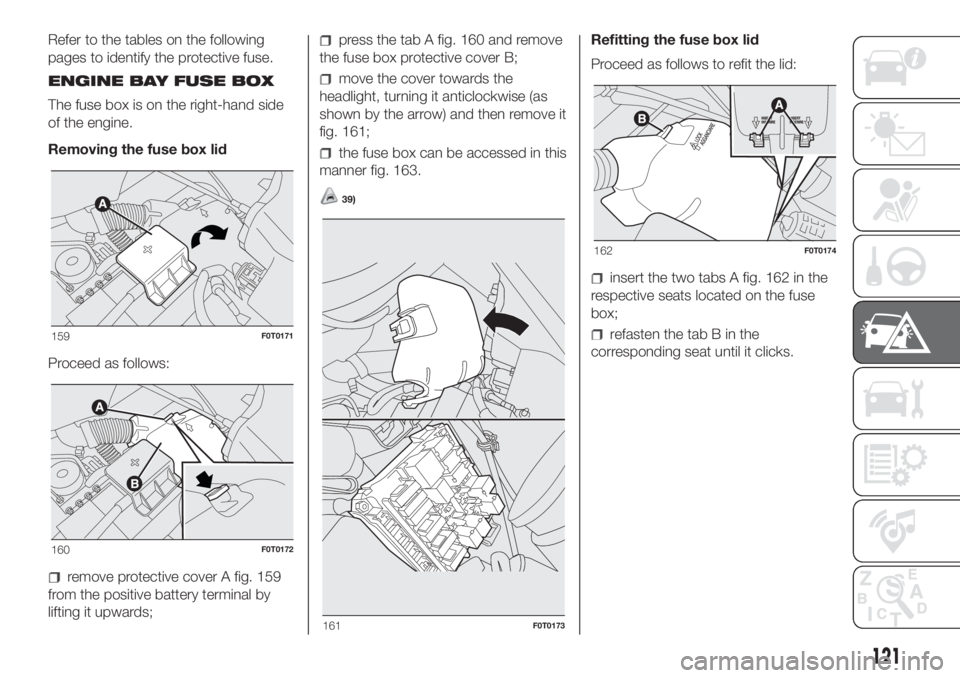
Refer to the tables on the following
pages to identify the protective fuse.
ENGINE BAY FUSE BOX
The fuse box is on the right-hand side
of the engine.
Removing the fuse box lid
Proceed as follows:
remove protective cover A fig. 159
from the positive battery terminal by
lifting it upwards;
press the tab A fig. 160 and remove
the fuse box protective cover B;
move the cover towards the
headlight, turning it anticlockwise (as
shown by the arrow) and then remove it
fig. 161;
the fuse box can be accessed in this
manner fig. 163.
39)
Refitting the fuse box lid
Proceed as follows to refit the lid:
insert the two tabs A fig. 162 in the
respective seats located on the fuse
box;
refasten the tab B in the
corresponding seat until it clicks.159F0T0171
160F0T0172
161F0T0173
162F0T0174
121
Page 137 of 196
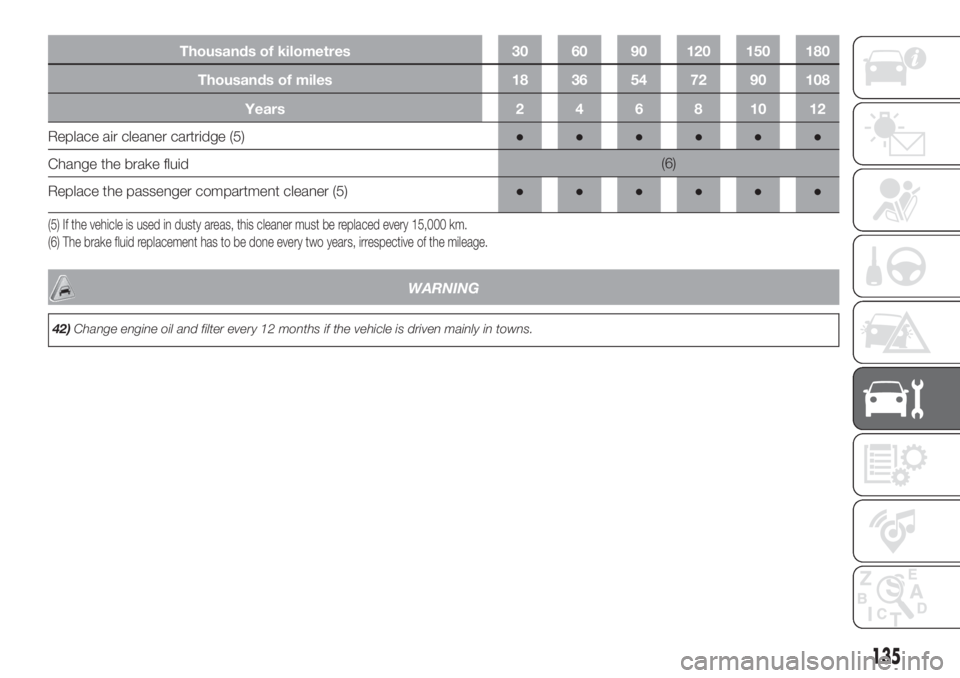
Thousands of kilometres 30 60 90 120 150 180
Thousands of miles 18 36 54 72 90 108
Years 2 4 6 8 10 12
Replace air cleaner cartridge (5)●●●●●●
Change the brake fluid(6)
Replace the passenger compartment cleaner (5)●●●●●●
(5) If the vehicle is used in dusty areas, this cleaner must be replaced every 15,000 km.
(6) The brake fluid replacement has to be done every two years, irrespective of the mileage.
WARNING
42)Change engine oil and filter every 12 months if the vehicle is driven mainly in towns.
135
Page 140 of 196
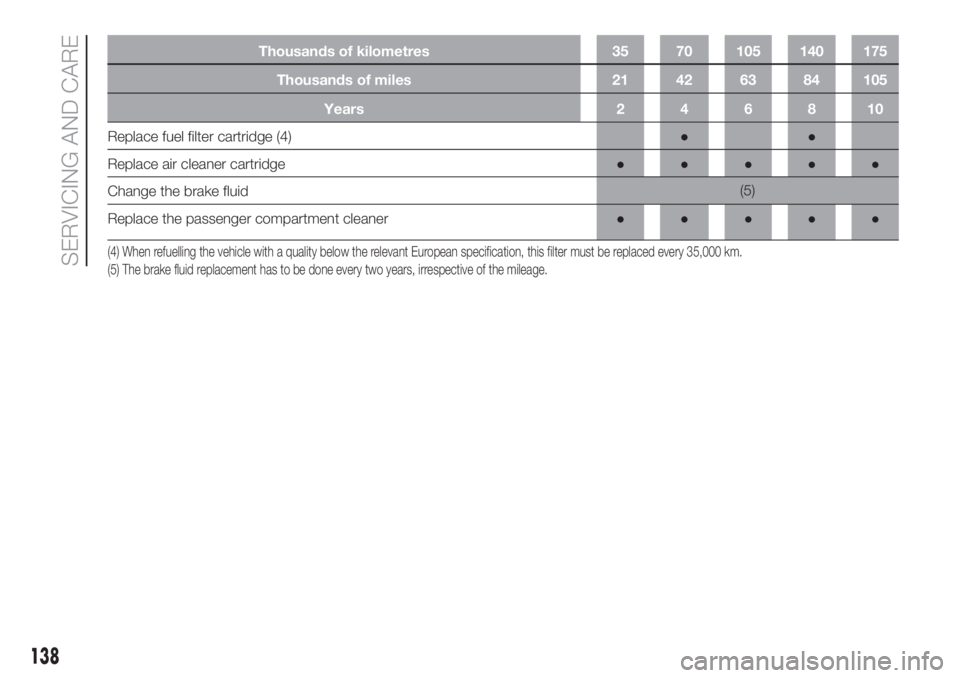
Thousands of kilometres 35 70 105 140 175
Thousands of miles 21 42 63 84 105
Years 2 4 6 8 10
Replace fuel filter cartridge (4)●●
Replace air cleaner cartridge●●●●●
Change the brake fluid(5)
Replace the passenger compartment cleaner●●●●●
(4) When refuelling the vehicle with a quality below the relevant European specification, this filter must be replaced every 35,000 km.
(5) The brake fluid replacement has to be done every two years, irrespective of the mileage.
138
SERVICING AND CARE
Page 145 of 196
ENGINE OIL
Engine oil level check
Check the oil level a few minutes (about
5) after the engine has stopped, with
the vehicle parked on level ground.
Take out the dipstick 1, clean it and
then reinsert it fully; take it out and
check that the level is between the MIN
and MAX marks on the dipstick. The
interval between MIN and MAX marks
corresponds to about 1 litre of oil.
Topping up the engine oil
If the oil level is close to or below the
MIN mark, add oil via the filler 2 until it
reaches the MAX mark.
The oil level must never exceed the
MAX. mark.
IMPORTANT If the engine oil level after
the check is over the MAX level, go
to a Fiat Dealership to have the correct
level restored.
IMPORTANT After adding or changing
the oil, let the engine turn over for a few
seconds and wait a few minutes after
turning it off before you check the level.
Engine oil consumption
The maximum engine oil consumption
is usually 400 grams every 1000 km.
When the vehicle is new, the engine
needs to be run in, therefore the engine
oil consumption can only be considered
stabilised after the first 5,000–6,000
km.IMPORTANT The oil consumption
depends on driving style and the
conditions under which the vehicle is
used.
IMPORTANT Always top up using
engine oil of the same specifications as
that already in the engine.
134)
44)
ENGINE COOLANT
The coolant level should be checked
when the engine is cold and should be
between the MIN and MAX lines on
the vessel.
If the level is low, pour a 50% mixture of
demineralised water and PETRONAS
LUBRICANTS PARAFLU
UPinto the
vessel through cap 3.
The mixture of 50% PARAFLU
UPand
50% distilled water protects against
freezing down to temperatures of
-35°C. For particularly harsh climate
conditions, we recommended using a
mixture of 60% PARAFLU
UPand 40%
distilled water.
135)
45)
WINDSCREEN/REAR
WINDOW WASHING FLUID
To add fluid, lift the cap 4 and pour in a
mixture of water and PETRONAS
DURANCE SC 35 fluid, in the following
proportions:
30% PETRONAS DURANCE SC 35
and 70% water in summer;
50% PETRONAS DURANCE SC 35
and 50% water in winter.
At temperatures below -20°C, use
undiluted PETRONAS DURANCE SC
35 fluid.
Check fluid level through the reservoir.
136) 137)
BRAKE FLUID
Unscrew the cap 5 and check that the
fluid in the reservoir is at the maximum
level.
The fluid level in the reservoir must not
exceed the MAX mark.
Use the brake fluid shown in the "Fluids
and lubricants" table (see "Technical
Specifications"). When opening the cap
A, make sure that no dirt gets into the
reservoir.
For topping-up, always use a funnel
with integrated filter with mesh equal to
or lower than 0.12 mm.
143
Page 147 of 196
140)Prevent power steering fluid from
coming into contact with hot engine parts:
it is flammable.
141)Battery fluid is poisonous and
corrosive. Avoid contact with skin and
eyes. Keep naked flames and sources of
sparks away from the battery: risk of
explosion and fire.
142)Using the battery with insufficient
battery fluid may irreparably damage the
battery and may cause an explosion.
143)When performing any operation on
the battery or near it, always protect your
eyes with special goggles.
WARNING
43)When topping up, take care not to mix
up the various types of fluids: they are
not compatible with each other and could
seriously damage the vehicle.
44)Used engine oil and replaced oil filters
contain substances which are harmful to
the environment. To change oil and filters,
we advise you to contact a Fiat Dealership.
45)PARAFLU
UPanti-freeze fluid is used
in the cooling system. Use fluid of the
same type as that contained in the cooling
system for any top-ups. PARAFLU
UP
fluid cannot be mixed with any other type
of fluid. If this occurs, do not start the
engine and contact your Fiat Dealership
immediately.
46)Prevent brake fluid, which is highly
corrosive, from coming into contact with
painted parts. Should it happen,
immediately wash with water.47)Incorrect installation of electric and
electronic devices may cause severe
damage to your vehicle. After purchasing
your vehicle, if you wish to install any
accessories (anti-theft, radio phone, etc.),
go to a Fiat Dealership, which will suggest
the most suitable devices and advise
you whether a higher capacity battery
needs to be installed.
48)If the vehicle will be unused for an
extended period of time in extremely cold
weather conditions, remove the battery
and store it in a heated area to prevent it
from freezing.
WARNING
3)Power steering fluid consumption is
extremely low; if another top-up is required
after only a short period of time, have the
system checked for leaks at a Fiat
Dealership.
4)Used transmission fluid contains
substances that are harmful to the
environment. It is advisable to have the oil
changed by a Fiat Dealership where it
will be disposed of respecting the
environment and according to legal
requirements.
5)Batteries contain substances which are
very dangerous for the environment. You
are recommended to go to a Fiat
Dealership to have the battery replaced
where the old battery will be disposed of
respecting both the environment and
the laws in force.
BATTERY
RECHARGING
IMPORTANT The battery recharging
procedure is given as information only.
You are advised to contact a Fiat
Dealership to have this operation
carried out.
We recommend recharging the battery
slowly for approximately 24 hours at
low amperage. Charging for a longer
time may damage the battery.
To recharge, proceed as follows:
without Start&Stop system:
disconnect the terminal from the
negative battery pole;
connect the charger cables to the
battery terminals, observing the polarity;
turn on the battery charger;
when it is recharged, turn the
charger off before disconnecting it from
the battery;
reconnect the terminal to the
negative battery pole.
145