oil change FIAT FREEMONT 2012 Owner handbook (in English)
[x] Cancel search | Manufacturer: FIAT, Model Year: 2012, Model line: FREEMONT, Model: FIAT FREEMONT 2012Pages: 332, PDF Size: 5.61 MB
Page 26 of 332
DOWN ButtonPress and release the DOWN button to
scroll downward through the main menus
and sub-menus.
SELECT Button Press and release the SELECT button for
access to main menus or sub-menus. Press
and hold the SELECT button for two seconds
to reset features.
BACK Button Press the BACK button to scroll back to a
previous menu or sub-menu.
ELECTRONIC VEHICLE INFORMATION
CENTER (EVIC) DISPLAYS
When the appropriate conditions exist, the EVIC dis-
plays the following messages:
• Turn Signal On (with a continuous warning chime if the vehicle is driven more than 1.6 km with either
turn signal on)
• Left Front Turn Signal Light Out (with a single chime)
• Left Rear Turn Signal Light Out (with a single chime)
• Right Front Turn Signal Light Out (with a single chime)
• Right Rear Turn Signal Light Out (with a single chime)
• RKE Battery Low (with a single chime) • Personal Settings Not Available – Vehicle Not in
PARK (for versions/markets, where provided)
• Left/Right Front Door Ajar (one or more doors open, with a single chime if speed is above 1.6 km/h)
• Left/Right Rear Door Ajar (one or more doors open, with a single chime if speed is above 1.6 km/h)
• Door(s) Ajar (with a single chime if vehicle is in motion)
• Liftgate Ajar (with a single chime)
• Low Washer Fluid (with a single chime)
• Ignition or Accessory On
• Vehicle Not in Park
• Key Left Vehicle
• Key Not Detected
• Low Tire Pressure (with a single chime). Refer to information on “Tire Pressure” and “Tire Pressure
Monitor” in “Starting And Operating”.
• Service TPM System (with a single chime). Refer to information on “Tire Pressure Monitor” in “Starting
And Operating”.
• Check Gascap (refer to “Adding Fuel” in “Technical Specifications”)
• Oil Change Required (with a single chime)
• Check Gascap (refer to “Adding Fuel” in “Starting And Operating”)
• Oil Change Due (with a single chime)
20
KNOWING YOUR
VEHICLE
SAFETY
STARTING AND
DRIVING
WARNING LIGHTSAND
MESSAGES
IN AN
EMERGENCY
SERVICING AND
CARETECHNICAL
SPECIFICATIONSCONTENTS
Page 29 of 332
Further overheating will cause the temperature gauge
to passH,the indicator will continuously flash and a
continuous chime will occur until the engine is allowed
to cool.
If the light turns on while driving, safely pull over and
stop the vehicle. If the A/C system is on, turn it off.
Also, shift the transmission into NEUTRAL and idle the
vehicle. If the temperature reading does not return to
normal, turn the engine off immediately and call for
service.
Transmission Temperature Warning Light This light indicates that the transmission fluid
temperature is running hot. This may occur
with severe usage, such as trailer towing. If
this light turns on, safely pull over and stop
the vehicle. Then, shift the transmission into NEU-
TRAL and run the engine at idle or faster until the light
turns off.
Continuous driving with the Transmission
Temperature Warning Light illuminated
will eventually cause severe transmission
damage or transmission failure.
WARNING!
If the Transmission Temperature Warning
Light is illuminated and you continue
operating the vehicle, in some circumstances you
could cause the fluid to boil over, come in contact
with hot engine or exhaust components and
cause a fire.
OIL CHANGE DUE
Your vehicle is equipped with an engine oil change
indicator system. The “Oil Change Due” message will
flash in the EVIC display for approximately 10 seconds
after a single chime has sounded to indicate the next
scheduled oil change interval. The engine oil change
indicator system is duty cycle based, which means the
engine oil change interval may fluctuate dependent
upon your personal driving style.
Unless reset, this message will continue to display each
time you cycle the ignition to the ON/RUN position.
To turn off the message temporarily, press and release
the BACK button. To reset the oil change indicator
system please refer to a Fiat Dealership.
FUEL ECONOMY
Press and release the UP or DOWN button until “Fuel
Economy” displays highlighted in the EVIC and press
the SELECT button. The following Fuel Economy func-
tions will display in the EVIC:
23KNOWING
YOURVEHICLESAFETY
STARTING ANDDRIVING
WARNING LIGHTSAND
MESSAGES
IN AN
EMERGENCY
SERVICING AND
CARETECHNICAL
SPECIFICATIONSCONTENTS
Page 199 of 332
The best protection against carbon monoxide entry
into the vehicle body is a properly maintained engine
exhaust system.
Whenever a change is noticed in the sound of the
exhaust system, when exhaust fumes can be detected
inside the vehicle, or when the underside or rear of the
vehicle is damaged, have a competent mechanic inspect
the complete exhaust system and adjacent body areas
for broken, damaged, deteriorated, or mispositioned
parts. Open seams or loose connections could permit
exhaust fumes to seep into the passenger compart-
ment. In addition, inspect the exhaust system each time
the vehicle is raised for lubrication or oil change.
Replace as required.
SAFETY CHECKS YOU SHOULD MAKE
INSIDE THE VEHICLE
Seat Belts
Inspect the seat belt system periodically, checking for
cuts, frays, and loose parts. Damaged parts must be
replaced immediately. Do not disassemble or modify
the system.
Front seat belt assemblies must be replaced after a
collision. Rear seat belt assemblies must be replaced
after a collision if they have been damaged (i.e., bent
retractor, torn webbing, etc.). If there is any question
regarding belt or retractor condition, replace the seatbelt.Air Bag Warning Light
The light should turn on and remain on for four to six
seconds as a bulb check when the ignition switch is first
turned ON. If the light is not lit during starting, or if the
light stays on, flickers, or turns on while driving, have
the system checked by an authorized dealer.
Defroster
Check operation by selecting the defrost mode and
place the blower control on high speed. You should be
able to feel the air directed against the windshield. See
your authorized dealer for service if your defroster is
inoperable.
Floor Mat Safety Information
Always use floor mats designed to fit the footwell of
your vehicle. Use only floor mats that leave the pedal
area unobstructed and that are firmly secured so that
they cannot slip out of position and interfere with the
pedals or impair safe operation of your vehicle in other
ways.
WARNING!
Pedals that cannot move freely can
cause loss of vehicle control and increase
the risk of serious personal injury.
Always make sure that floor mats are properly
attached to the floor mat fasteners.
(Continued)
193
KNOWING
YOURVEHICLESAFETYSTARTING ANDDRIVING
WARNING LIGHTSAND
MESSAGES
IN AN
EMERGENCY
SERVICING AND
CARETECHNICAL
SPECIFICATIONSCONTENTS
Page 201 of 332
STARTING AND DRIVING
ENGINE BREAK-IN
RECOMMENDATIONS
A long break-in period is not required for the engine
and drivetrain (transmission and axle) in your vehicle.
Drive moderately during the first 500 km. After the
initial 100 km, speeds up to 80 or 90 km/h are desirable.
While cruising, brief full-throttle acceleration, within
the limits of local traffic laws contributes to a good
break-in. Wide-open throttle acceleration in low gear
can be detrimental and should be avoided.
The engine oil installed in the engine at the factory is a
high-quality energy-conserving type lubricant. Oil
changes should be consistent with anticipated climate
conditions under which vehicle operations will occur.
For the recommended viscosity and quality grades,
refer to “Maintenance Procedures” in “Maintaining
Your Vehicle”. NON-DETERGENT OR STRAIGHT
MINERAL OILS MUST NEVER BE USED.
A new engine may consume some oil during its first few
thousand kilometers of operation. This should be con-
sidered a normal part of the break-in and not inter-
preted as an indication of difficulty. STARTING PROCEDURES
Before starting your vehicle, adjust your seat, adjust the
inside and outside mirrors, fasten your seat belt, and if
present, instruct all other occupants to buckle their
seat belts.
WARNING!
Before exiting a vehicle, always apply
the parking brake, shift the transmission
into PARK, and remove the key fob from the
ignition. When leaving the vehicle, always lock
your vehicle.
Never leave children alone in a vehicle, or with
access to an unlocked vehicle.
Allowing children to be in a vehicle unattended
is dangerous for a number of reasons. A child or
others could be seriously or fatally injured. Chil-
dren should be warned not to touch the parking
brake, brake pedal or the shift lever.
Do not leave the key fob in or near the vehicle,
and do not leave Keyless Enter-N-Go in the ACC
or ON/RUN mode. A child could operate power
windows, other controls, or move the vehicle.
(Continued)
195
KNOWING
YOURVEHICLE SAFETYSTARTING ANDDRIVINGWARNING LIGHTSAND
MESSAGES
IN AN
EMERGENCY
SERVICING AND
CARETECHNICAL
SPECIFICATIONSCONTENTS
Page 271 of 332
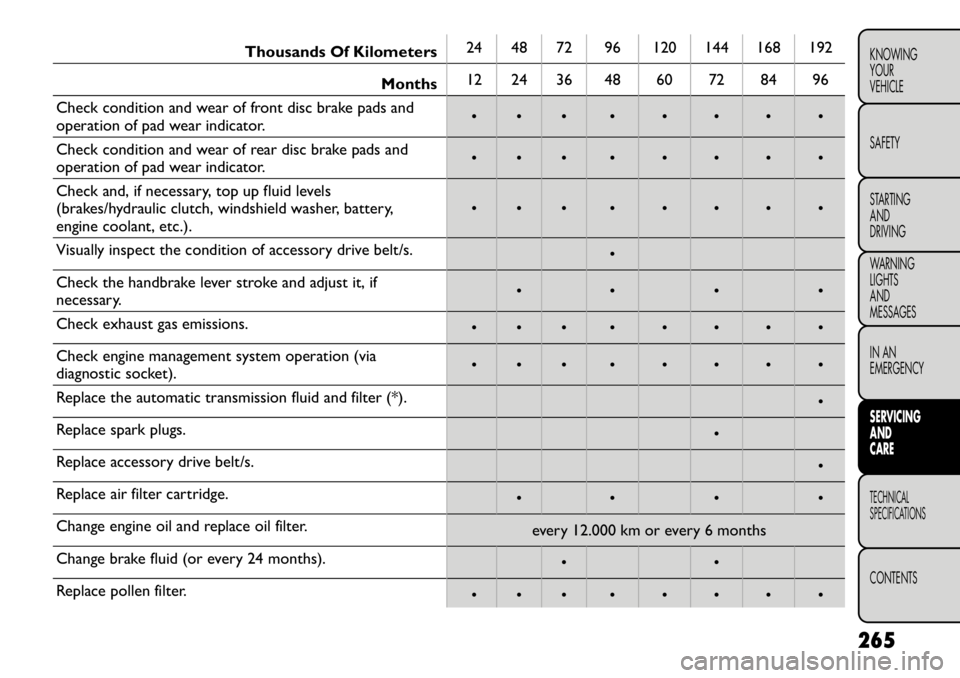
Thousands Of Kilometers24 48 72 96 120 144 168 192
Months 12 24 36 48 60 72 84 96
Check condition and wear of front disc brake pads and
operation of pad wear indicator. • • • • • • • •
Check condition and wear of rear disc brake pads and
operation of pad wear indicator. • • • • • • • •
Check and, if necessary, top up fluid levels
(brakes/hydraulic clutch, windshield washer, battery,
engine coolant, etc.). • • • • • • • •
Visually inspect the condition of accessory drive belt/s. •
Check the handbrake lever stroke and adjust it, if
necessary. • • • •
Check exhaust gas emissions. • • • • • • • •
Check engine management system operation (via
diagnostic socket). • • • • • • • •
Replace the automatic transmission fluid and filter (*). •
Replace spark plugs. •
Replace accessory drive belt/s. •
Replace air filter cartridge. • • • •
Change engine oil and replace oil filter. every 12.000 km or every 6 months
Change brake fluid (or every 24 months). • •
Replace pollen filter. • • • • • • • •
265
KNOWING
YOURVEHICLE SAFETY
STARTING ANDDRIVING
WARNING LIGHTSAND
MESSAGES
IN AN
EMERGENCYSERVICING AND
CARETECHNICAL
SPECIFICATIONSCONTENTS
Page 272 of 332
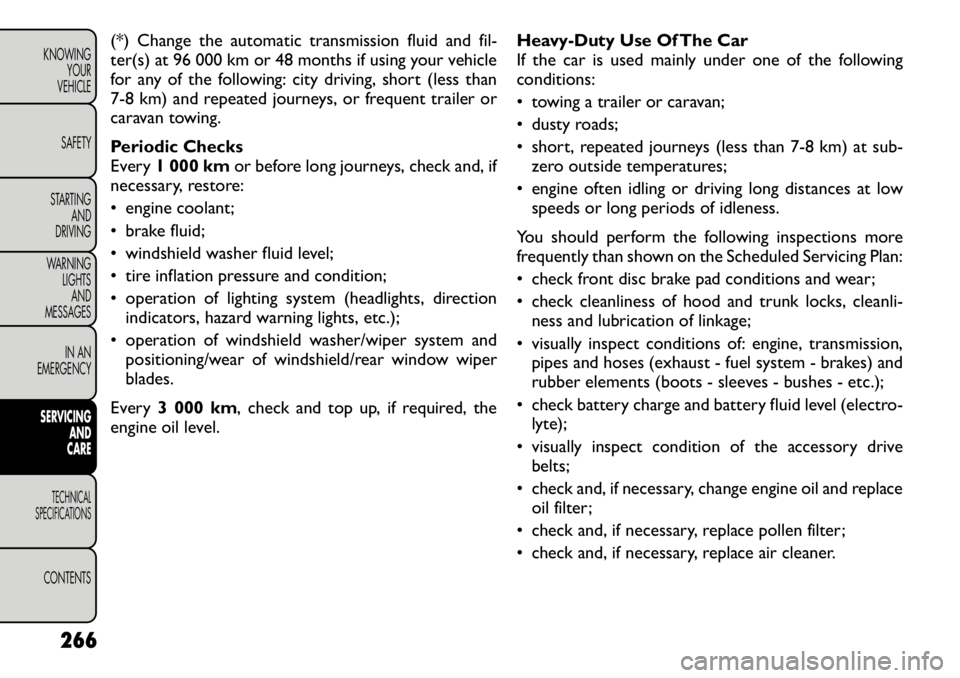
(*) Change the automatic transmission fluid and fil-
ter(s) at 96 000 km or 48 months if using your vehicle
for any of the following: city driving, short (less than
7-8 km) and repeated journeys, or frequent trailer or
caravan towing.
Periodic Checks
Every1 000 km or before long journeys, check and, if
necessary, restore:
• engine coolant;
• brake fluid;
• windshield washer fluid level;
• tire inflation pressure and condition;
• operation of lighting system (headlights, direction
indicators, hazard warning lights, etc.);
• operation of windshield washer/wiper system and positioning/wear of windshield/rear window wiper
blades.
Every 3 000 km , check and top up, if required, the
engine oil level. Heavy-Duty Use Of The Car
If the car is used mainly under one of the followingconditions:
• towing a trailer or caravan;
• dusty roads;
• short, repeated journeys (less than 7-8 km) at sub-
zero outside temperatures;
• engine often idling or driving long distances at low speeds or long periods of idleness.
You should perform the following inspections more
frequently than shown on the Scheduled Servicing Plan:
• check front disc brake pad conditions and wear;
• check cleanliness of hood and trunk locks, cleanli- ness and lubrication of linkage;
• visually inspect conditions of: engine, transmission, pipes and hoses (exhaust - fuel system - brakes) and
rubber elements (boots - sleeves - bushes - etc.);
• check battery charge and battery fluid level (electro- lyte);
• visually inspect condition of the accessory drive belts;
• check and, if necessary, change engine oil and replace oil filter;
• check and, if necessary, replace pollen filter;
• check and, if necessary, replace air cleaner.
266
KNOWING YOUR
VEHICLE
SAFETY
STARTING AND
DRIVING
WARNING LIGHTSAND
MESSAGES
IN AN
EMERGENCYSERVICING AND
CARETECHNICAL
SPECIFICATIONSCONTENTS
Page 274 of 332
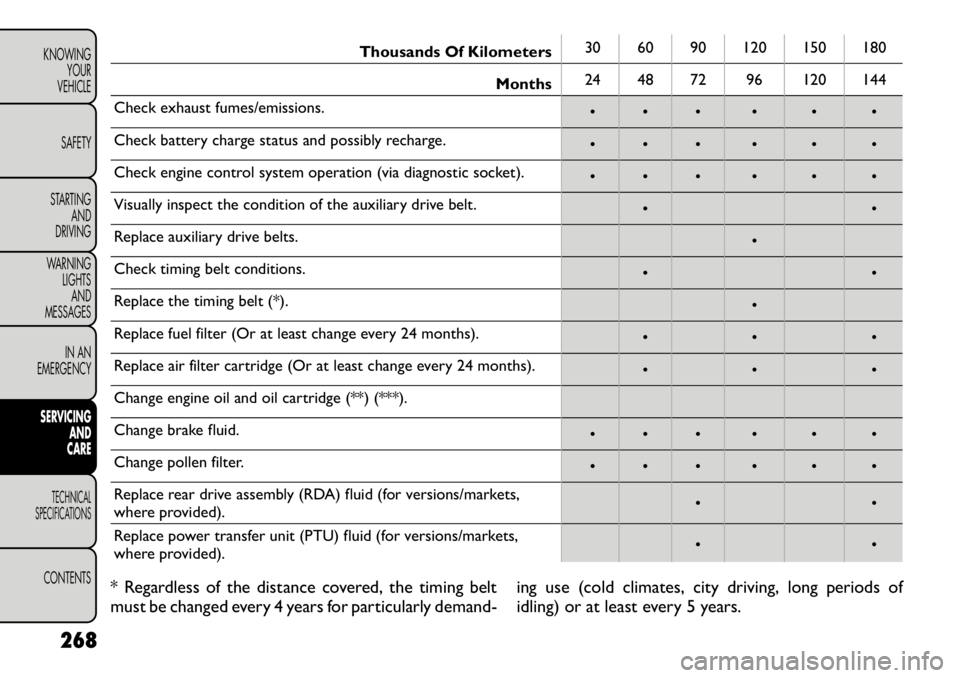
Thousands Of Kilometers30 60 90 120 150 180
Months 24 48 72 96 120 144
Check exhaust fumes/emissions. • • • • • •
Check battery charge status and possibly recharge. • • • • • •
Check engine control system operation (via diagnostic socket). • • • • • •
Visually inspect the condition of the auxiliary drive belt. • •
Replace auxiliary drive belts. •
Check timing belt conditions. • •
Replace the timing belt (*). •
Replace fuel filter (Or at least change every 24 months). • • •
Replace air filter cartridge (Or at least change every 24 months). • • •
Change engine oil and oil cartridge (**) (***).
Change brake fluid. • • • • • •
Change pollen filter. • • • • • •
Replace rear drive assembly (RDA) fluid (for versions/markets,
where provided). • •
Replace power transfer unit (PTU) fluid (for versions/markets,
where provided). • •
* Regardless of the distance covered, the timing belt
must be changed every 4 years for particularly demand- ing use (cold climates, city driving, long periods of
idling) or at least every 5 years.
268
KNOWING YOUR
VEHICLE
SAFETY
STARTING AND
DRIVING
WARNING LIGHTSAND
MESSAGES
IN AN
EMERGENCYSERVICING AND
CARETECHNICAL
SPECIFICATIONSCONTENTS
Page 275 of 332
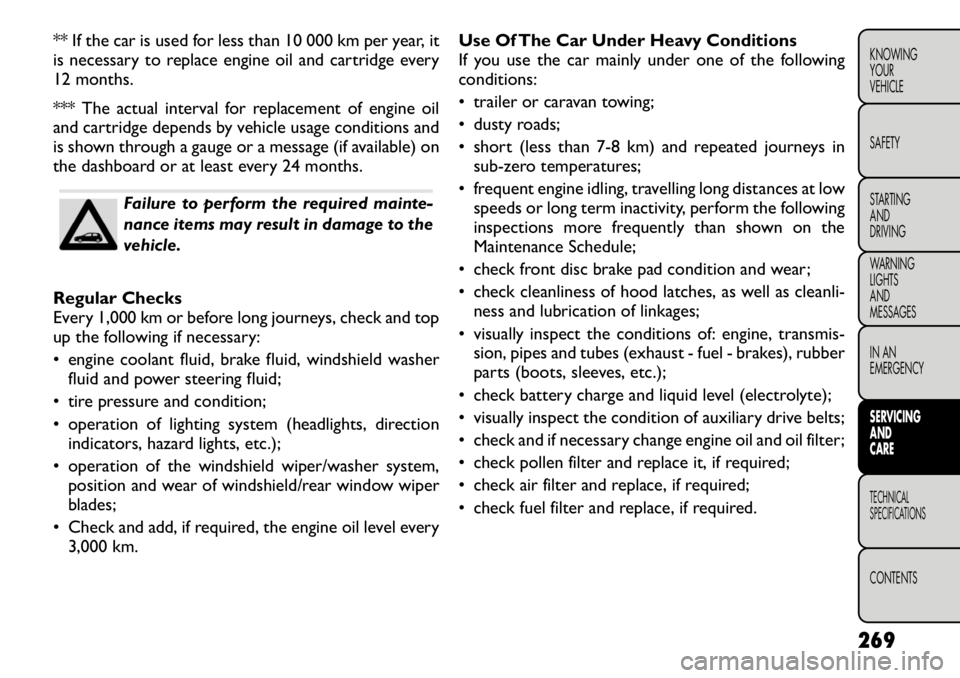
** If the car is used for less than 10 000 km per year, it
is necessary to replace engine oil and cartridge every
12 months.
*** The actual interval for replacement of engine oil
and cartridge depends by vehicle usage conditions and
is shown through a gauge or a message (if available) on
the dashboard or at least every 24 months.
Failure to perform the required mainte-
nance items may result in damage to the
vehicle.
Regular Checks
Every 1,000 km or before long journeys, check and top
up the following if necessary:
• engine coolant fluid, brake fluid, windshield washer fluid and power steering fluid;
• tire pressure and condition;
• operation of lighting system (headlights, direction indicators, hazard lights, etc.);
• operation of the windshield wiper/washer system, position and wear of windshield/rear window wiper
blades;
• Check and add, if required, the engine oil level every 3,000 km. Use Of The Car Under Heavy Conditions
If you use the car mainly under one of the followingconditions:
• trailer or caravan towing;
• dusty roads;
• short (less than 7-8 km) and repeated journeys in
sub-zero temperatures;
• frequent engine idling, travelling long distances at low speeds or long term inactivity, perform the following
inspections more frequently than shown on the
Maintenance Schedule;
• check front disc brake pad condition and wear;
• check cleanliness of hood latches, as well as cleanli- ness and lubrication of linkages;
• visually inspect the conditions of: engine, transmis- sion, pipes and tubes (exhaust - fuel - brakes), rubber
parts (boots, sleeves, etc.);
• check battery charge and liquid level (electrolyte);
• visually inspect the condition of auxiliary drive belts;
• check and if necessary change engine oil and oil filter;
• check pollen filter and replace it, if required;
• check air filter and replace, if required;
• check fuel filter and replace, if required.
269
KNOWING
YOURVEHICLE SAFETY
STARTING ANDDRIVING
WARNING LIGHTSAND
MESSAGES
IN AN
EMERGENCYSERVICING AND
CARETECHNICAL
SPECIFICATIONSCONTENTS
Page 279 of 332
Checking Oil Level – Diesel Engine
To assure proper engine lubrication, the engine oil
must be maintained at the correct level. Check the oil
level at regular intervals, such as every fuel stop.
The best time to check the engine oil level is about five
minutes after a fully warmed engine is shut off or
before starting the engine after it has sat overnight.
Checking the oil while the vehicle is on level ground will
improve the accuracy of the oil level readings. Maintain
the oil level between the MIN and MAX markings on
the dipstick. Adding 1 Liter of oil when the reading is at
the MIN mark will result in a MAX reading on theseengines.
Change Engine Oil – Gasoline Engine
Refer to the “Maintenance Schedule” for the proper
maintenance intervals.
Change Engine Oil – Diesel Engine
Refer to the “Maintenance Schedule” for the proper
maintenance intervals.
Engine Oil Viscosity – 3.6L Gasoline Engine
SAE 5W-30 engine oil is recommended for all operating
temperatures. This engine oil improves low tempera-
ture starting and vehicle fuel economy.The engine oil filler cap also shows the recommended
engine oil viscosity for your vehicle. For information on
engine oil filler cap location, refer to “Engine Compart-
ment” in “Servicing And Care” for further information.
Engine Oil Viscosity – 2.0L Diesel Engine
For best performance and maximum protection under
all types of operating conditions, the manufacturer
recommends Fully Synthetic Low Ash 5W-30 engine
oils that meet the requirements of FIAT 9.55535-S1
spec and ACEA C1/C2.
Materials Added To Engine Oil
Do not add any supplemental materials, other than leak
detection dyes, to the engine oil. Engine oil is an
engineered product and its performance may be im-
paired by supplemental additives.
Disposing Of Used Engine Oil And Oil Filters
Care should be taken in disposing of used engine oil and
oil filters from your vehicle. Used oil and oil filters,
indiscriminately discarded, can present a problem to
the environment. Contact your authorized dealer, ser-
vice station, or governmental agency for advice on how
and where used oil and oil filters can be safely discarded
in your area.
273
KNOWING
YOURVEHICLE SAFETY
STARTING ANDDRIVING
WARNING LIGHTSAND
MESSAGES
IN AN
EMERGENCYSERVICING AND
CARETECHNICAL
SPECIFICATIONSCONTENTS
Page 285 of 332
When refilling the washer fluid reservoir, apply some
washer fluid to a cloth or towel and wipe the wiper
blades clean. This will help blade performance.
To prevent freeze-up of your windshield washer system
in cold weather, select a solution or mixture that meets
or exceeds the temperature range of your climate. This
rating information can be found on most washer fluid
containers.
The fluid reservoir will hold nearly 4 Liters of washer
fluid when the “Washer Fluid Low” message appears in
the EVIC display.
WARNING!
Commercially available windshield
washer solvents are flammable. They
could ignite and burn you. Care must be exer-
cised when filling or working around the washer
solution.
INTERVENTION REGENERATION
STRATEGY – 2.0L DIESEL ENGINE
This vehicle is equipped with a state-of-the-art engine
and exhaust system containing a diesel particulate
filter. The engine and exhaust after-treatment system
work together to meet the Emission standards. The
system manages engine combustion to allow the ex-
haust system’s catalyst to trap and burn Particulate
Matter (PM) pollutants with no input or interaction on
your part. Refer to “Electronic Vehicle Information Center
(EVIC)” in “Knowing Your Vehicle” for further
information.
EXHAUST SYSTEM
The best protection against carbon monoxide entry
into the vehicle body is a properly maintained engine
exhaust system.
Whenever a change is noticed in the sound of the
exhaust system, when exhaust fumes can be detected
inside the vehicle, or when the underside or rear of the
vehicle is damaged, have a competent technician in-
spect the complete exhaust system and adjacent body
areas for broken, damaged, deteriorated, or misposi-
tioned parts. Open seams or loose connections could
permit exhaust fumes to seep into the passenger com-
partment. In addition, inspect the exhaust system each
time the vehicle is raised for lubrication or oil change.
Replace as required.
WARNING!
Exhaust gases can injure or kill. They
contain carbon monoxide (CO), which is
colorless and odorless. Breathing it can make you
unconscious and can eventually poison you. To
avoid breathing CO, refer to “Safety Tips/Exhaust
Gas” in “Safety” for further information.
279
KNOWING
YOURVEHICLE SAFETY
STARTING ANDDRIVING
WARNING LIGHTSAND
MESSAGES
IN AN
EMERGENCYSERVICING AND
CARETECHNICAL
SPECIFICATIONSCONTENTS