lock FIAT FREEMONT 2016 1.G Owners Manual
[x] Cancel search | Manufacturer: FIAT, Model Year: 2016, Model line: FREEMONT, Model: FIAT FREEMONT 2016 1.GPages: 412, PDF Size: 3.36 MB
Page 325 of 412
•Do not use sling type equipment when
towing.Vehicle damage may occur.
• When securing the vehicle to a flat bed
truck, do not attach to front or rear suspension
components. Damage to your vehicle may result
from improper towing.
• Do not push or tow this vehicle with another
vehicle as damage to the bumper fascia and trans-
mission may result .
• If the vehicle being towed requires steering, the
ignition switch must be in the ACC or ON/RUN
position, not in the LOCK/OFF position.
WITHOUT THE KEY FOB
Special care must be taken when the vehicle is towed
with the ignition in the OFF position. Flatbed towing is
the preferred towing method. However, if a flatbed
towing vehicle is not available, wheel lift towing equip-
ment may be used. Rear towing (with the front wheels
on the ground) is not allowed, as transmission damage
will occur. If rear towing is the only alternative, the
front wheels must be placed on a towing dolly. Proper
towing equipment is necessary to prevent damage to
the vehicle. ALL-WHEEL DRIVE (AWD) MODELS
The manufacturer requires towing with all four wheels
OFF
the ground. Acceptable methods are to tow the
vehicle on a flatbed, or with one end of vehicle raised
and the opposite end on a towing dolly.
Towing this vehicle in violation of the
above requirements can cause severe
transmission and/or power transfer unit
damage. Damage from improper towing is not
covered under the New Vehicle Limited Warranty.
FRONT WHEEL DRIVE (FWD) MODELS —
MANUAL TRANSMISSION
The manufacturer recommends towing your vehicle
with all four wheels OFF the ground using a flatbed.
Your vehicle may also be towed in the forward direc-
tion, with all four wheels on the ground, the transmis-
sion in NEUTRAL, and the ignition in the ACC or
ON/RUN position. If the transmission is not operative,
the vehicle must be towed with the front wheels OFF
the ground (using a flatbed truck, towing dolly, or
wheel lift equipment with the front wheels raised).
319
KNOWING
YOUR
VEHICLE
SAFETY
STARTING
AND
DRIVING
WARNING
LIGHTS
AND
MESSAGES
IN AN
EMERGENCY
SER VICING
AND
CARE
TECHNICAL
SPECIFICATIONS
CONTENTS
Page 328 of 412
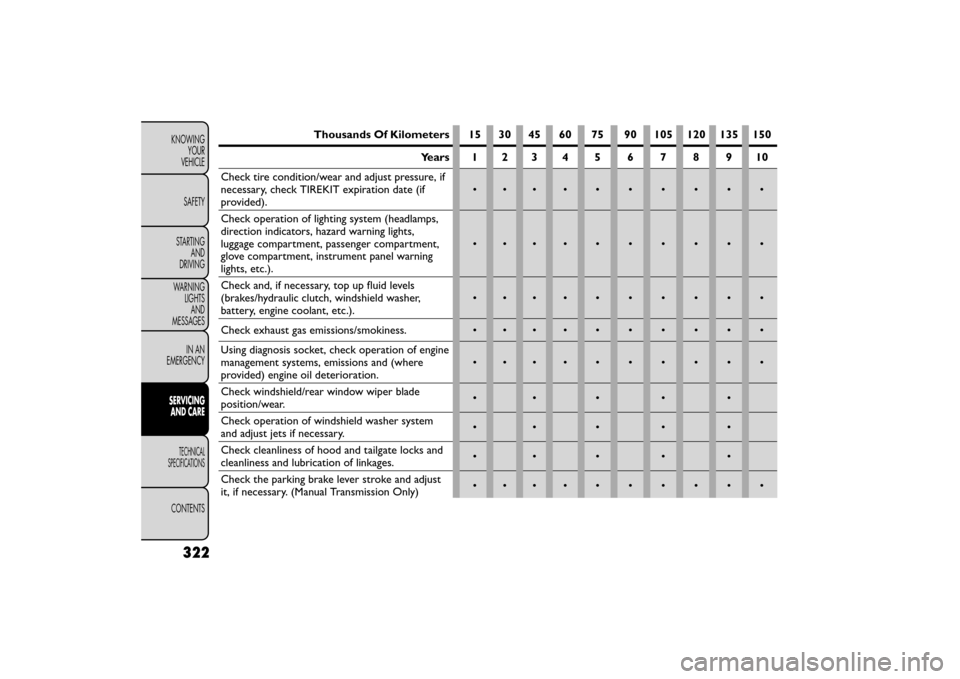
Thousands Of Kilometers 15 30 45 60 75 90 105 120 135 150Years 1 2 3 4 5678910
Check tire condition/wear and adjust pressure, if
necessary, check TIREKIT expiration date (if
provided). ••••••••••
Check operation of lighting system (headlamps,
direction indicators, hazard warning lights,
luggage compartment, passenger compartment,
glove compartment, instrument panel warning
lights, etc.). ••••••••••
Check and, if necessary, top up fluid levels
(brakes/hydraulic clutch, windshield washer,
battery, engine coolant, etc.). ••••••••••
Check exhaust gas emissions/smokiness. • • • • ••••••
Using diagnosis socket, check operation of engine
management systems, emissions and (where
provided) engine oil deterioration. ••••••••••
Check windshield/rear window wiper blade
position/wear. •••••
Check operation of windshield washer system
and adjust jets if necessary. •••••
Check cleanliness of hood and tailgate locks and
cleanliness and lubrication of linkages. •••••
Check the parking brake lever stroke and adjust
it, if necessary. (Manual Transmission Only) ••••••••••
322
KNOWING
YOUR
VEHICLE
SAFETY
STARTING AND
DRIVING
WARNING LIGHTSAND
MESSAGES
IN AN
EMERGENCY
SERVICINGAND C ARE
TECHNICAL
SPECIFICATIONS
CONTENTS
Page 331 of 412
Every3,000 km, check and top up, if required, the
engine oil level and automatic transmission fluid level
(four-speed automatic only).
Heavy-Duty Use Of The Car
If the car is used mainly under one of the following
conditions:
• towing a trailer or caravan;
• dusty roads;
• short, repeated journeys (less than 7-8 km) at sub- zero outside temperatures;
• engine often idling or driving long distances at low speeds or long periods of idleness.
You should perform the following inspections more
frequently than shown on the Scheduled Servicing Plan:
• check front disc brake pad conditions and wear;
• check cleanliness of hood and trunk locks, cleanli- ness and lubrication of linkage;
• visually inspect conditions of: engine, transmission, pipes and hoses (exhaust - fuel system - brakes) and
rubber elements (boots - sleeves - bushes - etc.);
• check battery charge and battery fluid level (electro- lyte); • visually inspect condition of the accessory drive
belts;
• check and, if necessary, change engine oil and replace oil filter;
• check and, if necessary, replace pollen filter;
• check and, if necessary, replace air cleaner.
MAINTENANCE SCHEDULE — DIESEL
ENGINE
To help you have the best driving experience possible,
the manufacturer has identified the specific vehicle
maintenance service intervals that are required to keep
your vehicle operating properly and safely.
The manufacturer recommends that these mainte-
nance intervals be performed at your selling dealer. The
technicians at your dealership know your vehicle best,
and have access to factory trained information, genuine
FIAT parts, and specially designed electronic and me-
chanical tools that can help prevent future costly re-
pairs.
The maintenance intervals shown should be performed
as indicated in this section.
325
KNOWING
YOUR
VEHICLE
SAFETY
STARTING
AND
DRIVING
WARNING
LIGHTS
AND
MESSAGES
IN AN
EMERGENCY
SERVICING
AND C ARE
TECHNICAL
SPECIFICATIONS
CONTENTS
Page 334 of 412
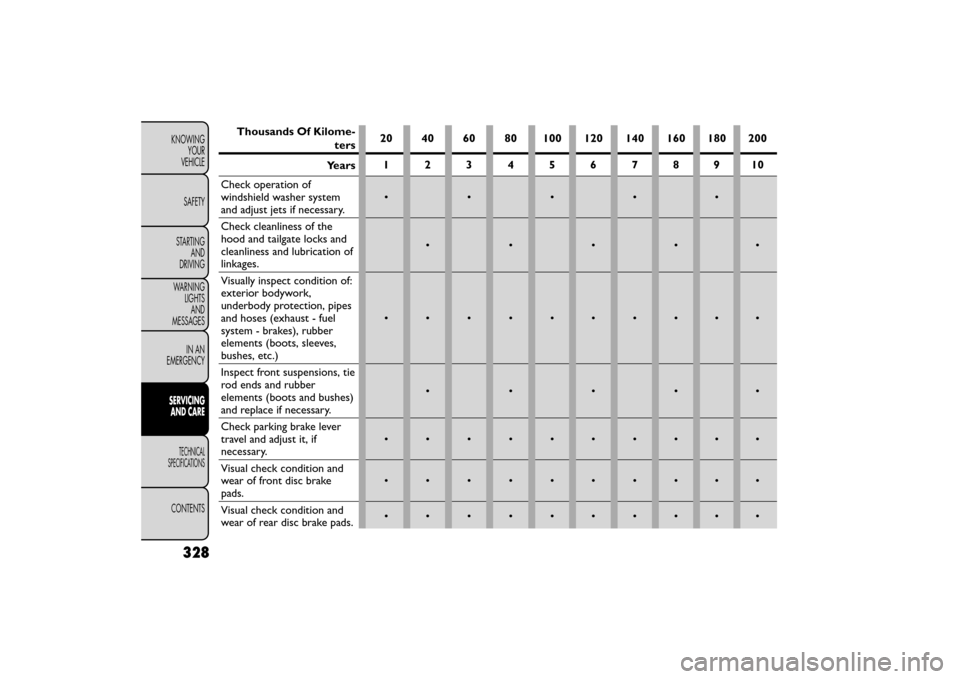
Thousands Of Kilome-
ters20 40 60 80 100 120 140 160 180 200
12345678910
Check operation of
windshield washer system
and adjust jets if necessary.
•••••
Check cleanliness of the
hood and tailgate locks and
cleanliness and lubrication of
linkages.
•••••
Visually inspect condition of:
exterior bodywork,
underbody protection, pipes
and hoses (exhaust - fuel
system - brakes), rubber
elements (boots, sleeves,
bushes, etc.)
••••••••••
Inspect front suspensions, tie
rod ends and rubber
elements (boots and bushes)
and replace if necessary.
•••••
Check parking brake lever
travel and adjust it, if
necessary.
••••••••••
Visual check condition and
wear of front disc brake
pads.
••••••••••
Visual check condition and
wear of rear disc brake pads.••••••••••
328
KNOWINGYOURVEHICLE
SAFETY
STARTINGANDDRIVING
WARNINGLIGHTSANDMESSAGES
IN ANEMERGENCY
SERVICINGAND CARE
TECHNICALSPECIFICATIONS
CONTENTS
Years
Page 337 of 412
Failure to perform the required mainte-
nance items may result in damage to the
vehicle.
Periodic Checks
Every 1,000 km or before long journeys, check and, if
necessary, restore:
• engine coolant;
• brake fluid;
• power steering fluid;
• windshield washer fluid level;
• tire inflation pressure and condition;
• operation of lighting system (headlights, direction indicators, hazard warning lights, etc.);
• operation of windshield washer/wiper system and positioning/wear of windshield/rear window wiper
blades.
Every 3,000 km, check and top up, if required, the
engine oil level.
Heavy-Duty Use Of The Car
If the car is used mainly under one of the following
conditions:
• towing a trailer or caravan; • dusty roads;
• short, repeated journeys (less than 7-8 km) at sub-
zero outside temperatures;
• engine often idling or driving long distances at low speeds or long periods of idleness.
You should perform the following inspections more
frequently than shown on the Scheduled Servicing Plan:
• check front disc brake pad conditions and wear;
• check cleanliness of hood and trunk locks, cleanli- ness and lubrication of linkage;
• visually inspect conditions of: engine, transmission, pipes and hoses (exhaust - fuel system - brakes) and
rubber elements (boots - sleeves - bushes - etc.);
• check battery charge and battery fluid level (electro- lyte);
• visually inspect condition of the accessory drive belts;
• check and, if necessary, change engine oil and replace oil filter;
• check and, if necessary, replace pollen filter;
• check and, if necessary, replace air cleaner.
331
KNOWING
YOUR
VEHICLE
SAFETY
STARTING
AND
DRIVING
WARNING
LIGHTS
AND
MESSAGES
IN AN
EMERGENCY
SERVICING
AND C ARE
TECHNICAL
SPECIFICATIONS
CONTENTS
Page 347 of 412
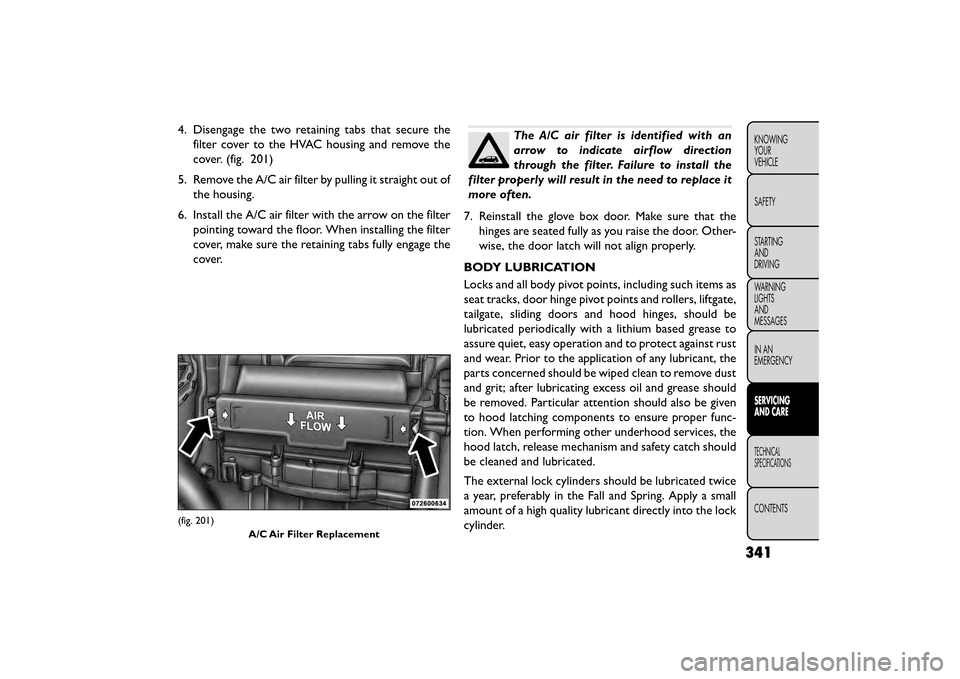
4. Disengage the two retaining tabs that secure thefilter cover to the HVAC housing and remove the
cover. (fig. 201)
5. Remove the A/C air filter by pulling it straight out of the housing.
6. Install the A/C air filter with the arrow on the filter pointing toward the floor. When installing the filter
cover, make sure the retaining tabs fully engage the
cover.The A/C air filter is identified with an
arrow to indicate airflow direction
through the filter. Failure to install the
filter properly will result in the need to replace it
more often.
7. Reinstall the glove box door. Make sure that the hinges are seated fully as you raise the door. Other-
wise, the door latch will not align properly.
BODY LUBRICATION
Locks and all body pivot points, including such items as
seat tracks, door hinge pivot points and rollers, liftgate,
tailgate, sliding doors and hood hinges, should be
lubricated periodically with a lithium based grease to
assure quiet, easy operation and to protect against rust
and wear. Prior to the application of any lubricant, the
parts concerned should be wiped clean to remove dust
and grit; after lubricating excess oil and grease should
be removed. Particular attention should also be given
to hood latching components to ensure proper func-
tion. When performing other underhood services, the
hood latch, release mechanism and safety catch should
be cleaned and lubricated.
The external lock cylinders should be lubricated twice
a year, preferably in the Fall and Spring. Apply a small
amount of a high quality lubricant directly into the lock
cylinder.
(fig. 201) A/C Air Filter Replacement
341
KNOWING
YOUR
VEHICLE
SAFETY
STARTING
AND
DRIVING
WARNING
LIGHTS
AND
MESSAGES
IN AN
EMERGENCY
SERVICING
AND CARE
TECHNICAL
SPECIFICATIONS
CONTENTS
Page 351 of 412
NOTE:Intentional tampering with emissions control
systems can result in civil penalties being assessed
against you.
WARNING!
A hot exhaust system can start a fire if you
park over materials that can burn. Such
materials might be grass or leaves coming into
contact with your exhaust system. Do not park or
operate your vehicle in areas where your exhaust
system can contact anything that can burn.
In unusual situations involving grossly malfunctioning
engine operation, a scorching odor may indicate severe
and abnormal catalyst overheating. If this occurs, safely
bring the vehicle to a complete stop, shut the engine
OFF, and allow the vehicle to cool. Thereafter, obtain
service, including a tune-up to manufacturer’s specifi-
cations immediately.
To minimize the possibility of catalyst damage:
• Do not shut OFF the engine or interrupt the ignition when the transmission is in gear and the vehicle is in
motion.
• Do not try to start the engine by pushing or towing the vehicle.
• Do not idle the engine with any ignition coil connec- tors disconnected for prolonged periods. COOLING SYSTEM
WARNING!
• When working near the radiator cool-
in g
fan, disconnect the fan motor lead or
turn the ignition switch to the LOCK position.The
fan is temperature controlled and can start at
any time the ignition switch is in the ON position.
• You or others can be badly burned by hot
engine coolant (antifreeze) or steam from your
radiator. If you see or hear steam coming from
under the hood, do not open the hood until the
radiator has had time to cool. Never tr y to open a
cooling system pressure cap when the radiator is
hot .
Car maintenance should be done at a
FIAT Dealership. For routine and minor
maintenance operations you wish to
carry out yourself, we do recommend you have
the proper equipment , genuine FIAT spare parts
and the necessary fluids; do not however carry out
these operations if you have no experience.
345
KNOWING
YOUR
VEHICLE
SAFETY
STARTING
AND
DRIVING
WARNING
LIGHTS
AND
MESSAGES
IN AN
EMERGENCY
SERVICING
AND C ARE
TECHNICAL
SPECIFICATIONS
CONTENTS
Page 366 of 412
TECHNICAL SPECIFICATIONS
VEHICLE IDENTIFICATION NUMBER
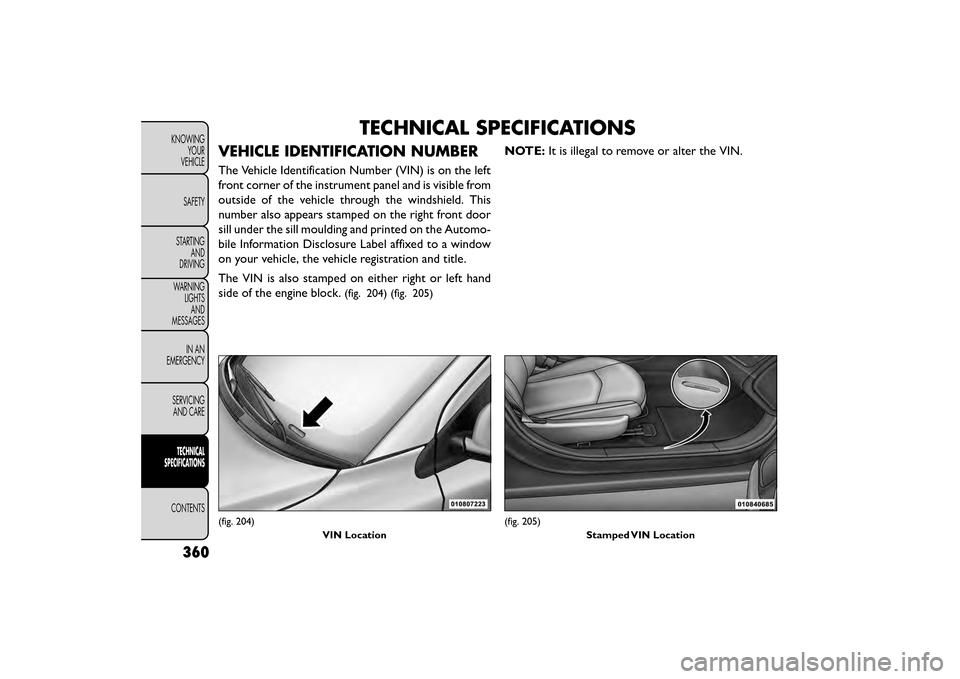
The Vehicle Identification Number (VIN) is on the left
front corner of the instrument panel and is visible from
outside of the vehicle through the windshield. This
number also appears stamped on the right front door
sill under the sill moulding and printed on the Automo-
bile Information Disclosure Label affixed to a window
on your vehicle, the vehicle registration and title.
The VIN is also stamped on either right or left hand
side of the engine block.
(fig. 204) (fig. 205)
NOTE:It is illegal to remove or alter the VIN.
(fig. 204)
VIN Location(fig. 205)Stamped VIN Location
360
KNOWINGYOUR
VEHICLE
SAFETY
STARTING AND
DRIVING
WARNING LIGHTSAND
MESSAGES
IN AN
EMERGENCY
SERVICINGAND CARE
TECHNICAL
SPECIFICATIONS
CONTENTS
Page 389 of 412
SELECTION OF ENGINE OIL FOR FLEXIBLE
FUEL VEHICLES (E-85) AND GASOLINE
VEHICLES
FFV vehicles operated on E-85 require specially formu-
lated engine oils. These special requirements are in-
cluded in SELENIA K POWER fully synthetic engine
oils, and in equivalent oils meeting FIAT Qualification
9.55535-CR1 API SN, ILSAC GF-5. The manufacturer
only recommends engine oils that are API Certified and
meet the requirements of FIAT Qualification 9.55535-
CR1 API SN, ILSAC GF-5 that contain additional re-
quirements, developed during extensive fleet testing,
to provide additional protection for your engine. Use
SELENIA K POWER fully synthetic engine oils or an
equivalent oil meeting the requirements of FIAT Quali-
fication 9.55535-CR1 API SN, ILSAC GF-5.
STARTING
The characteristics of E-85 fuel make it unsuitable for
use when ambient temperatures fall below -18°C. In
the range of -18°C to 0°C, you may experience an
increase in the time it takes for your engine to start,
and a deterioration in driveability (sags and/or hesita-
tions) until the engine is fully warmed up.NOTE:
Use of the engine block heater (if equipped) is
beneficial for E-85 startability when the ambient tem-
perature is less than 0°C.
CRUISING RANGE
Because E-85 fuel contains less energy per liter than
gasoline, you will experience an increase in fuel con-
sumption. You can expect your kilometers per liter and
your driving range to decrease by about 30%, com-
pared to gasoline operation.
REPLACEMENT PARTS
Many components in your Flexible Fuel Vehicle (FFV)
are designed to be compatible with ethanol. Always be
sure that your vehicle is serviced with correct ethanol
compatible parts.
Replacing fuel system components with
non-ethanol compatible components
can damage your vehicle.
MAINTENANCE
Do not use ethanol mixture greater than
85% in your vehicle. It will cause difficulty
in cold starting and may affect drivability.
383
KNOWING
YOUR
VEHICLE
SAFETY
STARTING
AND
DRIVING
WARNING
LIGHTS
AND
MESSAGES
IN AN
EMERGENCY
SERVICING
AND CARE
TECHNICAL
SPECIFICATIONS
CONTENTS
Page 397 of 412
CONTENTS
About Your Brakes..................... .140, 242
ABS (Anti-Lock Brake System) . . . . . .........141, 278
Adding Engine Coolant (Antifreeze) . . ............347
Adding Fuel ............................. .190
Adding Washer Fluid . . . .................... .343
Additives, Fuel . .......................... .380
Airbag................................ .205
Air Bag Advance Front Air Bag . ................205, 206
Air Bag Components . ................... .205
Air bag Operation ...................... .207
Air Bag Warning Light . ................... .213
Enhanced Accident Response . . . . ............212
Event Data Recorder (EDR) . . . . . ............215
FrontAirBag ......................... .205
If A Deployment Occurs . . . . . . .............211
Knee Impact Bolsters . . . . . . . . .............207
Maintaining Your Air Bag System .............214
Side Air Bags . . . . . . . . .................. .208
Air bag Light ..................... .213, 235, 273
Air bag Maintenance ....................... .214
Air Cleaner, Engine (Engine Air Cleaner Filter) ......338
Air Conditioner Maintenance . . . . . . . ...........339
Air Conditioning Filter . . . .................90, 340
Air Conditioning, Operating Tips . . . . ..........89, 91
Air Conditioning, Rear Zone . . . . . . . . .........76, 86
Air Conditioning Refrigerant . . . ............339, 340
Air Conditioning System . ................... .339
Air Pressure, Tires ..................... .275, 370
Alarm (Security Alarm) ................... .16, 278
Alarm System (Security Alarm) ...............16, 18All Wheel Drive (AWD)
.................... .255
Alterations/Modifications, Vehicle .................5
Antifreeze (Engine Coolant) ............346, 347, 384
Disposal ............................ .348
Anti-Lock Brake System (ABS) .................141
Anti-Lock War
ning Light ..............141, 143, 278
Arming System (Security Alarm) .................16
Auto Down Power Windows ..................128
Automatic Dimming Mirror ....................66
Automatic Door Locks ..................... .121
Automatic Headlights ........................92
Automatic Oil Change Indicator .................28
Automatic Transmission ................. .246, 351
Adding Fluid .......................... .352
Autostick ............................ .254
Fluid and Filter Changes .................. .354
Fluid Level Check ...................... .352
Gear Ranges .......................... .249
Autostick .............................. .254
Auto Unlock, Doors ....................... .121
Auxiliary Electrical Outlet (Power Outlet) .........112
Auxiliary Power Outlet ..................... .112
Back-Up Lights ........................... .305
Battery ................................ .338
Gas Caution .......................... .339
Keyless Transmitter Replacement (RKE) .........14
Location ............................ .338
Belts, Seat .............................. .234
Body Mechanism Lubrication ..................341
B-Pillar Location .......................... .366
391
KNOWING
YOUR
VEHICLE
SAFETY
STARTING
AND
DRIVING
WARNING
LIGHTS
AND
MESSAGES
IN AN
EMERGENCY
SERVICING
AND CARE
TECHNICAL
SPECIFICATIONS
CONTENTS