fuel FIAT FREEMONT 2016 1.G Owner's Manual
[x] Cancel search | Manufacturer: FIAT, Model Year: 2016, Model line: FREEMONT, Model: FIAT FREEMONT 2016 1.GPages: 412, PDF Size: 3.36 MB
Page 274 of 412
TOWING TIPS
Before setting out on a trip, practice turning, stopping,
and backing up the trailer in an area located away from
heavy traffic.
Manual Transmission (for versions/markets,
where provided)
If using a manual transmission vehicle for trailer towing,
all starts must be in FIRST gear to avoid clutch slippage.
Automatic Transmission (for versions/
markets,where provided)
The DRIVE range can be selected when towing. How-
ever, if frequent shifting occurs while in DRIVE, use the
AutoStick® shift control to manually select a lower
gear.
NOTE:Using a lower gear while operating the vehicle
under heavy loading conditions will improve perfor-
mance and extend transmission life by reducing exces-
sive shifting and heat build up. This action will also
provide better engine braking.
If you REGULARLY tow a trailer for more than 45
minutes of continuous operation, then change the
transmission fluid and filter as specified for “police,
taxi, fleet, or frequent trailer towing.” Refer to the
“Maintenance Schedule” for the proper maintenance
intervals. NOTE:
Check the transmission fluid level (four-speed
transmission only) before towing. The six-speed trans-
mission does not require a fluid level check before
towing. If, however, you notice fluid leakage or trans-
mission malfunction, see your authorized dealer imme-
diately for assistance.
Electronic Speed Control
• Do not use in hilly terrain or with heavy loads.
• When using the speed control, if you experience speed drops greater than 16 km/h, disengage until
you can get back to cruising speed.
• Use speed control in flat terrain and with light loads to maximize fuel efficiency.
AutoStick®
• When using the AutoStick® shift control, select the highest gear that allows for adequate performance
and avoids frequent downshifts. For example, choose
“4” if the desired speed can be maintained. Choose
“3” or “2” if needed to maintain the desired speed.
• To prevent excess heat generation, avoid continuous driving at high RPM. Reduce vehicle speed as neces-
sary to avoid extended driving at high RPM. Return
to a higher gear or vehicle speed when grade and
road conditions allow.
268
KNOWING YOUR
VEHICLE
SAFETY
STARTING AND
DRIVING
WARNING LIGHTSAND
MESSAGES
INAN
EMERGENC
Y
SERVICING AND CARE
TECHNICAL
SPECIFICATIONS
CONTENTS
Page 279 of 412
INSTRUMENT CLUSTER
DESCRIPTIONS
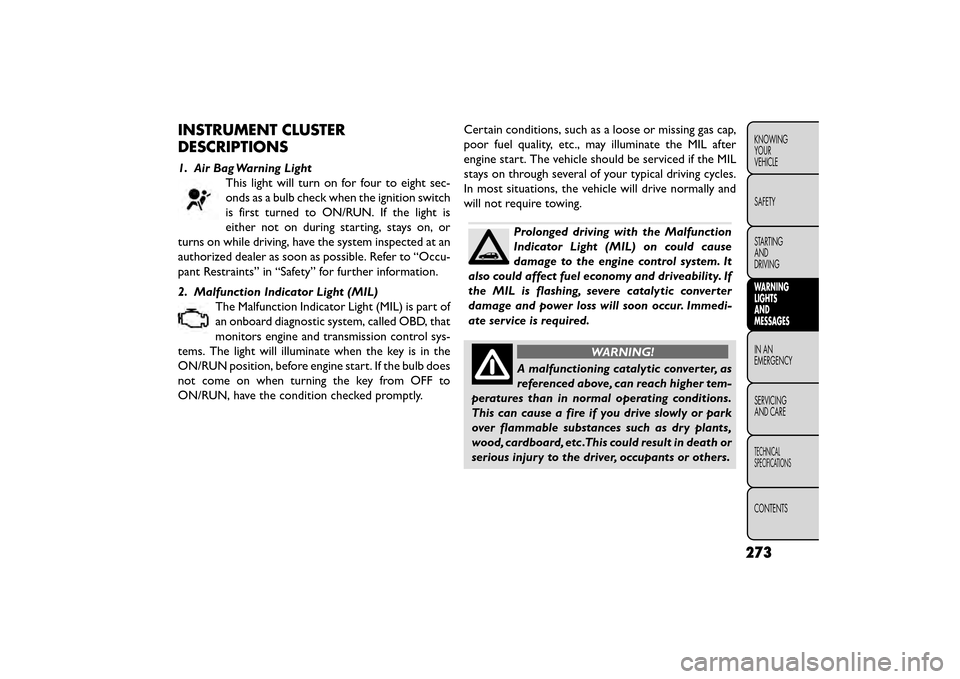
1. Air Bag Warning LightThis light will turn on for four to eight sec-
onds as a bulb check when the ignition switch
is first turned to ON/RUN. If the light is
either not on during starting, stays on, or
turns on while driving, have the system inspected at an
authorized dealer as soon as possible. Refer to “Occu-
pant Restraints” in “Safety” for further information.
2. Malfunction Indicator Light (MIL) The Malfunction Indicator Light (MIL) is part of
an onboard diagnostic system, called OBD, that
monitors engine and transmission control sys-
tems. The light will illuminate when the key is in the
ON/RUN position, before engine start. If the bulb does
not come on when turning the key from OFF to
ON/RUN, have the condition checked promptly. Certain conditions, such as a loose or missing gas cap,
poor fuel quality, etc., may illuminate the MIL after
engine start. The vehicle should be serviced if the MIL
stays on through several of your typical driving cycles.
In most situations, the vehicle will drive normally and
will not require towing.
Prolonged driving with the Malfunction
Indicator Light (MIL) on could cause
damage to the engine control system. It
also could affect fuel economy and driveability. If
the MIL is flashing, severe catalytic converter
damage and power loss will soon occur. Immedi-
ate service is required.
WARNING!
A malfunctioning catalytic converter, as
referen c
ed above, can reach higher tem-
peratures than in normal operating conditions.
This can cause a fire if you drive slowly or park
over flammable substances such as dry plants,
wood, cardboard, etc .This could result in death or
serious injury to the driver, occupants or others.
273
KNOWING
YOUR
VEHICLE
SAFETY
STARTING
AND
DRIVING
WARNING
LIGHTS
AND
MESSAGES
IN AN
EMERGENC
Y
SERVICING
AND
CARE
TECHNICAL
SPECIFICATIONS
CONTENTS
Page 281 of 412
7. Odometer Display / Electronic Vehicle Informa-
tion Center (EVIC) Display
Odometer
The odometer display shows the total distance the
vehicle has been driven.
Electronic Vehicle Information Center (EVIC) Dis-
play
The Electronic Vehicle Information Center (EVIC) fea-
tures a driver-interactive display that is located in the
instrument cluster. For further information, refer to
“Electronic Vehicle Information Center (EVIC)” in
“Knowing Your Vehicle”.
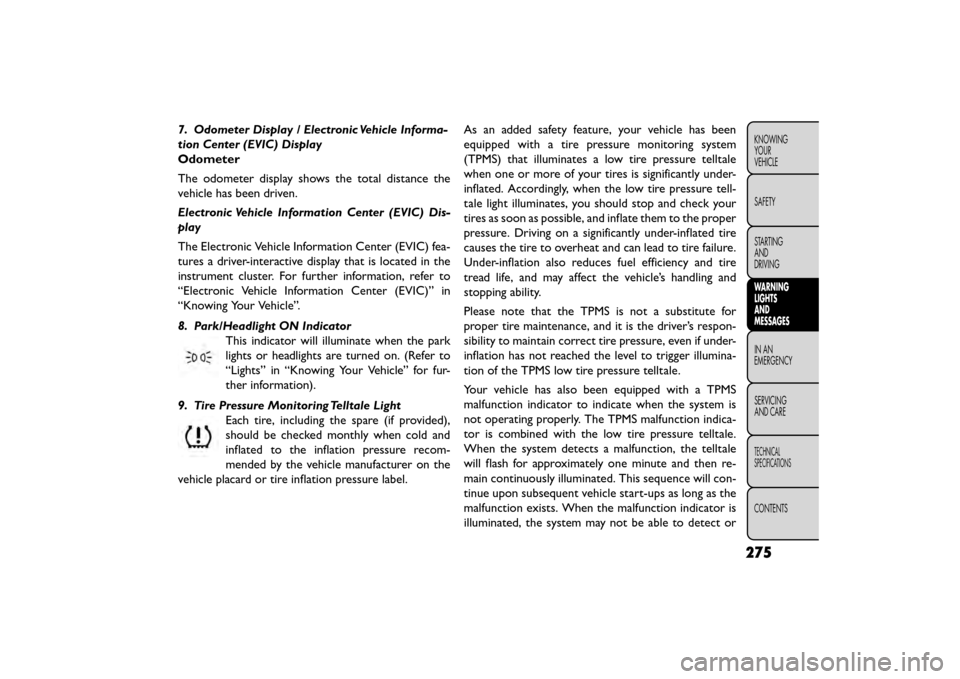
8. Park/Headlight ON IndicatorThis indicator will illuminate when the park
lights or headlights are turned on. (Refer to
“Lights” in “Knowing Your Vehicle” for fur-
ther information).
9. Tire Pressure Monitoring Telltale Light Each tire, including the spare (if provided),
should be checked monthly when cold and
inflated to the inflation pressure recom-
mended by the vehicle manufacturer on the
vehicle placard or tire inflation pressure label. As an added safety feature, your vehicle has been
equipped with a tire pressure monitoring system
(TPMS) that illuminates a low tire pressure telltale
when one or more of your tires is significantly under-
inflated. Accordingly, when the low tire pressure tell-
tale light illuminates, you should stop and check your
tires as soon as possible, and inflate them to the proper
pressure. Driving on a significantly under-inflated tire
causes the tire to overheat and can lead to tire failure.
Under-inflation also reduces fuel efficiency and tire
tread life, and may affect the vehicle’s handling and
stopping ability.
Please note that the TPMS is not a substitute for
proper tire maintenance, and it is the driver’s respon-
sibility to maintain correct tire pressure, even if under-
inflation has not reached the level to trigger illumina-
tion of the TPMS low tire pressure telltale.
Your vehicle has also been equipped with a TPMS
malfunction indicator to indicate when the system is
not operating properly. The TPMS malfunction indica-
tor is combined with the low tire pressure telltale.
When the system detects a malfunction, the telltale
will flash for approximately one minute and then re-
main continuously illuminated. This sequence will con-
tinue upon subsequent vehicle start-ups as long as the
malfunction exists. When the malfunction indicator is
illuminated, the system may not be able to detect or
275
KNOWING
YOUR
VEHICLE
SAFETY
STARTING
AND
DRIVING
WARNING
LIGHTS
AND
MESSAGES
IN
AN
EMERGENC
Y
SERVICING
AND
CARE
TECHNICAL
SPECIFICATIONS
CONTENTS
Page 284 of 412
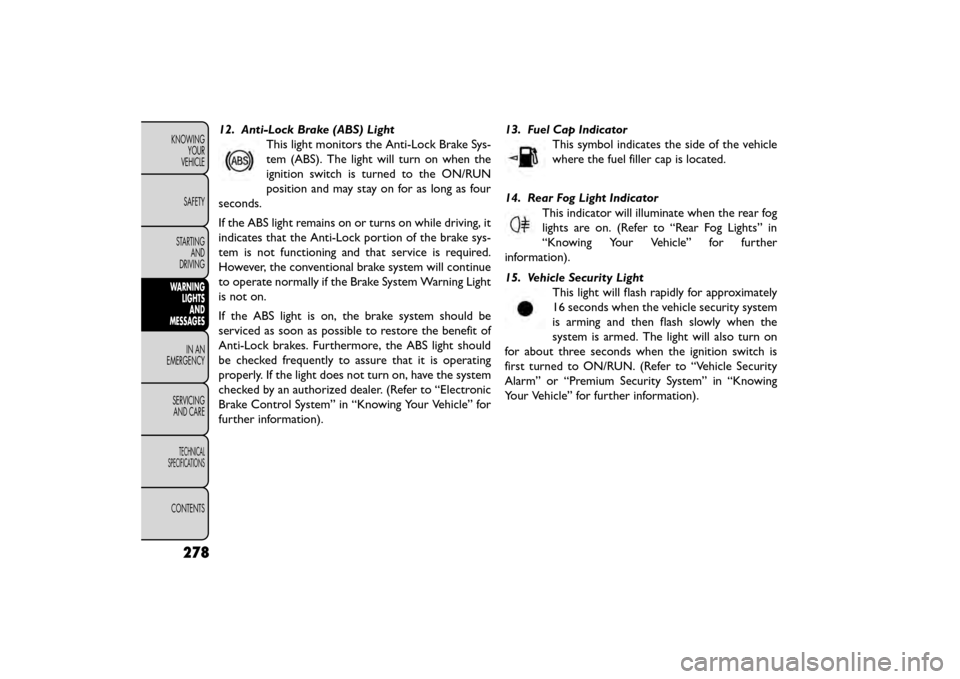
12. Anti-Lock Brake (ABS) LightThis light monitors the Anti-Lock Brake Sys-
tem (ABS). The light will turn on when the
ignition switch is turned to the ON/RUN
position and may stay on for as long as four
seconds.
If the ABS light remains on or turns on while driving, it
indicates that the Anti-Lock portion of the brake sys-
tem is not functioning and that service is required.
However, the conventional brake system will continue
to operate normally if the Brake System Warning Light
is not on.
If the ABS light is on, the brake system should be
serviced as soon as possible to restore the benefit of
Anti-Lock brakes. Furthermore, the ABS light should
be checked frequently to assure that it is operating
properly. If the light does not turn on, have the system
checked by an authorized dealer. (Refer to “Electronic
Brake Control System” in “Knowing Your Vehicle” for
further information). 13. Fuel Cap Indicator
This symbol indicates the side of the vehicle
where the fuel filler cap is located.
14. Rear Fog Light Indicator This indicator will illuminate when the rear fog
lights are on. (Refer to “Rear Fog Lights” in
“Knowing Your Vehicle” for further
information).
15. Vehicle Security Light This light will flash rapidly for approximately
16 seconds when the vehicle security system
is arming and then flash slowly when the
system is armed. The light will also turn on
for about three seconds when the ignition switch is
first turned to ON/RUN. (Refer to “Vehicle Security
Alarm” or “Premium Security System” in “Knowing
Your Vehicle” for further information).
278
KNOWING YOUR
VEHICLE
SAFETY
STARTING AND
DRIVING
WARNING LIGHTSAND
MESSAGES
INAN
EMERGENC
Y
SERVICING AND
CARE
TECHNICAL
SPECIFICATIONS
CONTENTS
Page 317 of 412
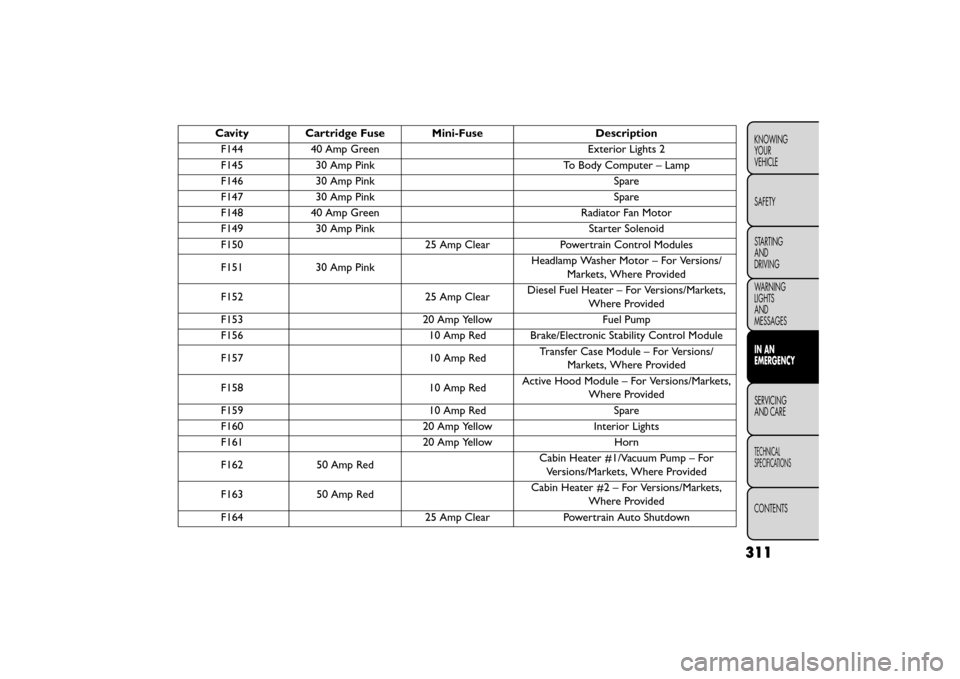
Cavity Cartridge Fuse Mini-FuseDescription
F144 40 Amp Green Exterior Lights 2
F145 30 Amp Pink To Body Computer – Lamp
F146 30 Amp Pink Spare
F147 30 Amp Pink Spare
F148 40 Amp Green Radiator Fan Motor
F149 30 Amp Pink Starter Solenoid
F150 25 Amp ClearPowertrain Control Modules
F151 30 Amp Pink Headlamp Washer Motor – For Versions/
Markets, Where Provided
F152 25 Amp ClearDiesel Fuel Heater – For Versions/Markets,
Where Provided
F153 20 Amp YellowFuel Pump
F156 10 Amp Red Brake/Electronic Stability Control Module
F157 10 Amp RedTransfer Case Module – For Versions/
Markets, Where Provided
F158 10 Amp RedActive Hood Module – For Versions/Markets,
Where Provided
F159 10 Amp RedSpare
F160 20 Amp YellowInterior Lights
F161 20 Amp YellowHorn
F162 50 Amp Red Cabin Heater #1/Vacuum Pump – For
Versions/Markets, Where Provided
F163 50 Amp Red Cabin Heater #2 – For Versions/Markets,
Where Provided
F164 25 Amp ClearPowertrain Auto Shutdown
311
KNOWING
YOUR
VEHICLE
SAFETY
STARTING
AND
DRIVING
WARNING
LIGHTS
AND
MESSAGES
IN AN
EMERGENCY
SERVICING
AND
CARE
TECHNICAL
SPECIFICATIONS
CONTENTS
Page 329 of 412
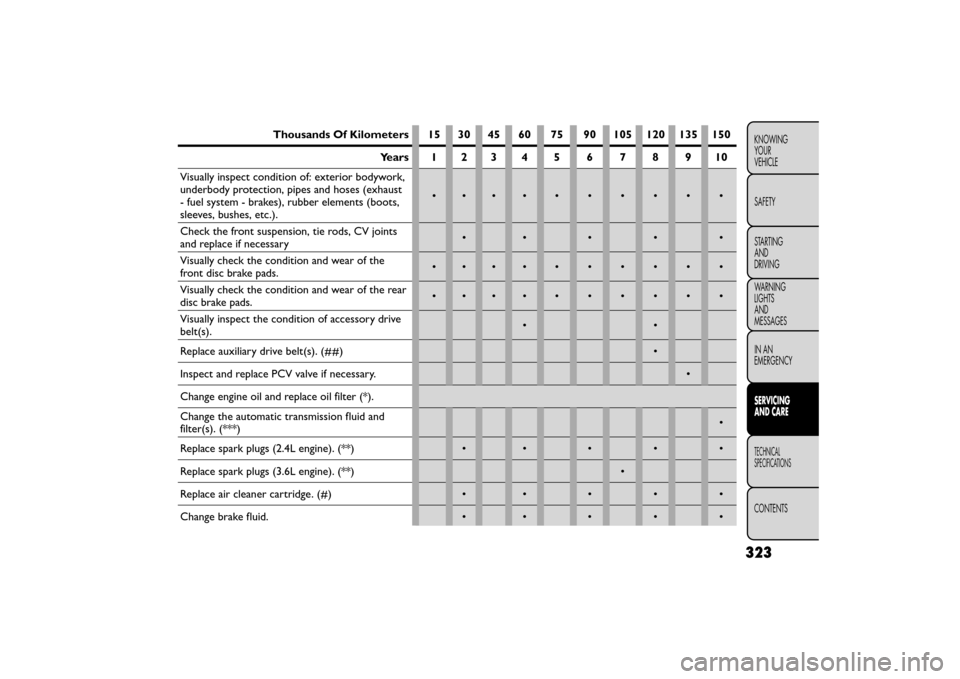
Thousands Of Kilometers 15 30 45 60 75 90 105 120 135 150Years 1 2 3 4 5678910
Visually inspect condition of: exterior bodywork,
underbody protection, pipes and hoses (exhaust
- fuel system - brakes), rubber elements (boots,
sleeves, bushes, etc.). ••••••••••
Check the front suspension, tie rods, CV joints
and replace if necessary •••••
Visually check the condition and wear of the
front disc brake pads. ••••••••••
Visually check the condition and wear of the rear
disc brake pads. ••••••••••
Visually inspect the condition of accessory drive
belt(s). ••
Replace auxiliary drive belt(s). (##) •
Inspect and replace PCV valve if necessary. •
Change engine oil and replace oil filter (*).
Change the automatic transmission fluid and
filter(s). (***) •
Replace spark plugs (2.4L engine). (**) • • • • •
Replace spark plugs (3.6L engine). (**) •
Replace air cleaner cartridge. (#) • • • • •
Change brake fluid. • • • • •
323
KNOWING
YOUR
VEHICLE
SAFETY
STARTING
AND
DRIVING
WARNING
LIGHTS
AND
MESSAGES
IN AN
EMERGENCY
SERVICING
AND C ARE
TECHNICAL
SPECIFICATIONS
CONTENTS
Page 331 of 412
Every3,000 km, check and top up, if required, the
engine oil level and automatic transmission fluid level
(four-speed automatic only).
Heavy-Duty Use Of The Car
If the car is used mainly under one of the following
conditions:
• towing a trailer or caravan;
• dusty roads;
• short, repeated journeys (less than 7-8 km) at sub- zero outside temperatures;
• engine often idling or driving long distances at low speeds or long periods of idleness.
You should perform the following inspections more
frequently than shown on the Scheduled Servicing Plan:
• check front disc brake pad conditions and wear;
• check cleanliness of hood and trunk locks, cleanli- ness and lubrication of linkage;
• visually inspect conditions of: engine, transmission, pipes and hoses (exhaust - fuel system - brakes) and
rubber elements (boots - sleeves - bushes - etc.);
• check battery charge and battery fluid level (electro- lyte); • visually inspect condition of the accessory drive
belts;
• check and, if necessary, change engine oil and replace oil filter;
• check and, if necessary, replace pollen filter;
• check and, if necessary, replace air cleaner.
MAINTENANCE SCHEDULE — DIESEL
ENGINE
To help you have the best driving experience possible,
the manufacturer has identified the specific vehicle
maintenance service intervals that are required to keep
your vehicle operating properly and safely.
The manufacturer recommends that these mainte-
nance intervals be performed at your selling dealer. The
technicians at your dealership know your vehicle best,
and have access to factory trained information, genuine
FIAT parts, and specially designed electronic and me-
chanical tools that can help prevent future costly re-
pairs.
The maintenance intervals shown should be performed
as indicated in this section.
325
KNOWING
YOUR
VEHICLE
SAFETY
STARTING
AND
DRIVING
WARNING
LIGHTS
AND
MESSAGES
IN AN
EMERGENCY
SERVICING
AND C ARE
TECHNICAL
SPECIFICATIONS
CONTENTS
Page 334 of 412
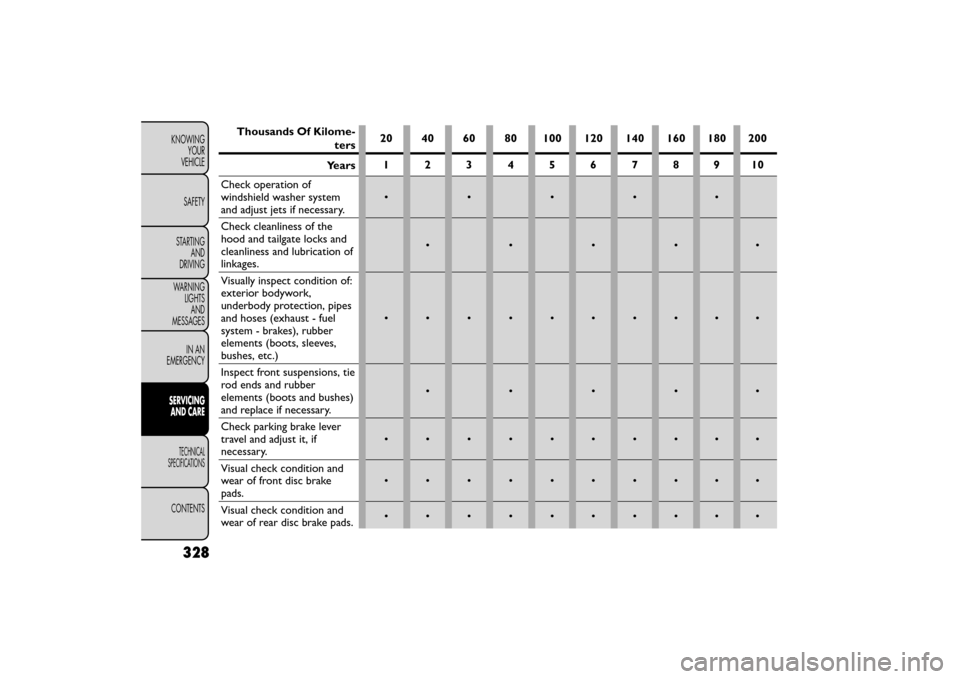
Thousands Of Kilome-
ters20 40 60 80 100 120 140 160 180 200
12345678910
Check operation of
windshield washer system
and adjust jets if necessary.
•••••
Check cleanliness of the
hood and tailgate locks and
cleanliness and lubrication of
linkages.
•••••
Visually inspect condition of:
exterior bodywork,
underbody protection, pipes
and hoses (exhaust - fuel
system - brakes), rubber
elements (boots, sleeves,
bushes, etc.)
••••••••••
Inspect front suspensions, tie
rod ends and rubber
elements (boots and bushes)
and replace if necessary.
•••••
Check parking brake lever
travel and adjust it, if
necessary.
••••••••••
Visual check condition and
wear of front disc brake
pads.
••••••••••
Visual check condition and
wear of rear disc brake pads.••••••••••
328
KNOWINGYOURVEHICLE
SAFETY
STARTINGANDDRIVING
WARNINGLIGHTSANDMESSAGES
IN ANEMERGENCY
SERVICINGAND CARE
TECHNICALSPECIFICATIONS
CONTENTS
Years
Page 335 of 412
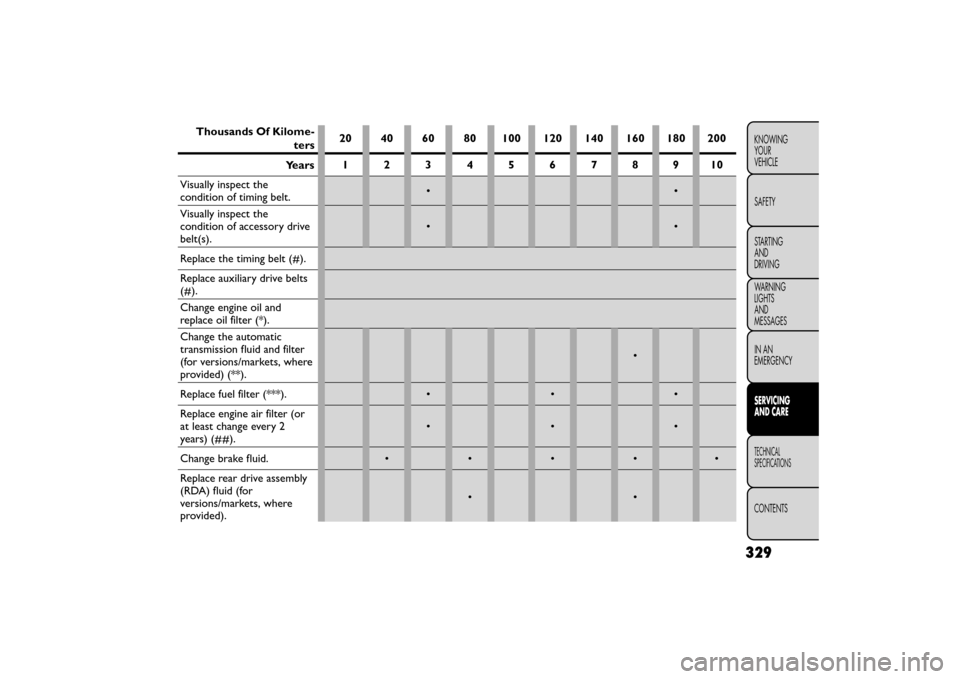
Thousands Of Kilome-
ters20 40 60 80 100 120 140 160 180 200
12345678910
Visually inspect the
condition of timing belt.••
Visually inspect the
condition of accessory drive
belt(s).
••
Replace the timing belt (#).
Replace auxiliary drive belts
(#).
Change engine oil and
replace oil filter (*).
Change the automatic
transmission fluid and filter
(for versions/markets, where
provided) (**).
•
Replace fuel filter (***). • • •
Replace engine air filter (or
at least change every 2
years) (##).
•••
Change brake fluid. • • • • •
Replace rear drive assembly
(RDA) fluid (for
versions/markets, where
provided).
••
329
KNOWING YOURVEHICLE
SAFETY
STARTING ANDDRIVING
WARNING LIGHTSANDMESSAGES
IN AN EMERGENCY
SERVICING AND CARE
TECHNICALSPECIFICATIONS
CONTENTS
Years
Page 336 of 412
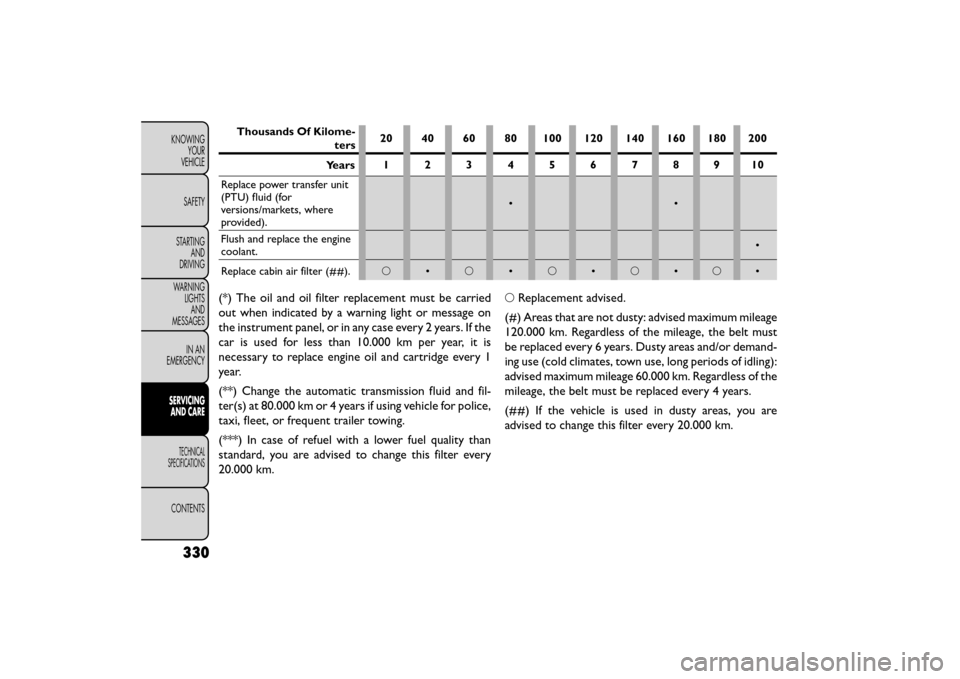
Thousands Of Kilome-
ters20 40 60 80 100 120 140 160 180 200
12345678910
Replace power transfer unit
(PTU) fluid (for
versions/markets, where
provided).
••
Flush and replace the engine
coolant.•
Replace cabin air filter (##).○•○•○•○•○•
(*) The oil and oil filter replacement must be carried
out when indicated by a warning light or message on
the instrument panel, or in any case every 2 years. If the
car is used for less than 10.000 km per year, it is
necessary to replace engine oil and cartridge every 1
year.
(**) Change the automatic transmission fluid and fil-
ter(s) at 80.000 km or 4 years if using vehicle for police,
taxi, fleet, or frequent trailer towing.
(***) In case of refuel with a lower fuel quality than
standard, you are advised to change this filter every
20.000 km.
○Replacement advised.
(#) Areas that are not dusty: advised maximum mileage
120.000 km. Regardless of the mileage, the belt must
be replaced every 6 years. Dusty areas and/or demand-
ing use (cold climates, town use, long periods of idling):
advised maximum mileage 60.000 km. Regardless of the
mileage, the belt must be replaced every 4 years.
(##) If the vehicle is used in dusty areas, you are
advised to change this filter every 20.000 km.
330
KNOWINGYOURVEHICLE
SAFETY
STARTINGANDDRIVING
WARNINGLIGHTSANDMESSAGES
IN ANEMERGENCY
SERVICINGAND CARE
TECHNICALSPECIFICATIONS
CONTENTS
Years