ECU FIAT FULLBACK 2016 1.G User Guide
[x] Cancel search | Manufacturer: FIAT, Model Year: 2016, Model line: FULLBACK, Model: FIAT FULLBACK 2016 1.GPages: 312, PDF Size: 13.67 MB
Page 117 of 312
Child restraint
anchorage points
(Double cab)
(where provided)
When fitting a child restraint, always
follow the manufacturer’s instructions
using the approved anchorage points
shown and install the child restraint
fitting package.
Anchorage locations
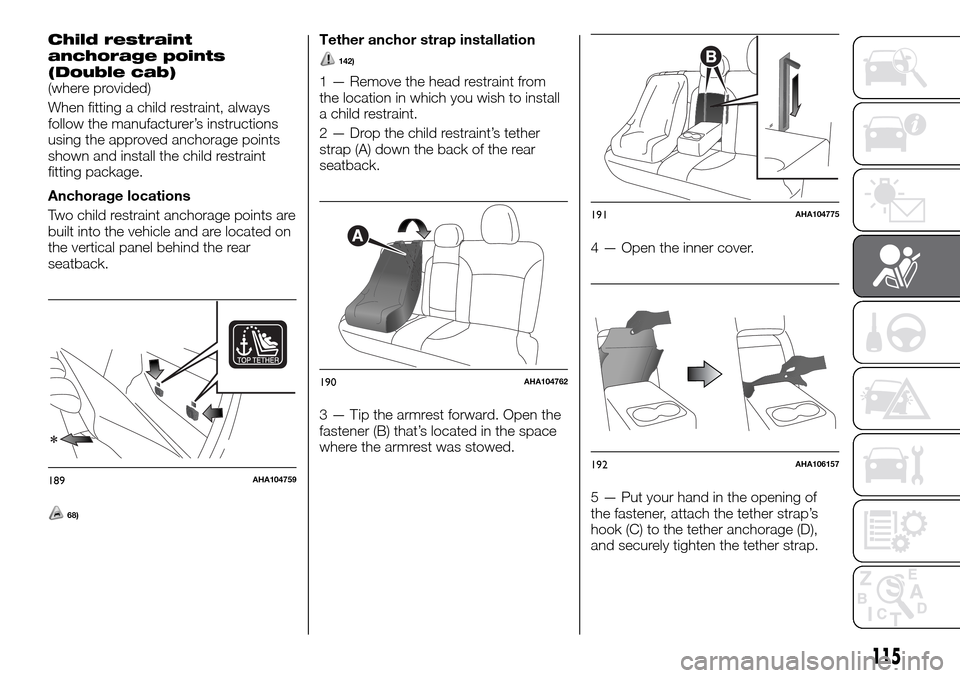
Two child restraint anchorage points are
built into the vehicle and are located on
the vertical panel behind the rear
seatback.
68)
Tether anchor strap installation
142)
1 — Remove the head restraint from
the location in which you wish to install
a child restraint.
2 — Drop the child restraint’s tether
strap (A) down the back of the rear
seatback.
3 — Tip the armrest forward. Open the
fastener (B) that’s located in the space
where the armrest was stowed.4 — Open the inner cover.
5 — Put your hand in the opening of
the fastener, attach the tether strap’s
hook (C) to the tether anchorage (D),
and securely tighten the tether strap.
189AHA104759
A
190AHA104762
B
191AHA104775
192AHA106157
115
Page 118 of 312
Installing a child
restraint system to the
lower anchorage
(ISOFIX child restraint mountings of
Double cab)
143)
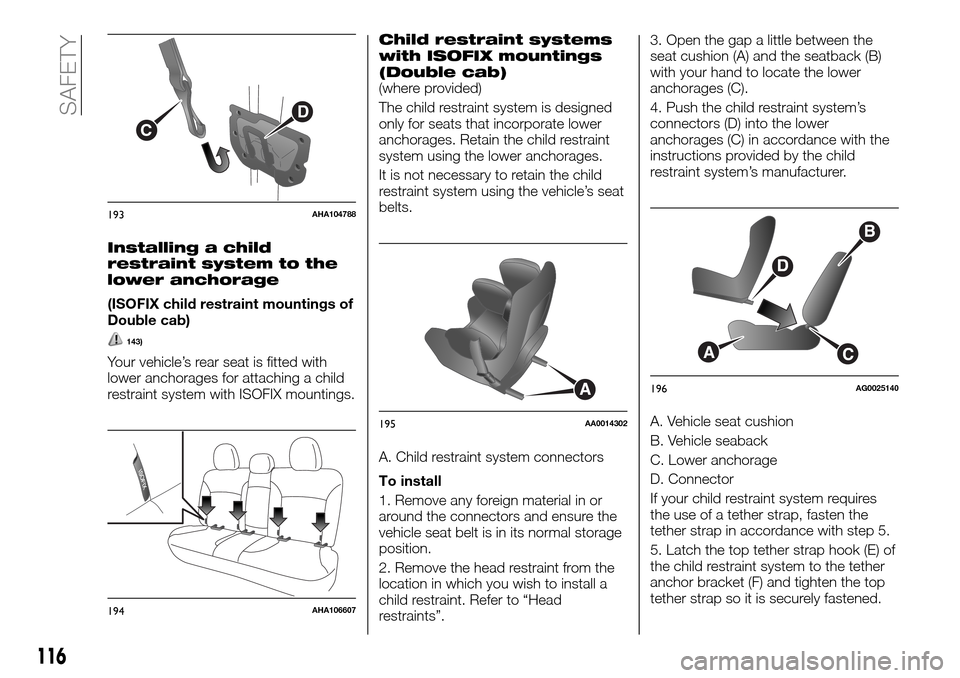
Your vehicle’s rear seat is fitted with
lower anchorages for attaching a child
restraint system with ISOFIX mountings.
Child restraint systems
with ISOFIX mountings
(Double cab)
(where provided)
The child restraint system is designed
only for seats that incorporate lower
anchorages. Retain the child restraint
system using the lower anchorages.
It is not necessary to retain the child
restraint system using the vehicle’s seat
belts.
A. Child restraint system connectors
To install
1. Remove any foreign material in or
around the connectors and ensure the
vehicle seat belt is in its normal storage
position.
2. Remove the head restraint from the
location in which you wish to install a
child restraint. Refer to “Head
restraints”.3. Open the gap a little between the
seat cushion (A) and the seatback (B)
with your hand to locate the lower
anchorages (C).
4. Push the child restraint system’s
connectors (D) into the lower
anchorages (C) in accordance with the
instructions provided by the child
restraint system’s manufacturer.
A. Vehicle seat cushion
B. Vehicle seaback
C. Lower anchorage
D. Connector
If your child restraint system requires
the use of a tether strap, fasten the
tether strap in accordance with step 5.
5. Latch the top tether strap hook (E) of
the child restraint system to the tether
anchor bracket (F) and tighten the top
tether strap so it is securely fastened.
D
C
193AHA104788
194AHA106607
A
195AA0014302
CA
D
B
196AG0025140
116
SAFETY
Page 119 of 312
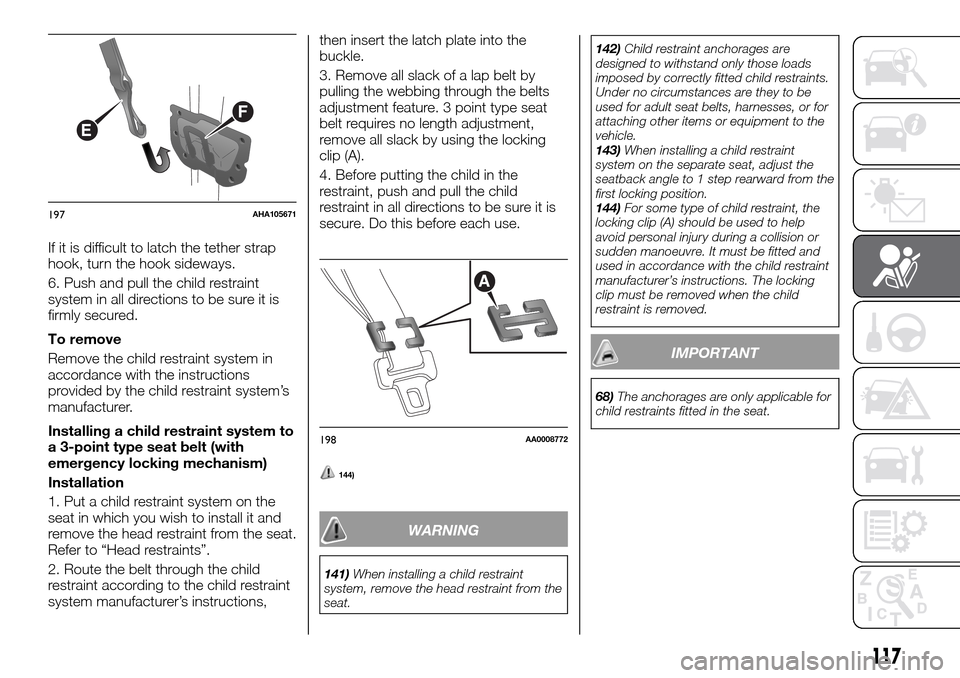
If it is difficult to latch the tether strap
hook, turn the hook sideways.
6. Push and pull the child restraint
system in all directions to be sure it is
firmly secured.
To remove
Remove the child restraint system in
accordance with the instructions
provided by the child restraint system’s
manufacturer.
Installing a child restraint system to
a 3-point type seat belt (with
emergency locking mechanism)
Installation
1. Put a child restraint system on the
seat in which you wish to install it and
remove the head restraint from the seat.
Refer to “Head restraints”.
2. Route the belt through the child
restraint according to the child restraint
system manufacturer’s instructions,then insert the latch plate into the
buckle.
3. Remove all slack of a lap belt by
pulling the webbing through the belts
adjustment feature. 3 point type seat
belt requires no length adjustment,
remove all slack by using the locking
clip (A).
4. Before putting the child in the
restraint, push and pull the child
restraint in all directions to be sure it is
secure. Do this before each use.
144)
WARNING
141)When installing a child restraint
system, remove the head restraint from the
seat.142)Child restraint anchorages are
designed to withstand only those loads
imposed by correctly fitted child restraints.
Under no circumstances are they to be
used for adult seat belts, harnesses, or for
attaching other items or equipment to the
vehicle.
143)When installing a child restraint
system on the separate seat, adjust the
seatback angle to 1 step rearward from the
first locking position.
144)For some type of child restraint, the
locking clip (A) should be used to help
avoid personal injury during a collision or
sudden manoeuvre. It must be fitted and
used in accordance with the child restraint
manufacturer’s instructions. The locking
clip must be removed when the child
restraint is removed.
IMPORTANT
68)The anchorages are only applicable for
child restraints fitted in the seat.
F
E
197AHA105671
A
198AA0008772
117
Page 136 of 312
DRIVING, ALCOHOL
AND DRUGS
Drunk driving is one of the most
frequent causes of accidents.
Your driving ability can be seriously
impaired even with blood alcohol levels
far below the legal minimum. If you
have been drinking, don’t drive. Ride
with a designated non-drinking driver,
call a cab or a friend, or use public
transportation. Drinking coffee or taking
a cold shower will not make you sober.
Similarly, prescription and
non-prescription drugs affect your
alertness, perception and reaction time.
Consult with your doctor or pharmacist
before driving while under the influence
of any of these medications.
199)
WARNING
199)NEVER DRINK AND DRIVE. Your
perceptions are less accurate, your reflexes
are slower and your judgment is impaired.
SAFE DRIVING
TECHNIQUES
Driving safety and protection against
injury cannot be fully ensured. However,
we recommend that you pay extra
attention to the following:
Seat belts
Before starting the vehicle, make sure
that you and your passengers have
fastened your seat belts.
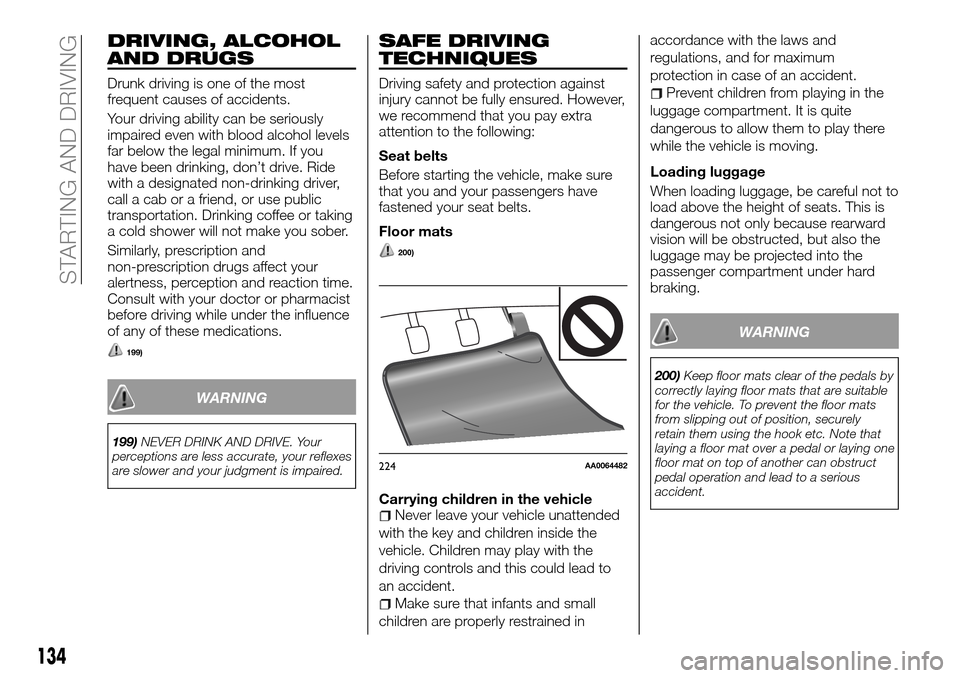
Floor mats
200)
Carrying children in the vehicleNever leave your vehicle unattended
with the key and children inside the
vehicle. Children may play with the
driving controls and this could lead to
an accident.
Make sure that infants and small
children are properly restrained inaccordance with the laws and
regulations, and for maximum
protection in case of an accident.
Prevent children from playing in the
luggage compartment. It is quite
dangerous to allow them to play there
while the vehicle is moving.
Loading luggage
When loading luggage, be careful not to
load above the height of seats. This is
dangerous not only because rearward
vision will be obstructed, but also the
luggage may be projected into the
passenger compartment under hard
braking.
WARNING
200)Keep floor mats clear of the pedals by
correctly laying floor mats that are suitable
for the vehicle. To prevent the floor mats
from slipping out of position, securely
retain them using the hook etc. Note that
laying a floor mat over a pedal or laying one
floor mat on top of another can obstruct
pedal operation and lead to a serious
accident.
224AA0064482
134
STARTING AND DRIVING
Page 155 of 312
Operation of the A/T
103) 104) 105) 106) 107) 108)
Passing acceleration
To gain extra acceleration in “D” (DRIVE)
position, push the accelerator to the
floor. The A/T will automatically
downshift.
In sport mode, downshifts do not take
place when the accelerator is
depressed all the way to the floor.
Waiting
For short waiting periods, such as at
traffic signals the vehicle can be left in
gear and held stationary with the
service brake. For longer waiting
periods with the engine running, place
the selector lever in the “N” (NEUTRAL)
position and apply the parking brake,
while holding the vehicle stationary with
the service brake.
109)
Parking
To park the vehicle, first bring it to a
complete stop, fully engage the parking
brake, and then move the selector lever
to the “P” (PARK) position.
If you are going to leave the vehicle
unattended, always switch off the
engine and carry the key.
On a slope, be sure to apply the
parking brake before moving the
selector lever to the “P” (PARK)
position. If you move the selector lever
to the “P” (PARK) position beforeapplying the parking brake, it may be
difficult to disengage the selector lever
from the “P” (PARK) position when next
you drive the vehicle, requiring
application of a strong force to the
selector lever to move from the “P”
(PARK) position.
When the A/T makes no speed
change
If the transmission does not change
speeds while driving, or your vehicle
does not pick up enough speed when
starting on an uphill slope, it may be
that there is something unusual
happening in the transmission, causing
a safety device to activate. Have your
vehicle checked by a Fiat Dealership as
soon as possible.
1. If your vehicle has difficulty moving
uphill, shift the selector lever into 2nd
gear of the sports mode. This method
might not work depending on the
transmission malfunction.
2. Once the vehicle is moving on a level
road, move the selector lever back to
“D” (DRIVE).
When the selector lever position display
in the instrument panel blinks, it means
that there is an abnormal condition in
the transmission. Refer to “When the
selector lever position display blinks”.
IMPORTANT
92)Always depress the brake pedal when
shifting the selector lever into a gear from
the “P” (PARK) or “N” (NEUTRAL) position.
Never put your foot on the accelerator
pedal while shifting the selector lever from
the “P” (PARK) or “N” (NEUTRAL) position.
93)Never shift into the “P” (PARK) or “R”
(REVERSE) position while the vehicle is in
motion to avoid a transmission damage.
94)Never move the selector lever to the
“N” (NEUTRAL) position while driving. A
serious accident could occur since you
could accidentally move the lever into the
“P” (PARK) or “R” (REVERSE) position or
you will lose engine braking.
95)On a gradient, the engine should be
started in the “P” (PARK) position, not in the
“N” (NEUTRAL) position.
96)To prevent rolling, always keep your
foot on the brake pedal when the vehicle is
in “N” (NEUTRAL) position, or when shifting
into or out of “N” (NEUTRAL) position.
97)To prevent transmission damage, never
shift into the “D” (DRIVE) position from the
“R” (REVERSE) position while the vehicle is
in motion.
98)In sports mode, the driver must
execute upward shifts in accordance with
prevailing road conditions, taking care to
keep the engine speed below the red zone.
99)Repeated continuous operation of the
selector lever or the shift paddles will
continuously switch shift position.
153
Page 178 of 312
IMPORTANT
123)Avoid driving habits that cause heavy
braking and never “ride” the brakes by
resting your foot on the brake pedal while
driving. It causes brake overheating and
fade.
WARNING
223)Do not turn off the engine while your
vehicle is in motion. If you turn off the
engine while driving, the power assistance
for the braking system will stop working
and your brakes will not work effectively.
224)If the power assist is lost or if either
brake hydraulic system stops working
properly, have your vehicle checked
immediately.
225)Do not leave any objects near the
brake pedal or let a floor mat slide under it;
doing so could prevent the full pedal stroke
that would be necessary in an emergency.
Make sure that the pedal can be operated
freely at all times. Make sure the floor mat
is securely held in place.
226)Driving with worn brake pads will
make it harder to stop, and can cause an
accident.
CRUISE CONTROL
(where provided)
Cruise control is an automatic speed
control system that keeps a set speed.
It can be activated at about 40 km/h or
more.
124) 125) 126)
Cruise control may not be able to keep
your speed on uphills or downhills.
Your speed may decrease on a steep
uphill. You may use the accelerator
pedal if you want to stay at your set
speed.
Your speed may increase to more than
the set speed on a steep downhill. You
have to use the brake to control your
speed. As a result, the set speed
driving is deactivated.Cruise control switches
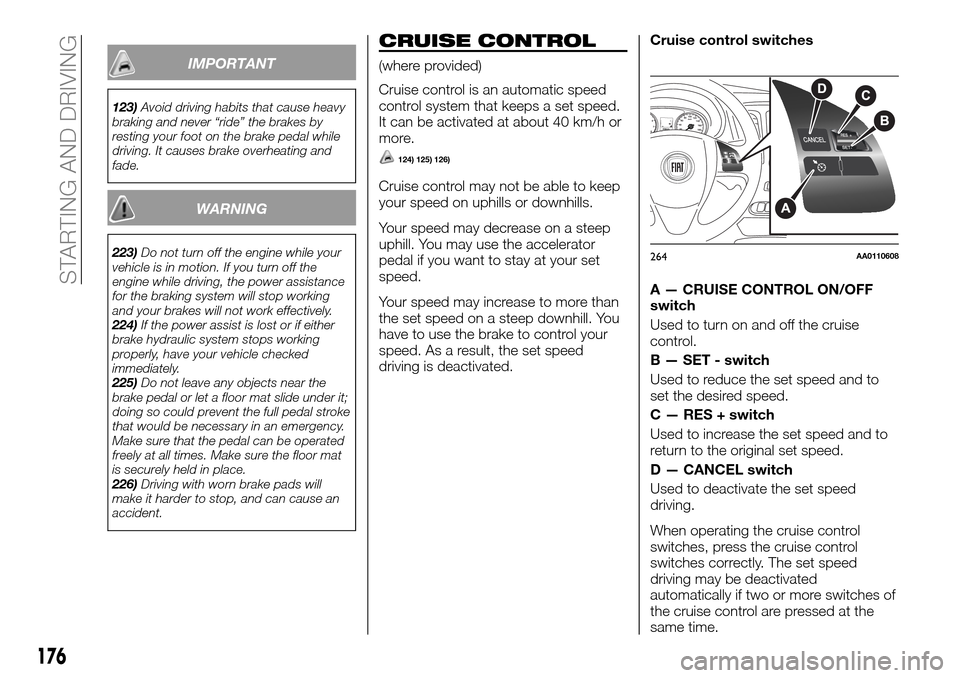
A — CRUISE CONTROL ON/OFF
switch
Used to turn on and off the cruise
control.
B — SET - switch
Used to reduce the set speed and to
set the desired speed.
C — RES + switch
Used to increase the set speed and to
return to the original set speed.
D — CANCEL switch
Used to deactivate the set speed
driving.
When operating the cruise control
switches, press the cruise control
switches correctly. The set speed
driving may be deactivated
automatically if two or more switches of
the cruise control are pressed at the
same time.
264AA0110608
176
STARTING AND DRIVING
Page 185 of 312
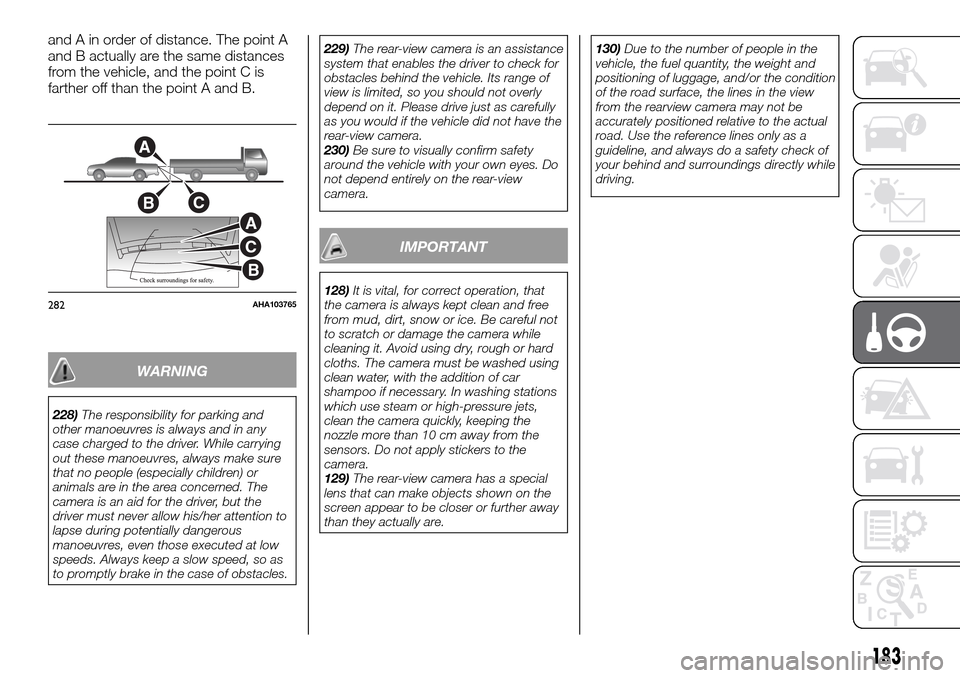
and A in order of distance. The point A
and B actually are the same distances
from the vehicle, and the point C is
farther off than the point A and B.
WARNING
228)The responsibility for parking and
other manoeuvres is always and in any
case charged to the driver. While carrying
out these manoeuvres, always make sure
that no people (especially children) or
animals are in the area concerned. The
camera is an aid for the driver, but the
driver must never allow his/her attention to
lapse during potentially dangerous
manoeuvres, even those executed at low
speeds. Always keep a slow speed, so as
to promptly brake in the case of obstacles.229)The rear-view camera is an assistance
system that enables the driver to check for
obstacles behind the vehicle. Its range of
view is limited, so you should not overly
depend on it. Please drive just as carefully
as you would if the vehicle did not have the
rear-view camera.
230)Be sure to visually confirm safety
around the vehicle with your own eyes. Do
not depend entirely on the rear-view
camera.
IMPORTANT
128)It is vital, for correct operation, that
the camera is always kept clean and free
from mud, dirt, snow or ice. Be careful not
to scratch or damage the camera while
cleaning it. Avoid using dry, rough or hard
cloths. The camera must be washed using
clean water, with the addition of car
shampoo if necessary. In washing stations
which use steam or high-pressure jets,
clean the camera quickly, keeping the
nozzle more than 10 cm away from the
sensors. Do not apply stickers to the
camera.
129)The rear-view camera has a special
lens that can make objects shown on the
screen appear to be closer or further away
than they actually are.130)Due to the number of people in the
vehicle, the fuel quantity, the weight and
positioning of luggage, and/or the condition
of the road surface, the lines in the view
from the rearview camera may not be
accurately positioned relative to the actual
road. Use the reference lines only as a
guideline, and always do a safety check of
your behind and surroundings directly while
driving.
B
A
C
C
A
B
282AHA103765
183
Page 192 of 312
Double cab
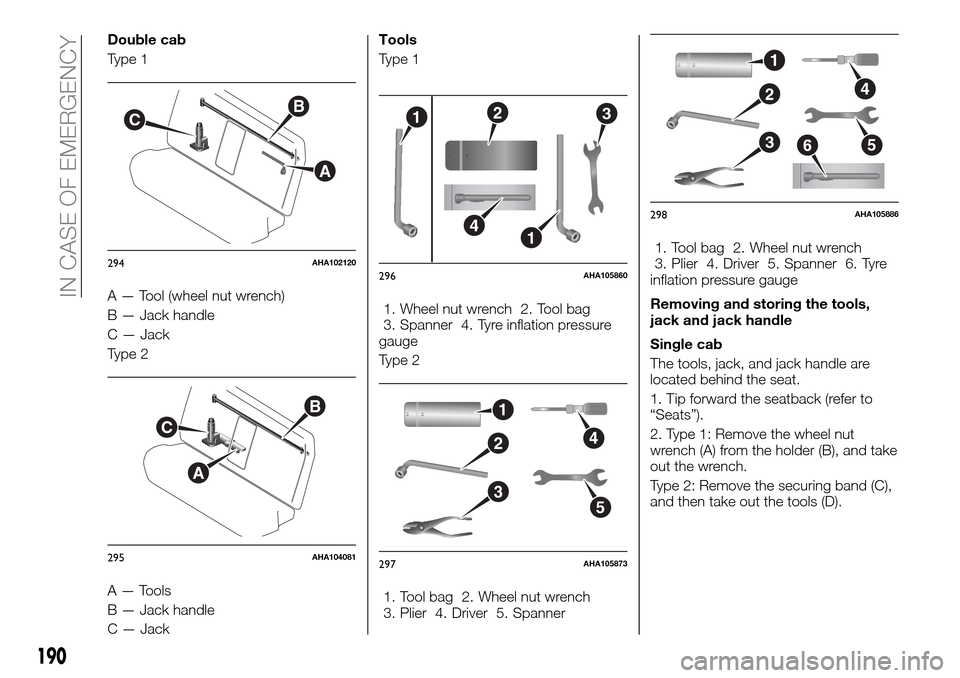
Type 1
A — Tool (wheel nut wrench)
B — Jack handle
C — Jack
Type 2
A — Tools
B — Jack handle
C — JackTools
Type 1
1. Wheel nut wrench 2. Tool bag
3. Spanner 4. Tyre inflation pressure
gauge
Type 2
1. Tool bag 2. Wheel nut wrench
3. Plier 4. Driver 5. Spanner1. Tool bag 2. Wheel nut wrench
3. Plier 4. Driver 5. Spanner 6. Tyre
inflation pressure gauge
Removing and storing the tools,
jack and jack handle
Single cab
The tools, jack, and jack handle are
located behind the seat.
1. Tip forward the seatback (refer to
“Seats”).
2. Type 1: Remove the wheel nut
wrench (A) from the holder (B), and take
out the wrench.
Type 2: Remove the securing band (C),
and then take out the tools (D).
B
A
C
294AHA102120
A
C
B
295AHA104081
123
41
296AHA105860
1
4
5
2
3
297AHA105873
1
4
5
2
36
298AHA105886
190
IN CASE OF EMERGENCY
Page 193 of 312
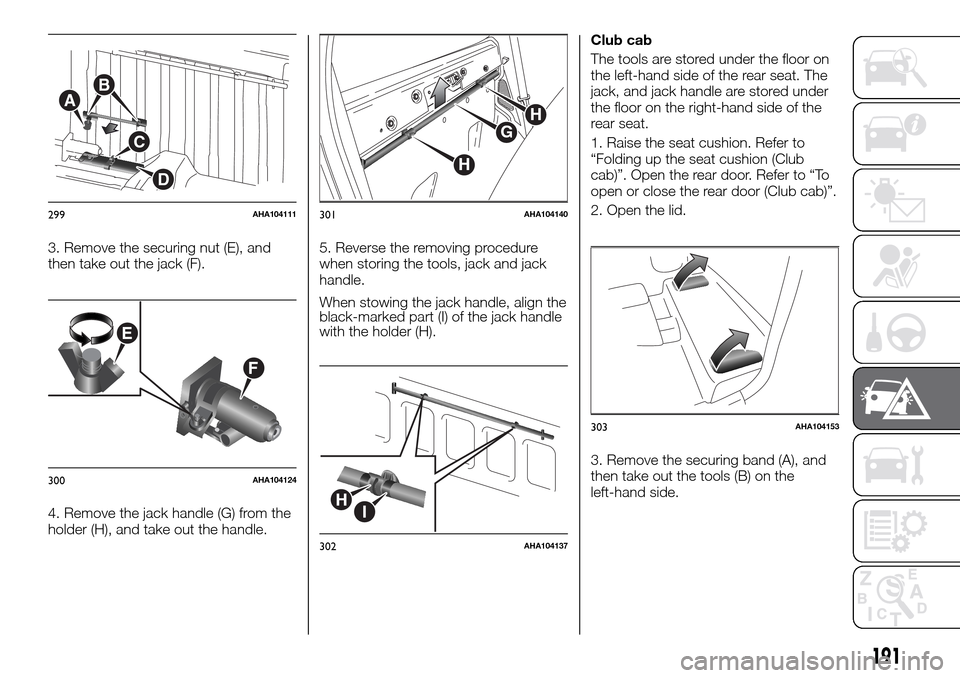
3. Remove the securing nut (E), and
then take out the jack (F).
4. Remove the jack handle (G) from the
holder (H), and take out the handle.5. Reverse the removing procedure
when storing the tools, jack and jack
handle.
When stowing the jack handle, align the
black-marked part (I) of the jack handle
with the holder (H).Club cab
The tools are stored under the floor on
the left-hand side of the rear seat. The
jack, and jack handle are stored under
the floor on the right-hand side of the
rear seat.
1. Raise the seat cushion. Refer to
“Folding up the seat cushion (Club
cab)”. Open the rear door. Refer to “To
open or close the rear door (Club cab)”.
2. Open the lid.
3. Remove the securing band (A), and
then take out the tools (B) on the
left-hand side.
A
C
D
B
299AHA104111
E
F
300AHA104124
H
H
G
301AHA104140
HI
302AHA104137
303AHA104153
191
Page 194 of 312
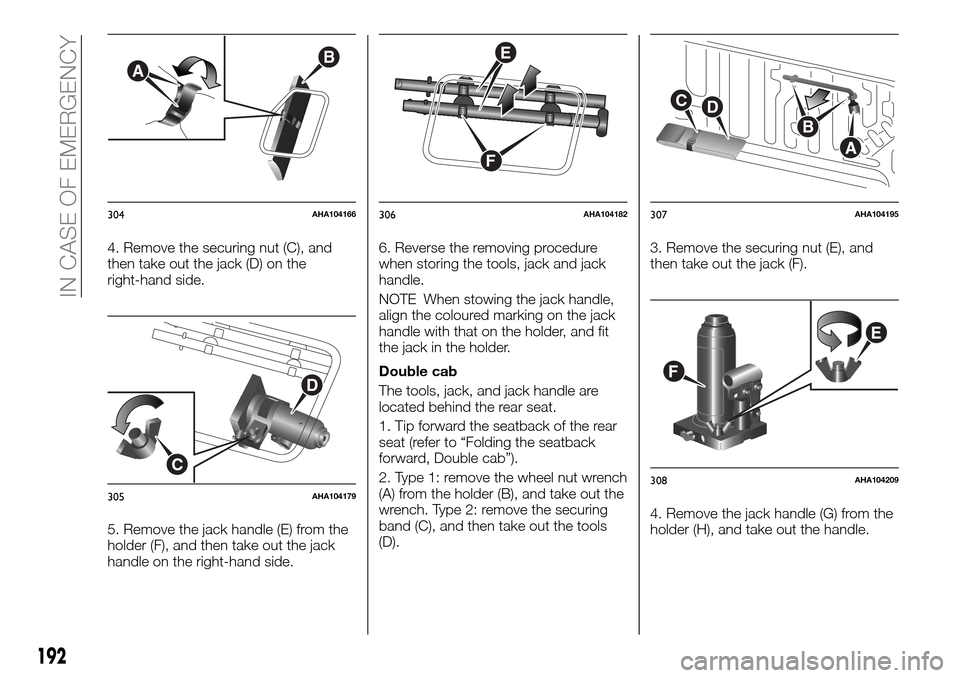
4. Remove the securing nut (C), and
then take out the jack (D) on the
right-hand side.
5. Remove the jack handle (E) from the
holder (F), and then take out the jack
handle on the right-hand side.6. Reverse the removing procedure
when storing the tools, jack and jack
handle.
NOTE When stowing the jack handle,
align the coloured marking on the jack
handle with that on the holder, and fit
the jack in the holder.
Double cab
The tools, jack, and jack handle are
located behind the rear seat.
1. Tip forward the seatback of the rear
seat (refer to “Folding the seatback
forward, Double cab”).
2. Type 1: remove the wheel nut wrench
(A) from the holder (B), and take out the
wrench. Type 2: remove the securing
band (C), and then take out the tools
(D).3. Remove the securing nut (E), and
then take out the jack (F).
4. Remove the jack handle (G) from the
holder (H), and take out the handle.
AB
304AHA104166
C
D
305AHA104179
F
E
306AHA104182
B
A
CD
307AHA104195
E
F
308AHA104209
192
IN CASE OF EMERGENCY