ECU FIAT FULLBACK 2016 1.G Owner's Manual
[x] Cancel search | Manufacturer: FIAT, Model Year: 2016, Model line: FULLBACK, Model: FIAT FULLBACK 2016 1.GPages: 312, PDF Size: 13.67 MB
Page 197 of 312
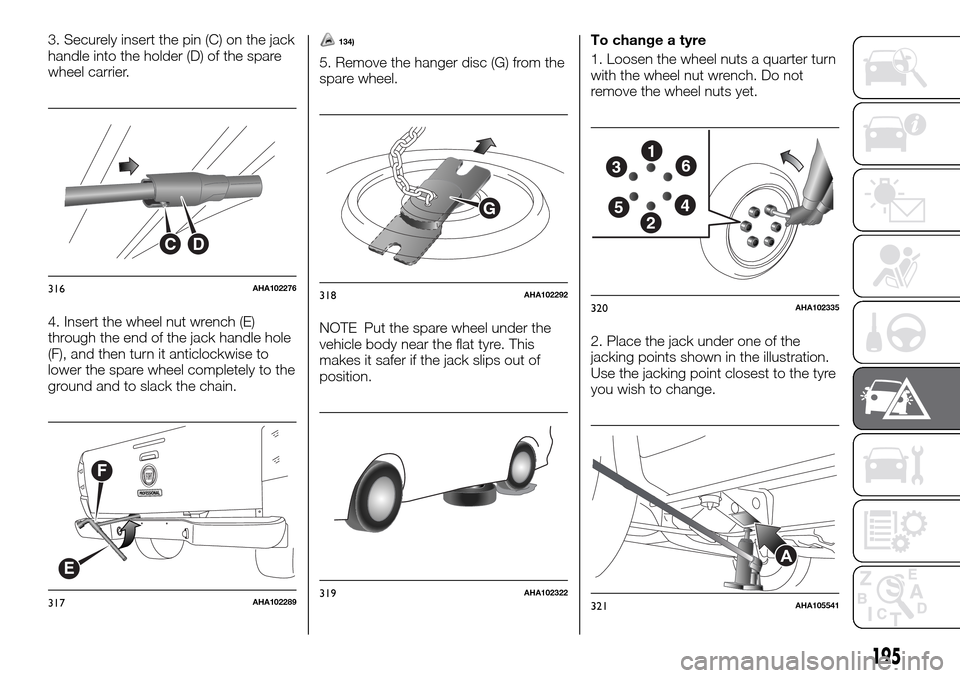
3. Securely insert the pin (C) on the jack
handle into the holder (D) of the spare
wheel carrier.
4. Insert the wheel nut wrench (E)
through the end of the jack handle hole
(F), and then turn it anticlockwise to
lower the spare wheel completely to the
ground and to slack the chain.134)
5. Remove the hanger disc (G) from the
spare wheel.
NOTE Put the spare wheel under the
vehicle body near the flat tyre. This
makes it safer if the jack slips out of
position.To change a tyre
1. Loosen the wheel nuts a quarter turn
with the wheel nut wrench. Do not
remove the wheel nuts yet.
2. Place the jack under one of the
jacking points shown in the illustration.
Use the jacking point closest to the tyre
you wish to change.
CD
316AHA102276
F
E
317AHA102289
G
318AHA102292
319AHA102322
1
2
3
45
6
320AHA102335
A
321AHA105541
195
Page 199 of 312
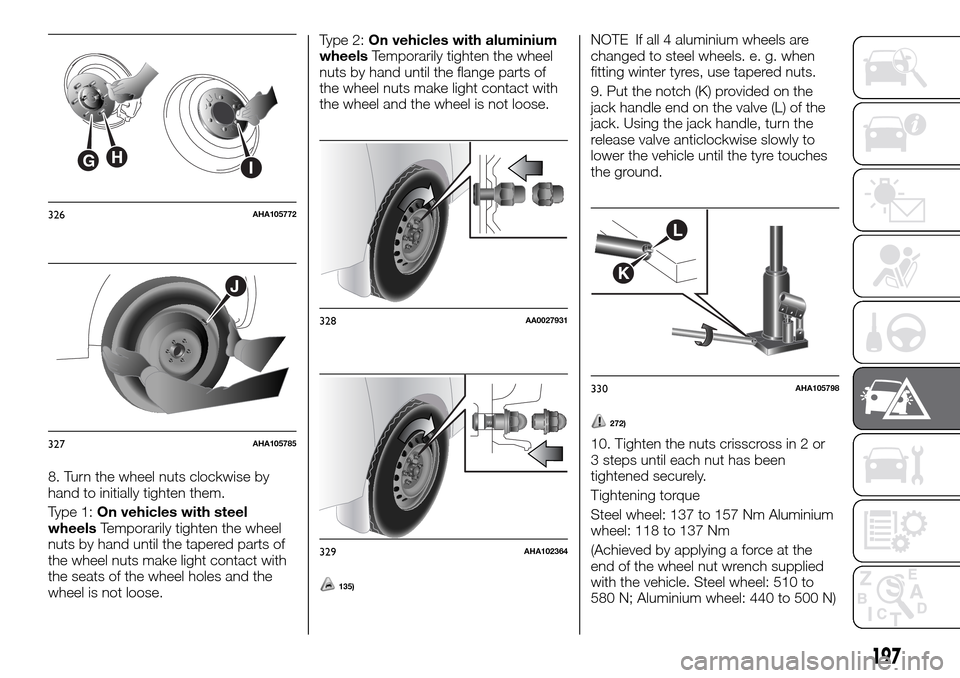
8. Turn the wheel nuts clockwise by
hand to initially tighten them.
Type 1:On vehicles with steel
wheelsTemporarily tighten the wheel
nuts by hand until the tapered parts of
the wheel nuts make light contact with
the seats of the wheel holes and the
wheel is not loose.Type 2:On vehicles with aluminium
wheelsTemporarily tighten the wheel
nuts by hand until the flange parts of
the wheel nuts make light contact with
the wheel and the wheel is not loose.
135)
NOTE If all 4 aluminium wheels are
changed to steel wheels. e. g. when
fitting winter tyres, use tapered nuts.
9. Put the notch (K) provided on the
jack handle end on the valve (L) of the
jack. Using the jack handle, turn the
release valve anticlockwise slowly to
lower the vehicle until the tyre touches
the ground.
272)
10. Tighten the nuts crisscross in 2 or
3 steps until each nut has been
tightened securely.
Tightening torque
Steel wheel: 137 to 157 Nm Aluminium
wheel: 118 to 137 Nm
(Achieved by applying a force at the
end of the wheel nut wrench supplied
with the vehicle. Steel wheel: 510 to
580 N; Aluminium wheel: 440 to 500 N)
GHI
326AHA105772
J
327AHA105785
328AA0027931
329AHA102364
L
K
330AHA105798
197
Page 201 of 312
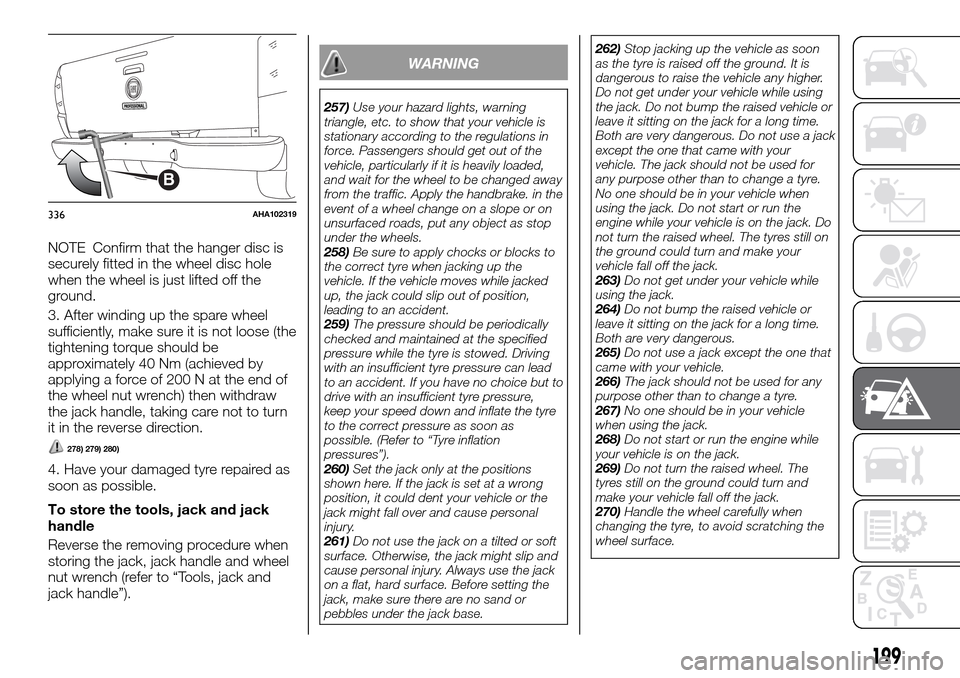
NOTE Confirm that the hanger disc is
securely fitted in the wheel disc hole
when the wheel is just lifted off the
ground.
3. After winding up the spare wheel
sufficiently, make sure it is not loose (the
tightening torque should be
approximately 40 Nm (achieved by
applying a force of 200 N at the end of
the wheel nut wrench) then withdraw
the jack handle, taking care not to turn
it in the reverse direction.
278) 279) 280)
4. Have your damaged tyre repaired as
soon as possible.
To store the tools, jack and jack
handle
Reverse the removing procedure when
storing the jack, jack handle and wheel
nut wrench (refer to “Tools, jack and
jack handle”).
WARNING
257)Use your hazard lights, warning
triangle, etc. to show that your vehicle is
stationary according to the regulations in
force. Passengers should get out of the
vehicle, particularly if it is heavily loaded,
and wait for the wheel to be changed away
from the traffic. Apply the handbrake. in the
event of a wheel change on a slope or on
unsurfaced roads, put any object as stop
under the wheels.
258)Be sure to apply chocks or blocks to
the correct tyre when jacking up the
vehicle. If the vehicle moves while jacked
up, the jack could slip out of position,
leading to an accident.
259)The pressure should be periodically
checked and maintained at the specified
pressure while the tyre is stowed. Driving
with an insufficient tyre pressure can lead
to an accident. If you have no choice but to
drive with an insufficient tyre pressure,
keep your speed down and inflate the tyre
to the correct pressure as soon as
possible. (Refer to “Tyre inflation
pressures”).
260)Set the jack only at the positions
shown here. If the jack is set at a wrong
position, it could dent your vehicle or the
jack might fall over and cause personal
injury.
261)Do not use the jack on a tilted or soft
surface. Otherwise, the jack might slip and
cause personal injury. Always use the jack
on a flat, hard surface. Before setting the
jack, make sure there are no sand or
pebbles under the jack base.262)Stop jacking up the vehicle as soon
as the tyre is raised off the ground. It is
dangerous to raise the vehicle any higher.
Do not get under your vehicle while using
the jack. Do not bump the raised vehicle or
leave it sitting on the jack for a long time.
Both are very dangerous. Do not use a jack
except the one that came with your
vehicle. The jack should not be used for
any purpose other than to change a tyre.
No one should be in your vehicle when
using the jack. Do not start or run the
engine while your vehicle is on the jack. Do
not turn the raised wheel. The tyres still on
the ground could turn and make your
vehicle fall off the jack.
263)Do not get under your vehicle while
using the jack.
264)Do not bump the raised vehicle or
leave it sitting on the jack for a long time.
Both are very dangerous.
265)Do not use a jack except the one that
came with your vehicle.
266)The jack should not be used for any
purpose other than to change a tyre.
267)No one should be in your vehicle
when using the jack.
268)Do not start or run the engine while
your vehicle is on the jack.
269)Do not turn the raised wheel. The
tyres still on the ground could turn and
make your vehicle fall off the jack.
270)Handle the wheel carefully when
changing the tyre, to avoid scratching the
wheel surface.
B
336AHA102319
199
Page 202 of 312
271)Mount the spare wheel with the valve
stem (J) facing outboard. If you cannot see
the valve stem (J), you have installed the
wheel backwards. Operating the vehicle
with the spare wheel installed backwards
can cause vehicle damage and result in an
accident.
272)Be sure to open the release valve
slowly. If it is opened quickly, the vehicle will
drop abruptly and the jack may come out
of position, causing a serious accident.
273)Never use your foot or a pipe
extension for extra force in the wheel nut
wrench. If you do so, you will tighten the
nut too much.
274)The tyre pressure should be
periodically checked and maintained at the
specified pressure while the tyre is stowed.
275)After changing the tyre and driving the
vehicle about 1,000 km, retighten the
wheel nuts to make sure that they have not
come loose.
276)If the steering wheel vibrates when
driving after changing the tyre, we
recommend you to have the tyres checked
for balance.
277)Do not mix one type of tyre with
another or use a different size from the one
listed. This would cause early wear and
poor handling.
278)The spare wheel should always be
securely in position. If a flat tyre is
changed, put the flat tyre in the spare
wheel mounting position with the wheel
outer surface upward, and use the wheel
nut wrench to secure it firmly.279)Never tamper with the inflation valve.
Never introduce tools of any kind between
rim and tyre. Check tyre and spare wheel
pressure regularly, referring to the values
shown in the "Technical specifications"
section.
280)The moving components of the jack
(screw and joints) can also cause injuries:
do not touch them. If you come into
contact with lubricating grease, clean
yourself thoroughly.
IMPORTANT
132)Avoid using different size tyres from
the one listed and the combined use of
different types of tyres, as this can affect
driving safety.
133)Even if a wheel has the same rim size
and offset as the specified type of wheel,
its shape may prevent it from being fitted
correctly. Consult an authorised Fiat
Dealership before using wheels that you
have.
134)When installing or removing the spare
wheel, please observe the followings. If you
do not follow them, it could result in break
the spare wheel carrier. Do not use the
power tool. Use the wheel nut wrench
stowed on the vehicle. Do not apply a force
of 400 N or more at the end of the wheel
nut wrench.
135)Never apply oil to either the wheel
bolts or the nuts or they will tighten too
much.
136)If the release valve is loosened too
much (2 or more turns) in the anticlockwise
direction, the jack’s oil will leak and the jack
cannot be used.137)Close the release valve slowly when
lowering the vehicle, or the valve may be
damaged.
200
IN CASE OF EMERGENCY
Page 203 of 312
TOWING
If your vehicle needs to be towed
If towing is necessary, we recommend
you to have it done by your Fiat
Dealership or a commercial tow truck
service. In the following cases,
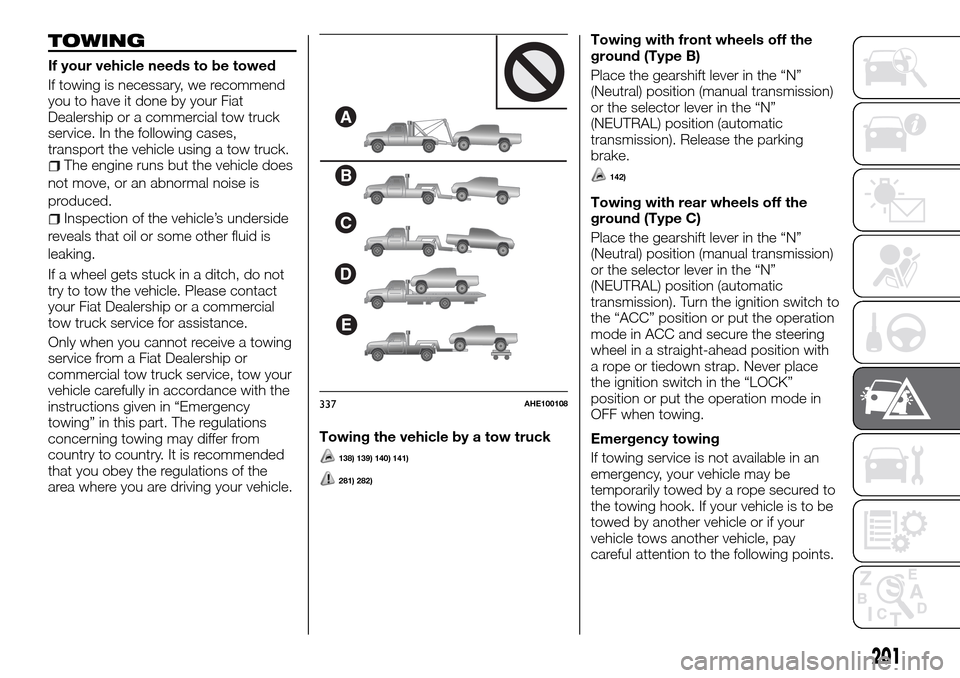
transport the vehicle using a tow truck.
The engine runs but the vehicle does
not move, or an abnormal noise is
produced.
Inspection of the vehicle’s underside
reveals that oil or some other fluid is
leaking.
If a wheel gets stuck in a ditch, do not
try to tow the vehicle. Please contact
your Fiat Dealership or a commercial
tow truck service for assistance.
Only when you cannot receive a towing
service from a Fiat Dealership or
commercial tow truck service, tow your
vehicle carefully in accordance with the
instructions given in “Emergency
towing” in this part. The regulations
concerning towing may differ from
country to country. It is recommended
that you obey the regulations of the
area where you are driving your vehicle.Towing the vehicle by a tow truck
138) 139) 140) 141)
281) 282)
Towing with front wheels off the
ground (Type B)
Place the gearshift lever in the “N”
(Neutral) position (manual transmission)
or the selector lever in the “N”
(NEUTRAL) position (automatic
transmission). Release the parking
brake.
142)
Towing with rear wheels off the
ground (Type C)
Place the gearshift lever in the “N”
(Neutral) position (manual transmission)
or the selector lever in the “N”
(NEUTRAL) position (automatic
transmission). Turn the ignition switch to
the “ACC” position or put the operation
mode in ACC and secure the steering
wheel in a straight-ahead position with
a rope or tiedown strap. Never place
the ignition switch in the “LOCK”
position or put the operation mode in
OFF when towing.
Emergency towing
If towing service is not available in an
emergency, your vehicle may be
temporarily towed by a rope secured to
the towing hook. If your vehicle is to be
towed by another vehicle or if your
vehicle tows another vehicle, pay
careful attention to the following points.
B
C
D
E
A
337AHE100108
201
Page 204 of 312
If your vehicle is to be towed by
another vehicle
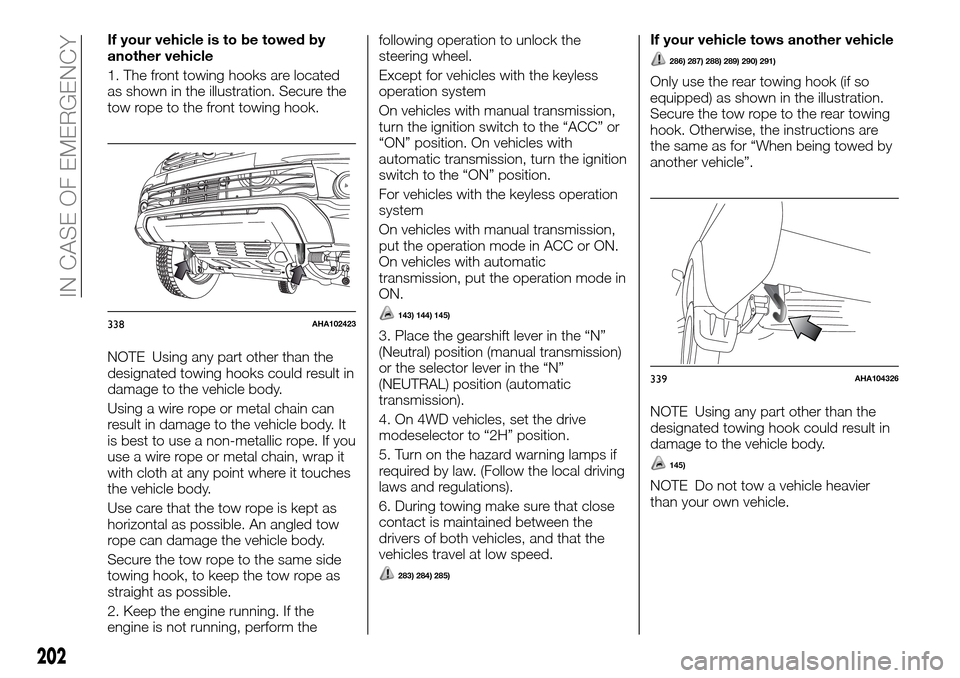
1. The front towing hooks are located
as shown in the illustration. Secure the
tow rope to the front towing hook.
NOTE Using any part other than the
designated towing hooks could result in
damage to the vehicle body.
Using a wire rope or metal chain can
result in damage to the vehicle body. It
is best to use a non-metallic rope. If you
use a wire rope or metal chain, wrap it
with cloth at any point where it touches
the vehicle body.
Use care that the tow rope is kept as
horizontal as possible. An angled tow
rope can damage the vehicle body.
Secure the tow rope to the same side
towing hook, to keep the tow rope as
straight as possible.
2. Keep the engine running. If the
engine is not running, perform thefollowing operation to unlock the
steering wheel.
Except for vehicles with the keyless
operation system
On vehicles with manual transmission,
turn the ignition switch to the “ACC” or
“ON” position. On vehicles with
automatic transmission, turn the ignition
switch to the “ON” position.
For vehicles with the keyless operation
system
On vehicles with manual transmission,
put the operation mode in ACC or ON.
On vehicles with automatic
transmission, put the operation mode in
ON.
143) 144) 145)
3. Place the gearshift lever in the “N”
(Neutral) position (manual transmission)
or the selector lever in the “N”
(NEUTRAL) position (automatic
transmission).
4. On 4WD vehicles, set the drive
modeselector to “2H” position.
5. Turn on the hazard warning lamps if
required by law. (Follow the local driving
laws and regulations).
6. During towing make sure that close
contact is maintained between the
drivers of both vehicles, and that the
vehicles travel at low speed.
283) 284) 285)
If your vehicle tows another vehicle
286) 287) 288) 289) 290) 291)
Only use the rear towing hook (if so
equipped) as shown in the illustration.
Secure the tow rope to the rear towing
hook. Otherwise, the instructions are
the same as for “When being towed by
another vehicle”.
NOTE Using any part other than the
designated towing hook could result in
damage to the vehicle body.
145)
NOTE Do not tow a vehicle heavier
than your own vehicle.
338AHA102423
339AHA104326
202
IN CASE OF EMERGENCY
Page 217 of 312
Headlamps (halogen bulb)
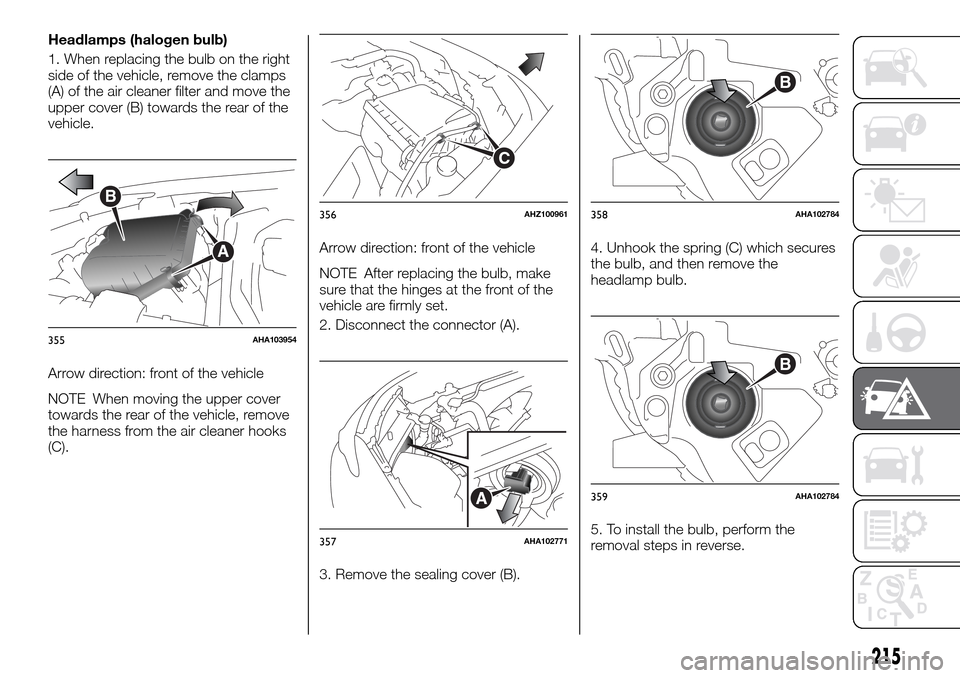
1. When replacing the bulb on the right
side of the vehicle, remove the clamps
(A) of the air cleaner filter and move the
upper cover (B) towards the rear of the
vehicle.
Arrow direction: front of the vehicle
NOTE When moving the upper cover
towards the rear of the vehicle, remove
the harness from the air cleaner hooks
(C).Arrow direction: front of the vehicle
NOTE After replacing the bulb, make
sure that the hinges at the front of the
vehicle are firmly set.
2. Disconnect the connector (A).
3. Remove the sealing cover (B).4. Unhook the spring (C) which secures
the bulb, and then remove the
headlamp bulb.
5. To install the bulb, perform the
removal steps in reverse.
B
A
355AHA103954
C
356AHZ100961
A
357AHA102771
B
358AHA102784
B
359AHA102784
215
Page 248 of 312
The engine oil used has a significant
effect on the engine’s performance,
service life and startability. Be sure to
use oil of the recommended quality and
appropriate viscosity. All engines
consume a certain amount of oil during
normal operation. Therefore, it is
important to check the oil level at
regular intervals or before starting a
long trip.
1. Park the car on a horizontal surface.
2. Switch off the engine.
3.Wait a few minutes.
4. Remove the dipstick and wipe it with
a clean cloth.
5. Reinsert the dipstick as far as it
goes.
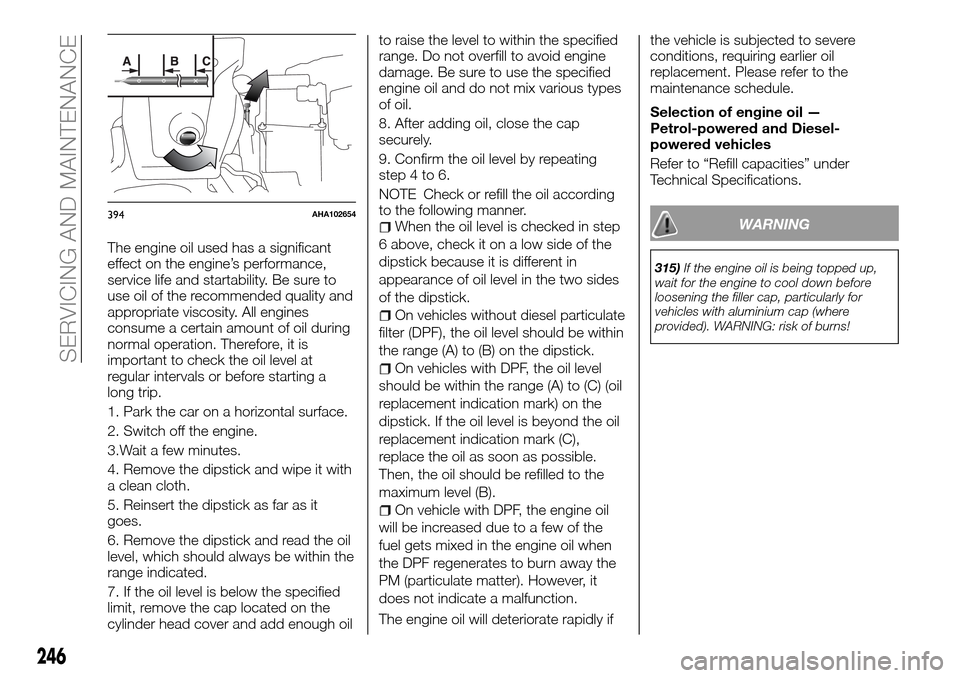
6. Remove the dipstick and read the oil
level, which should always be within the
range indicated.
7. If the oil level is below the specified
limit, remove the cap located on the
cylinder head cover and add enough oilto raise the level to within the specified
range. Do not overfill to avoid engine
damage. Be sure to use the specified
engine oil and do not mix various types
of oil.
8. After adding oil, close the cap
securely.
9. Confirm the oil level by repeating
step 4 to 6.
NOTE Check or refill the oil according
to the following manner.
When the oil level is checked in step
6 above, check it on a low side of the
dipstick because it is different in
appearance of oil level in the two sides
of the dipstick.
On vehicles without diesel particulate
filter (DPF), the oil level should be within
the range (A) to (B) on the dipstick.
On vehicles with DPF, the oil level
should be within the range (A) to (C) (oil
replacement indication mark) on the
dipstick. If the oil level is beyond the oil
replacement indication mark (C),
replace the oil as soon as possible.
Then, the oil should be refilled to the
maximum level (B).
On vehicle with DPF, the engine oil
will be increased due to a few of the
fuel gets mixed in the engine oil when
the DPF regenerates to burn away the
PM (particulate matter). However, it
does not indicate a malfunction.
The engine oil will deteriorate rapidly ifthe vehicle is subjected to severe
conditions, requiring earlier oil
replacement. Please refer to the
maintenance schedule.
Selection of engine oil —
Petrol-powered and Diesel-
powered vehicles
Refer to “Refill capacities” under
Technical Specifications.
WARNING
315)If the engine oil is being topped up,
wait for the engine to cool down before
loosening the filler cap, particularly for
vehicles with aluminium cap (where
provided). WARNING: risk of burns!
394AHA102654
246
SERVICING AND MAINTENANCE
Page 252 of 312
Fluid type
Use brake fluid conforming to DOT3 or
DOT4. The brake fluid is hygroscopic.
Too much moisture in the brake fluid will
adversely affect the brake system,
reducing the brake performance.
In addition, the brake fluid reservoir is
equipped with a special cap to prevent
the entrance of air, and this cap should
not be removed.
319) 320) 321) 322)
152) 153) 154)
WARNING
319)Take care in handling brake fluid as it
is harmful to the eyes, may irritate your skin
and also damage to painted surfaces.
320)Use only the specified brake fluid. Do
not mix or add different brand of brake fluid
to prevent chemical reaction. Do not let
any petroleum-based fluid touch, mix with,
or get into the brake fluid. This will damage
the seals.
321)Clean the filler cap before removing
and close the cap securely after
maintenance.
322)Brake fluid is poisonous and highly
corrosive. In the event of accidental
contact, immediately wash the affected
parts with water and mild soap. Then rinse
thoroughly. Call a doctor immediately if
swallowed.
IMPORTANT
152)Keep the reservoir tank cap closed to
prevent the brake fluid from deteriorating
except maintenance.
153)Prevent brake fluid, which is highly
corrosive, from coming into contact with
painted parts. Should it happen,
immediately wash with water.
154)The symbol
, on the brake fluid
container indicates if a brake fluid is
synthetic or mineral-based. Use of mineral
type fluids will damage the special rubber
seals of the braking system beyond repair.
CLUTCH FLUID
To check the fluid level
The clutch fluid in the master cylinder
should be checked when performing
other underhood service. In addition,
the system should be checked for
leakage at the same time.
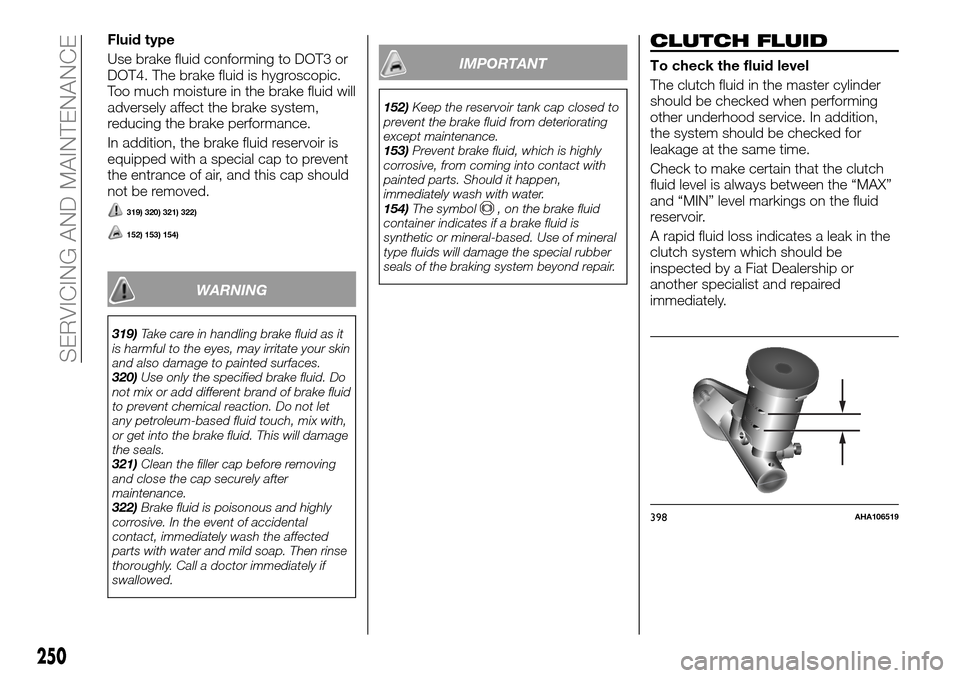
Check to make certain that the clutch
fluid level is always between the “MAX”
and “MIN” level markings on the fluid
reservoir.
A rapid fluid loss indicates a leak in the
clutch system which should be
inspected by a Fiat Dealership or
another specialist and repaired
immediately.
MAX
MIN
398AHA106519
250
SERVICING AND MAINTENANCE
Page 254 of 312
BATTERY
155) 156)
4)
The condition of the battery is very
important for quick starting of the
engine and proper functioning of the
vehicle’s electrical system. Regular
inspection and care are especially
important in cold weather.
Battery precautions
325) 326) 327) 328) 329) 330) 331) 332) 333) 334) 335)
Checking battery electrolyte level
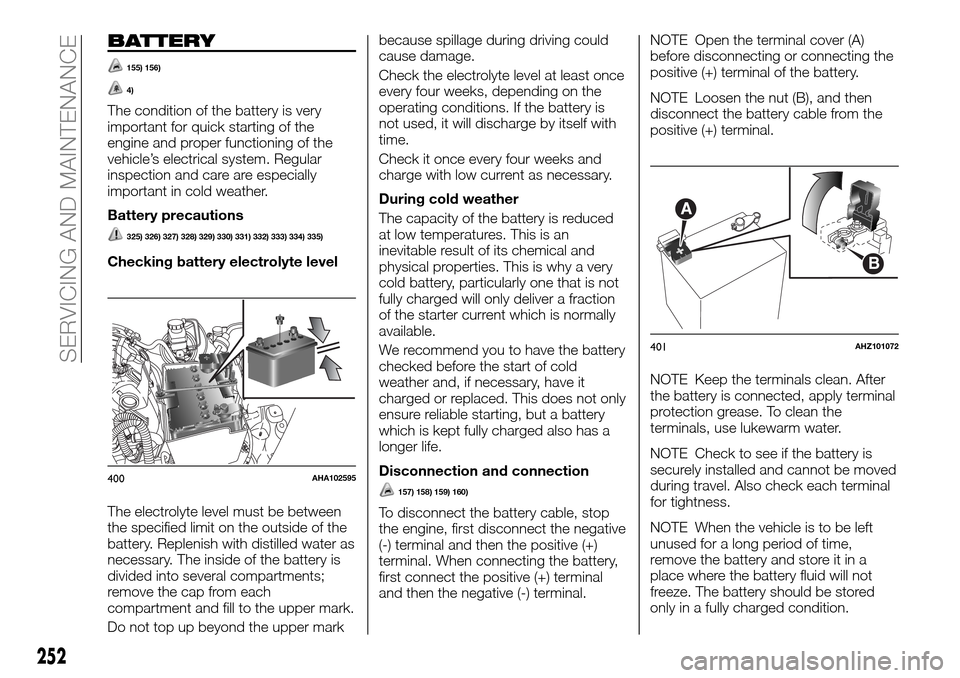
The electrolyte level must be between
the specified limit on the outside of the
battery. Replenish with distilled water as
necessary. The inside of the battery is
divided into several compartments;
remove the cap from each
compartment and fill to the upper mark.
Do not top up beyond the upper markbecause spillage during driving could
cause damage.
Check the electrolyte level at least once
every four weeks, depending on the
operating conditions. If the battery is
not used, it will discharge by itself with
time.
Check it once every four weeks and
charge with low current as necessary.
During cold weather
The capacity of the battery is reduced
at low temperatures. This is an
inevitable result of its chemical and
physical properties. This is why a very
cold battery, particularly one that is not
fully charged will only deliver a fraction
of the starter current which is normally
available.
We recommend you to have the battery
checked before the start of cold
weather and, if necessary, have it
charged or replaced. This does not only
ensure reliable starting, but a battery
which is kept fully charged also has a
longer life.
Disconnection and connection
157) 158) 159) 160)
To disconnect the battery cable, stop
the engine, first disconnect the negative
(-) terminal and then the positive (+)
terminal. When connecting the battery,
first connect the positive (+) terminal
and then the negative (-) terminal.NOTE Open the terminal cover (A)
before disconnecting or connecting the
positive (+) terminal of the battery.
NOTE Loosen the nut (B), and then
disconnect the battery cable from the
positive (+) terminal.
NOTE Keep the terminals clean. After
the battery is connected, apply terminal
protection grease. To clean the
terminals, use lukewarm water.
NOTE Check to see if the battery is
securely installed and cannot be moved
during travel. Also check each terminal
for tightness.
NOTE When the vehicle is to be left
unused for a long period of time,
remove the battery and store it in a
place where the battery fluid will not
freeze. The battery should be stored
only in a fully charged condition.
400AHA102595
A
B
401AHZ101072
252
SERVICING AND MAINTENANCE