ECU FIAT FULLBACK 2016 1.G Owner's Guide
[x] Cancel search | Manufacturer: FIAT, Model Year: 2016, Model line: FULLBACK, Model: FIAT FULLBACK 2016 1.GPages: 312, PDF Size: 13.67 MB
Page 256 of 312
WIPER BLADE
RUBBER
REPLACEMENT
336)
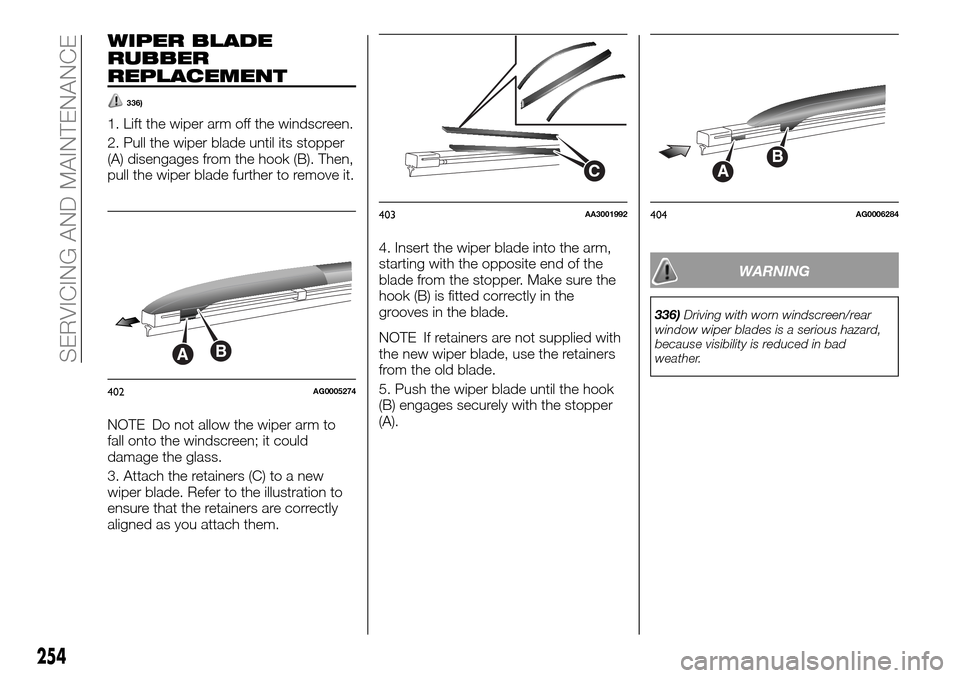
1. Lift the wiper arm off the windscreen.
2. Pull the wiper blade until its stopper
(A) disengages from the hook (B). Then,
pull the wiper blade further to remove it.
NOTE Do not allow the wiper arm to
fall onto the windscreen; it could
damage the glass.
3. Attach the retainers (C) to a new
wiper blade. Refer to the illustration to
ensure that the retainers are correctly
aligned as you attach them.4. Insert the wiper blade into the arm,
starting with the opposite end of the
blade from the stopper. Make sure the
hook (B) is fitted correctly in the
grooves in the blade.
NOTE If retainers are not supplied with
the new wiper blade, use the retainers
from the old blade.
5. Push the wiper blade until the hook
(B) engages securely with the stopper
(A).
WARNING
336)Driving with worn windscreen/rear
window wiper blades is a serious hazard,
because visibility is reduced in bad
weather.
AB
402AG0005274
C
403AA3001992
AB
404AG0006284
254
SERVICING AND MAINTENANCE
Page 261 of 312
169)After washing the vehicle, drive the
vehicle slowly while lightly depressing the
brake pedal several times in order to dry
out the brakes. Leaving the brakes wet
could result in reduced braking
performance. Also, there is a possibility that
they could freeze up or become inoperative
due to rust, rendering the vehicle unable to
move.
170)Using an automatic car wash, pay
attention to the following items, referring to
the operation manual or consulting a car
wash operator. If the following procedure is
not followed, it could result in damage to
your vehicle: 1 – the outside rear-view
mirrors are retracted. 2 – The antenna is
removed. 3 – The wiper arms are secured
in place with tape.4–Ifyour vehicle has
rain sensor wipers, place the wiper switch
lever in the “OFF” position to deactivate the
rain sensor.
171)Waxes containing high abrasive
compounds should not be used.
172)Do not use a scrubbing brush or other
hard tools as they may damage the plastic
part surface.
173)Do not bring the plastic parts into
contact with petrol, light oil, brake fluids,
engine oils, greases, paint thinners and
sulphuric acid (battery electrolyte) which
may crack, stain or discolour the plastic
parts. If they touch the plastic parts, wipe
them off with soft cloth, chamois or the like
and an aqueous solution of neutral
detergent then immediately rinse the
affected parts with water.
174)Do not use a brush or other hard
implement on the wheels. Doing so could
scratch the wheels.175)Do not use any cleaner that contains
an abrasive substance or is acidic or
alkaline. Doing so could cause the coating
on the wheels to peel or become
discoloured or stained.
176)Do not directly apply hot water using a
steam cleaner or by any other means.
177)Contact with seawater and road
deicer can cause corrosion. Rinse off such
substances as soon as possible.
IMPORTANT
6)Detergents pollute the environment. Only
wash your vehicle in areas equipped to
collect and treat wastewater from this type
of activity.
259
Page 263 of 312
Tyre inflation pressures
gauge
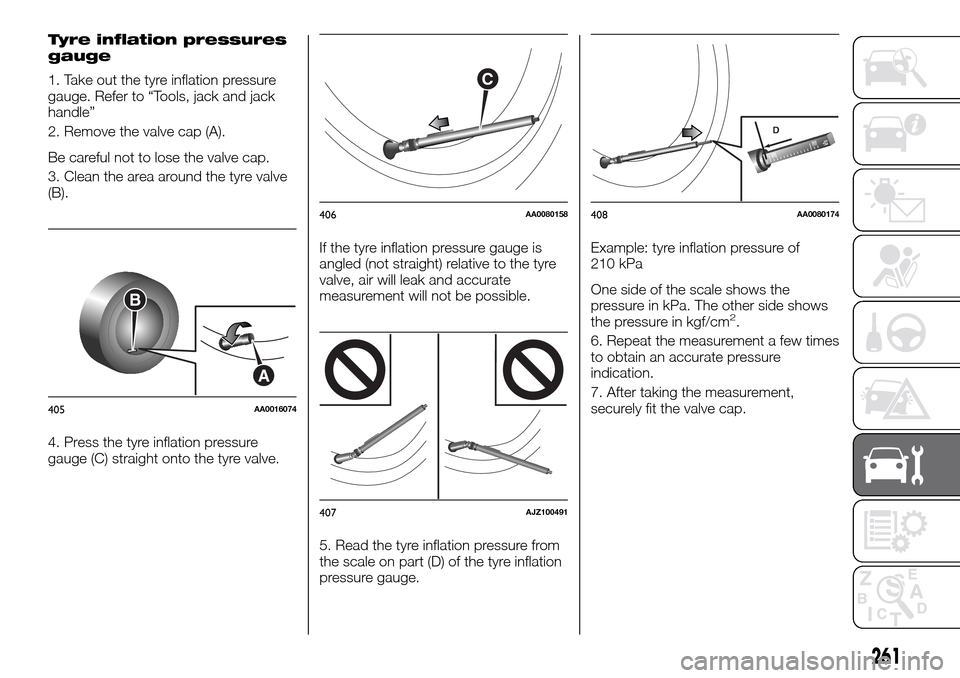
1. Take out the tyre inflation pressure
gauge. Refer to “Tools, jack and jack
handle”
2. Remove the valve cap (A).
Be careful not to lose the valve cap.
3. Clean the area around the tyre valve
(B).
4. Press the tyre inflation pressure
gauge (C) straight onto the tyre valve.If the tyre inflation pressure gauge is
angled (not straight) relative to the tyre
valve, air will leak and accurate
measurement will not be possible.
5. Read the tyre inflation pressure from
the scale on part (D) of the tyre inflation
pressure gauge.Example: tyre inflation pressure of
210 kPa
One side of the scale shows the
pressure in kPa. The other side shows
the pressure in kgf/cm
2.
6. Repeat the measurement a few times
to obtain an accurate pressure
indication.
7. After taking the measurement,
securely fit the valve cap.
A
B
405AA0016074
C
406AA0080158
407AJZ100491
D
408AA0080174
261
Page 266 of 312
181)If the tyres have arrows (A) indicating
the correct direction of rotation, swap the
front and rear tyres on the left hand side of
the vehicle and the front and rear tyres on
the right hand side of the vehicle separately.
Keep each tyre on its original side of the
vehicle. When fitting the tyres, make sure
the arrows point in the direction in which
the wheels will turn when the vehicle moves
forward. Any tyre whose arrow points in the
wrong direction will not perform to its full
potential.
182)Avoid the combined use of different
types of tyres. Using different types of tyres
can affect vehicle performance and safety.
183)If winter tyres with a lower speed
rating than that indicated in the Registration
Document are used, do not exceed the
maximum speed corresponding to the
speed rating of the tyres used.
184)Do not fit snow traction device (Tyre
chains) before you need them. This will
wear out your tyres and the road surface.
185)After driving around 100-300 metres,
stop and retighten the snow traction device
(Tyre chains).
186)Care should be taken with extremes of
steering lock to prevent possible contact
between the chains and the vehicle body.
187)Drive cautiously and do not exceed
50 km/h. Remember that preventing
accidents is not the purpose of snow
traction device (tyre chains).
188)When tyre chains are installed, take
care that they do not damage the disc
wheel or body.189)An aluminium wheel can be damaged
by a snow traction device (Tyre chains)
while driving. When fitting a snow traction
device (Tyre chains) on an aluminium wheel,
take care that any part of the snow traction
device (Tyre chains) and fitting cannot be
brought into contact with the wheel.
190)When installing or removing a tyre
chain, take care that hands and other parts
of your body are not injured by the sharp
edges of the vehicle body.
191)Install the chains only on the rear tyres
and tighten them as tightly as possible with
the ends securely fastened.
264
SERVICING AND MAINTENANCE