Wheel FIAT FULLBACK 2016 1.G User Guide
[x] Cancel search | Manufacturer: FIAT, Model Year: 2016, Model line: FULLBACK, Model: FIAT FULLBACK 2016 1.GPages: 312, PDF Size: 13.67 MB
Page 33 of 312
27)Once the dead lock system is engaged
it is impossible to open the doors from
inside the vehicle. Therefore, before
engaging the system check that there is no
one left inside. If the remote control battery
is flat, the system can be disengaged only
by inserting the key metal insert in either of
the door locks as described previously: in
this case the device remains active only for
the rear doors.
28)This spring loaded system has
activation forces that were designed for
optimum comfort. Accidental knocks or a
strong gust of wind may release the
springs and close the doors
spontaneously.
29)On vehicles with the rear bumper,
never swing down the rear gate because
the rear gate could be damaged.
30)Never close the rear gate with the link
or wire left unhooked.SEATS
SEAT ADJUSTMENT
Adjust the driver’s seat so that you are
comfortable and that you can reach the
pedals, steering wheel, switches etc.
while retaining a clear field of vision.
31) 32) 33) 34) 35) 36) 37) 38) 39) 40) 41) 42)
10)
FRONT SEATS
Manual type
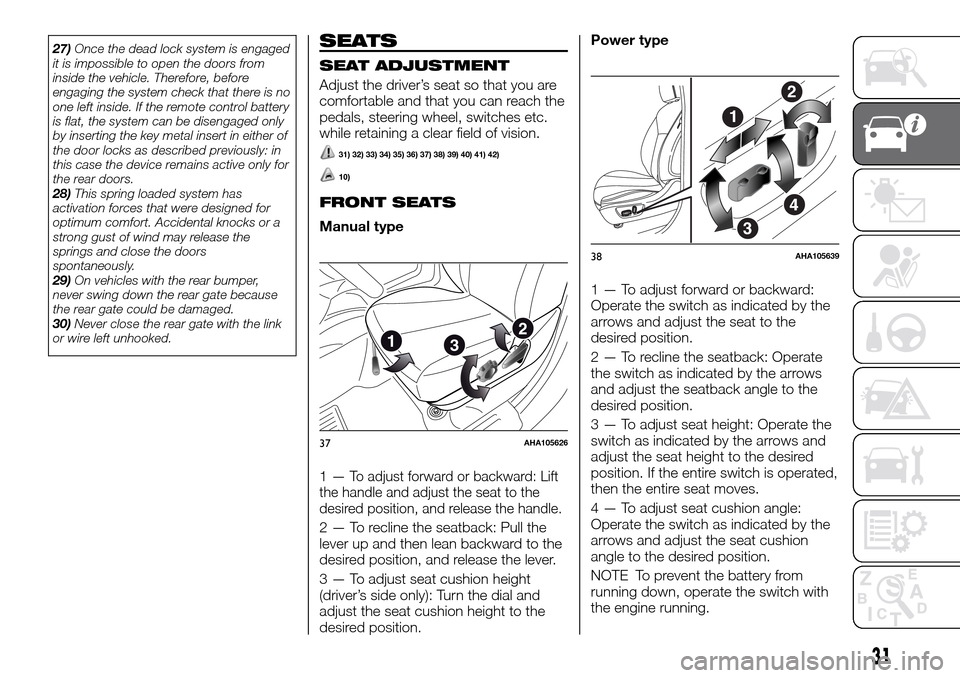
1—
To adjust forward or backward: Lift
the handle and adjust the seat to the
desired position, and release the handle.
2 — To recline the seatback: Pull the
lever up and then lean backward to the
desired position, and release the lever.
3 — To adjust seat cushion height
(driver’s side only): Turn the dial and
adjust the seat cushion height to the
desired position.Power type
1 — To adjust forward or backward:
Operate the switch as indicated by the
arrows and adjust the seat to the
desired position.
2 — To recline the seatback: Operate
the switch as indicated by the arrows
and adjust the seatback angle to the
desired position.
3 — To adjust seat height: Operate the
switch as indicated by the arrows and
adjust the seat height to the desired
position. If the entire switch is operated,
then the entire seat moves.
4 — To adjust seat cushion angle:
Operate the switch as indicated by the
arrows and adjust the seat cushion
angle to the desired position.
NOTE To prevent the battery from
running down, operate the switch with
the engine running.
312
37AHA105626
3
4
1
2
38AHA105639
31
Page 37 of 312
WARNING
43)All adjustments must only be carried
out with the vehicle stationary and the
engine off. Head restraints must be
adjusted so that the head, rather than the
neck, rests on them. Only in this case can
they protect your head correctly. To take
best advantage of the protection provided
by the head restraint, adjust the seat back
so that you are sitting up straight and your
head is as close to the head restraint as
possible.
44)Driving without the head restraints in
place can cause you and your passengers
serious injury or death in an accident. To
reduce the risk of injury in an accident,
always make sure the head restraints are
installed and properly positioned when the
seat is occupied.45)Never place a cushion or similar device
on the seatback. This can adversely affect
head restraint performance by increasing
the distance between your head and the
restraint.
46)When a person sits in the middle
seating position of the rear seat, pull up the
head restraint to a height at which it locks
in position. Be sure to make this
adjustment before starting to drive. Serious
injuries could otherwise be suffered in the
result of an impact (Double cab).
47)Make sure that the height adjusting
knob (A) is correctly adjusted as shown in
the illustration, and also lift the head
restraints to ensure that they do not come
out of the seatback.
48)The shape and size of the head
restraint differs according to the seat.
Always use the correct head restraint
provided for the seat and do not install the
head restraint in the wrong direction.
STEERING WHEEL
STEERING WHEEL
HEIGHT AND REACH
ADJUSTMENT
(Vehicles equipped with the reach
adjustment)
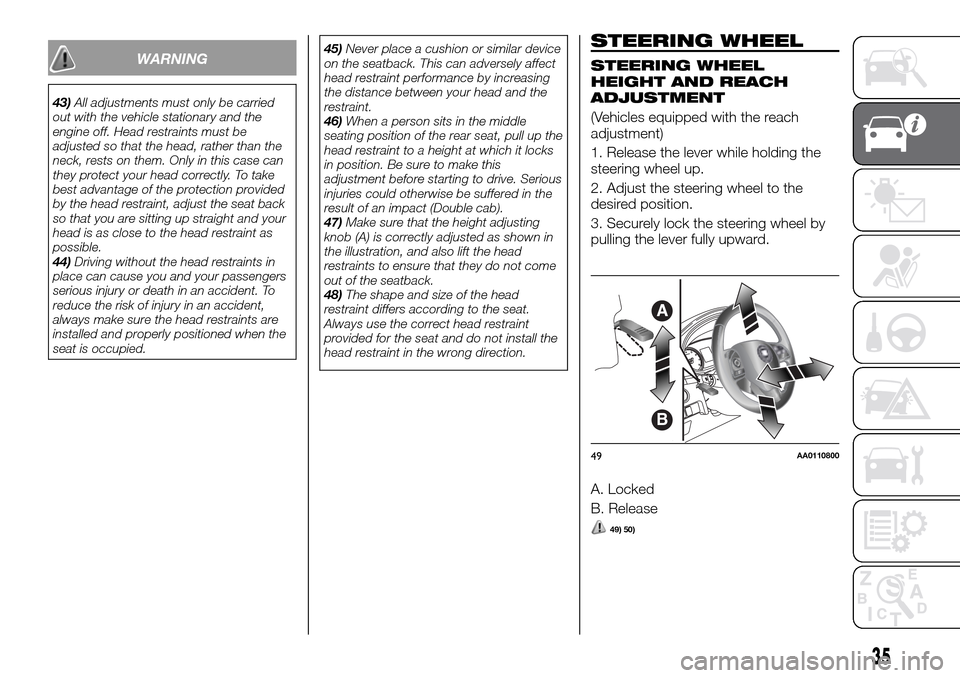
1. Release the lever while holding the
steering wheel up.
2. Adjust the steering wheel to the
desired position.
3. Securely lock the steering wheel by
pulling the lever fully upward.
A. Locked
B. Release
49) 50)
A
B
49AA0110800
35
Page 38 of 312
STEERING WHEEL LOCK
Except for vehicles equipped with
the keyless operation system
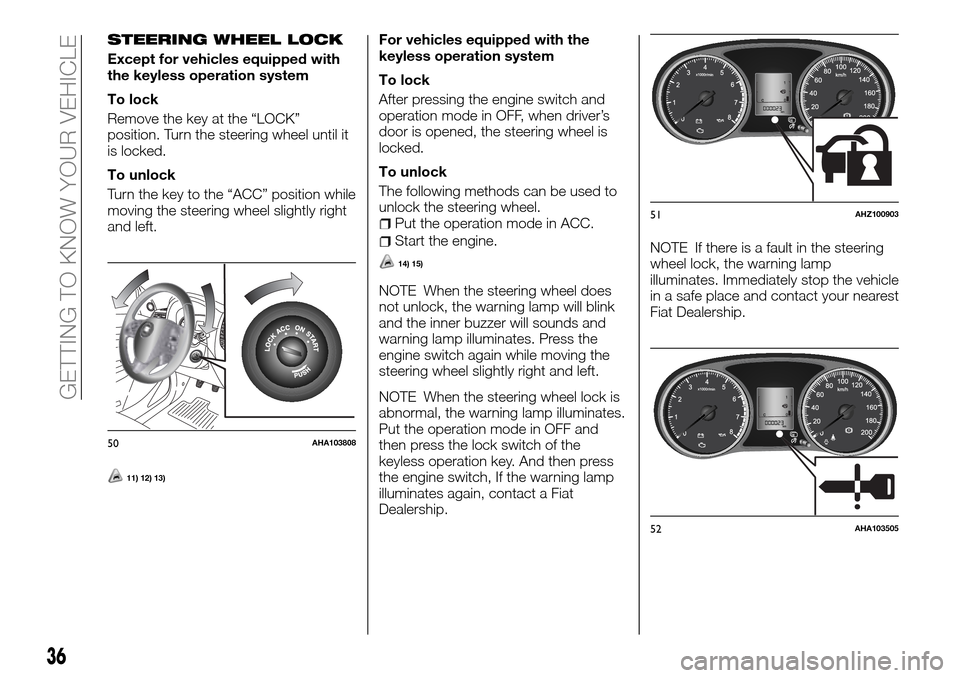
To lock
Remove the key at the “LOCK”
position. Turn the steering wheel until it
is locked.
To unlock
Turn the key to the “ACC” position while
moving the steering wheel slightly right
and left.
11) 12) 13)
For vehicles equipped with the
keyless operation system
To lock
After pressing the engine switch and
operation mode in OFF, when driver’s
door is opened, the steering wheel is
locked.
To unlock
The following methods can be used to
unlock the steering wheel.
Put the operation mode in ACC.
Start the engine.
14) 15)
NOTE When the steering wheel does
not unlock, the warning lamp will blink
and the inner buzzer will sounds and
warning lamp illuminates. Press the
engine switch again while moving the
steering wheel slightly right and left.
NOTE When the steering wheel lock is
abnormal, the warning lamp illuminates.
Put the operation mode in OFF and
then press the lock switch of the
keyless operation key. And then press
the engine switch, If the warning lamp
illuminates again, contact a Fiat
Dealership.NOTE If there is a fault in the steering
wheel lock, the warning lamp
illuminates. Immediately stop the vehicle
in a safe place and contact your nearest
Fiat Dealership.
50AHA103808
51AHZ100903
52AHA103505
36
GETTING TO KNOW YOUR VEHICLE
Page 39 of 312
WARNING
49)Do not attempt to adjust the steering
wheel while you are driving the vehicle.
50)It is absolutely forbidden to carry out
any after-market operation involving
steering system or steering column
modifications (e.g.: installation of anti-theft
device). This could badly affect
performance and safety, invalidate the
warranty and also result in the
non-compliance of the vehicle with
approval requirements.
IMPORTANT
11)Remove the key when leaving the
vehicle. In some countries, it is prohibited
to leave the key on the vehicle when
parked.
12)When the following operation is
performed with the operation mode in OFF,
the steering wheel is locked: 1 – open or
close the driver’s door. 2 – Close all the
doors. 3 – Open one of the doors when all
the doors are closed. 4 – Lock all the doors
with the keyless entry system or the keyless
operation function. 5 – The selector lever is
the “P” (PARK) position (A/T).
13)When the door is opened while the
steering wheel does not lock, the buzzer
sounds to alert the steering wheel is
unlocked.14)If the engine is stopped while driving,
do not open a door or press the LOCK
switch on the key until the vehicle stops in
a safe place. This could cause the steering
wheel to lock, making it impossible to
operate the vehicle.
15)Carry the key with you when leaving the
vehicle. If your vehicle needs to be towed,
perform the following operation to unlock
the steering wheel: on vehicles with M/T,
put the operation mode in ACC or ON, on
vehicles with A/T, put the operation mode
in ON.
REARVIEW MIRRORS
INSIDE REARVIEW
MIRROR
51) 52) 53) 54)
Adjust the rearview mirror only after
making any seat adjustments so you
have a clear view to the rear of the
vehicle.
Adjust the rear-view mirror to maximize
the view through the rear window.
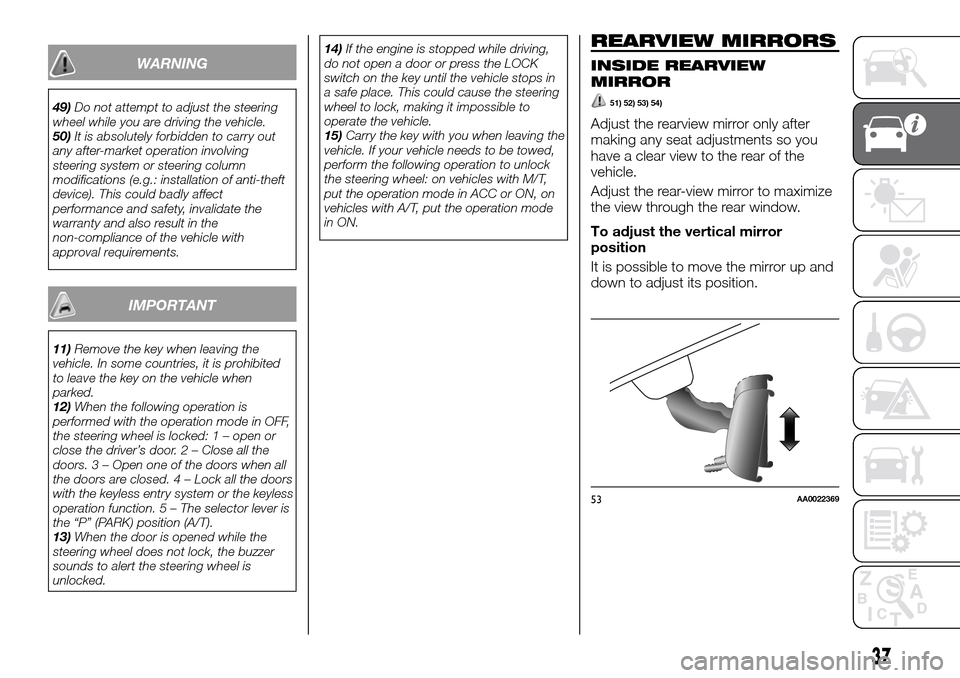
To adjust the vertical mirror
position
It is possible to move the mirror up and
down to adjust its position.
53AA0022369
37
Page 102 of 312
WARNING
102)In the following situations, brake
performance may be compromised or the
vehicle may become unstable if brakes are
applied suddenly; consequently, avoid
driving at high speeds or applying the
brakes suddenly. Furthermore, immediately
the vehicle should be brought to a stop in a
safe location and we recommend you to
have it checked. 1 – The brake warning
lamp does not illuminate when the parking
brake is applied or does not turn off when
the parking brake is released.2–The
brake warning lamp and the ABS warning
lamp illuminate at the same time. For
details, refer to “ABS warning lamp”. 3 –
The brake warning lamp remains
illuminated while driving.
103)The vehicle should be brought to a
halt in the following manner when brake
performance has deteriorated. 1 – Depress
the brake pedal harder than usual. Even if
the brake pedal moves down to the very
end of its possible stroke, keep it pressed
down hard. 2 – Should the brakes fail, use
engine braking to reduce your speed and
carefully pull the parking brake lever.
Depress the brake pedal to operate the
stop lamp to alert the vehicles behind you.
IMPORTANT
42)This warning lightwill flash after
starting or during prolonged cranking to
indicate a fault with the glow plug heating
system. If the engine starts, the vehicle can
be used as normal, but a Fiat Dealership
must be contacted as soon as possible.
43)If the diesel preheat indicator lamp
comes on after the engine is started, the
engine speed may not rise above the idling
speed because of fuel freezing. In this case,
keep the engine idling for about
10 minutes, then turn off the ignition switch
or put in OFF the operation mode, and
immediately turn it on or put in ON again to
confirm that the diesel preheat indicator
lamp is off.
44)When the ignition switch is turned to
the “ON” position or the operation mode is
put in ON, the warning lamp does not
come on or it remains on and does not go
off . The warning lamp comes on while
driving.
45)When this indicator lamp blinks, active
stability control function or active traction
control function is operating, which means
that the road is slippery or that your
vehicle’s wheels are beginning to slip. If this
happens, drive slower with less accelerator
input.46)If an abnormal condition occurs in the
system while driving, the
indicator lamp
will illuminate. In these cases, follow these
procedures:1–Ifthetemperature in the
braking system continues to increase due
to continuous brake control on a slippery
road surface, the
indicator lamp will
blink, and operation of the active traction
control function will be suspended to
protect the brake system (the engine
control of the traction control function and
normal brake operation will not be
affected.) Park your vehicle in a safe place.
When the temperature in the braking
system has come down, the indicator lamp
will go off and the active stability control
function and active traction control function
will start operating again.2–Ifthe
indicator lamp does not go out even
through the above procedure is followed,
there could be a problem in the system.
Stop the engine and start the engine again
and check whether the
indicator lamp
goes out. If the indicator lamp goes out,
there is no abnormal condition.3–Ifthe
indicator lamp illuminates even after
your vehicle is driven a short distance after
re-starting the engine, we recommend you
to have your vehicle checked as soon as
possible.
100
KNOWING THE INSTRUMENT PANEL
Page 103 of 312
47)If the vehicle is towed with the ignition
switch in the “ON” position or the operation
mode in ON and only the front wheels or
only the rear wheels raised off the ground,
the ASTC may operate, resulting in an
accident. When towing the vehicle with the
front wheels raised, keep the ignition switch
in the “LOCK” or “ACC” position or the
operation mode in ACC or OFF. When
towing the vehicle with the rear wheels
raised, keep the ignition switch in the
“ACC” position or the operation mode in
ACC. Refer to “Towing”.
48)Prolonged driving with this lamp on
may cause further damage to the emission
control system. It could also affect fuel
economy and drivability.
49)If the lamp does not illuminate when the
ignition switch is turned to the “ON”
position or the operation mode is put in
ON, we recommend you to have the
system checked.
50)If the lamp illuminates while the engine
is running, avoid driving at high speeds and
have the system inspected by a Fiat
Dealership as soon as possible. Accelerator
pedal and brake pedal response may be
negatively influenced under these
conditions.
51)If it illuminates while the engine is
running, there is a problem in the charging
system. Immediately park your vehicle in a
safe place and we recommend you to have
it checked.
52)If this lamp illuminates when the engine
oil level is not low, have it inspected.
53)This warning lamp does not indicate
the amount of oil in the crankcase. This
must be determined by checking the oil
level on the dipstick, while the engine is
switched off.54)If you continue driving with low engine
oil level or with this warning lamp
illuminated, engine seizure may occur.
55)Before moving your vehicle, check that
the warning lamp is OFF.
56)If any of the following conditions occur,
there may be a problem with the SRS
airbags and/or seat belt pre-tensioners,
and they may not function properly in a
collision or may suddenly activate without a
collision: 1 – Even when the ignition switch
or the operation mode is in ON, the SRS
warning lamp does not come on or it
remains on. 2 – The SRS warning lamp
comes on while driving.
57)The SRS airbags and seat belt
pre-tensioners are designed to help reduce
the risk of serious injury or death in certain
collisions. If either of the above conditions
occurs, immediately have your vehicle
checked by a Fiat Dealership.
58)Any of the following indicates that the
ABS is not functioning and only the
standard brake system is working. (The
standard brake system is functioning
normally.) If this happens, take your vehicle
to a Fiat Dealership.
101
Page 121 of 312
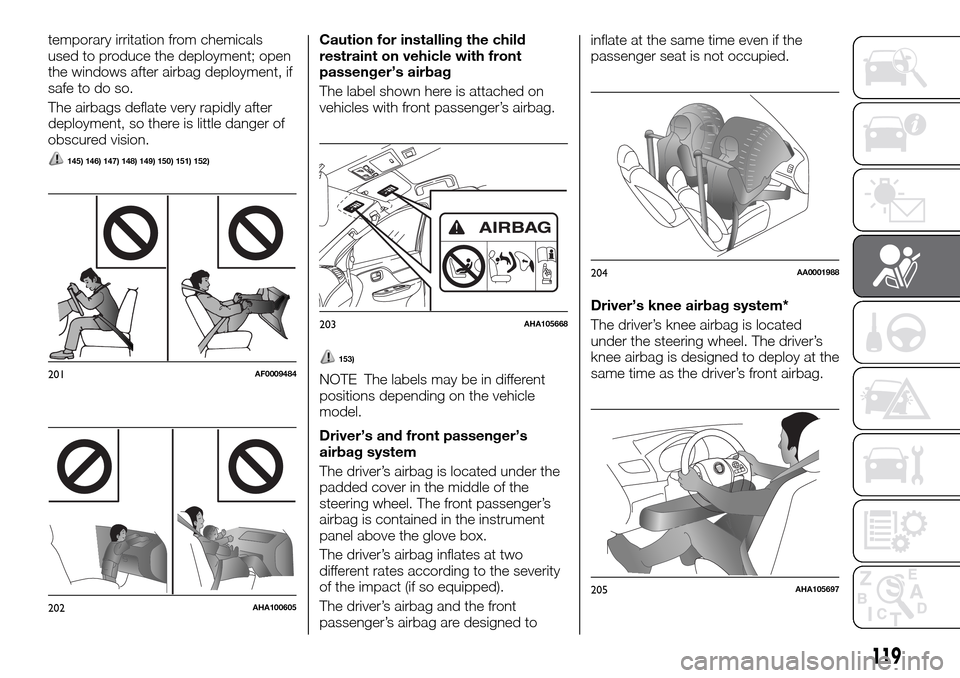
temporary irritation from chemicals
used to produce the deployment; open
the windows after airbag deployment, if
safe to do so.
The airbags deflate very rapidly after
deployment, so there is little danger of
obscured vision.
145) 146) 147) 148) 149) 150) 151) 152)
Caution for installing the child
restraint on vehicle with front
passenger’s airbag
The label shown here is attached on
vehicles with front passenger’s airbag.
153)
NOTE The labels may be in different
positions depending on the vehicle
model.
Driver’s and front passenger’s
airbag system
The driver’s airbag is located under the
padded cover in the middle of the
steering wheel. The front passenger’s
airbag is contained in the instrument
panel above the glove box.
The driver’s airbag inflates at two
different rates according to the severity
of the impact (if so equipped).
The driver’s airbag and the front
passenger’s airbag are designed toinflate at the same time even if the
passenger seat is not occupied.
Driver’s knee airbag system*
The driver’s knee airbag is located
under the steering wheel. The driver’s
knee airbag is designed to deploy at the
same time as the driver’s front airbag.201AF0009484
202AHA100605
203AHA105668
204AA0001988
205AHA105697
119
Page 122 of 312
Deployment of front
airbags and driver’s
knee airbag
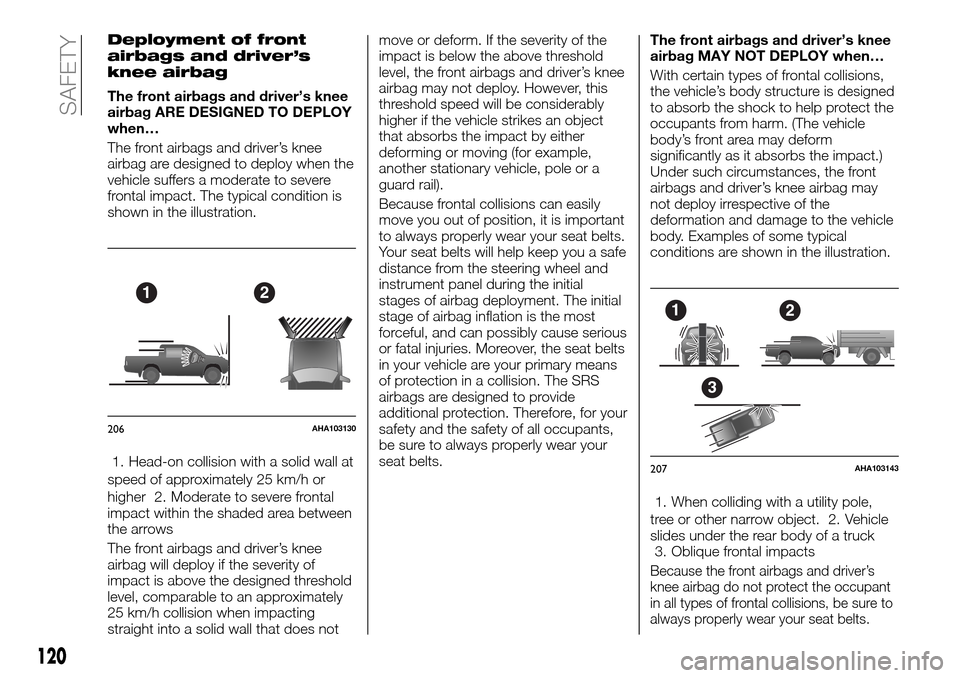
The front airbags and driver’s knee
airbag ARE DESIGNED TO DEPLOY
when…
The front airbags and driver’s knee
airbag are designed to deploy when the
vehicle suffers a moderate to severe
frontal impact. The typical condition is
shown in the illustration.
1. Head-on collision with a solid wall at
speed of approximately 25 km/h or
higher 2. Moderate to severe frontal
impact within the shaded area between
the arrows
The front airbags and driver’s knee
airbag will deploy if the severity of
impact is above the designed threshold
level, comparable to an approximately
25 km/h collision when impacting
straight into a solid wall that does notmove or deform. If the severity of the
impact is below the above threshold
level, the front airbags and driver’s knee
airbag may not deploy. However, this
threshold speed will be considerably
higher if the vehicle strikes an object
that absorbs the impact by either
deforming or moving (for example,
another stationary vehicle, pole or a
guard rail).
Because frontal collisions can easily
move you out of position, it is important
to always properly wear your seat belts.
Your seat belts will help keep you a safe
distance from the steering wheel and
instrument panel during the initial
stages of airbag deployment. The initial
stage of airbag inflation is the most
forceful, and can possibly cause serious
or fatal injuries. Moreover, the seat belts
in your vehicle are your primary means
of protection in a collision. The SRS
airbags are designed to provide
additional protection. Therefore, for your
safety and the safety of all occupants,
be sure to always properly wear your
seat belts.The front airbags and driver’s knee
airbag MAY NOT DEPLOY when…
With certain types of frontal collisions,
the vehicle’s body structure is designed
to absorb the shock to help protect the
occupants from harm. (The vehicle
body’s front area may deform
significantly as it absorbs the impact.)
Under such circumstances, the front
airbags and driver’s knee airbag may
not deploy irrespective of the
deformation and damage to the vehicle
body. Examples of some typical
conditions are shown in the illustration.
1. When colliding with a utility pole,
tree or other narrow object. 2. Vehicle
slides under the rear body of a truck
3. Oblique frontal impacts
Because the front airbags and driver’s
knee airbag do not protect the occupant
in all types of frontal collisions, be sure to
always properly wear your seat belts.
12
206AHA103130
2
3
1
207AHA103143
120
SAFETY
Page 123 of 312
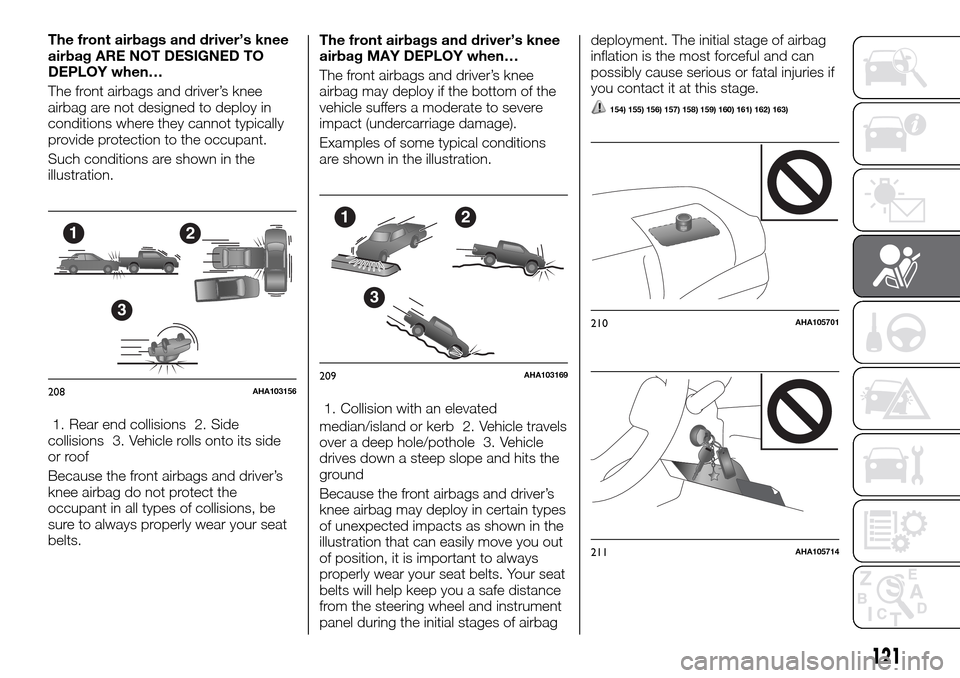
The front airbags and driver’s knee
airbag ARE NOT DESIGNED TO
DEPLOY when…
The front airbags and driver’s knee
airbag are not designed to deploy in
conditions where they cannot typically
provide protection to the occupant.
Such conditions are shown in the
illustration.
1. Rear end collisions 2. Side
collisions 3. Vehicle rolls onto its side
or roof
Because the front airbags and driver’s
knee airbag do not protect the
occupant in all types of collisions, be
sure to always properly wear your seat
belts.The front airbags and driver’s knee
airbag MAY DEPLOY when…
The front airbags and driver’s knee
airbag may deploy if the bottom of the
vehicle suffers a moderate to severe
impact (undercarriage damage).
Examples of some typical conditions
are shown in the illustration.
1. Collision with an elevated
median/island or kerb 2. Vehicle travels
over a deep hole/pothole 3. Vehicle
drives down a steep slope and hits the
ground
Because the front airbags and driver’s
knee airbag may deploy in certain types
of unexpected impacts as shown in the
illustration that can easily move you out
of position, it is important to always
properly wear your seat belts. Your seat
belts will help keep you a safe distance
from the steering wheel and instrument
panel during the initial stages of airbagdeployment. The initial stage of airbag
inflation is the most forceful and can
possibly cause serious or fatal injuries if
you contact it at this stage.
154) 155) 156) 157) 158) 159) 160) 161) 162) 163)
2
3
1
208AHA103156
2
3
1
209AHA103169
210AHA105701
211AHA105714
121
Page 126 of 312
WARNING
145)Airbags inflate at an extremely rapid
speed. In certain situations, contact with
inflating airbags can result in abrasions,
bruises, light cuts, and the like.
146)IT IS VERY IMPORTANT TO BE
PROPERLY SEATED. A driver or front
passenger too close to the steering wheel
or instrument panel during airbag
deployment can be killed or seriously
injured. Airbags inflate very fast, and with
great force. If the driver and front
passenger are not properly seated and
restrained, the airbags may not protect you
properly, and could cause serious or fatal
injuries when they inflate.
147)Do not sit on the edge of the seat, or
sit with your lower legs too close to the
instrument panel, or lean head or chest
close to the steering wheel or instrument
panel. Do not put feet or legs on or against
the instrument panel.
148)Always drive with your hands on the
rim of the steering wheel so that the airbag
can inflate freely if required. Do not drive
with your body bent forward. Keep your
back straight against the backrest.149)Place all infants and small children in
the rear seat and properly restrained using
an appropriate child restraint system. The
rear seat is the safest for infants and
children.
150)Infants and small children should
never be unrestrained, stand up against
the instrument panel or held in your arms
or on your lap. They could be seriously
injured or killed in a collision, including
when the airbag inflates. They should be
properly seated in an appropriate child
restraint system. See the “Child restraint”
section of this owner’s manual.
151)When there is an active passenger
airbag, DO NOT install rearward facing
child restraint systems on the front seat.
Deployment of the airbag in an accident
could cause fatal injuries to the child
regardless of the severity of the impact.
Therefore, always deactivate the passenger
side airbag when a rearward facing child
restraint system is installed on the front
passenger seat. The front passenger seat
must also be positioned back as far as
possible in order to prevent the child
restraint system from coming into contact
with the dashboard. Immediately reactivate
the passenger airbag as soon as the child
restraint system has been removed.
152)Older children should be seated,
properly wearing the seat belt, with an
appropriate booster seat if needed.
153)Extreme Hazard! NEVER use a
rearward facing child restraint on a seat
protected by an ACTIVE AIRBAG in front of
it, DEATH or SERIOUS INJURY to the
CHILD can occur.154)Do not fit any accessory that makes
the indicator impossible to see, and do not
cover the indicator with a sticker. You
would not be able to verify the status of the
passenger airbag system.
155)To reduce risk of serious or fatal
injury: always turn the ignition switch to the
“LOCK” position or put the operation mode
in OFF, before operating the front
passenger’s airbag ON-OFF switch. Failure
to do so could adversely affect the airbag
performance; Wait at least 60 seconds to
operate the front passenger’s airbag
ON-OFF switch after turning the ignition
switch to the “LOCK” position or putting
the operation mode in OFF. The SRS
airbag system is designed to retain enough
voltage to deploy the airbag; Always
remove the key from the front passenger’s
airbag ON-OFF switch after operating that
switch. Failure to do so could lead to
improper position of the front passenger’s
airbag ON-OFF switch; Do not turn OFF
the front passenger’s airbag ON-OFF
switch except when a child restraint
system is fitted to the front passenger seat;
If the OFF indicator does not come on
when the front passenger’s airbag ONOFF
switch is turned OFF, do not fit a child
restraint system to the front passenger
seat. We recommend you to have the
system inspected by a Fiat Dealership; if
the OFF indicator remains on when the
front passenger’s airbag ON-OFF switch is
turned ON, do not allow anyone to sit on
the front passenger seat. We recommend
you to have the system inspected by a Fiat
Dealership.
124
SAFETY