Wheel FIAT FULLBACK 2016 1.G Workshop Manual
[x] Cancel search | Manufacturer: FIAT, Model Year: 2016, Model line: FULLBACK, Model: FIAT FULLBACK 2016 1.GPages: 312, PDF Size: 13.67 MB
Page 192 of 312
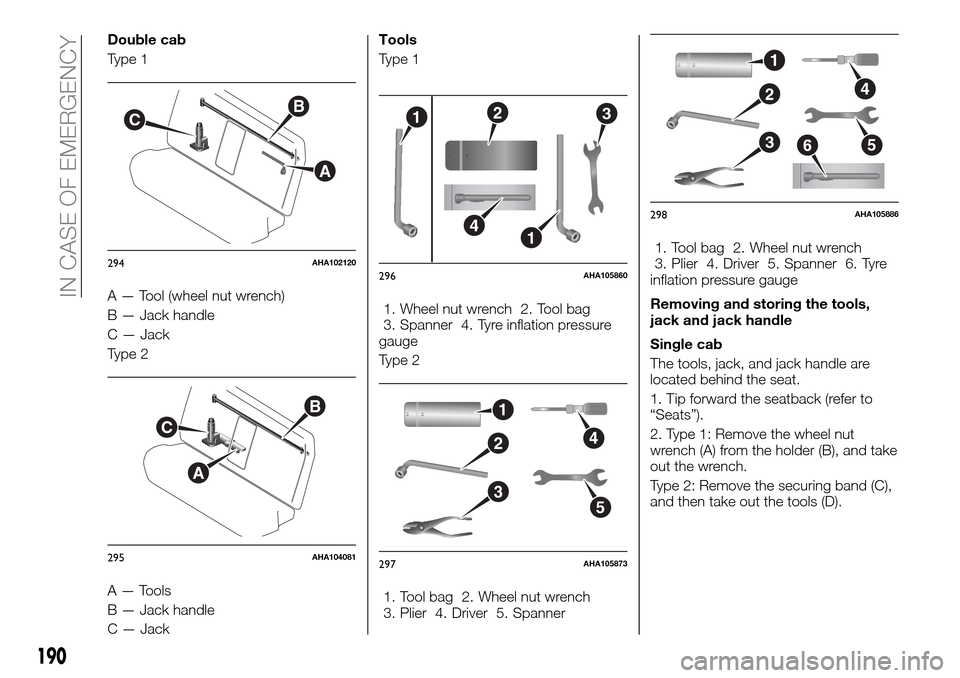
Double cab
Type 1
A — Tool (wheel nut wrench)
B — Jack handle
C — Jack
Type 2
A — Tools
B — Jack handle
C — JackTools
Type 1
1. Wheel nut wrench 2. Tool bag
3. Spanner 4. Tyre inflation pressure
gauge
Type 2
1. Tool bag 2. Wheel nut wrench
3. Plier 4. Driver 5. Spanner1. Tool bag 2. Wheel nut wrench
3. Plier 4. Driver 5. Spanner 6. Tyre
inflation pressure gauge
Removing and storing the tools,
jack and jack handle
Single cab
The tools, jack, and jack handle are
located behind the seat.
1. Tip forward the seatback (refer to
“Seats”).
2. Type 1: Remove the wheel nut
wrench (A) from the holder (B), and take
out the wrench.
Type 2: Remove the securing band (C),
and then take out the tools (D).
B
A
C
294AHA102120
A
C
B
295AHA104081
123
41
296AHA105860
1
4
5
2
3
297AHA105873
1
4
5
2
36
298AHA105886
190
IN CASE OF EMERGENCY
Page 194 of 312
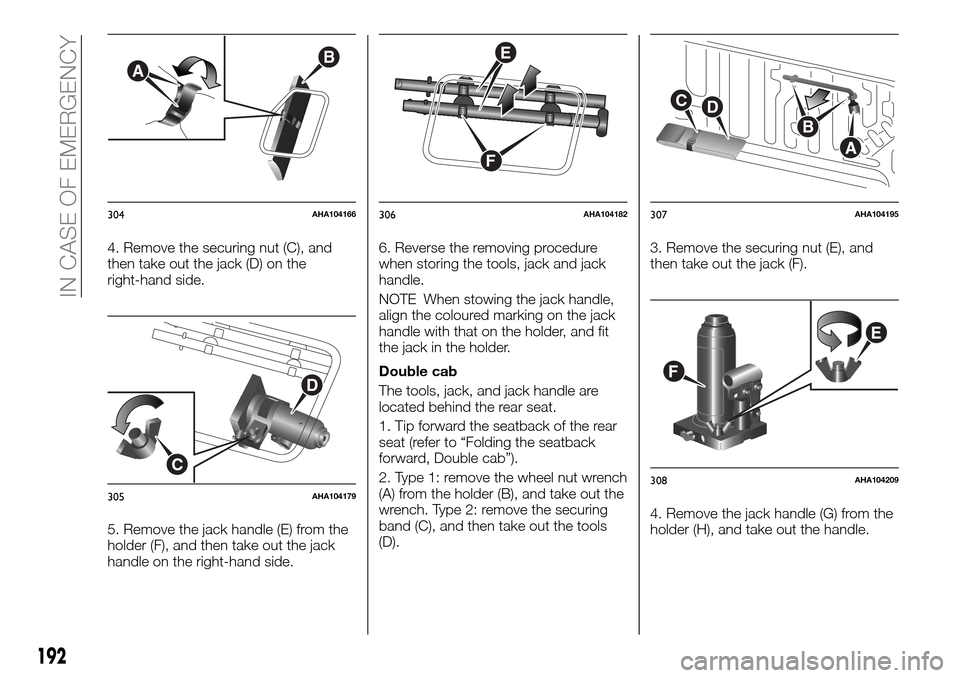
4. Remove the securing nut (C), and
then take out the jack (D) on the
right-hand side.
5. Remove the jack handle (E) from the
holder (F), and then take out the jack
handle on the right-hand side.6. Reverse the removing procedure
when storing the tools, jack and jack
handle.
NOTE When stowing the jack handle,
align the coloured marking on the jack
handle with that on the holder, and fit
the jack in the holder.
Double cab
The tools, jack, and jack handle are
located behind the rear seat.
1. Tip forward the seatback of the rear
seat (refer to “Folding the seatback
forward, Double cab”).
2. Type 1: remove the wheel nut wrench
(A) from the holder (B), and take out the
wrench. Type 2: remove the securing
band (C), and then take out the tools
(D).3. Remove the securing nut (E), and
then take out the jack (F).
4. Remove the jack handle (G) from the
holder (H), and take out the handle.
AB
304AHA104166
C
D
305AHA104179
F
E
306AHA104182
B
A
CD
307AHA104195
E
F
308AHA104209
192
IN CASE OF EMERGENCY
Page 196 of 312
HOW TO CHANGE A
TYRE
132) 133)
Before changing a tyre, first stop your
vehicle in a safe, flat location.
1. Park the vehicle on level and stable
ground, free of loose pebbles, etc.
2. Set the parking brake firmly.
3. On vehicles with manual
transmission, turn the ignition switch to
the “LOCK” position or put the
operation mode in OFF, and move the
gearshift lever to the “R” (Reverse)
position. On vehicles with automatic
transmission, move the selector lever to
the “P” (PARK) position, and turn the
ignition switch to the “LOCK” position
or put the operation mode in OFF.
4. Turn on the hazard flashers and set
up a warning triangle, flashing signal
lamp, etc., at an adequate distance
from the vehicle, and have all your
passengers leave the vehicle.
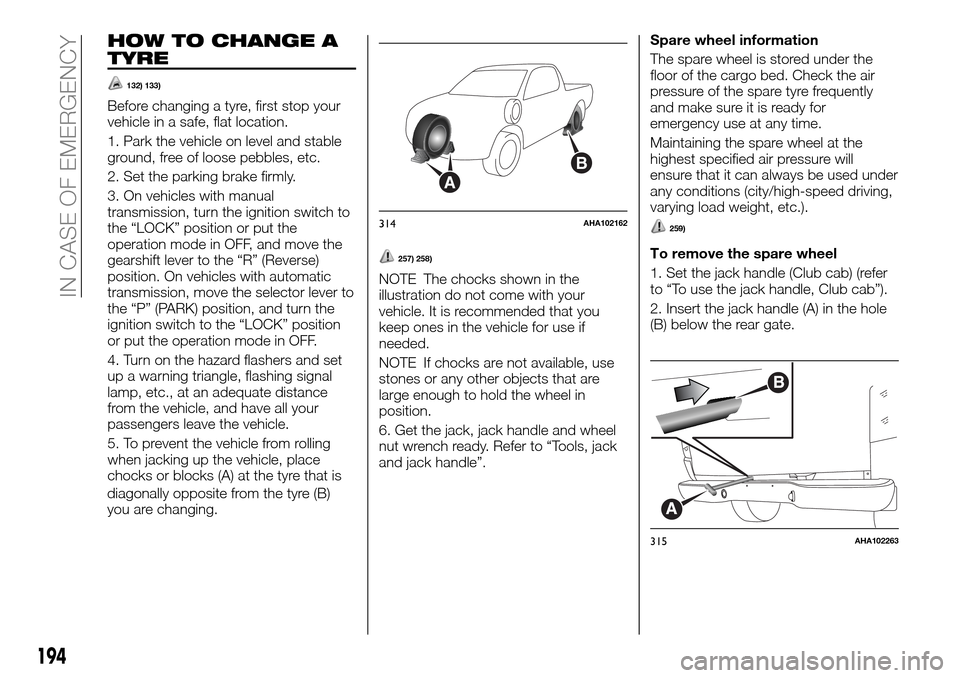
5. To prevent the vehicle from rolling
when jacking up the vehicle, place
chocks or blocks (A) at the tyre that is
diagonally opposite from the tyre (B)
you are changing.
257) 258)
NOTE The chocks shown in the
illustration do not come with your
vehicle. It is recommended that you
keep ones in the vehicle for use if
needed.
NOTE If chocks are not available, use
stones or any other objects that are
large enough to hold the wheel in
position.
6. Get the jack, jack handle and wheel
nut wrench ready. Refer to “Tools, jack
and jack handle”.Spare wheel information
The spare wheel is stored under the
floor of the cargo bed. Check the air
pressure of the spare tyre frequently
and make sure it is ready for
emergency use at any time.
Maintaining the spare wheel at the
highest specified air pressure will
ensure that it can always be used under
any conditions (city/high-speed driving,
varying load weight, etc.).
259)
To remove the spare wheel
1. Set the jack handle (Club cab) (refer
to “To use the jack handle, Club cab”).
2. Insert the jack handle (A) in the hole
(B) below the rear gate.
A
B
314AHA102162
A
B
315AHA102263
194
IN CASE OF EMERGENCY
Page 197 of 312
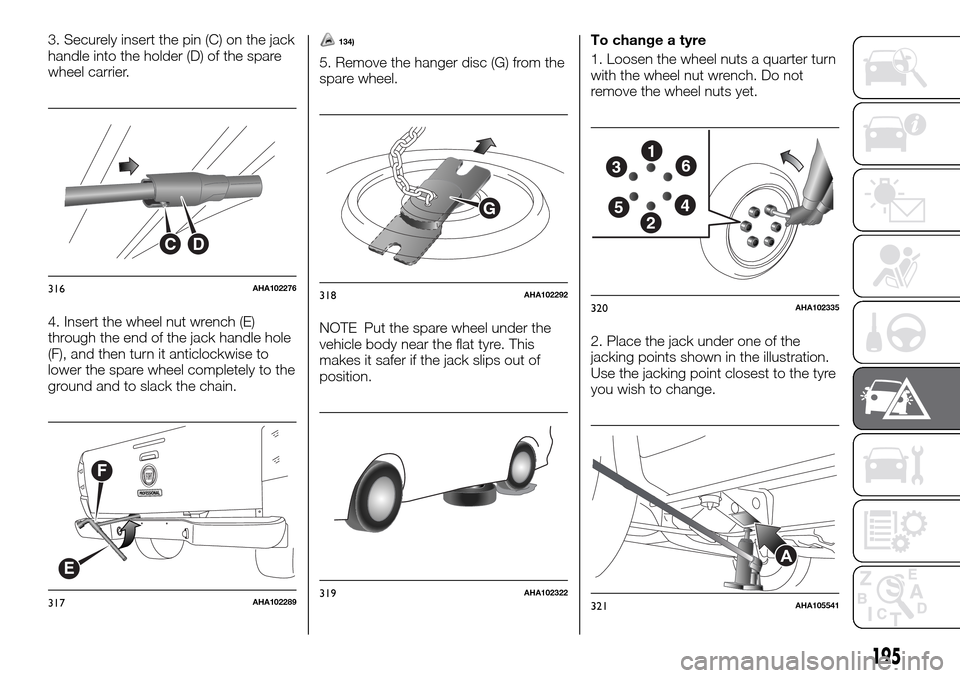
3. Securely insert the pin (C) on the jack
handle into the holder (D) of the spare
wheel carrier.
4. Insert the wheel nut wrench (E)
through the end of the jack handle hole
(F), and then turn it anticlockwise to
lower the spare wheel completely to the
ground and to slack the chain.134)
5. Remove the hanger disc (G) from the
spare wheel.
NOTE Put the spare wheel under the
vehicle body near the flat tyre. This
makes it safer if the jack slips out of
position.To change a tyre
1. Loosen the wheel nuts a quarter turn
with the wheel nut wrench. Do not
remove the wheel nuts yet.
2. Place the jack under one of the
jacking points shown in the illustration.
Use the jacking point closest to the tyre
you wish to change.
CD
316AHA102276
F
E
317AHA102289
G
318AHA102292
319AHA102322
1
2
3
45
6
320AHA102335
A
321AHA105541
195
Page 198 of 312
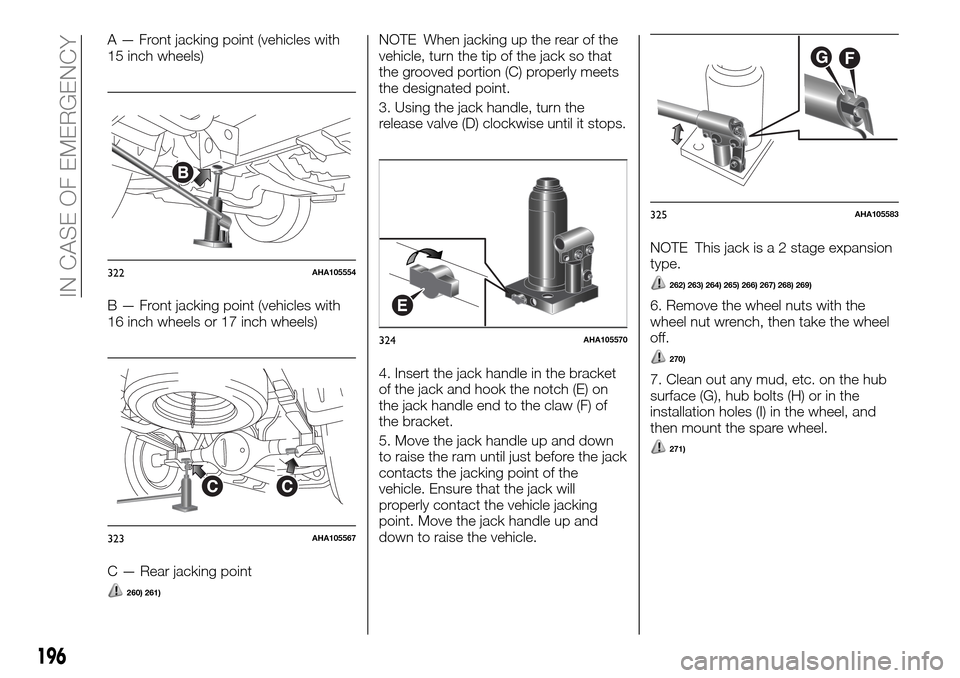
A — Front jacking point (vehicles with
15 inch wheels)
B — Front jacking point (vehicles with
16 inch wheels or 17 inch wheels)
C — Rear jacking point
260) 261)
NOTE When jacking up the rear of the
vehicle, turn the tip of the jack so that
the grooved portion (C) properly meets
the designated point.
3. Using the jack handle, turn the
release valve (D) clockwise until it stops.
4. Insert the jack handle in the bracket
of the jack and hook the notch (E) on
the jack handle end to the claw (F) of
the bracket.
5. Move the jack handle up and down
to raise the ram until just before the jack
contacts the jacking point of the
vehicle. Ensure that the jack will
properly contact the vehicle jacking
point. Move the jack handle up and
down to raise the vehicle.NOTE This jack is a 2 stage expansion
type.
262) 263) 264) 265) 266) 267) 268) 269)
6. Remove the wheel nuts with the
wheel nut wrench, then take the wheel
off.
270)
7. Clean out any mud, etc. on the hub
surface (G), hub bolts (H) or in the
installation holes (I) in the wheel, and
then mount the spare wheel.
271)
B
322AHA105554
CC
323AHA105567
E
324AHA105570
GF
325AHA105583
196
IN CASE OF EMERGENCY
Page 199 of 312
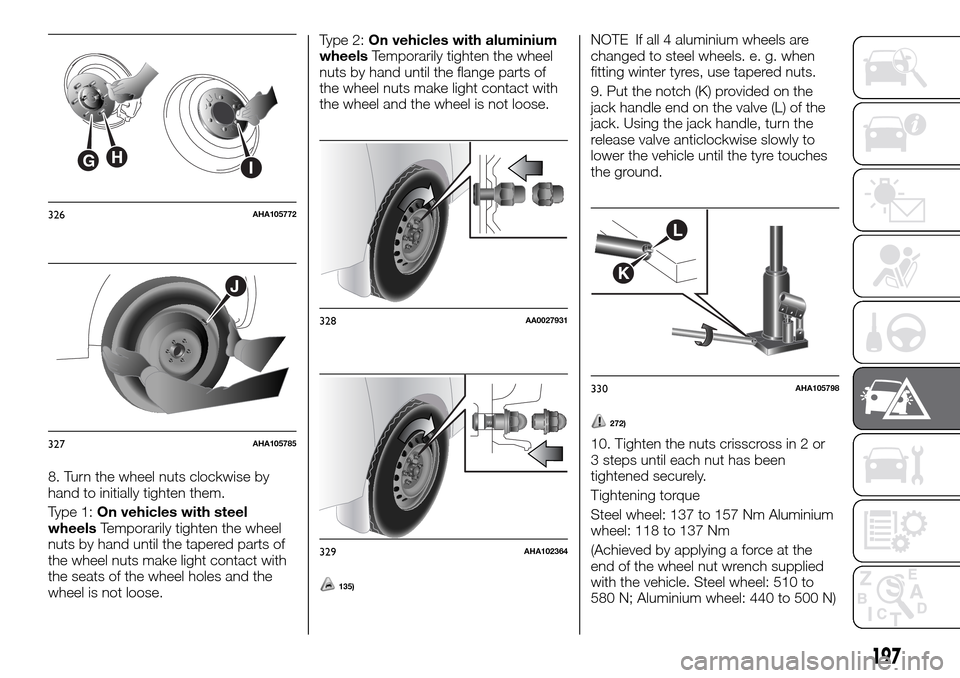
8. Turn the wheel nuts clockwise by
hand to initially tighten them.
Type 1:On vehicles with steel
wheelsTemporarily tighten the wheel
nuts by hand until the tapered parts of
the wheel nuts make light contact with
the seats of the wheel holes and the
wheel is not loose.Type 2:On vehicles with aluminium
wheelsTemporarily tighten the wheel
nuts by hand until the flange parts of
the wheel nuts make light contact with
the wheel and the wheel is not loose.
135)
NOTE If all 4 aluminium wheels are
changed to steel wheels. e. g. when
fitting winter tyres, use tapered nuts.
9. Put the notch (K) provided on the
jack handle end on the valve (L) of the
jack. Using the jack handle, turn the
release valve anticlockwise slowly to
lower the vehicle until the tyre touches
the ground.
272)
10. Tighten the nuts crisscross in 2 or
3 steps until each nut has been
tightened securely.
Tightening torque
Steel wheel: 137 to 157 Nm Aluminium
wheel: 118 to 137 Nm
(Achieved by applying a force at the
end of the wheel nut wrench supplied
with the vehicle. Steel wheel: 510 to
580 N; Aluminium wheel: 440 to 500 N)
GHI
326AHA105772
J
327AHA105785
328AA0027931
329AHA102364
L
K
330AHA105798
197
Page 200 of 312
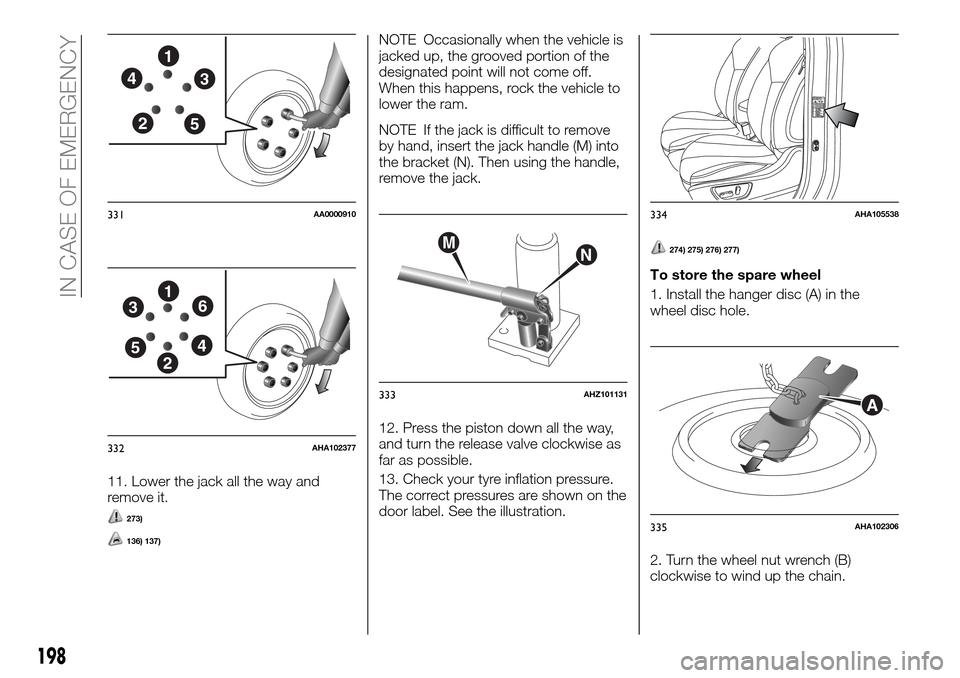
11. Lower the jack all the way and
remove it.
273)
136) 137)
NOTE Occasionally when the vehicle is
jacked up, the grooved portion of the
designated point will not come off.
When this happens, rock the vehicle to
lower the ram.
NOTE If the jack is difficult to remove
by hand, insert the jack handle (M) into
the bracket (N). Then using the handle,
remove the jack.
12. Press the piston down all the way,
and turn the release valve clockwise as
far as possible.
13. Check your tyre inflation pressure.
The correct pressures are shown on the
door label. See the illustration.
274) 275) 276) 277)
To store the spare wheel
1. Install the hanger disc (A) in the
wheel disc hole.
2. Turn the wheel nut wrench (B)
clockwise to wind up the chain.
1
2
34
5
331AA0000910
1
2
3
45
6
332AHA102377
MN
333AHZ101131
334AHA105538
A
335AHA102306
198
IN CASE OF EMERGENCY
Page 201 of 312
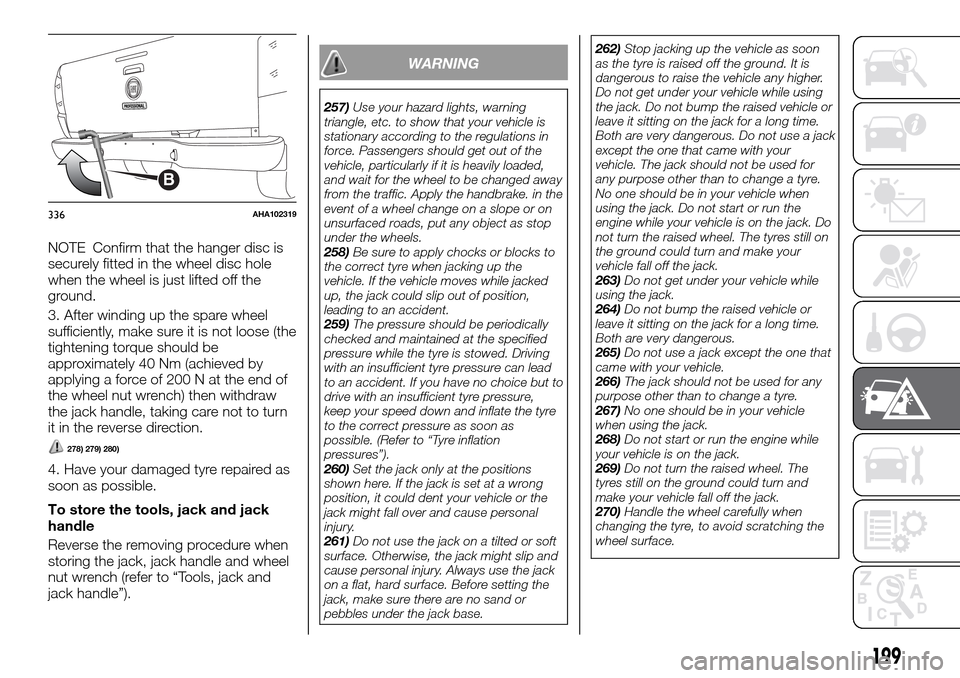
NOTE Confirm that the hanger disc is
securely fitted in the wheel disc hole
when the wheel is just lifted off the
ground.
3. After winding up the spare wheel
sufficiently, make sure it is not loose (the
tightening torque should be
approximately 40 Nm (achieved by
applying a force of 200 N at the end of
the wheel nut wrench) then withdraw
the jack handle, taking care not to turn
it in the reverse direction.
278) 279) 280)
4. Have your damaged tyre repaired as
soon as possible.
To store the tools, jack and jack
handle
Reverse the removing procedure when
storing the jack, jack handle and wheel
nut wrench (refer to “Tools, jack and
jack handle”).
WARNING
257)Use your hazard lights, warning
triangle, etc. to show that your vehicle is
stationary according to the regulations in
force. Passengers should get out of the
vehicle, particularly if it is heavily loaded,
and wait for the wheel to be changed away
from the traffic. Apply the handbrake. in the
event of a wheel change on a slope or on
unsurfaced roads, put any object as stop
under the wheels.
258)Be sure to apply chocks or blocks to
the correct tyre when jacking up the
vehicle. If the vehicle moves while jacked
up, the jack could slip out of position,
leading to an accident.
259)The pressure should be periodically
checked and maintained at the specified
pressure while the tyre is stowed. Driving
with an insufficient tyre pressure can lead
to an accident. If you have no choice but to
drive with an insufficient tyre pressure,
keep your speed down and inflate the tyre
to the correct pressure as soon as
possible. (Refer to “Tyre inflation
pressures”).
260)Set the jack only at the positions
shown here. If the jack is set at a wrong
position, it could dent your vehicle or the
jack might fall over and cause personal
injury.
261)Do not use the jack on a tilted or soft
surface. Otherwise, the jack might slip and
cause personal injury. Always use the jack
on a flat, hard surface. Before setting the
jack, make sure there are no sand or
pebbles under the jack base.262)Stop jacking up the vehicle as soon
as the tyre is raised off the ground. It is
dangerous to raise the vehicle any higher.
Do not get under your vehicle while using
the jack. Do not bump the raised vehicle or
leave it sitting on the jack for a long time.
Both are very dangerous. Do not use a jack
except the one that came with your
vehicle. The jack should not be used for
any purpose other than to change a tyre.
No one should be in your vehicle when
using the jack. Do not start or run the
engine while your vehicle is on the jack. Do
not turn the raised wheel. The tyres still on
the ground could turn and make your
vehicle fall off the jack.
263)Do not get under your vehicle while
using the jack.
264)Do not bump the raised vehicle or
leave it sitting on the jack for a long time.
Both are very dangerous.
265)Do not use a jack except the one that
came with your vehicle.
266)The jack should not be used for any
purpose other than to change a tyre.
267)No one should be in your vehicle
when using the jack.
268)Do not start or run the engine while
your vehicle is on the jack.
269)Do not turn the raised wheel. The
tyres still on the ground could turn and
make your vehicle fall off the jack.
270)Handle the wheel carefully when
changing the tyre, to avoid scratching the
wheel surface.
B
336AHA102319
199
Page 202 of 312
271)Mount the spare wheel with the valve
stem (J) facing outboard. If you cannot see
the valve stem (J), you have installed the
wheel backwards. Operating the vehicle
with the spare wheel installed backwards
can cause vehicle damage and result in an
accident.
272)Be sure to open the release valve
slowly. If it is opened quickly, the vehicle will
drop abruptly and the jack may come out
of position, causing a serious accident.
273)Never use your foot or a pipe
extension for extra force in the wheel nut
wrench. If you do so, you will tighten the
nut too much.
274)The tyre pressure should be
periodically checked and maintained at the
specified pressure while the tyre is stowed.
275)After changing the tyre and driving the
vehicle about 1,000 km, retighten the
wheel nuts to make sure that they have not
come loose.
276)If the steering wheel vibrates when
driving after changing the tyre, we
recommend you to have the tyres checked
for balance.
277)Do not mix one type of tyre with
another or use a different size from the one
listed. This would cause early wear and
poor handling.
278)The spare wheel should always be
securely in position. If a flat tyre is
changed, put the flat tyre in the spare
wheel mounting position with the wheel
outer surface upward, and use the wheel
nut wrench to secure it firmly.279)Never tamper with the inflation valve.
Never introduce tools of any kind between
rim and tyre. Check tyre and spare wheel
pressure regularly, referring to the values
shown in the "Technical specifications"
section.
280)The moving components of the jack
(screw and joints) can also cause injuries:
do not touch them. If you come into
contact with lubricating grease, clean
yourself thoroughly.
IMPORTANT
132)Avoid using different size tyres from
the one listed and the combined use of
different types of tyres, as this can affect
driving safety.
133)Even if a wheel has the same rim size
and offset as the specified type of wheel,
its shape may prevent it from being fitted
correctly. Consult an authorised Fiat
Dealership before using wheels that you
have.
134)When installing or removing the spare
wheel, please observe the followings. If you
do not follow them, it could result in break
the spare wheel carrier. Do not use the
power tool. Use the wheel nut wrench
stowed on the vehicle. Do not apply a force
of 400 N or more at the end of the wheel
nut wrench.
135)Never apply oil to either the wheel
bolts or the nuts or they will tighten too
much.
136)If the release valve is loosened too
much (2 or more turns) in the anticlockwise
direction, the jack’s oil will leak and the jack
cannot be used.137)Close the release valve slowly when
lowering the vehicle, or the valve may be
damaged.
200
IN CASE OF EMERGENCY
Page 203 of 312
TOWING
If your vehicle needs to be towed
If towing is necessary, we recommend
you to have it done by your Fiat
Dealership or a commercial tow truck
service. In the following cases,
transport the vehicle using a tow truck.
The engine runs but the vehicle does
not move, or an abnormal noise is
produced.
Inspection of the vehicle’s underside
reveals that oil or some other fluid is
leaking.
If a wheel gets stuck in a ditch, do not
try to tow the vehicle. Please contact
your Fiat Dealership or a commercial
tow truck service for assistance.
Only when you cannot receive a towing
service from a Fiat Dealership or
commercial tow truck service, tow your
vehicle carefully in accordance with the
instructions given in “Emergency
towing” in this part. The regulations
concerning towing may differ from
country to country. It is recommended
that you obey the regulations of the
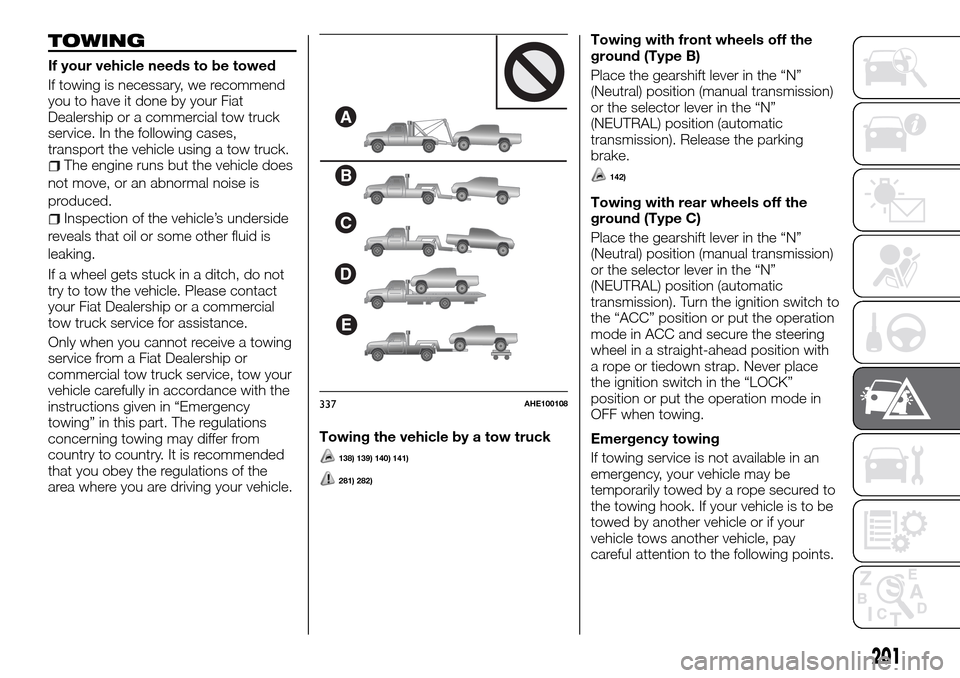
area where you are driving your vehicle.Towing the vehicle by a tow truck
138) 139) 140) 141)
281) 282)
Towing with front wheels off the
ground (Type B)
Place the gearshift lever in the “N”
(Neutral) position (manual transmission)
or the selector lever in the “N”
(NEUTRAL) position (automatic
transmission). Release the parking
brake.
142)
Towing with rear wheels off the
ground (Type C)
Place the gearshift lever in the “N”
(Neutral) position (manual transmission)
or the selector lever in the “N”
(NEUTRAL) position (automatic
transmission). Turn the ignition switch to
the “ACC” position or put the operation
mode in ACC and secure the steering
wheel in a straight-ahead position with
a rope or tiedown strap. Never place
the ignition switch in the “LOCK”
position or put the operation mode in
OFF when towing.
Emergency towing
If towing service is not available in an
emergency, your vehicle may be
temporarily towed by a rope secured to
the towing hook. If your vehicle is to be
towed by another vehicle or if your
vehicle tows another vehicle, pay
careful attention to the following points.
B
C
D
E
A
337AHE100108
201