low oil pressure FIAT FULLBACK 2016 1.G Owners Manual
[x] Cancel search | Manufacturer: FIAT, Model Year: 2016, Model line: FULLBACK, Model: FIAT FULLBACK 2016 1.GPages: 312, PDF Size: 13.67 MB
Page 96 of 312
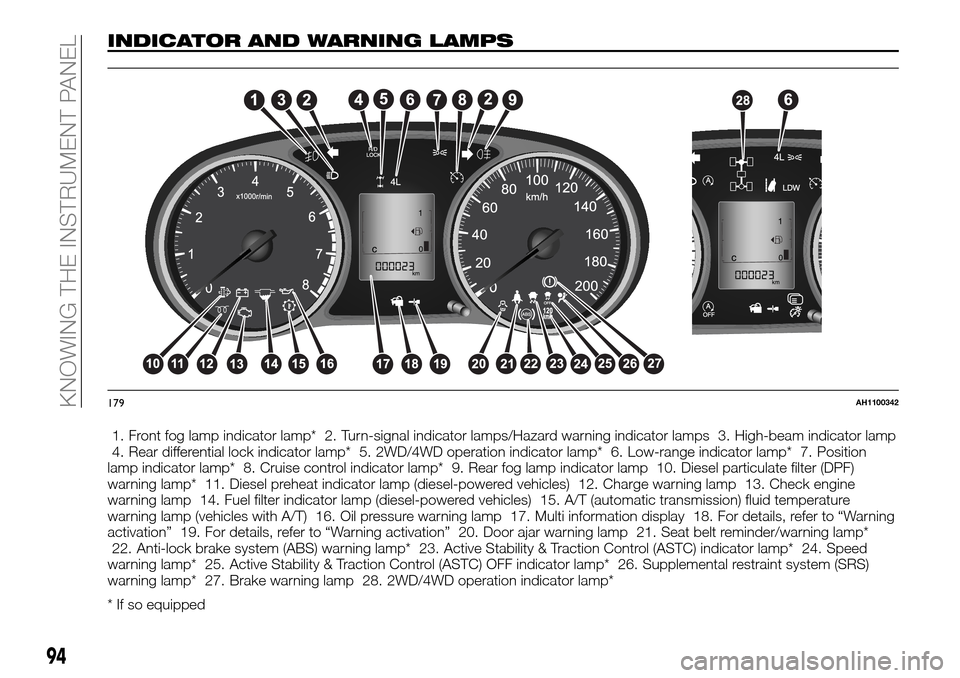
INDICATOR AND WARNING LAMPS
1. Front fog lamp indicator lamp* 2. Turn-signal indicator lamps/Hazard warning indicator lamps 3. High-beam indicator lamp
4. Rear differential lock indicator lamp* 5. 2WD/4WD operation indicator lamp* 6. Low-range indicator lamp* 7. Position
lamp indicator lamp* 8. Cruise control indicator lamp* 9. Rear fog lamp indicator lamp 10. Diesel particulate filter (DPF)
warning lamp* 11. Diesel preheat indicator lamp (diesel-powered vehicles) 12. Charge warning lamp 13. Check engine
warning lamp 14. Fuel filter indicator lamp (diesel-powered vehicles) 15. A/T (automatic transmission) fluid temperature
warning lamp (vehicles with A/T) 16. Oil pressure warning lamp 17. Multi information display 18. For details, refer to “Warning
activation” 19. For details, refer to “Warning activation” 20. Door ajar warning lamp 21. Seat belt reminder/warning lamp*
22. Anti-lock brake system (ABS) warning lamp* 23. Active Stability & Traction Control (ASTC) indicator lamp* 24. Speed
warning lamp* 25. Active Stability & Traction Control (ASTC) OFF indicator lamp* 26. Supplemental restraint system (SRS)
warning lamp* 27. Brake warning lamp 28. 2WD/4WD operation indicator lamp*
* If so equipped
179AH1100342
94
KNOWING THE INSTRUMENT PANEL
Page 100 of 312
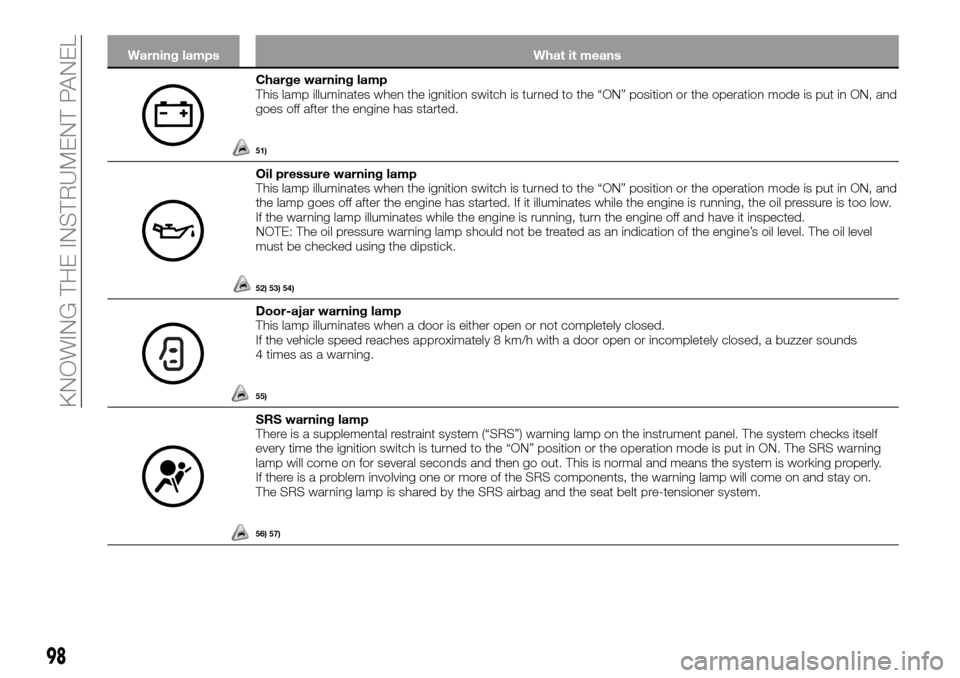
Warning lamps What it means
Charge warning lamp
This lamp illuminates when the ignition switch is turned to the “ON” position or the operation mode is put in ON, and
goes off after the engine has started.
51)
Oil pressure warning lamp
This lamp illuminates when the ignition switch is turned to the “ON” position or the operation mode is put in ON, and
the lamp goes off after the engine has started. If it illuminates while the engine is running, the oil pressure is too low.
If the warning lamp illuminates while the engine is running, turn the engine off and have it inspected.
NOTE: The oil pressure warning lamp should not be treated as an indication of the engine’s oil level. The oil level
must be checked using the dipstick.
52) 53) 54)
Door-ajar warning lamp
This lamp illuminates when a door is either open or not completely closed.
If the vehicle speed reaches approximately 8 km/h with a door open or incompletely closed, a buzzer sounds
4 times as a warning.
55)
SRS warning lamp
There is a supplemental restraint system (“SRS”) warning lamp on the instrument panel. The system checks itself
every time the ignition switch is turned to the “ON” position or the operation mode is put in ON. The SRS warning
lamp will come on for several seconds and then go out. This is normal and means the system is working properly.
If there is a problem involving one or more of the SRS components, the warning lamp will come on and stay on.
The SRS warning lamp is shared by the SRS airbag and the seat belt pre-tensioner system.
56) 57)
98
KNOWING THE INSTRUMENT PANEL
Page 175 of 312
117)Never cross a stream where the water
is deep. Do not change gears while
crossing the stream. Frequent crossing of
streams can adversely affect the life span
of the vehicle; we recommend you to take
the necessary measures to prepare,
inspect, and repair the vehicle.
118)After crossing a stream, apply the
brakes to be sure they are functioning
properly. If the brakes are wet and not
functioning properly, dry them out by
driving slowly while lightly depressing the
brake pedal. Inspect each part of the
vehicle carefully.
WARNING
218)When attempting to rock your vehicle
out of a stuck position, be sure that the
area around the vehicle is clear of people
and physical objects. The rocking motion
may cause the vehicle to suddenly launch
forward or backward, causing injury or
damage to nearby people or objects.
219)Go straight up. Do not try to traverse
across a steep slope.
220)If you begin to lose traction, ease off
the accelerator pedal and gently turn the
steering wheel alternatively left and right to
regain adequate traction again.
221)Avoid snaking down a sharp grade.
Descend the grade as straight as possible.
CAUTIONS ON
HANDLING OF
4 WHEEL DRIVE
VEHICLES
Tyres and wheels
Since the driving torque can be applied
to the 4 wheels, the performance of the
vehicle when operating in 4-wheel drive
is greatly affected by the condition of
the tyres.
Pay close attention to the tyres.
Install specified tyres on all wheels.
Refer to “Tyres and wheels”.
Be sure to the appropriate tyre
inflation pressure according to no cargo
or cargo. Refer to “Tyre inflation
pressures”.
Be sure to fit all 4 tyres and wheels of
the same size and type. When
replacement of any of the tyres or
wheels is necessary, replace all of them.
All tyres should be rotated whenever
the wear difference between the front
and rear tyres is recognizable.
Good vehicle performance cannot be
expected if there is a difference in wear
between tyres. Refer to “Tyre rotation”.
Check the tyre inflation pressure
regularly.
119)
Towing
If towing is necessary, we recommend
you to have it done by a Fiat Dealership
or a commercial tow truck service. In
the following cases, transport the
vehicle using a tow truck.
The engine runs but the vehicle does
not move or abnormal noise is
produced.
Inspection of the vehicle’s underside
reveals that oil or some other fluid is
leaking.
Only when you cannot receive a towing
service from a Fiat Dealership or
commercial tow truck service, tow your
vehicle carefully in accordance with the
instructions given in “Towing”.
173
Page 176 of 312
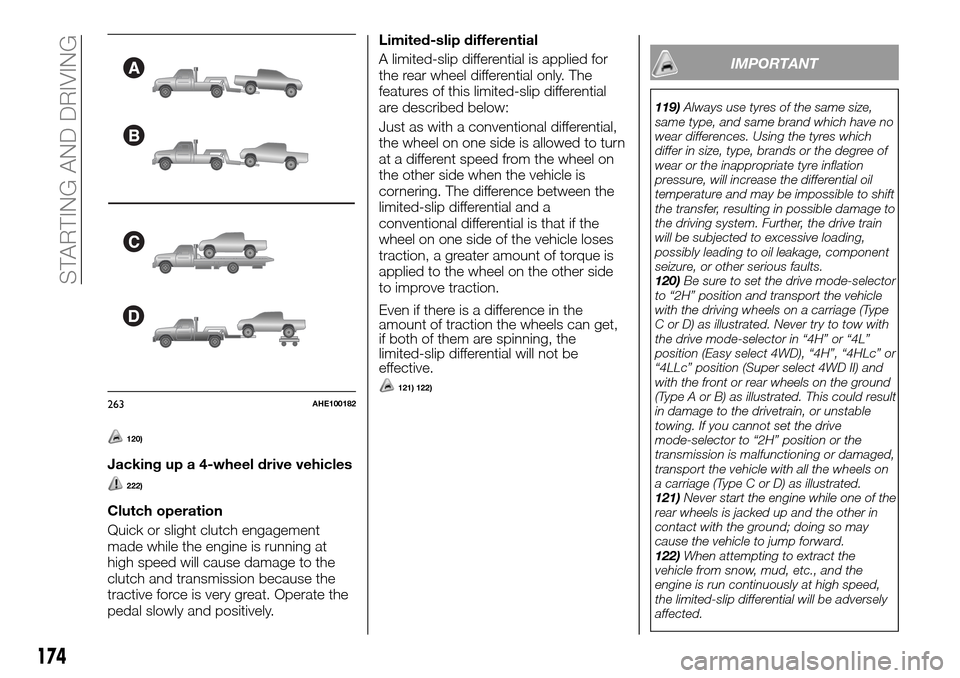
120)
Jacking up a 4-wheel drive vehicles
222)
Clutch operation
Quick or slight clutch engagement
made while the engine is running at
high speed will cause damage to the
clutch and transmission because the
tractive force is very great. Operate the
pedal slowly and positively.Limited-slip differential
A limited-slip differential is applied for
the rear wheel differential only. The
features of this limited-slip differential
are described below:
Just as with a conventional differential,
the wheel on one side is allowed to turn
at a different speed from the wheel on
the other side when the vehicle is
cornering. The difference between the
limited-slip differential and a
conventional differential is that if the
wheel on one side of the vehicle loses
traction, a greater amount of torque is
applied to the wheel on the other side
to improve traction.
Even if there is a difference in the
amount of traction the wheels can get,
if both of them are spinning, the
limited-slip differential will not be
effective.
121) 122)
IMPORTANT
119)Always use tyres of the same size,
same type, and same brand which have no
wear differences. Using the tyres which
differ in size, type, brands or the degree of
wear or the inappropriate tyre inflation
pressure, will increase the differential oil
temperature and may be impossible to shift
the transfer, resulting in possible damage to
the driving system. Further, the drive train
will be subjected to excessive loading,
possibly leading to oil leakage, component
seizure, or other serious faults.
120)Be sure to set the drive mode-selector
to “2H” position and transport the vehicle
with the driving wheels on a carriage (Type
C or D) as illustrated. Never try to tow with
the drive mode-selector in “4H” or “4L”
position (Easy select 4WD), “4H”, “4HLc” or
“4LLc” position (Super select 4WD II) and
with the front or rear wheels on the ground
(Type A or B) as illustrated. This could result
in damage to the drivetrain, or unstable
towing. If you cannot set the drive
mode-selector to “2H” position or the
transmission is malfunctioning or damaged,
transport the vehicle with all the wheels on
a carriage (Type C or D) as illustrated.
121)Never start the engine while one of the
rear wheels is jacked up and the other in
contact with the ground; doing so may
cause the vehicle to jump forward.
122)When attempting to extract the
vehicle from snow, mud, etc., and the
engine is run continuously at high speed,
the limited-slip differential will be adversely
affected.
B
C
D
A
263AHE100182
174
STARTING AND DRIVING
Page 202 of 312
271)Mount the spare wheel with the valve
stem (J) facing outboard. If you cannot see
the valve stem (J), you have installed the
wheel backwards. Operating the vehicle
with the spare wheel installed backwards
can cause vehicle damage and result in an
accident.
272)Be sure to open the release valve
slowly. If it is opened quickly, the vehicle will
drop abruptly and the jack may come out
of position, causing a serious accident.
273)Never use your foot or a pipe
extension for extra force in the wheel nut
wrench. If you do so, you will tighten the
nut too much.
274)The tyre pressure should be
periodically checked and maintained at the
specified pressure while the tyre is stowed.
275)After changing the tyre and driving the
vehicle about 1,000 km, retighten the
wheel nuts to make sure that they have not
come loose.
276)If the steering wheel vibrates when
driving after changing the tyre, we
recommend you to have the tyres checked
for balance.
277)Do not mix one type of tyre with
another or use a different size from the one
listed. This would cause early wear and
poor handling.
278)The spare wheel should always be
securely in position. If a flat tyre is
changed, put the flat tyre in the spare
wheel mounting position with the wheel
outer surface upward, and use the wheel
nut wrench to secure it firmly.279)Never tamper with the inflation valve.
Never introduce tools of any kind between
rim and tyre. Check tyre and spare wheel
pressure regularly, referring to the values
shown in the "Technical specifications"
section.
280)The moving components of the jack
(screw and joints) can also cause injuries:
do not touch them. If you come into
contact with lubricating grease, clean
yourself thoroughly.
IMPORTANT
132)Avoid using different size tyres from
the one listed and the combined use of
different types of tyres, as this can affect
driving safety.
133)Even if a wheel has the same rim size
and offset as the specified type of wheel,
its shape may prevent it from being fitted
correctly. Consult an authorised Fiat
Dealership before using wheels that you
have.
134)When installing or removing the spare
wheel, please observe the followings. If you
do not follow them, it could result in break
the spare wheel carrier. Do not use the
power tool. Use the wheel nut wrench
stowed on the vehicle. Do not apply a force
of 400 N or more at the end of the wheel
nut wrench.
135)Never apply oil to either the wheel
bolts or the nuts or they will tighten too
much.
136)If the release valve is loosened too
much (2 or more turns) in the anticlockwise
direction, the jack’s oil will leak and the jack
cannot be used.137)Close the release valve slowly when
lowering the vehicle, or the valve may be
damaged.
200
IN CASE OF EMERGENCY
Page 206 of 312
142)Never tow an automatic transmission
vehicle with the front wheels up (and the
rear wheels on the ground) (Type B) when
the automatic transmission fluid level is low.
This may cause serious and expensive
damage to the transmission.
143)When the engine is not running, the
brake booster and power steering pump do
not operate. This means higher brake
depression force and higher steering effort
are required. Therefore, vehicle operation is
very difficult.
144)Do not leave the ignition switch in the
“LOCK” position or the operation mode in
OFF. The steering wheel will lock, causing
loss of control.
145)On vehicles with super select 4WD II,
when you are going to tow another vehicle,
set the drive mode-selector to “4H”
position. Selecting “2H” drive may increase
the differential oil temperature, resulting in
possible damage to the driving system.
Further, the drive train will be subjected to
excessive loading possibly leading to oil
leakage, component seizure, or other
serious faults.OPERATION UNDER
ADVERSE DRIVING
CONDITIONS
On a flooded road
Avoid flooded roads. Water could enter
the brake discs, resulting in temporarily
ineffective brakes. In such cases, lightly
depress the brake pedal to see if the
brakes operate properly. If they do not,
lightly depress the pedal several times
while driving in order to dry the brake
pads.
When driving in rain or on a road with
many puddles a layer of water may
form between the tyres and the road
surface. This reduces a tyre’s frictional
resistance on the road, resulting in loss
of steering stability and braking
capability.
To cope with this, observe the following
items:
(a) Drive your vehicle at a slow speed.
(b) Do not drive on worn tyres.
(c) Always maintain the specified tyre
inflation pressures.On a snow-covered or frozen road
When driving on a snow-covered or
frozen road, it is recommended that you
use snow tyres or snow traction device
(tyre chains). Refer to the “Snow tyres”
and “Snow traction device (tyre chains)”
sections.
Avoid high-speed operation, sudden
acceleration, abrupt brake application
and sharp cornering.
Depressing the brake pedal during
travel on snowy or icy roads may cause
tyre slippage and skidding. When
traction between the tyres and the road
is reduced the wheels may skid and the
vehicle cannot readily be brought to a
stop by conventional braking
techniques. Braking will differ,
depending upon whether you have
anti-lock brake system (ABS). If you do
have ABS, brake by pressing the brake
pedal hard, and keeping it pressed. If
you do not have ABS, pump the brake
pedal with short rapid jabs, each time
fully applying and fully releasing for
greatest effect.
Allow extra distance between your
vehicle and the vehicle in front of you,
and avoid sudden braking.
Accumulation of ice on the braking
system can cause the wheels to lock.
Pull away from a standstill slowly after
confirming safety around the vehicle.
292)
204
IN CASE OF EMERGENCY
Page 242 of 312
PERIODIC CHECKS
Before long journeys, check and, if
necessary, restore:
engine coolant level;
brake fluid level;
windscreen washer fluid level;
operation of lighting system
(headlamps, direction indicators, hazard
warning lights, etc.);
tyre inflation pressure and condition;
tyre alignment;
operation of screen washer/wiper
system and positioning/wear of
windscreen/rear window wiper blades.
To ensure that the vehicle is always
efficient and well maintained, it is
advisable to make sure that you carry
out the above operations regularly
(approximately every 1000 km and
every 3000 km for checking and
topping up engine oil is advisable).
DEMANDING
VEHICLE USE
If the vehicle is mostly used in one of
the following conditions:
towing a trailer or caravan;
dusty roads;
short, repeated journeys (less than
7-8 km) at sub-zero outside
temperatures;
engine often idling or driving long
distances at low speeds or long periods
of inactivity;
the following checks must be carried
out more often than indicated in the
Scheduled Servicing Plan:
check front disc brake pad
conditions and wear;
check cleanliness of bonnet and
boot locks, cleanliness and lubrication
of linkage;
visually inspect conditions of: engine,
gearbox, transmission, pipes and hoses
(exhaust - fuel system - brakes) and
rubber elements (boots - sleeves -
bushes - etc.);
check battery charge and battery
fluid level (electrolyte);
visually inspect condition of the
accessory drive belts;
check and, if necessary, change
engine oil and replace oil filter;
check and, if necessary, replace
pollen filter.
240
SERVICING AND MAINTENANCE
Page 250 of 312
Ambient temperature
(minimum) °CPetrol-powered vehicles
Anti-freeze concentration %Diesel-powered vehicles
Anti-freeze concentration %
-15 30
50 -20 35
-25 40
-30 45
-35 50
-50 60 60
During cold weather
If the temperatures in your area drop below freezing, there is the danger that the coolant in the engine or radiator could freeze
and cause severe damage to the engine and/or radiator. Add a sufficient amount of antifreeze to the coolant to prevent it from
freezing.
The concentration should be checked before the start of cold weather and anti-freeze added to the system if necessary.
WARNING
316)Do not open the radiator cap (B) while
the engine is hot. The coolant system is
under pressure and any hot coolant
escaping could cause severe burns.
IMPORTANT
148)Do not use alcohol or methanol
anti-freeze or any engine coolants mixed
with alcohol or methanol anti-freeze. The
use of an improper anti-freeze can cause
corrosion of the aluminium components.149)For effective anti-corrosion and
anti-freeze performance, keep the
anti-freeze concentration within the range
of 30 to 60 %. Concentrations exceeding
60 % will result in a reduction of both the
anti-freeze and cooling performance thus
adversely affecting the engine.
150)Do not top up with water only. Water
by itself reduces the rust-protective and
anti-freeze qualities of the coolant and has
a lower boiling point. It can also cause
damage to the cooling system if it should
freeze. Do not use tapwater, as it can
cause corrosion and rust formation.151)PARAFLU UP anti-freeze is used in
the engine cooling system. Use fluid of the
same type as that contained in the cooling
system for any top-ups. PARAFLU UP
cannot be mixed with any other type of
fluid. If this happens, do not start the
engine under any circumstances and
contact a Fiat Dealership.
248
SERVICING AND MAINTENANCE
Page 260 of 312
Window glass
The window glass can normally be
cleaned using only a sponge and water.
Glass cleaner can be used to remove
oil, grease, insect carcasses, etc. After
washing the glass, wipe it dry with a
clean, dry, soft cloth. Never use a cloth
that is used for cleaning a painted
surface to clean a window. Wax from
the painted surface could get on the
glass and lower glass transparency and
visibility.
To clean the inside of the rear window,
always use a soft cloth and wipe the
window glass along the demister heater
element so as not to cause damage.
Wiper blades
Use a soft cloth and glass cleaner to
remove grease, insect carcasses, etc.,
from the wiper blades. Replace the
wiper blades when they no longer wipe
properly.
Engine compartment
Clean the engine compartment at the
beginning and end of winter. Pay
particular attention to flanges, crevices
and peripheral parts where dust
containing road chemicals and other
corrosive materials might collect.
If salt and other chemicals are used on
the roads in your area, clean the engine
compartment at least every three
months.Never spray or splash water on the
electrical components in the engine
compartment, as this may cause
damage.
Do not bring the nearby parts, the
plastic parts and so on into contact
with sulphuric acid (battery electrolyte)
which may crack, stain or discolour
them.
If they are in contact, wipe off with soft
cloth, chamois or the like and an
aqueous solution of neutral detergent
then immediately rinse the affected
parts with plenty of water.
IMPORTANT
163)Avoid washing with rollers and/or
brushes in washing stations. Wash the
vehicle only by hand using neutral pH
detergents; dry it with a wet chamois
leather. Abrasive products and/or polishes
should not be used for cleaning the car.
Bird droppings must be washed off
immediately and thoroughly as the acid
they contain is particularly aggressive.
Avoid (if at all possible) parking the vehicle
under trees; remove vegetable resins
immediately as, when dried, it may only be
possible to remove them with abrasive
products and/or polishes, which is highly
inadvisable as they could alter the typical
opaqueness of the paint. Do not use pure
windscreen washer fluid for cleaning the
front windscreen and rear window; dilute it
min. 50% with water. Only use pure screen
washer fluid when strictly necessary due to
outside temperature conditions.164)When washing the under side of your
vehicle or wheel, be careful not to injure
your hands.
165)If your vehicle has rain sensor wipers,
place the wiper switch lever in the “OFF”
position to deactivate the rain sensor
before washing the vehicle. Otherwise, the
wipers will operate in the presence of water
spray on the windscreen and may get
damaged as a result.
166)Refrain from excessively using a car
wash as its brushes may scratch the paint
surface, causing it to lose its gloss.
Scratches will be especially visible on
darker coloured vehicles.
167)Never spray or splash water on the
electrical components in the engine
compartment. Doing so could have an
adverse effect on the engine startability.
Exercise caution also when washing the
underbody; be careful not to spray water
into the engine compartment.
168)Some types of hot water washing
equipment apply high pressure and heat to
the vehicle. They may cause heat distortion
and damage to the vehicle resin parts and
may result in flooding of the vehicle interior.
Therefore maintain a good distance of
approx. 70 cm or more between the vehicle
body and the washing nozzle. Also, when
washing around the door glass, hold the
nozzle at a distance of more than 70 cm
and at right angles to the glass surface.
258
SERVICING AND MAINTENANCE
Page 265 of 312
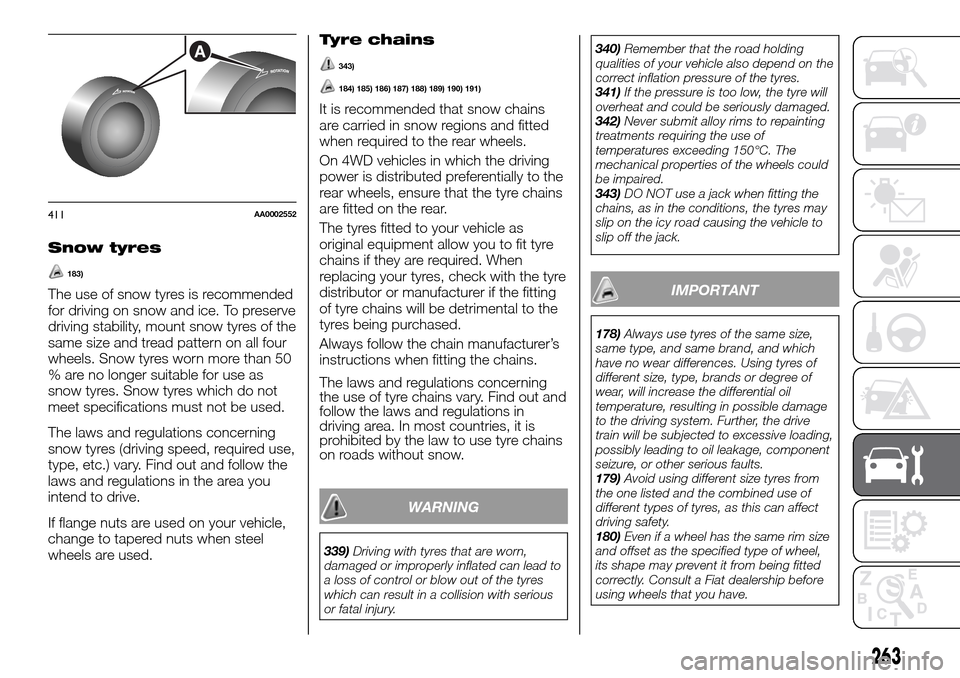
Snow tyres
183)
The use of snow tyres is recommended
for driving on snow and ice. To preserve
driving stability, mount snow tyres of the
same size and tread pattern on all four
wheels. Snow tyres worn more than 50
% are no longer suitable for use as
snow tyres. Snow tyres which do not
meet specifications must not be used.
The laws and regulations concerning
snow tyres (driving speed, required use,
type, etc.) vary. Find out and follow the
laws and regulations in the area you
intend to drive.
If flange nuts are used on your vehicle,
change to tapered nuts when steel
wheels are used.
Tyre chains
343)
184) 185) 186) 187) 188) 189) 190) 191)
It is recommended that snow chains
are carried in snow regions and fitted
when required to the rear wheels.
On 4WD vehicles in which the driving
power is distributed preferentially to the
rear wheels, ensure that the tyre chains
are fitted on the rear.
The tyres fitted to your vehicle as
original equipment allow you to fit tyre
chains if they are required. When
replacing your tyres, check with the tyre
distributor or manufacturer if the fitting
of tyre chains will be detrimental to the
tyres being purchased.
Always follow the chain manufacturer’s
instructions when fitting the chains.
The laws and regulations concerning
the use of tyre chains vary. Find out and
follow the laws and regulations in
driving area. In most countries, it is
prohibited by the law to use tyre chains
on roads without snow.
WARNING
339)Driving with tyres that are worn,
damaged or improperly inflated can lead to
a loss of control or blow out of the tyres
which can result in a collision with serious
or fatal injury.340)Remember that the road holding
qualities of your vehicle also depend on the
correct inflation pressure of the tyres.
341)If the pressure is too low, the tyre will
overheat and could be seriously damaged.
342)Never submit alloy rims to repainting
treatments requiring the use of
temperatures exceeding 150°C. The
mechanical properties of the wheels could
be impaired.
343)DO NOT use a jack when fitting the
chains, as in the conditions, the tyres may
slip on the icy road causing the vehicle to
slip off the jack.
IMPORTANT
178)Always use tyres of the same size,
same type, and same brand, and which
have no wear differences. Using tyres of
different size, type, brands or degree of
wear, will increase the differential oil
temperature, resulting in possible damage
to the driving system. Further, the drive
train will be subjected to excessive loading,
possibly leading to oil leakage, component
seizure, or other serious faults.
179)Avoid using different size tyres from
the one listed and the combined use of
different types of tyres, as this can affect
driving safety.
180)Even if a wheel has the same rim size
and offset as the specified type of wheel,
its shape may prevent it from being fitted
correctly. Consult a Fiat dealership before
using wheels that you have.
A
411AA0002552
263