steering FIAT FULLBACK 2016 1.G Owner's Guide
[x] Cancel search | Manufacturer: FIAT, Model Year: 2016, Model line: FULLBACK, Model: FIAT FULLBACK 2016 1.GPages: 312, PDF Size: 13.67 MB
Page 167 of 312
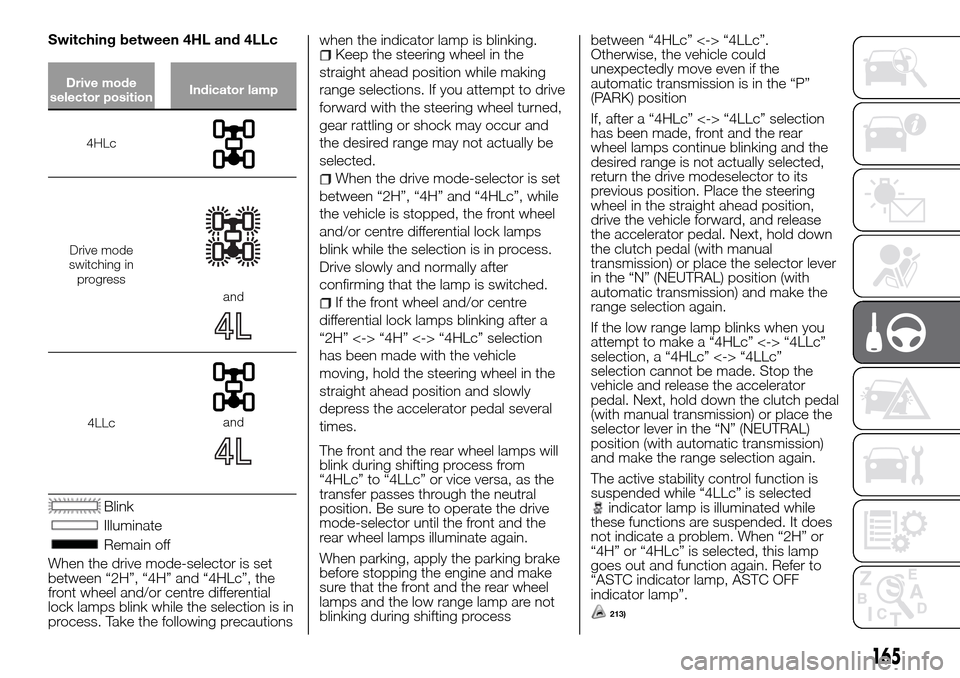
Switching between 4HL and 4LLc
Drive mode
selector positionIndicator lamp
4HLc
Drive mode
switching in
progress
and
4LLcand
Blink
Illuminate
Remain off
When the drive mode-selector is set
between “2H”, “4H” and “4HLc”, the
front wheel and/or centre differential
lock lamps blink while the selection is in
process. Take the following precautionswhen the indicator lamp is blinking.
Keep the steering wheel in the
straight ahead position while making
range selections. If you attempt to drive
forward with the steering wheel turned,
gear rattling or shock may occur and
the desired range may not actually be
selected.
When the drive mode-selector is set
between “2H”, “4H” and “4HLc”, while
the vehicle is stopped, the front wheel
and/or centre differential lock lamps
blink while the selection is in process.
Drive slowly and normally after
confirming that the lamp is switched.
If the front wheel and/or centre
differential lock lamps blinking after a
“2H” <-> “4H” <-> “4HLc” selection
has been made with the vehicle
moving, hold the steering wheel in the
straight ahead position and slowly
depress the accelerator pedal several
times.
The front and the rear wheel lamps will
blink during shifting process from
“4HLc” to “4LLc” or vice versa, as the
transfer passes through the neutral
position. Be sure to operate the drive
mode-selector until the front and the
rear wheel lamps illuminate again.
When parking, apply the parking brake
before stopping the engine and make
sure that the front and the rear wheel
lamps and the low range lamp are not
blinking during shifting processbetween “4HLc” <-> “4LLc”.
Otherwise, the vehicle could
unexpectedly move even if the
automatic transmission is in the “P”
(PARK) position
If, after a “4HLc” <-> “4LLc” selection
has been made, front and the rear
wheel lamps continue blinking and the
desired range is not actually selected,
return the drive modeselector to its
previous position. Place the steering
wheel in the straight ahead position,
drive the vehicle forward, and release
the accelerator pedal. Next, hold down
the clutch pedal (with manual
transmission) or place the selector lever
in the “N” (NEUTRAL) position (with
automatic transmission) and make the
range selection again.
If the low range lamp blinks when you
attempt to make a “4HLc” <-> “4LLc”
selection, a “4HLc” <-> “4LLc”
selection cannot be made. Stop the
vehicle and release the accelerator
pedal. Next, hold down the clutch pedal
(with manual transmission) or place the
selector lever in the “N” (NEUTRAL)
position (with automatic transmission)
and make the range selection again.
The active stability control function is
suspended while “4LLc” is selected
indicator lamp is illuminated while
these functions are suspended. It does
not indicate a problem. When “2H” or
“4H” or “4HLc” is selected, this lamp
goes out and function again. Refer to
“ASTC indicator lamp, ASTC OFF
indicator lamp”.
213)
165
Page 170 of 312
differential lock is disengaged, these
lamps go out and function again. Refer
to “ABS warning lamp”, “ASTC
indicator lamp, ASTC OFF indicator
lamp”.
If the indicator lamp continues blinking
after the switch has been pressed to
deactivate the rear differential lock, hold
the steering wheel in the straight ahead
position then slowly depress and
release the accelerator pedal several
times.
If the indicator lamp continues blinking
after the switch has been pressed to
activate the rear differential lock, bear in
mind the following instructions:
If the vehicle speed is 12 km/h or
higher, decelerate to a speed of
2.5 km/h or lower. The indicator lamp
will illuminate steadily and the rear
differential lock will be activated.
If the vehicle speed is 12 km/h or lower,
turn the steering wheel from side to
side until the indicator lamp illuminates
steadily. If the vehicle is stuck in soft
ground, make sure the area around the
vehicle is clear then repeatedly attempt
to drive forward and backward. The
indicator lamp will illuminate steadily
and the rear differential lock will be
activated.
111)
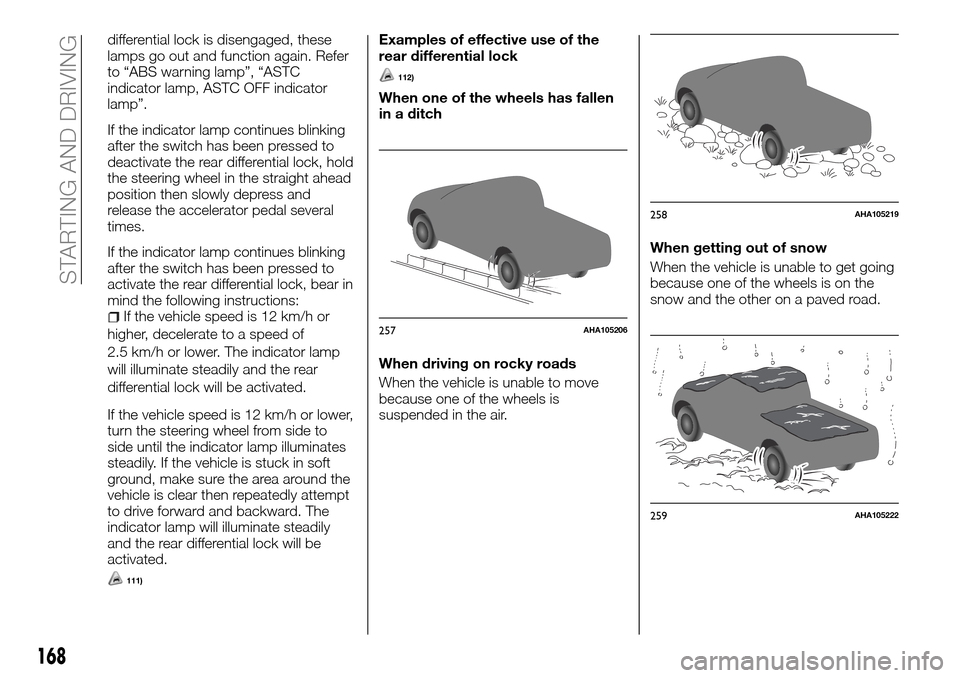
Examples of effective use of the
rear differential lock
112)
When one of the wheels has fallen
in a ditch
When driving on rocky roads
When the vehicle is unable to move
because one of the wheels is
suspended in the air.When getting out of snow
When the vehicle is unable to get going
because one of the wheels is on the
snow and the other on a paved road.
257AHA105206
258AHA105219
259AHA105222
168
STARTING AND DRIVING
Page 171 of 312
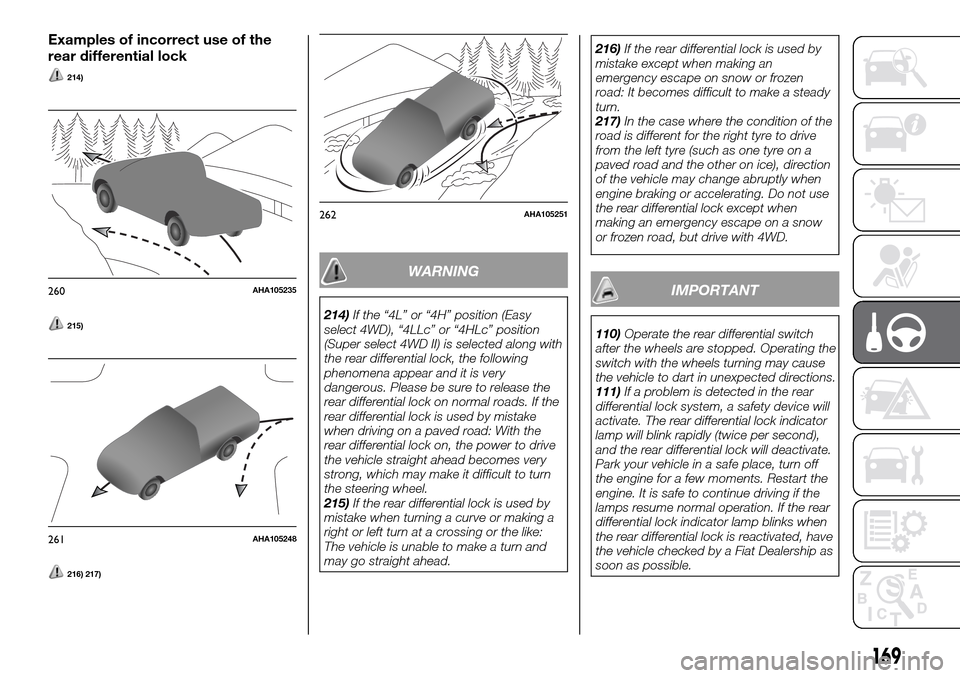
Examples of incorrect use of the
rear differential lock
214)
215)
216) 217)
WARNING
214)If the “4L” or “4H” position (Easy
select 4WD), “4LLc” or “4HLc” position
(Super select 4WD II) is selected along with
the rear differential lock, the following
phenomena appear and it is very
dangerous. Please be sure to release the
rear differential lock on normal roads. If the
rear differential lock is used by mistake
when driving on a paved road: With the
rear differential lock on, the power to drive
the vehicle straight ahead becomes very
strong, which may make it difficult to turn
the steering wheel.
215)If the rear differential lock is used by
mistake when turning a curve or making a
right or left turn at a crossing or the like:
The vehicle is unable to make a turn and
may go straight ahead.216)If the rear differential lock is used by
mistake except when making an
emergency escape on snow or frozen
road: It becomes difficult to make a steady
turn.
217)In the case where the condition of the
road is different for the right tyre to drive
from the left tyre (such as one tyre on a
paved road and the other on ice), direction
of the vehicle may change abruptly when
engine braking or accelerating. Do not use
the rear differential lock except when
making an emergency escape on a snow
or frozen road, but drive with 4WD.
IMPORTANT
110)Operate the rear differential switch
after the wheels are stopped. Operating the
switch with the wheels turning may cause
the vehicle to dart in unexpected directions.
111)If a problem is detected in the rear
differential lock system, a safety device will
activate. The rear differential lock indicator
lamp will blink rapidly (twice per second),
and the rear differential lock will deactivate.
Park your vehicle in a safe place, turn off
the engine for a few moments. Restart the
engine. It is safe to continue driving if the
lamps resume normal operation. If the rear
differential lock indicator lamp blinks when
the rear differential lock is reactivated, have
the vehicle checked by a Fiat Dealership as
soon as possible.
260AHA105235
261AHA105248
262AHA105251
169
Page 172 of 312
112)Use the rear differential lock only as an
emergency measure when the vehicle is
stuck and cannot be freed with the drive
mode-selector in “4L” or “4H” position
(Easy select 4WD) or in “4LLc” or “4HLc”
position (Super select 4WD II). Deactivate
the rear differential lock immediately after
using it.4 WHEEL DRIVE
OPERATION
By selecting 4-wheel drive, both axles
of the vehicle are rigidly connected with
each other. This improves the traction
characteristics. When turning sharp
corners or moving forward and
backward repeatedly, however, the
drive line is stressed, which is felt as a
braking effect. A 4-wheel drive vehicle
can accelerate more quickly and
smoothly.
However, note that the braking distance
is not shorter than that of a rear-wheel
drive vehicle.
When using 4-wheel drive on rough
roads (snow, mud, sand, etc.), it is
important to operate the vehicle
correctly.
The driving posture should be more
upright and closer to the wheel than
usual; adjust the seat to a good
position for easy steering and pedal
operation. Be sure to wear the seat belt
After driving on rough roads, check
each part of the vehicle and wash it
thoroughly with water. Refer to the
“Vehicle care” section and “Inspection
and maintenance following rough road
operation”.Driving on dry paved road and
highway
Select “2H” position (Easy select 4WD),
“2H” or “4H” position (Super select
4WD II) to drive on the dry paved road.
Especially on dry highway, never select
the “4H” or “4L” position (Easy select
4WD), “4HLc” or “4LLc” position (Super
select 4WD II).
113)
Driving on snowy or icy roads
Set the drive mode-selector to “4H”
position (Easy select 4WD), “4H” or
“4HLc” position in accordance with the
road conditions (Super select 4WD II)
and then gradually depress the
accelerator pedal for a smooth start.
Keep the pressure on the accelerator
pedal as constant as possible, and
drive at low speed. The use of snow
tyres and/or tyre chains is
recommended.
Maintain a safe distance between
vehicles, avoid sudden braking, and
use engine braking (downshifting).
114)
170
STARTING AND DRIVING
Page 174 of 312
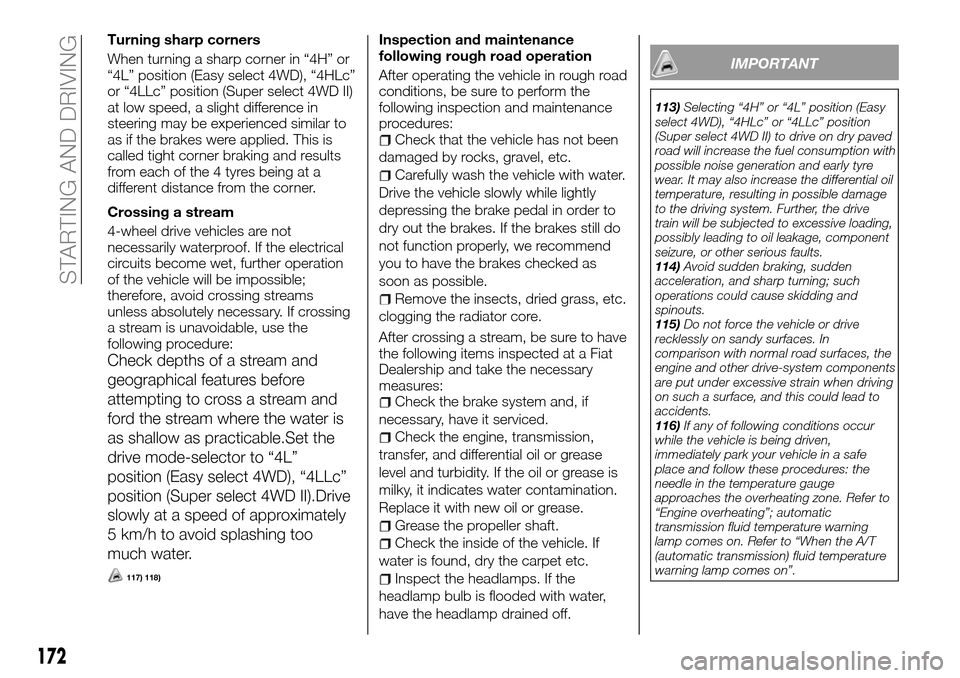
Turning sharp corners
When turning a sharp corner in “4H” or
“4L” position (Easy select 4WD), “4HLc”
or “4LLc” position (Super select 4WD II)
at low speed, a slight difference in
steering may be experienced similar to
as if the brakes were applied. This is
called tight corner braking and results
from each of the 4 tyres being at a
different distance from the corner.
Crossing a stream
4-wheel drive vehicles are not
necessarily waterproof. If the electrical
circuits become wet, further operation
of the vehicle will be impossible;
therefore, avoid crossing streams
unless absolutely necessary. If crossing
a stream is unavoidable, use the
following procedure:
Check depths of a stream and
geographical features before
attempting to cross a stream and
ford the stream where the water is
as shallow as practicable.Set the
drive mode-selector to “4L”
position (Easy select 4WD), “4LLc”
position (Super select 4WD II).Drive
slowly at a speed of approximately
5 km/h to avoid splashing too
much water.
117) 118)
Inspection and maintenance
following rough road operation
After operating the vehicle in rough road
conditions, be sure to perform the
following inspection and maintenance
procedures:
Check that the vehicle has not been
damaged by rocks, gravel, etc.
Carefully wash the vehicle with water.
Drive the vehicle slowly while lightly
depressing the brake pedal in order to
dry out the brakes. If the brakes still do
not function properly, we recommend
you to have the brakes checked as
soon as possible.
Remove the insects, dried grass, etc.
clogging the radiator core.
After crossing a stream, be sure to have
the following items inspected at a Fiat
Dealership and take the necessary
measures:
Check the brake system and, if
necessary, have it serviced.
Check the engine, transmission,
transfer, and differential oil or grease
level and turbidity. If the oil or grease is
milky, it indicates water contamination.
Replace it with new oil or grease.
Grease the propeller shaft.
Check the inside of the vehicle. If
water is found, dry the carpet etc.
Inspect the headlamps. If the
headlamp bulb is flooded with water,
have the headlamp drained off.
IMPORTANT
113)Selecting “4H” or “4L” position (Easy
select 4WD), “4HLc” or “4LLc” position
(Super select 4WD II) to drive on dry paved
road will increase the fuel consumption with
possible noise generation and early tyre
wear. It may also increase the differential oil
temperature, resulting in possible damage
to the driving system. Further, the drive
train will be subjected to excessive loading,
possibly leading to oil leakage, component
seizure, or other serious faults.
114)Avoid sudden braking, sudden
acceleration, and sharp turning; such
operations could cause skidding and
spinouts.
115)Do not force the vehicle or drive
recklessly on sandy surfaces. In
comparison with normal road surfaces, the
engine and other drive-system components
are put under excessive strain when driving
on such a surface, and this could lead to
accidents.
116)If any of following conditions occur
while the vehicle is being driven,
immediately park your vehicle in a safe
place and follow these procedures: the
needle in the temperature gauge
approaches the overheating zone. Refer to
“Engine overheating”; automatic
transmission fluid temperature warning
lamp comes on. Refer to “When the A/T
(automatic transmission) fluid temperature
warning lamp comes on”.
172
STARTING AND DRIVING
Page 175 of 312
117)Never cross a stream where the water
is deep. Do not change gears while
crossing the stream. Frequent crossing of
streams can adversely affect the life span
of the vehicle; we recommend you to take
the necessary measures to prepare,
inspect, and repair the vehicle.
118)After crossing a stream, apply the
brakes to be sure they are functioning
properly. If the brakes are wet and not
functioning properly, dry them out by
driving slowly while lightly depressing the
brake pedal. Inspect each part of the
vehicle carefully.
WARNING
218)When attempting to rock your vehicle
out of a stuck position, be sure that the
area around the vehicle is clear of people
and physical objects. The rocking motion
may cause the vehicle to suddenly launch
forward or backward, causing injury or
damage to nearby people or objects.
219)Go straight up. Do not try to traverse
across a steep slope.
220)If you begin to lose traction, ease off
the accelerator pedal and gently turn the
steering wheel alternatively left and right to
regain adequate traction again.
221)Avoid snaking down a sharp grade.
Descend the grade as straight as possible.
CAUTIONS ON
HANDLING OF
4 WHEEL DRIVE
VEHICLES
Tyres and wheels
Since the driving torque can be applied
to the 4 wheels, the performance of the
vehicle when operating in 4-wheel drive
is greatly affected by the condition of
the tyres.
Pay close attention to the tyres.
Install specified tyres on all wheels.
Refer to “Tyres and wheels”.
Be sure to the appropriate tyre
inflation pressure according to no cargo
or cargo. Refer to “Tyre inflation
pressures”.
Be sure to fit all 4 tyres and wheels of
the same size and type. When
replacement of any of the tyres or
wheels is necessary, replace all of them.
All tyres should be rotated whenever
the wear difference between the front
and rear tyres is recognizable.
Good vehicle performance cannot be
expected if there is a difference in wear
between tyres. Refer to “Tyre rotation”.
Check the tyre inflation pressure
regularly.
119)
Towing
If towing is necessary, we recommend
you to have it done by a Fiat Dealership
or a commercial tow truck service. In
the following cases, transport the
vehicle using a tow truck.
The engine runs but the vehicle does
not move or abnormal noise is
produced.
Inspection of the vehicle’s underside
reveals that oil or some other fluid is
leaking.
Only when you cannot receive a towing
service from a Fiat Dealership or
commercial tow truck service, tow your
vehicle carefully in accordance with the
instructions given in “Towing”.
173
Page 187 of 312
IF THE VEHICLE
BREAKS DOWN
If the vehicle breaks down on the road,
move it to the shoulder and use the
hazard warning flashers and/or the
warning triangle etc. Refer to “Hazard
warning flasher switch”.
If the engine stops/fails
Vehicle operation and control are
affected if the engine stops. Before
moving the vehicle to a safe area, be
aware of the following:
The brake booster becomes
inoperative and the pedal effort will
increase. Press down the brake pedal
harder than usual.
Since the power steering system is
no longer operative, the steering wheel
feels heavy when turning it.
EMERGENCY
STARTING
231) 232) 233) 234) 235) 236) 237) 238) 239) 240) 241) 242)
243) 244) 245) 246) 247)
If the engine cannot be started because
the battery is weak or dead, the battery
from another vehicle can be used with
jumper cables to start the engine.
1. Get the vehicles close enough so the
jumper cables can reach, but be sure
the vehicles aren’t touching each other.
2. Turn off all lamps, heater and other
electrical loads.
3. Set the parking brake firmly on each
vehicle. Put an automatic transmission
in “P” (PARK) or a manual transmission
in “N” (Neutral). Stop the engine.
4. Make sure battery electrolyte is at the
proper level. Refer to “Battery”.
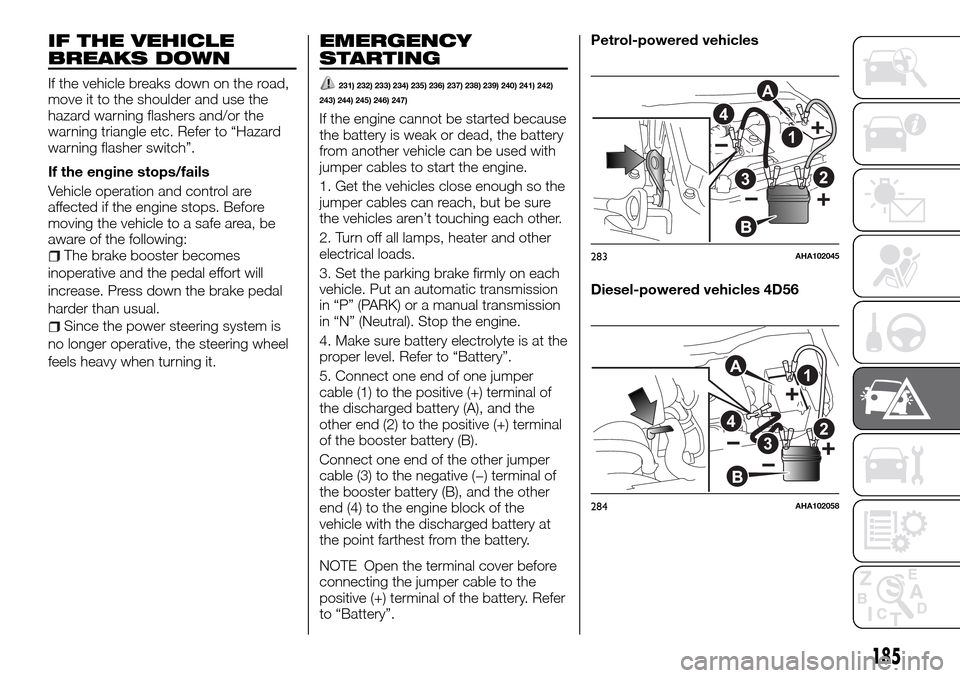
5. Connect one end of one jumper
cable (1) to the positive (+) terminal of
the discharged battery (A), and the
other end (2) to the positive (+) terminal
of the booster battery (B).
Connect one end of the other jumper
cable (3) to the negative (−) terminal of
the booster battery (B), and the other
end (4) to the engine block of the
vehicle with the discharged battery at
the point farthest from the battery.
NOTE Open the terminal cover before
connecting the jumper cable to the
positive (+) terminal of the battery. Refer
to “Battery”.Petrol-powered vehicles
Diesel-powered vehicles 4D56
A
B
1
4
23
283AHA102045
A
B
1
423
284AHA102058
185
Page 202 of 312
271)Mount the spare wheel with the valve
stem (J) facing outboard. If you cannot see
the valve stem (J), you have installed the
wheel backwards. Operating the vehicle
with the spare wheel installed backwards
can cause vehicle damage and result in an
accident.
272)Be sure to open the release valve
slowly. If it is opened quickly, the vehicle will
drop abruptly and the jack may come out
of position, causing a serious accident.
273)Never use your foot or a pipe
extension for extra force in the wheel nut
wrench. If you do so, you will tighten the
nut too much.
274)The tyre pressure should be
periodically checked and maintained at the
specified pressure while the tyre is stowed.
275)After changing the tyre and driving the
vehicle about 1,000 km, retighten the
wheel nuts to make sure that they have not
come loose.
276)If the steering wheel vibrates when
driving after changing the tyre, we
recommend you to have the tyres checked
for balance.
277)Do not mix one type of tyre with
another or use a different size from the one
listed. This would cause early wear and
poor handling.
278)The spare wheel should always be
securely in position. If a flat tyre is
changed, put the flat tyre in the spare
wheel mounting position with the wheel
outer surface upward, and use the wheel
nut wrench to secure it firmly.279)Never tamper with the inflation valve.
Never introduce tools of any kind between
rim and tyre. Check tyre and spare wheel
pressure regularly, referring to the values
shown in the "Technical specifications"
section.
280)The moving components of the jack
(screw and joints) can also cause injuries:
do not touch them. If you come into
contact with lubricating grease, clean
yourself thoroughly.
IMPORTANT
132)Avoid using different size tyres from
the one listed and the combined use of
different types of tyres, as this can affect
driving safety.
133)Even if a wheel has the same rim size
and offset as the specified type of wheel,
its shape may prevent it from being fitted
correctly. Consult an authorised Fiat
Dealership before using wheels that you
have.
134)When installing or removing the spare
wheel, please observe the followings. If you
do not follow them, it could result in break
the spare wheel carrier. Do not use the
power tool. Use the wheel nut wrench
stowed on the vehicle. Do not apply a force
of 400 N or more at the end of the wheel
nut wrench.
135)Never apply oil to either the wheel
bolts or the nuts or they will tighten too
much.
136)If the release valve is loosened too
much (2 or more turns) in the anticlockwise
direction, the jack’s oil will leak and the jack
cannot be used.137)Close the release valve slowly when
lowering the vehicle, or the valve may be
damaged.
200
IN CASE OF EMERGENCY
Page 203 of 312
TOWING
If your vehicle needs to be towed
If towing is necessary, we recommend
you to have it done by your Fiat
Dealership or a commercial tow truck
service. In the following cases,
transport the vehicle using a tow truck.
The engine runs but the vehicle does
not move, or an abnormal noise is
produced.
Inspection of the vehicle’s underside
reveals that oil or some other fluid is
leaking.
If a wheel gets stuck in a ditch, do not
try to tow the vehicle. Please contact
your Fiat Dealership or a commercial
tow truck service for assistance.
Only when you cannot receive a towing
service from a Fiat Dealership or
commercial tow truck service, tow your
vehicle carefully in accordance with the
instructions given in “Emergency
towing” in this part. The regulations
concerning towing may differ from
country to country. It is recommended
that you obey the regulations of the
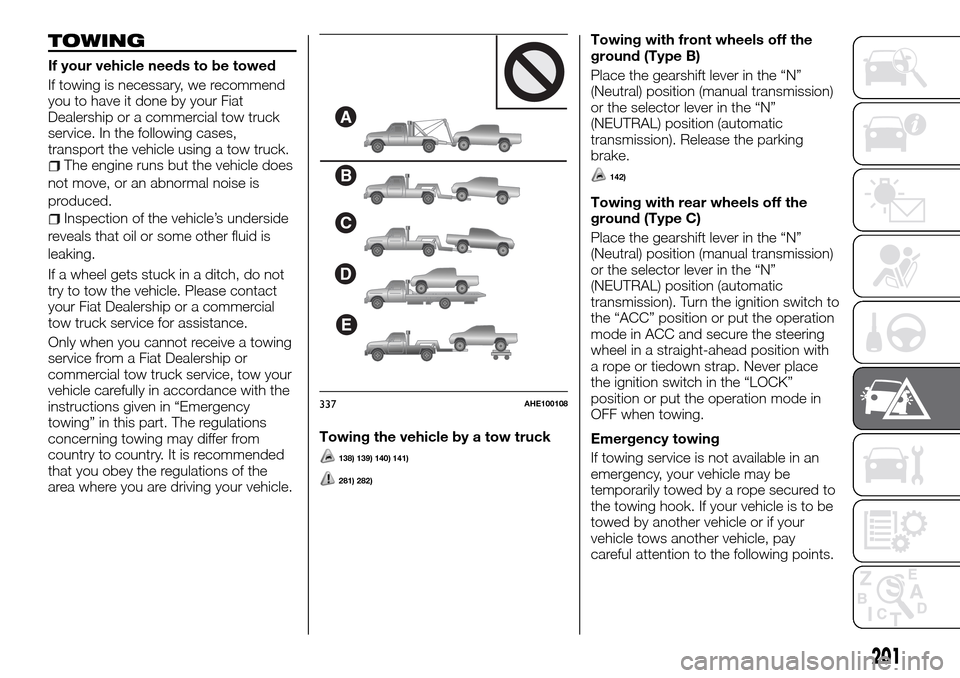
area where you are driving your vehicle.Towing the vehicle by a tow truck
138) 139) 140) 141)
281) 282)
Towing with front wheels off the
ground (Type B)
Place the gearshift lever in the “N”
(Neutral) position (manual transmission)
or the selector lever in the “N”
(NEUTRAL) position (automatic
transmission). Release the parking
brake.
142)
Towing with rear wheels off the
ground (Type C)
Place the gearshift lever in the “N”
(Neutral) position (manual transmission)
or the selector lever in the “N”
(NEUTRAL) position (automatic
transmission). Turn the ignition switch to
the “ACC” position or put the operation
mode in ACC and secure the steering
wheel in a straight-ahead position with
a rope or tiedown strap. Never place
the ignition switch in the “LOCK”
position or put the operation mode in
OFF when towing.
Emergency towing
If towing service is not available in an
emergency, your vehicle may be
temporarily towed by a rope secured to
the towing hook. If your vehicle is to be
towed by another vehicle or if your
vehicle tows another vehicle, pay
careful attention to the following points.
B
C
D
E
A
337AHE100108
201
Page 204 of 312
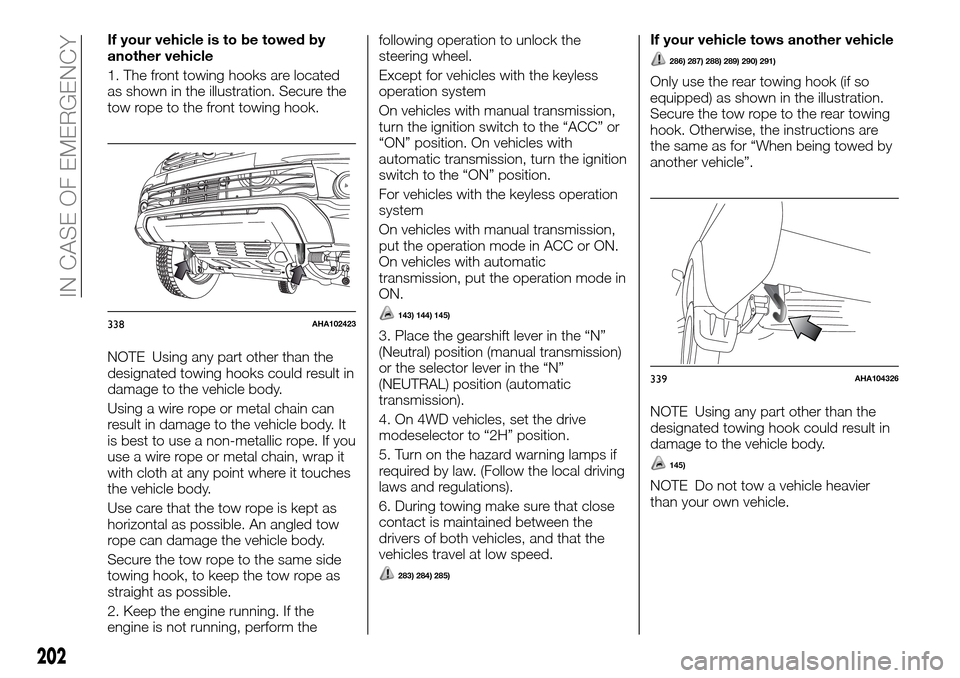
If your vehicle is to be towed by
another vehicle
1. The front towing hooks are located
as shown in the illustration. Secure the
tow rope to the front towing hook.
NOTE Using any part other than the
designated towing hooks could result in
damage to the vehicle body.
Using a wire rope or metal chain can
result in damage to the vehicle body. It
is best to use a non-metallic rope. If you
use a wire rope or metal chain, wrap it
with cloth at any point where it touches
the vehicle body.
Use care that the tow rope is kept as
horizontal as possible. An angled tow
rope can damage the vehicle body.
Secure the tow rope to the same side
towing hook, to keep the tow rope as
straight as possible.
2. Keep the engine running. If the
engine is not running, perform thefollowing operation to unlock the
steering wheel.
Except for vehicles with the keyless
operation system
On vehicles with manual transmission,
turn the ignition switch to the “ACC” or
“ON” position. On vehicles with
automatic transmission, turn the ignition
switch to the “ON” position.
For vehicles with the keyless operation
system
On vehicles with manual transmission,
put the operation mode in ACC or ON.
On vehicles with automatic
transmission, put the operation mode in
ON.
143) 144) 145)
3. Place the gearshift lever in the “N”
(Neutral) position (manual transmission)
or the selector lever in the “N”
(NEUTRAL) position (automatic
transmission).
4. On 4WD vehicles, set the drive
modeselector to “2H” position.
5. Turn on the hazard warning lamps if
required by law. (Follow the local driving
laws and regulations).
6. During towing make sure that close
contact is maintained between the
drivers of both vehicles, and that the
vehicles travel at low speed.
283) 284) 285)
If your vehicle tows another vehicle
286) 287) 288) 289) 290) 291)
Only use the rear towing hook (if so
equipped) as shown in the illustration.
Secure the tow rope to the rear towing
hook. Otherwise, the instructions are
the same as for “When being towed by
another vehicle”.
NOTE Using any part other than the
designated towing hook could result in
damage to the vehicle body.
145)
NOTE Do not tow a vehicle heavier
than your own vehicle.
338AHA102423
339AHA104326
202
IN CASE OF EMERGENCY