ECU FIAT FULLBACK 2017 Owner handbook (in English)
[x] Cancel search | Manufacturer: FIAT, Model Year: 2017, Model line: FULLBACK, Model: FIAT FULLBACK 2017Pages: 312, PDF Size: 12.31 MB
Page 116 of 312
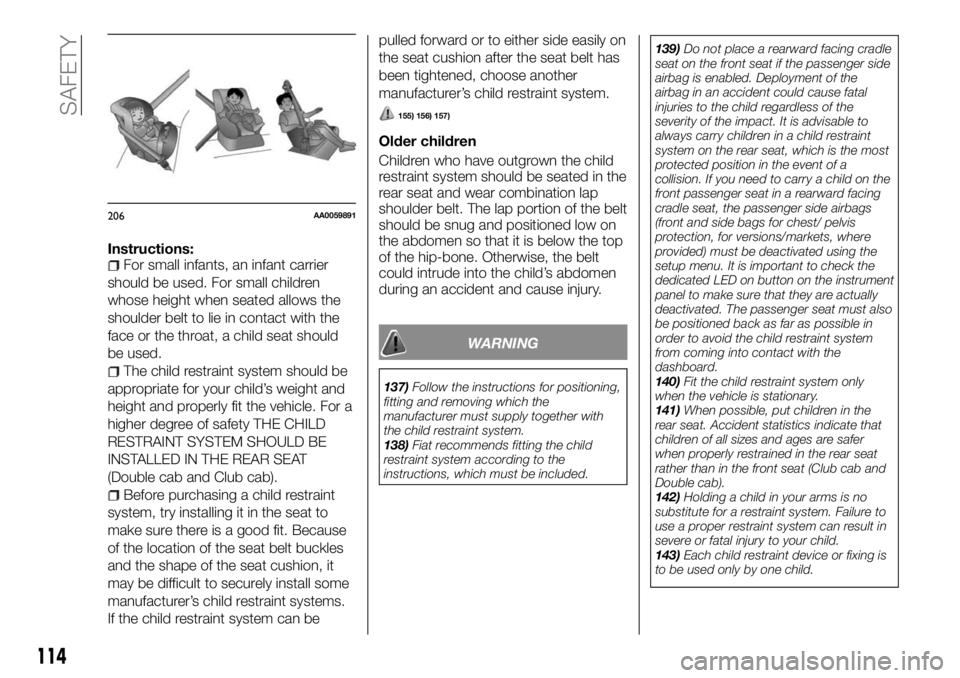
Instructions:For small infants, an infant carrier
should be used. For small children
whose height when seated allows the
shoulder belt to lie in contact with the
face or the throat, a child seat should
be used.
The child restraint system should be
appropriate for your child’s weight and
height and properly fit the vehicle. For a
higher degree of safety THE CHILD
RESTRAINT SYSTEM SHOULD BE
INSTALLED IN THE REAR SEAT
(Double cab and Club cab).
Before purchasing a child restraint
system, try installing it in the seat to
make sure there is a good fit. Because
of the location of the seat belt buckles
and the shape of the seat cushion, it
may be difficult to securely install some
manufacturer’s child restraint systems.
If the child restraint system can bepulled forward or to either side easily on
the seat cushion after the seat belt has
been tightened, choose another
manufacturer’s child restraint system.
155) 156) 157)
Older children
Children who have outgrown the child
restraint system should be seated in the
rear seat and wear combination lap
shoulder belt. The lap portion of the belt
should be snug and positioned low on
the abdomen so that it is below the top
of the hip-bone. Otherwise, the belt
could intrude into the child’s abdomen
during an accident and cause injury.
WARNING
137)Follow the instructions for positioning,
fitting and removing which the
manufacturer must supply together with
the child restraint system.
138)Fiat recommends fitting the child
restraint system according to the
instructions, which must be included.139)Do not place a rearward facing cradle
seat on the front seat if the passenger side
airbag is enabled. Deployment of the
airbag in an accident could cause fatal
injuries to the child regardless of the
severity of the impact. It is advisable to
always carry children in a child restraint
system on the rear seat, which is the most
protected position in the event of a
collision. If you need to carry a child on the
front passenger seat in a rearward facing
cradle seat, the passenger side airbags
(front and side bags for chest/ pelvis
protection, for versions/markets, where
provided) must be deactivated using the
setup menu. It is important to check the
dedicated LED on button on the instrument
panel to make sure that they are actually
deactivated. The passenger seat must also
be positioned back as far as possible in
order to avoid the child restraint system
from coming into contact with the
dashboard.
140)Fit the child restraint system only
when the vehicle is stationary.
141)When possible, put children in the
rear seat. Accident statistics indicate that
children of all sizes and ages are safer
when properly restrained in the rear seat
rather than in the front seat (Club cab and
Double cab).
142)Holding a child in your arms is no
substitute for a restraint system. Failure to
use a proper restraint system can result in
severe or fatal injury to your child.
143)Each child restraint device or fixing is
to be used only by one child.
206AA0059891
114
SAFETY
Page 117 of 312
144)Incorrect fitting of the child restraint
system may result in an inefficient
protection system. In the event of an
accident the child restraint system may
become loose and the child may be
injured, even fatally. When fitting a restraint
system for newborns or children, strictly
comply with the instructions provided by
the Manufacturer.
145)On the sun visor there is a label with
suitable symbols reminding the user that it
is compulsory to deactivate the airbag if a
rearward facing child restraint system is
fitted. Always comply with the instructions
on the passenger side sun visor (see the
"Supplementary Restraint System (SRS) -
Airbag" paragraph).
146)Extreme Hazard! NEVER use a
rearward facing child restraint on a seat
protected by an ACTIVE AIRBAG in front of
it, DEATH or SERIOUS INJURY to the
CHILD can occur.
147)When attaching a child restraint
system to the rear seat, prevent the front
seat from touching the child restraint
system. Otherwise, the child could be
seriously injured in the event of hard
braking or a collision (Club cab and Double
cab).
148)On vehicles with an airbag for the
front passenger, a REARWARD FACING
CHILD RESTRAINT must NOT be used in
the front passenger seat as it places an
infant too close to the passenger airbag.
The force of an inflating airbag could kill or
cause serious injuries to the child. A
rearward facing child restraint must only be
used in the rear seat. (Club cab and
Double cab).149)Do not move the front or rear seat if a
child is seated on it or on the dedicated
child restraint system.
150)A FORWARD FACING CHILD
RESTRAINT should be used in the rear
seat whenever possible; if it must be used
in the front passenger seat, adjust the seat
to the most rearward position. Failure to do
so could kill or cause serious injuries to the
child.
151)Always make sure that the diagonal
section of the seat belt does not pass
under the arms or behind the back of the
child. In the event of an accident the seat
belt will not be able to secure the child,
with the risk of injury, including fatal injury.
Therefore the child must always wear the
seat belt correctly.
152)Do not use the same lower
anchorage to install more than one child
restraint system.
153)If a Universal ISOFIX child seat system
is not fixed to all three anchorages, it will
not be able to protect the child correctly. In
a crash, the child could be seriously or
fatally injured. 86)
154)Fit the child restraint system when the
car is stationary. The child restraint system
is correctly fixed to the brackets when you
hear the click. Follow the instructions for
assembly, disassembly and positioning that
the Manufacturer must supply with the
child restraint system.
155)After installation, push and pull the
child restraint system back and forth, and
side to side, to see that it is positively
secured. If the child restraint system is not
installed securely, it may cause injury to the
child or other occupants in the case of
accident or sudden stops.156)When the child restraint system is not
in use, keep your child restraint system
secured with the seat belt or remove it
from the vehicle in order to prevent it from
being thrown around inside the vehicle
during an accident.
157)After installing a child restraint system,
do not move the seat: always remove the
child restraint system before making any
adjustment.
115
Page 126 of 312
Installing a child
restraint system to the
lower anchorage
(ISOFIX child restraint
mountings) and tether
anchorage (Double cab)
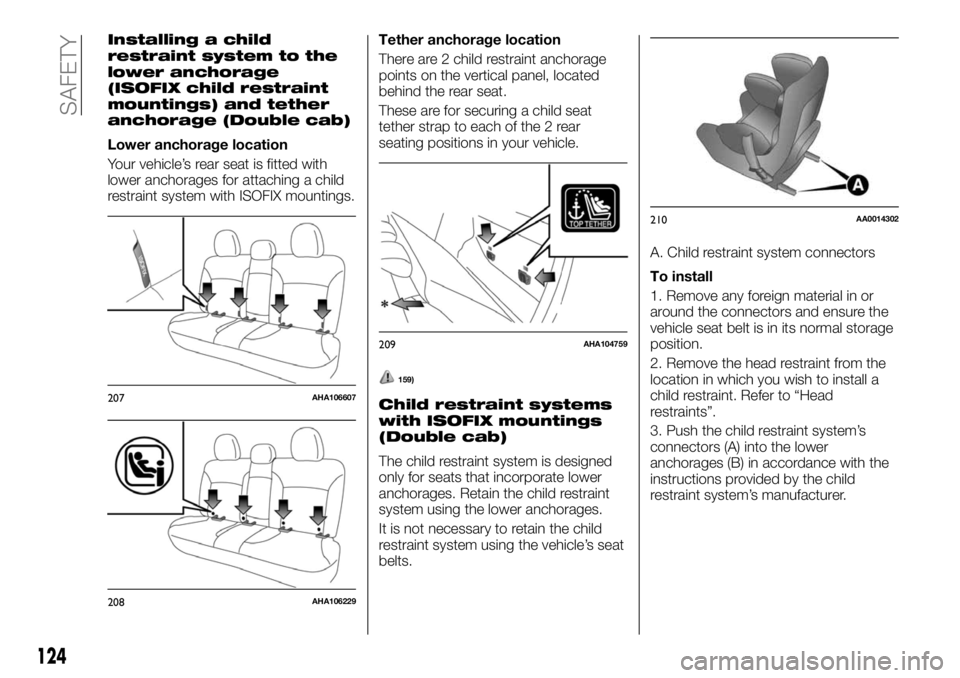
Lower anchorage location
Your vehicle’s rear seat is fitted with
lower anchorages for attaching a child
restraint system with ISOFIX mountings.Tether anchorage location
There are 2 child restraint anchorage
points on the vertical panel, located
behind the rear seat.
These are for securing a child seat
tether strap to each of the 2 rear
seating positions in your vehicle.
159)
Child restraint systems
with ISOFIX mountings
(Double cab)
The child restraint system is designed
only for seats that incorporate lower
anchorages. Retain the child restraint
system using the lower anchorages.
It is not necessary to retain the child
restraint system using the vehicle’s seat
belts.A. Child restraint system connectors
To install
1. Remove any foreign material in or
around the connectors and ensure the
vehicle seat belt is in its normal storage
position.
2. Remove the head restraint from the
location in which you wish to install a
child restraint. Refer to “Head
restraints”.
3. Push the child restraint system’s
connectors (A) into the lower
anchorages (B) in accordance with the
instructions provided by the child
restraint system’s manufacturer.
207AHA106607
208AHA106229
209AHA104759
210AA0014302
124
SAFETY
Page 127 of 312
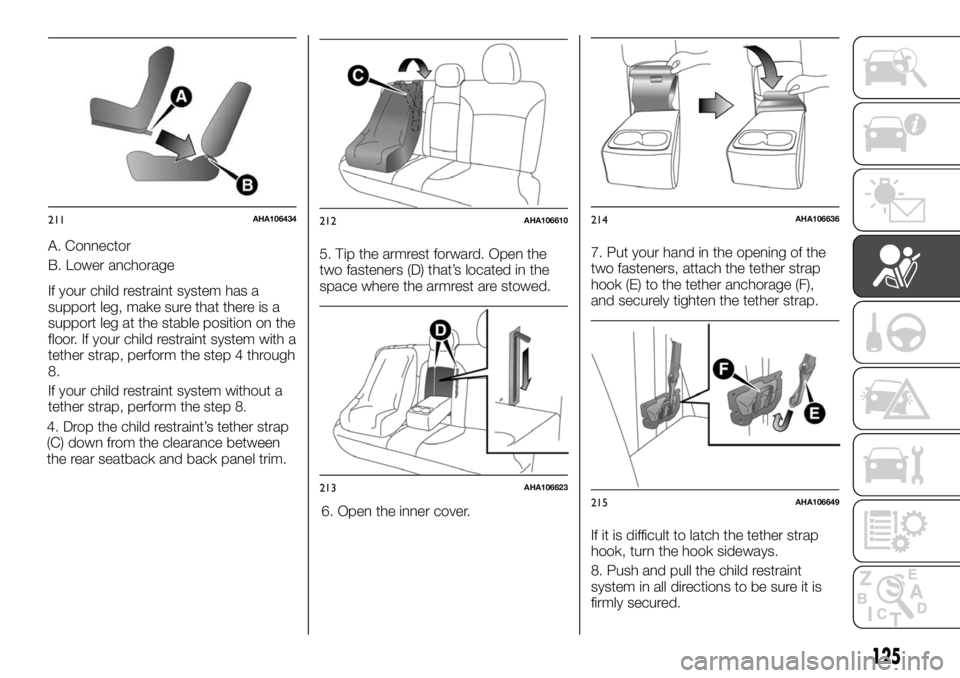
A. Connector
B. Lower anchorage
If your child restraint system has a
support leg, make sure that there is a
support leg at the stable position on the
floor. If your child restraint system with a
tether strap, perform the step 4 through
8.
If your child restraint system without a
tether strap, perform the step 8.
4. Drop the child restraint’s tether strap
(C) down from the clearance between
the rear seatback and back panel trim.5. Tip the armrest forward. Open the
two fasteners (D) that’s located in the
space where the armrest are stowed.
6. Open the inner cover.7. Put your hand in the opening of the
two fasteners, attach the tether strap
hook (E) to the tether anchorage (F),
and securely tighten the tether strap.
If it is difficult to latch the tether strap
hook, turn the hook sideways.
8. Push and pull the child restraint
system in all directions to be sure it is
firmly secured.
211AHA106434212AHA106610
213AHA106623
214AHA106636
215AHA106649
125
Page 128 of 312
To remove
Remove the child restraint system in
accordance with the instructions
provided by the child restraint system’s
manufacturer.
Installing a child restraint system to
a 3-point type seat belt (with
emergency locking mechanism)
Installation
1. Put a child restraint system on the
seat in which you wish to install it and
remove the head restraint from the seat.
Refer to “Head restraints”.
2. When installing a child restraint
system in the front passenger seat,
adjust seat slide to its most rearward
position.
3. Route the belt through the child
restraint according to the child restraint
system manufacturer’s instructions,
then insert the latch plate into the
buckle.
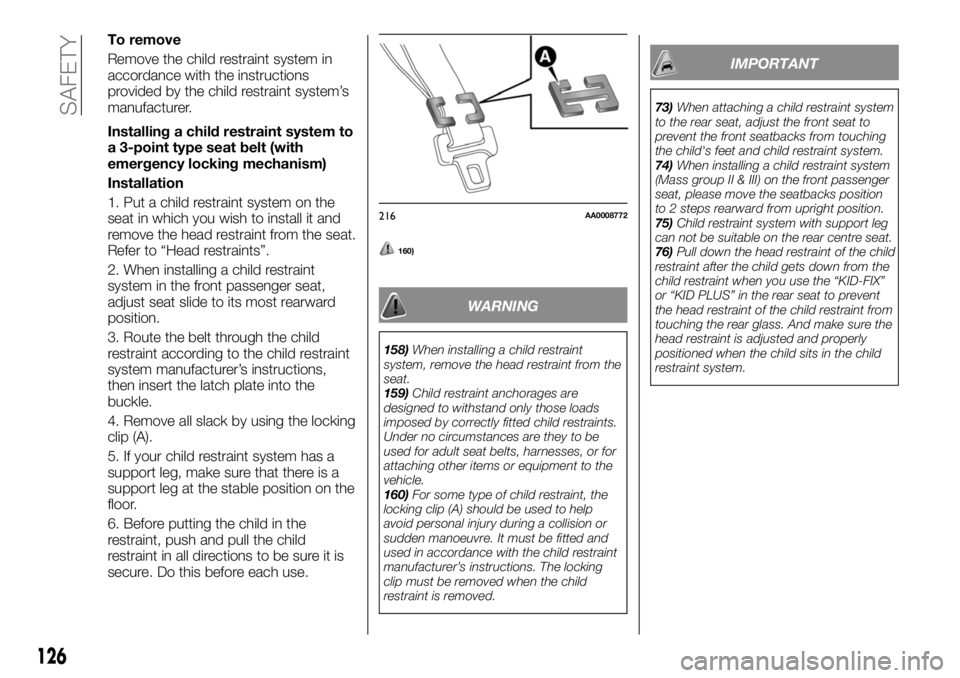
4. Remove all slack by using the locking
clip (A).
5. If your child restraint system has a
support leg, make sure that there is a
support leg at the stable position on the
floor.
6. Before putting the child in the
restraint, push and pull the child
restraint in all directions to be sure it is
secure. Do this before each use.
160)
WARNING
158)When installing a child restraint
system, remove the head restraint from the
seat.
159)Child restraint anchorages are
designed to withstand only those loads
imposed by correctly fitted child restraints.
Under no circumstances are they to be
used for adult seat belts, harnesses, or for
attaching other items or equipment to the
vehicle.
160)For some type of child restraint, the
locking clip (A) should be used to help
avoid personal injury during a collision or
sudden manoeuvre. It must be fitted and
used in accordance with the child restraint
manufacturer’s instructions. The locking
clip must be removed when the child
restraint is removed.
IMPORTANT
73)When attaching a child restraint system
to the rear seat, adjust the front seat to
prevent the front seatbacks from touching
the child's feet and child restraint system.
74)When installing a child restraint system
(Mass group II & III) on the front passenger
seat, please move the seatbacks position
to 2 steps rearward from upright position.
75)Child restraint system with support leg
can not be suitable on the rear centre seat.
76)Pull down the head restraint of the child
restraint after the child gets down from the
child restraint when you use the “KID-FIX”
or “KID PLUS” in the rear seat to prevent
the head restraint of the child restraint from
touching the rear glass. And make sure the
head restraint is adjusted and properly
positioned when the child sits in the child
restraint system.
216AA0008772
126
SAFETY
Page 144 of 312
When the trailer stability assist system
operates the brakes, the brake lamp
turns on. About the towing of the trailer,
refer to “Trailer towing”.
83) 84)
NOTE When TSA system operates, the
vehicle body may vibrate and the
operating sounds from the engine
compartment may be heard. These
motions indicate normal operation of
the system, not abnormal operation.
NOTE TSA system operates when the
vehicle speed is about 55 km/h or
higher.
NOTE When TSA system operates, the
ESC operation indicator lamp blinks on
and off.
NOTE When ESC does not work, TSA
system does not operate.
WARNING
218)When facing uphill, do not rely on
using the hill start assist to maintain a
stopped position as an alternative to
depressing the brake pedal. Doing so
could cause an accident.
219)Do not turn the ignition switch to the
“LOCK” or “ACC” position or the operation
mode in ACC or OFF while the hill start
assist is operating. The hill start assist
could stop operating, which could result in
an accident.
IMPORTANT
77)Do not overly rely on the hill start assist
to prevent backwards movement of the
vehicle. Under certain circumstances, even
when hill start assist is activated, the
vehicle may move backwards if the brake
pedal is not sufficiently depressed, if the
vehicle is heavily loaded, if the road is very
steep or slippery or if the vehicle tows a
trailer, etc.
78)The hill start assist is not designed to
keep the vehicle stopped in place on uphill
slopes for more than 2 seconds.
79)If the warning is turn on, the hill start
assist will not operate. Start off carefully.
80)Park your vehicle in a safe place and
stop the engine. Restart the engine and
check whether the warning indicator went
out, in which case the hill start assist is
again working normally. If they warning
remains displayed or reappear frequently, it
is not necessary to stop the vehicle
immediately, but the vehicle should be
inspected by a Fiat Dealership.
81)Do not stop the engine while the
vehicle is moving. Stopping the engine
would make the steering wheel extremely
hard to turn, possibly resulting in an
accident.
82)Do not leave the steering wheel turned
all the way in one direction. This can cause
damage to the power steering system.83)Do not over-rely on TSA system. Due to
the slippery road surface, heavy side wind,
inappropriate weight and positioning of
luggage, and/or driving at high speed, TSA
system may fail to secure the stability.
Always drive appropriately in accordance
with the condition of traffic, road surface
condition, weather, and the weight and
positioning of luggage.
84)The trailer stability assist system does
not operate in case as follows: 1 – When
sudden braking and braking while driving
downhill cause an abrupt motion of the
vehicle which makes the vehicle and the
trailer form a dogleg shape. 2 – When a
sideslip occurs by sudden steering.
142
SAFETY
Page 147 of 312
DRIVING, ALCOHOL
AND DRUGS
Drunk driving is one of the most
frequent causes of accidents.
Your driving ability can be seriously
impaired even with blood alcohol levels
far below the legal minimum. If you
have been drinking, don’t drive. Ride
with a designated non-drinking driver,
call a cab or a friend, or use public
transportation. Drinking coffee or taking
a cold shower will not make you sober.
Similarly, prescription and
non-prescription drugs affect your
alertness, perception and reaction time.
Consult with your doctor or pharmacist
before driving while under the influence
of any of these medications.
220)
WARNING
220)NEVER DRINK AND DRIVE. Your
perceptions are less accurate, your reflexes
are slower and your judgment is impaired.
SAFE DRIVING
TECHNIQUES
Driving safety and protection against
injury cannot be fully ensured. However,
we recommend that you pay extra
attention to the following:
Seat belts
Before starting the vehicle, make sure
that you and your passengers have
fastened your seat belts.
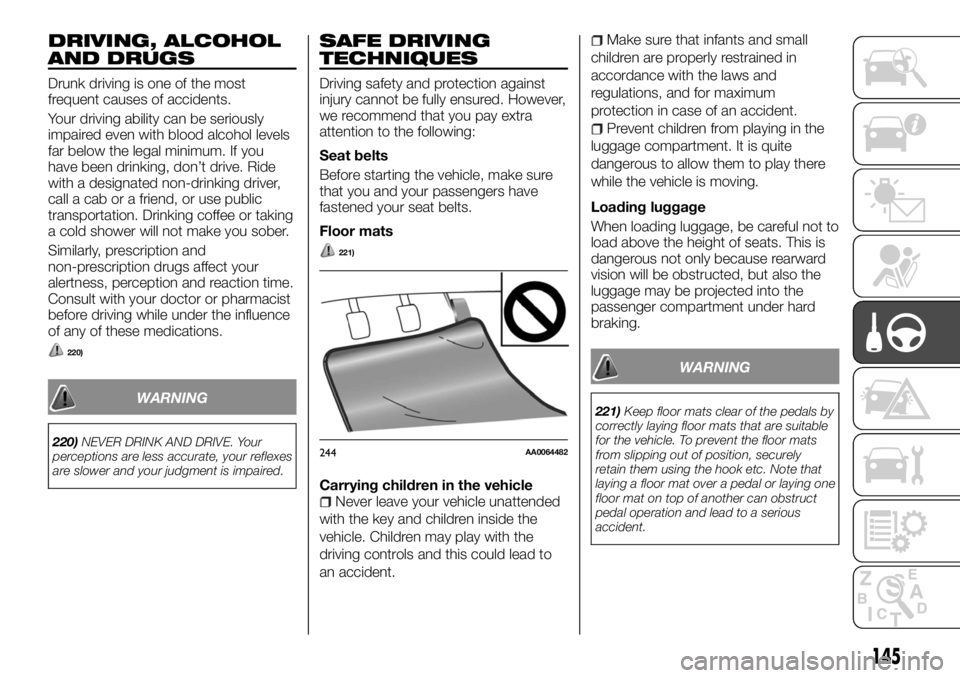
Floor mats
221)
Carrying children in the vehicleNever leave your vehicle unattended
with the key and children inside the
vehicle. Children may play with the
driving controls and this could lead to
an accident.
Make sure that infants and small
children are properly restrained in
accordance with the laws and
regulations, and for maximum
protection in case of an accident.
Prevent children from playing in the
luggage compartment. It is quite
dangerous to allow them to play there
while the vehicle is moving.
Loading luggage
When loading luggage, be careful not to
load above the height of seats. This is
dangerous not only because rearward
vision will be obstructed, but also the
luggage may be projected into the
passenger compartment under hard
braking.
WARNING
221)Keep floor mats clear of the pedals by
correctly laying floor mats that are suitable
for the vehicle. To prevent the floor mats
from slipping out of position, securely
retain them using the hook etc. Note that
laying a floor mat over a pedal or laying one
floor mat on top of another can obstruct
pedal operation and lead to a serious
accident.
244AA0064482
145
Page 165 of 312
Operation of the A/T
122) 123) 124) 125) 126) 127)
Passing acceleration
To gain extra acceleration in “D” (DRIVE)
position, push the accelerator to the
floor. The A/T will automatically
downshift.
In sports mode, downshifts do not take
place when the accelerator is
depressed all the way to the floor.
Waiting
For short waiting periods, such as at
traffic signals the vehicle can be left in
gear and held stationary with the
service brake. For longer waiting
periods with the engine running, place
the selector lever in the “N” (NEUTRAL)
position and apply the parking brake,
while holding the vehicle stationary with
the service brake.
128)
Parking
To park the vehicle, first bring it to a
complete stop, fully engage the parking
brake, and then move the selector lever
to the “P” (PARK) position.
If you are going to leave the vehicle
unattended, always switch off the
engine and carry the key.
On a slope, be sure to apply the
parking brake before moving the
selector lever to the “P” (PARK)
position. If you move the selector lever
to the “P” (PARK) position beforeapplying the parking brake, it may be
difficult to disengage the selector lever
from the “P” (PARK) position when next
you drive the vehicle, requiring
application of a strong force to the
selector lever to move from the “P”
(PARK) position.
When the A/T makes no speed
change
If the transmission does not change
speeds while driving, or your vehicle
does not pick up enough speed when
starting on an uphill slope, it may be
that there is something unusual
happening in the transmission, causing
a safety device to activate. Immediately
have your vehicle checked by a Fiat
Dealership as soon as possible.
1. If your vehicle has difficulty moving
uphill, shift the selector lever into 2nd
gear of the sports mode. This method
might not work depending on the
transmission malfunction.
2. Once the vehicle is moving on a level
road, move the selector lever back to
“D” (DRIVE).
When the selector lever position display
in the instrument panel blinks, it means
that there is an abnormal condition in
the transmission. Refer to “When the
selector lever position display blinks”.
IMPORTANT
111)Always depress the brake pedal when
shifting the selector lever into a gear from
the “P” (PARK) or “N” (NEUTRAL) position.
Never put your foot on the accelerator
pedal while shifting the selector lever from
the “P” (PARK) or “N” (NEUTRAL) position.
112)Never shift into the “P” (PARK) or “R”
(REVERSE) position while the vehicle is in
motion to avoid a transmission damage.
113)Never move the selector lever to the
“N” (NEUTRAL) position while driving. A
serious accident could occur since you
could accidentally move the lever into the
“P” (PARK) or “R” (REVERSE) position or
you will lose engine braking.
114)On a gradient, the engine should be
started in the “P” (PARK) position, not in the
“N” (NEUTRAL) position.
115)To prevent rolling, always keep your
foot on the brake pedal when the vehicle is
in “N” (NEUTRAL) position, or when shifting
into or out of “N” (NEUTRAL) position.
116)To prevent transmission damage,
never shift into the “D” (DRIVE) position
from the “R” (REVERSE) position while the
vehicle is in motion.
117)In sports mode, the driver must
execute upward shifts in accordance with
prevailing road conditions, taking care to
keep the engine speed below the red zone.
118)Repeated continuous operation of the
selector lever or the shift paddles will
continuously switch shift position.
163
Page 185 of 312
A film of water can be formed on the
brake discs or brake drums and
prevent normal braking after driving in
heavy rain or through large puddles, or
after the vehicle is washed. If this
occurs, dry the brakes out by driving
slowly while lightly depressing the brake
pedal.
When driving downhill
It is important to take advantage of the
engine braking by shifting to a lower
shift position while driving on steep
downhill roads in order to prevent the
brakes from overheating.
239)
Brake pads and linings
Avoid hard braking situations. New
brakes need to be broken-in by
moderate use for the first 200 km.
The disc brakes are provided with a
warning device which emits a shrieking
metallic sound while braking if the brake
pads have reached their wear limit. If
you hear this sound, have the brake
pads replaced.
240)
IMPORTANT
148)Avoid driving habits that cause heavy
braking and never “ride” the brakes by
resting your foot on the brake pedal while
driving. It causes bake overheating and
fade.
WARNING
237)Do not turn off the engine while your
vehicle is in motion. If you turn off the
engine while driving, the power assistance
for the braking system will stop working
and your brakes will not work effectively.
238)If the power assist is lost or if either
brake hydraulic system stops working
properly, have your vehicle checked
immediately.
239)Do not leave any objects near the
brake pedal or let a floor mat slide under it;
doing so could prevent the full pedal stroke
that would be necessary in an emergency.
Make sure that the pedal can be operated
freely at all times. Make sure the floor mat
is securely held in place.
240)Driving with worn brake pads will
make it harder to stop, and can cause an
accident.
CRUISE CONTROL
(where provided)
Cruise control is an automatic speed
control system that keeps a set speed.
It can be activated at approximately
40 km/h or more.
241) 242)
149) 150) 151)
NOTE Cruise control may not be able
to keep your speed on uphills or
downhills. Your speed may decrease on
a steep uphill. You may use the
accelerator pedal if you want to stay at
your set speed. Your speed may
increase to more than the set speed on
183
a steep downhill. You have to use the
brake to control your speed. As a
result, the set speed driving is
deactivated.
Page 204 of 312
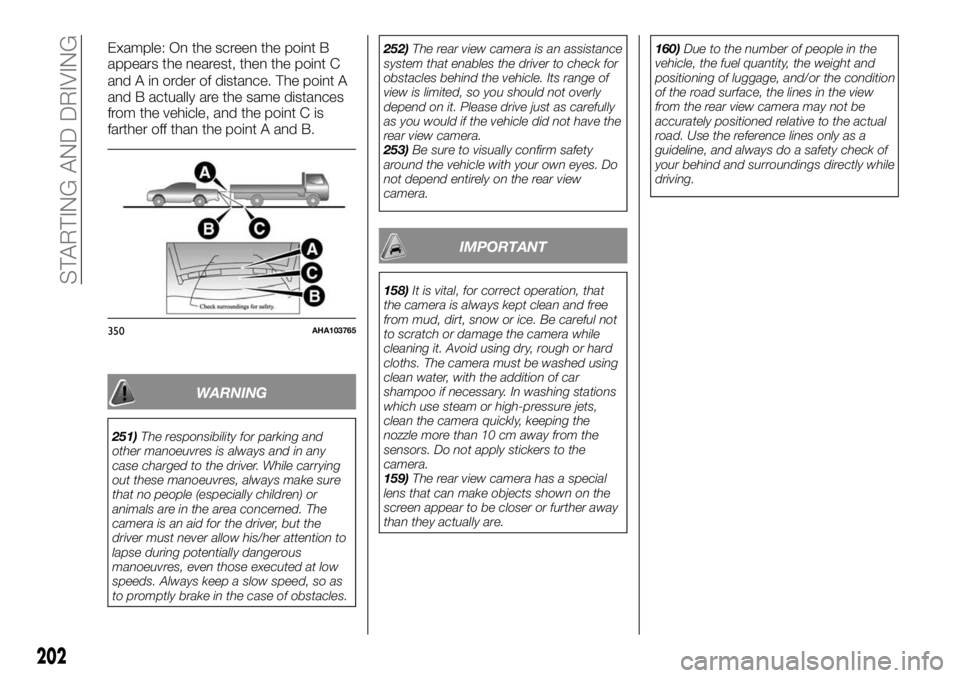
and A in order of distance. The point A
and B actually are the same distances
from the vehicle, and the point C is
farther off than the point A and B.
WARNING
251)The responsibility for parking and
other manoeuvres is always and in any
case charged to the driver. While carrying
out these manoeuvres, always make sure
that no people (especially children) or
animals are in the area concerned. The
camera is an aid for the driver, but the
driver must never allow his/her attention to
lapse during potentially dangerous
manoeuvres, even those executed at low
speeds. Always keep a slow speed, so as
to promptly brake in the case of obstacles.252)The rear view camera is an assistance
system that enables the driver to check for
obstacles behind the vehicle. Its range of
view is limited, so you should not overly
depend on it. Please drive just as carefully
as you would if the vehicle did not have the
rear view camera.
253)Be sure to visually confirm safety
around the vehicle with your own eyes. Do
not depend entirely on the rear view
camera.
IMPORTANT
158)It is vital, for correct operation, that
the camera is always kept clean and free
from mud, dirt, snow or ice. Be careful not
to scratch or damage the camera while
cleaning it. Avoid using dry, rough or hard
cloths. The camera must be washed using
clean water, with the addition of car
shampoo if necessary. In washing stations
which use steam or high-pressure jets,
clean the camera quickly, keeping the
nozzle more than 10 cm away from the
sensors. Do not apply stickers to the
camera.
159)The rear view camera has a special
lens that can make objects shown on the
screen appear to be closer or further away
than they actually are.160)Due to the number of people in the
vehicle, the fuel quantity, the weight and
positioning of luggage, and/or the condition
of the road surface, the lines in the view
from the rear view camera may not be
accurately positioned relative to the actual
road. Use the reference lines only as a
guideline, and always do a safety check of
your behind and surroundings directly while
driving.
350AHA103765
202
STARTING AND DRIVING
Example: On the screen the point B
appears the nearest, then the point C