engine FIAT FULLBACK 2018 Owner handbook (in English)
[x] Cancel search | Manufacturer: FIAT, Model Year: 2018, Model line: FULLBACK, Model: FIAT FULLBACK 2018Pages: 316, PDF Size: 10.52 MB
Page 193 of 316
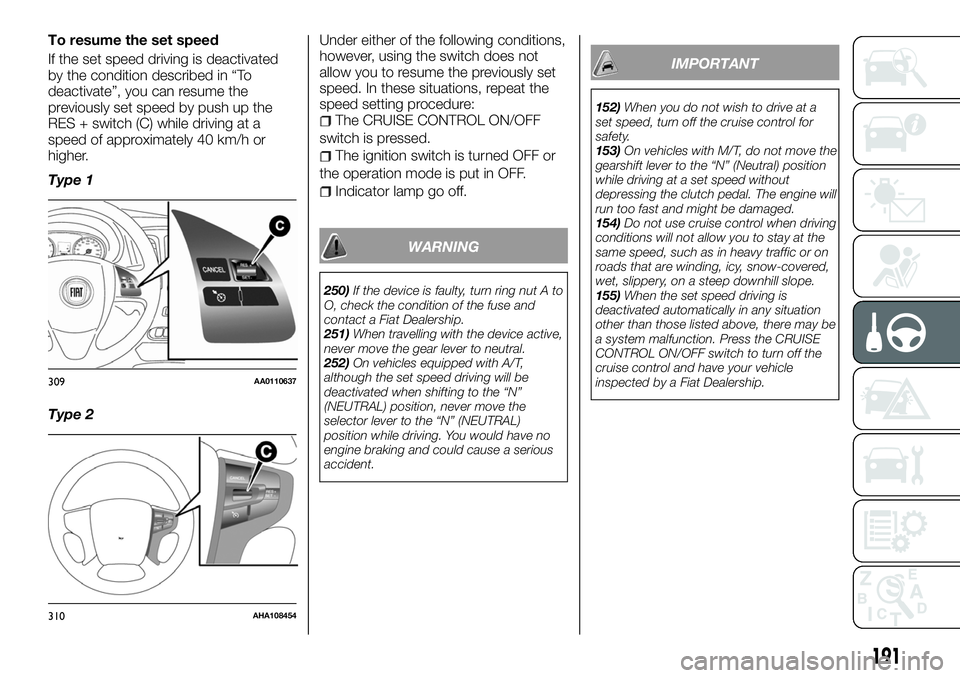
To resume the set speed
If the set speed driving is deactivated
by the condition described in “To
deactivate”, you can resume the
previously set speed by push up the
RES + switch (C) while driving at a
speed of approximately 40 km/h or
higher.
Type 1
Type 2Under either of the following conditions,
however, using the switch does not
allow you to resume the previously set
speed. In these situations, repeat the
speed setting procedure:
The CRUISE CONTROL ON/OFF
switch is pressed.
The ignition switch is turned OFF or
the operation mode is put in OFF.
Indicator lamp go off.
WARNING
250)If the device is faulty, turn ring nut A to
O, check the condition of the fuse and
contact a Fiat Dealership.
251)When travelling with the device active,
never move the gear lever to neutral.
252)On vehicles equipped with A/T,
although the set speed driving will be
deactivated when shifting to the “N”
(NEUTRAL) position, never move the
selector lever to the “N” (NEUTRAL)
position while driving. You would have no
engine braking and could cause a serious
accident.
IMPORTANT
152)When you do not wish to drive at a
set speed, turn off the cruise control for
safety.
153)On vehicles with M/T, do not move the
gearshift lever to the “N” (Neutral) position
while driving at a set speed without
depressing the clutch pedal. The engine will
run too fast and might be damaged.
154)Do not use cruise control when driving
conditions will not allow you to stay at the
same speed, such as in heavy traffic or on
roads that are winding, icy, snow-covered,
wet, slippery, on a steep downhill slope.
155)When the set speed driving is
deactivated automatically in any situation
other than those listed above, there may be
a system malfunction. Press the CRUISE
CONTROL ON/OFF switch to turn off the
cruise control and have your vehicle
inspected by a Fiat Dealership.
309AA0110637
310AHA108454
191
Page 194 of 316
SPEED LIMITER
The Speed Limiter is a driver assist
function to prevent from exceeding the
speed set by driver while engine power
control.
156)
NOTE If depressing the clutch pedal
(M/T), the Speed Limiter does not
activate.
If the vehicle speed exceeds the set
speed, control state “LIMIT” and the
Speed Limiter’s symbol will blink in the
combination meter.
If the vehicle speed exceeds the set
speed after indicated, control state
“LIMIT” and the beep alert will sound a
certain period of time.
While running without blinked control
state “LIMIT” and the Speed Limiter’s
symbol, if you decrease the set speed
and vehicle speed is more than set
speed, control state “LIMIT” and the
Speed Limiter’s symbol blinking starts
but beep alert is delayed.
In this case, when vehicle speed keeps
exceeding set speed for about
30 seconds after control state “LIMIT”
and the Speed Limiter’s symbol are
blinked, beep alert will sound a certain
period of time.
If the vehicle speeds decreases less
than set speeds, control state “LIMIT”
and the Speed Limiter’s symbol stop
blinking. When beep alert is sounding,
the beep alert also goes off.NOTE However, this gives priority to
audio and visual signal of safety
reasons or driver’s demand. If the set
speed is too lower based on current
shift position, the Speed Limiter may
not limit the vehicle speed to prevent
engine stall.
Speed Limiter control switches
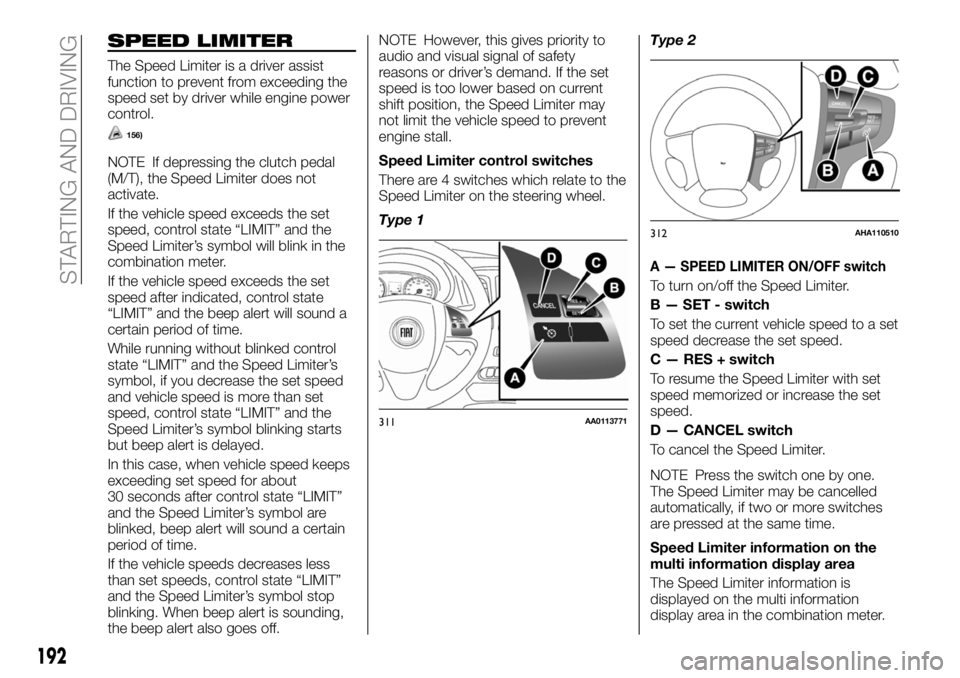
There are 4 switches which relate to the
Speed Limiter on the steering wheel.
Type 1Type 2
A — SPEED LIMITER ON/OFF switch
To turn on/off the Speed Limiter.
B — SET - switch
To set the current vehicle speed to a set
speed decrease the set speed.
C — RES + switch
To resume the Speed Limiter with set
speed memorized or increase the set
speed.
D — CANCEL switch
To cancel the Speed Limiter.
NOTE Press the switch one by one.
The Speed Limiter may be cancelled
automatically, if two or more switches
are pressed at the same time.
Speed Limiter information on the
multi information display area
The Speed Limiter information is
displayed on the multi information
display area in the combination meter.
311AA0113771
312AHA110510
192
STARTING AND DRIVING
Page 207 of 316
IN AN EMERGENCY
A punctured tyre or a burnt-out bulb?
At times, a problem may interfere with
our journey.
The pages on emergencies can help
you to deal with critical situations
independently and with calm.
In an emergency we recommend that
you call the freephone number found in
the Warranty Booklet.
It is also possible to call the
00 800 3428 0000 freephone number
to search the nearest Fiat Dealership.ERA GLONASS.............206
IF THE VEHICLE BREAKS DOWN. .210
IF THE OPERATION MODE CANNOT
BE CHANGED TO OFF (VEHICLES
EQUIPPED WITH THE KEYLESS
OPERATION SYSTEM).........211
EMERGENCY STARTING.......211
ENGINE OVERHEATING........212
BLEEDING THE FUEL SYSTEM . . .213
REMOVAL OF WATER FROM THE
FUEL FILTER...............214
TOOLS, JACK AND JACK
HANDLE..................214
HOW TO CHANGE A TYRE.....219
TOWING..................226
OPERATION UNDER ADVERSE
DRIVING CONDITIONS........229
FUSIBLE LINKS.............230
FUSES...................230
REPLACEMENT OF LAMP BULBS .238
205
Page 212 of 316
IF THE VEHICLE
BREAKS DOWN
If the vehicle breaks down on the road,
move it to the shoulder and use the
hazard warning flashers and/or the
warning triangle etc. Refer to “Hazard
warning flasher switch”.
If the engine stops/fails
Vehicle operation and control are
affected if the engine stops. Before
moving the vehicle to a safe area, be
aware of the following:
The brake booster becomes
inoperative and the pedal effort will
increase. Press down the brake pedal
harder than usual.
Since the power steering system is
no longer operative, the steering wheel
feels heavy when turning it.
First-aid kit and warning triangle
securing bands*
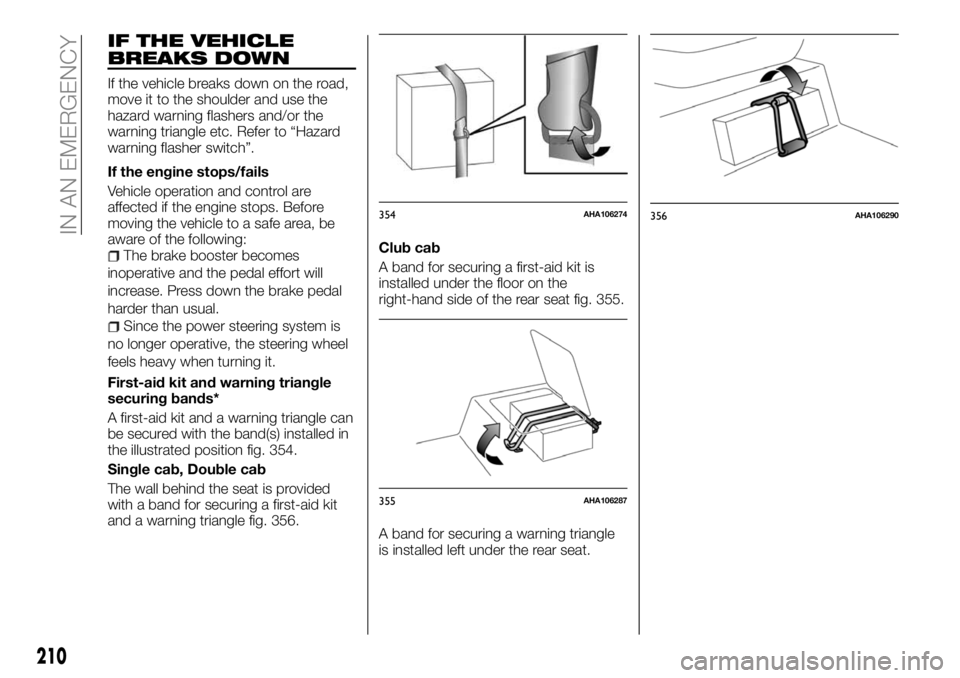
A first-aid kit and a warning triangle can
be secured with the band(s) installed in
the illustrated position fig. 354.
Single cab, Double cab
The wall behind the seat is provided
with a band for securing a first-aid kit
and a warning triangle fig. 356.Club cab
A band for securing a first-aid kit is
installed under the floor on the
right-hand side of the rear seat fig. 355.
A band for securing a warning triangle
is installed left under the rear seat.
.
354AHA106274
355AHA106287
356AHA106290
210
IN AN EMERGENCY
Page 213 of 316
IF THE OPERATION
MODE CANNOT BE
CHANGED TO OFF
(VEHICLES
EQUIPPED WITH THE
KEYLESS
OPERATION
SYSTEM)
If the operation mode cannot be
changed to OFF, perform the following
procedure.
Move the selector lever to the “P”
(PARK) position, and then change the
operation mode to OFF. (For vehicles
with A/T)
One of the other causes could be
low battery voltage. If this occurs, the
keyless entry system, keyless operation
function, and steering lock will also not
operate. Contact an authorised Fiat
dealership.
EMERGENCY
STARTING
276) 277) 278) 279) 280) 281) 282) 283) 284) 285) 286) 287)
288) 289) 290) 291) 292)
If the engine cannot be started because
the battery is weak or dead, the battery
from another vehicle can be used with
jumper cables to start the engine.
1. Get the vehicles close enough so the
jumper cables can reach, but be sure
the vehicles aren’t touching each other.
2. Turn off all lamps, heater and other
electrical loads.
3. Set the parking brake firmly on each
vehicle. Put an automatic transmission
in “P” (PARK) or a manual transmission
in “N” (Neutral). Stop the engine.
4. Make sure battery electrolyte is at the
proper level. Refer to “Battery”.
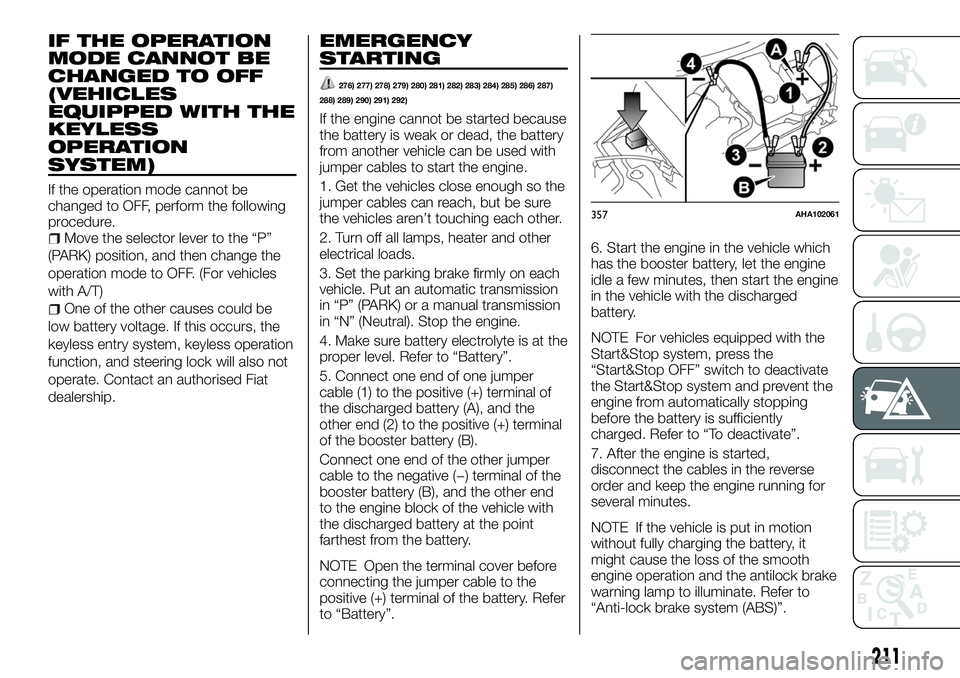
5. Connect one end of one jumper
cable (1) to the positive (+) terminal of
the discharged battery (A), and the
other end (2) to the positive (+) terminal
of the booster battery (B).
Connect one end of the other jumper
cable to the negative (−) terminal of the
booster battery (B), and the other end
to the engine block of the vehicle with
the discharged battery at the point
farthest from the battery.
NOTE Open the terminal cover before
connecting the jumper cable to the
positive (+) terminal of the battery. Refer
to “Battery”.6. Start the engine in the vehicle which
has the booster battery, let the engine
idle a few minutes, then start the engine
in the vehicle with the discharged
battery.
NOTE For vehicles equipped with the
Start&Stop system, press the
“Start&Stop OFF” switch to deactivate
the Start&Stop system and prevent the
engine from automatically stopping
before the battery is sufficiently
charged. Refer to “To deactivate”.
7. After the engine is started,
disconnect the cables in the reverse
order and keep the engine running for
several minutes.
NOTE If the vehicle is put in motion
without fully charging the battery, it
might cause the loss of the smooth
engine operation and the antilock brake
warning lamp to illuminate. Refer to
“Anti-lock brake system (ABS)”.
357AHA102061
211
Page 214 of 316
WARNING
276)To start the engine using jumper
cables from another vehicle, perform the
correct procedures according to the
instruction below. Incorrect procedures
could result in a fire or explosion or
damage to the vehicles.
277)Keep sparks, cigarettes and flames
away from the battery because the battery
may produce an explosion.
278)Do not attempt to start the engine by
pulling or pushing the vehicle. It could
damage your vehicle.
279)Check the other vehicle. It must have
a 12-volt battery. If the other system isn’t
12-volt, shorting can damage both
vehicles.
280)Use the proper cables suitable for the
battery size to prevent overheating of the
cables.
281)Check the jumper cables for damage
and corrosion before use.
282)Always wear protective eye goggles
when working near the battery.
283)Keep the battery out of the reach of
children.
284)Turn off the ignition on both vehicles
beforehand. Make sure that the cables or
your clothes cannot be caught by the fan
or drive belt. Personal injury could result.
285)If electrolyte fluid is not visible, or
appears to be frozen, Do Not Attempt
Jump Starting! A battery might rupture or
explode if the temperature is below the
freezing point or if it is not filled to the
proper level.286)Electrolyte is corrosive diluted
sulphuric acid. If electrolyte (battery acid)
comes into contact with your hands, eyes,
clothes or the painted surface of your
vehicle, it should be thoroughly flushed
with water. If electrolyte gets in your eyes,
flush them with water immediately and
thoroughly, and get prompt medical
attention.
287)Make sure that the connection is
made to the appointed position (shown in
the illustration). If the connection is made
directly to the negative (−) side of the
battery, the inflammable gases generated
from the battery might catch fire and
explode.
288)When connecting the jumper cables,
do not connect the positive (+) cable to the
negative (−) terminal. Otherwise sparks
might cause explosion of the battery.
289)Use care not to get the jumper cable
caught in the cooling fan or other rotating
part in the engine compartment.
290)Keep the engine of the vehicle giving
assistance running.
291)Battery fluid is poisonous and
corrosive: avoid contact with your skin and
eyes. The battery should be charged in a
well ventilated place, away from naked
flames or possible sources of sparks:
danger of explosion and fire.
292)Do not attempt to charge a frozen
battery: it must be thawed first, otherwise it
may explode. If freezing has occurred, the
battery should be checked by skilled
personnel to make sure that the internal
elements are not damaged and that the
body is not cracked, with the risk of leaking
poisonous and corrosive acid.
ENGINE
OVERHEATING
When the engine is overheating,will
blink. If this occurs, take the following
corrective measures:
1. Stop the vehicle in a safe place.
2. Check whether steam is coming from
the engine compartment.
If steam does not come from the engine
compartment: with the engine still
running, raise the bonnet to ventilate
the engine compartment.
NOTE For vehicles equipped with the
Start&Stop system, press the
“Start&Stop OFF” switch to deactivate
the system before stopping the vehicle.
If steam is coming from the engine
compartment: stop the engine, and
when the steam stops, raise the bonnet
to ventilate the engine compartment.
Restart the engine.
293) 294) 295)
3. Confirm that the cooling fan (B) is
turning.
If the cooling fan is turning: after the
high coolant temperature warning has
gone off, stop the engine
If the cooling fan is not turning: stop the
engine immediately and contact a Fiat
dealership for assistance.
212
IN AN EMERGENCY
Page 215 of 316
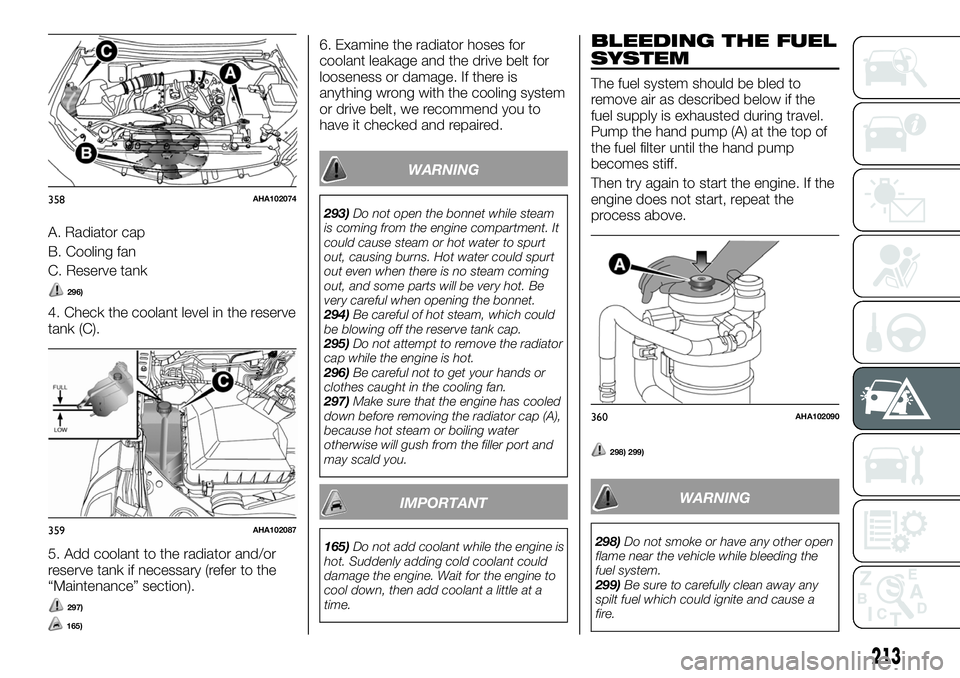
A. Radiator cap
B. Cooling fan
C. Reserve tank
296)
4. Check the coolant level in the reserve
tank (C).
5. Add coolant to the radiator and/or
reserve tank if necessary (refer to the
“Maintenance” section).
297)
165)
6. Examine the radiator hoses for
coolant leakage and the drive belt for
looseness or damage. If there is
anything wrong with the cooling system
or drive belt, we recommend you to
have it checked and repaired.
WARNING
293)Do not open the bonnet while steam
is coming from the engine compartment. It
could cause steam or hot water to spurt
out, causing burns. Hot water could spurt
out even when there is no steam coming
out, and some parts will be very hot. Be
very careful when opening the bonnet.
294)Be careful of hot steam, which could
be blowing off the reserve tank cap.
295)Do not attempt to remove the radiator
cap while the engine is hot.
296)Be careful not to get your hands or
clothes caught in the cooling fan.
297)Make sure that the engine has cooled
down before removing the radiator cap (A),
because hot steam or boiling water
otherwise will gush from the filler port and
may scald you.
IMPORTANT
165)Do not add coolant while the engine is
hot. Suddenly adding cold coolant could
damage the engine. Wait for the engine to
cool down, then add coolant a little at a
time.
BLEEDING THE FUEL
SYSTEM
The fuel system should be bled to
remove air as described below if the
fuel supply is exhausted during travel.
Pump the hand pump (A) at the top of
the fuel filter until the hand pump
becomes stiff.
Then try again to start the engine. If the
engine does not start, repeat the
process above.
298) 299)
WARNING
298)Do not smoke or have any other open
flame near the vehicle while bleeding the
fuel system.
299)Be sure to carefully clean away any
spilt fuel which could ignite and cause a
fire.
358AHA102074
359AHA102087
360AHA102090
213
Page 216 of 316
REMOVAL OF WATER
FROM THE FUEL
FILTER
(Diesel-powered vehicles)
If the fuel filter indicator lamp in the
instrument panel illuminates during
driving, it indicates that water has
accumulated in the fuel filter. If this
occurs, remove the water as described
below.
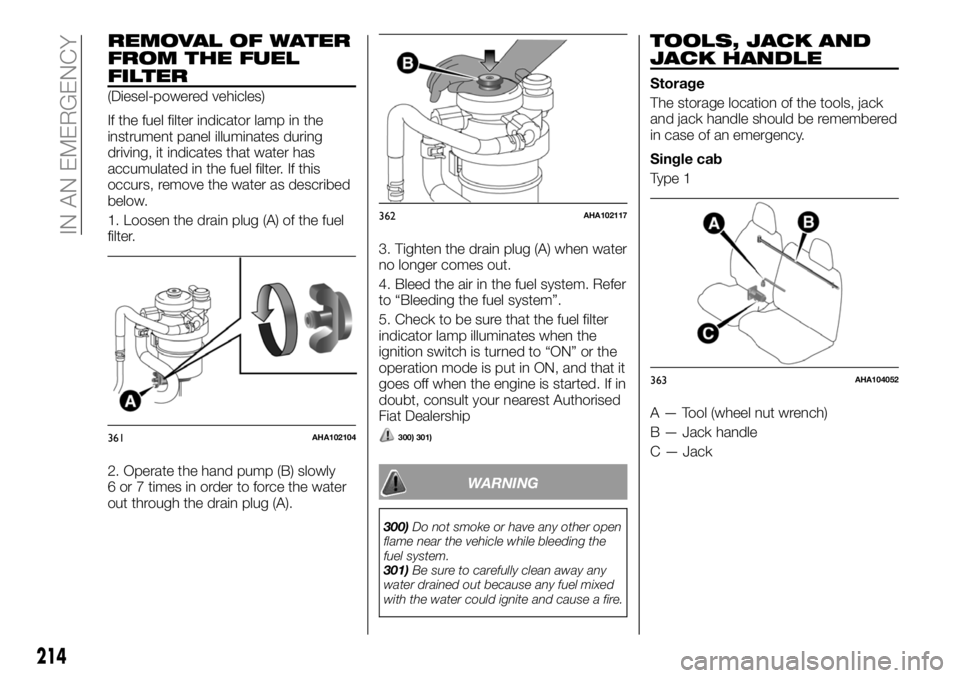
1. Loosen the drain plug (A) of the fuel
filter.
2. Operate the hand pump (B) slowly
6 or 7 times in order to force the water
out through the drain plug (A).3. Tighten the drain plug (A) when water
no longer comes out.
4. Bleed the air in the fuel system. Refer
to “Bleeding the fuel system”.
5. Check to be sure that the fuel filter
indicator lamp illuminates when the
ignition switch is turned to “ON” or the
operation mode is put in ON, and that it
goes off when the engine is started. If in
doubt, consult your nearest Authorised
Fiat Dealership
300) 301)
WARNING
300)Do not smoke or have any other open
flame near the vehicle while bleeding the
fuel system.
301)Be sure to carefully clean away any
water drained out because any fuel mixed
with the water could ignite and cause a fire.
TOOLS, JACK AND
JACK HANDLE
Storage
The storage location of the tools, jack
and jack handle should be remembered
in case of an emergency.
Single cab
Type 1
A — Tool (wheel nut wrench)
B — Jack handle
C — Jack
361AHA102104
362AHA102117
363AHA104052
214
IN AN EMERGENCY
Page 227 of 316
311)Stop jacking up the vehicle as soon
as the tyre is raised off the ground. It is
dangerous to raise the vehicle any higher.
Do not get under your vehicle while using
the jack. Do not bump the raised vehicle or
leave it sitting on the jack for a long time.
Both are very dangerous. Do not use a jack
except the one that came with your
vehicle. The jack should not be used for
any purpose other than to change a tyre.
No one should be in your vehicle when
using the jack. Do not start or run the
engine while your vehicle is on the jack. Do
not turn the raised wheel. The tyres still on
the ground could turn and make your
vehicle fall off the jack.
312)Do not get under your vehicle while
using the jack.
313)Do not bump the raised vehicle or
leave it sitting on the jack for a long time.
Both are very dangerous.
314)Do not use a jack except the one that
came with your vehicle.
315)The jack should not be used for any
purpose other than to change a tyre.
316)No one should be in your vehicle
when using the jack.
317)Do not start or run the engine while
your vehicle is on the jack.
318)Do not turn the raised wheel. The
tyres still on the ground could turn and
make your vehicle fall off the jack.
319)Handle the wheel carefully when
changing the tyre, to avoid scratching the
wheel surface.
320)Mount the spare wheel with the valve
stem K) facing outboard fig. 0. If you
cannot see the valve stem (K), you have
installed the wheel backwards.Operating the vehicle with the spare wheel
installed backwards can cause vehicle
damage and result in an accident.
321)Be sure to open the release valve
slowly. If it is opened quickly, the vehicle will
drop abruptly and the jack may come out
of position, causing a serious accident.
322)Never use your foot or a pipe
extension for extra force in the wheel nut
wrench. If you do so, you will tighten the
nut too much.
323)The tyre pressure should be
periodically checked and maintained at the
specified pressure while the tyre is stowed.
324)After changing the tyre and driving the
vehicle about 1,000 km, retighten the wheel
nuts to make sure that they have not come
loose.
325)If the steering wheel vibrates when
driving after changing the tyre, we
recommend you to have the tyres checked
for balance.
326)Do not mix one type of tyre with
another or use a different size from the one
listed. This would cause early wear and
poor handling.
327)The spare wheel should always be
securely in position. If a flat tyre is changed,
put the flat tyre in the spare wheel
mounting position with the wheel outer
surface upward, and use the wheel nut
wrench to secure it firmly.
328)Never tamper with the inflation valve.
Never introduce tools of any kind between
rim and tyre. Check tyre and spare wheel
pressure regularly, referring to the values
shown in the "Technical specifications"
section.329)The moving components of the jack
(screw and joints) can also cause injuries:
do not touch them. If you come into
contact with lubricating grease, clean
yourself thoroughly.
IMPORTANT
166)Avoid using different size tyres from
the one listed and the combined use of
different types of tyres, as this can affect
driving safety.
167)Even if a wheel has the same rim size
and offset as the specified type of wheel,
its shape may prevent it from being fitted
correctly. Consult an authorised Fiat
Dealership before using wheels that you
have.
168)When installing or removing the spare
wheel, please observe the followings. If you
do not follow them, it could result in break
the spare wheel carrier. Do not use the
power tool. Use the wheel nut wrench
stowed on the vehicle. Do not apply a force
of 400 N or more at the end of the wheel
nut wrench.
169)Never apply oil to either the wheel
bolts or the nuts or they will tighten too
much.
170)If the release valve is loosened too
much (2 or more turns) in the anticlockwise
direction, the jack’s oil will leak and the jack
cannot be used.
171)Close the release valve slowly when
lowering the vehicle, or the valve may be
damaged.
225
Page 228 of 316
TOWING
If your vehicle needs to be towed
If towing is necessary, we recommend
you to have it done by a Fiat Dealership
or a commercial tow truck service. In
the following cases, transport the
vehicle using a tow truck.
The engine runs but the vehicle does
not move, or an abnormal noise is
produced.
Inspection of the vehicle’s underside
reveals that oil or some other fluid is
leaking.
If a wheel gets stuck in a ditch, do not
try to tow the vehicle. Please contact a
Fiat Dealership or a commercial tow
truck service for assistance.
Only when you cannot receive a towing
service from a Fiat Dealership or
commercial tow truck service, tow your
vehicle carefully in accordance with the
instructions given in “Emergency
towing” in this part. The regulations
concerning towing may differ from
country to country. It is recommended
that you obey the regulations of the
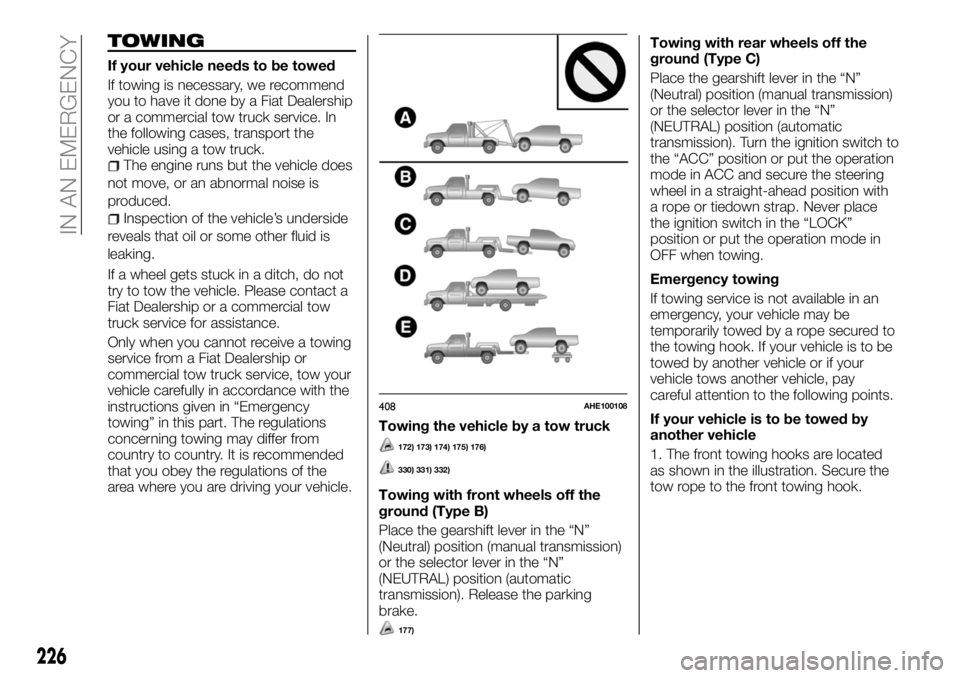
area where you are driving your vehicle.Towing the vehicle by a tow truck
172) 173) 174) 175) 176)
330) 331) 332)
Towing with front wheels off the
ground (Type B)
Place the gearshift lever in the “N”
(Neutral) position (manual transmission)
or the selector lever in the “N”
(NEUTRAL) position (automatic
transmission). Release the parking
brake.
177)
Towing with rear wheels off the
ground (Type C)
Place the gearshift lever in the “N”
(Neutral) position (manual transmission)
or the selector lever in the “N”
(NEUTRAL) position (automatic
transmission). Turn the ignition switch to
the “ACC” position or put the operation
mode in ACC and secure the steering
wheel in a straight-ahead position with
a rope or tiedown strap. Never place
the ignition switch in the “LOCK”
position or put the operation mode in
OFF when towing.
Emergency towing
If towing service is not available in an
emergency, your vehicle may be
temporarily towed by a rope secured to
the towing hook. If your vehicle is to be
towed by another vehicle or if your
vehicle tows another vehicle, pay
careful attention to the following points.
If your vehicle is to be towed by
another vehicle
1. The front towing hooks are located
as shown in the illustration. Secure the
tow rope to the front towing hook.
408AHE100108
226
IN AN EMERGENCY