engine FIAT FULLBACK 2018 Owner handbook (in English)
[x] Cancel search | Manufacturer: FIAT, Model Year: 2018, Model line: FULLBACK, Model: FIAT FULLBACK 2018Pages: 316, PDF Size: 10.52 MB
Page 229 of 316
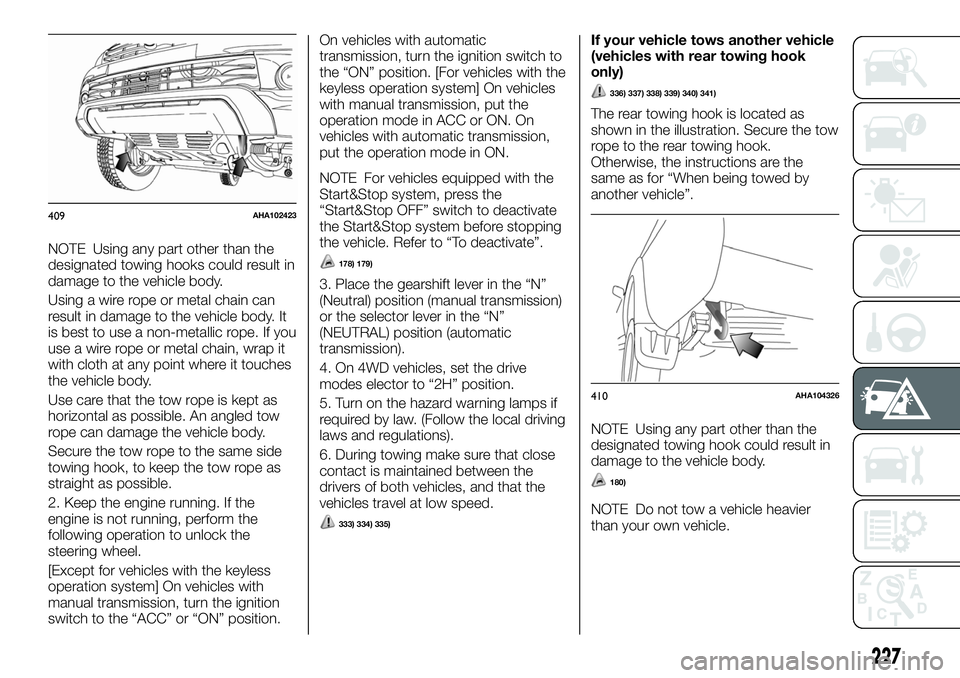
NOTE Using any part other than the
designated towing hooks could result in
damage to the vehicle body.
Using a wire rope or metal chain can
result in damage to the vehicle body. It
is best to use a non-metallic rope. If you
use a wire rope or metal chain, wrap it
with cloth at any point where it touches
the vehicle body.
Use care that the tow rope is kept as
horizontal as possible. An angled tow
rope can damage the vehicle body.
Secure the tow rope to the same side
towing hook, to keep the tow rope as
straight as possible.
2. Keep the engine running. If the
engine is not running, perform the
following operation to unlock the
steering wheel.
[Except for vehicles with the keyless
operation system] On vehicles with
manual transmission, turn the ignition
switch to the “ACC” or “ON” position.On vehicles with automatic
transmission, turn the ignition switch to
the “ON” position. [For vehicles with the
keyless operation system] On vehicles
with manual transmission, put the
operation mode in ACC or ON. On
vehicles with automatic transmission,
put the operation mode in ON.
NOTE For vehicles equipped with the
Start&Stop system, press the
“Start&Stop OFF” switch to deactivate
the Start&Stop system before stopping
the vehicle. Refer to “To deactivate”.178) 179)
3. Place the gearshift lever in the “N”
(Neutral) position (manual transmission)
or the selector lever in the “N”
(NEUTRAL) position (automatic
transmission).
4. On 4WD vehicles, set the drive
modes elector to “2H” position.
5. Turn on the hazard warning lamps if
required by law. (Follow the local driving
laws and regulations).
6. During towing make sure that close
contact is maintained between the
drivers of both vehicles, and that the
vehicles travel at low speed.
333) 334) 335)
If your vehicle tows another vehicle
(vehicles with rear towing hook
only)
336) 337) 338) 339) 340) 341)
The rear towing hook is located as
shown in the illustration. Secure the tow
rope to the rear towing hook.
Otherwise, the instructions are the
same as for “When being towed by
another vehicle”.
NOTE Using any part other than the
designated towing hook could result in
damage to the vehicle body.
180)
NOTE Do not tow a vehicle heavier
than your own vehicle.
409AHA102423
410AHA104326
227
Page 230 of 316
WARNING
330)Towing must not be made for getting
past significant obstacles on the road (e.g.
heaps of snow or material on the road
surface).
331)Towing must be made exclusively on
roads/streets; the device must not be used
to recover the vehicle if it got off the road.
332)As your vehicle is equipped with ESC,
if the vehicle is towed with the ignition
switch in the “ON” position or the operation
mode in ON and only the front wheels or
only the rear wheels raised off the ground,
the active traction control system may
operate, resulting in an accident.
333)Avoid sudden braking, acceleration
and steering wheel movements; such
driving operation could cause damage to
the towing hook or towing rope. People in
the vicinity could be injured as a result.334)When going down a long slope, the
brakes may overheat, reducing
effectiveness. Have your vehicle transport
by a tow truck.
335)The person in the vehicle being towed
must pay attention to the brake lamps of
the towing vehicle and make sure the rope
never becomes slack.
336)Do not use flexible cables for towing
and avoid jerking. During towing
operations, make sure that the fastened
joint does not damage adjoining
components.
337)When towing the vehicle comply with
the specific rules of the Highway Code
regarding the towing device and the
behaviour on the road.
338)Do not start the engine while towing
the vehicle.
339)Towing must be made exclusively on
roads/streets; the device must not be used
to recover the vehicle if it got off the road.
340)Towing must not be made for getting
past significant obstacles on the road (e.g.
heaps of snow or material on the road
surface).
341)Towing must take place with the two
vehicles (one towing, the other towed)
aligned as much as possible; towing by
roadside assistance vehicles, too, must
take place with the two vehicles aligned as
much as possible.
IMPORTANT
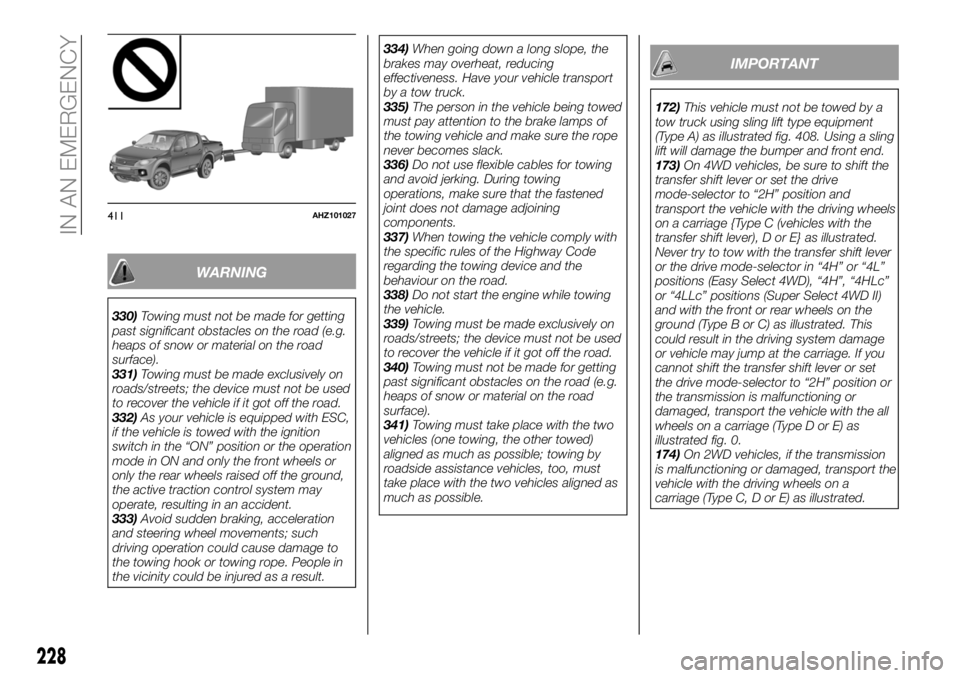
172)This vehicle must not be towed by a
tow truck using sling lift type equipment
(Type A) as illustrated fig. 408. Using a sling
lift will damage the bumper and front end.
173)On 4WD vehicles, be sure to shift the
transfer shift lever or set the drive
mode-selector to “2H” position and
transport the vehicle with the driving wheels
on a carriage {Type C (vehicles with the
transfer shift lever), D or E} as illustrated.
Never try to tow with the transfer shift lever
or the drive mode-selector in “4H” or “4L”
positions (Easy Select 4WD), “4H”, “4HLc”
or “4LLc” positions (Super Select 4WD II)
and with the front or rear wheels on the
ground (Type B or C) as illustrated. This
could result in the driving system damage
or vehicle may jump at the carriage. If you
cannot shift the transfer shift lever or set
the drive mode-selector to “2H” position or
the transmission is malfunctioning or
damaged, transport the vehicle with the all
wheels on a carriage (Type D or E) as
illustrated fig. 0.
174)On 2WD vehicles, if the transmission
is malfunctioning or damaged, transport the
vehicle with the driving wheels on a
carriage (Type C, D or E) as illustrated.
411AHZ101027
228
IN AN EMERGENCY
Page 231 of 316
175)If you tow the vehicles with automatic
transmission with the driving wheels on the
ground (Type B) as illustrated, make sure
that the towing speed and distance given
below are never exceeded, causing
damage to the transmission. Towing speed:
30 km/h Towing distance: 80 km For the
towing speed and the towing distance,
follow the local driving laws and
regulations.
176)On vehicles with manual transmission,
do not tow the vehicle with the rear wheels
on the ground (Type B) as illustrated.
177)Never tow an automatic transmission
vehicle with the front wheels up (and the
rear wheels on the ground) (Type B) when
the automatic transmission fluid level is low.
This may cause serious and expensive
damage to the transmission.
178)When the engine is not running, the
brake booster and power steering pump do
not operate. This means higher brake
depression force and higher steering effort
are required. Therefore, vehicle operation is
very difficult.
179)Do not leave the ignition switch in the
“LOCK” position or the operation mode in
OFF. The steering wheel will lock, causing
loss of control.
180)On vehicles with Super Select 4WD II,
when you are going to tow another vehicle,
set the drive mode-selector to “4H”
position. Selecting “2H” drive may increase
the differential oil temperature, resulting in
possible damage to the driving system.
Further, the drive train will be subjected to
excessive loading possibly leading to oil
leakage, component seizure, or other
serious faults.OPERATION UNDER
ADVERSE DRIVING
CONDITIONS
On a flooded road
Avoid flooded roads. In the event
driving flooded roads, doing so may
cause the following serious damage to
the vehicle.
Engine stalling
Short in electrical components
Engine damage caused by water
immersion
After driving flooded roads, be sure to
have an inspection at a Fiat Dealership
and take the necessary measures or
repair.
On a wet road
When driving in rain or on a road with
many puddles a layer of water may
form between the tyres and the road
surface. This reduces a tyre’s frictional
resistance on the road, resulting in loss
of steering stability and braking
capability.
To cope with this, observe the following
items:
(a) Drive your vehicle at a slow speed.
(b) Do not drive on worn tyres.
(c) Always maintain the specified tyre
inflation pressures.On a snow-covered or frozen road
When driving on a snow-covered or
frozen road, it is recommended that you
use snow tyres or snow traction device
(tyre chains). Refer to the “Snow tyres”
and “Snow traction device (tyre chains)”
sections.
Avoid high-speed operation, sudden
acceleration, abrupt brake application
and sharp cornering.
Depressing the brake pedal during
travel on snowy or icy roads may cause
tyre slippage and skidding. When
traction between the tyres and the road
is reduced the wheels may skid and the
vehicle cannot readily be brought to a
stop by conventional braking
techniques. Braking will differ,
depending upon whether you have
anti-lock brake system (ABS). If you do
have ABS, brake by pressing the brake
pedal hard, and keeping it pressed. If
you do not have ABS, pump the brake
pedal with short rapid jabs, each time
fully applying and fully releasing for
greatest effect.
Allow extra distance between your
vehicle and the vehicle in front of you,
and avoid sudden braking.
Accumulation of ice on the braking
system can cause the wheels to lock.
Pull away from a standstill slowly after
confirming safety around the vehicle.
342)
229
Page 232 of 316
On a bumpy or rutted road
Drive as slow as possible when driving
on bumpy or rutted roads.
181)
WARNING
342)Do not press the accelerator pedal
rapidly. If the wheels break free of the ice,
the vehicle could suddenly start moving
and possibly cause an accident.
IMPORTANT
181)The impact on tyres and/or wheels
when driving on a bumpy or rutted road
can damage the tyre and/or wheel.
FUSIBLE LINKS
The fusible links will melt to prevent a
fire if a large current attempts to flow
through certain electrical systems. In
case of a melted fuse link, we
recommend you to have your vehicle
inspected. For the fusible links, please
refer to “Passenger compartment fuse
location table” and “Engine
compartment fuse location table”.
343)
WARNING
343)Fusible links must not be replaced by
any other device. Failing to fit the correct
fusible may result in fire in the vehicle,
property destruction and serious or fatal
injuries at any time.
FUSES
Fuse block location
To prevent damage to the electrical
system due to short-circuiting or
overloading, each individual circuit is
provided with a fuse. There are fuse
blocks in the passenger compartment
and in the engine compartment.
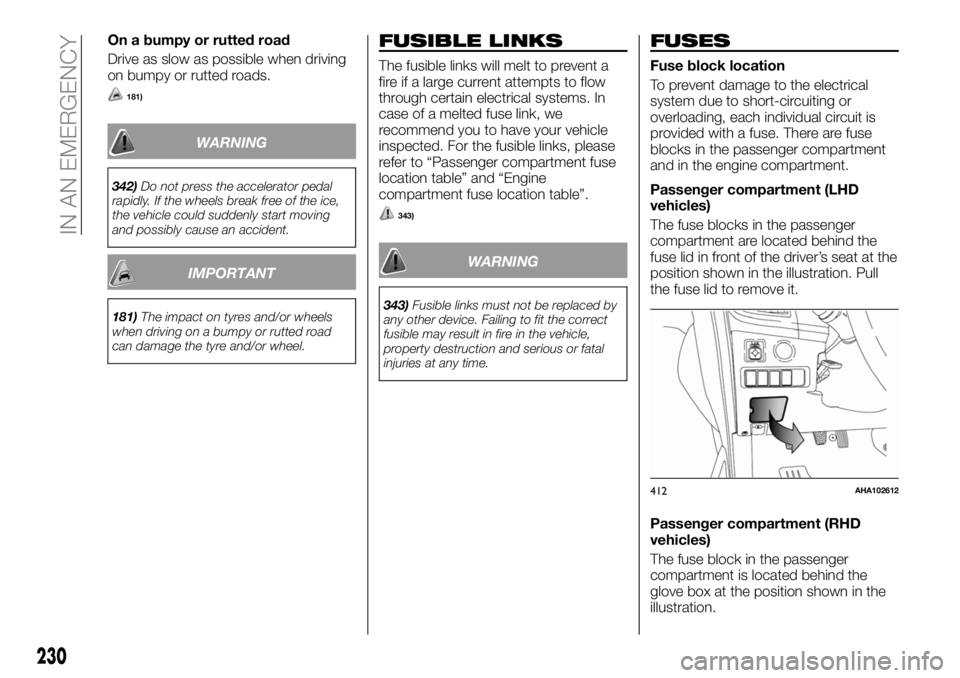
Passenger compartment (LHD
vehicles)
The fuse blocks in the passenger
compartment are located behind the
fuse lid in front of the driver’s seat at the
position shown in the illustration. Pull
the fuse lid to remove it.
Passenger compartment (RHD
vehicles)
The fuse block in the passenger
compartment is located behind the
glove box at the position shown in the
illustration.
412AHA102612
230
IN AN EMERGENCY
Page 233 of 316
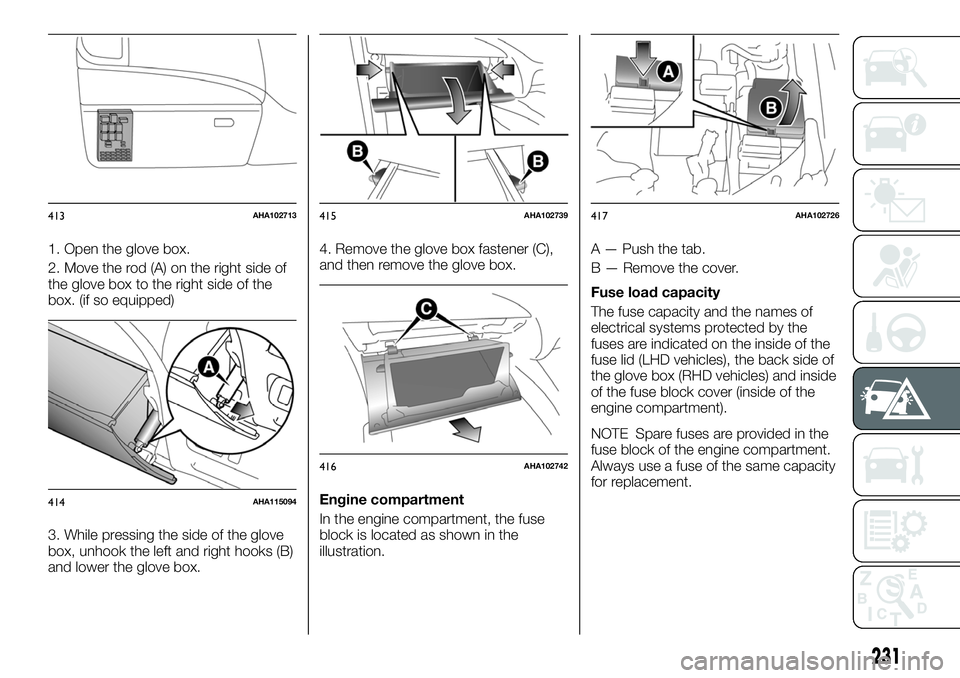
1. Open the glove box.
2. Move the rod (A) on the right side of
the glove box to the right side of the
box. (if so equipped)
3. While pressing the side of the glove
box, unhook the left and right hooks (B)
and lower the glove box.4. Remove the glove box fastener (C),
and then remove the glove box.
Engine compartment
In the engine compartment, the fuse
block is located as shown in the
illustration.A — Push the tab.
B — Remove the cover.
Fuse load capacity
The fuse capacity and the names of
electrical systems protected by the
fuses are indicated on the inside of the
fuse lid (LHD vehicles), the back side of
the glove box (RHD vehicles) and inside
of the fuse block cover (inside of the
engine compartment).
NOTE Spare fuses are provided in the
fuse block of the engine compartment.
Always use a fuse of the same capacity
for replacement.
413AHA102713
414AHA115094
415AHA102739
416AHA102742
417AHA102726
231
Page 235 of 316
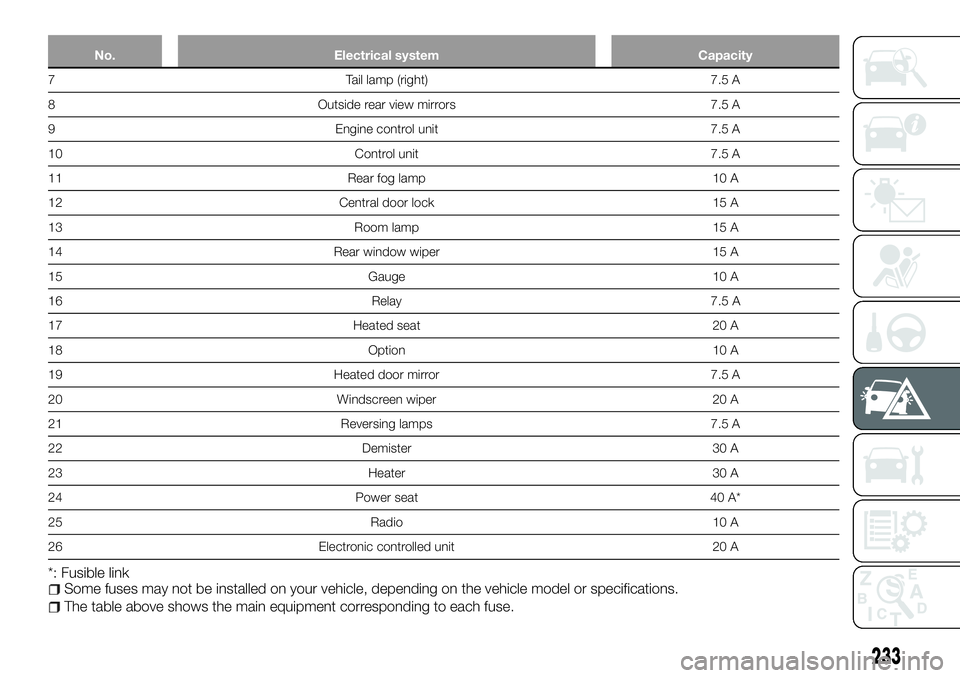
No. Electrical system Capacity
7 Tail lamp (right) 7.5 A
8 Outside rear view mirrors 7.5 A
9 Engine control unit 7.5 A
10 Control unit 7.5 A
11 Rear fog lamp 10 A
12 Central door lock 15 A
13 Room lamp 15 A
14 Rear window wiper 15 A
15 Gauge 10 A
16 Relay 7.5 A
17 Heated seat 20 A
18 Option 10 A
19 Heated door mirror 7.5 A
20 Windscreen wiper 20 A
21 Reversing lamps 7.5 A
22 Demister 30 A
23 Heater 30 A
24 Power seat 40 A*
25 Radio 10 A
26 Electronic controlled unit 20 A
*: Fusible linkSome fuses may not be installed on your vehicle, depending on the vehicle model or specifications.
The table above shows the main equipment corresponding to each fuse.
233
Page 236 of 316
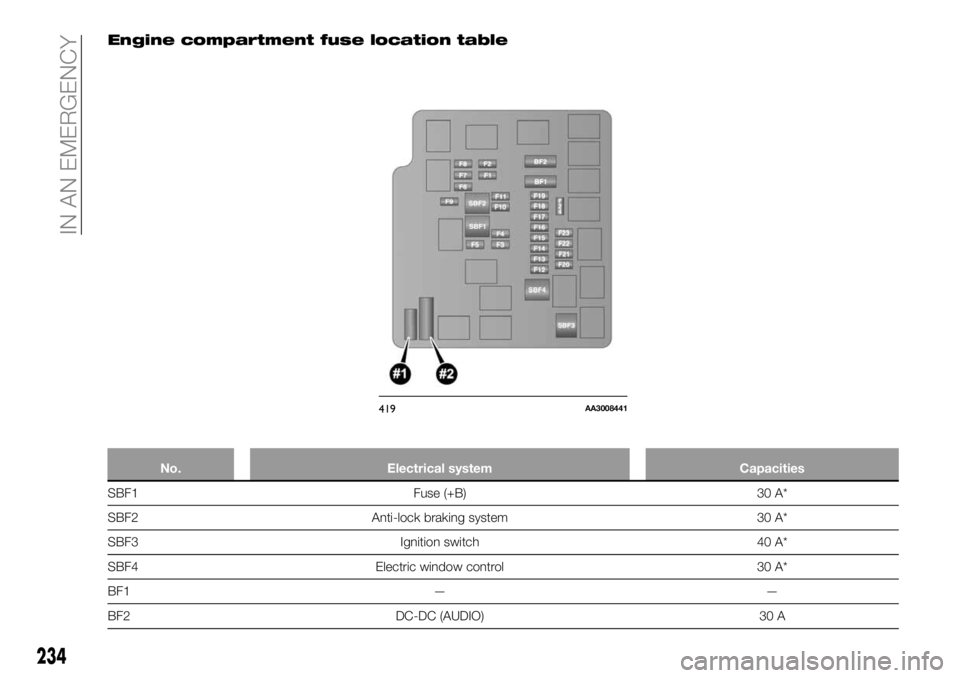
Engine compartment fuse location table
No. Electrical system Capacities
SBF1 Fuse (+B) 30 A*
SBF2 Anti-lock braking system 30 A*
SBF3 Ignition switch 40 A*
SBF4 Electric window control 30 A*
BF1 — —
BF2 DC-DC (AUDIO) 30 A
419AA3008441
234
IN AN EMERGENCY
Page 237 of 316
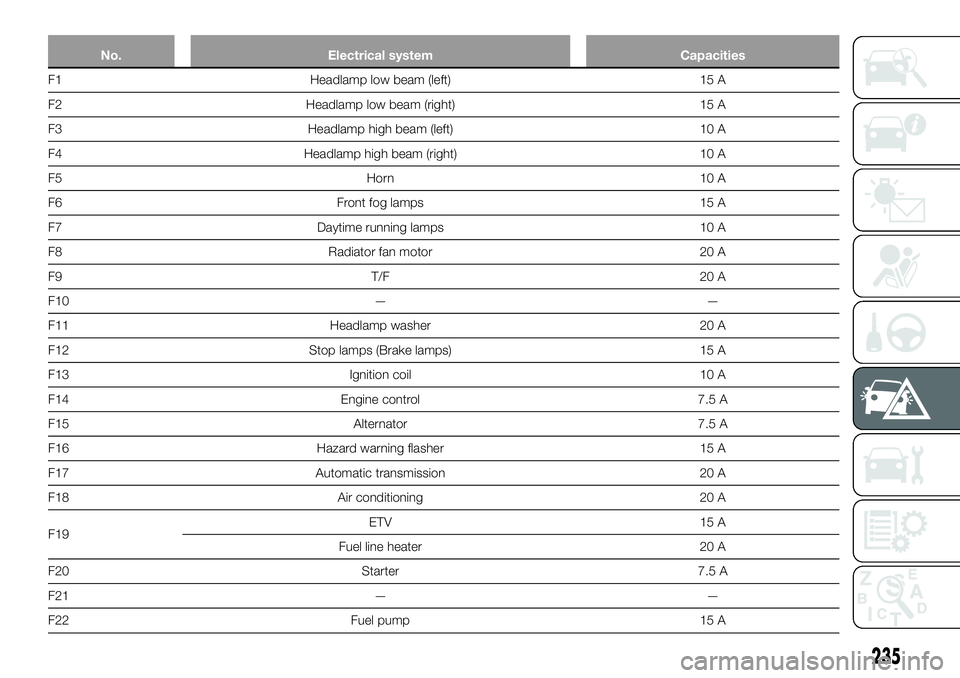
No. Electrical system Capacities
F1 Headlamp low beam (left) 15 A
F2 Headlamp low beam (right) 15 A
F3 Headlamp high beam (left) 10 A
F4 Headlamp high beam (right) 10 A
F5 Horn 10 A
F6 Front fog lamps 15 A
F7 Daytime running lamps 10 A
F8 Radiator fan motor 20 A
F9 T/F 20 A
F10 — —
F11 Headlamp washer 20 A
F12 Stop lamps (Brake lamps) 15 A
F13 Ignition coil 10 A
F14 Engine control 7.5 A
F15 Alternator 7.5 A
F16 Hazard warning flasher 15 A
F17 Automatic transmission 20 A
F18 Air conditioning 20 A
F19ETV 15 A
Fuel line heater 20 A
F20 Starter 7.5 A
F21 — —
F22 Fuel pump 15 A
235
Page 238 of 316
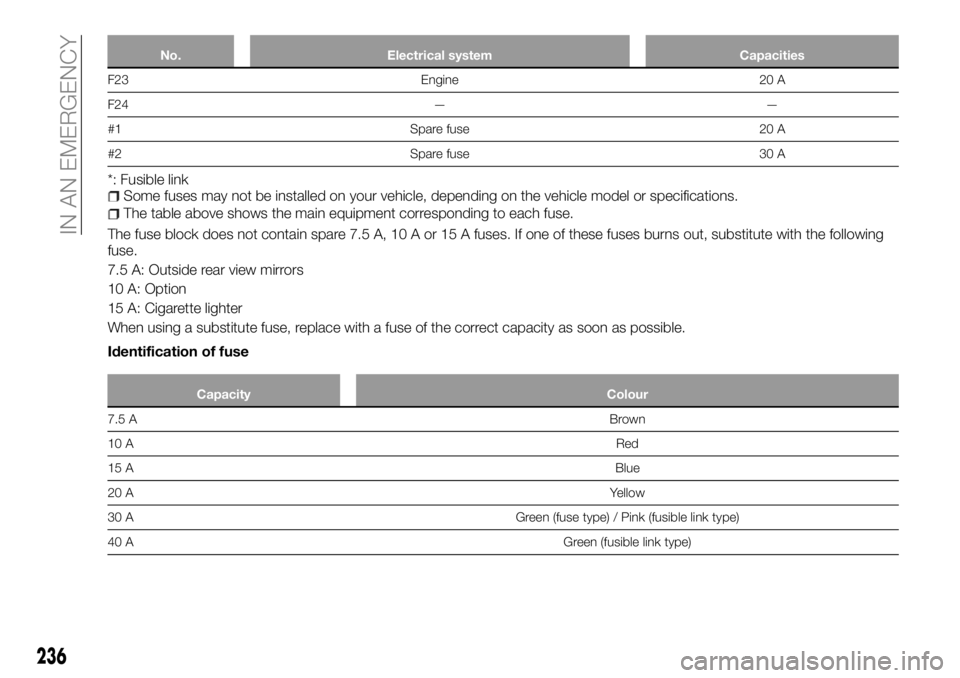
No. Electrical system Capacities
F23 Engine 20 A
F24 — —
#1 Spare fuse 20 A
#2 Spare fuse 30 A
*: Fusible linkSome fuses may not be installed on your vehicle, depending on the vehicle model or specifications.
The table above shows the main equipment corresponding to each fuse.
The fuse block does not contain spare 7.5 A, 10 A or 15 A fuses. If one of these fuses burns out, substitute with the following
fuse.
7.5 A: Outside rear view mirrors
10 A: Option
15 A: Cigarette lighter
When using a substitute fuse, replace with a fuse of the correct capacity as soon as possible.
Identification of fuse
Capacity Colour
7.5 ABrown
10 ARed
15 ABlue
20 AYellow
30 A Green (fuse type) / Pink (fusible link type)
40 AGreen (fusible link type)
236
IN AN EMERGENCY
Page 239 of 316
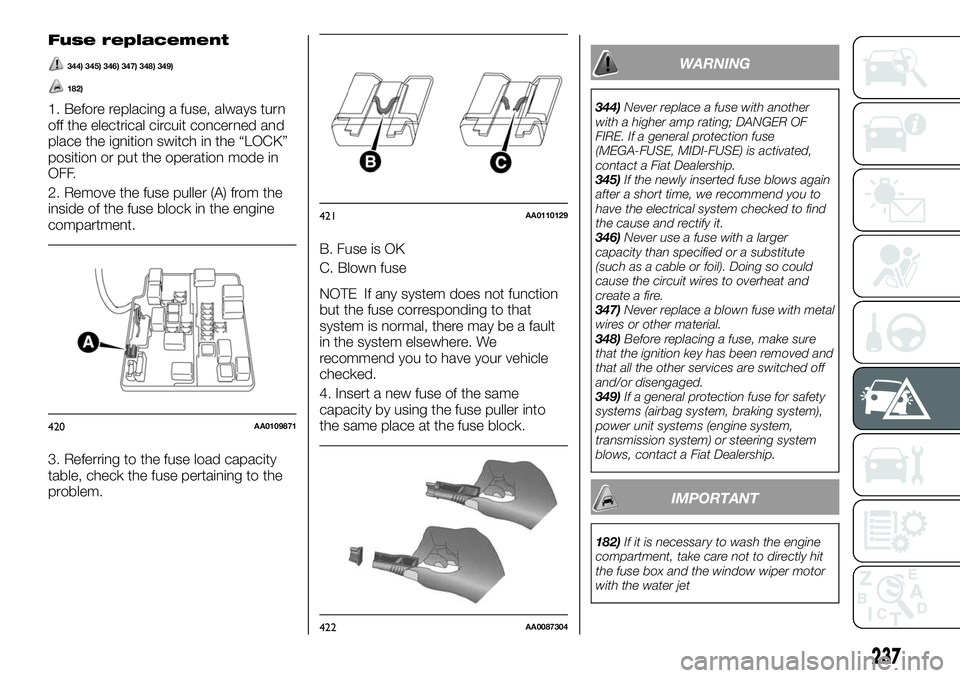
Fuse replacement
344) 345) 346) 347) 348) 349)
182)
1. Before replacing a fuse, always turn
off the electrical circuit concerned and
place the ignition switch in the “LOCK”
position or put the operation mode in
OFF.
2. Remove the fuse puller (A) from the
inside of the fuse block in the engine
compartment.
3. Referring to the fuse load capacity
table, check the fuse pertaining to the
problem.B. Fuse is OK
C. Blown fuse
NOTE If any system does not function
but the fuse corresponding to that
system is normal, there may be a fault
in the system elsewhere. We
recommend you to have your vehicle
checked.
4. Insert a new fuse of the same
capacity by using the fuse puller into
the same place at the fuse block.
WARNING
344)Never replace a fuse with another
with a higher amp rating; DANGER OF
FIRE. If a general protection fuse
(MEGA-FUSE, MIDI-FUSE) is activated,
contact a Fiat Dealership.
345)If the newly inserted fuse blows again
after a short time, we recommend you to
have the electrical system checked to find
the cause and rectify it.
346)Never use a fuse with a larger
capacity than specified or a substitute
(such as a cable or foil). Doing so could
cause the circuit wires to overheat and
create a fire.
347)Never replace a blown fuse with metal
wires or other material.
348)Before replacing a fuse, make sure
that the ignition key has been removed and
that all the other services are switched off
and/or disengaged.
349)If a general protection fuse for safety
systems (airbag system, braking system),
power unit systems (engine system,
transmission system) or steering system
blows, contact a Fiat Dealership.
IMPORTANT
182)If it is necessary to wash the engine
compartment, take care not to directly hit
the fuse box and the window wiper motor
with the water jet
420AA0109871
421AA0110129
422AA0087304
237