ECU FIAT FULLBACK 2018 Owner handbook (in English)
[x] Cancel search | Manufacturer: FIAT, Model Year: 2018, Model line: FULLBACK, Model: FIAT FULLBACK 2018Pages: 316, PDF Size: 10.52 MB
Page 206 of 316
When approaching solid objects
The reference lines for distance and
vehicle width are intended to indicate
the distance to a flat object such as a
level, flat road surface. This may make
the distance to a projecting object
shown on the screen differ from the
actual distance to the projecting object.
Do not use them as a guide to
distances to solid objects.
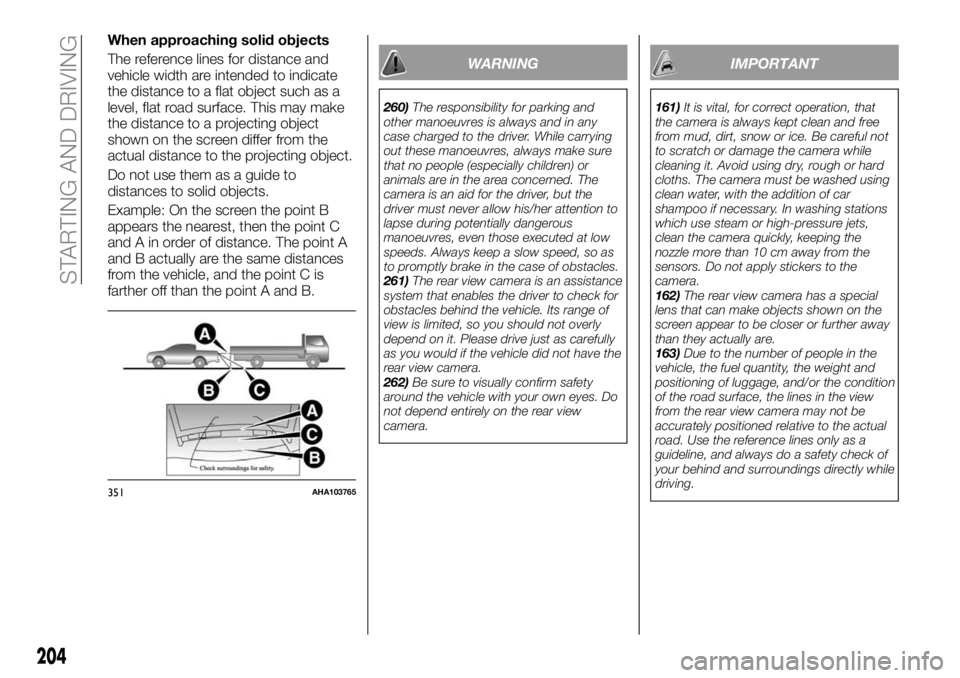
Example: On the screen the point B
appears the nearest, then the point C
and A in order of distance. The point A
and B actually are the same distances
from the vehicle, and the point C is
farther off than the point A and B.
WARNING
260)The responsibility for parking and
other manoeuvres is always and in any
case charged to the driver. While carrying
out these manoeuvres, always make sure
that no people (especially children) or
animals are in the area concerned. The
camera is an aid for the driver, but the
driver must never allow his/her attention to
lapse during potentially dangerous
manoeuvres, even those executed at low
speeds. Always keep a slow speed, so as
to promptly brake in the case of obstacles.
261)The rear view camera is an assistance
system that enables the driver to check for
obstacles behind the vehicle. Its range of
view is limited, so you should not overly
depend on it. Please drive just as carefully
as you would if the vehicle did not have the
rear view camera.
262)Be sure to visually confirm safety
around the vehicle with your own eyes. Do
not depend entirely on the rear view
camera.
IMPORTANT
161)It is vital, for correct operation, that
the camera is always kept clean and free
from mud, dirt, snow or ice. Be careful not
to scratch or damage the camera while
cleaning it. Avoid using dry, rough or hard
cloths. The camera must be washed using
clean water, with the addition of car
shampoo if necessary. In washing stations
which use steam or high-pressure jets,
clean the camera quickly, keeping the
nozzle more than 10 cm away from the
sensors. Do not apply stickers to the
camera.
162)The rear view camera has a special
lens that can make objects shown on the
screen appear to be closer or further away
than they actually are.
163)Due to the number of people in the
vehicle, the fuel quantity, the weight and
positioning of luggage, and/or the condition
of the road surface, the lines in the view
from the rear view camera may not be
accurately positioned relative to the actual
road. Use the reference lines only as a
guideline, and always do a safety check of
your behind and surroundings directly while
driving.
351AHA103765
204
STARTING AND DRIVING
Page 212 of 316
IF THE VEHICLE
BREAKS DOWN
If the vehicle breaks down on the road,
move it to the shoulder and use the
hazard warning flashers and/or the
warning triangle etc. Refer to “Hazard
warning flasher switch”.
If the engine stops/fails
Vehicle operation and control are
affected if the engine stops. Before
moving the vehicle to a safe area, be
aware of the following:
The brake booster becomes
inoperative and the pedal effort will
increase. Press down the brake pedal
harder than usual.
Since the power steering system is
no longer operative, the steering wheel
feels heavy when turning it.
First-aid kit and warning triangle
securing bands*
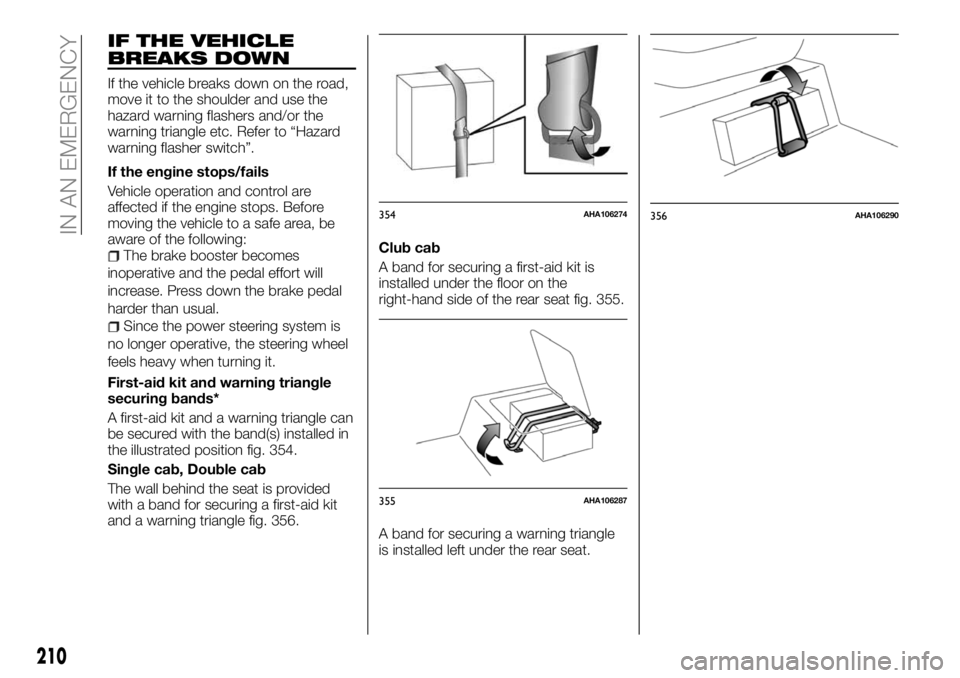
A first-aid kit and a warning triangle can
be secured with the band(s) installed in
the illustrated position fig. 354.
Single cab, Double cab
The wall behind the seat is provided
with a band for securing a first-aid kit
and a warning triangle fig. 356.Club cab
A band for securing a first-aid kit is
installed under the floor on the
right-hand side of the rear seat fig. 355.
A band for securing a warning triangle
is installed left under the rear seat.
.
354AHA106274
355AHA106287
356AHA106290
210
IN AN EMERGENCY
Page 218 of 316
Jack
The jack is used only for the purpose of
changing a tyre when a tyre is
punctured.
NOTE The jack is maintenance-free.
NOTE The jack is in conformity with EC
law as approximated by the Machinery
Directive 2006/42/EC.
NOTE The EC declaration of conformity
is attached to the section “Declaration
of Conformity” in the end of this
owner's manual. The business name,
full address of the manufacturer and of
his authorised representative and the
designation of the jack are described in
the EC declaration of conformity.
Removing and storing the tools,
jack and jack handle
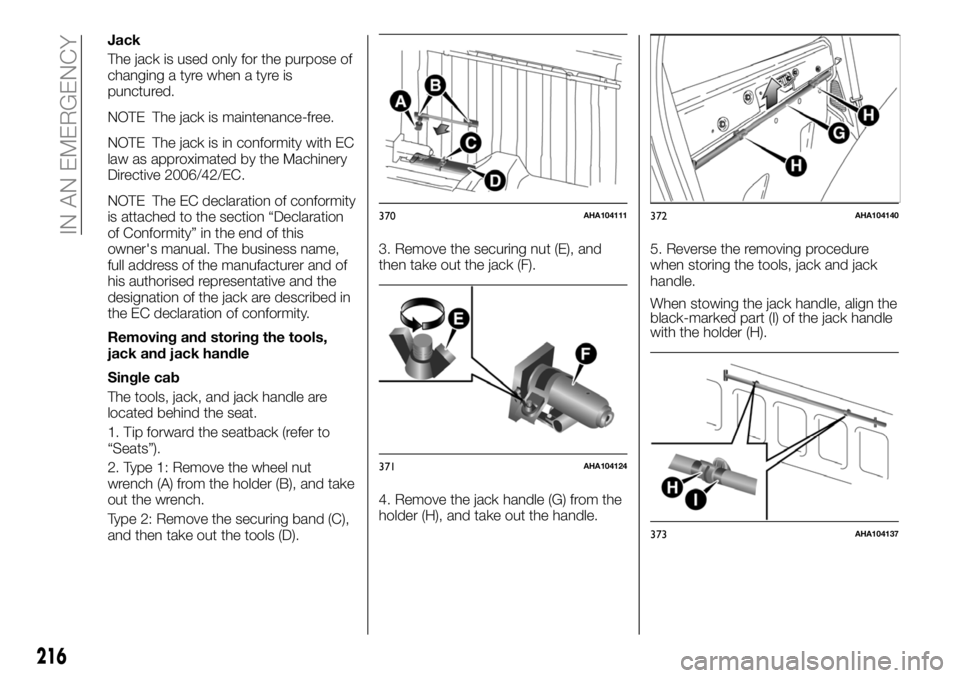
Single cab
The tools, jack, and jack handle are
located behind the seat.
1. Tip forward the seatback (refer to
“Seats”).
2. Type 1: Remove the wheel nut
wrench (A) from the holder (B), and take
out the wrench.
Type 2: Remove the securing band (C),
and then take out the tools (D).3. Remove the securing nut (E), and
then take out the jack (F).
4. Remove the jack handle (G) from the
holder (H), and take out the handle.5. Reverse the removing procedure
when storing the tools, jack and jack
handle.
When stowing the jack handle, align the
black-marked part (I) of the jack handle
with the holder (H).
370AHA104111
371AHA104124
372AHA104140
373AHA104137
216
IN AN EMERGENCY
Page 219 of 316
Club cab
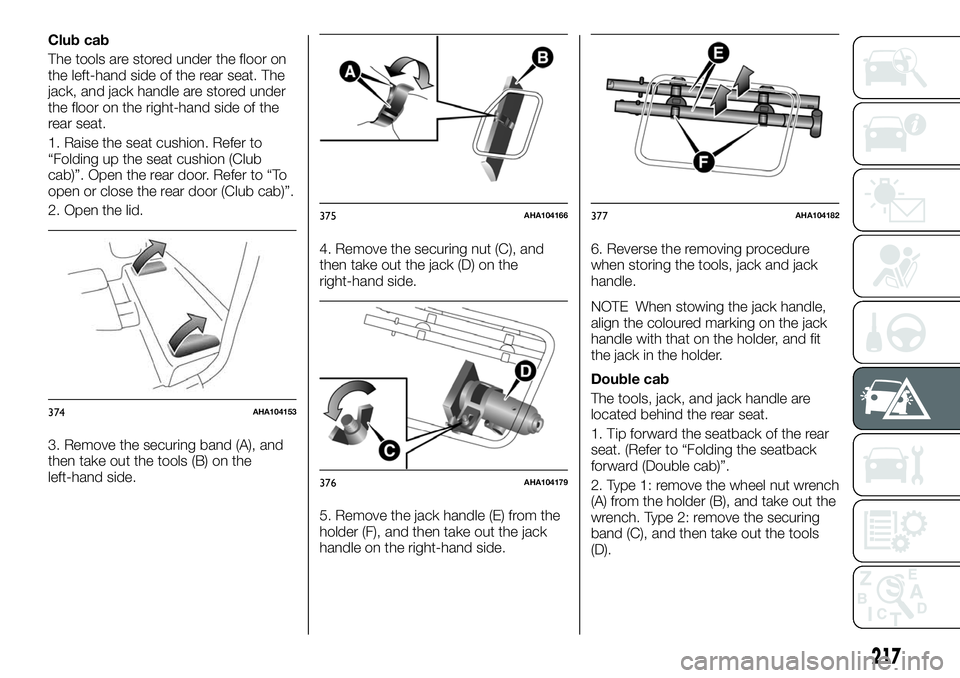
The tools are stored under the floor on
the left-hand side of the rear seat. The
jack, and jack handle are stored under
the floor on the right-hand side of the
rear seat.
1. Raise the seat cushion. Refer to
“Folding up the seat cushion (Club
cab)”. Open the rear door. Refer to “To
open or close the rear door (Club cab)”.
2. Open the lid.
3. Remove the securing band (A), and
then take out the tools (B) on the
left-hand side.4. Remove the securing nut (C), and
then take out the jack (D) on the
right-hand side.
5. Remove the jack handle (E) from the
holder (F), and then take out the jack
handle on the right-hand side.6. Reverse the removing procedure
when storing the tools, jack and jack
handle.
NOTE When stowing the jack handle,
align the coloured marking on the jack
handle with that on the holder, and fit
the jack in the holder.
Double cab
The tools, jack, and jack handle are
located behind the rear seat.
1. Tip forward the seatback of the rear
seat. (Refer to “Folding the seatback
forward (Double cab)”.
2. Type 1: remove the wheel nut wrench
(A) from the holder (B), and take out the
wrench. Type 2: remove the securing
band (C), and then take out the tools
(D).
374AHA104153
375AHA104166
376AHA104179
377AHA104182
217
Page 220 of 316
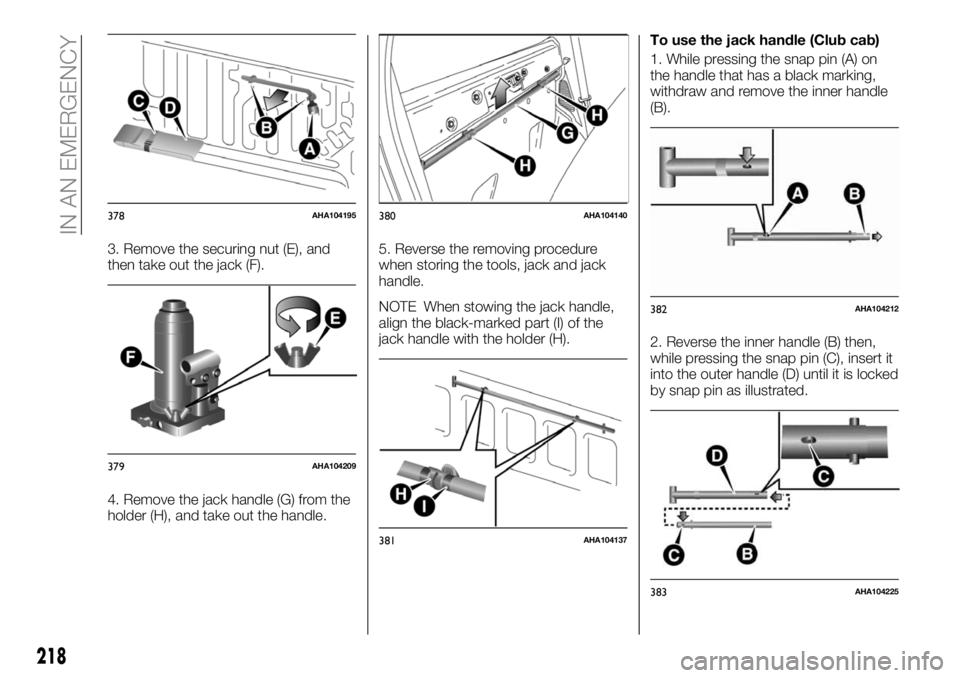
3. Remove the securing nut (E), and
then take out the jack (F).
4. Remove the jack handle (G) from the
holder (H), and take out the handle.5. Reverse the removing procedure
when storing the tools, jack and jack
handle.
NOTE When stowing the jack handle,
align the black-marked part (I) of the
jack handle with the holder (H).To use the jack handle (Club cab)
1. While pressing the snap pin (A) on
the handle that has a black marking,
withdraw and remove the inner handle
(B).
2. Reverse the inner handle (B) then,
while pressing the snap pin (C), insert it
into the outer handle (D) until it is locked
by snap pin as illustrated.
378AHA104195
379AHA104209
380AHA104140
381AHA104137
382AHA104212
383AHA104225
218
IN AN EMERGENCY
Page 222 of 316
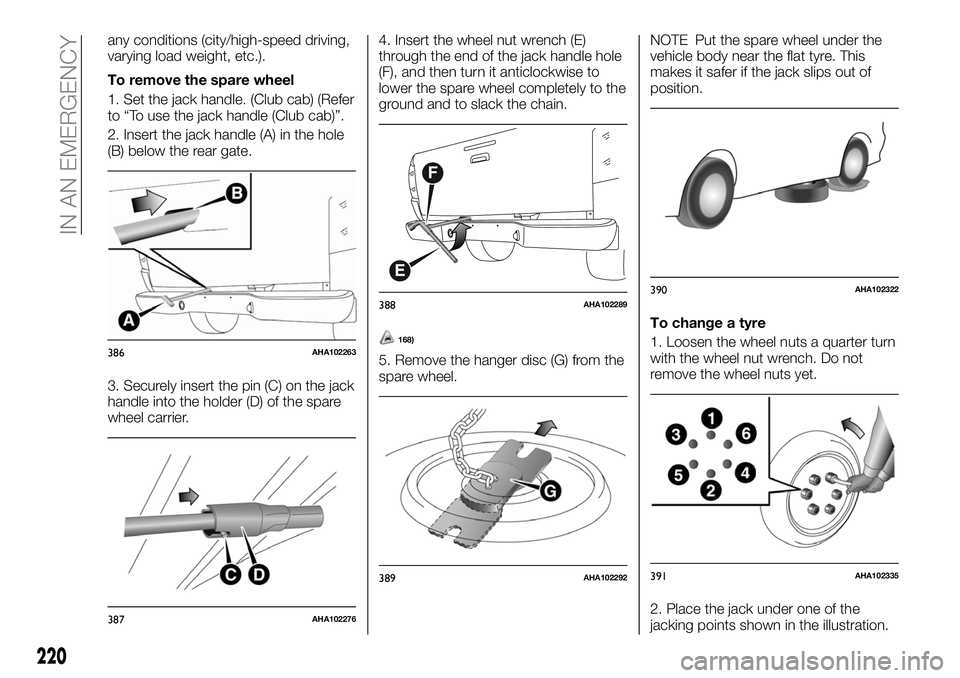
any conditions (city/high-speed driving,
varying load weight, etc.).
To remove the spare wheel
1. Set the jack handle. (Club cab) (Refer
to “To use the jack handle (Club cab)”.
2. Insert the jack handle (A) in the hole
(B) below the rear gate.
3. Securely insert the pin (C) on the jack
handle into the holder (D) of the spare
wheel carrier.4. Insert the wheel nut wrench (E)
through the end of the jack handle hole
(F), and then turn it anticlockwise to
lower the spare wheel completely to the
ground and to slack the chain.
168)
5. Remove the hanger disc (G) from the
spare wheel.NOTE Put the spare wheel under the
vehicle body near the flat tyre. This
makes it safer if the jack slips out of
position.
To change a tyre
1. Loosen the wheel nuts a quarter turn
with the wheel nut wrench. Do not
remove the wheel nuts yet.
2. Place the jack under one of the
jacking points shown in the illustration.386AHA102263
387AHA102276
388AHA102289
389AHA102292
390AHA102322
391AHA102335
220
IN AN EMERGENCY
Page 225 of 316
321)
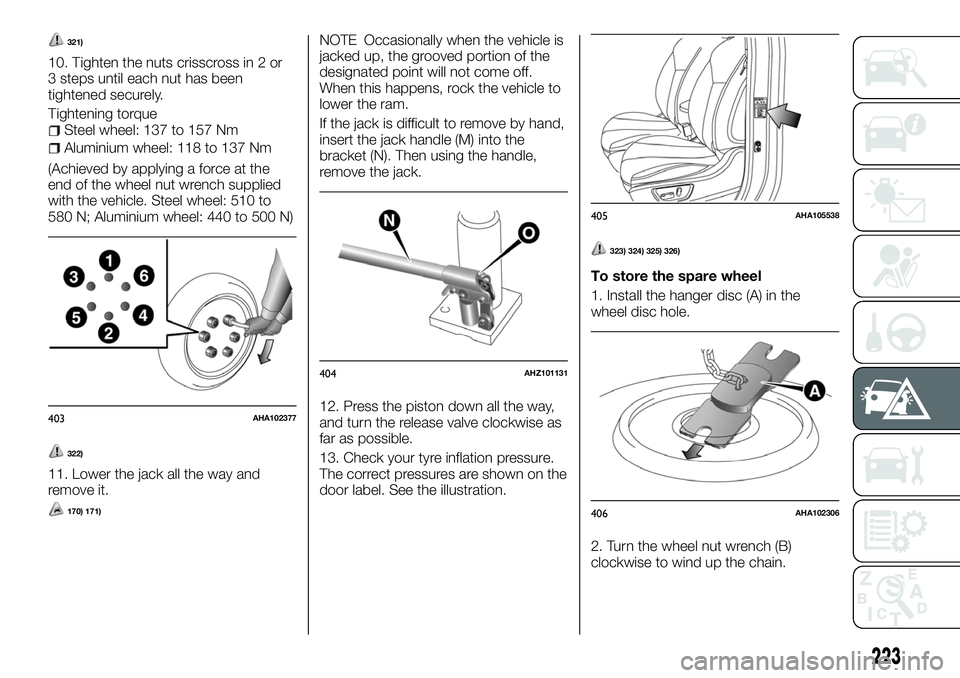
10. Tighten the nuts crisscross in 2 or
3 steps until each nut has been
tightened securely.
Tightening torque
Steel wheel: 137 to 157 Nm
Aluminium wheel: 118 to 137 Nm
(Achieved by applying a force at the
end of the wheel nut wrench supplied
with the vehicle. Steel wheel: 510 to
580 N; Aluminium wheel: 440 to 500 N)
322)
11. Lower the jack all the way and
remove it.
170) 171)
NOTE Occasionally when the vehicle is
jacked up, the grooved portion of the
designated point will not come off.
When this happens, rock the vehicle to
lower the ram.
If the jack is difficult to remove by hand,
insert the jack handle (M) into the
bracket (N). Then using the handle,
remove the jack.
12. Press the piston down all the way,
and turn the release valve clockwise as
far as possible.
13. Check your tyre inflation pressure.
The correct pressures are shown on the
door label. See the illustration.
323) 324) 325) 326)
To store the spare wheel
1. Install the hanger disc (A) in the
wheel disc hole.
2. Turn the wheel nut wrench (B)
clockwise to wind up the chain.
403AHA102377
404AHZ101131
405AHA105538
406AHA102306
223
Page 226 of 316
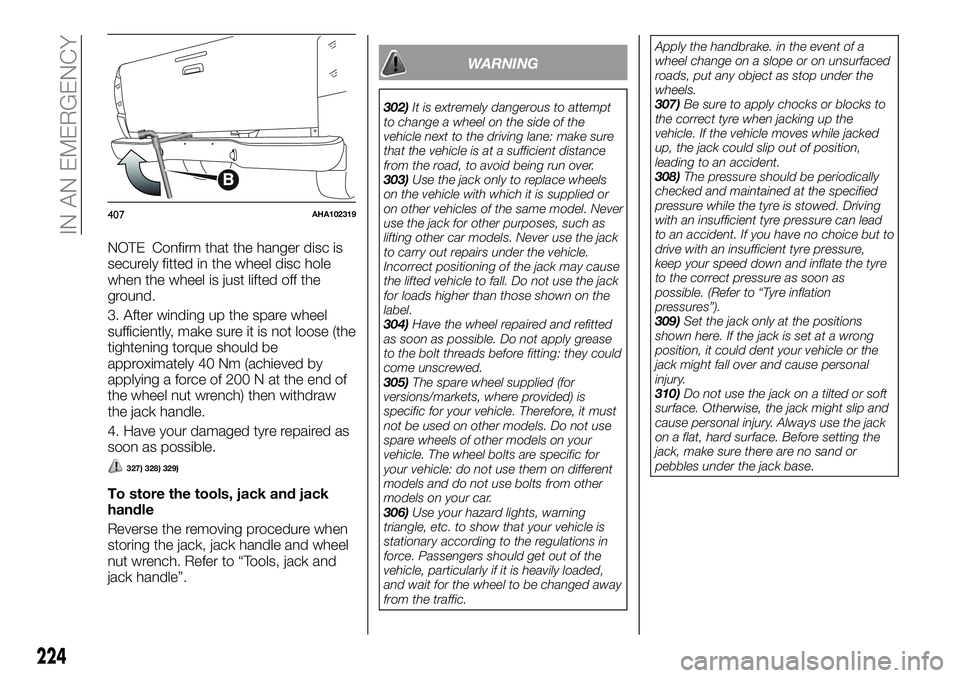
NOTE Confirm that the hanger disc is
securely fitted in the wheel disc hole
when the wheel is just lifted off the
ground.
3. After winding up the spare wheel
sufficiently, make sure it is not loose (the
tightening torque should be
approximately 40 Nm (achieved by
applying a force of 200 N at the end of
the wheel nut wrench) then withdraw
the jack handle.
4. Have your damaged tyre repaired as
soon as possible.
327) 328) 329)
To store the tools, jack and jack
handle
Reverse the removing procedure when
storing the jack, jack handle and wheel
nut wrench. Refer to “Tools, jack and
jack handle”.
WARNING
302)It is extremely dangerous to attempt
to change a wheel on the side of the
vehicle next to the driving lane: make sure
that the vehicle is at a sufficient distance
from the road, to avoid being run over.
303)Use the jack only to replace wheels
on the vehicle with which it is supplied or
on other vehicles of the same model. Never
use the jack for other purposes, such as
lifting other car models. Never use the jack
to carry out repairs under the vehicle.
Incorrect positioning of the jack may cause
the lifted vehicle to fall. Do not use the jack
for loads higher than those shown on the
label.
304)Have the wheel repaired and refitted
as soon as possible. Do not apply grease
to the bolt threads before fitting: they could
come unscrewed.
305)The spare wheel supplied (for
versions/markets, where provided) is
specific for your vehicle. Therefore, it must
not be used on other models. Do not use
spare wheels of other models on your
vehicle. The wheel bolts are specific for
your vehicle: do not use them on different
models and do not use bolts from other
models on your car.
306)Use your hazard lights, warning
triangle, etc. to show that your vehicle is
stationary according to the regulations in
force. Passengers should get out of the
vehicle, particularly if it is heavily loaded,
and wait for the wheel to be changed away
from the traffic.Apply the handbrake. in the event of a
wheel change on a slope or on unsurfaced
roads, put any object as stop under the
wheels.
307)Be sure to apply chocks or blocks to
the correct tyre when jacking up the
vehicle. If the vehicle moves while jacked
up, the jack could slip out of position,
leading to an accident.
308)The pressure should be periodically
checked and maintained at the specified
pressure while the tyre is stowed. Driving
with an insufficient tyre pressure can lead
to an accident. If you have no choice but to
drive with an insufficient tyre pressure,
keep your speed down and inflate the tyre
to the correct pressure as soon as
possible. (Refer to “Tyre inflation
pressures”).
309)Set the jack only at the positions
shown here. If the jack is set at a wrong
position, it could dent your vehicle or the
jack might fall over and cause personal
injury.
310)Do not use the jack on a tilted or soft
surface. Otherwise, the jack might slip and
cause personal injury. Always use the jack
on a flat, hard surface. Before setting the
jack, make sure there are no sand or
pebbles under the jack base.
407AHA102319
224
IN AN EMERGENCY
Page 227 of 316
311)Stop jacking up the vehicle as soon
as the tyre is raised off the ground. It is
dangerous to raise the vehicle any higher.
Do not get under your vehicle while using
the jack. Do not bump the raised vehicle or
leave it sitting on the jack for a long time.
Both are very dangerous. Do not use a jack
except the one that came with your
vehicle. The jack should not be used for
any purpose other than to change a tyre.
No one should be in your vehicle when
using the jack. Do not start or run the
engine while your vehicle is on the jack. Do
not turn the raised wheel. The tyres still on
the ground could turn and make your
vehicle fall off the jack.
312)Do not get under your vehicle while
using the jack.
313)Do not bump the raised vehicle or
leave it sitting on the jack for a long time.
Both are very dangerous.
314)Do not use a jack except the one that
came with your vehicle.
315)The jack should not be used for any
purpose other than to change a tyre.
316)No one should be in your vehicle
when using the jack.
317)Do not start or run the engine while
your vehicle is on the jack.
318)Do not turn the raised wheel. The
tyres still on the ground could turn and
make your vehicle fall off the jack.
319)Handle the wheel carefully when
changing the tyre, to avoid scratching the
wheel surface.
320)Mount the spare wheel with the valve
stem K) facing outboard fig. 0. If you
cannot see the valve stem (K), you have
installed the wheel backwards.Operating the vehicle with the spare wheel
installed backwards can cause vehicle
damage and result in an accident.
321)Be sure to open the release valve
slowly. If it is opened quickly, the vehicle will
drop abruptly and the jack may come out
of position, causing a serious accident.
322)Never use your foot or a pipe
extension for extra force in the wheel nut
wrench. If you do so, you will tighten the
nut too much.
323)The tyre pressure should be
periodically checked and maintained at the
specified pressure while the tyre is stowed.
324)After changing the tyre and driving the
vehicle about 1,000 km, retighten the wheel
nuts to make sure that they have not come
loose.
325)If the steering wheel vibrates when
driving after changing the tyre, we
recommend you to have the tyres checked
for balance.
326)Do not mix one type of tyre with
another or use a different size from the one
listed. This would cause early wear and
poor handling.
327)The spare wheel should always be
securely in position. If a flat tyre is changed,
put the flat tyre in the spare wheel
mounting position with the wheel outer
surface upward, and use the wheel nut
wrench to secure it firmly.
328)Never tamper with the inflation valve.
Never introduce tools of any kind between
rim and tyre. Check tyre and spare wheel
pressure regularly, referring to the values
shown in the "Technical specifications"
section.329)The moving components of the jack
(screw and joints) can also cause injuries:
do not touch them. If you come into
contact with lubricating grease, clean
yourself thoroughly.
IMPORTANT
166)Avoid using different size tyres from
the one listed and the combined use of
different types of tyres, as this can affect
driving safety.
167)Even if a wheel has the same rim size
and offset as the specified type of wheel,
its shape may prevent it from being fitted
correctly. Consult an authorised Fiat
Dealership before using wheels that you
have.
168)When installing or removing the spare
wheel, please observe the followings. If you
do not follow them, it could result in break
the spare wheel carrier. Do not use the
power tool. Use the wheel nut wrench
stowed on the vehicle. Do not apply a force
of 400 N or more at the end of the wheel
nut wrench.
169)Never apply oil to either the wheel
bolts or the nuts or they will tighten too
much.
170)If the release valve is loosened too
much (2 or more turns) in the anticlockwise
direction, the jack’s oil will leak and the jack
cannot be used.
171)Close the release valve slowly when
lowering the vehicle, or the valve may be
damaged.
225
Page 228 of 316
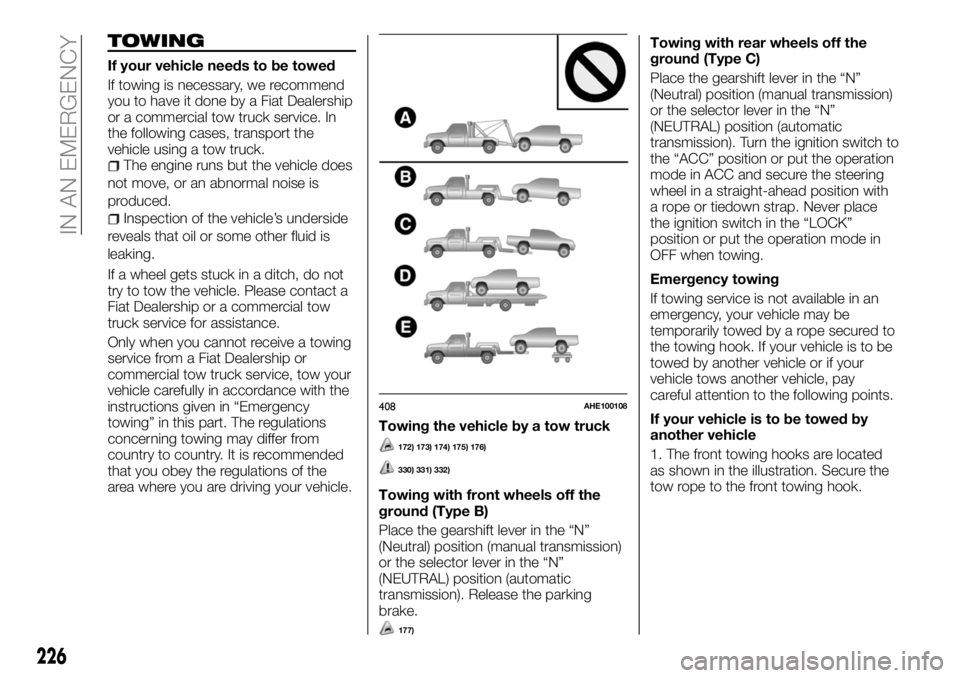
TOWING
If your vehicle needs to be towed
If towing is necessary, we recommend
you to have it done by a Fiat Dealership
or a commercial tow truck service. In
the following cases, transport the
vehicle using a tow truck.
The engine runs but the vehicle does
not move, or an abnormal noise is
produced.
Inspection of the vehicle’s underside
reveals that oil or some other fluid is
leaking.
If a wheel gets stuck in a ditch, do not
try to tow the vehicle. Please contact a
Fiat Dealership or a commercial tow
truck service for assistance.
Only when you cannot receive a towing
service from a Fiat Dealership or
commercial tow truck service, tow your
vehicle carefully in accordance with the
instructions given in “Emergency
towing” in this part. The regulations
concerning towing may differ from
country to country. It is recommended
that you obey the regulations of the
area where you are driving your vehicle.Towing the vehicle by a tow truck
172) 173) 174) 175) 176)
330) 331) 332)
Towing with front wheels off the
ground (Type B)
Place the gearshift lever in the “N”
(Neutral) position (manual transmission)
or the selector lever in the “N”
(NEUTRAL) position (automatic
transmission). Release the parking
brake.
177)
Towing with rear wheels off the
ground (Type C)
Place the gearshift lever in the “N”
(Neutral) position (manual transmission)
or the selector lever in the “N”
(NEUTRAL) position (automatic
transmission). Turn the ignition switch to
the “ACC” position or put the operation
mode in ACC and secure the steering
wheel in a straight-ahead position with
a rope or tiedown strap. Never place
the ignition switch in the “LOCK”
position or put the operation mode in
OFF when towing.
Emergency towing
If towing service is not available in an
emergency, your vehicle may be
temporarily towed by a rope secured to
the towing hook. If your vehicle is to be
towed by another vehicle or if your
vehicle tows another vehicle, pay
careful attention to the following points.
If your vehicle is to be towed by
another vehicle
1. The front towing hooks are located
as shown in the illustration. Secure the
tow rope to the front towing hook.
408AHE100108
226
IN AN EMERGENCY