ignition FIAT FULLBACK 2018 Owner handbook (in English)
[x] Cancel search | Manufacturer: FIAT, Model Year: 2018, Model line: FULLBACK, Model: FIAT FULLBACK 2018Pages: 316, PDF Size: 10.52 MB
Page 110 of 316
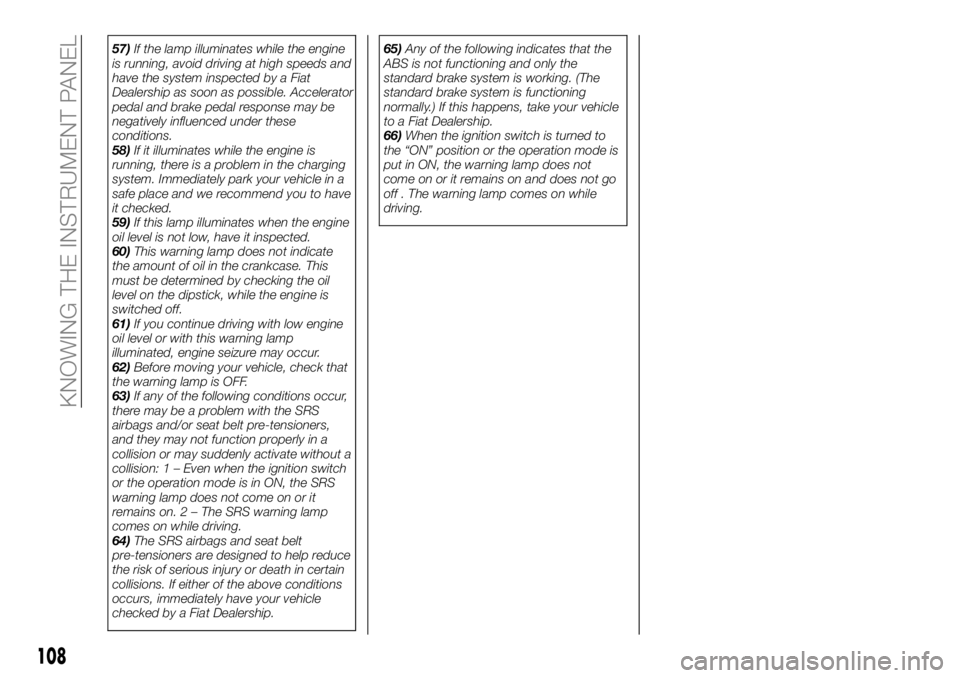
57)If the lamp illuminates while the engine
is running, avoid driving at high speeds and
have the system inspected by a Fiat
Dealership as soon as possible. Accelerator
pedal and brake pedal response may be
negatively influenced under these
conditions.
58)If it illuminates while the engine is
running, there is a problem in the charging
system. Immediately park your vehicle in a
safe place and we recommend you to have
it checked.
59)If this lamp illuminates when the engine
oil level is not low, have it inspected.
60)This warning lamp does not indicate
the amount of oil in the crankcase. This
must be determined by checking the oil
level on the dipstick, while the engine is
switched off.
61)If you continue driving with low engine
oil level or with this warning lamp
illuminated, engine seizure may occur.
62)Before moving your vehicle, check that
the warning lamp is OFF.
63)If any of the following conditions occur,
there may be a problem with the SRS
airbags and/or seat belt pre-tensioners,
and they may not function properly in a
collision or may suddenly activate without a
collision: 1 – Even when the ignition switch
or the operation mode is in ON, the SRS
warning lamp does not come on or it
remains on. 2 – The SRS warning lamp
comes on while driving.
64)The SRS airbags and seat belt
pre-tensioners are designed to help reduce
the risk of serious injury or death in certain
collisions. If either of the above conditions
occurs, immediately have your vehicle
checked by a Fiat Dealership.65)Any of the following indicates that the
ABS is not functioning and only the
standard brake system is working. (The
standard brake system is functioning
normally.) If this happens, take your vehicle
to a Fiat Dealership.
66)When the ignition switch is turned to
the “ON” position or the operation mode is
put in ON, the warning lamp does not
come on or it remains on and does not go
off . The warning lamp comes on while
driving.
108
KNOWING THE INSTRUMENT PANEL
Page 114 of 316
70)Do not insert any foreign objects
(pieces of plastic, paper clips, buttons, etc.)
in the buckle or retractor mechanism
fig. 200. In addition, do not modify, remove,
or install the seat belt. Otherwise, the seat
belt may not be able to provide adequate
protection in a collision or other situation.
71)A dirty belt should be cleaned with
neutral detergent in warm water. After
rinsing in water, let it dry in the shade. Do
not attempt to bleach or re-dye the belts
because this affects their characteristics.SBR SYSTEM
Seat belt reminder
For the driver and the front
passenger’s seat (where provided)
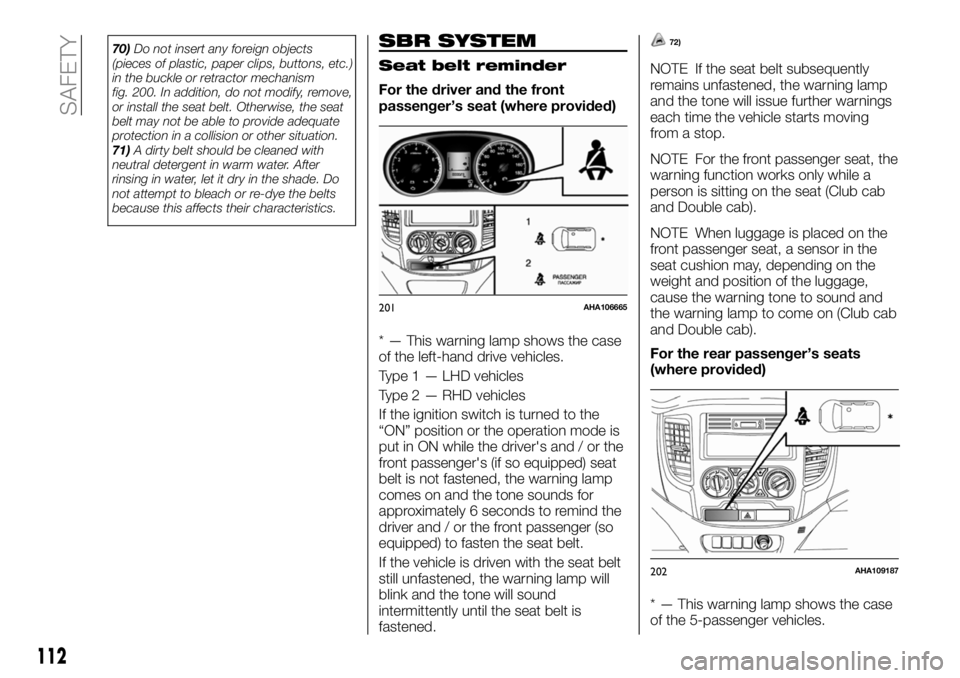
* — This warning lamp shows the case
of the left-hand drive vehicles.
Type 1 — LHD vehicles
Type 2 — RHD vehicles
If the ignition switch is turned to the
“ON” position or the operation mode is
put in ON while the driver's and / or the
front passenger's (if so equipped) seat
belt is not fastened, the warning lamp
comes on and the tone sounds for
approximately 6 seconds to remind the
driver and / or the front passenger (so
equipped) to fasten the seat belt.
If the vehicle is driven with the seat belt
still unfastened, the warning lamp will
blink and the tone will sound
intermittently until the seat belt is
fastened.
72)
NOTE If the seat belt subsequently
remains unfastened, the warning lamp
and the tone will issue further warnings
each time the vehicle starts moving
from a stop.
NOTE For the front passenger seat, the
warning function works only while a
person is sitting on the seat (Club cab
and Double cab).
NOTE When luggage is placed on the
front passenger seat, a sensor in the
seat cushion may, depending on the
weight and position of the luggage,
cause the warning tone to sound and
the warning lamp to come on (Club cab
and Double cab).
For the rear passenger’s seats
(where provided)
* — This warning lamp shows the case
of the 5-passenger vehicles.
201AHA106665
202AHA109187
112
SAFETY
Page 115 of 316
If the ignition switch is turned to the
“ON” position or the operation mode is
put in ON while a seat belt is not
fastened, the warning lamp comes on
for approximately 30 seconds to remind
the rear passenger to fasten the seat
belt.
If the vehicle is driven with the seat belt
still unfastened, the warning lamps
come on for approximately another
30 seconds. (This illumination happens
only the first time the vehicle starts
moving with the seat belt still
unfastened.)
The warning lamps go off when the
seat belt is fastened.
NOTE The warning lamp comes on
even if no one is sitting on the rear
seats.
NOTE If a seat belt is unfastened while
the vehicle is being driven, the tone
sounds for approximately 1 second and
the warning lamp comes on for
approximately 30 seconds. At the same
time, the warning lamp for the seat
where the seat belt is not fastened
comes on.
NOTE If the seat belts are initially
fastened but a seat belt is unfastened
while the vehicle is stationary and the
vehicle is then driven with the seat belt
still unfastened, the warning lamp
comes on again for approximately
30 seconds.Adjustable seat belt anchor (front
seats of Club cab and Double cab)
The seat belt anchor height can be
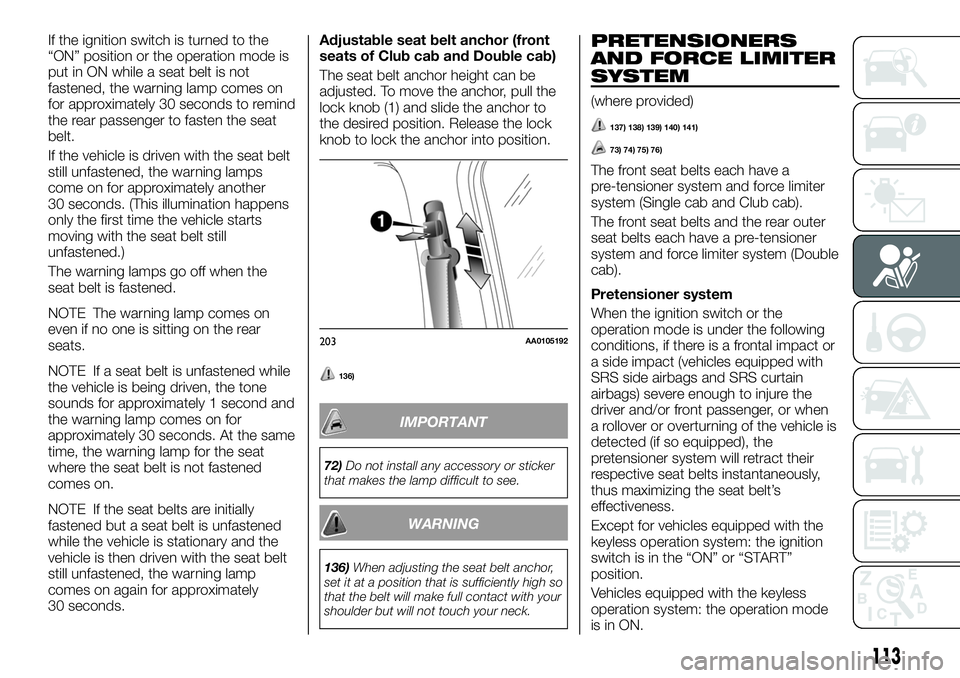
adjusted. To move the anchor, pull the
lock knob (1) and slide the anchor to
the desired position. Release the lock
knob to lock the anchor into position.
136)
IMPORTANT
72)Do not install any accessory or sticker
that makes the lamp difficult to see.
WARNING
136)When adjusting the seat belt anchor,
set it at a position that is sufficiently high so
that the belt will make full contact with your
shoulder but will not touch your neck.
PRETENSIONERS
AND FORCE LIMITER
SYSTEM
(where provided)
137) 138) 139) 140) 141)
73) 74) 75) 76)
The front seat belts each have a
pre-tensioner system and force limiter
system (Single cab and Club cab).
The front seat belts and the rear outer
seat belts each have a pre-tensioner
system and force limiter system (Double
cab).
Pretensioner system
When the ignition switch or the
operation mode is under the following
conditions, if there is a frontal impact or
a side impact (vehicles equipped with
SRS side airbags and SRS curtain
airbags) severe enough to injure the
driver and/or front passenger, or when
a rollover or overturning of the vehicle is
detected (if so equipped), the
pretensioner system will retract their
respective seat belts instantaneously,
thus maximizing the seat belt’s
effectiveness.
Except for vehicles equipped with the
keyless operation system: the ignition
switch is in the “ON” or “START”
position.
Vehicles equipped with the keyless
operation system: the operation mode
is in ON.
203AA0105192
113
Page 132 of 316
Only when the ignition switch or the
operation mode is under the following
conditions, the airbags will operate.
Except for vehicles equipped with the
keyless operation system: the ignition
switch is in the “ON” or “START”
position.
Vehicles equipped with the keyless
operation system: the operation mode
is in ON.
When the airbag control unit detects
rollover of the vehicle, curtain airbags
will be deployed (if so equipped).
The airbags deployment produces a
sudden, loud noise, and releases some
smoke and powder, but these
conditions are not injurious, and do not
indicate a fire in the vehicle. People with
respiratory problems may feel some
temporary irritation from chemicals
used to produce the deployment; open
the windows after airbag deployment, if
safe to do so.
The airbags deflate very rapidly after
deployment, so there is little danger of
obscured vision.
167) 168) 169) 170) 171) 172) 173) 174) 175) 176) 177) 178)
179)
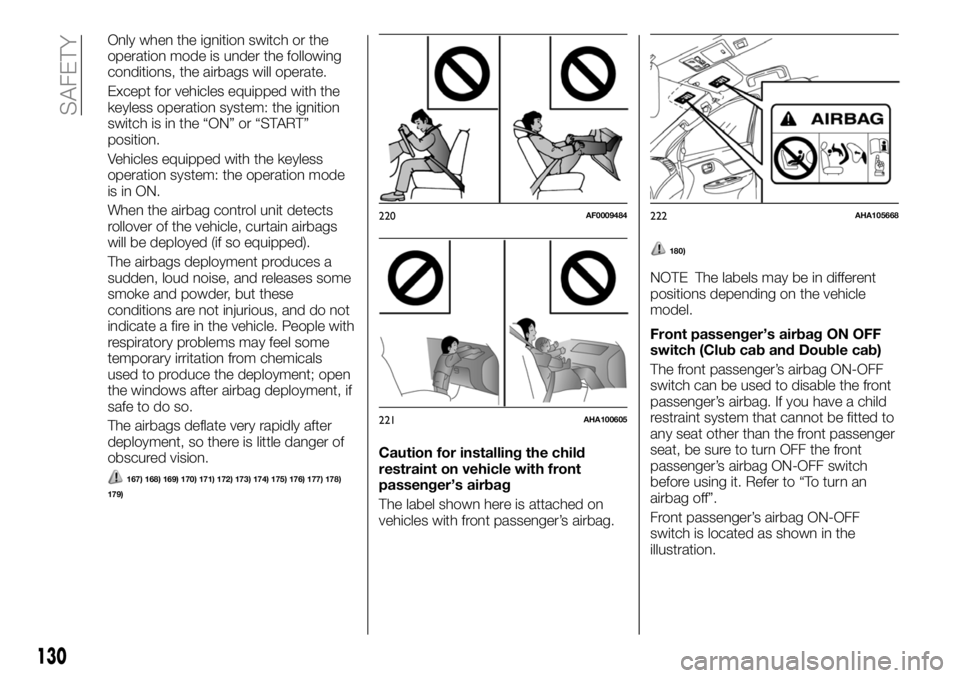
Caution for installing the child
restraint on vehicle with front
passenger’s airbag
The label shown here is attached on
vehicles with front passenger’s airbag.
180)
NOTE The labels may be in different
positions depending on the vehicle
model.
Front passenger’s airbag ON OFF
switch (Club cab and Double cab)
The front passenger’s airbag ON-OFF
switch can be used to disable the front
passenger’s airbag. If you have a child
restraint system that cannot be fitted to
any seat other than the front passenger
seat, be sure to turn OFF the front
passenger’s airbag ON-OFF switch
before using it. Refer to “To turn an
airbag off”.
Front passenger’s airbag ON-OFF
switch is located as shown in the
illustration.
220AF0009484
221AHA100605
222AHA105668
130
SAFETY
Page 133 of 316
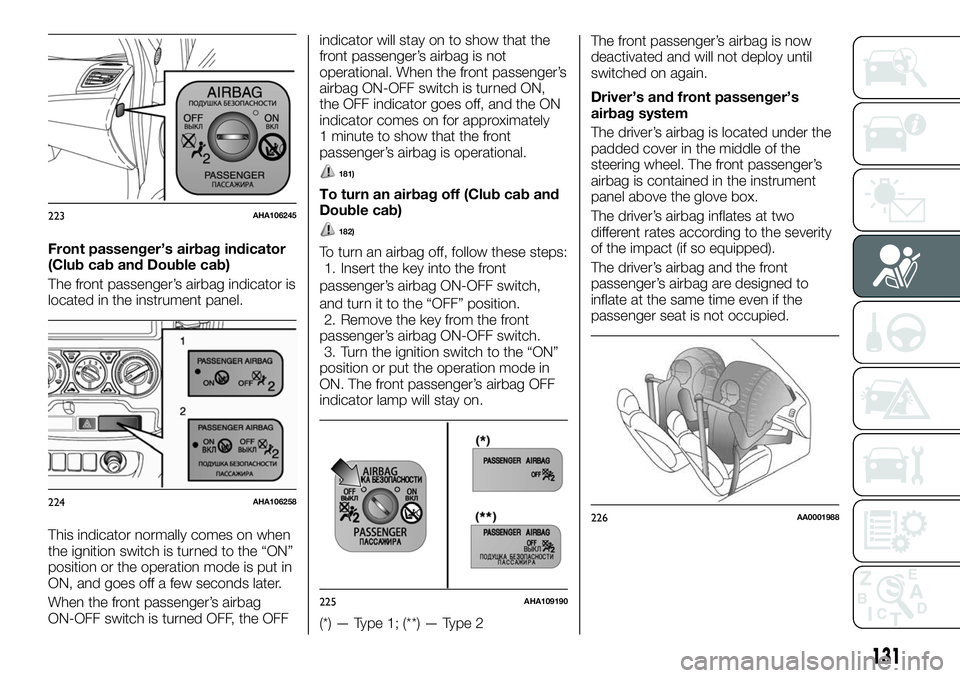
Front passenger’s airbag indicator
(Club cab and Double cab)
The front passenger’s airbag indicator is
located in the instrument panel.
This indicator normally comes on when
the ignition switch is turned to the “ON”
position or the operation mode is put in
ON, and goes off a few seconds later.
When the front passenger’s airbag
ON-OFF switch is turned OFF, the OFFindicator will stay on to show that the
front passenger’s airbag is not
operational. When the front passenger’s
airbag ON-OFF switch is turned ON,
the OFF indicator goes off, and the ON
indicator comes on for approximately
1 minute to show that the front
passenger’s airbag is operational.
181)
To turn an airbag off (Club cab and
Double cab)
182)
To turn an airbag off, follow these steps:
1. Insert the key into the front
passenger’s airbag ON-OFF switch,
and turn it to the “OFF” position.
2. Remove the key from the front
passenger’s airbag ON-OFF switch.
3. Turn the ignition switch to the “ON”
position or put the operation mode in
ON. The front passenger’s airbag OFF
indicator lamp will stay on.
(*) — Type 1; (**) — Type 2The front passenger’s airbag is now
deactivated and will not deploy until
switched on again.
Driver’s and front passenger’s
airbag system
The driver’s airbag is located under the
padded cover in the middle of the
steering wheel. The front passenger’s
airbag is contained in the instrument
panel above the glove box.
The driver’s airbag inflates at two
different rates according to the severity
of the impact (if so equipped).
The driver’s airbag and the front
passenger’s airbag are designed to
inflate at the same time even if the
passenger seat is not occupied.
223AHA106245
224AHA106258
225AHA109190
226AA0001988
131
Page 139 of 316
178)When there is an active passenger
airbag, DO NOT install rearward facing
child restraint systems on the front seat.
Deployment of the airbag in an accident
could cause fatal injuries to the child
regardless of the severity of the impact.
Therefore, always deactivate the passenger
side airbag when a rearward facing child
restraint system is installed on the front
passenger seat. The front passenger seat
must also be positioned back as far as
possible in order to prevent the child
restraint system from coming into contact
with the dashboard. Immediately reactivate
the passenger airbag as soon as the child
restraint system has been removed.
179)Older children should be seated,
properly wearing the seat belt, with an
appropriate booster seat if needed.
180)Extreme Hazard! NEVER use a
rearward facing child restraint on a seat
protected by an ACTIVE AIRBAG in front of
it, DEATH or SERIOUS INJURY to the
CHILD can occur.
181)Do not fit any accessory that makes
the indicator impossible to see, and do not
cover the indicator with a sticker. You would
not be able to verify the status of the
passenger airbag system.182)To reduce risk of serious or fatal injury:
always turn the ignition switch to the
“LOCK” position or put the operation mode
in OFF, before operating the front
passenger’s airbag ON-OFF switch. Failure
to do so could adversely affect the airbag
performance; Wait at least 60 seconds to
operate the front passenger’s airbag
ON-OFF switch after turning the ignition
switch to the “LOCK” position or putting
the operation mode in OFF. The SRS airbag
system is designed to retain enough
voltage to deploy the airbag; Always
remove the key from the front passenger’s
airbag ON-OFF switch after operating that
switch. Failure to do so could lead to
improper position of the front passenger’s
airbag ON-OFF switch; Do not turn OFF the
front passenger’s airbag ON-OFF switch
except when a child restraint system is
fitted to the front passenger seat; If the OFF
indicator does not come on when the front
passenger’s airbag ONOFF switch is turned
OFF, do not fit a child restraint system to
the front passenger seat. We recommend
you to have the system inspected by a Fiat
Dealership; if the OFF indicator remains on
when the front passenger’s airbag ON-OFF
switch is turned ON, do not allow anyone
to sit on the front passenger seat. We
recommend you to have the system
inspected by a Fiat Dealership.
183)Do not apply stickers or other objects
to the steering wheel, the dashboard in the
passenger side airbag area and the seats.
Never put objects (e.g. mobile phones) on
the passenger side of the dashboard since
they could interfere with correct inflation of
the passenger airbag and also cause
serious injury to the passengers.184)Do not set anything on, or attach
anything to, the instrument panel above the
glove box. It might strike and injure an
occupant if the airbag inflates.
185)Do not attach accessories to, or put
them in front of, the windscreen. These
objects could restrict the airbag inflation, or
strike and injure an occupant if the airbags
inflate.
186)Do not attach additional keys or
accessories (hard, pointed or heavy
objects) to the ignition key. Such objects
could prevent the driver’s knee airbag from
inflating normally or could be propelled to
cause serious injury if the airbag inflates.
See fig. 233.
187)Do not attach accessories to the
lower portion of the driver’s side instrument
panel. Such objects could prevent the
driver’s knee airbag from inflating normally
or could be propelled to cause serious
injury if the airbag inflates.
188)Do not put packages, pets or other
objects between the airbags and the driver
or front passenger. It could affect airbag
performance, or could cause injury when
the airbag inflates.
189)Right after the airbag inflation, several
airbag system components will be hot. Do
not touch these components. There is a
danger of being burnt.
190)The airbag system is designed to
work only once. Once the airbags have
deployed, they will not work again. They
must promptly be replaced and we
recommend you to have the entire airbag
system inspected by a Fiat Dealership.
191)Do not affix rigid objects to the
garment hooks or support handles.
137
Page 142 of 316
An operation noise is emitted from the
engine compartment or feel a shock
from the brake pedal when start driving
immediately after starting the engine.
These are normal sound or operation
that the ABS makes when performing a
self-check. It does not indicate a
malfunction.
The ABS can be used after the vehicle
has reached a speed over
approximately 10 km/h. It stops
working when the vehicle slows below
7 km/h.
208) 209) 210) 211) 212) 213) 214) 215) 216)
After driving on icy roads
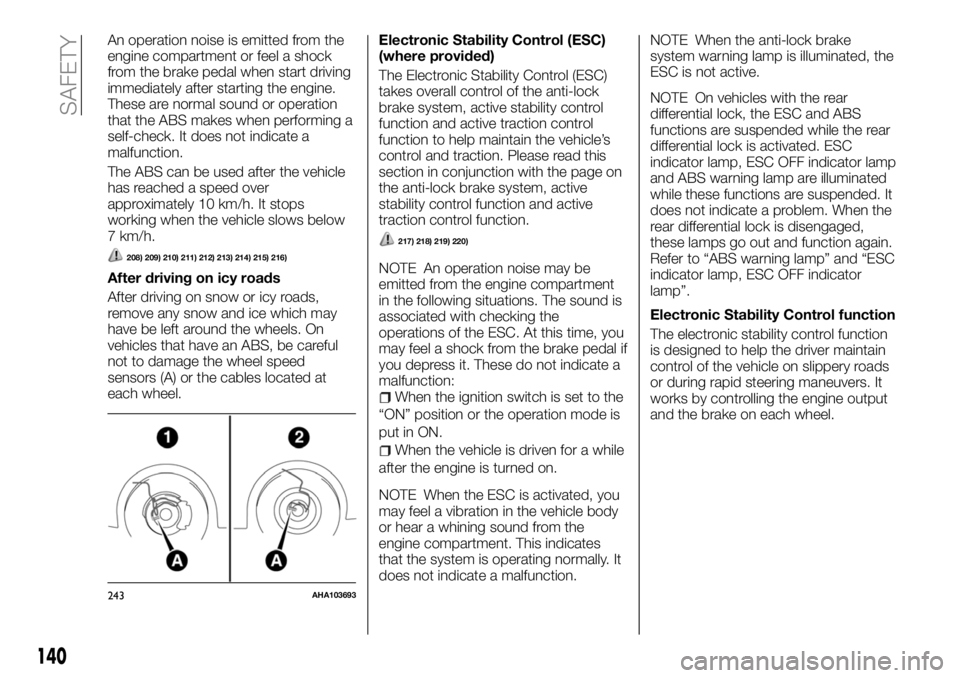
After driving on snow or icy roads,
remove any snow and ice which may
have be left around the wheels. On
vehicles that have an ABS, be careful
not to damage the wheel speed
sensors (A) or the cables located at
each wheel.Electronic Stability Control (ESC)
(where provided)
The Electronic Stability Control (ESC)
takes overall control of the anti-lock
brake system, active stability control
function and active traction control
function to help maintain the vehicle’s
control and traction. Please read this
section in conjunction with the page on
the anti-lock brake system, active
stability control function and active
traction control function.
217) 218) 219) 220)
NOTE An operation noise may be
emitted from the engine compartment
in the following situations. The sound is
associated with checking the
operations of the ESC. At this time, you
may feel a shock from the brake pedal if
you depress it. These do not indicate a
malfunction:
When the ignition switch is set to the
“ON” position or the operation mode is
put in ON.
When the vehicle is driven for a while
after the engine is turned on.
NOTE When the ESC is activated, you
may feel a vibration in the vehicle body
or hear a whining sound from the
engine compartment. This indicates
that the system is operating normally. It
does not indicate a malfunction.NOTE When the anti-lock brake
system warning lamp is illuminated, the
ESC is not active.
NOTE On vehicles with the rear
differential lock, the ESC and ABS
functions are suspended while the rear
differential lock is activated. ESC
indicator lamp, ESC OFF indicator lamp
and ABS warning lamp are illuminated
while these functions are suspended. It
does not indicate a problem. When the
rear differential lock is disengaged,
these lamps go out and function again.
Refer to “ABS warning lamp” and “ESC
indicator lamp, ESC OFF indicator
lamp”.
Electronic Stability Control function
The electronic stability control function
is designed to help the driver maintain
control of the vehicle on slippery roads
or during rapid steering maneuvers. It
works by controlling the engine output
and the brake on each wheel.
243AHA103693
140
SAFETY
Page 143 of 316
NOTE The electronic stability control
function does not operate when the
drive mode-selector is in the “4L”
position (Easy Select 4WD), “4LLc”
position (Super Select 4WD II). When
the active stability control function is
operating with the drive mode-selector
in the “2H” or “4H” position (Easy
Select 4WD), “2H”, “4H” or “4HLc”
position (Super Select 4WD II), setting
the drive modeselector to the “4L”
(Easy Select 4WD), “4LLc” position
(Super Select 4WD II) position makes
the active stability control function
deactivate automatically.
NOTE The electronic stability control
function operates at speeds of about
15 km/h or higher.
NOTE On vehicles with the rear
differential lock, the electronic stability
control function does not operate when
the rear differential lock is activated.
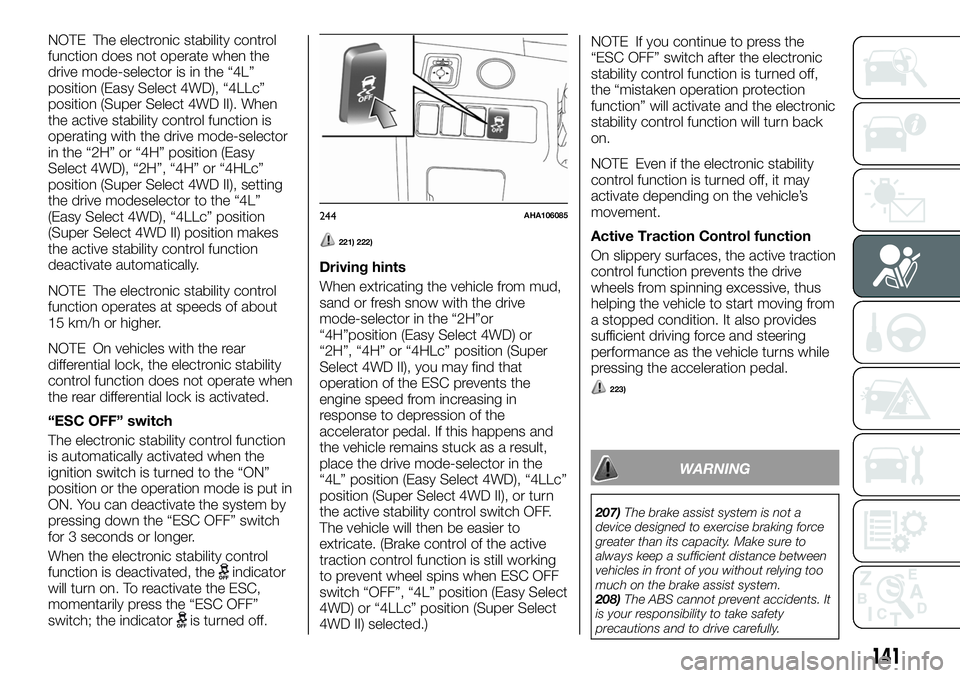
“ESC OFF” switch
The electronic stability control function
is automatically activated when the
ignition switch is turned to the “ON”
position or the operation mode is put in
ON. You can deactivate the system by
pressing down the “ESC OFF” switch
for 3 seconds or longer.
When the electronic stability control
function is deactivated, the
indicator
will turn on. To reactivate the ESC,
momentarily press the “ESC OFF”
switch; the indicator
is turned off.
221) 222)
Driving hints
When extricating the vehicle from mud,
sand or fresh snow with the drive
mode-selector in the “2H”or
“4H”position (Easy Select 4WD) or
“2H”, “4H” or “4HLc” position (Super
Select 4WD II), you may find that
operation of the ESC prevents the
engine speed from increasing in
response to depression of the
accelerator pedal. If this happens and
the vehicle remains stuck as a result,
place the drive mode-selector in the
“4L” position (Easy Select 4WD), “4LLc”
position (Super Select 4WD II), or turn
the active stability control switch OFF.
The vehicle will then be easier to
extricate. (Brake control of the active
traction control function is still working
to prevent wheel spins when ESC OFF
switch “OFF”, “4L” position (Easy Select
4WD) or “4LLc” position (Super Select
4WD II) selected.)NOTE If you continue to press the
“ESC OFF” switch after the electronic
stability control function is turned off,
the “mistaken operation protection
function” will activate and the electronic
stability control function will turn back
on.
NOTE Even if the electronic stability
control function is turned off, it may
activate depending on the vehicle’s
movement.
Active Traction Control function
On slippery surfaces, the active traction
control function prevents the drive
wheels from spinning excessive, thus
helping the vehicle to start moving from
a stopped condition. It also provides
sufficient driving force and steering
performance as the vehicle turns while
pressing the acceleration pedal.
223)
WARNING
207)The brake assist system is not a
device designed to exercise braking force
greater than its capacity. Make sure to
always keep a sufficient distance between
vehicles in front of you without relying too
much on the brake assist system.
208)The ABS cannot prevent accidents. It
is your responsibility to take safety
precautions and to drive carefully.
244AHA106085
141
Page 145 of 316
NOTE The hill start assist is activated
when all of the following conditions are
met.
The engine is running (the hill start
assist will not be activated while the
engine is starting or immediately after
the engine is started).
On vehicles equipped with M/T, the
gearshift lever is in the following
position: When starting an uphill slope
forwards > The gearshift lever is in any
position other than “R” (the hill start
assist will operate, even if the gearshift
lever is in the “N” position). When
starting an uphill slope backwards >
The gearshift lever is in the “R” position
(the hill start assist will not operate
when the gearshift lever is in the “N”
position).
On vehicles equipped with A/T, the
selector lever is in any position other
than “P” or “N”.
The vehicle is completely stationary,
with the brake pedal depressed.
The parking brake is released.
NOTE The hill start assist will not
operate if the accelerator pedal is
depressed before the brake pedal is
released.
NOTE The hill start assist also operates
when reversing on an uphill slope.NOTE When the hill start assist is
activated, you may feel the operating
sound. This is a normal result of the hill
start assist operation, and does not
indicate a problem.
Warning indicator
If an abnormal condition occurs in the
system, the indicator lamp
will turn
on.
83) 84)
Power Steering System
The power steering system operates
while the engine is running. It helps
reduce the effort needed to turn the
steering wheel.
The power steering system has
mechanical steering capability in case
the power assist is lost. If the power
assist is lost for some reason, you will
still be able to steer your vehicle, but
you will notice it takes much more effort
to steer. If this happens, have your
vehicle inspected at a Fiat Dealership.
85) 86)
Trailer Stability Assist — TSA
(where provided)
The trailer stability assist system helps
safely running while towing a trailer by
controlling the braking force of each
wheel and engine power in order to
stabilize the motion when detecting the
continuous sway of the vehicle caused
by a trailer.When the trailer stability assist system
operates the brakes, the brake lamp
turns on. About the towing of the trailer,
refer to “Trailer towing”.
87) 88)
NOTE When TSA system operates, the
vehicle body may vibrate and the
operating sounds from the engine
compartment may be heard. These
motions indicate normal operation of
the system, not abnormal operation.
NOTE TSA system operates when the
vehicle speed is about 55 km/h or
higher.
NOTE When TSA system operates, the
ESC operation indicator lamp blinks on
and off.
NOTE When ESC does not work, TSA
system does not operate.
WARNING
224)When facing uphill, do not rely on
using the hill start assist to maintain a
stopped position as an alternative to
depressing the brake pedal. Doing so
could cause an accident.
225)Do not turn the ignition switch to the
“LOCK” or “ACC” position or the operation
mode in ACC or OFF while the hill start
assist is operating. The hill start assist
could stop operating, which could result in
an accident.
143
Page 153 of 316
PARKING
To park the vehicle, stop the engine,
fully engage the parking brake and then
move the gearshift lever to 1st or “R”
(Reverse) position for vehicles equipped
with M/T, or set the selector lever to “P”
(PARK) position for vehicles equipped
with A/T.
Parking on a hill
To prevent the vehicle from rolling,
follow these procedures:
Parking on a downhill slope
Turn the front wheels towards the kerb
and move the vehicle forward until the
kerb side wheel gently touches the
kerb.
On vehicles equipped with M/T, apply
the parking brake and place the
gearshift lever into the “R” (Reverse)
position.
On vehicles equipped with A/T, apply
the parking brake and place the
selector lever into the “P” (PARK)
position. If necessary, apply chocks to
wheels.
Parking on a uphill slope
Turn the front wheels away from the
kerb and move the vehicle back until
the kerb side wheel gently touches the
kerb.
On vehicles equipped with M/T, apply
the parking brake and place the
gearshift lever into the 1st position.
On vehicles equipped with A/T, applythe parking brake and place the
selector lever into the “P” (PARK)
position. If necessary, apply chocks to
wheels.
NOTE If your vehicle is equipped with
A/T, be sure to apply the parking brake
before moving selector lever to the “P”
(PARK) position. If you move selector
lever to the “P” (PARK) position before
applying the parking brake, it may be
difficult to disengage selector lever from
the “P” (PARK) position when next you
drive the vehicle, requiring application of
a strong force the selector lever to
move from the “P” (PARK) position.
NOTE IMPORTANT: NEVER leave the
car with the gearbox in neutral or, on
versions equipped with A/T, before
placing the gear lever in the “P” (PARK)
position.
Parking with the engine running
Never leave the engine running while
you take a short sleep/rest. Also, never
leave the engine running in a closed or
poorly ventilated place.
When leaving the vehicle
Always carry the key and lock all doors
when leaving the vehicle unattended.
Always try to park your vehicle in a well
lit area.
228) 229) 230)
WARNING
228)Leaving the engine running risks injury
or death from accidentally moving the
gearshift lever (with M/T) or the selector
lever (with A/T) or the accumulation of toxic
exhaust fumes on the passenger
compartment.
229)Never leave children unattended in
the vehicle. Always remove the ignition key
when leaving the vehicle and take it out
with you.
230)Do not park your vehicle in areas
where combustible materials such as dry
grass or leaves can come in contact with a
hot exhaust, since a fire could occur.
151