ignition FIAT FULLBACK 2018 Owner handbook (in English)
[x] Cancel search | Manufacturer: FIAT, Model Year: 2018, Model line: FULLBACK, Model: FIAT FULLBACK 2018Pages: 316, PDF Size: 10.52 MB
Page 211 of 316
WARNING
263)In the country or area where is no
available emergency call centre of the
ERA-GLONASS, or where the radio wave
of emergency call cannot be transmitted or
received normally, the system does not
operate. In this case, directly arrange an
emergency vehicle or road service with a
cellular phone, etc.
264)If an emergency occurs and you feel a
smell of the fuel or a bad smell, do not stay
inside the vehicle and escape to a safe
place immediately.
265)While waiting for the rescue after the
emergency call, take action to prevent
secondary accidents such as a rear end
collision with the following vehicle, and
escape to a safe place.
266)In the following cases, directly arrange
an emergency vehicle or road service with
a cellular phone, etc. 1 - When the system
does not operate by failing because of
collision, etc. 2 - When the vehicle is in the
place where radio waves cannot be
transmitted and received (for example,
indoor, a basement parking area,
mountainous area, inside a tunnel, etc.). 3 -
When the line to the emergency call centre
is busy and the call is not reachable to the
emergency call centre.
267)Do not remove or install the above
parts. This can cause failure of contact or
equipment, and the system may not
operate normally.268)If the red lamp and/or the green lamp
do not illuminate after setting the ignition
switch or the operation mode to “ON”,
there is a possible failure in the system.
Have the system inspected by a Fiat
Dealership.
269)If the red lamp remains illuminated or
illuminates again after approximately
20 seconds has elapsed after setting the
ignition switch or the operation mode to
“ON”, there is a possible failure in the
system or the battery for exclusive use of
the ERA-GLONASS may be exhausted.
The battery life is approximately 3 years.
Have the system immediately inspected or
replace the battery by a Fiat Dealership.
270)When the system is not in the
standby state, the system does not
operate. When you drive, make sure to
check that the system is in the standby
state.
271)Before pressing the SOS switch, stop
the vehicle in a safe place. If you operate it
while driving, your attention to the
surrounding circumstances becomes
insufficient enough to cause an
unexpected accident.
272)If the red lamp illuminates as follows,
directly arrange an emergency vehicle or
road service with a cellular phone, etc. 1 -
When the red lamp remains illuminated
(there is a possible failure in the system). 2
- When the red lamp illuminates for
60 seconds (the vehicle may be in the
place where radio waves cannot be
transmitted and received).273)Do not replace the speakers. If they
are replaced, the buzzer sound or the voice
of the operator at the emergency call
centre may not be audible. If the speakers
need to be replaced due to a failure etc.
we recommend you to consult a Fiat
Dealership.
274)An error may occur between the
actual report point and the point reported
to the emergency call centre. Mutually
confirm the report point and the object
through the phone call with the operator of
the emergency call centre.
275)If any of the check results are not
normal, the red lamp illuminates (for
approximately 5 seconds) and the buzzer
sounds 3 times. In this case, there is a
possible failure in the system. Have the
system immediately inspected at a Fiat
Dealership.
IMPORTANT
164)Do not open the cover except when
you press the SOS switch. You may press
the SOS switch by mistake. In addition, if
the cover is opened while driving, the cover
can cause injury in case of emergency.
209
Page 214 of 316
WARNING
276)To start the engine using jumper
cables from another vehicle, perform the
correct procedures according to the
instruction below. Incorrect procedures
could result in a fire or explosion or
damage to the vehicles.
277)Keep sparks, cigarettes and flames
away from the battery because the battery
may produce an explosion.
278)Do not attempt to start the engine by
pulling or pushing the vehicle. It could
damage your vehicle.
279)Check the other vehicle. It must have
a 12-volt battery. If the other system isn’t
12-volt, shorting can damage both
vehicles.
280)Use the proper cables suitable for the
battery size to prevent overheating of the
cables.
281)Check the jumper cables for damage
and corrosion before use.
282)Always wear protective eye goggles
when working near the battery.
283)Keep the battery out of the reach of
children.
284)Turn off the ignition on both vehicles
beforehand. Make sure that the cables or
your clothes cannot be caught by the fan
or drive belt. Personal injury could result.
285)If electrolyte fluid is not visible, or
appears to be frozen, Do Not Attempt
Jump Starting! A battery might rupture or
explode if the temperature is below the
freezing point or if it is not filled to the
proper level.286)Electrolyte is corrosive diluted
sulphuric acid. If electrolyte (battery acid)
comes into contact with your hands, eyes,
clothes or the painted surface of your
vehicle, it should be thoroughly flushed
with water. If electrolyte gets in your eyes,
flush them with water immediately and
thoroughly, and get prompt medical
attention.
287)Make sure that the connection is
made to the appointed position (shown in
the illustration). If the connection is made
directly to the negative (−) side of the
battery, the inflammable gases generated
from the battery might catch fire and
explode.
288)When connecting the jumper cables,
do not connect the positive (+) cable to the
negative (−) terminal. Otherwise sparks
might cause explosion of the battery.
289)Use care not to get the jumper cable
caught in the cooling fan or other rotating
part in the engine compartment.
290)Keep the engine of the vehicle giving
assistance running.
291)Battery fluid is poisonous and
corrosive: avoid contact with your skin and
eyes. The battery should be charged in a
well ventilated place, away from naked
flames or possible sources of sparks:
danger of explosion and fire.
292)Do not attempt to charge a frozen
battery: it must be thawed first, otherwise it
may explode. If freezing has occurred, the
battery should be checked by skilled
personnel to make sure that the internal
elements are not damaged and that the
body is not cracked, with the risk of leaking
poisonous and corrosive acid.
ENGINE
OVERHEATING
When the engine is overheating,will
blink. If this occurs, take the following
corrective measures:
1. Stop the vehicle in a safe place.
2. Check whether steam is coming from
the engine compartment.
If steam does not come from the engine
compartment: with the engine still
running, raise the bonnet to ventilate
the engine compartment.
NOTE For vehicles equipped with the
Start&Stop system, press the
“Start&Stop OFF” switch to deactivate
the system before stopping the vehicle.
If steam is coming from the engine
compartment: stop the engine, and
when the steam stops, raise the bonnet
to ventilate the engine compartment.
Restart the engine.
293) 294) 295)
3. Confirm that the cooling fan (B) is
turning.
If the cooling fan is turning: after the
high coolant temperature warning has
gone off, stop the engine
If the cooling fan is not turning: stop the
engine immediately and contact a Fiat
dealership for assistance.
212
IN AN EMERGENCY
Page 216 of 316
REMOVAL OF WATER
FROM THE FUEL
FILTER
(Diesel-powered vehicles)
If the fuel filter indicator lamp in the
instrument panel illuminates during
driving, it indicates that water has
accumulated in the fuel filter. If this
occurs, remove the water as described
below.
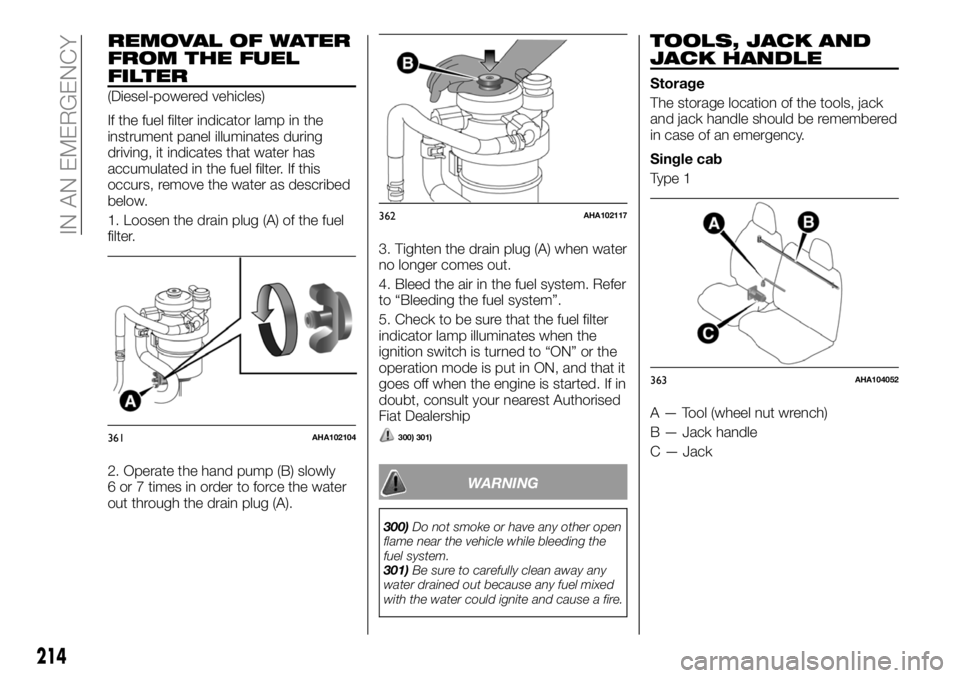
1. Loosen the drain plug (A) of the fuel
filter.
2. Operate the hand pump (B) slowly
6 or 7 times in order to force the water
out through the drain plug (A).3. Tighten the drain plug (A) when water
no longer comes out.
4. Bleed the air in the fuel system. Refer
to “Bleeding the fuel system”.
5. Check to be sure that the fuel filter
indicator lamp illuminates when the
ignition switch is turned to “ON” or the
operation mode is put in ON, and that it
goes off when the engine is started. If in
doubt, consult your nearest Authorised
Fiat Dealership
300) 301)
WARNING
300)Do not smoke or have any other open
flame near the vehicle while bleeding the
fuel system.
301)Be sure to carefully clean away any
water drained out because any fuel mixed
with the water could ignite and cause a fire.
TOOLS, JACK AND
JACK HANDLE
Storage
The storage location of the tools, jack
and jack handle should be remembered
in case of an emergency.
Single cab
Type 1
A — Tool (wheel nut wrench)
B — Jack handle
C — Jack
361AHA102104
362AHA102117
363AHA104052
214
IN AN EMERGENCY
Page 221 of 316
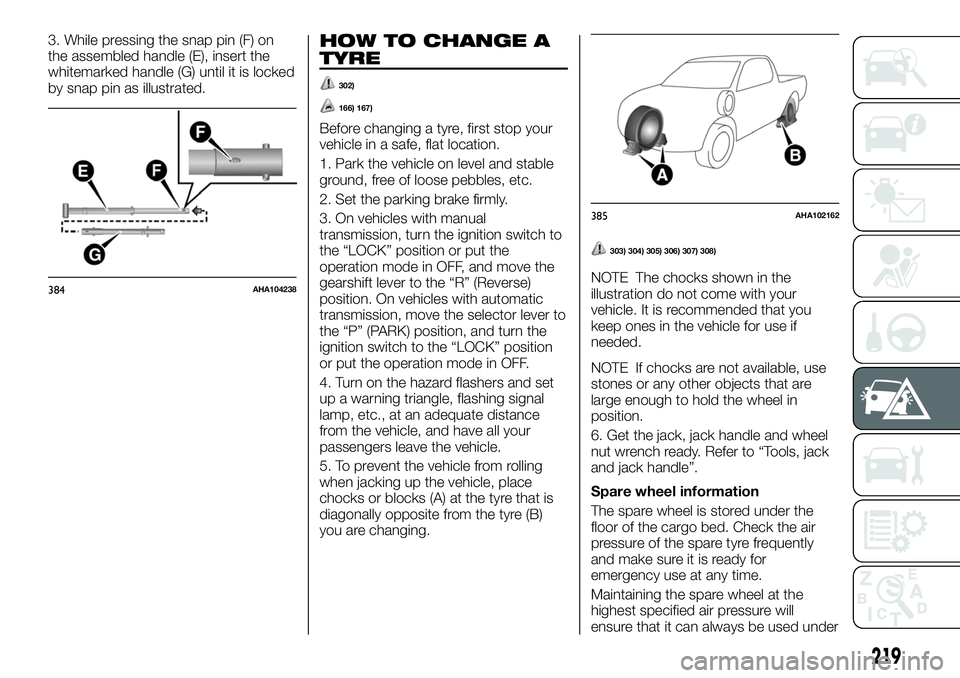
3. While pressing the snap pin (F) on
the assembled handle (E), insert the
whitemarked handle (G) until it is locked
by snap pin as illustrated.HOW TO CHANGE A
TYRE
302)
166) 167)
Before changing a tyre, first stop your
vehicle in a safe, flat location.
1. Park the vehicle on level and stable
ground, free of loose pebbles, etc.
2. Set the parking brake firmly.
3. On vehicles with manual
transmission, turn the ignition switch to
the “LOCK” position or put the
operation mode in OFF, and move the
gearshift lever to the “R” (Reverse)
position. On vehicles with automatic
transmission, move the selector lever to
the “P” (PARK) position, and turn the
ignition switch to the “LOCK” position
or put the operation mode in OFF.
4. Turn on the hazard flashers and set
up a warning triangle, flashing signal
lamp, etc., at an adequate distance
from the vehicle, and have all your
passengers leave the vehicle.
5. To prevent the vehicle from rolling
when jacking up the vehicle, place
chocks or blocks (A) at the tyre that is
diagonally opposite from the tyre (B)
you are changing.
303) 304) 305) 306) 307) 308)
NOTE The chocks shown in the
illustration do not come with your
vehicle. It is recommended that you
keep ones in the vehicle for use if
needed.
NOTE If chocks are not available, use
stones or any other objects that are
large enough to hold the wheel in
position.
6. Get the jack, jack handle and wheel
nut wrench ready. Refer to “Tools, jack
and jack handle”.
Spare wheel information
The spare wheel is stored under the
floor of the cargo bed. Check the air
pressure of the spare tyre frequently
and make sure it is ready for
emergency use at any time.
Maintaining the spare wheel at the
highest specified air pressure will
ensure that it can always be used under384AHA104238
385AHA102162
219
Page 228 of 316
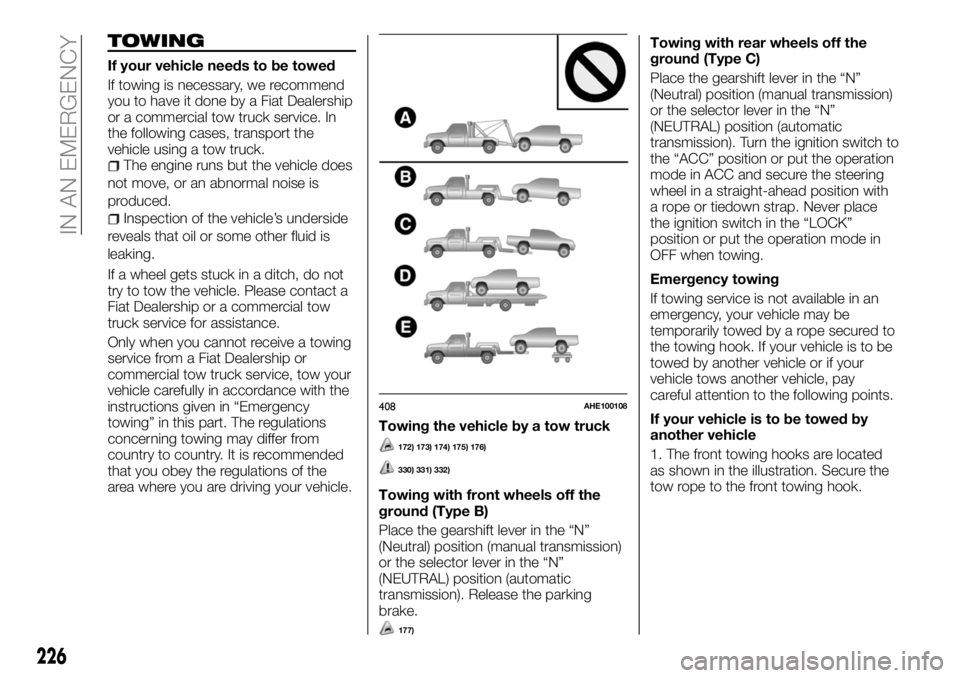
TOWING
If your vehicle needs to be towed
If towing is necessary, we recommend
you to have it done by a Fiat Dealership
or a commercial tow truck service. In
the following cases, transport the
vehicle using a tow truck.
The engine runs but the vehicle does
not move, or an abnormal noise is
produced.
Inspection of the vehicle’s underside
reveals that oil or some other fluid is
leaking.
If a wheel gets stuck in a ditch, do not
try to tow the vehicle. Please contact a
Fiat Dealership or a commercial tow
truck service for assistance.
Only when you cannot receive a towing
service from a Fiat Dealership or
commercial tow truck service, tow your
vehicle carefully in accordance with the
instructions given in “Emergency
towing” in this part. The regulations
concerning towing may differ from
country to country. It is recommended
that you obey the regulations of the
area where you are driving your vehicle.Towing the vehicle by a tow truck
172) 173) 174) 175) 176)
330) 331) 332)
Towing with front wheels off the
ground (Type B)
Place the gearshift lever in the “N”
(Neutral) position (manual transmission)
or the selector lever in the “N”
(NEUTRAL) position (automatic
transmission). Release the parking
brake.
177)
Towing with rear wheels off the
ground (Type C)
Place the gearshift lever in the “N”
(Neutral) position (manual transmission)
or the selector lever in the “N”
(NEUTRAL) position (automatic
transmission). Turn the ignition switch to
the “ACC” position or put the operation
mode in ACC and secure the steering
wheel in a straight-ahead position with
a rope or tiedown strap. Never place
the ignition switch in the “LOCK”
position or put the operation mode in
OFF when towing.
Emergency towing
If towing service is not available in an
emergency, your vehicle may be
temporarily towed by a rope secured to
the towing hook. If your vehicle is to be
towed by another vehicle or if your
vehicle tows another vehicle, pay
careful attention to the following points.
If your vehicle is to be towed by
another vehicle
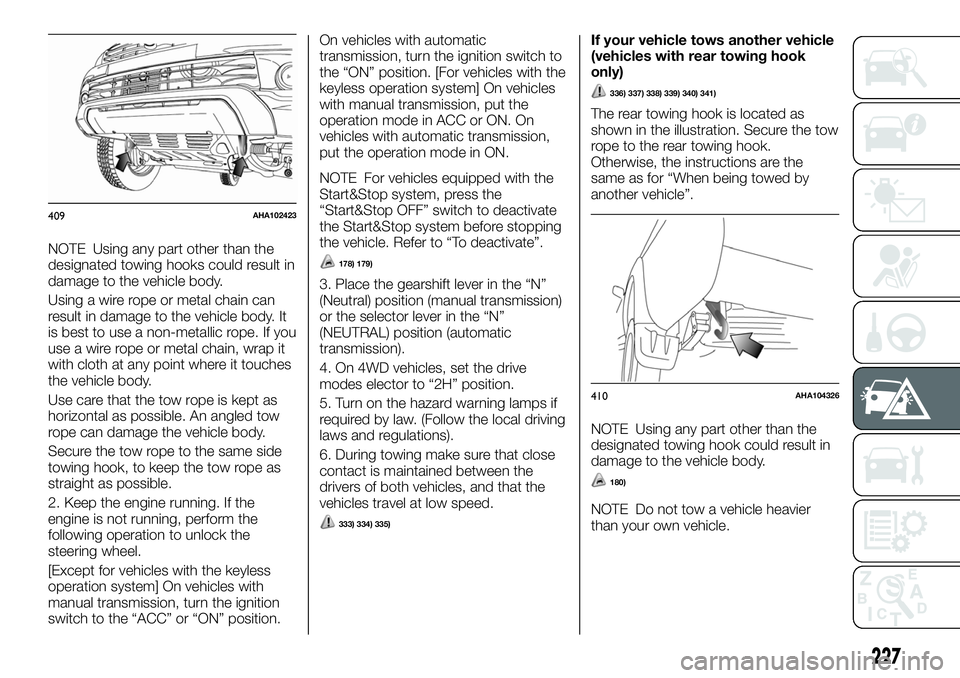
1. The front towing hooks are located
as shown in the illustration. Secure the
tow rope to the front towing hook.
408AHE100108
226
IN AN EMERGENCY
Page 229 of 316
NOTE Using any part other than the
designated towing hooks could result in
damage to the vehicle body.
Using a wire rope or metal chain can
result in damage to the vehicle body. It
is best to use a non-metallic rope. If you
use a wire rope or metal chain, wrap it
with cloth at any point where it touches
the vehicle body.
Use care that the tow rope is kept as
horizontal as possible. An angled tow
rope can damage the vehicle body.
Secure the tow rope to the same side
towing hook, to keep the tow rope as
straight as possible.
2. Keep the engine running. If the
engine is not running, perform the
following operation to unlock the
steering wheel.
[Except for vehicles with the keyless
operation system] On vehicles with
manual transmission, turn the ignition
switch to the “ACC” or “ON” position.On vehicles with automatic
transmission, turn the ignition switch to
the “ON” position. [For vehicles with the
keyless operation system] On vehicles
with manual transmission, put the
operation mode in ACC or ON. On
vehicles with automatic transmission,
put the operation mode in ON.
NOTE For vehicles equipped with the
Start&Stop system, press the
“Start&Stop OFF” switch to deactivate
the Start&Stop system before stopping
the vehicle. Refer to “To deactivate”.178) 179)
3. Place the gearshift lever in the “N”
(Neutral) position (manual transmission)
or the selector lever in the “N”
(NEUTRAL) position (automatic
transmission).
4. On 4WD vehicles, set the drive
modes elector to “2H” position.
5. Turn on the hazard warning lamps if
required by law. (Follow the local driving
laws and regulations).
6. During towing make sure that close
contact is maintained between the
drivers of both vehicles, and that the
vehicles travel at low speed.
333) 334) 335)
If your vehicle tows another vehicle
(vehicles with rear towing hook
only)
336) 337) 338) 339) 340) 341)
The rear towing hook is located as
shown in the illustration. Secure the tow
rope to the rear towing hook.
Otherwise, the instructions are the
same as for “When being towed by
another vehicle”.
NOTE Using any part other than the
designated towing hook could result in
damage to the vehicle body.
180)
NOTE Do not tow a vehicle heavier
than your own vehicle.
409AHA102423
410AHA104326
227
Page 230 of 316
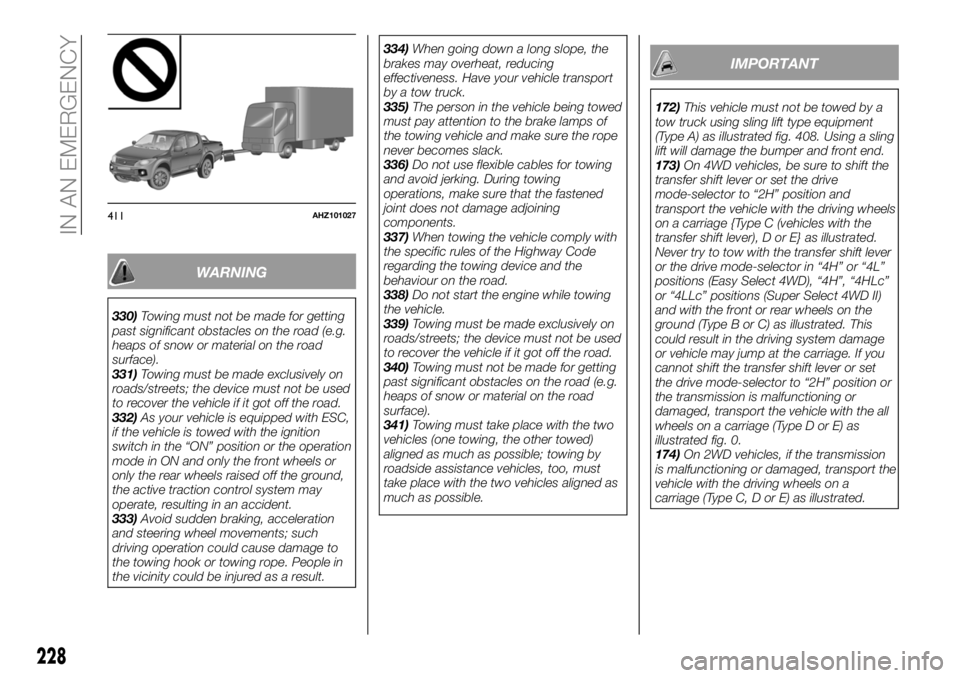
WARNING
330)Towing must not be made for getting
past significant obstacles on the road (e.g.
heaps of snow or material on the road
surface).
331)Towing must be made exclusively on
roads/streets; the device must not be used
to recover the vehicle if it got off the road.
332)As your vehicle is equipped with ESC,
if the vehicle is towed with the ignition
switch in the “ON” position or the operation
mode in ON and only the front wheels or
only the rear wheels raised off the ground,
the active traction control system may
operate, resulting in an accident.
333)Avoid sudden braking, acceleration
and steering wheel movements; such
driving operation could cause damage to
the towing hook or towing rope. People in
the vicinity could be injured as a result.334)When going down a long slope, the
brakes may overheat, reducing
effectiveness. Have your vehicle transport
by a tow truck.
335)The person in the vehicle being towed
must pay attention to the brake lamps of
the towing vehicle and make sure the rope
never becomes slack.
336)Do not use flexible cables for towing
and avoid jerking. During towing
operations, make sure that the fastened
joint does not damage adjoining
components.
337)When towing the vehicle comply with
the specific rules of the Highway Code
regarding the towing device and the
behaviour on the road.
338)Do not start the engine while towing
the vehicle.
339)Towing must be made exclusively on
roads/streets; the device must not be used
to recover the vehicle if it got off the road.
340)Towing must not be made for getting
past significant obstacles on the road (e.g.
heaps of snow or material on the road
surface).
341)Towing must take place with the two
vehicles (one towing, the other towed)
aligned as much as possible; towing by
roadside assistance vehicles, too, must
take place with the two vehicles aligned as
much as possible.
IMPORTANT
172)This vehicle must not be towed by a
tow truck using sling lift type equipment
(Type A) as illustrated fig. 408. Using a sling
lift will damage the bumper and front end.
173)On 4WD vehicles, be sure to shift the
transfer shift lever or set the drive
mode-selector to “2H” position and
transport the vehicle with the driving wheels
on a carriage {Type C (vehicles with the
transfer shift lever), D or E} as illustrated.
Never try to tow with the transfer shift lever
or the drive mode-selector in “4H” or “4L”
positions (Easy Select 4WD), “4H”, “4HLc”
or “4LLc” positions (Super Select 4WD II)
and with the front or rear wheels on the
ground (Type B or C) as illustrated. This
could result in the driving system damage
or vehicle may jump at the carriage. If you
cannot shift the transfer shift lever or set
the drive mode-selector to “2H” position or
the transmission is malfunctioning or
damaged, transport the vehicle with the all
wheels on a carriage (Type D or E) as
illustrated fig. 0.
174)On 2WD vehicles, if the transmission
is malfunctioning or damaged, transport the
vehicle with the driving wheels on a
carriage (Type C, D or E) as illustrated.
411AHZ101027
228
IN AN EMERGENCY
Page 231 of 316
175)If you tow the vehicles with automatic
transmission with the driving wheels on the
ground (Type B) as illustrated, make sure
that the towing speed and distance given
below are never exceeded, causing
damage to the transmission. Towing speed:
30 km/h Towing distance: 80 km For the
towing speed and the towing distance,
follow the local driving laws and
regulations.
176)On vehicles with manual transmission,
do not tow the vehicle with the rear wheels
on the ground (Type B) as illustrated.
177)Never tow an automatic transmission
vehicle with the front wheels up (and the
rear wheels on the ground) (Type B) when
the automatic transmission fluid level is low.
This may cause serious and expensive
damage to the transmission.
178)When the engine is not running, the
brake booster and power steering pump do
not operate. This means higher brake
depression force and higher steering effort
are required. Therefore, vehicle operation is
very difficult.
179)Do not leave the ignition switch in the
“LOCK” position or the operation mode in
OFF. The steering wheel will lock, causing
loss of control.
180)On vehicles with Super Select 4WD II,
when you are going to tow another vehicle,
set the drive mode-selector to “4H”
position. Selecting “2H” drive may increase
the differential oil temperature, resulting in
possible damage to the driving system.
Further, the drive train will be subjected to
excessive loading possibly leading to oil
leakage, component seizure, or other
serious faults.OPERATION UNDER
ADVERSE DRIVING
CONDITIONS
On a flooded road
Avoid flooded roads. In the event
driving flooded roads, doing so may
cause the following serious damage to
the vehicle.
Engine stalling
Short in electrical components
Engine damage caused by water
immersion
After driving flooded roads, be sure to
have an inspection at a Fiat Dealership
and take the necessary measures or
repair.
On a wet road
When driving in rain or on a road with
many puddles a layer of water may
form between the tyres and the road
surface. This reduces a tyre’s frictional
resistance on the road, resulting in loss
of steering stability and braking
capability.
To cope with this, observe the following
items:
(a) Drive your vehicle at a slow speed.
(b) Do not drive on worn tyres.
(c) Always maintain the specified tyre
inflation pressures.On a snow-covered or frozen road
When driving on a snow-covered or
frozen road, it is recommended that you
use snow tyres or snow traction device
(tyre chains). Refer to the “Snow tyres”
and “Snow traction device (tyre chains)”
sections.
Avoid high-speed operation, sudden
acceleration, abrupt brake application
and sharp cornering.
Depressing the brake pedal during
travel on snowy or icy roads may cause
tyre slippage and skidding. When
traction between the tyres and the road
is reduced the wheels may skid and the
vehicle cannot readily be brought to a
stop by conventional braking
techniques. Braking will differ,
depending upon whether you have
anti-lock brake system (ABS). If you do
have ABS, brake by pressing the brake
pedal hard, and keeping it pressed. If
you do not have ABS, pump the brake
pedal with short rapid jabs, each time
fully applying and fully releasing for
greatest effect.
Allow extra distance between your
vehicle and the vehicle in front of you,
and avoid sudden braking.
Accumulation of ice on the braking
system can cause the wheels to lock.
Pull away from a standstill slowly after
confirming safety around the vehicle.
342)
229
Page 234 of 316
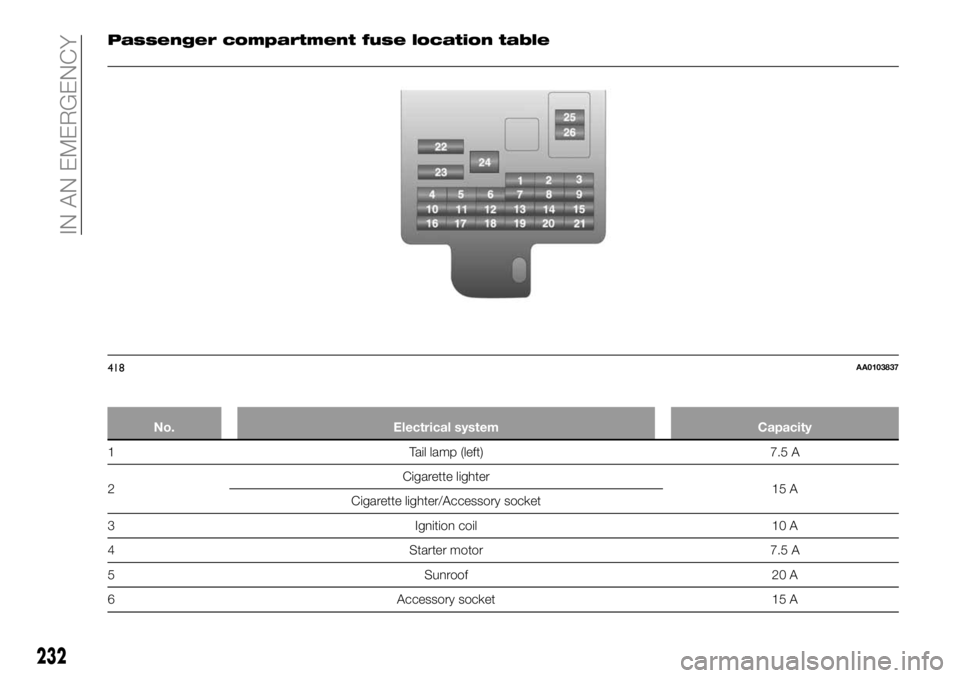
Passenger compartment fuse location table
No. Electrical system Capacity
1 Tail lamp (left) 7.5 A
2Cigarette lighter
15 A
Cigarette lighter/Accessory socket
3 Ignition coil 10 A
4 Starter motor 7.5 A
5 Sunroof 20 A
6 Accessory socket 15 A
418AA0103837
232
IN AN EMERGENCY
Page 236 of 316
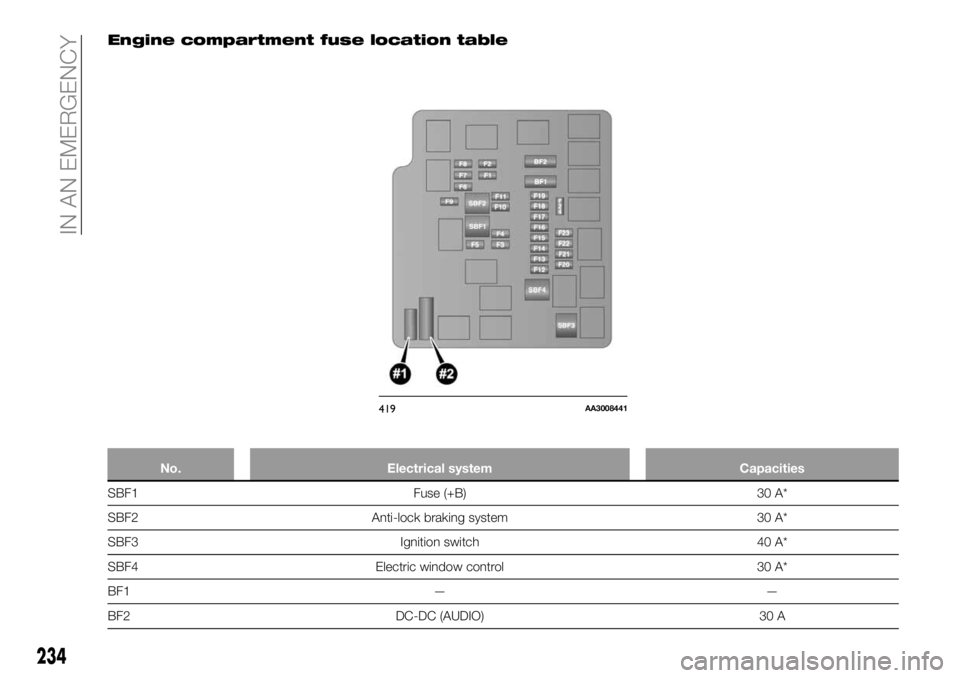
Engine compartment fuse location table
No. Electrical system Capacities
SBF1 Fuse (+B) 30 A*
SBF2 Anti-lock braking system 30 A*
SBF3 Ignition switch 40 A*
SBF4 Electric window control 30 A*
BF1 — —
BF2 DC-DC (AUDIO) 30 A
419AA3008441
234
IN AN EMERGENCY