weight FIAT FULLBACK 2018 Owner handbook (in English)
[x] Cancel search | Manufacturer: FIAT, Model Year: 2018, Model line: FULLBACK, Model: FIAT FULLBACK 2018Pages: 316, PDF Size: 10.52 MB
Page 34 of 316
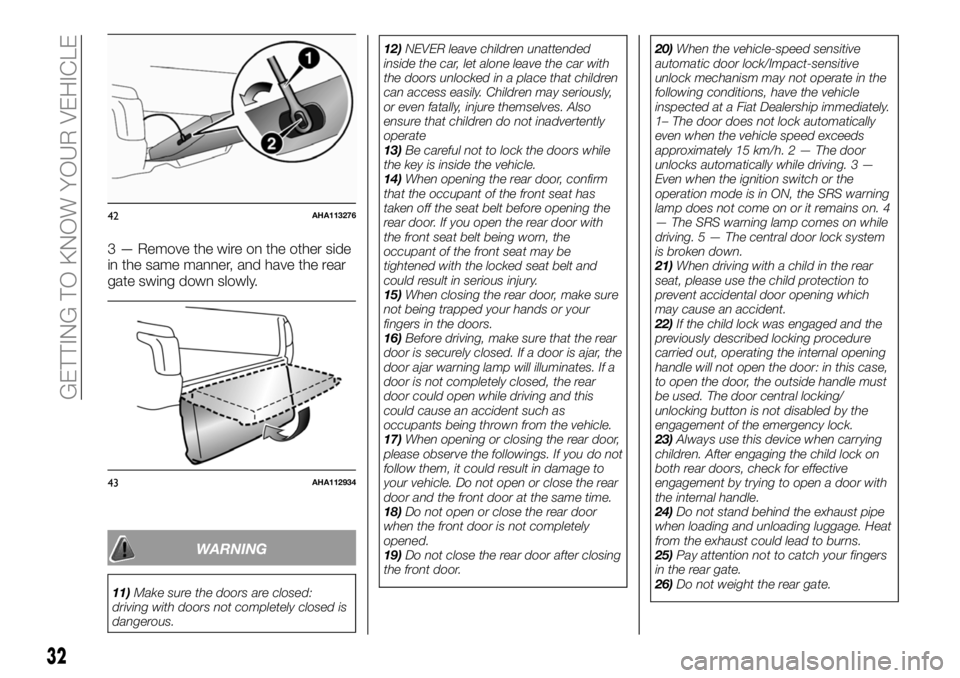
3 — Remove the wire on the other side
in the same manner, and have the rear
gate swing down slowly.
WARNING
11)Make sure the doors are closed:
driving with doors not completely closed is
dangerous.12)NEVER leave children unattended
inside the car, let alone leave the car with
the doors unlocked in a place that children
can access easily. Children may seriously,
or even fatally, injure themselves. Also
ensure that children do not inadvertently
operate
13)Be careful not to lock the doors while
the key is inside the vehicle.
14)When opening the rear door, confirm
that the occupant of the front seat has
taken off the seat belt before opening the
rear door. If you open the rear door with
the front seat belt being worn, the
occupant of the front seat may be
tightened with the locked seat belt and
could result in serious injury.
15)When closing the rear door, make sure
not being trapped your hands or your
fingers in the doors.
16)Before driving, make sure that the rear
door is securely closed. If a door is ajar, the
door ajar warning lamp will illuminates. If a
door is not completely closed, the rear
door could open while driving and this
could cause an accident such as
occupants being thrown from the vehicle.
17)When opening or closing the rear door,
please observe the followings. If you do not
follow them, it could result in damage to
your vehicle. Do not open or close the rear
door and the front door at the same time.
18)Do not open or close the rear door
when the front door is not completely
opened.
19)Do not close the rear door after closing
the front door.20)When the vehicle-speed sensitive
automatic door lock/Impact-sensitive
unlock mechanism may not operate in the
following conditions, have the vehicle
inspected at a Fiat Dealership immediately.
1– The door does not lock automatically
even when the vehicle speed exceeds
approximately 15 km/h. 2 — The door
unlocks automatically while driving. 3 —
Even when the ignition switch or the
operation mode is in ON, the SRS warning
lamp does not come on or it remains on. 4
— The SRS warning lamp comes on while
driving. 5 — The central door lock system
is broken down.
21)When driving with a child in the rear
seat, please use the child protection to
prevent accidental door opening which
may cause an accident.
22)If the child lock was engaged and the
previously described locking procedure
carried out, operating the internal opening
handle will not open the door: in this case,
to open the door, the outside handle must
be used. The door central locking/
unlocking button is not disabled by the
engagement of the emergency lock.
23)Always use this device when carrying
children. After engaging the child lock on
both rear doors, check for effective
engagement by trying to open a door with
the internal handle.
24)Do not stand behind the exhaust pipe
when loading and unloading luggage. Heat
from the exhaust could lead to burns.
25)Pay attention not to catch your fingers
in the rear gate.
26)Do not weight the rear gate.
42AHA113276
43AHA112934
32
GETTING TO KNOW YOUR VEHICLE
Page 79 of 316
82)For safety reasons, the bonnet must
always be properly closed while the car is
travelling. Therefore, make sure that the
bonnet is properly closed and that the lock
is engaged. If you discover that the bonnet
is not perfectly closed during travel, stop
immediately and close the bonnet in the
correct manner.
IMPORTANT
30)Note that the support bar may
disengage the bonnet if the open bonnet is
lifted by a strong wind.
31)After inserting the support bar into the
slot, make sure the bar supports the
bonnet securely from falling down on to
your head or body.
CARGO AREA
CARGO LOADS
83) 84)
Cargo loads precautions
When loading luggage, be careful to the
following.
Stow cargo and luggage in the cargo
area whenever possible.
Distribute cargo or luggage evenly so
that it is not unbalanced.
Do not place cargo or luggage on
the instrument panel. Also, do not stack
up cargo or luggage on the front
passenger’s seat or the rear seat.
Having the driver’s vision blocked, and
your cargo being thrown inside the
cabin if you suddenly have to brake can
cause a serious accident or injury.
Loading a roof carrier
32) 33)
NOTE We recommend you to use a
FCA GENUINE roof carrier, since the
brackets to be used have a special
shape. For details, we recommend you
to consult an Authorised Fiat
Dealership.
Roof carrier precaution
34) 35)
NOTE To prevent wind noise or
reduction in fuel economy, remove the
roof carrier when not in use.NOTE Remove the roof carrier before
using an automatic car wash.
HIGH-LOAD SYSTEM,
PROTRUDING LOADS
Check that the load is distributed evenly
on the flatbed and that the rear side
panel is correctly closed, so that the
load, or part of it, cannot fall onto the
road surface.
Some simple suggestions can improve
driving safety, comfort and vehicle
duration:
distribute the load evenly over the
platform: if it must be concentrated it in
a single area, choose an area mid-way
between both axles;
remember that the dynamic
behaviour of the vehicle is affected by
the transported weight: in particular, the
stopping distances are longer,
especially at high speed.
Bumpy roads and heavy braking may
cause unexpected load shifting with
consequently hazardous situations:
before setting off, secure the load tightly
using the partition and appropriate
hooks, steel cables, ropes or chains
strong enough to hold the items to be
secured.
83) 84) 85) 86) 87) 88)
77
Page 80 of 316
WARNING
83)If the vehicle is parked on a very steep
slope or side gradient, opening the rear
flap of the flatbed or a side door may
cause any objects or luggage which is not
fixed to spill out.
84)If you wish to carry a reserve of petrol
in a can, observe the legal restrictions and
only use a can that is type-approved and
properly secured to the load anchorage
eyebolts. Anyway, by doing so, you
increase the risk of fire in the event of an
accident with your vehicle.
85)Respect the maximum permitted
vehicle loads also shown on the
registration certificate. The user is
responsible for arranging goods in the
luggage compartment and/or on the load
platform within the maximum permitted
loads.
86)Do not carry unnecessary objects on
the flatbed. Particularly if the vehicle is
driven in cities, where frequent stopping
and starting is necessary, supplementary
loads on the vehicle may have major
repercussions on fuel consumption.
Furthermore, do not travel with
unnecessary luggage, loads etc. on the
roof: the increased air resistance will
increase fuel consumption.
87)Using a lower gear when travelling with
heavy loads will improve vehicle
performance and extend the life of the
gearbox, limiting gear shifts and
overheating. This action ensures better
exhaust braking.88)All precautions must be adopted to
prevent danger to other road users if the
load protrudes beyond the contour of the
vehicle. The rear and side protrusion must
be indicated according to the laws in force
in the country. The load must not
compromise stability of the vehicle or cover
lights, visual indicators or identifying plates.
Poles, bars and similar loads which are
difficult to see arranged horizontally must
not protrude beyond the contour of the
vehicle.
IMPORTANT
32)Use a roof carrier that properly fits your
vehicle. Do not load luggage directly onto
the roof. For installation, refer to the
instruction manual accompanying the roof
carrier.
33)Make sure that the weight of the
luggage does not exceed the allowable roof
load. If the allowable roof load is exceeded,
this may cause damage to the vehicle. The
roof load is the total allowable load on the
roof (the weight of the roof carrier plus the
weight of luggage placed on the roof
carrier). For the specific value, refer to
“Maximum roof load”.34)When luggage is loaded onto the
vehicle, please make sure to drive slowly
and avoid excessive maneuvers such as
sudden braking or quick turning. In
addition, place the luggage on the carrier
so that its weight is distributed evenly with
the heaviest items on the bottom. Do not
load items that are wider than the roof
carrier. The additional weight on the roof
could raise the vehicle’s centre of gravity
and affect vehicle handling characteristics.
As a result, driving errors or emergency
maneuvers could lead to a loss of control
and result in an accident.
35)Before driving and after travelling a
short distance, always check the load to
make sure it is securely fastened to the roof
carrier. Check periodically during your travel
that the load remains secure.
78
GETTING TO KNOW YOUR VEHICLE
Page 81 of 316
TRAILER TOWING
In order to tow a trailer with your
vehicle, when having a trailer towing
device mounted that meets all relevant
regulations in your area, consult a Fiat
Dealership.
Check that your towbar coupling ball
does not obscure your vehicle’s licence
plate when the trailer or caravan is
disconnected. If it obscures the licence
plate, please remove the towbar
coupling ball. And if the towbar
coupling ball is lockable by using a key
or any kind of tools, please remove the
coupling ball and use a towbar coupling
ball which can be removed or
repositioned without the use of a key or
any kind of tools instead.
The regulations concerning the towing
of a trailer may differ from country to
country. You are advised to obey the
regulations in each area.
NOTE If you are going to tow a trailer,
pay careful attention to the following
points.
89)
Maximum towable weight with brake
and maximum trailernose weight
Never exceed the maximum towable
weight with brake and the maximum
trailer-nose weight as listed in the
specifications. (Refer to “Vehicle
weight”.If you tow a trailer at an altitude
of more than 1,000 m above sea-level,reduce your weight by 10 % of the
gross combination weight for every
increase of 1,000 m above sea-level, as
the engine output is lowered owing to
decrease in atmospheric pressure.
Towing bar mounting specifications
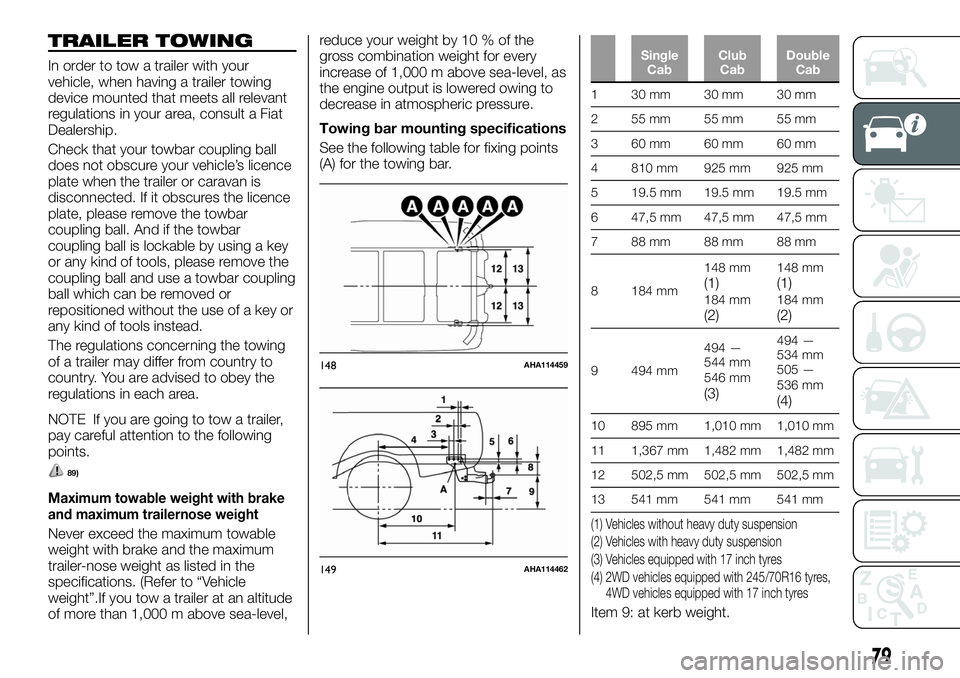
See the following table for fixing points
(A) for the towing bar.
Single
CabClub
CabDouble
Cab
1 30mm 30mm 30mm
2 55mm 55mm 55mm
3 60mm 60mm 60mm
4 810 mm 925 mm 925 mm
5 19.5 mm 19.5 mm 19.5 mm
6 47,5 mm 47,5 mm 47,5 mm
7 88mm 88mm 88mm
8 184 mm148 mm
(1)184 mm(2)
148 mm(1)184 mm(2)
9 494 mm494 —
544 mm
546 mm
(3)
494 —
534 mm
505 —
536 mm
(4)
10 895 mm 1,010 mm 1,010 mm
11 1,367 mm 1,482 mm 1,482 mm
12 502,5 mm 502,5 mm 502,5 mm
13 541 mm 541 mm 541 mm
(1) Vehicles without heavy duty suspension
(2) Vehicles with heavy duty suspension
(3) Vehicles equipped with 17 inch tyres
(4) 2WD vehicles equipped with 245/70R16 tyres,
4WD vehicles equipped with 17 inch tyres
Item 9: at kerb weight.
148AHA114459
149AHA114462
79
Page 82 of 316
NOTE The values under item 9 are
applicable to unladen vehicles. The
value can also be varied depending on
the tyre size, optional equipment and
suspension conditions.
Operating hints
Have your vehicle serviced prior to
towing a heavy trailer, taking particular
care of the state of engine tune, the
condition of brakes, steering and tyres.
Adjust tyre pressures to those
specifications at trailer towing (refer to
“tyre inflation pressure”). Check the
tyres, wiring and brakes (if fitted) on the
trailer.
Leave plenty of room between the
front of your vehicle and the preceding
vehicle. If the trailer begins to sway or
becomes difficult to handle, gently slow
down or apply the independent trailer
brakes (if fitted) NOT the vehicle brakes.
Stop the vehicle and trailer in a safe
location. One cause of swaying is poor
trailer balance and until this has been
overcome the swaying will recur.
Relocated the load in your trailer and
re-assess the problem.
Be sure that the driving speed does
not exceed 100 km/h for trailer
operation.
It is also recommended that you
obey the local regulations in case
driving speed with a trailer is limited to
less than 100 km/h.
To prevent the clutch from slipping
(vehicle with a M/T only), do not rev the
engine more than is required when
starting off.
To prevent shocks from the overrun
brake, depress the brake pedal lightly at
first and then more strongly.
To make full use of engine braking,
change to a lower gear before
descending a slope.
The body, brakes, clutch, and
chassis will be under additional strain
when towing a trailer.
The heavier weight and higher rolling
and air resistance will increase fuel
consumption.
Additional precautions for vehicles
equipped with an automatic
transmission
It is recommended a lower gear in
sports mode on slopes or at low speed,
taking care to keep the engine speed
below the red zone.
WARNING
89)Danger of Accident! A towing bar
should be fitted according to Fiat
Dealership guidelines.
INTERIOR FEATURES
SUN VISORS
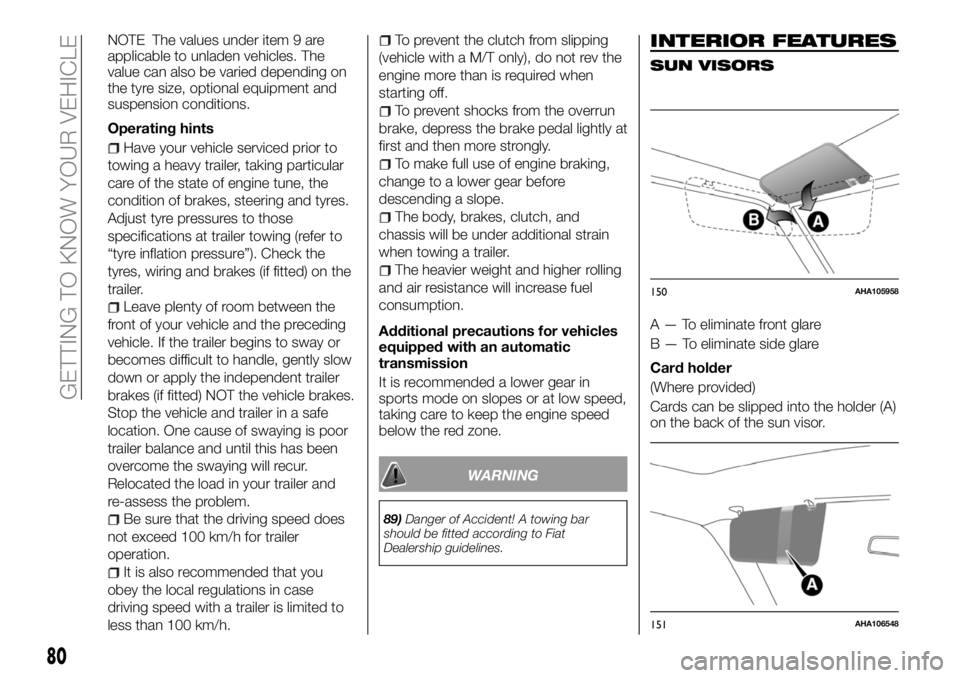
A — To eliminate front glare
B — To eliminate side glare
Card holder
(Where provided)
Cards can be slipped into the holder (A)
on the back of the sun visor.
150AHA105958
151AHA106548
80
GETTING TO KNOW YOUR VEHICLE
Page 114 of 316
70)Do not insert any foreign objects
(pieces of plastic, paper clips, buttons, etc.)
in the buckle or retractor mechanism
fig. 200. In addition, do not modify, remove,
or install the seat belt. Otherwise, the seat
belt may not be able to provide adequate
protection in a collision or other situation.
71)A dirty belt should be cleaned with
neutral detergent in warm water. After
rinsing in water, let it dry in the shade. Do
not attempt to bleach or re-dye the belts
because this affects their characteristics.SBR SYSTEM
Seat belt reminder
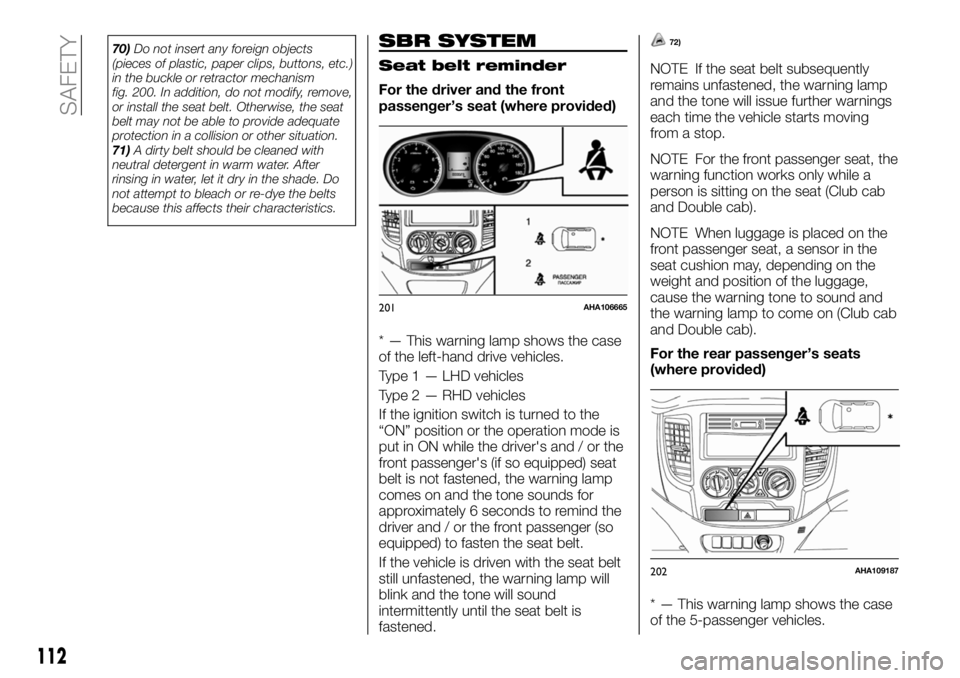
For the driver and the front
passenger’s seat (where provided)
* — This warning lamp shows the case
of the left-hand drive vehicles.
Type 1 — LHD vehicles
Type 2 — RHD vehicles
If the ignition switch is turned to the
“ON” position or the operation mode is
put in ON while the driver's and / or the
front passenger's (if so equipped) seat
belt is not fastened, the warning lamp
comes on and the tone sounds for
approximately 6 seconds to remind the
driver and / or the front passenger (so
equipped) to fasten the seat belt.
If the vehicle is driven with the seat belt
still unfastened, the warning lamp will
blink and the tone will sound
intermittently until the seat belt is
fastened.
72)
NOTE If the seat belt subsequently
remains unfastened, the warning lamp
and the tone will issue further warnings
each time the vehicle starts moving
from a stop.
NOTE For the front passenger seat, the
warning function works only while a
person is sitting on the seat (Club cab
and Double cab).
NOTE When luggage is placed on the
front passenger seat, a sensor in the
seat cushion may, depending on the
weight and position of the luggage,
cause the warning tone to sound and
the warning lamp to come on (Club cab
and Double cab).
For the rear passenger’s seats
(where provided)
* — This warning lamp shows the case
of the 5-passenger vehicles.
201AHA106665
202AHA109187
112
SAFETY
Page 118 of 316
The child restraint system should be
appropriate for your child’s weight and
height and properly fit the vehicle. For a
higher degree of safety THE CHILD
RESTRAINT SYSTEM SHOULD BE
INSTALLED IN THE REAR SEAT.
Before purchasing a child restraint
system, try installing it in the seat to
make sure there is a good fit. Because
of the location of the seat belt buckles
and the shape of the seat cushion, it
may be difficult to securely install some
manufacturer’s child restraint systems.
If the child restraint system can be
pulled forward or to either side easily on
the seat cushion after the seat belt has
been tightened, choose another
manufacturer’s child restraint system.
161) 162) 163)
NOTE Depending on the seating
position in the vehicle and the child
restraint system that you have, the child
restraint can be attached using one of
the following two locations:
Using the lower anchorage in the
rear seat ONLY if the child restraint has
ISOFIX mountings (Double Cab).
Using the seat belt.
Older children
Children who have outgrown the child
restraint system should be seated in the
rear seat and wear combination lap
shoulder belt. The lap portion of the belt
should be snug and positioned low on
the abdomen so that it is below the top
of the hip-bone. Otherwise, the belt
could intrude into the child’s abdomen
during an accident and cause injury.
WARNING
142)When installing a child restraint
system, refer to the instructions provided
by the manufacturer of the restraint
system. Failure to do so can result in
severe or fatal injury to your child.
143)Follow the instructions for positioning,
fitting and removing which the
manufacturer must supply together with
the child restraint system.
144)It is recommended to fit the child
restraint system according to the
instructions, which must be included.145)Do not place a rearward facing cradle
seat on the front seat if the passenger side
airbag is enabled. Deployment of the
airbag in an accident could cause fatal
injuries to the child regardless of the
severity of the impact. It is advisable to
always carry children in a child restraint
system on the rear seat, which is the most
protected position in the event of a
collision. If you need to carry a child on the
front passenger seat in a rearward facing
cradle seat, the passenger side airbags
(front and side bags for chest/ pelvis
protection, for versions/markets, where
provided) must be deactivated using the
setup menu. It is important to check the
dedicated LED on button on the instrument
panel to make sure that they are actually
deactivated. The passenger seat must also
be positioned back as far as possible in
order to avoid the child restraint system
from coming into contact with the
dashboard.
146)Fit the child restraint system only
when the vehicle is stationary.
147)When possible, put children in the
rear seat. Accident statistics indicate that
children of all sizes and ages are safer
when properly restrained in the rear seat
rather than in the front seat (Club cab and
Double cab).
148)Holding a child in your arms is no
substitute for a restraint system. Failure to
use a proper restraint system can result in
severe or fatal injury to your child.
149)Each child restraint device or fixing is
to be used only by one child.
116
SAFETY
Page 146 of 316
IMPORTANT
81)Do not overly rely on the hill start assist
to prevent backwards movement of the
vehicle. Under certain circumstances, even
when hill start assist is activated, the
vehicle may move backwards if the brake
pedal is not sufficiently depressed, if the
vehicle is heavily loaded, if the road is very
steep or slippery or if the vehicle tows a
trailer, etc.
82)The hill start assist is not designed to
keep the vehicle stopped in place on uphill
slopes for more than 2 seconds.
83)If the warning is turn on, the hill start
assist will not operate. Start off carefully.
84)Park your vehicle in a safe place and
stop the engine. Restart the engine and
check whether the warning indicator went
out, in which case the hill start assist is
again working normally. If they warning
remains displayed or reappear frequently, it
is not necessary to stop the vehicle
immediately, but the vehicle should be
inspected by a Fiat Dealership.
85)Do not stop the engine while the
vehicle is moving. Stopping the engine
would make the steering wheel extremely
hard to turn, possibly resulting in an
accident.
86)Do not leave the steering wheel turned
all the way in one direction. This can cause
damage to the power steering system.87)Do not over-rely on TSA system. Due to
the slippery road surface, heavy side wind,
inappropriate weight and positioning of
luggage, and/or driving at high speed, TSA
system may fail to secure the stability.
Always drive appropriately in accordance
with the condition of traffic, road surface
condition, weather, and the weight and
positioning of luggage.
88)The trailer stability assist system does
not operate in case as follows: 1 – When
sudden braking and braking while driving
downhill cause an abrupt motion of the
vehicle which makes the vehicle and the
trailer form a dogleg shape. 2 – When a
sideslip occurs by sudden steering.
144
SAFETY
Page 148 of 316
ECONOMICAL
DRIVING
For economical driving, there are some
technical requirements that have to be
met. The prerequisite for low fuel
consumption is a properly adjusted
engine. In order to achieve longer life of
the vehicle and the most economical
operation, we recommend you to have
the vehicle checked at regular intervals
in accordance with the service
standards.
Fuel economy and generation of
exhaust gas and noise are highly
influenced by personal driving habits as
well as the particular operating
conditions. The following points should
be observed in order to minimize wear
of brakes, tyres and engine as well as
to reduce environmental pollution.
Accelerating and decelerating
Drive according to traffic conditions,
and avoid sudden starts, sudden
acceleration, and sudden braking, as
they will increase fuel consumption.
Shifting
Shift only at an appropriate speed and
engine speed. Always use the highest
shift position possible.
The transfer shift lever or the drive
modeselector should be set to “2H”
when driving 4WD vehicles on normal
roads and express ways to obtain best
possible fuel economy.City traffic
Frequent starting and stopping
increases the average fuel
consumption. Use roads with smooth
traffic flow whenever possible. When
driving on congested roads, avoid use
of a low shift position at high engine
speeds.
Idling
The vehicle consumes fuel even during
idling. Avoid extended idling whenever
possible.
Speed
At higher the vehicle speed, more fuel is
consumed. Avoid driving at full speed.
Even a slight release of the accelerator
pedal will save a significant amount of
fuel.
Tyre inflation pressure
Check the tyre inflation pressures at
regular intervals. Low tyre inflation
pressure increases road resistance and
fuel consumption. In addition, low tyre
pressures adversely affect tyre wear
and driving stability.
Cargo loads
Do not drive with unnecessary articles
in the luggage compartment. Especially
during city driving where frequent
starting and stopping is necessary, the
increased weight of the vehicle will
greatly affect fuel consumption. Also
avoid driving with unnecessary luggage
or carriers, etc., on the roof; theincreased air resistance will increase
fuel consumption.
Cold engine starting
Starting of a cold engine consumes
more fuel. Unnecessary fuel
consumption is also caused by keeping
a hot engine running. After the engine is
started, commence driving as soon as
possible.
Cooler or air conditioning
The use of the air conditioner will
increase the fuel consumption.
146
STARTING AND DRIVING
Page 168 of 316
121)In sports mode, the driver must
execute upward shifts in accordance with
prevailing road conditions, taking care to
keep the engine speed below the red zone.
122)Repeated continuous operation of the
selector lever or the shift paddles will
continuously switch shift position.
123)For vehicles equipped with the shift
paddles, do not use the left- and right-hand
shift paddles at the same time. Doing so
could cause a shift of gear ratio that you do
not expect.
124)If the selector lever position display
blinks while you are driving, it is likely that a
safety device is operating because of a
malfunction in the automatic transmission.
Have the vehicle inspected by a Fiat
Dealership as soon as possible.
125)If the lamp comes on, reduce the
engine speed and stop the vehicle in a safe
area. Then set the selector lever to “P”
(PARK) position and idle the engine until the
warning lamp goes off. When the warning
lamp goes off, resume normal driving. If the
warning lamp does not go off, we
recommend you to have your vehicle
inspected by a Fiat Dealership.
126)Before selecting a gear with the
engine running and the vehicle stationary,
fully depress the brake pedal to prevent the
vehicle from creeping. The vehicle will begin
to move as soon as the gear is engaged,
especially when the engine speed is high,
at fast idle or with the air conditioner
operating, the brakes should only be
released when you are ready to drive away.
127)Depress the brake pedal with the right
foot at all times. Using the left foot could
cause driver movement delay in case of an
emergency.128)To prevent sudden acceleration, never
race the engine when shifting from the “P”
(PARK) or “N” (NEUTRAL) position.
129)Operating the accelerator pedal while
the other foot is resting on the brake pedal
will affect braking efficiency and may cause
premature wear of brake pads.
130)Use the selector lever in the correct
shift position in accordance with driving
conditions. Never coast downhill backward
with the selector lever in the {“D” (DRIVE) or
sports mode} or coast forward with the
selector lever in the “R” (REVERSE)
position. The engine may stop and the
unexpected increase in brake pedal effort
and steering wheel weight could lead to an
accident.
131)Do not race the engine with brake
pedal pressed when the vehicle is
stationary. This can damage the A/T. Also,
when you depress the accelerator pedal
while holding down the brake pedal with
the selector lever in the “P” (PARK), “N”
(NEUTRAL) or “D” (DRIVE) position, the
engine revolutions may not rise as high as
when performing the same operation with
the selector lever in the “N” (NEUTRAL)
position.
132)Never hold the vehicle stationary on a
hill using the accelerator pedal (without
using the brake pedal). Always apply the
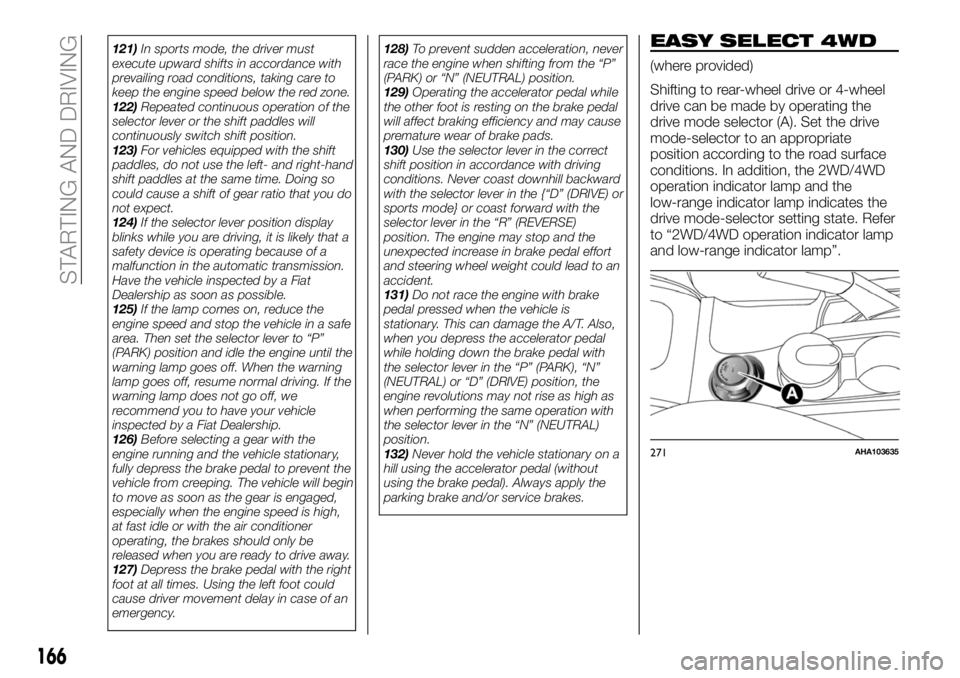
parking brake and/or service brakes.EASY SELECT 4WD
(where provided)
Shifting to rear-wheel drive or 4-wheel
drive can be made by operating the
drive mode selector (A). Set the drive
mode-selector to an appropriate
position according to the road surface
conditions. In addition, the 2WD/4WD
operation indicator lamp and the
low-range indicator lamp indicates the
drive mode-selector setting state. Refer
to “2WD/4WD operation indicator lamp
and low-range indicator lamp”.
271AHA103635
166
STARTING AND DRIVING