fuel FIAT IDEA 2012 1.G User Guide
[x] Cancel search | Manufacturer: FIAT, Model Year: 2012, Model line: IDEA, Model: FIAT IDEA 2012 1.GPages: 210, PDF Size: 3.65 MB
Page 35 of 210
34
SAFETY
DEVICES
CORRECT USE
OF THE CAR
WARNING
LIGHTS AND
MESSAGES
IN AN
EMERGENCY
CAR
MAINTENANCE
TECHNICAL
SPECIFICATIONS
INDEX
DASHBOARD
AND CONTROLS
New mission
The new mission begins after:
– “manual” resetting by the user, by press-
ing the relevant button;
– “automatic” resetting, when the “Trip
distance” reaches 9999.9 km or when the
“Travel time” reaches 99.59 (99 hours and
59 minutes);
– disconnection/reconnection of the bat-
tery.
IMPORTANT The reset operations per-
formed after the “General Trip” message
appears are used to also reset the “Trip
B”, which, on its turn, is used to reset the
values of the corresponding function. Travel time
This value shows the time elapsed since
the start of a new mission.
IMPORTANT If information is not avail-
able, the message “----” will appear instead
of the Trip Computer values. Displaying
of the values will be resumed regularly
when normal operation is restored with-
out resetting the values displayed before
the failure nor starting a new mission.
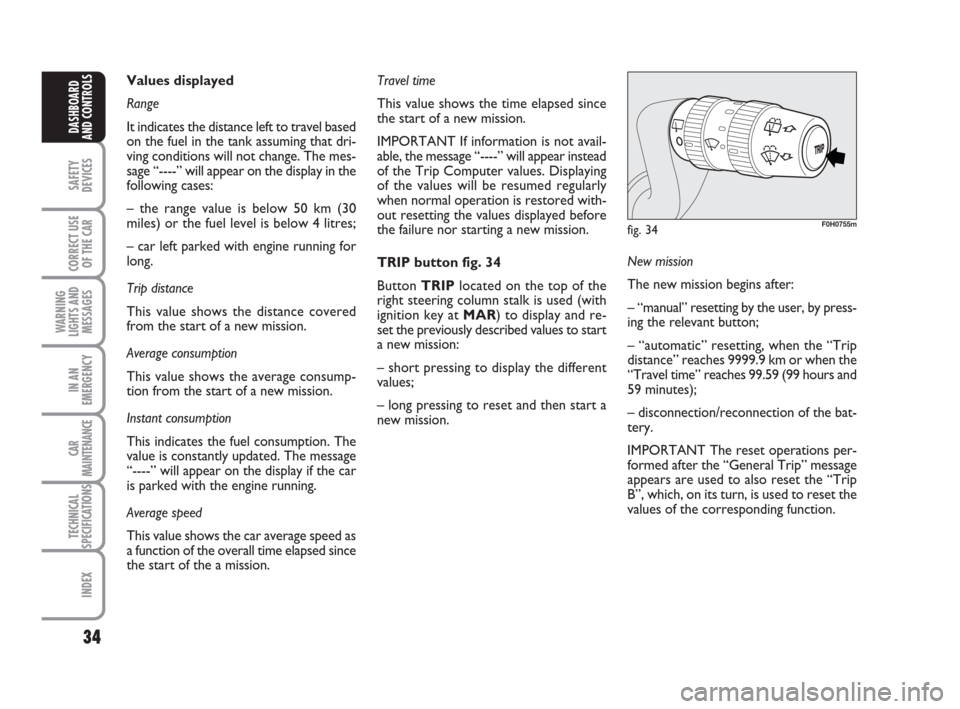
TRIP button fig. 34
Button TRIPlocated on the top of the
right steering column stalk is used (with
ignition key at MAR) to display and re-
set the previously described values to start
a new mission:
– short pressing to display the different
values;
– long pressing to reset and then start a
new mission. Values displayed
Range
It indicates the distance left to travel based
on the fuel in the tank assuming that dri-
ving conditions will not change. The mes-
sage “----” will appear on the display in the
following cases:
– the range value is below 50 km (30
miles) or the fuel level is below 4 litres;
– car left parked with engine running for
long.
Trip distance
This value shows the distance covered
from the start of a new mission.
Average consumption
This value shows the average consump-
tion from the start of a new mission.
Instant consumption
This indicates the fuel consumption. The
value is constantly updated. The message
“----” will appear on the display if the car
is parked with the engine running.
Average speed
This value shows the car average speed as
a function of the overall time elapsed since
the start of the a mission.
fig. 34F0H0755m
001-035 idea GB 1 ed 10-07-2008 8:27 Pagina 34
Page 68 of 210
67
SAFETY
DEVICES
CORRECT USE
OF THE CAR
WARNING
LIGHTS AND
MESSAGES
IN AN
EMERGENCY
CAR
MAINTENANCE
TECHNICAL
SPECIFICATIONS
INDEX
DASHBOARD
AND CONTROLS
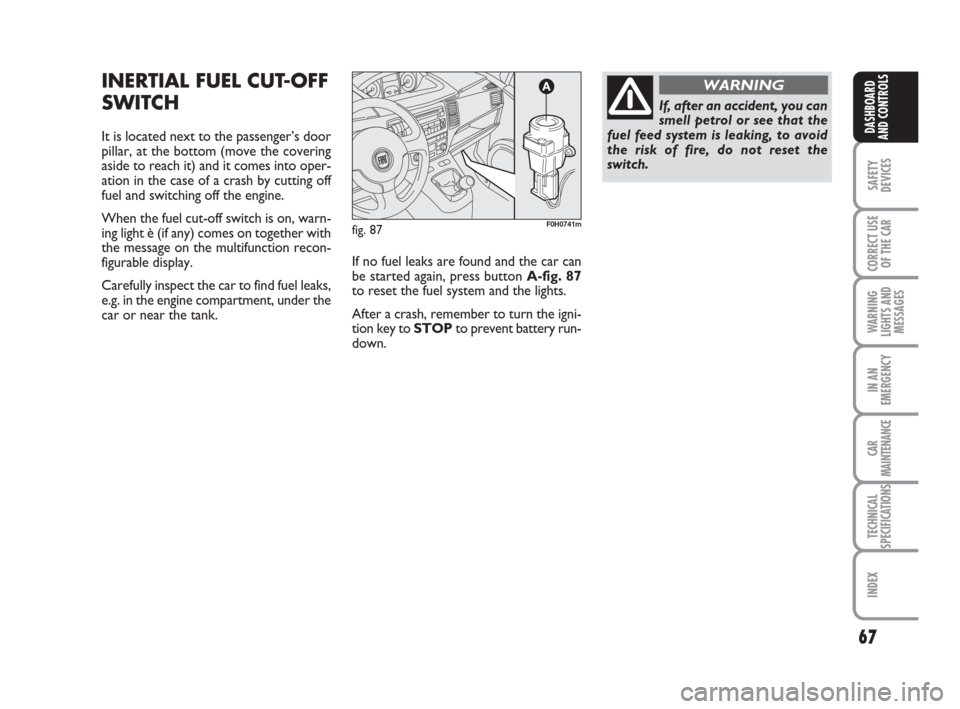
INERTIAL FUEL CUT-OFF
SWITCH
It is located next to the passenger’s door
pillar, at the bottom (move the covering
aside to reach it) and it comes into oper-
ation in the case of a crash by cutting off
fuel and switching off the engine.
When the fuel cut-off switch is on, warn-
ing light è (if any) comes on together with
the message on the multifunction recon-
figurable display.
Carefully inspect the car to find fuel leaks,
e.g. in the engine compartment, under the
car or near the tank.If no fuel leaks are found and the car can
be started again, press button A-fig. 87
to reset the fuel system and the lights.
After a crash, remember to turn the igni-
tion key to STOPto prevent battery run-
down.
fig. 87F0H0741m
If, after an accident, you can
smell petrol or see that the
fuel feed system is leaking, to avoid
the risk of fire, do not reset the
switch.
WARNING
036-092 idea GB 1 ed 10-07-2008 16:12 Pagina 67
Page 91 of 210
90
SAFETY
DEVICES
CORRECT USE
OF THE CAR
WARNING
LIGHTS AND
MESSAGES
IN AN
EMERGENCY
CAR
MAINTENANCE
TECHNICAL
SPECIFICATIONS
INDEX
DASHBOARD
AND CONTROLS
The car must only be filled
with diesel fuel for motor ve-
hicles, in compliance with Eu-
ropean Standard EN590. The
use of other products or mixtures may
irreparably damage the engine with in-
validation of the warranty due to the
damage caused. In the event of acci-
dentally filling with another type of fu-
el, do not start the engine and empty
the tank. If the engine has been run
even for only a very short time, in ad-
dition to the tank, it is also necessary
to drain out the whole fuel circuit.
AT THE FILLING
STATION
PETROL ENGINES
Use only unleaded petrol.
To prevent errors, the diameter of the fu-
el tank filler is too small to introduce a lead
petrol pump filler. Use petrol with a rat-
ed octane number (R.O.N.) not lower
than 95.
IMPORTANT An inefficient catalyst leads
to harmful exhaust emissions, thus con-
tributing to air pollution.
IMPORTANT Never use leaded petrol,
even in small amount or in an emergency,
as this would damage the catalyst beyond
repair.MULTIJET ENGINES
Operation at low temperatures
If the outside temperature is very low, the
diesel thickens due to the formation of
paraffin and could cause the malfunction-
ing of the fuel system.
In order to avoid these problems, differ-
ent types of diesel are distributed ac-
cording to the season: summer type, win-
ter type and arctic type (cold, mountain
areas). If refuelling with diesel fuel not suit-
able for the current temperature, mix
diesel fuel with TUTELA DIESEL ART ad-
ditive in the proportions stated on the can,
putting first the antifreeze in the tank and
then the diesel fuel.
If driving or parking the vehicle for a long
period in cold areas/mountains, refuel with
the diesel fuel available at local filling sta-
tions.
In this situation you are also recom-
mended to have in the tank an amount of
fuel 50% higher than usable capacity.REFUELLING
To guarantee full tank filling, carry out two
refuelling operations after the first click of
the fuel delivery gun. Avoid further top-
ping up operations that could cause dam-
ages to the fuel system.
036-092 idea GB 1 ed 10-07-2008 16:12 Pagina 90
Page 92 of 210
91
SAFETY
DEVICES
CORRECT USE
OF THE CAR
WARNING
LIGHTS AND
MESSAGES
IN AN
EMERGENCY
CAR
MAINTENANCE
TECHNICAL
SPECIFICATIONS
INDEX
DASHBOARD
AND CONTROLS
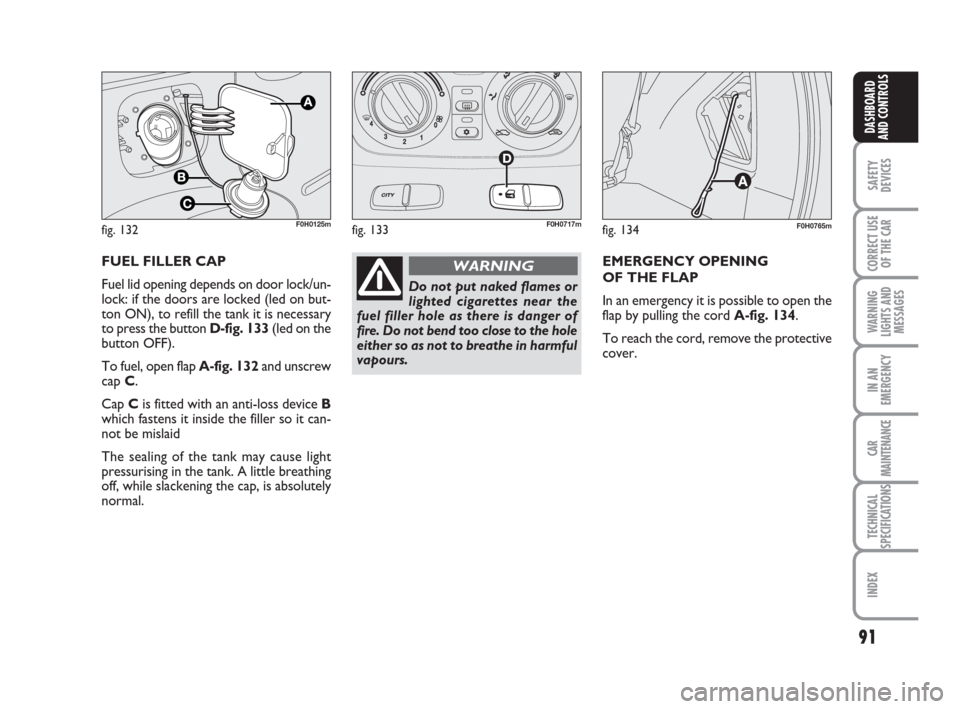
FUEL FILLER CAP
Fuel lid opening depends on door lock/un-
lock: if the doors are locked (led on but-
ton ON), to refill the tank it is necessary
to press the button D-fig. 133(led on the
button OFF).
To fuel, open flap A-fig. 132and unscrew
cap C.
Cap Cis fitted with an anti-loss device B
which fastens it inside the filler so it can-
not be mislaid
The sealing of the tank may cause light
pressurising in the tank. A little breathing
off, while slackening the cap, is absolutely
normal.
fig. 132F0H0125mfig. 133F0H0717m
Do not put naked flames or
lighted cigarettes near the
fuel filler hole as there is danger of
fire. Do not bend too close to the hole
either so as not to breathe in harmful
vapours.
WARNINGEMERGENCY OPENING
OF THE FLAP
In an emergency it is possible to open the
flap by pulling the cord A-fig. 134.
To reach the cord, remove the protective
cover.
fig. 134F0H0765m
036-092 idea GB 1 ed 10-07-2008 16:12 Pagina 91
Page 93 of 210
PROTECTING
THE ENVIRONMENT
The devices for curtailing petrol engine
emissions are the following:
❒three-way catalytic converter;
❒Lambda sensor;
❒fuel evaporation system.
In addition, do not let the engine run, even
for a test, with one or more spark plugs
disconnected.
The devices for curtailing diesel fuel en-
gine emissions are the following:
❒oxidising catalytic converter;
❒exhaust gas recirculation system
(E.G.R.).
❒diesel particulate filter (DPF)DIESEL PARTICULATE
FILTER (DPF) (for 1.3 Multijet
versions 90 HP)
The Diesel Particulate Filter is a mechan-
ical filter, integral with the exhaust system,
that physically traps particulates present
in the exhaust gases of Diesel engines.
The diesel particular filter has been adopt-
ed to eliminate almost totally particulates
in compliance with current / future law
regulations.
During normal use of the vehicle, the en-
gine control unit records a set of data (e.g.:
travel time, type of route, temperatures,
etc.) and it will then calculate how much
particulates has been trapped by the filter.
Since this filter physically traps particulates,
it shall be cleaned (reclaimed) at regular
intervals by burning carbon particles.
Reclaiming procedure is controlled auto-
matically by the engine control unit ac-
cording to the filter conditions and the
conditions of use of the vehicle.
During normal service the
catalyst reaches high tem-
peratures. Do not therefore park the
car over inflammable materials (grass,
dry leaves, pine needles, etc.): fire
hazard.
WARNING
During reclaiming the following phenom-
ena could take place: idling slight increase,
fan activation, slight smoke increase, high
exhaust temperatures. These situations
shall not be considered as faults and they
do not affect vehicle performance and en-
vironment.
If the dedicated message is displayed, re-
fer to paragraph “Warning lights and mes-
sages”.
DASHBOARD
AND CONTROLS
INDEX
TECHNICAL
SPECIFICATIONS
CAR
MAINTENANCE
IN AN
EMERGENCY
WARNING
LIGHTS AND
MESSAGES
CORRECT USE
OF THE CAR
SAFETY
DEVICES
92
036-092 idea GB 1 ed 10-07-2008 16:12 Pagina 92
Page 114 of 210
113
WARNING
LIGHTS AND
MESSAGES
IN AN
EMERGENCY
CAR
MAINTENANCE
TECHNICAL
SPECIFICATIONS
INDEX
DASHBOARD
AND CONTROLS
SAFETY
DEVICES
CORRECT USE
OF THE CAR
❒Turn the ignition key to AVVas soon
as warning light m goes out. If you wait
too long you will lose the benefit of
the work done by the glow plugs. Re-
lease the key as soon as the engine
starts.
IMPORTANT With cold engine, the ac-
celerator pedal shall be completely re-
leased while turning the ignition key to
AVV.
If the engine does not start at the first at-
tempt, return the ignition key to STOP
before repeating starting.
If, when the ignition key is on MAR, warn-
ing light
Yremains lit, turn the key to
STOPand then back to MAR; if the
warning light remains on, try with the oth-
er keys provided with the car.
If you still cannot start the engine, contact
Fiat Dealership.
IMPORTANT Never leave the ignition key
at MARwhen the engine is off.The warning light
mwill
flash for 60 seconds at start-
up or during prolonged crank-
ing to signal a fault in the
glow plug heating system. You can use
the car as usual if the engine starts but
you should contact a Fiat Dealership
as soon as possible.
HOW TO WARM UP
THE ENGINE AFTER
IT HAS JUST STARTED
(petrol and Multijet versions)
Proceed as follows:
❒Drive off slowly, letting the engine turn
at medium revs. Do not accelerate
abruptly;
❒Do not drive at full performance for
the initial kilometres. Wait until the
coolant temperature gauge starts
moving.
STOPPING THE ENGINE
Turn the ignition to STOPwhile the en-
gine is idling.
IMPORTANT After a taxing drive, you
should allow the engine to “catch its
breath” before turning it off by letting it
idle to allow the temperature in the en-
gine compartment to fall.Never bump start the engine
by pushing, towing or coast-
ing downhill. This could cause
fuel to flow into the catalyt-
ic exhaust system and damage it be-
yond repair.
A quick burst on the acceler-
ator before turning off the en-
gine serves absolutely no
practical purpose, it wastes
fuel and is damaging especially to tur-
bocharged engines.
Remember that the servo-
brake and power steering
are not operational until the engine
has been started, therefore much ef-
fort than usual is required on the
brake pedal and steering wheel.
WARNING
111-122 idea GB 1 ed 10-07-2008 8:29 Pagina 113
Page 117 of 210
116
WARNING
LIGHTS AND
MESSAGES
IN AN
EMERGENCY
CAR
MAINTENANCE
TECHNICAL
SPECIFICATIONS
INDEX
DASHBOARD
AND CONTROLS
SAFETY
DEVICES
CORRECT USE
OF THE CAR
CONTAINING
RUNNING COSTS
Here are some suggestions which may
help you to keep the running costs of your
car down and lower the amount of toxic
emissions released into the atmosphere.
GENERAL CONSIDERATIONS
Car maintenance
Have checks and adjustments carried out
in accordance with the “Service schedule”.
Tyres
Check the pressure of the tyres routine-
ly at an interval of no more than 4 weeks:
if the pressure is too low, consumption
levels increase as resistance to rolling is
higher.
Unnecessary loads
Do not travel with too much luggage
stowed in the boot. The weight of the car
(especially when driving in town) and its
trim greatly affects consumption and sta-
bility.Roof rack/ski rack
Remove the roof rack or the ski rack from
the roof as soon as they are no longer
used. These accessories lower air pene-
tration and adversely affect consumption
levels. When needing to carry particular-
ly voluminous objects, preferably use a
trailer.
Electric devices
Use electric devices only for the amount
of time needed. Rear heated window, ad-
ditional headlights, windscreen wipers and
heater fan need a considerable amount of
energy, therefore increasing the require-
ment of current increases fuel consump-
tion (up to +25% in the urban cycle).
Climate control
The air conditioner is an additional load
which greatly affects the engine leading to
higher consumption (on average up to
+20%). When the temperature outside
the vehicle permits it, use the air vents
where possible.
Spoilers
The use of non-certified aerodynamic
items may adversely affect air drag and
consumption levels.DRIVING STYLE
Starting
Do not warm the engine with the car at
a standstill or at idle or high speed: under
these conditions the engine warms up
much more slowly, increasing electrical
consumption and emissions. It is therefore
advisable to move off immediately, slow-
ly, avoiding high speeds. This way the en-
gine will warm faster.
Unnecessary actions
Avoid accelerating when waiting at traffic
lights or before switching off the engine.
This and also double declutching is ab-
solutely pointless on modern cars and al-
so increase consumption and pollution.
Gear selection
As soon as the conditions of the traffic and
road allow, use a higher gear. Using a low
gear to obtain brilliant performance in-
creases consumption.
In the same way improper use of a high
gear increases consumption, emissions an
engine wear.
111-122 idea GB 1 ed 10-07-2008 8:29 Pagina 116
Page 118 of 210
117
WARNING
LIGHTS AND
MESSAGES
IN AN
EMERGENCY
CAR
MAINTENANCE
TECHNICAL
SPECIFICATIONS
INDEX
DASHBOARD
AND CONTROLS
SAFETY
DEVICES
CORRECT USE
OF THE CAR
Top speed
Fuel consumption considerably increases
with speed. Keep speed as constant as
possible, avoid superfluous braking and ac-
celerating, which cost in terms of both fu-
el and emissions.
Acceleration
Accelerating violently increasing the revs
will greatly affect consumption and emis-
sions: acceleration should be gradual and
should not exceed the maximum torque.CONDITIONS OF USE
Cold starting
Short journeys and frequent cold starts do
not allow the engine to reach optimum
operating temperature. This results in a
significant increase in consumption levels
(from +15 to +30% on the urban cycle)
and emission of harmful substances.
Traffic situations
and road conditions
Rather high consumption levels are tied to
situations with heavy traffic, for example
in queues with frequent use of the lower
gears or in cities with many traffic lights.
Also winding mountain roads and rough
road surfaces adversely affect consump-
tion.
Traffic hold-ups
During prolonged hold-ups (e.g.: level
crossings) the engine should be switched
off.TOWING TRAILERS
IMPORTANT NOTES
For towing caravans or trailers the car
must be fitted with a certified tow hook
and an adequate electric system. Installa-
tion should be carried out by specialised
personnel who release a special document
for circulation on the road.
Install any specific and/or additional rear-
view mirrors as specified by law.
Remember that when towing a trailer,
steep hills are harder to climb, the brak-
ing spaces increase and overtaking takes
longer depending on the overall weight.
Engage a low gear when driving downhill,
rather than constantly using the brake.
The weight the trailer exerts on the car
tow hook reduces by the same amount
the actual vehicle loading capacity. To
make sure the maximum towable weight
is not exceeded (given in the log book) ac-
count should be taken of the fully laden
trailer, including accessories and person-
al belongings.
111-122 idea GB 1 ed 10-07-2008 8:29 Pagina 117
Page 124 of 210
123
IN AN
EMERGENCY
CAR
MAINTENANCE
TECHNICAL
SPECIFICATIONS
INDEX
DASHBOARD
AND CONTROLS
SAFETY
DEVICES
CORRECT USE
OF THE CAR
WARNING
LIGHTS AND
MESSAGES
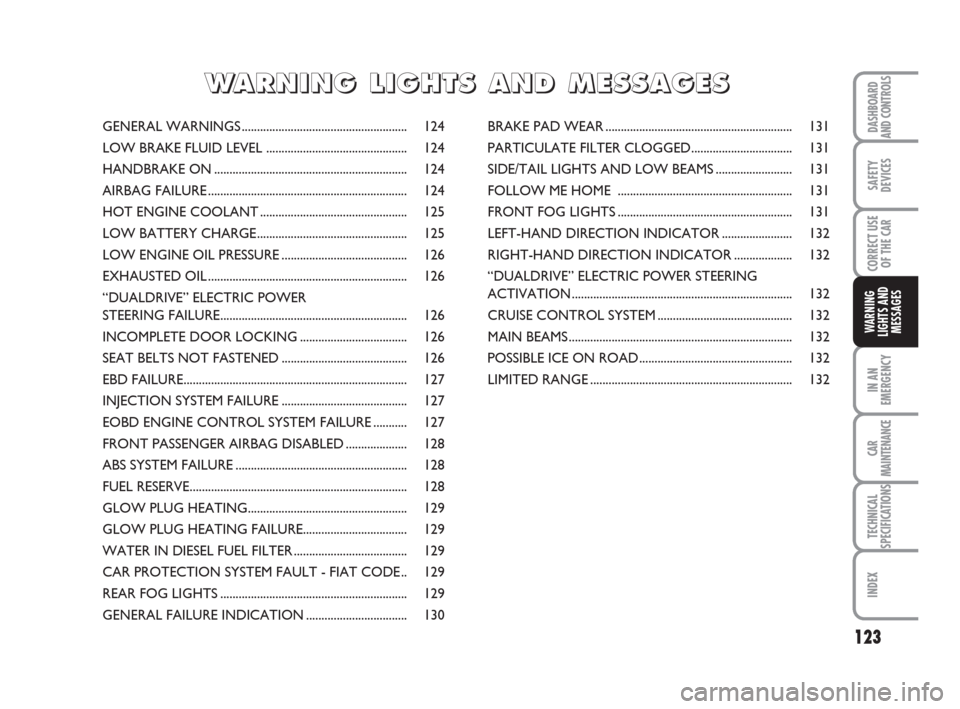
GENERAL WARNINGS ...................................................... 124
LOW BRAKE FLUID LEVEL .............................................. 124
HANDBRAKE ON ............................................................... 124
AIRBAG FAILURE ................................................................. 124
HOT ENGINE COOLANT ................................................ 125
LOW BATTERY CHARGE................................................. 125
LOW ENGINE OIL PRESSURE ......................................... 126
EXHAUSTED OIL ................................................................. 126
“DUALDRIVE” ELECTRIC POWER
STEERING FAILURE............................................................. 126
INCOMPLETE DOOR LOCKING ................................... 126
SEAT BELTS NOT FASTENED ......................................... 126
EBD FAILURE......................................................................... 127
INJECTION SYSTEM FAILURE ......................................... 127
EOBD ENGINE CONTROL SYSTEM FAILURE ........... 127
FRONT PASSENGER AIRBAG DISABLED .................... 128
ABS SYSTEM FAILURE ........................................................ 128
FUEL RESERVE....................................................................... 128
GLOW PLUG HEATING.................................................... 129
GLOW PLUG HEATING FAILURE.................................. 129
WATER IN DIESEL FUEL FILTER ..................................... 129
CAR PROTECTION SYSTEM FAULT - FIAT CODE .. 129
REAR FOG LIGHTS ............................................................. 129
GENERAL FAILURE INDICATION ................................. 130
WW W
A A
R R
N N
I I
N N
G G
L L
I I
G G
H H
T T
S S
A A
N N
D D
M M
E E
S S
S S
A A
G G
E E E
S S
BRAKE PAD WEAR ............................................................. 131
PARTICULATE FILTER CLOGGED................................. 131
SIDE/TAIL LIGHTS AND LOW BEAMS ......................... 131
FOLLOW ME HOME ......................................................... 131
FRONT FOG LIGHTS ......................................................... 131
LEFT-HAND DIRECTION INDICATOR ....................... 132
RIGHT-HAND DIRECTION INDICATOR ................... 132
“DUALDRIVE” ELECTRIC POWER STEERING
ACTIVATION ........................................................................ 132
CRUISE CONTROL SYSTEM ............................................ 132
MAIN BEAMS ......................................................................... 132
POSSIBLE ICE ON ROAD.................................................. 132
LIMITED RANGE .................................................................. 132
123-132 idea GB 1 ed 10-07-2008 8:29 Pagina 123
Page 129 of 210
128
IN AN
EMERGENCY
CAR
MAINTENANCE
TECHNICAL
SPECIFICATIONS
INDEX
DASHBOARD
AND CONTROLS
SAFETY
DEVICES
CORRECT USE
OF THE CAR
WARNING
LIGHTS AND
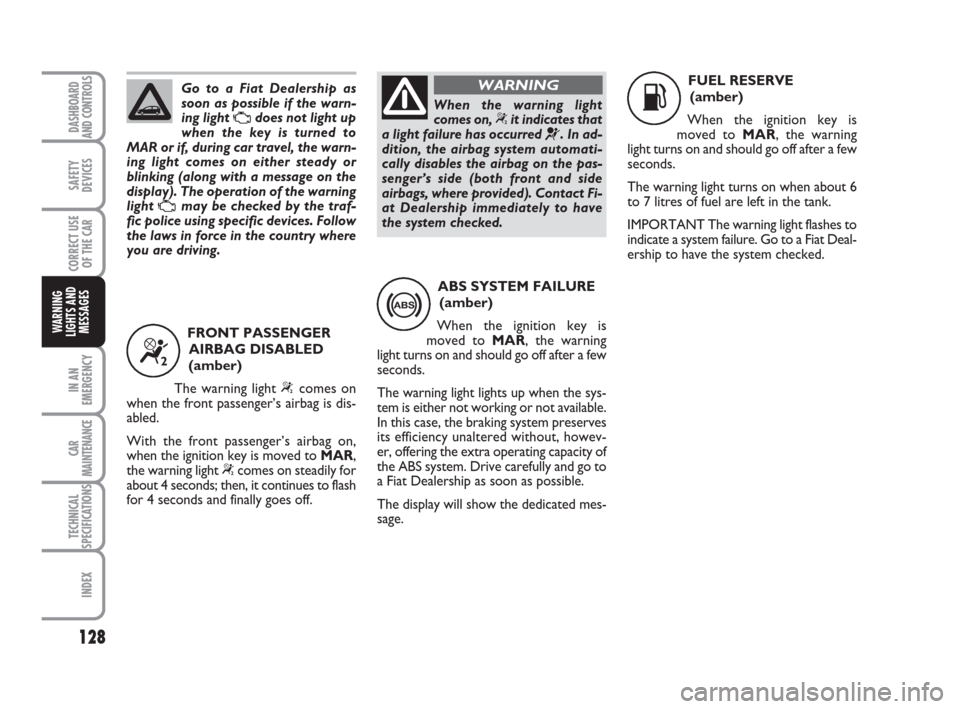
MESSAGESFRONT PASSENGER
AIRBAG DISABLED
(amber)
The warning light
“comes on
when the front passenger’s airbag is dis-
abled.
With the front passenger’s airbag on,
when the ignition key is moved to MAR,
the warning light
“comes on steadily for
about 4 seconds; then, it continues to flash
for 4 seconds and finally goes off.
“
ABS SYSTEM FAILURE
(amber)
When the ignition key is
moved to MAR, the warning
light turns on and should go off after a few
seconds.
The warning light lights up when the sys-
tem is either not working or not available.
In this case, the braking system preserves
its efficiency unaltered without, howev-
er, offering the extra operating capacity of
the ABS system. Drive carefully and go to
a Fiat Dealership as soon as possible.
The display will show the dedicated mes-
sage.
>
FUEL RESERVE
(amber)
When the ignition key is
moved to MAR, the warning
light turns on and should go off after a few
seconds.
The warning light turns on when about 6
to 7 litres of fuel are left in the tank.
IMPORTANT The warning light flashes to
indicate a system failure. Go to a Fiat Deal-
ership to have the system checked.
KWhen the warning light
comes on, “it indicates that
a light failure has occurred
¬. In ad-
dition, the airbag system automati-
cally disables the airbag on the pas-
senger’s side (both front and side
airbags, where provided). Contact Fi-
at Dealership immediately to have
the system checked.
WARNINGGo to a Fiat Dealership as
soon as possible if the warn-
ing light
Udoes not light up
when the key is turned to
MAR or if, during car travel, the warn-
ing light comes on either steady or
blinking (along with a message on the
display). The operation of the warning
light
Umay be checked by the traf-
fic police using specific devices. Follow
the laws in force in the country where
you are driving.
123-132 idea GB 1 ed 10-07-2008 8:29 Pagina 128