fuel FIAT IDEA 2012 1.G Owner's Manual
[x] Cancel search | Manufacturer: FIAT, Model Year: 2012, Model line: IDEA, Model: FIAT IDEA 2012 1.GPages: 210, PDF Size: 3.65 MB
Page 130 of 210
129
IN AN
EMERGENCY
CAR
MAINTENANCE
TECHNICAL
SPECIFICATIONS
INDEX
DASHBOARD
AND CONTROLS
SAFETY
DEVICES
CORRECT USE
OF THE CAR
WARNING
LIGHTS AND
MESSAGES
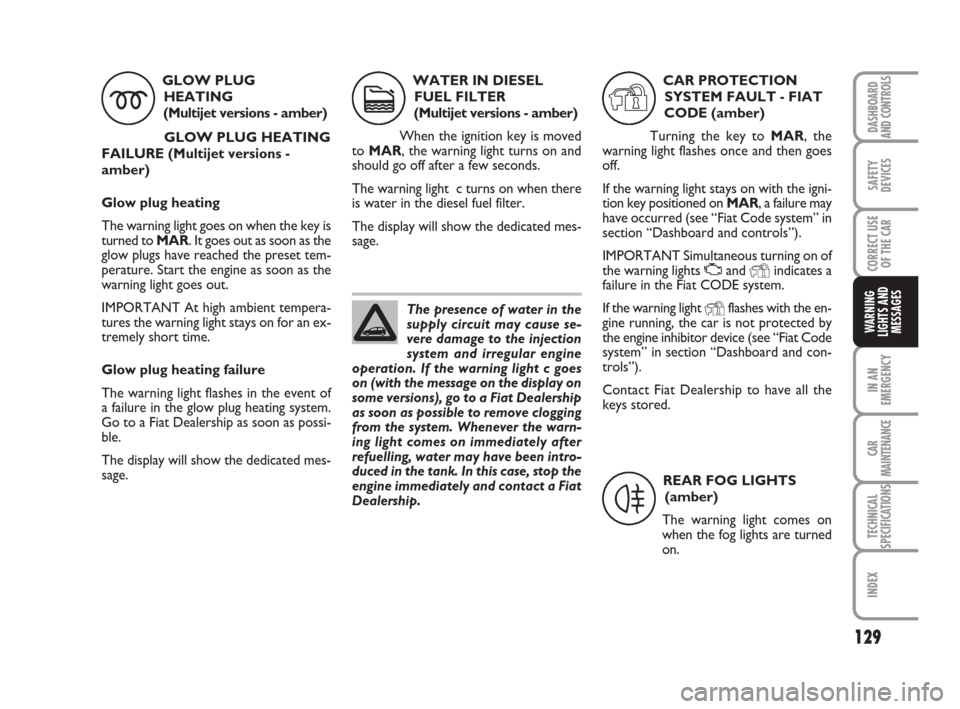
GLOW PLUG
HEATING
(Multijet versions - amber)
GLOW PLUG HEATING
FAILURE (Multijet versions -
amber)
Glow plug heating
The warning light goes on when the key is
turned to MAR. It goes out as soon as the
glow plugs have reached the preset tem-
perature. Start the engine as soon as the
warning light goes out.
IMPORTANT At high ambient tempera-
tures the warning light stays on for an ex-
tremely short time.
Glow plug heating failure
The warning light flashes in the event of
a failure in the glow plug heating system.
Go to a Fiat Dealership as soon as possi-
ble.
The display will show the dedicated mes-
sage.
m
WATER IN DIESEL
FUEL FILTER
(Multijet versions - amber)
When the ignition key is moved
to MAR, the warning light turns on and
should go off after a few seconds.
The warning light c turns on when there
is water in the diesel fuel filter.
The display will show the dedicated mes-
sage.
c
CAR PROTECTION
SYSTEM FAULT - FIAT
CODE (amber)
Turning the key to MAR, the
warning light flashes once and then goes
off.
If the warning light stays on with the igni-
tion key positioned on MAR, a failure may
have occurred (see “Fiat Code system” in
section “Dashboard and controls”).
IMPORTANT Simultaneous turning on of
the warning lights
Uand Yindicates a
failure in the Fiat CODE system.
If the warning light
Yflashes with the en-
gine running, the car is not protected by
the engine inhibitor device (see “Fiat Code
system” in section “Dashboard and con-
trols”).
Contact Fiat Dealership to have all the
keys stored.
Y
REAR FOG LIGHTS
(amber)
The warning light comes on
when the fog lights are turned
on.
4
The presence of water in the
supply circuit may cause se-
vere damage to the injection
system and irregular engine
operation. If the warning light c goes
on (with the message on the display on
some versions), go to a Fiat Dealership
as soon as possible to remove clogging
from the system. Whenever the warn-
ing light comes on immediately after
refuelling, water may have been intro-
duced in the tank. In this case, stop the
engine immediately and contact a Fiat
Dealership.
123-132 idea GB 1 ed 10-07-2008 8:29 Pagina 129
Page 131 of 210
130
IN AN
EMERGENCY
CAR
MAINTENANCE
TECHNICAL
SPECIFICATIONS
INDEX
DASHBOARD
AND CONTROLS
SAFETY
DEVICES
CORRECT USE
OF THE CAR
WARNING
LIGHTS AND
MESSAGES
GENERAL FAILURE
INDICATION
(amber)
The warning light turns on in the
following circumstances.
External light failure
The warning light comes on (on some ver-
sions only) when a failure is detected in
one of the following lights:
– tail lights
– stop lights (excluding 3rd stop)
– rear fog lights
– direction indicators
– plate lights.
The fault identified in the lights above may
be due to: one or more burnt lamps, a
blown protection fuse or interruption of
the electrical connection.
The display will show the dedicated mes-
sage.
è
Fresh air filter clogged
(where provided)
The warning light turns on when the par-
ticulate filter is clogged and the driving
conditions do not enable automatic acti-
vation of the regeneration procedure.
To allow the regeneration procedure,
keep the car running until the warning light
turns off.
The display will show the dedicated mes-
sage.
Engine oil pressure sensor failure
The warning light turns on when a failure
is detected in the engine oil pressure sen-
sor. Go to a Fiat Dealership as soon as
possible.Twilight/rain sensor failure
The warning light turns on when a failure
is detected in the twilight/rain sensors. Go
to a Fiat Dealership as soon as possible.
The display will show the dedicated mes-
sage.
Fuel cut-off switch tripped
The warning light comes on when the fu-
el cut-off switch trips.
The display will show the dedicated mes-
sage.
Speed limit exceeded
The display shows the dedicated message
when the car exceeds the set speed limit
(see “Multifunction Display” in section
“Dashboard and controls”).
123-132 idea GB 1 ed 10-07-2008 8:29 Pagina 130
Page 133 of 210
132
IN AN
EMERGENCY
CAR
MAINTENANCE
TECHNICAL
SPECIFICATIONS
INDEX
DASHBOARD
AND CONTROLS
SAFETY
DEVICES
CORRECT USE
OF THE CAR
WARNING
LIGHTS AND
MESSAGES
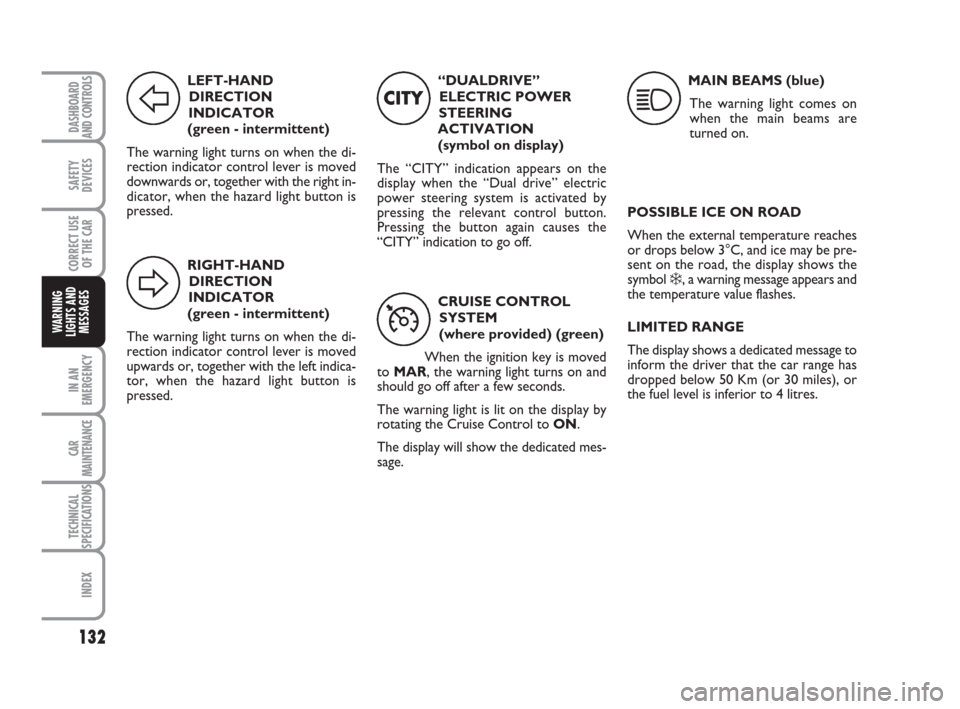
LEFT-HAND
DIRECTION
INDICATOR
(green - intermittent)
The warning light turns on when the di-
rection indicator control lever is moved
downwards or, together with the right in-
dicator, when the hazard light button is
pressed.
F
RIGHT-HAND
DIRECTION
INDICATOR
(green - intermittent)
The warning light turns on when the di-
rection indicator control lever is moved
upwards or, together with the left indica-
tor, when the hazard light button is
pressed.
D
“DUALDRIVE”
ELECTRIC POWER
STEERING
ACTIVATION
(symbol on display)
The “CITY” indication appears on the
display when the “Dual drive” electric
power steering system is activated by
pressing the relevant control button.
Pressing the button again causes the
“CITY” indication to go off.
CITY
CRUISE CONTROL
SYSTEM
(where provided) (green)
When the ignition key is moved
to MAR, the warning light turns on and
should go off after a few seconds.
The warning light is lit on the display by
rotating the Cruise Control to ON.
The display will show the dedicated mes-
sage.
Ü
MAIN BEAMS (blue)
The warning light comes on
when the main beams are
turned on.
1
POSSIBLE ICE ON ROAD
When the external temperature reaches
or drops below 3°C, and ice may be pre-
sent on the road, the display shows the
symbol
❄, a warning message appears and
the temperature value flashes.
LIMITED RANGE
The display shows a dedicated message to
inform the driver that the car range has
dropped below 50 Km (or 30 miles), or
the fuel level is inferior to 4 litres.
123-132 idea GB 1 ed 10-07-2008 8:29 Pagina 132
Page 136 of 210
135
CAR
MAINTENANCE
TECHNICAL
SPECIFICATIONS
INDEX
DASHBOARD
AND CONTROLS
SAFETY
DEVICES
CORRECT USE
OF THE CAR
WARNING
LIGHTS AND
MESSAGES
IN AN
EMERGENCY
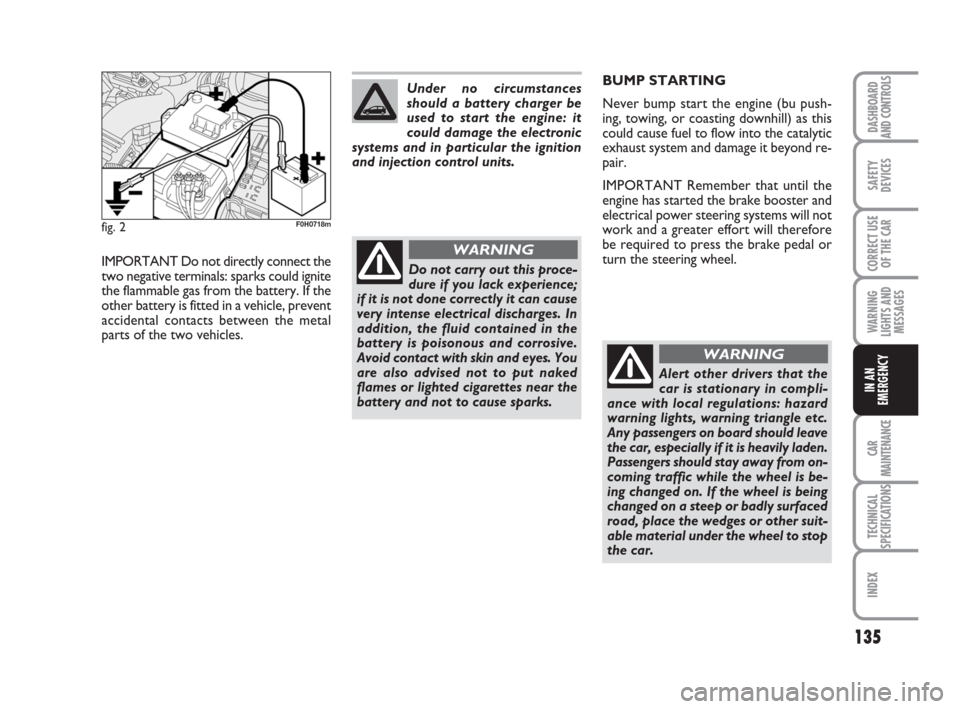
fig. 2F0H0718m
IMPORTANT Do not directly connect the
two negative terminals: sparks could ignite
the flammable gas from the battery. If the
other battery is fitted in a vehicle, prevent
accidental contacts between the metal
parts of the two vehicles.Do not carry out this proce-
dure if you lack experience;
if it is not done correctly it can cause
very intense electrical discharges. In
addition, the fluid contained in the
battery is poisonous and corrosive.
Avoid contact with skin and eyes. You
are also advised not to put naked
flames or lighted cigarettes near the
battery and not to cause sparks.
WARNING
Under no circumstances
should a battery charger be
used to start the engine: it
could damage the electronic
systems and in particular the ignition
and injection control units.BUMP STARTING
Never bump start the engine (bu push-
ing, towing, or coasting downhill) as this
could cause fuel to flow into the catalytic
exhaust system and damage it beyond re-
pair.
IMPORTANT Remember that until the
engine has started the brake booster and
electrical power steering systems will not
work and a greater effort will therefore
be required to press the brake pedal or
turn the steering wheel.
Alert other drivers that the
car is stationary in compli-
ance with local regulations: hazard
warning lights, warning triangle etc.
Any passengers on board should leave
the car, especially if it is heavily laden.
Passengers should stay away from on-
coming traffic while the wheel is be-
ing changed on. If the wheel is being
changed on a steep or badly surfaced
road, place the wedges or other suit-
able material under the wheel to stop
the car.
WARNING
133-160 idea GB 1 ed 10-07-2008 8:30 Pagina 135
Page 158 of 210
157
CAR
MAINTENANCE
TECHNICAL
SPECIFICATIONS
INDEX
DASHBOARD
AND CONTROLS
SAFETY
DEVICES
CORRECT USE
OF THE CAR
WARNING
LIGHTS AND
MESSAGES
IN AN
EMERGENCY
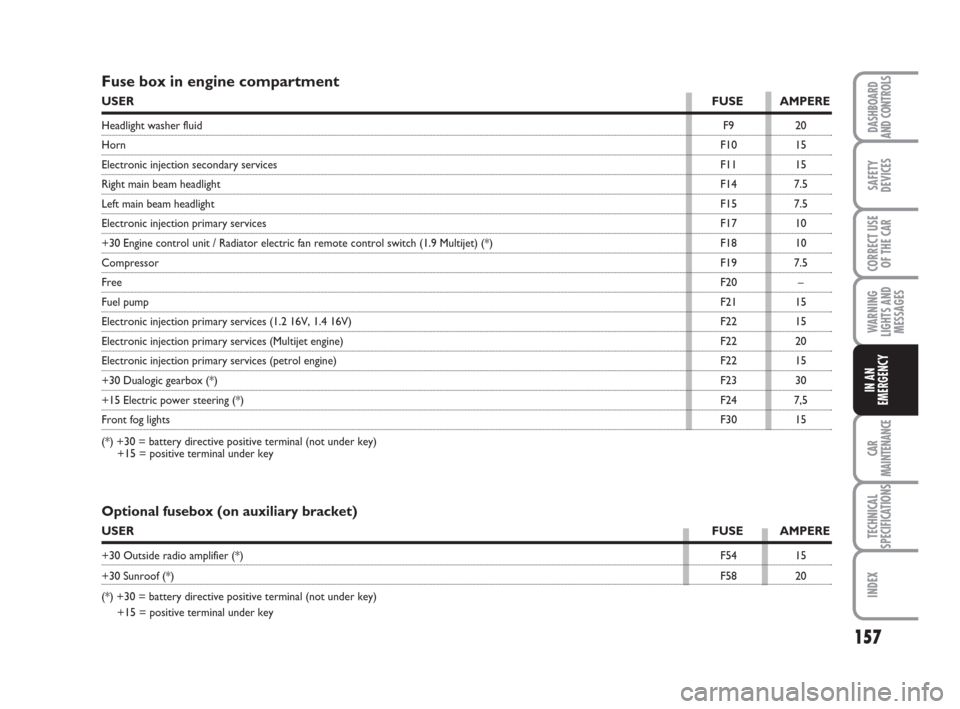
Fuse box in engine compartment
USERFUSE AMPERE
Headlight washer fluidF9 20
HornF10 15
Electronic injection secondary servicesF11 15
Right main beam headlightF14 7.5
Left main beam headlightF15 7.5
Electronic injection primary servicesF17 10
+30 Engine control unit / Radiator electric fan remote control switch (1.9 Multijet) (*) F18 10
CompressorF19 7.5
FreeF20 –
Fuel pumpF21 15
Electronic injection primary services (1.2 16V, 1.4 16V)F22 15
Electronic injection primary services (Multijet engine)F22 20
Electronic injection primary services (petrol engine)F22 15
+30 Dualogic gearbox (*)F23 30
+15 Electric power steering (*)F24 7,5
Front fog lightsF30 15
(*) +30 = battery directive positive terminal (not under key)
+15 = positive terminal under key
Optional fusebox (on auxiliary bracket)
USERFUSE AMPERE
+30 Outside radio amplifier (*)F54 15
+30 Sunroof (*)F58 20
(*) +30 = battery directive positive terminal (not under key)
+15 = positive terminal under key
133-160 idea GB 1 ed 10-07-2008 8:30 Pagina 157
Page 162 of 210
161
TECHNICAL
SPECIFICATIONS
INDEX
DASHBOARD
AND CONTROLS
SAFETY
DEVICES
CORRECT USE
OF THE CAR
WARNING
LIGHTS AND
MESSAGES
IN AN
EMERGENCY
CAR
MAINTENANCE
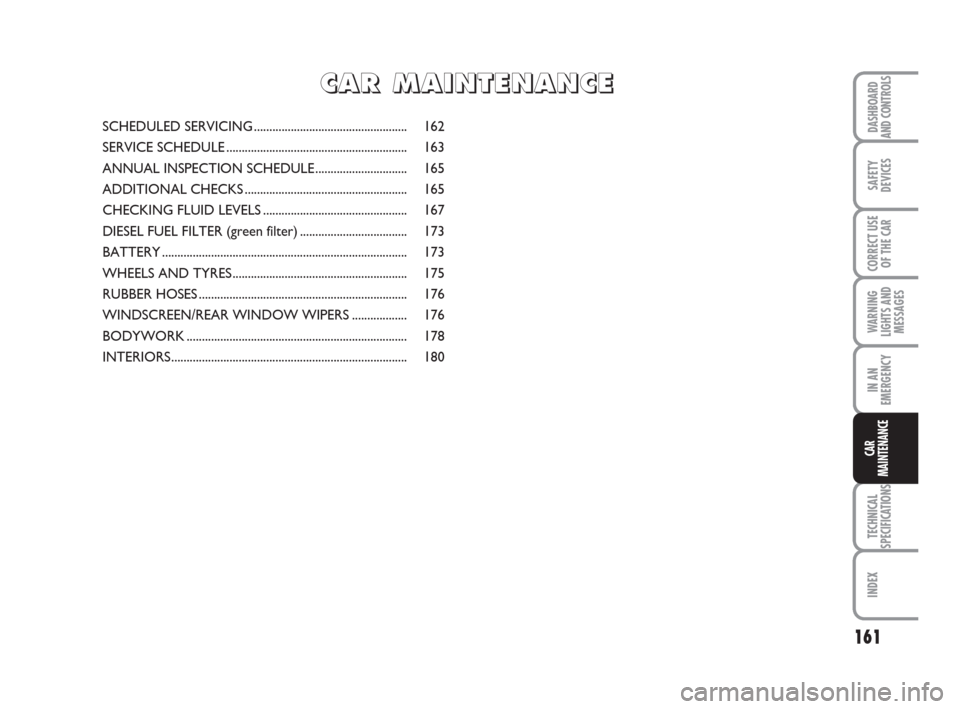
SCHEDULED SERVICING .................................................. 162
SERVICE SCHEDULE ........................................................... 163
ANNUAL INSPECTION SCHEDULE .............................. 165
ADDITIONAL CHECKS ..................................................... 165
CHECKING FLUID LEVELS ............................................... 167
DIESEL FUEL FILTER (green filter) ................................... 173
BATTERY ................................................................................ 173
WHEELS AND TYRES ......................................................... 175
RUBBER HOSES .................................................................... 176
WINDSCREEN/REAR WINDOW WIPERS .................. 176
BODYWORK ........................................................................ 178
INTERIORS............................................................................. 180
CC C
A A
R R
M M
A A
I I
N N
T T
E E
N N
A A
N N
C C
E E
161-180 idea GB 1 ed 10-07-2008 8:30 Pagina 161
Page 164 of 210
163
TECHNICAL
SPECIFICATIONS
INDEX
DASHBOARD
AND CONTROLS
SAFETY
DEVICES
CORRECT USE
OF THE CAR
WARNING
LIGHTS AND
MESSAGES
IN AN
EMERGENCY
CAR
MAINTENANCE
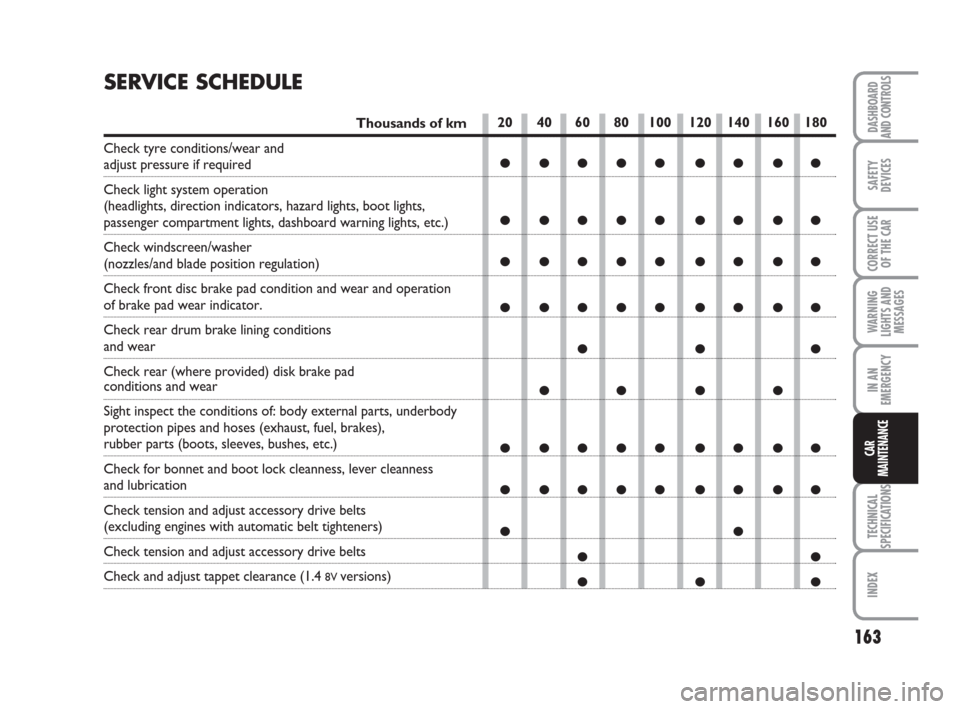
SERVICE SCHEDULE
Thousands of km
Check tyre conditions/wear and
adjust pressure if required
Check light system operation
(headlights, direction indicators, hazard lights, boot lights,
passenger compartment lights, dashboard warning lights, etc.)
Check windscreen/washer
(nozzles/and blade position regulation)
Check front disc brake pad condition and wear and operation
of brake pad wear indicator.
Check rear drum brake lining conditions
and wear
Check rear (where provided) disk brake pad
conditions and wear
Sight inspect the conditions of: body external parts, underbody
protection pipes and hoses (exhaust, fuel, brakes),
rubber parts (boots, sleeves, bushes, etc.)
Check for bonnet and boot lock cleanness, lever cleanness
and lubrication
Check tension and adjust accessory drive belts
(excluding engines with automatic belt tighteners)
Check tension and adjust accessory drive belts
Check and adjust tappet clearance (1.4 8V versions)
20 40 60 80 100 120 140 160 180
●●●●● ●●●●
●●●●● ●●●●
●●●●● ●●●●
●●●●● ●●●●
●●●
●● ● ●
●●●●● ●●●●
●●●●● ●●●●
●●
●●
●●●
161-180 idea GB 1 ed 10-07-2008 8:30 Pagina 163
Page 165 of 210
164
TECHNICAL
SPECIFICATIONS
INDEX
DASHBOARD
AND CONTROLS
SAFETY
DEVICES
CORRECT USE
OF THE CAR
WARNING
LIGHTS AND
MESSAGES
IN AN
EMERGENCY
CAR
MAINTENANCE
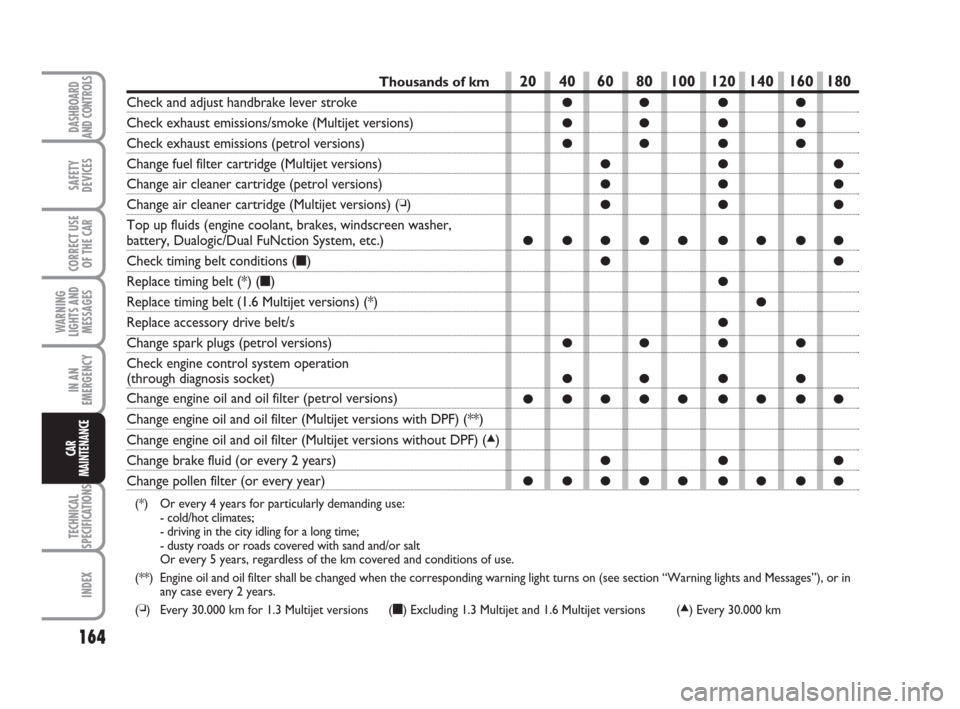
Thousands of km
Check and adjust handbrake lever stroke
Check exhaust emissions/smoke (Multijet versions)
Check exhaust emissions (petrol versions)
Change fuel filter cartridge (Multijet versions)
Change air cleaner cartridge (petrol versions)
Change air cleaner cartridge (Multijet versions) (❏)
Top up fluids (engine coolant, brakes, windscreen washer,
battery, Dualogic/Dual FuNction System, etc.)
Check timing belt conditions (■)
Replace timing belt (*) (■)
Replace timing belt (1.6 Multijet versions) (*)
Replace accessory drive belt/s
Change spark plugs (petrol versions)
Check engine control system operation
(through diagnosis socket)
Change engine oil and oil filter (petrol versions)
Change engine oil and oil filter (Multijet versions with DPF) (**)
Change engine oil and oil filter (Multijet versions without DPF) (▲)
Change brake fluid (or every 2 years)
Change pollen filter (or every year)
(*) Or every 4 years for particularly demanding use:
- cold/hot climates;
- driving in the city idling for a long time;
- dusty roads or roads covered with sand and/or salt
Or every 5 years, regardless of the km covered and conditions of use.
(**) Engine oil and oil filter shall be changed when the corresponding warning light turns on (see section “Warning lights and Messages”), or in
any case every 2 years.
(
❏) Every 30.000 km for 1.3 Multijet versions (■) Excluding 1.3 Multijet and 1.6 Multijet versions (▲) Every 30.000 km
20 40 60 80 100 120 140 160 180
●● ● ●
●● ● ●
●● ● ●
●●●
●●●
●●●
●●●●● ●●●●
●●
●
●
●
●● ● ●
●● ● ●
●●●●● ●●●●
●●●
●●●●● ●●●●
161-180 idea GB 1 ed 10-07-2008 8:30 Pagina 164
Page 166 of 210
165
TECHNICAL
SPECIFICATIONS
INDEX
DASHBOARD
AND CONTROLS
SAFETY
DEVICES
CORRECT USE
OF THE CAR
WARNING
LIGHTS AND
MESSAGES
IN AN
EMERGENCY
CAR
MAINTENANCE
ANNUAL INSPECTION
SCHEDULE
For cars with an annual mileage of below
20,000 km (for example about 15,000 km)
the following yearly inspection programme
is provided:
❒check tyre conditions/wear and adjust
pressure if required (including the
spare wheel);
❒check lighting system operation (head-
lights, direction indicators, hazard
lights, boot lights, passenger compart-
ment lights, warning lights, etc.);
❒check windscreen/washer (nozzles/
and blade position regulation)
❒check front disk brake pad conditions
and wear;
❒sight inspect the conditions of: engine,
gearbox, transmission, pipes and hoses
(exhaust - fuel - brakes), rubber parts
(boots, sleeves, bushes, etc;
❒check for bonnet and boot lock clean-
ness, lever cleanness and lubrication;
❒check battery charge;
❒visual check on various drive belt con-
ditions;
❒top up fluid levels (engine coolant,
brakes, windscreen washer, battery,
etc.);
❒change engine oil;
❒change engine oil filter;
❒replace pollen filter (where provided).
ADDITIONAL CHECKS
Every 1,000 km or before long journeys,
check and top up if required:
❒engine coolant fluid level;
❒brake fluid level;
❒windscreen washer fluid level;
❒tyre pressure and conditions.
Every 3,000 km check and top up if re-
quired: engine oil level.
You are recommended to use FL Selenia
products, designed and produced specifi-
cally for Fiat cars (see table “Capacities”
in section “Technical specifications”).
161-180 idea GB 1 ed 10-07-2008 8:30 Pagina 165
Page 167 of 210
166
TECHNICAL
SPECIFICATIONS
INDEX
DASHBOARD
AND CONTROLS
SAFETY
DEVICES
CORRECT USE
OF THE CAR
WARNING
LIGHTS AND
MESSAGES
IN AN
EMERGENCY
CAR
MAINTENANCE
IMPORTANT - Engine oil
Should prevailing use of the car be under
one of the following specially heavy con-
ditions:
❒trailer or caravan towing;
❒dusty roads;
❒short distances (less than 7-8 km) re-
peated and with external tempera-
tures below zero;
❒frequently idling engines or long dis-
tance low speed driving (e.g. taxis or
door-to-door deliveries) or in case of
a long term inactivity;
replace engine oil more frequently than
required on “Service schedule”.
IMPORTANT - Air cleaner
If the car is used on dusty roads change
the air cleaner more frequently than the
indications in the “Service schedule”.
If in doubt as to how often the engine oil
and air cleaner should be changed ac-
cording to how you use the car, contact
a Fiat Dealership.IMPORTANT - Pollen filter
If the vehicle is used frequently in dusty or
heavily polluted environments it is advis-
able to replace the filtering element more
frequently; in particular it should be re-
placed if a reduction of the amount of air
admitted to the passenger compartment
is noted.
IMPORTANT - Diesel filter
The possibility of topping up with diesel
fuel not complying with EN590 European
Norm might make it necessary to replace
the filter more frequently than indicated
in the “Service schedule”.IMPORTANT - Battery
The charge in the battery should be
checked at the start of winter to limit the
risk of electrolyte freezing.
This check should be carried out more
frequently if the car is used mainly for
short trips, or if it is fitted with accessories
that permanently absorb electricity even
with the ignition key removed, especially
in the case of after market accessories. If
the car is used in hot climates or particu-
larly harsh conditions it is wise to check
the level of the battery fluid (electrolyte)
more frequently than specified in the “Ser-
vice schedule” in this section.
Car maintenance should be
entrusted to Fiat Dealership.
For routine and minor main-
tenance operations you wish
to carry out yourself, always make sure
you have the proper equipment, gen-
uine Fiat spare parts and the necessary
fluids; do not however carry out these
operations if you have no experience.
161-180 idea GB 1 ed 10-07-2008 8:30 Pagina 166