bonnet FIAT MULTIPLA 2006 1.G User Guide
[x] Cancel search | Manufacturer: FIAT, Model Year: 2006, Model line: MULTIPLA, Model: FIAT MULTIPLA 2006 1.GPages: 266, PDF Size: 4.61 MB
Page 211 of 266

210
SAFETY
DEVICES
CORRECT USE
OF THE CAR
WARNING
LIGHTS AND
MESSAGES
IN AN
EMERGENCY
TECHNICAL
SPECIFICATIONS
INDEX
DASHBOARD
AND CONTROLS
CAR
MAINTENANCE
USE OF THE CAR UNDER
HEAVY CONDITIONS
Should prevailing use of the car be under one of the
following specially heavy conditions:
❒trailer or caravan towing;
❒dusty roads;
❒short distances (less than 7-8 km) and repeated
with external temperatures below zero;
❒frequently idling engines or long distance low
speed driving (e.g.: door-to-door deliveries) or in
case of a long term inactivity;
❒urban routes;carry out checks more frequently than required on
Service Schedule:
❒check front disk brake pad conditions and wear;
❒check cleanness of bonnet and boot locks and
lever cleanness and lubrication;
❒sight inspect the conditions of: engine, gearbox,
transmission, pipes and hoses (exhaust - fuel -
brakes), rubber parts (boots, sleeves, bushes, etc.);
❒check battery charge and fluid level (electrolyte);
❒visual check on various drive belt conditions;
❒check and replace pollen filter, if required;
❒check and replace air cleaner, if required.
Page 224 of 266
223
SAFETY
DEVICES
CORRECT USE
OF THE CAR
WARNING
LIGHTS AND
MESSAGES
TECHNICAL
SPECIFICATIONS
INDEX
DASHBOARD
AND CONTROLS
IN AN
EMERGENCY
CAR
MAINTENANCE
USEFUL ADVICE FOR LENGTHENING
THE LIFE OF YOUR BATTERY
To avoid draining your battery and lengthen its life,
observe the following indications:
❒when you park the car, ensure the doors, tailgate
and bonnet are closed properly. Passenger’s
compartment lights must be off;
❒ceiling lights must be off. The car is however
provided with an automatic system for switching off
internal lights;
❒do not keep accessories (e.g.: sound system, hazard
lights, etc.) switched on for a long time when the
engine is not running;
❒before performing any operation on the electrical
system, disconnect the battery negative cable;
❒battery terminals shall always be perfectly tightened.
IMPORTANT A battery which is kept at a charge of
less than 50% (optical indicator with dark colour
without green area in the middle) for any length of
time will be damaged by sulphation leading to a
reduction in cranking power.Moreover, this might lead to a higher risk of the
battery electrolyte freezing (this may even occur at -
10°C). If the car is inactive for a long period of time,
refer to “Storing the car”, in section “Driving your
car”.
If after buying the car, you want to install electric
accessories which require permanent electric supply
(alarm, etc.) contact Fiat Dealership whose qualified
personnel, in addition to suggesting the most suitable
devices, will evaluate the overall electric absorption,
checking whether the car’s electric system is capable
of withstanding the load required, or whether it
should be integrated with a more powerful battery.
In fact, since these devices continue absorbing energy
even when the ignition key is off, they gradually run
down the battery.
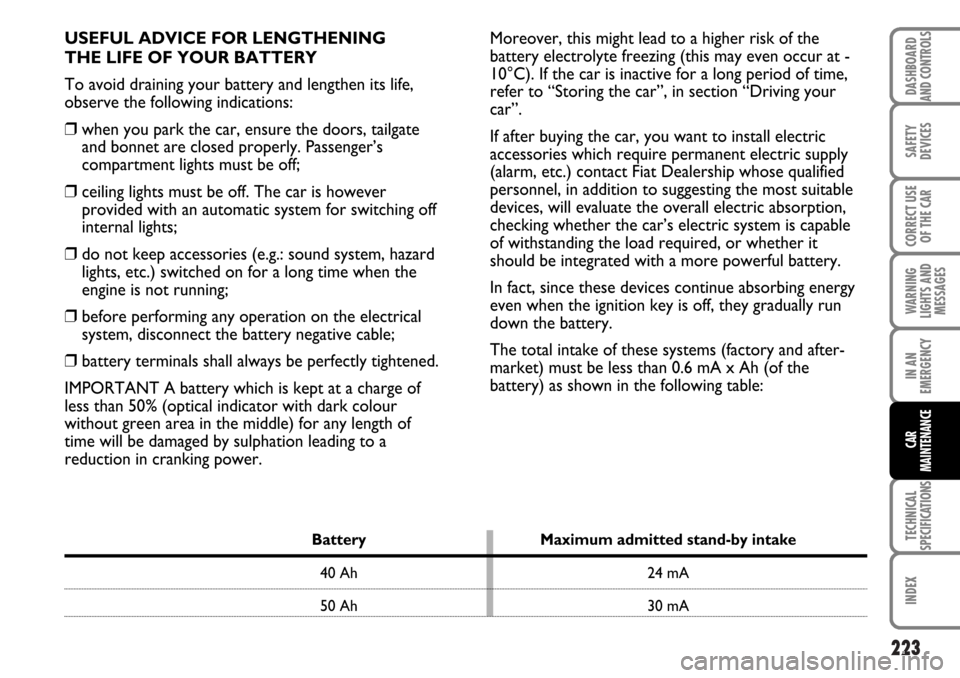
The total intake of these systems (factory and after-
market) must be less than 0.6 mA x Ah (of the
battery) as shown in the following table:
Battery Maximum admitted stand-by intake
40 Ah 24 mA
50 Ah 30 mA
Page 231 of 266
230
SAFETY
DEVICES
CORRECT USE
OF THE CAR
WARNING
LIGHTS AND
MESSAGES
IN AN
EMERGENCY
TECHNICAL
SPECIFICATIONS
INDEX
DASHBOARD
AND CONTROLS
CAR
MAINTENANCE
ADVICE FOR PRESERVING
THE BODYWORK
Paint
Paintwork does not only serve an aesthetic purpose,
but also protects the underlying sheet metal.
In the case of deep scrapes or scores, you are advised
to have the necessary touching up carried out
immediately to avoid the formation of rust.
Only use original products when touching up the
paintwork (see section “Technical specifications”).
Ordinary paint maintenance consists in washing at
intervals depending on the conditions and environment
of use. For example, in highly polluted areas, or if the
roads are sprayed with salt, it is wise to wash the car
more frequently.
To wash the car properly:
❒remove the aerial from the roof to prevent damages
if the car is washed in an automatic carwash;
❒wash the body using a low pressure jet of water.
❒wipe a sponge with a slightly soapy solution over
the bodywork, frequently rinsing with the sponge.❒rinse well with water and dry with a jet of air or a
chamois leather.
When drying, take particular care with the less visible
parts like door frames, bonnet and around the
headlights where water may collect. The car should
not be taken to a closed area immediately, but left in
the open so that residual water can evaporate.
Do not wash the car after it has been left in the sun or
with the bonnet hot: this may alter the shine of the
paintwork.
Exterior plastic parts must be cleaned in the same way
as the rest of the car.
Where possible, do not park under trees; the resinous
substance many species release give the paint a dull
appearance and increase the possibility of triggering
rust processes.
IMPORTANT Bird droppings must be washed off
immediately and thoroughly as the acid they contain is
particularly aggressive.
Detergents cause water pollution. Therefore the engine compartment should be washed in areas
equipped for collecting and purifying the liquid used in the washing process.
Page 257 of 266
TECHNICAL
SPECIFICATIONS
256
SAFETY
DEVICES
CORRECT USE
OF THE CAR
WARNING
LIGHTS AND
MESSAGES
CAR
MAINTENANCE
INDEXDASHBOARD
AND CONTROLS
IN AN
EMERGENCY
I I
N N
D D
E E
X X
– Isofix type child restraint
system .......................................... 126
Ceiling lights
– front ............................................. 63
– front bulb replacement ............ 192
– rear .............................................. 64
– rear bulb replacement ............. 193
Cellular phone set-up ..................... 106
Changing a wheel ............................ 167
Chassis marking .............................. 235
Checking fluid levels
– brake fluid ................................... 219
– engine oil ..................................... 214
– engine oil consumption............ 215
– power steering fluid ................. 218
– windscreen/rear window
washer fluid ................................ 217
Cigar lighter ...................................... 69
Clock .................................................. 21
Clutch ................................................ 238
CO
2emissions ................................ 253
Controls
– front fog lights............................ 65
– fuel cut-off switch ..................... 66 – advice for preserving
the bodywork ............................ 230
– headlights .................................... 231
– identification plate..................... 234
– paint.............................................. 230
– versions ...................................... 236
– warranty ..................................... 229
– windows ...................................... 231
Bonnet ............................................... 85
Boot.................................................... 78
– anchoring the load .................... 80
– extending the boot .................. 81
– opening/closing .......................... 78
Brake fluid level ............................... 219
Brake light (replacement) .............. 190
Brakes ................................................ 239
– fluid level ..................................... 219
– service and emergency brake .. 239
Bulb replacement ............................ 183
Bulb types.......................................... 184
Capacities......................................... 249
Car maintenance ............................. 205
Carrying children safely ................. 120
ABS system...................................... 90
Additional checks ............................ 210
Adjusting the headlight beam ....... 88
Aerial ................................................. 103
Airbags ............................................... 129
– deactivation ................................ 131
– description and operation ..... 129
– front ............................................. 129
– general warnings........................ 134
– side ............................................... 132
Air cleaner ........................................ 220
Air vents
(directional and adjustable) ........ 49
Annual inspection plan ................... 209
Ashtray .............................................. 69
Automatic climate control system 54
Battery
– changing ....................................... 222
– fluid level .................................... 221
– recharging ................................... 202
– useful advice for lengthening
the life of your battery............. 223
Bodywork